
By Dr. Pellumb Kabashi, DBA, MBA, EA, CFE, CES
Founder, Tax Expert Today LLC · Tax advisors, enrolled agents, CPAs, and attorneys · Serving clients in all 50 states
Quick Answer: An IRS CP161 notice is the first bill the IRS sends a business when a filed return, such as a Form 941, 1120, 1065 or 1041, shows a balance due with no math error. It lists the tax, the payments the IRS credited, and any penalties and interest. For payroll tax, unpaid tax left more than 10 days after the notice date can raise the deposit penalty to 15 percent. Call (239) 441-2005 for a free consultation.
What is an IRS CP161 notice?
An IRS CP161 notice is a balance due bill for a business tax return. It tells the business that the tax shown on a filed return, plus any penalties and interest, is more than the payments and credits the IRS has applied to that tax period. The IRS did not change the return; it is asking for the unpaid amount.
- It is a first notice. The Internal Revenue Manual calls the CP161 a first notice of tax, penalties or interest due on a business return.
- It involves no math error. The IRS label for the notice is “No Math Error, Balance Due.”
- It is issued to an employer ID number. The notice is addressed to the business and shows its EIN, the form number and the tax period.
- It is the start of collection. Unpaid balances move on to reminder notices and then to a notice of intent to levy.
The IRS page for the CP161 describes it in one line: you received the notice because you have an unpaid balance due. The Internal Revenue Manual at 21.3.1.7.19 is more precise. It says a CP161 “is issued to taxpayer as a first notice to notify them of tax, penalties, or interest due on any BMF return with a balance due of $1.00 or more and no math errors.” BMF stands for Business Master File, the IRS system that holds accounts for employers, corporations, partnerships, trusts, estates and exempt organizations. That one sentence answers most of the confusion around the notice. An IRS CP161 notice is not an audit, it is not a proposed change, and it is not a lien. It is a bill.
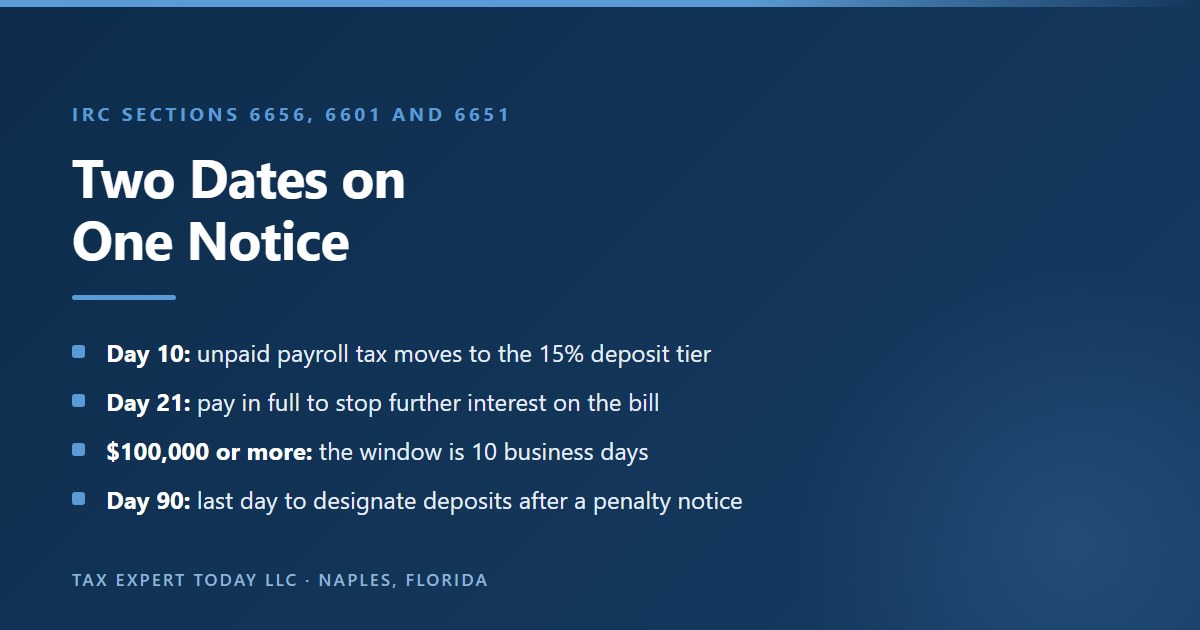
Because it is a bill, the IRS CP161 notice is also a legal milestone. Under IRC section 6303, the IRS must give notice of an assessed tax and demand payment within 60 days after it assesses the tax. For most businesses, the IRS CP161 notice is that notice and demand. Several clocks start on its date: the 10 day clock for the highest tier of the deposit penalty on payroll taxes, the 21 day clock for interest and the failure to pay penalty on amounts the IRS added, and the broader collection sequence that follows if nothing is paid. Reading the notice date carefully is therefore the first task, before any call to the IRS.
The individual counterpart is the IRS CP14 notice, which bills a balance due on a Form 1040. The two work the same way in principle. The difference is the account system and, for employers, the deposit rules that make timing on an IRS CP161 notice more expensive than timing on a CP14.
Which business returns trigger an IRS CP161 notice?
An IRS CP161 notice can follow almost any business return filed on the Business Master File, including employment tax returns, corporate income tax returns, partnership returns, trust and estate returns and excise returns. The most common sources are Form 941 payroll returns and Form 1120 corporate returns that were filed with less paid than the return showed.
- Payroll returns: Forms 941, 943, 944 and 945, where deposit rules also apply.
- Income tax returns: Form 1120 series for corporations and Form 1041 for trusts and estates.
- Pass-through returns: Form 1065 and Form 1120-S, usually for late filing or similar penalties.
- Other business returns: excise returns such as Form 720 and exempt organization returns such as Form 990-T.
The sample notice the IRS publishes, the CP161 sample PDF, is built around a Form 941 for a quarter ending December 31. That is no accident. Employment tax is where most CP161 notices start, because an employer must deposit payroll taxes on a schedule during the quarter and then reconcile those deposits on the quarterly return. When the return shows more tax than the deposits cover, the difference becomes a balance due, and the IRS bills it on a CP161.
The IRS CP161 page lists the publications that matter for each kind of filer, which is a useful clue to who receives the notice: Publication 15 for employers, Publication 542 for corporations, Publication 559 for executors and administrators, and Publication 598 for exempt organizations with unrelated business income. A partnership or S corporation usually owes no income tax at the entity level, so an IRS CP161 notice to one of those entities typically bills a penalty, such as a late filing penalty, rather than tax.
| Return | Who files it | What a CP161 usually bills |
|---|---|---|
| Form 941, 943, 944, 945 | Employers and payers of nonpayroll withholding | Unpaid payroll tax, failure to deposit penalty, failure to file or pay penalty, interest |
| Form 1120 series | C corporations and other corporate filers | Unpaid income tax, estimated tax penalty under IRC §6655, late filing or payment penalty, interest |
| Form 1041 | Trusts and estates | Unpaid income tax, estimated tax penalty under IRC §6654, interest |
| Form 1065 and Form 1120-S | Partnerships and S corporations | Mainly penalties, such as late filing, because the entity usually owes no income tax |
| Form 720 and Form 990-T | Excise filers and exempt organizations | Unpaid excise or unrelated business income tax, penalties, interest |
The table reflects common patterns, not every possibility. The notice itself always names the form number and tax period, and that line controls. If the form number on an IRS CP161 notice is one the business does not file, that alone is a reason to call before paying, because a payment applied to the wrong account can create a second problem on top of the first.
Why did I get an IRS CP161 notice if I already paid?
The most common reason is that a payment exists but did not post to the tax period and form on the notice. An EFTPS deposit entered for the wrong quarter, form or EIN leaves the billed period short even though the money reached the Treasury. Late deposits can also leave a penalty balance.
- Wrong tax period: a deposit for the fourth quarter entered as the third quarter.
- Wrong form type: a Form 941 deposit coded as Form 940 or Form 1120.
- Wrong EIN: a payment made under a related entity or the owner’s other business.
- Late, not missing: the tax was paid but after its deposit date, so the balance is a penalty.
- Payment still processing: a payment made close to the notice date that the notice does not yet show.
The sample CP161 includes a section titled “Payments credited to your account for the tax period” with each payment date and amount, and it asks the business to call if anything is incorrect or missing. That list is the place to start. Compare it line by line with the business’s EFTPS history, bank statements and payroll provider reports for the same quarter. If a deposit appears in the bank records but not on the notice, the question becomes where it went. The IRM instructions for CP161 calls tell IRS assistors that when a taxpayer says a payment was made and has not been credited, they should research for the payment under the payment tracer procedures.
Several features of the deposit system make misapplication more common for businesses than for individuals. The Electronic Federal Tax Payment System asks the person making the deposit to choose a form and a tax period for every payment, and a single wrong click sends money to an account the IRS will not look at when it bills the 941. Payroll service providers usually deposit under the employer’s EIN, but a change of provider or a lapse in the service agreement can leave a quarter partly deposited. And deposits within a quarter are, under IRC section 6656(e), generally applied to the most recent liability within that period, which can produce a deposit penalty even when the total for the quarter was paid.
A different situation arises when the return shows deposits that were never made. Form 941 asks for total deposits for the quarter, and if that line reflects what the business intended to deposit rather than what actually cleared, the IRS bills the difference. The fix in that case is payment, not a tracer. The early review should separate those two situations quickly, because a business that spends weeks tracing a payment that never left its account loses the 10 day and 21 day windows described below.
Finally, an IRS CP161 notice can bill only penalties and interest. A return filed late, or tax deposited late, can leave the tax column at zero while penalties remain. The failure to pay penalty and the failure to deposit penalty are separate additions, and the notice shows each one in its billing summary.
How do I read the billing summary on an IRS CP161 notice?
The billing summary on page 1 shows the tax you owed for the period, subtracts the payments the IRS credited, adds each penalty and interest charge, and gives one amount due by a stated date. Later pages show the payments credited, how each penalty was figured, and the interest computation, so each line can be checked against the business’s own records.
- Tax you owed: generally the tax shown on the return as filed.
- Payments you made: only payments posted to this form and period.
- Penalties: listed separately, such as failure to file, failure to pay, or failure to deposit.
- Interest charges: figured from the original due date to the notice date.
- Amount due by: the date that controls further interest and penalty on the billed balance.
The IRS sample shows the structure clearly. Its billing summary lists the tax owed for the December 31 quarter, subtracts the payments made, adds a failure to file penalty, a failure to pay penalty and interest, and states an amount due by a date 21 days after the notice date. Directly below, under the heading “What you need to do immediately,” the sample adds a second instruction: pay the unpaid tax by a date 10 days after the notice date, and the full balance by the later date. Then it warns that if the unpaid tax is not paid by the first date, the IRS will charge an additional 5 percent failure to deposit penalty.
Many businesses never notice that the IRS CP161 notice carries two dates. That is the single most expensive reading error on this notice, and the next two sections explain why the dates exist.
The penalty pages are worth reading closely, too. The sample explains each penalty with the statute behind it and shows the date filed, the months late, the unpaid amount, the penalty rate and the amount. If a penalty uses a filing date the business can disprove, such as a return mailed on time by certified mail, that is a correction request, not a penalty relief request. If the penalty math is correct but there was a reason for the delay, that is a request for relief, discussed later in this guide.
What is the 10 day deadline on an IRS CP161 notice?
For taxes that must be deposited, such as Form 941 payroll taxes, the 10 day date is the deadline to pay the unpaid tax before the failure to deposit penalty rises to its highest tier. Under IRC section 6656(b)(1)(B), tax still not deposited 10 days after the first delinquency notice carries a 15 percent penalty instead of 10 percent.
- The 10 days run from the notice date, not from the day the notice arrives.
- It applies to the unpaid tax, not to penalties and interest on the notice.
- It mainly affects deposit taxes, such as payroll and some excise taxes.
- It is separate from the 21 day window that governs interest and the failure to pay penalty.
The failure to deposit penalty in IRC section 6656 is graduated by how late the deposit is. The statute sets the applicable percentage at 2 percent if the failure is for not more than 5 days, 5 percent for more than 5 but not more than 15 days, and 10 percent for more than 15 days. Section 6656(b)(1)(B) then adds a special rule: if the tax is not deposited on or before the earlier of “the day 10 days after the date of the first delinquency notice to the taxpayer under section 6303” or the day the IRS makes a demand for immediate payment, the applicable percentage becomes 15 percent.
An IRS CP161 notice is usually that first delinquency notice. The Internal Revenue Manual at 20.1.4.17 calls this the “15 Percent 4th Tier Penalty” and says it applies to the tax that remains unpaid on the eleventh day following the date of the first delinquency notice. The IRS computer marks the account when the return posts, waits several processing cycles to allow a payment to arrive, and then assesses the additional 5 percent if the tax has not been paid in full. The IRS describes the same rule to employers in Publication 15, where the 15 percent row applies to amounts still unpaid more than 10 days after the date of the first notice the IRS sent asking for the tax due.
| When the tax is deposited | Failure to deposit penalty | Authority |
|---|---|---|
| 1 to 5 days late | 2 percent of the late amount | IRC §6656(b)(1)(A)(i) |
| 6 to 15 days late | 5 percent | IRC §6656(b)(1)(A)(ii) |
| 16 or more days late, before the 10 day notice date | 10 percent | IRC §6656(b)(1)(A)(iii) |
| Paid directly to the IRS or with the return instead of deposited | 10 percent, unless an exception applies | Publication 15, Deposit Penalties |
| Still unpaid more than 10 days after the first notice | 15 percent | IRC §6656(b)(1)(B) |
A hypothetical shows the stakes. Suppose a business owes $40,000 of Form 941 tax that it never deposited, and it receives an IRS CP161 notice for the quarter. If it pays the $40,000 of tax within 10 days of the notice date, the deposit penalty generally stays at the 10 percent tier, or $4,000. If it waits until day 20, the tier rises to 15 percent, or $6,000. The extra $2,000 comes from timing alone. This is where many generic descriptions of the CP161 go wrong: the “10 days” they cite is real, but it is a deposit penalty rule for the tax portion, not a general deadline to respond.
The IRS CP161 page also tells the business to contact the IRS within 10 days of the notice date if it thinks the IRS made a mistake. That is the same instinct from a different angle: the first 10 days are when a misapplied deposit can be found and moved before the fourth tier is assessed. A business that believes the tax was already paid should call inside that window with proof of the deposit, rather than paying twice or waiting for the next notice.
How long do I have to pay an IRS CP161 notice before more interest is charged?
For balances under $100,000, paying the full amount within 21 calendar days of the notice date generally stops further interest on the billed amount and avoids the failure to pay penalty on tax the IRS assessed after the return. For balances of $100,000 or more, the window is 10 business days. The amount due date printed on the notice reflects this rule.
- Under $100,000: 21 calendar days from the notice date.
- $100,000 or more: 10 business days from the notice date.
- Interest already charged stays: interest up to the notice date is part of the bill.
- Paying late reopens interest: interest then runs on the unpaid balance until paid.
Two code sections create this window. IRC section 6601(e)(3) says that if an amount billed in a notice and demand is paid within 21 calendar days (10 business days if the amount is $100,000 or more), interest on the amount paid is not imposed for the period after the notice. IRC section 6651(a)(3) uses the same window for the failure to pay penalty on tax that was required to be shown on a return but was not shown, and therefore had to be assessed later. The IRS CP161 page says the same thing in plain terms: the IRS does not charge additional interest if the full amount is paid by the payment due date, but interest continues on any unpaid balance after that date.
It is worth keeping the rules for tax shown on the return separate from tax added later. For tax the business reported on its own return but did not pay, the failure to pay penalty under section 6651(a)(2) generally runs from the original due date of the return, at 0.5 percent a month up to 25 percent. The IRS sample explains that the penalty increases to 1 percent a month if the IRS issues a notice of intent to levy and the balance is not paid within 10 days of that later notice. Paying by the date on the IRS CP161 notice stops the monthly penalty from growing further. It does not erase the months that have already passed.
| Clock | Starts | What it controls | Authority |
|---|---|---|---|
| 10 days | Notice date | Whether undeposited payroll tax moves to the 15 percent deposit penalty tier | IRC §6656(b)(1)(B) |
| 10 days | Notice date | The IRS window to call if you think it made a mistake | IRS CP161 page |
| 21 calendar days | Notice date | No further interest on amounts paid in full, balances under $100,000 | IRC §6601(e)(3) |
| 10 business days | Notice date | The same rule for billed amounts of $100,000 or more | IRC §§6601(e)(3), 6651(a)(3) |
| 90 days | Date of a deposit penalty notice | Right to designate how deposits apply within the period to reduce the penalty | IRC §6656(e)(2) |
Because the window is measured from the notice date, a notice that sits in a mail tray for a week has already used a third of its 21 days. Businesses with more than one location, or with a registered agent or accountant who receives mail first, are the most likely to lose time this way. The notices and letters section of the IRS business tax account lets an authorized user read IRS notices online and see account balances by period, which can shorten that delay.
What penalties can appear on an IRS CP161 notice?
An IRS CP161 notice can include a failure to file penalty, a failure to pay penalty, a failure to deposit penalty for payroll and other deposit taxes, an estimated tax penalty for corporations, trusts and estates, and a dishonored payment penalty, plus interest on all of them. Each penalty is shown on its own line with the rate and the statute.
- Failure to file: 5 percent a month, up to 25 percent, on unpaid tax for a late return.
- Failure to pay: 0.5 percent a month, up to 25 percent.
- Failure to deposit: 2 to 15 percent of tax not deposited on time.
- Estimated tax: figured like interest on underpaid installments.
- Interest: charged on tax and most penalties until paid in full.
| Penalty | Usual rate | Applies to | Statute |
|---|---|---|---|
| Failure to file | 5 percent a month, maximum 25 percent, reduced by any failure to pay penalty for the same month | Returns filed after the due date | IRC §6651(a)(1) |
| Failure to pay | 0.5 percent a month, maximum 25 percent | Tax shown on the return and not paid by the due date | IRC §6651(a)(2) and (a)(3) |
| Failure to deposit | 2, 5, 10 or 15 percent | Payroll and other taxes that must be deposited | IRC §6656 |
| Corporate estimated tax | Interest-like charge on each short installment | Form 1120 series | IRC §6655 |
| Trust and estate estimated tax | Interest-like charge on each short installment | Form 1041 | IRC §6654 |
| Interest | Federal short-term rate plus 3 points for most taxpayers, compounded daily | Unpaid tax and most penalties | IRC §6601 |
The penalty pages on the sample CP161 walk through the failure to file and failure to pay math in the same format the real notice uses. For example, the sample shows a return filed two months late with a combined late filing rate of 4.5 percent, because the failure to file penalty for each month is reduced by the failure to pay penalty for that month. That reduction under IRC section 6651(c)(1) is easy to miss when checking the arithmetic by hand.
Larger C corporations can see a different interest rate on part of the balance. IRC section 6621(c) raises the underpayment rate from 3 to 5 percentage points above the federal short-term rate on a large corporate underpayment, meaning an underpayment of more than $100,000 for a period, starting on the 30th day after the first qualifying notice of the proposed or actual assessment. That adjustment is rare for small businesses but worth knowing about on a large IRS CP161 notice, because it is another reason the first 30 days matter. For quick estimates of how interest and penalties grow over time, our IRS penalty and interest calculator shows the general mechanics, though the notice itself is the controlling figure.
How do I respond to an IRS CP161 notice if I disagree?
Call the toll-free number on the notice, or write to the address on it, with proof of why the balance is wrong, such as the missing deposit record or the filing date. The IRS says to contact it within 10 days of the notice date if you think it made a mistake.
- Gather the EFTPS record: the acknowledgment number, date, amount, form and period for each deposit.
- Pull the return as filed: including Schedule B or the monthly liability lines for Form 941.
- Get the account transcript: to see which payments posted where.
- Call or write: using the contact information and caller ID on the notice.
- Keep a record: date, time, assistor ID number and what was agreed.
The IRM instructions for CP161 calls describe three paths. If the taxpayer agrees, the assistor verifies the status of the account and gives a payoff figure. If the taxpayer says a payment was made and not credited, the assistor researches the payment. If the taxpayer disagrees for another reason, the assistor researches the account, explains the balance and adjusts the account if appropriate. If the balance is confirmed, the call is generally transferred to the IRS Automated Collection System. Knowing that sequence helps a business frame its call: lead with the specific payment or filing date in dispute, not a general objection.
When a deposit was misapplied, the request is to move it. Bring the deposit details: the EFTPS acknowledgment number, the date, the amount, and the form and period that were selected. When the deposit went to another EIN, the request may involve both accounts, and the assistor will usually need to see that the other account has a credit to move. When the problem is a Form 941 deposit schedule rather than a missing deposit, the response is different again. The Internal Revenue Manual at 20.1.4.8.8.1 says the IRS averages the deposit penalty across the quarter when the record of federal tax liability is missing, incomplete or does not match the total tax. A corrected liability schedule can change how the penalty is computed, which is a correction rather than a request for relief.
If the business agrees with part of the bill, paying the undisputed portion inside the 10 day and 21 day windows usually makes sense while the disputed portion is worked out. Partial payment limits the deposit penalty tier on the tax that is truly owed and stops interest on the amount paid, without conceding the rest.
Authorizing a representative before the call often saves time. Form 2848 lets an enrolled agent, CPA or attorney speak to the IRS, pull transcripts and request adjustments for the business, and the IRS CP161 page itself suggests it for businesses that want an accountant to contact the IRS on their behalf.
How do I pay an IRS CP161 notice?
A business can pay the balance on an IRS CP161 notice through EFTPS, through the IRS business tax account, by same-day wire, or by check or money order payable to the United States Treasury with the EIN, tax period and form number written on it. The payment must be applied to the form and period on the notice.
- EFTPS: select the same form and tax period as the notice, and a balance due payment type.
- Business tax account: balance due payments and payment history in one place.
- Check or money order: payable to United States Treasury, with the payment stub.
- Write the identifiers: EIN, tax period and form number on the check and any letter.
The sample CP161 tells the business to make the check payable to the United States Treasury and to write its Employer ID number, the tax period and the form number on the payment and any correspondence. It also says a business enrolled in EFTPS can use that method instead. The same principle that caused many CP161 notices applies to paying them: an electronic payment applied to the wrong period will leave the billed balance unpaid and may create an overpayment somewhere else. Checking the form and period field twice is cheaper than a second notice.
Speed matters most for the tax portion of a payroll balance, because of the 10 day rule. A business that intends to pay in full but needs time to gather funds may still pay the tax first, then the penalties and interest by the 21 day date. If the business cannot pay in full at all, the payment plan options below apply, but paying as much as possible now still reduces penalty and interest on the amount paid. The IRS sample notice makes the same suggestion: pay as much as you can now and call to discuss the rest.
Can I get the penalties on an IRS CP161 notice removed?
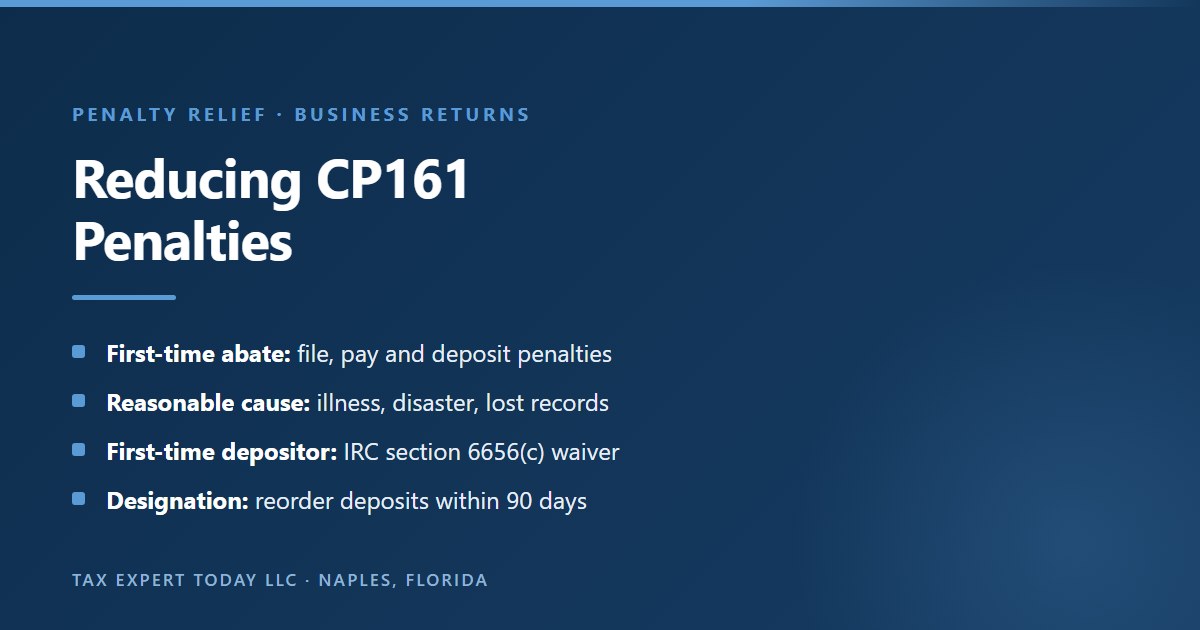
Possibly. The IRS offers first-time penalty abatement for failure to file, failure to pay and failure to deposit penalties when the business has a clean recent history, and it can remove penalties for reasonable cause. The deposit penalty also has a first-time depositor waiver and a 90 day right to redesignate deposits. Interest on the tax generally cannot be removed.
- First-time abatement: an administrative waiver for businesses with a clean prior three years.
- Reasonable cause: circumstances beyond the business’s control, with ordinary care shown.
- First-time depositor waiver: for an inadvertent failure in the first quarter of deposits or after a schedule change.
- Deposit designation: reassigning deposits within the period, within 90 days of the penalty notice.
The IRS describes first-time abate as covering the failure to file, failure to pay and failure to deposit penalties. For the deposit penalty, the IRS page lists added conditions, including that the IRS did not waive the deposit penalty four or more times in the prior three years (12 consecutive quarters) and that the penalty was not charged for EFTPS avoidance. Our guide to first-time penalty abatement covers the history test in detail, and the IRS can often grant it by phone.
For penalties that do not qualify for first-time relief, reasonable cause penalty abatement is the main route. The sample CP161 lists the kinds of circumstances the IRS considers, such as serious illness, a death in the family, or loss of records in a natural disaster, and asks the business to identify each penalty and explain why it should be reconsidered. A written request is usually stronger than a phone request when the facts are complicated. Some businesses file IRS Form 843, especially after the penalty has been paid, and the CP161 sample points to Form 843 for penalties caused by erroneous written advice from the IRS.
Two rules are unique to the deposit penalty. IRC section 6656(c) allows the IRS to waive the penalty for an inadvertent failure to deposit employment tax in the first quarter the business was required to deposit, or the first deposit after a change in deposit frequency, if the return was filed on time and the business meets the net worth limits. Section 6656(d) allows abatement the first time a depositor inadvertently sends the payment to the IRS instead of depositing it. And section 6656(e)(2) lets a business designate how its deposits apply within the period during the 90 days after a notice that a deposit penalty has been imposed. Publication 15 notes that the designation can minimize the penalty and points to Revenue Procedure 2001-58 for the method. Redesignation is often the most effective tool when the business deposited enough in total but in the wrong order.
What if my business cannot pay the CP161 balance?
A business that cannot pay in full can usually request a payment plan by calling the number on the notice or the IRS business line, or by filing Form 9465. Larger balances may require Form 433-B. Interest and penalties continue until paid, and the business generally must stay current on new deposits during the plan.
- Short-term plan: up to 180 days to pay, with no setup fee.
- Long-term plan: monthly payments, with a setup fee that varies by method.
- Financial statement: Form 433-B may be required for larger or complex balances.
- Stay current: new payroll deposits and returns must be timely during the plan.
The IRS payment plans page says business taxpayers should call the number on the notice or 800-829-4933, and lists the setup fees for direct debit and other long-term plans. It also notes that only individuals can apply for a short-term plan online, so a business usually arranges one by phone. When a business cannot meet the payment the IRS proposes, the IRS asks for financial information on Form 433-B or a related form. Our guide to IRS installment agreement options explains the general structure, and the same principles apply to business balances.
Employment tax balances need extra care. An installment agreement on a payroll balance does not stop new liabilities from accruing each payday, and a business that falls behind on current deposits while paying an old quarter can default its plan and invite enforced collection. In the IRS’s own terms, a payroll balance includes trust fund taxes the business withheld from employees, which is why the IRS treats it more seriously than other business debts. Where a business truly cannot pay, options such as an offer in compromise or currently not collectible status may be available in qualifying cases, though each has strict conditions and the analysis differs for an operating business.
What happens if I ignore an IRS CP161 notice?
An unpaid CP161 balance moves through the IRS notice sequence: reminder notices, then a notice of intent to levy on Form CP504B, and then a final notice with collection due process rights. For employment tax, the IRS can serve a disqualified employment tax levy before offering a hearing, and the unpaid trust fund portion can be assessed personally against responsible people.
- Reminder notices: follow the IRS CP161 notice if the balance stays open.
- CP504B: a notice of intent to levy for business balances.
- Final notice: the levy notice that carries collection due process rights.
- Payroll exception: some employment tax levies can come before a hearing.
- Personal exposure: the trust fund recovery penalty.
The business notice stream follows the same broad pattern as the individual stream, which our guides to the CP501, CP503 and CP504 notices describe. For businesses, the intent to levy notice is the CP504B. The IRS says the business should pay or contact the IRS no later than 30 days from the date of that notice, and that if it does not, the IRS may serve a disqualified employment tax levy or a federal contractor levy. In most other situations, the IRS first sends a final notice that offers a hearing, such as the Letter 1058 or LT11.
The disqualified employment tax levy is the reason payroll balances escalate faster than other business debts. Under IRC section 6330(f)(3), the IRS may levy to collect employment taxes from a business that, under the definition in section 6330(h)(1), requested a collection due process hearing on unpaid employment taxes arising in the two years before the period being levied. The hearing is still available, but it comes within a reasonable time after the levy rather than before. For a business with recurring payroll problems, that can mean a levy on bank accounts or receivables without the usual pre-levy hearing. Our guide to an IRS bank levy release explains what can be done once a levy hits.
A federal tax lien is another common step for larger balances, and it can affect business credit and financing. The IRS collection process publication describes both liens and levies. Ignoring an IRS CP161 notice does not make the balance smaller; interest and penalties grow, the deposit penalty can reach its top tier, and the options narrow with each notice.
Can an unpaid Form 941 balance on an IRS CP161 notice become personal?
Yes, the trust fund part can. If a business does not pay withheld income tax and the employees’ share of Social Security and Medicare tax, the IRS can assess the trust fund recovery penalty under IRC section 6672 against each person who was responsible for paying it and willfully did not. The penalty equals 100 percent of the unpaid trust fund tax.
- Trust fund taxes: withheld income tax and the employee share of FICA.
- Responsible person: anyone with authority to decide which bills get paid.
- Willfulness: knowing the taxes were due and paying other creditors instead.
- Not the employer share: the employer’s own FICA match is not trust fund tax.
IRC section 6672 makes the penalty personal. Publication 15 explains that a responsible person can be an officer or employee of a corporation, a partner or employee of a partnership, an accountant, a volunteer director, or anyone else responsible for collecting, accounting for or paying over the taxes, including someone who signs checks or otherwise controls how business funds are spent. The IRS generally pursues the penalty when the taxes cannot be collected from the business itself.
This guide does not cover the penalty in depth; our article on the trust fund recovery penalty explains the interview process, the proposed assessment letter and appeal rights. The practical point for an IRS CP161 notice is simpler. When a business has limited cash and receives a payroll balance due notice, paying the trust fund portion first protects the owners and officers from personal exposure, and the business can designate that a voluntary payment be applied to trust fund taxes. That ordering decision is often the most important one a business makes after receiving an IRS CP161 notice on Form 941.
Were some IRS CP161 notices sent in error?
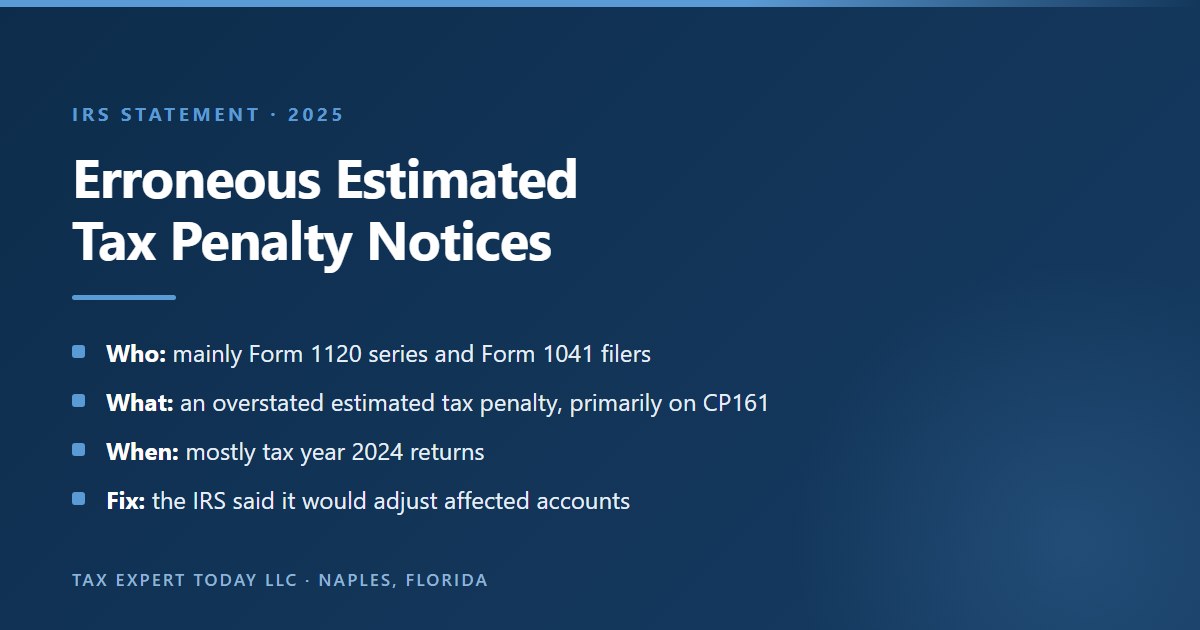
Yes. In 2025 the IRS acknowledged that a small percentage of business filers received notices, primarily the CP161, showing an erroneous increase to the penalty for not paying estimated tax, mostly for tax year 2024. The IRS said it was correcting the accounts without taxpayers having to contact it. Any IRS CP161 notice that bills an estimated tax penalty deserves a second look.
- Who was affected: mainly Form 1120 series and Form 1041 filers, plus some Form 990-PF, 990-T and 8804 filers.
- Which method: filers using the prior-year safe harbor or the annualized income method.
- Which years: mostly 2024, and other returns filed January through July 2025.
- The fix: the IRS said it would adjust affected accounts and send notices of the adjustment.
The IRS statement was reported by NBC Boston on September 26, 2025. According to that report, the IRS said the affected filers were Form 1120 series and Form 1041 filers who computed the penalty using the required annual payment based on the prior year or the annualized income installment method, Form 990-PF and 990-T filers, and Form 8804 filers, and that it would send affected taxpayers a notice after October 13 showing a positive adjustment. Professional groups, including the National Association of Tax Professionals, tracked the problem through 2025, with many reports focused on trusts that were not required to make estimated payments at all.
The lesson extends beyond that one episode. An IRS CP161 notice is generated by a computer from the return as processed, and it can be wrong. If a corporation or trust used a safe harbor on Form 2220 or Form 2210 and the notice ignores it, or if the trust had no estimated tax requirement, the response is a correction request with the computation attached, not a payment. Because the IRS said it would fix the 2025 problem on its own, anyone who received one of those notices and has not seen an adjustment should check the account transcript before paying.
How does the IRS CP161 notice compare with CP14, CP220 and CP504B?
The IRS CP161 notice is the business version of the first balance due bill: the CP14 does the same job for individuals. A CP220 is different because it reports a change the IRS made to a business return. A CP504B comes later, as the intent to levy. Knowing which notice you have tells you whether you are at the billing, adjustment or enforcement stage.
- CP161: business balance due, no change to the return.
- CP14: individual balance due, no change to the return.
- CP220: the IRS changed a business return, which may create a balance.
- CP504B: business notice of intent to levy, a later stage.
| Notice | Who receives it | What it means | Stage |
|---|---|---|---|
| CP161 | Businesses, trusts, estates, exempt organizations | Balance due on a business return, no math error | First bill |
| CP14 | Individuals | Balance due on Form 1040, no math error | First bill |
| CP11 | Individuals | The IRS corrected a math error and you owe more | Correction and bill |
| CP220 | Businesses | The IRS changed the business return, which may create a balance | Adjustment |
| CP504B | Businesses | Notice of intent to levy for an unpaid business balance | Enforcement warning |
The comparison matters because the right response differs. An IRS CP161 notice is answered by paying, tracing a payment, or requesting penalty relief. A CP11 carries a statutory 60 day right to have a math error change reversed. A change notice like the CP220, or the individual CP22A, reports an adjustment already made, and the review starts with whether the adjustment was right. A CP504B is a warning that enforced collection is close, and the response has to be fast.
CP161 notice help Naples: tax resolution Naples and Southwest Florida
Our office in Naples, Florida works with business owners, corporate officers and trustees who have received an IRS CP161 notice and need to sort out what is owed, what was misapplied and what can be abated. The review usually starts with the business account transcript and the EFTPS history for the period, so every deposit can be matched to the form and quarter where it actually posted. That one comparison often shows whether the balance is real, a deposit in the wrong period, or a penalty that a correction or a designation can reduce.
Business owners searching for CP161 notice help in Naples often ask whether to pay first and argue later, whether a payroll provider error can be fixed, and how to protect officers from the trust fund recovery penalty. Short answers: paying the undisputed tax inside the 10 day window usually limits the deposit penalty, provider errors are usually fixed by moving the deposit rather than paying twice, and the order in which payroll balances are paid can matter for personal exposure. Our IRS resolution and audit support service and our Naples tax resolution page explain how we handle business balance due notices, penalty abatement requests and the collection steps that can follow them.
Tax Expert Today LLC
11983 Tamiami Trail N, Naples, FL 34110
Phone: (239) 441-2005
Hours: Monday through Friday, 10:00 to 5:00 ET
Where can I get help with an IRS CP161 notice in Naples, FL? CP161 responses are handled by phone, fax and mail, so help does not depend on visiting an IRS office. A representative authorized on Form 2848 can pull the business transcript, trace and move misapplied deposits, request first-time abatement or reasonable cause relief, designate deposits within the 90 day window and set up a payment plan. Tax Expert Today LLC is located at 11983 Tamiami Trail N in Naples and works with businesses in Collier and Lee Counties and nationwide. Florida has no personal income tax, but Florida C corporations generally file a state corporate income tax return, so a Naples business may be working with the Florida Department of Revenue on a separate track while it resolves the federal CP161.
When to Engage a Professional
Many businesses can resolve an IRS CP161 notice on their own, especially when the balance is small, the cause is clear and the money is available. Consider engaging a representative when the notice bills unpaid payroll tax, when deposits appear to have posted to the wrong period, form or EIN, when the notice includes a large deposit or estimated tax penalty that may be wrong, when the business cannot pay in full, when several quarters are open, or when owners or officers are worried about the trust fund recovery penalty. Those are the situations in which the 10 day and 21 day windows, the 90 day designation right and the order of payments matter most. Dr. Kabashi is an Enrolled Agent authorized to represent taxpayers before the IRS in all 50 states, and every engagement starts from the statute, the regulations and the IRS’s own procedures rather than assumptions about what the IRS will do. Outcomes depend on each business’s facts.
This article is educational and general in nature. It does not constitute tax or legal advice for any particular taxpayer, and outcomes depend on individual facts and circumstances. Penalty rates, interest rates, payment plan fees and IRS procedures are current as of the publication date and are subject to change.
Published October 15, 2026 by Dr. Pellumb Kabashi « Back to Learning Center
Have a question this article touches on?
Tax Expert Today LLC, based in Naples, Florida and serving clients across the United States.
Schedule a Consultation (239) 441-2005