
By Dr. Pellumb Kabashi, DBA, MBA, CES, CFE, EA
Founder, Tax Expert Today LLC · Tax advisors, enrolled agents, CPAs, and attorneys · Serving clients in all 50 states
Quick Answer: For 2026, trust tax rates reach the 37 percent bracket at just $16,000 of retained taxable income, compared with $640,600 for a single individual, and retained investment income above $16,000 can also owe the 3.8 percent net investment income tax. Income a trust distributes is generally taxed to beneficiaries at their own rates instead, and distributions made by March 6, 2027 can count for 2026. Call (239) 441-2005 for a free consultation.
What Are the Trust Tax Rates for 2026?
For 2026, a non-grantor trust pays 10 percent on its first $3,300 of taxable income, 24 percent up to $11,700, 35 percent up to $16,000, and 37 percent on everything above $16,000. These trust tax rates come from Revenue Procedure 2025-32 and apply only to income the trust keeps rather than distributes.
- 10 percent bracket: taxable income up to $3,300.
- 24 percent bracket: $3,300 to $11,700, with $330 of tax on the first $3,300.
- 35 percent bracket: $11,700 to $16,000, with $2,346 of tax below it.
- 37 percent bracket: above $16,000, with $3,851 of tax on the first $16,000.
- Source: the 2026 inflation adjustments to IRC section 1(j)(2)(E) in Revenue Procedure 2025-32.
The table that sets trust tax rates is the estates and trusts schedule in section 1 of the Internal Revenue Code. The original rate table in section 1(e) still sits in the statute, but for tax years after 2017 the operative schedule is the one in section 1(j)(2)(E), which the IRS adjusts for inflation each fall. The 2026 figures were published in Revenue Procedure 2025-32, in the table labeled Section 1(j)(2)(E), Estates and Trusts. We checked the numbers in this guide directly against that document on November 17, 2026, rather than relying on any secondary summary.
That check matters because several pages ranking for trust tax rates in late 2026 still publish the 2025 schedule under a 2026 heading. The 2025 breakpoints were $3,150, $11,450, and $15,650. The 2026 breakpoints are $3,300, $11,700, and $16,000. On a trust with $100,000 of retained ordinary income, the difference is modest in dollars, but a return prepared from the wrong table is still a wrong return, and a trustee comparing retention against distribution should start from the correct numbers.
The schedule applies to the taxable income a trust keeps. Income that is properly distributed and deducted under IRC section 661 or section 651 is generally taxed to the beneficiary instead, at the beneficiary’s own rates. That single feature is why the rate table, on its own, rarely tells a trustee what to do. Our 2026 lifetime gift tax exemption guide covers the transfer tax side of the same trusts.
| If taxable income is | The tax is |
|---|---|
| Not over $3,300 | 10% of taxable income |
| Over $3,300 but not over $11,700 | $330 plus 24% of the excess over $3,300 |
| Over $11,700 but not over $16,000 | $2,346 plus 35% of the excess over $11,700 |
| Over $16,000 | $3,851 plus 37% of the excess over $16,000 |
Estates use the same schedule as trusts. A decedent’s estate that keeps income during administration is therefore exposed to the same compressed brackets, which is one reason executors also weigh distributions before an estate closes.
Why Do Trusts Reach the 37 Percent Bracket So Quickly?
Trusts reach 37 percent at $16,000 of taxable income in 2026, while a single individual does not reach it until $640,600. Congress compressed the trust schedule so that wealthy families could not split income across many trusts to use lower brackets repeatedly. The result is a strong tax incentive to distribute income to beneficiaries.
- Trust 37 percent threshold for 2026: $16,000.
- Single filer 37 percent threshold for 2026: $640,600.
- Married filing jointly 37 percent threshold for 2026: $768,700.
- Ratio: a single filer has roughly 40 times more room below the highest bracket.
The compressed schedule is a deliberate policy choice. Before 1987, trusts had a broader rate schedule, and families could create several trusts for the same beneficiaries, each of which filed its own return and used its own low brackets. The Tax Reform Act of 1986 compressed the schedule sharply, and the multiple trust rules in IRC section 643(f) allow the IRS to treat two or more trusts as one where they have substantially the same grantors and beneficiaries and a principal purpose of avoiding tax.
The comparison is easiest to see side by side. The brackets for an unmarried individual in Revenue Procedure 2025-32 run through 10, 12, 22, 24, 32, and 35 percent before reaching 37 percent at $640,600. A trust skips the 12, 22, and 32 percent brackets entirely and reaches 37 percent after only $16,000. Income kept inside a trust is therefore usually taxed at a higher marginal rate than the same income in the hands of almost any individual beneficiary.
| Taxpayer | 37% bracket begins at | Brackets used before 37% |
|---|---|---|
| Estate or trust | $16,000 | 10%, 24%, 35% |
| Single individual | $640,600 | 10%, 12%, 22%, 24%, 32%, 35% |
| Married filing jointly | $768,700 | 10%, 12%, 22%, 24%, 32%, 35% |
| Head of household | $640,600 | 10%, 12%, 22%, 24%, 32%, 35% |
| Married filing separately | $384,350 | 10%, 12%, 22%, 24%, 32%, 35% |
The compression also pulls in a second tax. Because the net investment income tax threshold for a trust is tied to the start of the highest bracket under IRC section 1411(a)(2), retained investment income above $16,000 can face a combined federal rate of 40.8 percent on ordinary income.
How Much Tax Does a Trust Pay at Different Income Levels?
On $25,000 of retained ordinary taxable income in 2026, a trust owes about $7,181 of regular federal income tax, an average rate near 28.7 percent. A single individual with the same $25,000 of taxable income owes about $2,752, roughly 11 percent. The gap widens as income grows, before the net investment income tax.
- $5,000 of taxable income: trust about $738, single filer $500.
- $16,000: trust $3,851, single filer about $1,672.
- $50,000: trust about $16,431, single filer about $5,752.
- $100,000: trust about $34,931, single filer about $16,712.
- All figures: hypothetical, ordinary income only, before NIIT and credits.
The ladder below applies the 2026 schedules from Revenue Procedure 2025-32 to the same amount of taxable income for a trust and for a single individual. It isolates the rate structure. It does not include the trust’s personal exemption under IRC section 642(b), the individual standard deduction, qualified dividend or capital gain rates, the net investment income tax, or any state tax, so it is a teaching tool rather than a projection for any real trust.
Two features stand out. First, the trust’s average rate climbs quickly because so little income is sheltered by the 10 percent bracket. Second, the individual’s advantage persists at every level shown, which is why the default planning question for a non-grantor trust is not whether distributions save tax, but whether there is a non-tax reason to accept the higher rate. Our dynasty trust guide addresses one of the most common non-tax reasons, which is keeping assets inside a long-term trust for future generations.
| Taxable income | Trust tax | Trust average rate | Single filer tax | Single average rate |
|---|---|---|---|---|
| $5,000 | $738 | 14.8% | $500 | 10.0% |
| $16,000 | $3,851 | 24.1% | $1,672 | 10.5% |
| $25,000 | $7,181 | 28.7% | $2,752 | 11.0% |
| $50,000 | $16,431 | 32.9% | $5,752 | 11.5% |
| $100,000 | $34,931 | 34.9% | $16,712 | 16.7% |
| $250,000 | $90,431 | 36.2% | $56,456 | 22.6% |
Every figure above is a hypothetical illustration prepared for this guide and is not a prediction for any trust or person. Results depend on the character of the income, deductions, credits, and the beneficiary’s other income.
What Capital Gains Rates Apply to a Trust in 2026?
A trust pays 0 percent on long-term capital gains and qualified dividends that fall within its first $3,300 of taxable income, 15 percent up to $16,250, and 20 percent above $16,250 in 2026. A single individual keeps the 15 percent rate up to $545,500, so retained gains also face compressed rate breakpoints.
- 0 percent rate: taxable income up to $3,300 for a trust.
- 15 percent rate: up to $16,250 for a trust, versus $545,500 for a single filer.
- 20 percent rate: trust taxable income above $16,250.
- Stacking: preferential income is stacked above ordinary income, so ordinary income fills the 0 percent band first.
The capital gain breakpoints for 2026 appear in section 4.03 of Revenue Procedure 2025-32, under the heading Maximum Capital Gains Rate, with a separate line for estates and trusts. The maximum zero rate amount for a trust is $3,300 and the maximum 15 percent rate amount is $16,250. The same breakpoints govern qualified dividends, because IRC section 1(h)(11) taxes qualified dividend income as net capital gain.
The stacking rule changes the result more than most trustees expect. Ordinary income such as interest is counted first. A trust with $29,900 of ordinary taxable income has already used the 0 and 15 percent bands before its first dollar of capital gain is counted, so every dollar of retained long-term gain is taxed at 20 percent. A trust whose only income is capital gain, by contrast, may see part of its gain taxed at 0 and 15 percent.
| Filing status | 0% rate up to | 15% rate up to | 20% rate above |
|---|---|---|---|
| Estates and trusts | $3,300 | $16,250 | $16,250 |
| Single individuals | $49,450 | $545,500 | $545,500 |
| Married filing jointly | $98,900 | $613,700 | $613,700 |
| Heads of household | $66,200 | $579,600 | $579,600 |
| Married filing separately | $49,450 | $306,850 | $306,850 |
Unrecaptured section 1250 gain and collectibles gain keep their own maximum rates of 25 and 28 percent. Our tax gain harvesting guide shows how the 0 percent band works for individuals, which is the same mechanism in a far wider band.
Does the 3.8 Percent Net Investment Income Tax Apply to Trusts?
Yes. Under IRC section 1411(a)(2), a non-grantor trust owes 3.8 percent on the lesser of its undistributed net investment income or its adjusted gross income above the dollar amount where the highest bracket begins. For 2026 that threshold is $16,000, compared with $200,000 for a single individual, a figure that is not indexed for inflation.
- Trust threshold for 2026: $16,000, tied to the start of the 37 percent bracket.
- Single individual threshold: $200,000 of modified adjusted gross income.
- Base: undistributed net investment income, after the distribution deduction.
- Exempt trusts: grantor trusts, charitable trusts, and certain other trusts listed in the regulations.
- Combined federal rate on retained ordinary investment income: up to 40.8 percent.
The statute imposes the tax on the lesser of two amounts: undistributed net investment income, or the excess of adjusted gross income, as defined in section 1411(a)(2) by cross reference to section 67(e), over the dollar amount at which the highest bracket begins. Because that bracket begins at $16,000 in 2026, the threshold rises each year with inflation, unlike the individual thresholds of $200,000 and $250,000, which have never been indexed.
Distributions are the main planning lever. Under Treasury Regulation 1.1411-3(e), undistributed net investment income is net investment income reduced by distributions of net investment income to beneficiaries and by certain charitable deductions. The income that leaves the trust is then tested at the beneficiary’s level against the individual threshold, which many beneficiaries never cross. The IRS net investment income tax page summarizes the individual rules and confirms the trust and estate application.
| Approach | Trust AGI | Undistributed NII | Excess over $16,000 | Trust NIIT |
|---|---|---|---|---|
| Retain everything | $99,900 | $100,000 | $83,900 | $3,188 |
| Distribute $60,000 of interest and dividends | $39,900 | $40,000 | $23,900 | $908 |
| Distribute all $100,000, gains in DNI | $0 | $0 | $0 | $0 |
The figures assume a complex trust with a $100 exemption and no other deductions, and they are hypothetical. Whether a distributed amount escapes NIIT entirely depends on the beneficiary’s own modified adjusted gross income.
Is a Trust Taxed at a Higher Rate Than an Individual?
A non-grantor trust that keeps its income is usually taxed at a higher rate than an individual with the same income, because its brackets are compressed and its net investment income tax threshold is lower. A grantor trust is not taxed separately at all, so its income is taxed at the grantor’s individual rates instead.
- Non-grantor trust: separate taxpayer, compressed brackets, files Form 1041.
- Grantor trust: income reported by the grantor at individual rates.
- Distributed income: generally taxed to the beneficiary at individual rates.
- Retained income: taxed to the trust at trust tax rates.
The question in the search results, whether a trust is taxed at a higher rate, has two different answers depending on the kind of trust. A revocable living trust, and many irrevocable trusts designed for estate planning, are grantor trusts under IRC sections 671 through 679. Their income is reported by the grantor as if the trust did not exist for income tax purposes, so trust tax rates never apply while grantor status lasts.
Only a non-grantor trust is a separate income taxpayer under IRC section 641. For that trust, the comparison turns on how much income is kept. A trust that distributes all of its income each year may owe little or no tax itself. A trust that accumulates income for future beneficiaries, or for a beneficiary who cannot yet receive it, pays the compressed rates on what it keeps.
| Trust type | Who reports the income | Rate schedule |
|---|---|---|
| Revocable living trust | Grantor, on Form 1040 | Individual rates |
| Intentionally defective grantor trust | Grantor, on Form 1040 | Individual rates |
| Irrevocable non-grantor trust, income retained | Trust, on Form 1041 | Trust rates |
| Irrevocable non-grantor trust, income distributed | Beneficiary, through Schedule K-1 | Beneficiary’s individual rates |
| Trust after the grantor dies | Usually the trust, unless a section 645 election applies | Trust or estate rates |
Our intentionally defective grantor trust guide explains why some families choose grantor status on purpose, paying the trust’s income tax from outside the trust.
Which Trusts Pay Their Own Income Tax and Which Do Not?
Non-grantor trusts pay their own income tax on retained income, while grantor trusts do not, because the grantor is treated as owning the trust assets under IRC sections 671 through 679. A trust’s status can change, most often when the grantor dies or releases a retained power, so trustees should confirm status every year.
- Grantor trust: retained powers or interests listed in sections 673 through 677.
- Non-grantor trust: none of those powers is held by the grantor or a nonadverse party.
- Status change: grantor death usually converts a revocable trust to a non-grantor trust.
- Section 645 election: lets a qualified revocable trust be treated as part of the estate.
The grantor trust rules ask whether the grantor, or a nonadverse party, holds powers or interests that the Code treats as ownership. Examples include a reversionary interest under section 673, certain powers to control beneficial enjoyment under section 674, administrative powers under section 675, a power to revoke under section 676, and the use of income for the grantor or the grantor’s spouse under section 677. Whether a party is adverse or nonadverse is defined in section 672.
When the grantor of a revocable trust dies, the power to revoke ends and the trust usually becomes a separate taxpayer. IRC section 645 allows the trustee and the executor to elect to treat a qualified revocable trust as part of the estate, which can let the trust use a fiscal year and certain estate rules during administration. The election is made on Form 8855 and has its own deadline, so it belongs on the first meeting agenda after a death rather than at the first filing deadline.
| Feature in the trust | Usual result | Code section |
|---|---|---|
| Grantor can revoke the trust | Grantor trust | 676 |
| Income may be paid to the grantor or spouse | Grantor trust | 677(a) |
| Grantor holds a substitution power in a nonfiduciary capacity | Often grantor trust | 675(4) |
| Independent trustee with discretion, no retained powers | Often non-grantor trust | 674(c) |
| Grantor has died | Usually non-grantor, absent section 645 | 641, 645 |
Status is a legal conclusion that depends on the exact trust language and on state law, so these signals are a starting point for review rather than an answer.
What Is the Difference Between a Simple Trust and a Complex Trust?
A simple trust must distribute all of its income currently, makes no charitable gifts, and distributes no principal during the year. Every other non-grantor trust is a complex trust for that year. The label can change annually, and it controls the personal exemption, the distribution deduction rules, and whether the 65-day election is available.
- Simple trust: required to distribute all income currently under IRC section 651.
- Complex trust: may accumulate income, make charitable gifts, or distribute principal under section 661.
- Exemption: $300 for a simple trust, $100 for most complex trusts.
- 65-day election: available to complex trusts and estates only.
- Year by year: a simple trust that distributes principal is complex for that year.
The simple trust and complex trust labels come from the deduction sections rather than from the trust document’s title. IRC section 651 covers a trust whose governing instrument requires all of its income to be distributed currently, does not provide for charitable amounts, and does not distribute principal during the year. Treasury Regulation 1.651(a)-1 confirms that a trust can be simple in one year and complex in another, and that a trust is complex in the year it terminates if it distributes principal.
The practical difference shows up in the distribution deduction. A simple trust deducts the income required to be distributed, whether or not it was actually paid, and the beneficiary reports that amount under section 652. A complex trust deducts amounts actually paid, credited, or required to be distributed under section 661, and its beneficiaries report under section 662, using the tier system described later in this guide.
| Feature | Simple trust | Complex trust |
|---|---|---|
| Must distribute all income currently | Yes | No |
| May accumulate income | No | Yes |
| May distribute principal in the year | No (becomes complex that year) | Yes |
| Charitable deduction under 642(c) | Not available | Available if the instrument allows |
| Personal exemption | $300 | $100 |
| Deduction section | 651 | 661 |
| Beneficiary inclusion section | 652 | 662 |
| 65-day election under 663(b) | Not available | Available |
Searchers looking for simple trust vs complex trust usually want to know which label their trust carries. The answer is in the distribution clause of the governing instrument and in what actually happened during the year, so a trustee should confirm both before the return is prepared.
What Personal Exemption Does a Trust Get?
A trust required to distribute all of its income currently gets a $300 personal exemption under IRC section 642(b), and most other trusts get $100. An estate gets $600. A qualified disability trust may claim a larger exemption tied to the individual exemption amount, subject to income phaseouts.
- Estate: $600.
- Trust required to distribute all income currently: $300.
- Other trusts: $100.
- Qualified disability trust: an amount tied to the section 151(d) exemption amount.
- Not inflation indexed: the $600, $300, and $100 amounts are fixed in the statute.
The exemption amounts in IRC section 642(b) have not changed in decades and are not adjusted for inflation. They are small by design. A trust is not meant to have a standard deduction comparable to an individual’s, which is one more reason retained income moves into the higher brackets so quickly. A trust with $4,000 of retained interest income and a $100 exemption already has income in the 24 percent bracket in 2026.
The qualified disability trust rule is the exception that matters for families who support a disabled beneficiary through a third-party or first-party supplemental needs trust. A trust that meets the definition in section 642(b)(2)(C) can claim an exemption measured by the individual exemption amount under section 151(d). Because the 2025 legislation changed the individual personal exemption framework, the amount available for 2026 should be confirmed from the current Form 1041 instructions before the return is filed.
| Entity | Exemption | Indexed for inflation |
|---|---|---|
| Decedent’s estate | $600 | No |
| Trust required to distribute all income currently | $300 | No |
| Other trust | $100 | No |
| Qualified disability trust | Tied to section 151(d) amount, with phaseout | Follows section 151(d) |
The exemption is claimed on Form 1041 and reduces the trust’s taxable income. In our worked example later in this guide, it is the reason a trust with $100,000 of income shows $99,900 of taxable income when nothing is distributed.
What Is Distributable Net Income?
Distributable net income, or DNI, is the ceiling on how much a trust can deduct for distributions and how much beneficiaries must report as income. Defined in IRC section 643(a), it starts with the trust’s taxable income and adjusts it, most importantly by usually excluding capital gains allocated to principal and by adding back tax-exempt interest.
- Ceiling: the distribution deduction cannot exceed DNI.
- Measure: beneficiaries are taxed only up to their share of DNI.
- Capital gains: usually excluded unless Reg. 1.643(a)-3 includes them.
- Tax-exempt interest: included in DNI but carries out as tax-exempt.
- Character: DNI keeps the character of the income that makes it up.
IRC section 643(a) defines distributable net income as the trust’s taxable income computed with several modifications. The distribution deduction itself is ignored, as is the personal exemption. Capital gains allocated to corpus and not paid, credited, or required to be distributed are excluded, as are capital losses except to the extent they offset gains included in DNI. Tax-exempt interest is added back, reduced by the expenses allocable to it.
DNI does three jobs at once. It limits the trust’s deduction under section 661, it limits what beneficiaries must include under section 662, and it determines the character of what they include. If a trust distributes $80,000 in a year when its DNI is $60,000, the beneficiaries report only $60,000 of income. The extra $20,000 is treated as a distribution of principal and is generally not taxable to them. Distributable net income is also searched heavily on its own, much of it by students, so the definition here focuses on how a trustee actually uses it.
| Item | Amount | In DNI? |
|---|---|---|
| Taxable interest | $30,000 | Yes |
| Qualified dividends | $30,000 | Yes |
| Long-term capital gain allocated to principal | $40,000 | No, under the default rule |
| Personal exemption | ($100) | Not deducted in computing DNI |
| Distributable net income | $60,000 | Ceiling on the distribution deduction |
The example assumes no trustee fees or other deductions to keep the arithmetic visible. Real trusts allocate deductions among income items, which changes the character of each dollar carried out.
How Does the Distribution Deduction Move Income to Beneficiaries?
A non-grantor trust deducts what it distributes, up to distributable net income, and each beneficiary includes a matching amount in income. The deduction is IRC section 651 for simple trusts and section 661 for complex trusts, and the inclusion is section 652 or 662. Together they tax each dollar once, either to the trust or to the beneficiary.
- Simple trust deduction: income required to be distributed, up to DNI.
- Complex trust deduction: amounts required, paid, or credited, up to DNI.
- Beneficiary inclusion: the same amount, reported from Schedule K-1.
- Character: the beneficiary’s share keeps the trust’s mix of income.
- Tax-exempt income: no deduction for the tax-exempt part, and no tax to the beneficiary.
This is the mechanism behind every retain versus distribute decision. The trust is taxed on taxable income after the distribution deduction. The beneficiary is taxed on the distributed share. Because the deduction and the inclusion are both capped by DNI, the system is designed to prevent the same dollar from being taxed twice and to prevent it from escaping tax altogether.
The regulations under Treasury Regulation 1.661(a)-2 describe what counts as paid or credited, including distributions in kind. Property distributed in kind is generally counted at the lesser of its basis or fair market value unless the trustee elects to recognize gain under section 643(e). That election can matter when a trustee distributes appreciated securities instead of cash.
| Distribution | Trust deduction | Beneficiary includes | Trust keeps taxable |
|---|---|---|---|
| $0 | $0 | $0 | $60,000 plus any excluded gains |
| $30,000 | $30,000 | $30,000 | $30,000 plus any excluded gains |
| $60,000 | $60,000 | $60,000 | Only excluded gains |
| $80,000 | $60,000 (capped at DNI) | $60,000 | Only excluded gains; $20,000 treated as principal |
The mechanics are reported on Schedule B of Form 1041, which computes DNI and the income distribution deduction, and on each beneficiary’s Schedule K-1 (Form 1041).
How Are Beneficiaries Taxed on Trust Distributions?
Beneficiaries are taxed on their share of distributable net income, and the income keeps its character. Interest is reported as interest, qualified dividends as qualified dividends, and capital gain as capital gain if it was included in DNI. The amounts come from Schedule K-1 (Form 1041), and principal distributions beyond DNI are generally not taxable.
- Character flows through: under sections 652(b) and 662(b).
- Proportional allocation: each class of income is allocated pro rata unless the instrument or local law provides otherwise.
- K-1 reporting: interest in box 1, ordinary dividends in box 2a, qualified dividends in box 2b.
- Principal: distributions beyond DNI are generally a tax-free return of principal.
The character rule in section 652(b) and section 662(b) is what makes distribution planning work. Qualified dividends distributed to a beneficiary in the 15 percent capital gain bracket are taxed at 15 percent instead of the 20 percent the trust would pay above $16,250. Treasury Regulation 1.652(b)-2 requires that each class of income be allocated proportionately unless the governing instrument or local law specifically allocates different classes to different beneficiaries.
The Schedule K-1 (Form 1041) instructions list where each item goes on the beneficiary’s own return: box 1 interest, box 2a ordinary dividends, box 2b qualified dividends, boxes 3 and 4a net short-term and long-term capital gain, and box 5 other portfolio income, among others. A beneficiary whose K-1 arrives late can face an amended return, which is one practical reason trustees aim to finalize distributions and the K-1 early in the filing season.
| K-1 box | Item | Where the beneficiary usually reports it |
|---|---|---|
| 1 | Interest income | Form 1040, Schedule B |
| 2a | Ordinary dividends | Form 1040, Schedule B |
| 2b | Qualified dividends | Form 1040, qualified dividend line |
| 3 | Net short-term capital gain | Schedule D |
| 4a | Net long-term capital gain | Schedule D |
| 5 | Other portfolio and nonbusiness income | As the K-1 instructions direct |
| 14 | Other information, including tax-exempt interest | As the instructions direct |
Box numbers and codes follow the current K-1 instructions and can change by year, so the instructions for the year of the return control.
What Is the Tier System for Complex Trust Distributions?
The tier system decides which complex trust beneficiaries absorb DNI first. First-tier beneficiaries, who receive income required to be distributed currently, are taxed first, up to DNI. Second-tier beneficiaries, who receive discretionary or other amounts, share whatever DNI is left. The ordering can shift the tax burden among family members.
- First tier: income required to be distributed currently, under section 662(a)(1).
- Second tier: all other amounts properly paid, credited, or required to be distributed, under section 662(a)(2).
- DNI absorption: first tier uses DNI before second tier receives any.
- Separate share rule: under section 663(c), separate shares are treated as separate trusts for DNI.
IRC section 662(a) creates the two tiers. A beneficiary entitled to a mandatory income distribution is first tier and includes that amount up to DNI. If DNI is larger than the first-tier distributions, the remainder is allocated among second-tier beneficiaries in proportion to what they received. If DNI is smaller, second-tier beneficiaries may receive their distributions entirely as tax-free principal.
The separate share rule in section 663(c) can override the simple tier result. When a trust has substantially separate and independent shares for different beneficiaries, each share computes its own DNI. A beneficiary of one share is not taxed on income earned by another share. Trusts that divide into shares for children after a parent’s death often fall into this rule, and the share computation can change who reports what.
| Beneficiary | Tier | Distribution | Taxable share of DNI |
|---|---|---|---|
| Surviving spouse, mandatory income | First | $40,000 | $40,000 |
| Child A, discretionary | Second | $30,000 | $10,000 |
| Child B, discretionary | Second | $30,000 | $10,000 |
| Total | $100,000 | $60,000 |
In the example, $40,000 of DNI is absorbed by the first tier and the remaining $20,000 is split between the two second-tier beneficiaries in proportion to their $30,000 distributions. The other $40,000 they received is principal. The numbers are hypothetical.
Does a Revocable Living Trust Pay Trust Tax Rates?
No, not while the grantor is alive. A revocable living trust is a grantor trust under IRC section 676, so its income is reported on the grantor’s Form 1040 at individual rates. Trust tax rates generally begin to matter after the grantor dies, when the trust becomes irrevocable and usually becomes a separate taxpayer.
- During life: grantor trust, no separate rate schedule.
- Identification: often uses the grantor’s Social Security number during life.
- After death: usually a non-grantor trust that needs its own EIN.
- Section 645 election: can treat a qualified revocable trust as part of the estate.
- Administration period: retained income may then face trust or estate rates.
Most of the questions people ask about trust taxes come from heirs and successor trustees after a death, not from grantors. The trust that was invisible for income tax purposes during life becomes a separate taxpayer once the power to revoke ends. Income earned after the date of death is reported on Form 1041 by the trust or the estate, and any income kept during the administration period is taxed at the compressed schedule.
That timing is why distribution planning often matters most in the first and final years of administration. Income in respect of a decedent under IRC section 691, such as a final paycheck, deferred compensation, or certain retirement account payments, can arrive in the trust or estate and be taxed at trust rates unless it is distributed. Assets that receive a new basis under section 1014 can often be sold with little gain, but income earned on them after death is taxable in the normal way.
| Stage | Who reports income | Rate schedule |
|---|---|---|
| Grantor alive and competent | Grantor, Form 1040 | Individual |
| Grantor alive but incapacitated | Usually still the grantor | Individual |
| After death, section 645 election made | Estate, Form 1041 | Estate and trust rates on retained income |
| After death, no election | Trust, Form 1041 | Trust rates on retained income |
| Trust continues for beneficiaries | Trust, Form 1041, with K-1s | Trust rates on retained income only |
Families who moved to Florida with an existing revocable trust can review our trust situs after moving to Florida guide and our Florida estate planning for new residents guide.
Should a Trustee Retain or Distribute Trust Income?
A trustee should start with the trust document and the beneficiaries’ needs, then compare the tax on retained income at trust tax rates with the tax each beneficiary would pay. Distribution often lowers the family’s combined federal tax, but spendthrift concerns, creditor exposure, a beneficiary’s own high bracket, or the trust’s purpose can justify retaining income.
- Fiduciary duty first: the governing instrument and state law decide what is permitted.
- Compare combined tax: trust tax plus beneficiary tax under each option.
- Count NIIT twice: at the trust’s $16,000 threshold and the beneficiary’s $200,000 or $250,000 threshold.
- Check non-tax risks: creditors, divorce, disability benefits, and maturity.
- Document the reasoning: in the trust records each year.
The tax answer and the fiduciary answer are not always the same. A trustee who distributes income to save tax but violates the trust’s purpose, for example by handing a large sum to a beneficiary with a known addiction or a pending divorce, may face a claim for breach of trust that costs far more than the tax saved. In Florida, section 738.201 of the Florida Statutes requires a fiduciary to act impartially and in good faith when making allocations and exercising discretion.
Within those limits, the federal tax comparison is mechanical. Compute the trust’s tax with no distribution, then with the distribution being considered, and add each beneficiary’s incremental tax. The difference is the family-level saving or cost. The worked example in the next section does exactly that for a hypothetical trust, and our estate and trust planning services page describes how that analysis fits a broader fiduciary review.
| Factor | Points toward distributing | Points toward retaining |
|---|---|---|
| Beneficiary’s marginal rate | Low or moderate bracket | Already in the 35 or 37 percent bracket |
| Beneficiary’s circumstances | Stable, financially mature | Creditor claims, divorce, addiction, disability benefits |
| Trust purpose | Income support for the beneficiary | Long-term accumulation for future generations |
| Character of income | Qualified dividends and interest | Capital gains that cannot carry out under the instrument |
| State tax | Beneficiary lives in a no-income-tax state such as Florida | Beneficiary lives in a high-tax state while the trust owes none |
Each factor is a general observation. The right answer for a particular trust depends on the instrument, the beneficiaries, and the trustee’s duties under the governing law.
How Much Tax Can Distributing Trust Income Save in 2026?
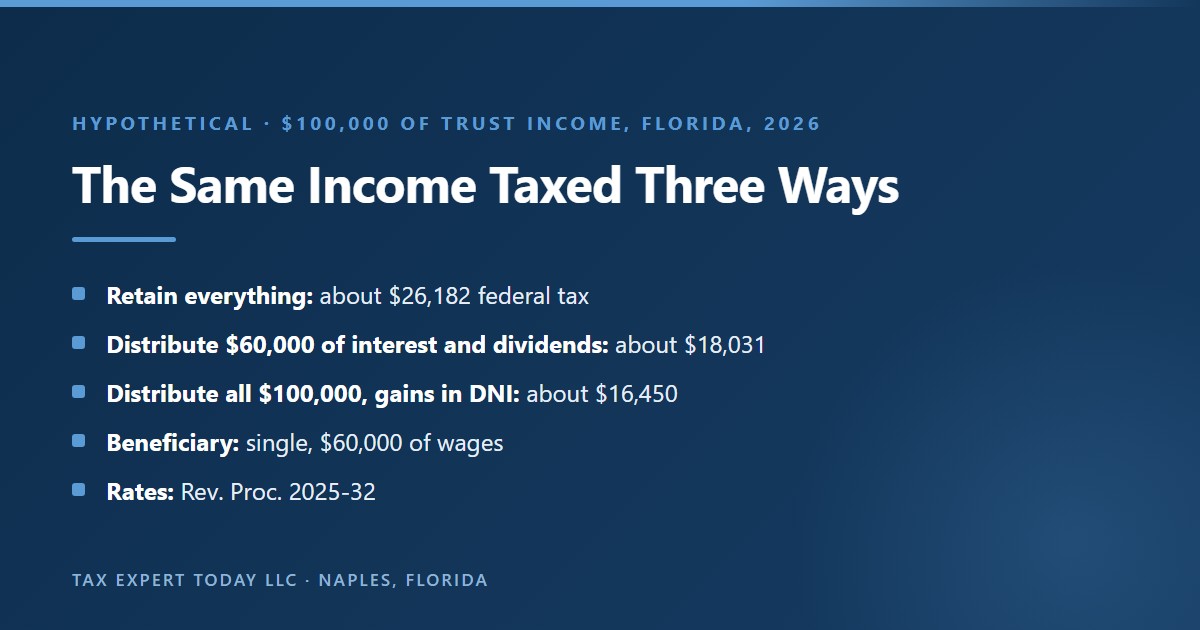
In our hypothetical 2026 example, a trust with $30,000 of interest, $30,000 of qualified dividends, and $40,000 of long-term gain owes about $26,182 if it retains everything. Distributing the $60,000 of interest and dividends cuts the family total to about $18,031. Carrying gains into DNI and distributing all $100,000 lowers it to about $16,450.
- Retain everything: about $26,182 of federal tax, all at the trust level.
- Distribute $60,000 of interest and dividends: about $18,031 combined.
- Distribute all $100,000 with gains in DNI: about $16,450, all at the beneficiary level.
- Difference: about $9,732 between the first and third approaches.
- Assumptions: complex trust, one single beneficiary with $60,000 of wages, 2026 rates, federal tax only.
The example uses one beneficiary, a single filer with $60,000 of wages who takes the 2026 standard deduction of $16,100, so the beneficiary starts with $43,900 of taxable income. The trust is a complex trust with a $100 exemption, no deductions for fees, and no state tax, because both the trust and the beneficiary are assumed to be in Florida. All rates come from Revenue Procedure 2025-32.
When the trust keeps everything, its $99,900 of taxable income includes $29,900 of ordinary income, which uses up the 0 and 15 percent capital gain bands, so all $70,000 of dividends and gain is taxed at 20 percent. Regular tax is about $22,994, and the net investment income tax under section 1411(a)(2) adds about $3,188. When the trust distributes the $60,000 of interest and dividends, the beneficiary’s extra tax is about $10,450, and the trust’s tax on the retained gain falls to about $6,672 plus $908 of NIIT, because its gain now starts in the 0 percent band.
| Approach | Trust income tax | Trust NIIT | Beneficiary added tax | Family total |
|---|---|---|---|---|
| A. Retain all income and gain | $22,994 | $3,188 | $0 | $26,182 |
| B. Distribute $60,000 of interest and dividends | $6,672 | $908 | $10,450 | $18,031 |
| C. Distribute all $100,000, gain included in DNI | $0 | $0 | $16,450 | $16,450 |
Approach C is only available if the gain can be included in DNI under the rules discussed next. Every figure is a hypothetical illustration, rounded to whole dollars, and is not a client outcome or a prediction for any trust. A beneficiary in a higher bracket, a beneficiary in a taxing state, or trust deductions would change every number.
When Are Capital Gains Included in Distributable Net Income?
Capital gains are included in DNI only if Treasury Regulation 1.643(a)-3(b) is satisfied: the gain is allocated to income, or allocated to principal but consistently treated as part of a distribution, or allocated to principal but actually distributed or used to determine the distribution. Otherwise the gain stays in principal and is taxed to the trust.
- Rule 1: gain allocated to income under the instrument or local law.
- Rule 2: gain allocated to principal but treated consistently on the books, records, and returns as distributed.
- Rule 3: gain allocated to principal but actually distributed, or used to measure the distribution.
- Authority: the instrument, local law, or a reasonable and impartial exercise of fiduciary discretion.
- Final year: gains are generally included in DNI in the year a trust terminates.
The default treatment in IRC section 643(a)(3) excludes capital gains allocated to corpus from DNI. Treasury Regulation 1.643(a)-3(b) then lists the three circumstances in which gains are included anyway. Each one requires authority from the governing instrument, from applicable local law, or from a reasonable and impartial exercise of discretion granted by either. A trustee cannot simply decide at return time that gains carried out.
The consistency requirement in the second rule is where many trusts succeed or fail. If a trustee has a discretionary power to treat principal distributions as coming from realized gains, the trustee must exercise it consistently, year after year, and reflect it on the trust’s books and returns. A practice that appears only in the years when it helps may not satisfy the regulation. This is the single biggest gap in the pages that currently rank for trust tax rates: none of them explains that approach C in our worked example depends on this regulation.
| Situation | Gain in DNI? | What supports it |
|---|---|---|
| Instrument allocates gains to income | Yes | Rule 1 |
| Gains to principal, trustee consistently treats principal distributions as from gains | Yes | Rule 2, if consistent on books, records, and returns |
| Gains to principal, but sale proceeds actually distributed | Yes | Rule 3 |
| Gains to principal, reinvested, nothing distributed from them | No | Default exclusion |
| Trust terminates and distributes everything | Generally yes | Final year treatment |
The regulation also says that if gains are paid or set aside for charity so that a section 642(c) deduction is allowed, they are included in DNI to that extent.
Why Do Capital Gains Usually Stay Taxed at the Trust Level?
Capital gains usually stay taxed at the trust level because state principal and income law, including Florida’s Uniform Fiduciary Income and Principal Act, generally allocates gains to principal. Gains allocated to principal are excluded from DNI by default, so they cannot carry out to beneficiaries unless one of the Treasury Regulation 1.643(a)-3 exceptions applies.
- Default allocation: sale proceeds and gains go to principal.
- Florida law: chapter 738 of the Florida Statutes governs Florida-administered trusts.
- Tax result: gain allocated to principal is excluded from DNI.
- Override: the governing instrument can allocate gains differently.
Trust accounting and tax accounting are separate systems that interact. Trust accounting decides whether a receipt belongs to the income beneficiaries or to the remainder beneficiaries. For trusts administered in Florida, section 738.404 of the Florida Statutes directs a fiduciary to allocate to principal, among other items, money received from the sale or exchange of principal assets, and section 738.104 makes the chapter apply when Florida is the principal place of administration.
Tax accounting then follows the trust accounting result unless an exception applies. Because gains are principal under the default rule, they are excluded from DNI and taxed to the trust. That is why a trust whose beneficiaries are in low brackets can still owe 20 percent on its gains plus 3.8 percent NIIT. The fix, where one is available, is in the governing instrument or in a properly exercised fiduciary power, not in the tax return.
| Trust accounting treatment | Federal tax treatment | Who usually pays |
|---|---|---|
| Gain allocated to principal, reinvested | Excluded from DNI | Trust |
| Gain allocated to principal, consistently treated as distributed | Included in DNI | Beneficiary, if distributed |
| Gain allocated to income by the instrument | Included in DNI | Beneficiary, if distributed |
| Gain realized in the trust’s final year | Generally included in DNI | Beneficiaries receiving the final distribution |
Trusts administered in other states follow that state’s version of the principal and income act, which may differ. Our trust decanting guide explains one way older trusts are sometimes updated to add modern provisions, along with the tax questions that raises.
How Does a Trustee’s Power to Adjust Change the Answer?
A power to adjust lets a trustee reallocate between income and principal when that is needed to treat beneficiaries fairly. Under Florida section 738.203, a Florida fiduciary may have that power, and a reallocation to income can, if exercised reasonably and impartially, bring capital gains into DNI under Treasury Regulation 1.643(a)-3.
- Source of the power: section 738.203 of the Florida Statutes, unless the instrument says otherwise.
- Purpose: fairness between income and remainder beneficiaries, not tax savings alone.
- Unitrust option: section 738.303 allows conversion to a unitrust in some cases.
- Tax link: Reg. 1.643(a)-3 respects reasonable and impartial exercises of discretion granted by local law.
Modern principal and income acts recognize that a trust invested for total return may produce little traditional income even while it grows. Section 738.203 of the Florida Statutes gives a fiduciary a power to adjust between income and principal, subject to limits, when the fiduciary determines that doing so will assist in administering the trust impartially. Section 738.303 allows a fiduciary, by following its procedures, to convert a trust to a unitrust that pays a fixed percentage of value.
The federal regulations anticipate these state laws. Treasury Regulation 1.643(b)-1 generally respects state statutes that provide for a reasonable apportionment between income and remainder beneficiaries, including a power to adjust and a unitrust amount of between 3 and 5 percent. When an adjustment allocates gain to income, or a unitrust amount is satisfied from gains, the gain may be included in DNI. The decision is still a fiduciary one, and an adjustment made only to save tax, without regard to the beneficiaries’ interests, invites challenge.
| Method | Where it comes from | Main limit |
|---|---|---|
| Instrument allocates gains to income | Trust document | Must already be in the document or added by decanting or modification |
| Power to adjust | Fla. Stat. 738.203 for Florida trusts | Impartial, reasonable exercise; statutory restrictions |
| Unitrust conversion | Fla. Stat. 738.303 for Florida trusts | Procedures and notice; 3 to 5 percent range under Reg. 1.643(b)-1 |
| Consistent treatment of principal distributions as from gains | Discretion under the instrument or local law | Must be consistent on books, records, and returns |
Our NING trust guide covers a structure where state income tax, rather than federal brackets, is the primary driver of the distribution decision.
When Does Retaining Income in the Trust Make Sense?
Retaining income can make sense when the beneficiary is already in a high bracket, when a distribution would expose assets to creditors or a divorcing spouse, when it would disqualify a beneficiary from needs-based benefits, or when the trust exists to build wealth for later generations. In those cases, paying trust tax rates may be an acceptable cost.
- High-bracket beneficiary: little or no rate saving from distributing.
- Asset protection: distributed cash leaves the trust’s spendthrift protection.
- Public benefits: distributions can affect means-tested benefits for a disabled beneficiary.
- Minors: distributions to young beneficiaries can trigger the kiddie tax.
- Long-term purpose: dynasty and generation-skipping trusts often accumulate by design.
A beneficiary who is already in the 35 or 37 percent bracket gains little from receiving ordinary income, and may pay more on investment income once the beneficiary’s own $200,000 or $250,000 net investment income tax threshold is crossed. For that beneficiary, the trust’s compressed brackets may cost only slightly more than a distribution would, and keeping the assets inside the trust preserves its protections. Our spousal lifetime access trust guide discusses one structure where that tradeoff often arises.
Distributions to minors deserve their own check. Unearned income above the 2026 threshold of $2,700 for a child subject to the kiddie tax can be taxed at the parents’ rate, using the $1,350 figure published in Revenue Procedure 2025-32 for the standard deduction element. A distribution to a young beneficiary may therefore move income from one high rate to another rather than to a low rate. Our 2026 kiddie tax guide works that comparison through with hypothetical numbers for parents in different brackets.
| Situation | Why retention may be chosen | Tax cost of retention |
|---|---|---|
| Beneficiary in the 37 percent bracket | Little or no rate difference | Mainly NIIT timing and the trust’s lower threshold |
| Beneficiary facing creditor claims | Spendthrift protection stays in place | Trust tax rates on retained income |
| Beneficiary receiving needs-based benefits | Protects eligibility | Trust tax rates, unless a qualified disability trust exemption helps |
| Minor beneficiary | Kiddie tax may apply anyway | Comparison of trust rates with parents’ rates |
| Generation-skipping trust | Accumulation is the trust’s purpose | Trust tax rates every year |
The $2,700 kiddie tax figure is twice the $1,350 amount in Revenue Procedure 2025-32 and should be confirmed against the Form 8615 instructions for the year. Benefit eligibility rules are outside the scope of this guide.
How Does the Beneficiary’s Own Tax Bracket Change the Math?
The higher the beneficiary’s own bracket, the smaller the saving from distributing. In our hypothetical, distributing $60,000 of interest and dividends to a beneficiary with $60,000 of wages saves about $8,151. For a beneficiary already in the 35 percent bracket with income above the NIIT threshold, the same distribution saves far less and may cost slightly more.
- Low-bracket beneficiary: largest saving.
- Middle-bracket beneficiary: saving narrows as ordinary income reaches 22 and 24 percent.
- High-bracket beneficiary: saving can approach zero once beneficiary NIIT applies.
- Multiple beneficiaries: spreading distributions can use several sets of low brackets.
The comparison below holds the trust constant and changes only the beneficiary. For the beneficiary with $60,000 of wages, the $30,000 of interest is taxed at 12 and 22 percent and the $30,000 of qualified dividends at 15 percent. For a hypothetical beneficiary with $700,000 of wages, the interest is taxed at 37 percent, the dividends at 20 percent, and all $60,000 is also subject to the 3.8 percent net investment income tax at the individual level under section 1411.
At that income level, the trust’s own tax on the same $60,000, at 37 and 20 percent plus 3.8 percent above $16,000 of AGI, is close to the beneficiary’s. Because the trust’s NIIT threshold is so low, the trust may still pay slightly more, but the gap is small enough that non-tax reasons often decide the question. A trustee with several beneficiaries can sometimes direct discretionary distributions toward the beneficiaries in the lowest brackets, if the instrument permits and the distribution is otherwise appropriate.
| Beneficiary profile | Beneficiary added tax | Trust tax saved | Approximate family saving |
|---|---|---|---|
| Single, $60,000 of wages | $10,450 | $18,601 | $8,151 |
| Single, $150,000 of wages | About $12,080 | $18,601 | About $6,521 |
| Single, $700,000 of wages | About $19,380 | $18,601 | About ($779), a small cost |
The trust tax saved is the difference between approach A ($26,182) and the trust’s share of approach B ($7,580). The higher-income rows are simplified hypothetical estimates that ignore phaseouts and other items, and they are not predictions for any person.
What Is the 65-Day Rule for Trusts?
The 65-day rule in IRC section 663(b) lets the trustee of a complex trust, or an estate’s executor, elect to treat distributions made in the first 65 days of a tax year as if they were made on the last day of the prior year. It gives trustees time to measure the year’s income before deciding how much to distribute.
- Who can elect: complex trusts and decedents’ estates.
- What it does: moves a distribution back into the prior tax year for tax purposes.
- Why it helps: the trustee can distribute after year-end, once income is known.
- Election is annual: it must be made for each year it is wanted.
- Simple trusts: not needed, because their income is taxed to beneficiaries anyway.
IRC section 663(b)(1) provides that if, within the first 65 days of any tax year, an amount is properly paid or credited, it shall be considered paid or credited on the last day of the preceding year. Section 663(b)(2) makes the rule elective, and Treasury Regulation 1.663(b)-1 confirms that the fiduciary may elect to treat any amount or portion paid within the 65 days as paid on the last day of the prior year.
The practical problem it solves is timing. A trustee rarely knows a trust’s final income on December 31, because year-end dividends, capital gain distributions from mutual funds, and K-1s from partnerships arrive later. The 65-day window lets the trustee wait for that information, run the retain versus distribute comparison on actual numbers, and then distribute in January or February with the result counted for the year that just ended.
| Question | Answer | Authority |
|---|---|---|
| Who may elect | Fiduciary of a complex trust, or an executor | IRC 663(b); Form 1041 instructions |
| What qualifies | Amounts properly paid or credited within the first 65 days | IRC 663(b)(1) |
| Effect | Treated as paid on the last day of the prior year | Treas. Reg. 1.663(b)-1(a) |
| How long it lasts | Only the year for which it is made | Treas. Reg. 1.663(b)-1(a)(2) |
| Revocable | No, after the due date of the return including extensions | Treas. Reg. 1.663(b)-2(a) |
Wealthspire is the only page among those we read in the current results for trust tax rates that mentions the 65-day rule, and none of the pages we read gives the 2026 date or the dollar limit on the election, both of which follow.
What Is the 65-Day Deadline for the 2026 Tax Year?
For a calendar-year trust, the 65-day window for 2026 runs from January 1 through March 6, 2027. A distribution must be properly paid or credited by March 6, 2027 to be eligible for the section 663(b) election for 2026. March 6, 2027 falls on a Saturday, and the statute counts days rather than business days.
- Window opens: January 1, 2027.
- Window closes: March 6, 2027, the 65th day of the year.
- Counting: 31 days in January, 28 in February 2027, plus 6 days in March.
- Practical deadline: banks and brokerages may not process transfers on a Saturday, so plan for Friday, March 5, 2027.
- Fiscal-year trusts: count 65 days from the first day of the new fiscal year.
The statute speaks of the first 65 days of the tax year, not of business days, and neither section 663(b) nor the regulations under it move the date for a weekend. In 2027, January has 31 days and February has 28, which brings the count to 59 at the end of February, so the 65th day is March 6, 2027. A trustee who intends to rely on the election should treat the last practical day as the last banking day before that date, which is Friday, March 5, 2027.
The demand pattern for this topic mirrors the deadline. Search interest for the 65 day rule trust phrase rises from January and peaks in February and March, according to DataForSEO monthly data we reviewed on November 17, 2026. Trustees and preparers who start the comparison in December have time to obtain final figures and act before the window closes.
| Month | Days counted | Running total |
|---|---|---|
| January 2027 | 31 | 31 |
| February 2027 | 28 | 59 |
| March 1 to March 6, 2027 | 6 | 65 |
| Last day of the window | Saturday, March 6, 2027 | Day 65 |
The election deadline is different from the distribution deadline. The distribution must be made within the 65 days, but the election itself is made on the timely filed Form 1041, as the next section explains.
How Does a Trustee Make the Section 663(b) Election?
The trustee makes the 65-day election by checking the box for the section 663(b) election on Form 1041, in the Other Information section, on a return filed by its due date including extensions. Under Treasury Regulation 1.663(b)-2, the election becomes irrevocable after the last day for making it and applies only to that year.
- Where: Form 1041, Other Information, the question on the section 663(b) election.
- When: by the return’s due date, including extensions.
- Irrevocable: after the last day prescribed for making it.
- No return required: a statement filed with the IRS, under the same regulation.
- Amount: the trustee may elect for all or part of the qualifying distributions.
Treasury Regulation 1.663(b)-2(a) says that when a trust return is required, the election is made in the appropriate place on the return, not later than the time prescribed for filing the return including extensions. The Form 1041 instructions point to Question 6 under Other Information and state that for the election to be valid, the return must be filed by the due date including extensions. A late return can therefore cost the election even when the distribution was made on time.
The election can cover a portion of the distributions. A trustee who distributed $50,000 in February 2027 may elect to treat $30,000 as a 2026 distribution and leave $20,000 as a 2027 distribution, which can help balance income between two years. Whatever is elected must be reported consistently on the beneficiaries’ Schedules K-1 for 2026.
| Step | Timing for 2026 | Notes |
|---|---|---|
| Estimate 2026 income and DNI | December 2026 to February 2027 | Wait for year-end dividends and K-1s where possible |
| Make the distribution | By March 6, 2027 | Must be properly paid or credited |
| Decide the elected amount | Before the return is filed | All or part of the qualifying amount |
| Check the box on Form 1041 | By April 15, 2027, or the extended due date | Irrevocable after the deadline |
| Issue Schedules K-1 | With the return | Beneficiaries report the elected amount for 2026 |
The election is also available to a decedent’s estate, according to the Form 1041 instructions, which matters in the year a revocable trust or estate begins administration.
How Much Can Be Treated as Distributed Under the 65-Day Election?
The elected amount cannot exceed the greater of the trust’s accounting income or its distributable net income for the year, reduced by amounts already paid, credited, or required to be distributed during that year. This limit, in Treasury Regulation 1.663(b)-1(a)(2), stops a trustee from pulling back more than the year’s income.
- Starting point: the greater of fiduciary accounting income or DNI for the year.
- Reduction: amounts already paid, credited, or required to be distributed in that year.
- Excluded from the reduction: amounts treated as prior-year distributions under a prior 65-day election.
- Anything above the cap: stays a distribution of the new year.
Treasury Regulation 1.663(b)-1(a)(2) limits the election to the amount of income of the trust, as defined in Regulation 1.643(b)-1, or the trust’s DNI if greater, reduced by amounts paid, credited, or required to be distributed during the year other than those already treated as made in a preceding year under section 663(b). The trustee therefore needs both numbers, accounting income from the trust’s books and DNI from the tax computation, before deciding how much to elect.
In our worked example, DNI is $60,000 and accounting income is also $60,000, because the gain is principal. If the trustee distributed $20,000 during 2026, the most that a January or February 2027 distribution can be treated as a 2026 distribution is $40,000. A larger distribution is allowed, but the excess is a 2027 distribution for tax purposes.
| Item | Amount |
|---|---|
| Fiduciary accounting income for 2026 | $60,000 |
| Distributable net income for 2026 | $60,000 |
| Greater of the two | $60,000 |
| Less: distributions already made during 2026 | ($20,000) |
| Maximum amount eligible for the 2026 election | $40,000 |
| Distribution made February 15, 2027 | $50,000 |
| Treated as 2027 distribution | $10,000 |
The figures are hypothetical. Where gains are included in DNI under Regulation 1.643(a)-3, DNI can exceed accounting income, and the larger figure sets the cap.
What Is the Section 643(g) Election for Estimated Tax?
Section 643(g) lets a trustee treat some or all of the trust’s estimated tax payments as paid by a beneficiary, as if distributed on the last day of the year. The election is made on Form 1041-T by the 65th day after the trust’s year ends, which is March 6, 2027 for a calendar-year 2026 trust.
- Who may elect: the trustee of a trust, and an executor only for an estate’s final year.
- Form: Form 1041-T, Allocation of Estimated Tax Payments to Beneficiaries.
- Deadline: the 65th day after the close of the tax year.
- Effect: treated as a distribution to the beneficiary and as the beneficiary’s estimated tax payment.
- K-1 reporting: box 13, code A, according to the Form 1041 instructions.
Under IRC section 643(g), the trustee may elect to treat any portion of a payment of estimated tax made by the trust as a payment made by a beneficiary. The amount is treated as paid or credited to the beneficiary on the last day of the trust’s tax year. The Form 1041 instructions explain that the election is made by filing Form 1041-T by the 65th day after the close of the tax year, and that a decedent’s estate may make it only for its final year.
The election helps when a trust paid estimated tax during the year expecting to retain income, and the trustee later decides to distribute. Instead of requesting a refund for the trust while the beneficiary scrambles to pay tax on the distribution, the trustee can move the payment to the beneficiary’s account. The amount allocated counts as a distribution, so it carries out DNI like any other.
| Feature | Section 663(b) election | Section 643(g) election |
|---|---|---|
| What moves | A distribution made in the first 65 days | Trust estimated tax payments |
| Who may elect | Complex trusts and estates | Trusts; estates only in the final year |
| How | Checkbox on Form 1041 | Form 1041-T |
| Deadline | Due date of Form 1041, with extensions | 65th day after year-end |
| 2026 deadline for a calendar-year trust | April 15, 2027, or the extended date | March 6, 2027 |
The two elections have the same 65-day flavor but different deadlines, which is a frequent source of missed elections.
Do Trusts Have to Pay Estimated Tax?
Yes. Under IRC section 6654(l), the individual estimated tax rules generally apply to trusts and estates, so a non-grantor trust expecting to owe tax usually pays quarterly using Form 1041-ES. A decedent’s estate, and certain trusts that receive the residue of an estate, are exempt for tax years ending within two years of death.
- General rule: section 6654 applies to trusts and estates under section 6654(l)(1).
- Form: Form 1041-ES vouchers or electronic payment.
- Two-year exception: estates and certain qualifying trusts after a death.
- Safe harbor planning: the same prior-year and current-year concepts as for individuals.
- Underpayment: computed on Form 2210 for the trust.
IRC section 6654(l) extends the individual estimated tax rules to estates and trusts, with an exception for an estate, and for a trust that was treated as owned by the decedent and receives the residue under the will, for any tax year ending before the date two years after the decedent’s death. The Form 1041-ES page provides the vouchers and payment instructions for fiduciaries.
Estimated tax interacts with the distribution decision. A trust that pays quarterly estimates assuming it will retain income may overpay if the trustee later distributes, which is the situation the section 643(g) election addresses. A trust that plans to distribute nearly all income may need little or no estimated tax, while each beneficiary may need to adjust their own withholding or estimates to cover the income that will arrive on their K-1.
| Installment | Usual due date |
|---|---|
| First | April 15, 2026 |
| Second | June 15, 2026 |
| Third | September 15, 2026 |
| Fourth | January 15, 2027 |
Dates that fall on a weekend or legal holiday move to the next business day. Confirm the current year’s schedule on the Form 1041-ES page.
What Year-End Steps Should a Trustee Take Before December 31, 2026?
Before December 31, 2026, a trustee should estimate the trust’s income and gains for the year, identify each beneficiary’s likely bracket, review the governing instrument for distribution and capital gain provisions, and plan any year-end sales. The 65-day rule allows the final distribution decision to wait until March 6, 2027, but preparation should start now.
- Project income: interest, dividends, fund distributions, and K-1 income.
- Review the instrument: mandatory income, discretion, and gain allocation language.
- Gather beneficiary data: other income, filing status, and state of residence.
- Plan sales: realized gains are taxed to the trust unless they can carry out.
- Calendar the deadlines: March 6, 2027 for distributions and Form 1041-T; April 15, 2027 for Form 1041.
The worst time to discover that capital gains cannot carry out is after the trust has sold a concentrated position in December. A trustee planning a large sale can review the governing instrument and, for a Florida trust, the fiduciary powers under section 738.203 before the sale rather than after it. Where gains will be taxed to the trust no matter what, spreading sales across tax years may keep more of the gain in the 15 percent band.
The beneficiary information is the piece most often missing. A trustee needs to know roughly what each beneficiary’s taxable income will be to know whether a distribution saves tax. Our Naples, Florida tax planning team often works through this checklist with trustees and families in November and December.
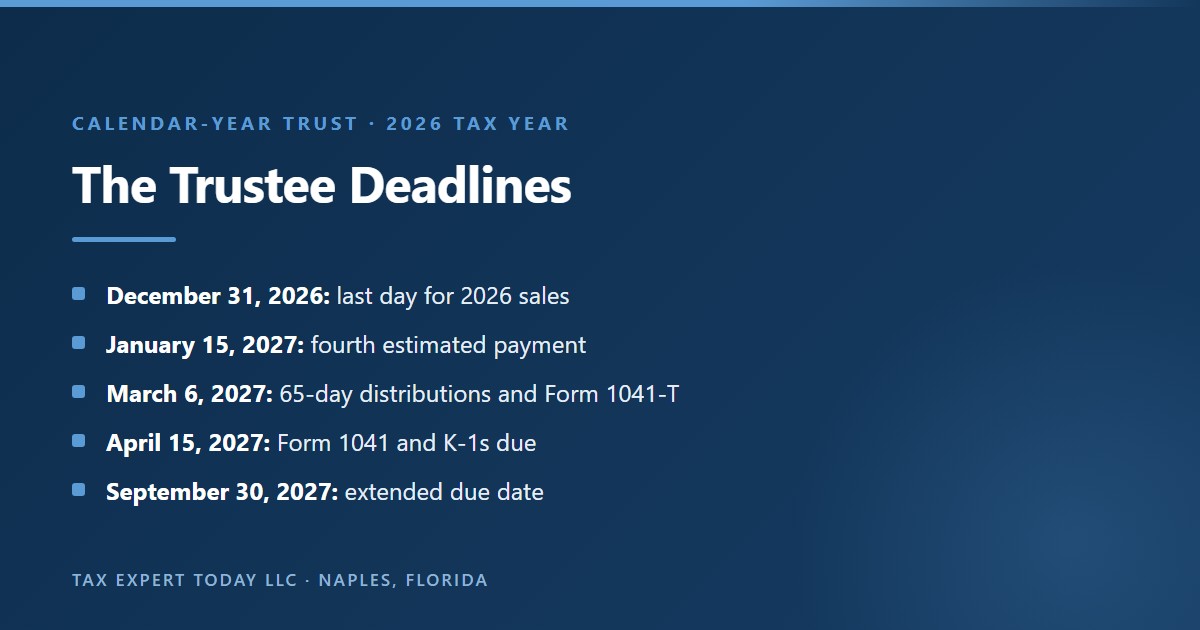
| Date | Step |
|---|---|
| November to December 2026 | Project income and gains; review the instrument; collect beneficiary data |
| December 31, 2026 | Last day for 2026 sales and for distributions counted without an election |
| January 15, 2027 | Fourth-quarter estimated tax payment, if due |
| January to March 6, 2027 | Run the comparison on final figures; make distributions eligible for the 663(b) election |
| March 6, 2027 | Last day of the 65-day window and of the Form 1041-T deadline |
| April 15, 2027 | Form 1041 and Schedules K-1 due, or file Form 7004 for an extension |
The calendar assumes a calendar-year trust. Fiscal-year estates follow their own dates.
When Must a Trust File a Trust Tax Return?
A trust must file Form 1041 for any year in which it has any taxable income, has gross income of $600 or more regardless of taxable income, or has a beneficiary who is a nonresident alien. These thresholds come from IRC section 6012(a). A grantor trust generally reports under the grantor’s return instead, though optional reporting methods exist.
- Any taxable income: filing required.
- Gross income of $600 or more: filing required even with no taxable income.
- Nonresident alien beneficiary: filing required regardless of income.
- Estates: required at $600 of gross income.
- Grantor trusts: special reporting rules in the Form 1041 instructions.
IRC section 6012(a)(4) requires a return from every trust having for the tax year any taxable income, or having gross income of $600 or over regardless of the amount of taxable income, and section 6012(a)(5) adds every estate or trust of which any beneficiary is a nonresident alien. A trust that distributes all of its income may have no taxable income but still must file because its gross income exceeds $600.
The trust tax return searched for by many successor trustees is Form 1041, U.S. Income Tax Return for Estates and Trusts. It reports the trust’s income, deductions, distribution deduction, and tax, and it transmits a Schedule K-1 to each beneficiary who received a distribution of DNI. The Form 1041 instructions also describe optional methods that let many grantor trusts skip the Form 1041 by furnishing information directly to the grantor.
| Entity | Must file if | Section |
|---|---|---|
| Trust | Any taxable income | 6012(a)(4) |
| Trust | Gross income of $600 or more | 6012(a)(4) |
| Estate | Gross income of $600 or more | 6012(a)(3) |
| Estate or trust | Any beneficiary is a nonresident alien | 6012(a)(5) |
| Grantor trust | Reporting follows the grantor trust rules and optional methods | Form 1041 instructions |
A trust must have its own employer identification number to file Form 1041. A revocable trust that used the grantor’s Social Security number during life usually needs a new number after the grantor’s death.
When Is Form 1041 Due for 2026, and Can It Be Extended?
For a calendar-year trust, the 2026 Form 1041 and Schedules K-1 are due April 15, 2027. Form 7004 provides an automatic five-and-a-half-month extension of time to file, which moves the deadline to September 30, 2027. An extension of time to file is not an extension of time to pay any tax due.
- Due date: the 15th day of the 4th month after year-end.
- 2026 calendar-year deadline: April 15, 2027.
- Extension: Form 7004, automatic five and a half months.
- Extended deadline: September 30, 2027.
- Payment: tax is still due by the original due date.
The Form 1041 instructions state that calendar-year estates and trusts file Form 1041 and Schedules K-1 by April 15, and fiscal-year filers by the 15th day of the fourth month after the tax year ends. If the due date falls on a weekend or legal holiday, the return is due the next business day. An automatic extension of five and a half months is requested on Form 7004.
The extension interacts with the 65-day election. Because the section 663(b) election must be made on a return filed by the due date including extensions, a trust on extension has until September 30, 2027 to make the 2026 election. The distribution itself, however, still had to be made by March 6, 2027. Beneficiaries of an extended trust receive their K-1s later, which may require them to extend their own returns.
| Deadline | Date | What is due |
|---|---|---|
| Original due date | April 15, 2027 | Form 1041, Schedules K-1, and any tax |
| Extended due date | September 30, 2027 | Form 1041 and Schedules K-1 if Form 7004 was filed |
| 65-day distribution window | March 6, 2027 | Distributions eligible for the section 663(b) election |
| Form 1041-T | March 6, 2027 | Section 643(g) estimated tax allocation |
Penalties for late filing and late payment are described in the Form 1041 instructions under Interest and Penalties.
What Does Schedule B of Form 1041 Calculate?
Schedule B of Form 1041 calculates distributable net income and the income distribution deduction. It starts from adjusted total income, adjusts for tax-exempt interest and capital gains, arrives at DNI, and then limits the deduction to the lesser of DNI or the amounts required, paid, or credited. Its result flows to the trust’s taxable income.
- Input: adjusted total income from page 1.
- Adjustments: tax-exempt interest, capital gains allocated to corpus, and other items.
- Output 1: distributable net income.
- Output 2: the income distribution deduction, carried to page 1.
- Tie to K-1s: the beneficiaries’ shares should reconcile to the deduction.
Schedule B is where the tax law in section 643(a), section 651, and section 661 becomes arithmetic. The Form 1041 instructions walk line by line through adjusted total income, the addition of tax-exempt interest, the subtraction of net gain shown on Schedule D that is allocable to corpus, and the resulting DNI. The schedule then lists income required to be distributed currently and other amounts paid, credited, or required to be distributed.
A common review step is to reconcile Schedule B with the K-1s. The sum of the beneficiaries’ shares of income on their K-1s should match the income distribution deduction, after adjusting for tax-exempt income. When the numbers do not tie, the cause is often an error in allocating capital gains or tax-exempt interest, or a 65-day election that was reflected on the return but not on the K-1s.
| Line concept | Amount |
|---|---|
| Adjusted total income | $100,000 |
| Less: capital gain allocated to corpus | ($40,000) |
| Distributable net income | $60,000 |
| Amounts paid, credited, or required to be distributed | $60,000 |
| Income distribution deduction (lesser of DNI or distributions) | $60,000 |
The table is a simplified illustration of the logic, not a reproduction of Schedule B’s numbered lines. Line numbers and order follow the instructions for the year of the return.
What Does a Beneficiary Receive on Schedule K-1 (Form 1041)?
A beneficiary receives a Schedule K-1 (Form 1041) showing their share of the trust’s income, deductions, and credits, separated by character: interest, ordinary and qualified dividends, short-term and long-term capital gains, other income, and items such as tax-exempt interest and section 199A information. The beneficiary reports those amounts on their own return.
- Who gets one: each beneficiary who received a distribution of DNI.
- Character preserved: each box corresponds to a type of income.
- Final year: excess deductions and carryovers may appear on the final K-1.
- Timing: furnished with the Form 1041, by its due date.
- Mismatch risk: a late or amended K-1 can require an amended individual return.
The Schedule K-1 (Form 1041) instructions describe each box and the codes used for other items, including the net investment income tax information under code H in box 14 and section 199A information under code I. Beneficiaries should not report more than their K-1 shows, and they should keep the K-1 with their records, because it supports the character of what they reported.
The K-1 is also where the retain versus distribute decision becomes visible to beneficiaries. A beneficiary who receives a cash distribution of $50,000 may see only $30,000 of income on the K-1 if DNI was smaller, with the rest treated as principal. Explaining that difference in advance prevents confusion, and it reflects the character rules in section 662(b).
| Item | What it shows |
|---|---|
| Box 1 | Interest income |
| Box 2a and 2b | Ordinary dividends and the qualified portion |
| Boxes 3 and 4a | Net short-term and net long-term capital gain |
| Box 11 | Final year deductions, including excess deductions and carryovers |
| Box 13, code A | Estimated tax payments allocated under section 643(g) |
| Box 14 | Other information, such as tax-exempt interest, NIIT information, and section 199A information |
Codes and box assignments follow the instructions for the year of the K-1. Our qualified business income deduction guide explains how section 199A amounts on a K-1 are used.
How Are Trustee Fees and Other Trust Deductions Handled?
Trustee fees, tax preparation fees, and other costs that would not have been incurred if the property were not held in trust are generally deductible in computing a trust’s adjusted gross income under IRC section 67(e). Costs that an individual would commonly incur, such as certain investment advisory fees, face tighter limits. Deductions also reduce DNI.
- Section 67(e) costs: deductible for trusts and estates.
- Bundled fees: may need to be split between deductible and limited portions.
- Allocation to tax-exempt income: a share of deductions may be disallowed.
- Effect on distributions: deductions reduce DNI and change the character carried out.
- Personal exemption: separately allowed under section 642(b).
The rules for trust deductions are more technical than the rate table and deserve a careful review on each return. Costs paid in connection with the administration of the trust that would not have been incurred if the property were not held in trust are treated as above-the-line deductions under section 67(e). The Form 1041 instructions explain how to identify those costs, how to treat bundled fiduciary fees, and how to allocate deductions to tax-exempt income.
Deductions also shape the retain versus distribute result. Because DNI is computed after deductions, a $5,000 trustee fee reduces the income that can carry out, and the way the fee is allocated among interest, dividends, and tax-exempt income changes the character of what beneficiaries receive. In our worked example we assumed no deductions so that the rates would be easy to follow; a real trust would rarely be that simple.
| Expense | Usual treatment | Where to check |
|---|---|---|
| Trustee or executor fee | Generally deductible under section 67(e) | Form 1041 instructions |
| Fiduciary return preparation | Generally deductible under section 67(e) | Form 1041 instructions |
| Investment advisory fee an individual would also pay | Limited | Form 1041 instructions, bundled fee rules |
| Expenses allocable to tax-exempt income | Disallowed to that extent | Form 1041 instructions |
| Charitable amounts paid under the instrument | Section 642(c) deduction | IRC 642(c) |
Whether a particular cost qualifies depends on the facts, the terms of the engagement, and the instructions for the year, so this table is a general guide only.
How Does the Alternative Minimum Tax Apply to Trusts in 2026?
Trusts and estates are subject to the alternative minimum tax. For 2026, a trust’s AMT exemption is $31,400, and it phases out once alternative minimum taxable income exceeds $104,800, disappearing entirely at $167,600, according to Revenue Procedure 2025-32. Most trusts with ordinary investment income do not owe AMT, but some do.
- 2026 exemption: $31,400.
- Phaseout begins: $104,800 of alternative minimum taxable income.
- Fully phased out: $167,600.
- Computed on: Schedule I of Form 1041.
- Distributions: carry out alternative minimum tax items to beneficiaries as well.
The 2026 exemption and phaseout amounts for estates and trusts appear in section 4.10 of Revenue Procedure 2025-32, alongside those for individuals. The trust computation is made on Schedule I of Form 1041, which also computes an income distribution deduction on a minimum tax basis, so that AMT items follow distributions to beneficiaries in the same way that regular tax items do.
AMT exposure is most common in trusts that hold private activity bonds or that have large deductions not allowed for AMT purposes. A trust with ordinary interest, dividends, and gains usually computes a regular tax higher than its tentative minimum tax. Because the compressed regular brackets already reach 37 percent at $16,000, AMT rarely becomes the binding tax for a trust of the kind used in our example.
| Filing status | Exemption | Phaseout begins | Fully phased out |
|---|---|---|---|
| Estates and trusts | $31,400 | $104,800 | $167,600 |
| Single individuals | $90,100 | $500,000 | $680,200 |
| Married filing jointly | $140,200 | $1,000,000 | $1,280,400 |
The figures are from Revenue Procedure 2025-32. Whether AMT applies to a particular trust requires the full Schedule I computation.
Does the Section 199A Deduction Apply to Trusts?
Yes, a non-grantor trust can claim the section 199A qualified business income deduction on business income it retains, and it passes 199A information to beneficiaries on income it distributes. For 2026, the threshold amount for a trust follows the all other returns figure of $201,750 in Revenue Procedure 2025-32, with a phase-in range ending at $276,750.
- Retained QBI: deduction claimed by the trust.
- Distributed QBI: reported to beneficiaries in box 14, code I.
- 2026 threshold: $201,750 for all other returns.
- Multiple trust rules: section 199A has its own anti-abuse provisions.
- Grantor trusts: the grantor claims the deduction.
The Form 1041 instructions include a detailed section on the qualified business income deduction for trusts and estates, including how to determine the trust’s qualified trades or businesses, how specified service trade or business limits apply, and how to allocate items between the trust and its beneficiaries. The threshold and phase-in amounts for 2026 are in section 4.26 of Revenue Procedure 2025-32.
For a trust that owns an interest in an operating business, such as an S corporation or a partnership, the 199A deduction can soften the compressed rates on retained business income. The decision to retain or distribute that income then affects who claims the deduction. Our S corp vs C corp guide covers the entity side of the same planning question, and IRC section 199A contains the statutory rules.
| Filing status | Threshold amount | Phase-in range ends |
|---|---|---|
| Married filing jointly | $403,500 | $553,500 |
| Married filing separately | $201,775 | $276,775 |
| All other returns, including trusts and estates | $201,750 | $276,750 |
Whether trust income is qualified business income depends on the underlying business and on the trust’s records. Trusts that hold S corporation stock must also meet the separate electing small business trust or qualified subchapter S trust rules.
How Do States Tax Non-Grantor Trusts?
States tax non-grantor trusts under different residency tests, based on where the grantor lived when the trust was created, where the trustee lives, where the trust is administered, or where the beneficiaries live. A trust can owe state tax in one state while its beneficiaries live in another, so state rules can change the retain versus distribute answer.
- Grantor-based tests: residence of the grantor when the trust became irrevocable.
- Trustee or administration tests: where the trustee lives or the trust is administered.
- Beneficiary-based tests: where a resident beneficiary lives.
- Source income: real estate or business income may be taxed where earned.
- Distributions: may shift state tax from the trust’s state to the beneficiary’s state.
Federal law sets the rate schedule, but each state decides whether a trust is a resident for its own income tax. Several states look at the grantor’s residence when the trust was created. Others look at the trustee’s residence or the place of administration, and a few look to resident beneficiaries. A trust created by a former resident of a high-tax state may still be treated as that state’s resident trust years after the family moves. Our NING trust guide explains a structure built to address state income tax, and it is the place to start for that question.
Distributions interact with state tax in a way the federal comparison does not capture. Income distributed to a beneficiary living in Florida carries no Florida personal income tax, while the same income retained by a trust that is a resident of another state may be taxed there. The reverse can also be true. This guide does not re-derive each state’s rules; the trust’s situs and residency analysis belongs with our trust situs after moving to Florida guide.
| Test | What it looks at | Planning consideration |
|---|---|---|
| Grantor residence | Where the grantor lived when the trust became irrevocable | May follow the trust after the family moves |
| Trustee residence | Where an individual or corporate trustee resides | Changing trustees may change the result |
| Place of administration | Where the trust is managed | Moving administration may change the result |
| Beneficiary residence | Where a resident beneficiary lives | Distributions and residence interact |
| Source income | Where real property or a business produces income | May apply regardless of residency |
State trust taxation changes frequently and is the subject of ongoing litigation in several states, so the trust’s specific facts should be reviewed each year.
Does a Florida Trust Pay State Income Tax?
Florida does not impose a personal income tax, so a trust administered in Florida with Florida beneficiaries generally pays only federal income tax on its retained income. That makes the federal comparison the main driver of distribution decisions for Florida trusts, though source income from other states and other states’ residency tests can still apply.
- Florida personal income tax: none.
- Federal trust tax rates: still apply in full.
- Florida trust administration law: chapter 738 governs income and principal.
- Out-of-state exposure: possible for source income or a former residence of the grantor.
Florida’s absence of a personal income tax is one reason many families choose Florida trustees and Florida administration. For a trust that is not taxed by any other state, the decision to retain or distribute turns on federal rates and on the beneficiaries’ circumstances. Florida administration also brings Florida’s Uniform Fiduciary Income and Principal Act, which section 738.104 applies when Florida is the principal place of administration, and which governs the income and principal allocations that drive DNI.
A Florida trust can still owe state tax elsewhere. Rental real estate in another state, a business interest that produces income sourced to another state, or a grantor who created the trust while a resident of a state that taxes trusts based on the grantor’s residence may each produce a filing obligation outside Florida. Our Florida estate planning for new residents guide covers several of those transitions.
| Question | Why it matters |
|---|---|
| Is the trust administered in Florida? | Florida principal and income law applies under 738.104 |
| Did the grantor create the trust while living in another state? | That state may still claim the trust as a resident |
| Does the trust own property or a business in another state? | Source income may be taxed there |
| Where do the beneficiaries live? | Distributed income may be taxed in their state |
| Is the trust a grantor trust? | If so, the grantor’s own state residence controls |
The checklist is general and does not replace a review of the specific trust and each state’s rules.
What Happens to Trust Income in the Year a Trust Terminates?
In the final year, a trust generally distributes everything, so its income and capital gains usually carry out to the beneficiaries and are taxed at their rates. Under IRC section 642(h), unused capital loss and net operating loss carryovers, and final-year deductions in excess of income, pass to the beneficiaries who succeed to the trust property.
- Final distributions: usually carry out all DNI, including gains.
- Capital loss carryovers: pass to beneficiaries under section 642(h)(1).
- Excess deductions: pass to beneficiaries under section 642(h)(2).
- K-1 reporting: box 11, according to the K-1 instructions.
- Timing: a termination late in the year can still use the 65-day rule if the trust is complex.
IRC section 642(h) provides that on termination, a net operating loss carryover or capital loss carryover, and final-year deductions other than the personal exemption and charitable deduction that exceed gross income, are allowed to the beneficiaries succeeding to the trust’s property. The Schedule K-1 instructions report these amounts in box 11, with separate codes for section 67(e) expenses, other itemized deductions, capital loss carryovers, and net operating loss carryovers.
Because gains that are actually distributed on termination are generally included in DNI, as the examples in Treasury Regulation 1.643(a)-3 illustrate, termination often turns a trust that paid 20 percent on its gains for years into one whose beneficiaries pay 15 percent or less on the last ones. Trustees sometimes time a planned termination with that in mind, as long as the timing is consistent with the governing instrument.
| Item | Passes to beneficiaries? | Authority |
|---|---|---|
| Final year income, including gains | Generally yes, through DNI | IRC 662; Reg. 1.643(a)-3 |
| Unused capital loss carryover | Yes | IRC 642(h)(1) |
| Net operating loss carryover | Yes | IRC 642(h)(1) |
| Excess final-year deductions | Yes, other than the exemption and charitable deduction | IRC 642(h)(2) |
| Unused personal exemption | No | IRC 642(h)(2) |
How each beneficiary uses the carried items depends on the type of deduction and on current law for the year, as the K-1 instructions describe.
Does the Throwback Rule Still Apply to Trusts?
For most domestic trusts, no. IRC section 665(c) generally computes accumulation distributions from qualified domestic trusts without regard to undistributed net income, which effectively removes the throwback rule for them. The throwback rules still apply to foreign trusts, certain domestic trusts that were once foreign, and certain trusts created before March 1, 1984.
- Domestic trusts: generally outside throwback after section 665(c).
- Foreign trusts: throwback and the interest charge still apply.
- Formerly foreign trusts: generally treated like foreign trusts for this purpose.
- Pre-1984 multiple trusts: may remain subject to the rules.
The throwback rules in IRC sections 665 through 668 were designed to stop trusts from accumulating income at low rates and distributing it later without additional tax. Section 665(c) now provides that for a qualified trust, distributions are computed without regard to undistributed net income, and defines a qualified trust as any trust other than a foreign trust, a domestic trust that was at any time a foreign trust except as regulations provide, or certain trusts created before March 1, 1984 that would be aggregated with other trusts.
For a domestic trust, that means accumulated income from earlier years is generally not taxed again when it is eventually distributed. The tax paid at trust rates in the accumulation year is final. For a foreign trust, the section 667 computation and an interest charge can make an accumulation distribution far more expensive than a current one. Our Form 3520 guide covers the reporting side of foreign trusts.
| Trust | Throwback applies? | Section |
|---|---|---|
| Domestic trust, never foreign, created after March 1, 1984 | Generally no | 665(c) |
| Foreign trust | Yes | 665 to 668 |
| Domestic trust that was once foreign | Generally yes, except as regulations provide | 665(c)(2)(A) |
| Certain pre-March 1, 1984 trusts aggregated under the multiple trust rules | May apply | 665(c)(2)(B) |
Foreign trust taxation involves additional reporting and penalties and should be reviewed separately with a qualified professional.
What Are Common Trust Income Tax Mistakes?
Common mistakes include using the prior year’s bracket table, assuming capital gains carry out to beneficiaries when the instrument does not allow it, missing the March 6, 2027 deadline for 65-day distributions, filing Form 1041 late and losing the election, ignoring the trust’s $16,000 NIIT threshold, and treating a grantor trust as a separate taxpayer.
- Stale brackets: 2025 numbers labeled as 2026.
- Gain assumptions: gains in DNI only under Reg. 1.643(a)-3.
- Missed window: distributions after March 6, 2027 cannot be elected back to 2026.
- Late return: the 663(b) election requires a timely return, including extensions.
- Grantor confusion: income reported on the wrong return.
Most of these mistakes are not about complicated law. They are about dates and documents. A preparer who copies last year’s rate table, a trustee who distributes on March 8, or a return that goes out after the extended due date can each turn a planned saving into a cost. In our worked example, missing the 65-day window would move the trust from approach B back to approach A for 2026, a difference of about $8,151 in hypothetical federal tax.
The others involve reading the trust instrument. Whether gains can carry out, whether a beneficiary is first tier or second tier, and whether the trust is a grantor trust are all answered by the document and by state law. A careful annual review of the instrument, alongside the tax computation, prevents most of them. Our charitable remainder trust guide shows how a very different trust type follows its own ordering rules, which is a useful contrast.
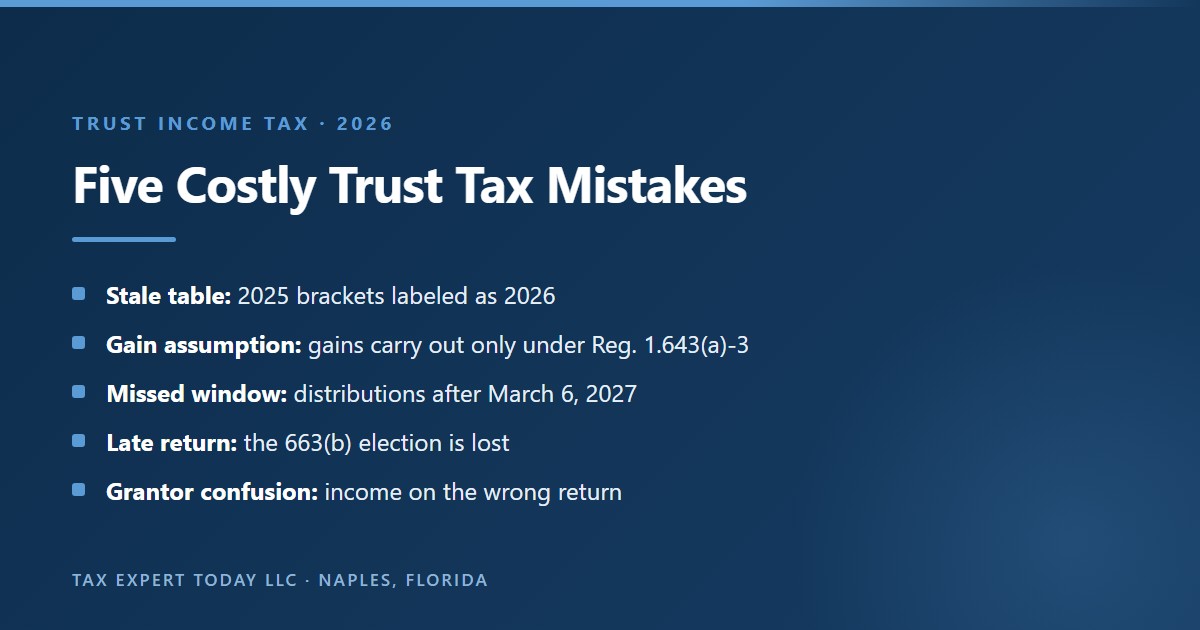
| Mistake | Likely consequence | Usual prevention |
|---|---|---|
| Using 2025 brackets for 2026 | Incorrect tax computed | Use Rev. Proc. 2025-32 for 2026 |
| Assuming gains carry out | Trust underreports, beneficiary overreports | Review instrument and Reg. 1.643(a)-3 |
| Distributing after March 6, 2027 | Distribution counts for 2027 | Calendar the 65-day window |
| Late Form 1041 | 663(b) election lost | File on time or extend with Form 7004 |
| Missing Form 1041-T deadline | Estimated payments stay with the trust | File by the 65th day |
| Reporting a grantor trust as separate | Income on the wrong return | Confirm status annually |
The consequences listed are general possibilities. Penalties and corrections depend on the facts, and amended returns may be needed for both the trust and the beneficiaries.
Are Trust Distributions Taxable to the Beneficiary?
Trust distributions are taxable to the beneficiary only to the extent they carry out distributable net income. Amounts above the trust’s DNI for the year are generally a tax-free distribution of principal. Income that is taxable keeps its character, so qualified dividends and capital gains included in DNI keep their lower rates in the beneficiary’s hands.
- Taxable part: the beneficiary’s share of DNI, shown on Schedule K-1.
- Tax-free part: principal distributed beyond DNI.
- Character: interest, dividends, and included gains keep their tax treatment.
- Grantor trust distributions: generally not taxable to the beneficiary, because the grantor reports the income.
- Inherited principal: not income, though income earned on it after death is.
This is the question most beneficiaries ask first, and the answer comes from the same DNI ceiling that limits the trust’s deduction under section 661. A beneficiary who receives $100,000 from a trust whose DNI was $60,000 reports $60,000 of income, split by character, and receives the remaining $40,000 as principal. The IRS Publication 559 discussion of beneficiaries of estates and trusts describes the same treatment for estate beneficiaries.
Where the beneficiary lives matters for the state side. A beneficiary who has moved to Florida generally pays no Florida personal income tax on the distribution, which is why trustees of family trusts often ask about a beneficiary’s residence when planning distributions. Our guides to establishing Florida residency, retiring to Florida and taxes, and Florida asset protection for new residents cover the residency and protection questions that often travel with a trust distribution. Families with a non-citizen surviving spouse should also review our qualified domestic trust guide, because distributions of principal from that kind of trust follow separate estate tax rules.
| Component | Amount | Taxable to the beneficiary? |
|---|---|---|
| Interest carried out | $30,000 | Yes, as ordinary income |
| Qualified dividends carried out | $30,000 | Yes, at qualified dividend rates |
| Principal beyond DNI | $40,000 | Generally no |
| Total distributed | $100,000 | $60,000 taxable |
The example assumes the $40,000 of gain is allocated to principal and excluded from DNI, so the trust, not the beneficiary, pays tax on that gain. It is hypothetical and simplified.
Trust Tax Help in Naples & Southwest Florida
Tax Expert Today LLC works with trustees, executors, and beneficiaries in Naples, Florida and across Southwest Florida on trust tax rates and the distribution decision. That work can include projecting retained versus distributed tax, reviewing gain allocation language, timing 65-day distributions, and preparing Form 1041 and Schedules K-1. Results depend on each trust’s facts.
- Trust tax help Naples: Form 1041 preparation and distribution planning for trusts administered in Collier and Lee counties.
- Projections: trust and beneficiary tax under retain and distribute scenarios.
- Elections: section 663(b) and section 643(g) timing and reporting.
- Service area: an office in Naples, with clients served in all 50 states.
Our office is at 11983 Tamiami Trail N, Naples FL 34110. Call (239) 441-2005, Monday through Friday, 10 a.m. to 5 p.m. ET. Our Naples tax planning page and our tax planning services page describe how the firm works with families, and our estate and trust planning services page covers fiduciary and trust work.
Southwest Florida is home to many trusts created by families who moved from states that tax trust income, along with trusts that hold seasonal and rental real estate, interests in closely held businesses, and concentrated stock positions. Each of those features changes the distribution decision. A trust created in another state may also need a residency review before its first Florida-administered return.
Where can I get help with trust tax rates and Form 1041 in Naples, FL? Tax Expert Today LLC is based at 11983 Tamiami Trail N in Naples and works with trustees and beneficiaries on retain versus distribute projections, 65-day distribution elections, capital gain allocation questions, and Form 1041 preparation. The firm does not promise any particular tax result, and outcomes depend on the trust instrument and the facts of each family.
| Season | Typical activity | Trust tax step |
|---|---|---|
| November and December 2026 | Year-end review while many seasonal residents return | Project income, gains, and beneficiary brackets |
| January to early March 2027 | Peak season for many local families | Make 65-day distributions by March 6, 2027 |
| April 2027 | Individual and fiduciary returns due | File Form 1041 by April 15, 2027 or extend |
| Summer 2027 | Slower months for many families | Review the instrument, trustee, and situs before the next year |
When to Engage a Professional
Consider professional help when a trust first becomes irrevocable, when a trustee is deciding whether to distribute a year’s income, before a large sale of trust assets, before the March 6, 2027 deadline for 65-day distributions, and when a trust is about to terminate. Each step can change who pays tax and at what rate.
- After a grantor’s death: status, EIN, section 645 election, and first-year planning.
- Before a large sale: whether gains can carry out to beneficiaries.
- Before March 6, 2027: 65-day distributions and Form 1041-T.
- At termination: final distributions, carryovers, and excess deductions.
Tax Expert Today LLC is a Naples, Florida firm of tax advisors, enrolled agents, CPAs, and attorneys serving clients in all 50 states. To discuss trust tax rates, a distribution decision, or Form 1041 for a trust, contact our Naples, Florida tax planning team, review our estate and trust planning services, or call (239) 441-2005. Readers may also find our guides to the intentionally defective grantor trust, the dynasty trust, the NING trust, the grantor retained annuity trust, the qualified personal residence trust, the charitable lead trust, the irrevocable life insurance trust, the qualified domestic trust, the family limited partnership, and the 2026 lifetime gift tax exemption useful, along with the full learning center.
| Situation | Why it matters |
|---|---|
| Revocable trust becomes irrevocable at death | New taxpayer, new EIN, possible section 645 election |
| Trust with low-bracket beneficiaries retaining income | Possible family-level saving from distributions |
| Planned sale of a concentrated position in trust | Gains may be taxed to the trust at 20 percent plus NIIT |
| Trust created in another state, now administered in Florida | State residency and situs questions |
| Trust nearing termination | Final-year gains, carryovers, and excess deductions |
This article is general information about the federal income taxation of trusts and estates and is not tax, legal, or investment advice for any specific trust, trustee, or beneficiary. Statutory and regulatory references were checked against the text of IRC sections 1, 199A, 641, 642, 643, 645, 651, 652, 661, 662, 663, 665, 667, 671, 672, 674, 677, 691, 1014, 1411, 6012, and 6654, Treasury Regulations 1.643(a)-3, 1.643(b)-1, 1.651(a)-1, 1.652(b)-2, 1.661(a)-2, 1.663(b)-1, 1.663(b)-2, and 1.1411-3, Revenue Procedure 2025-32, the Form 1041 and Schedule K-1 (Form 1041) instructions, and Florida Statutes sections 738.104, 738.201, 738.203, 738.303, and 738.404 on November 17, 2026. All dollar examples, including trust income, beneficiary wages, distributions, and tax amounts, are hypothetical illustrations prepared for this guide, simplified to omit deductions, credits, state taxes, and other items, and are not client outcomes or predictions for any taxpayer. Whether capital gains may be included in distributable net income, whether a trust is a grantor trust, and whether a distribution is consistent with a trustee’s duties depend on the governing instrument, state law, and facts not addressed here. Tax laws apply differently to each person’s facts. Consult a qualified professional about your situation before taking any action.
Published November 17, 2026 by Dr. Pellumb Kabashi « Back to Learning Center
Have a question this article touches on?
Tax Expert Today LLC, based in Naples, Florida and serving clients across the United States.
Schedule a Consultation (239) 441-2005