
By Dr. Pellumb Kabashi, DBA, MBA, CES, CFE, EA
Founder, Tax Expert Today LLC · Tax advisors, enrolled agents, CPAs, and attorneys · Serving clients in all 50 states
Quick Answer
A family limited partnership is a state law partnership that holds family assets, with parents usually acting as general partners and children or trusts holding limited interests. Gifts of limited interests are often valued at a discount, but IRC section 2036 can pull the assets back into the estate, and gifted interests lose the basis step-up. Call (239) 441-2005 for a free consultation.
What is a family limited partnership?
A family limited partnership is a limited partnership formed under state law whose partners are members of one family or trusts for them. It holds assets such as real estate, a securities portfolio, or a business interest, and separates management, held by general partners, from economic ownership, held mostly by limited partners.
- Legal form: an ordinary limited partnership under a state statute, with a certificate filed with the state.
- Tax form: a partnership for federal income tax purposes, filing Form 1065 and issuing Schedules K-1.
- Typical owners: parents or a parent-controlled company as general partner, children, grandchildren, or trusts as limited partners.
- Typical purpose: centralized management, transfer of value over time, and, in some cases, a lower gift and estate tax value for transferred interests.
There is no federal statute that defines a family limited partnership. The phrase is a planning label for a limited partnership in which family members hold the interests. The Cornell Legal Information Institute describes it in the same general terms. What makes the arrangement interesting for tax purposes is not the entity itself but what happens when a parent gives away or sells limited partnership interests, and what happens when that parent later dies still holding the general partner interest and whatever limited interests remain.
Most published explanations stop at the structure and the promise of a valuation discount. This guide spends most of its length on the parts that decide whether the plan works when it is tested: the estate inclusion rules in IRC section 2036, the valuation rules in section 2704 and section 2703, the gift tax return and its disclosure rules, the income tax allocation rule in section 704(e), and the income tax cost of giving away interests that would otherwise receive a new basis at death.
| Feature | General partner | Limited partner |
|---|---|---|
| Who usually holds it | Parent, or an LLC or corporation the parent controls | Children, grandchildren, trusts, and often the parents at the start |
| Typical share of capital | Often 1 to 2 percent | Often 98 to 99 percent |
| Management rights | Runs the partnership, decides distributions and investments | Generally none beyond rights in the agreement and state law |
| Liability under state law | Personally liable for partnership obligations unless an entity is used | Generally limited to the capital contributed |
| Federal income tax reporting | Schedule K-1 from Form 1065 | Schedule K-1 from Form 1065 |
| Main transfer tax issue | Retained control can support estate inclusion under section 2036(a)(2) | Valuation discounts and present interest questions on gifts |
How is a family limited partnership structured?
A typical family limited partnership has one general partner and several limited partners. Parents contribute assets in exchange for both kinds of interests, then transfer limited interests to children or trusts by gift or sale. The partnership agreement controls management, distributions, transfers, and dissolution, and those terms drive both valuation and estate inclusion.
- Formation: a certificate of limited partnership filed with the state, plus a written partnership agreement.
- Funding: partners contribute property in exchange for interests, ideally in proportion to value contributed.
- Transfers: gifts or sales of limited interests, each requiring a separate valuation.
- Ongoing operation: a bank account, books, annual partnership returns, and distributions under the agreement.
The order of these steps matters more than most families expect. If a parent contributes assets and on the same day gives away limited interests, the IRS may argue that the parent really made a gift of the underlying assets, a step transaction argument that removes the discount. Funding the partnership first, letting it operate, and then transferring interests later is the conventional sequence, although no statute sets a minimum waiting period. A clear paper trail showing contributions credited to capital accounts, a funded bank account, and records that match the agreement is what allows a later reviewer to see a real partnership rather than a set of documents.
Many families place a limited liability company or a corporation in the general partner role. That limits the personal liability that a general partner would otherwise carry under state law, and it can let more than one family member share management. It also changes the estate inclusion analysis, because the question becomes who controls the general partner entity and what that person could do with the partnership. A parent who controls the entity that controls the partnership is, for section 2036 purposes, usually in the same position as a parent who is the general partner directly.
| Structure | How it works | What it changes |
|---|---|---|
| Parent as individual general partner | Parent holds about 1 percent as general partner and the rest as limited interests | Simplest, but the parent carries general partner liability and clear control |
| Parent-controlled LLC as general partner | An LLC owned by the parent holds the general partner interest | Limits liability; control questions now run through the LLC |
| Co-general partners | Parent and an adult child, or a professional, share management | Can dilute the parent’s sole control, but joint powers can still count under section 2036(a)(2) |
| Trust as limited partner | Gifted interests go to a trust rather than outright to children | Adds creditor and spendthrift protection, and changes income tax reporting |
| Independent general partner | A person outside the family manages the partnership | Weakens the control argument but gives up family management |
Why do families use a family limited partnership?
Families use a family limited partnership to keep assets under central management, to transfer value to younger generations gradually, to protect assets from the creditors of individual partners, and to set rules for who may own family property. Gift and estate tax savings from discounts are one reason, but courts expect a real nontax reason as well.
- Central management: one manager instead of many fractional owners of the same properties or accounts.
- Gradual transfer: ownership moves through gifts or sales of interests without moving title to the underlying assets.
- Restrictions on ownership: transfer limits that keep interests inside the family.
- Creditor protection: under many state laws, a partner’s creditor is limited to a charging order.
The nontax reasons are not an afterthought. The bona fide sale exception in section 2036, discussed below, has been read by the Tax Court to require a legitimate and significant nontax reason for creating the partnership. A family that can point to a real management problem, such as several rental properties that need one decision maker, a farm that must not be split among heirs, or an investment portfolio that benefits from pooled management, stands on firmer ground than a family whose only reason was the discount. Courts have repeatedly looked at whether the stated reasons were actually served by how the partnership was run.
The tax reason, stated simply, is that a limited interest in a partnership is worth less to a buyer than a proportional share of what the partnership owns, because the holder cannot control the partnership or easily sell the interest. When a parent gives a child a limited interest, the gift is measured by what a hypothetical buyer would pay for that interest, not by the child’s share of the assets. The value that escapes gift tax at the time of transfer, and the future growth on the transferred interest, are the targets of the plan.
| Stated reason | What tends to support it | What tends to undermine it |
|---|---|---|
| Centralized management of an active business or real estate | Active management after formation, a business plan, operating records | Assets left untouched and unmanaged after funding |
| Keeping a family asset intact across generations | Transfer restrictions applied in practice | Restrictions ignored when convenient |
| Protection from creditors or divorcing spouses of heirs | Heirs with identifiable exposure, consistent restrictions | A reason added only after an audit begins |
| Pooling of family investments | Several contributors, a real investment strategy | A single contributor with no change in investments |
| Training the next generation in management | Younger partners actually involved in decisions | Younger partners never consulted |
How do valuation discounts work for family limited partnership interests?
Gift and estate tax values reflect what a hypothetical willing buyer would pay. A limited partnership interest without control and without a ready market is usually worth less than its share of net asset value. Appraisers express that gap as a discount for lack of control and a discount for lack of marketability, applied one after the other.
- Starting point: net asset value, the fair market value of partnership assets less liabilities.
- Lack of control: the holder cannot force distributions, sales, or liquidation.
- Lack of marketability: there is no public market and the agreement restricts transfers.
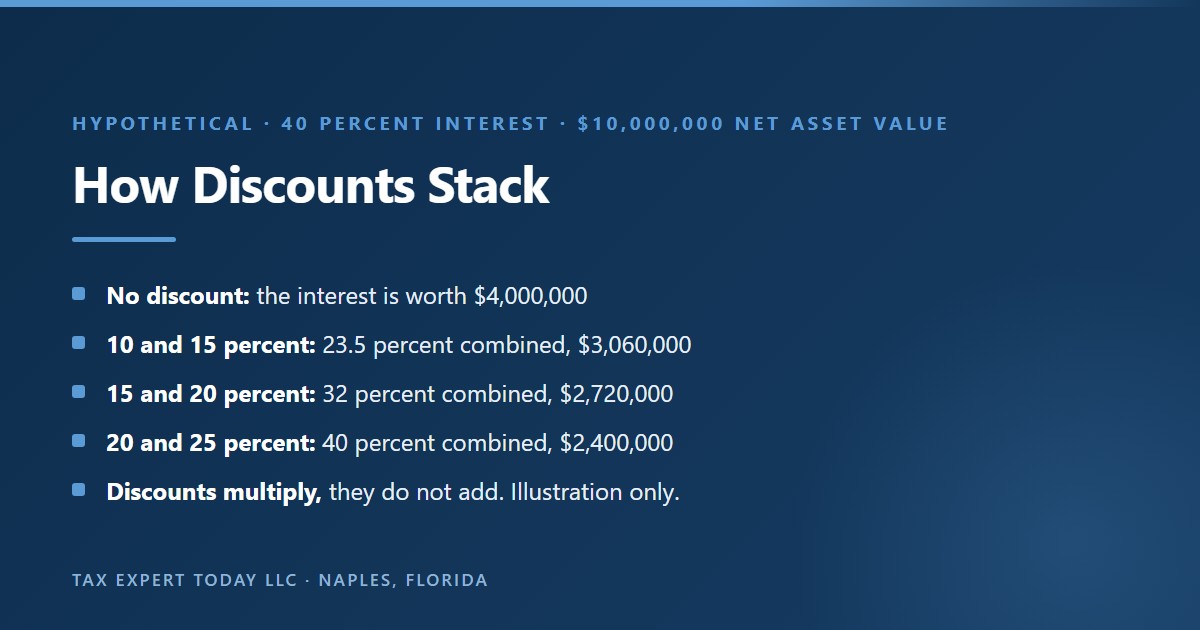
- Combined effect: discounts multiply rather than add, so two 20 percent discounts produce 36 percent, not 40.
The legal standard is the willing buyer and willing seller test in Treasury Regulation section 25.2512-1 for gifts and section 20.2031-1 for estates. Under that test the buyer and seller are hypothetical, not the actual family members, and each is assumed to have reasonable knowledge of the relevant facts. The IRS accepted in Revenue Ruling 93-12 that family relationships alone do not require the interests held by different family members to be valued together, so a minority interest given to each child can generally be valued as a minority interest.
Discounts are applied in sequence. If the limited interest is first discounted for lack of control and the result is then discounted for lack of marketability, the combined discount is one minus the product of the two remaining fractions. The table below shows the arithmetic for a hypothetical 40 percent limited interest in a partnership with a net asset value of $10,000,000. The discount levels are illustrations of the arithmetic, not a forecast of what any appraiser would conclude for any partnership.
| Lack of control discount | Lack of marketability discount | Combined discount | Value of the 40 percent interest |
|---|---|---|---|
| None | None | 0.0 percent | $4,000,000 |
| 10 percent | 15 percent | 23.5 percent | $3,060,000 |
| 15 percent | 20 percent | 32.0 percent | $2,720,000 |
| 20 percent | 25 percent | 40.0 percent | $2,400,000 |
In this hypothetical, a 32 percent combined discount moves $4,000,000 of underlying value for a reported gift of $2,720,000. At the 40 percent estate tax rate, the $1,280,000 gap represents up to $512,000 of transfer tax that would not be owed on that transfer if the value holds up and the interest stays out of the estate. Those two conditions are what the rest of this guide is about.
What discount levels are typical, and who decides them?
No rule sets a discount for family limited partnership interests. A qualified appraiser determines value from the partnership agreement, the asset mix, comparable market data, and the facts on the valuation date. Discounts are generally smaller for partnerships holding cash and marketable securities and larger for those holding real estate or operating businesses.
- Asset mix matters: a portfolio of listed stocks is easier to value and sell than a rental property.
- Agreement terms matter: distribution policy, transfer limits, and withdrawal rights drive marketability.
- Size of the interest matters: a 49 percent block may be valued differently from a 5 percent block.
- The IRS reviews the appraisal: an aggressive conclusion invites examination and a valuation penalty risk.
Lack of control discounts are often supported with data from publicly traded closed-end funds or real estate investment trusts that trade below their net asset value. Lack of marketability discounts are often supported with restricted stock and pre-initial public offering studies. Each of those data sets has known limits, and IRS appraisers and courts have rejected discounts that relied on studies without explaining why the comparison fits the partnership in question. The quality of the reasoning in the appraisal often matters as much as the number.
Valuation penalties are a practical limit on how far an appraisal can go. Under IRC section 6662(g) and (h), a gift or estate tax valuation that is 65 percent or less of the correct value can draw a substantial understatement penalty, and one that is 40 percent or less can draw a gross valuation misstatement penalty. A reasonable cause defense generally requires reliance on a qualified appraisal that the taxpayer had good reason to trust.
| Factor | Tends to support a larger discount | Tends to support a smaller discount |
|---|---|---|
| Assets held | Real estate, private business interests, raw land | Cash, Treasury securities, listed stock |
| Distribution history | No required distributions, irregular history | Regular distributions of most income |
| Transfer restrictions | Consent required, rights of first refusal | Free transferability within the family |
| Term of the partnership | Long fixed term, no withdrawal right | Partner may withdraw and receive value |
| Size of interest | Small fractional interest | Interest large enough to block or force decisions |
How does the 2026 estate and gift tax law affect a family limited partnership?
For 2026 the basic exclusion amount is $15,000,000 per person under IRC section 2010(c)(3), as amended by Public Law 119-21, and it is indexed after 2026. The annual gift exclusion is $19,000 per donee under Revenue Procedure 2025-32. Transfers above the exclusion are taxed at a maximum rate of 40 percent.
- Basic exclusion amount, 2026: $15,000,000 per person, $30,000,000 for a married couple using portability or two estates.
- Annual exclusion, 2026: $19,000 per donee, $38,000 with gift splitting between spouses.
- Annual exclusion to a noncitizen spouse, 2026: $194,000.
- Rate above the exclusion: 40 percent under IRC section 2001(c).
The 2025 law, signed on July 4, 2025, replaced the scheduled 2026 drop in the exclusion with a permanent $15,000,000 base amount. The statutory text of IRC section 2010(c)(3) now reads $15,000,000, with inflation adjustments for decedents dying after 2026, and the IRS estate and gift tax update page lists the 2026 amount as $15,000,000. The 2026 annual exclusion and the noncitizen spouse amount appear in section 4.42 of Revenue Procedure 2025-32.
For a family limited partnership, the larger exclusion changes the question rather than ending it. Families whose combined estates are comfortably under $30,000,000 may no longer need discounts to avoid estate tax, and for them the income tax cost of losing the basis step-up on gifted interests can outweigh any transfer tax benefit. Families above that level, or whose assets are expected to grow past it, still face a 40 percent tax on the excess, and for them the discount and the shift of future growth remain meaningful. Our guide to the lifetime gift tax exemption in 2026 covers how lifetime gifts use the same exclusion.
| Item | 2025 | 2026 | Source |
|---|---|---|---|
| Basic exclusion amount per person | $13,990,000 | $15,000,000 | IRC 2010(c)(3); IRS update page |
| Annual exclusion per donee | $19,000 | $19,000 | Rev. Proc. 2025-32, sec. 4.42 |
| Annual exclusion, noncitizen spouse | $190,000 | $194,000 | Rev. Proc. 2025-32, sec. 4.42 |
| Maximum transfer tax rate | 40 percent | 40 percent | IRC 2001(c) |
| Section 6166 two percent portion | See Rev. Proc. 2024-40 | $1,940,000 | Rev. Proc. 2025-32, sec. 4.51 |
Does a family limited partnership still make sense with a $15 million exclusion?
It depends on the size of the estate, expected growth, and how likely the heirs are to sell the assets. Below roughly the available exclusion, the main benefits are management and protection, and gifting interests can cost the heirs a basis step-up. Above it, discounts and the shift of growth can still reduce estate tax at 40 percent.
- Estates well below the exclusion: the tax case for discounted gifts is weak; holding assets until death may produce a better income tax result.
- Estates near the exclusion: growth, not today’s value, decides whether tax will be owed.
- Estates above the exclusion: discounted gifts and growth shifting can still reduce tax materially.
- Every estate: management, family governance, and protection from creditors can justify the entity on their own.
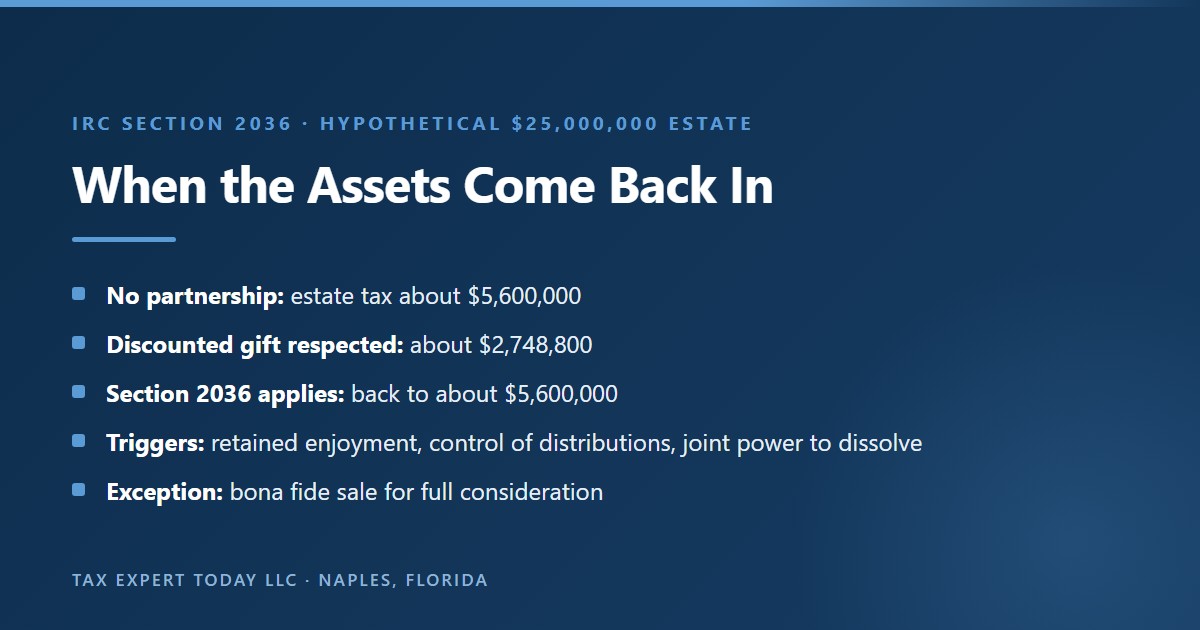
Consider a hypothetical single owner with $25,000,000 of assets, $10,000,000 of which could be placed in a family limited partnership. If nothing is done and the partnership assets grow to $14,000,000 by death, the taxable estate is $29,000,000 and the estate tax above the $15,000,000 exclusion is $5,600,000. If the owner gives away a 99 percent limited interest at a 32 percent combined discount, the reported gift is about $6,732,000, and if the plan holds, the estate tax falls to about $2,748,800. The difference, about $2,851,200, is the discount plus the growth that occurred outside the estate.
The same hypothetical looks different once income tax is counted. If the partnership’s assets had a basis of $3,000,000 and the children later sell them for $14,000,000, the gifted interests carry the parent’s basis, and the children’s share of the gain is about $10,890,000. At a combined 23.8 percent federal rate on long-term gain, that is about $2,591,820 of income tax that would have been avoided if the parent had held the assets until death and the partnership had a section 754 election in place. The net benefit of the plan in this illustration is only about $259,380, and it would be negative for a smaller estate. These are hypothetical figures, not a prediction for any family.
| Scenario | Estate tax base | Estate tax at 40 percent above $15,000,000 |
|---|---|---|
| No partnership, assets held until death | $29,000,000 | $5,600,000 |
| Gift of 99 percent interest at full value, no discount | $25,040,000 | $4,016,000 |
| Gift of 99 percent interest at 32 percent discount, plan respected | $21,872,000 | $2,748,800 |
| Same gift, but section 2036 includes the assets | $29,000,000 | $5,600,000 |
What is IRC section 2036 and why does it pull FLP assets back into the estate?
Section 2036 includes in a decedent’s gross estate any property the decedent transferred while keeping the right to its income or enjoyment, or the right to decide who enjoys it. When a parent contributes assets to a family limited partnership and keeps either kind of right, the full value of the assets can be taxed at death.
- Section 2036(a)(1): retained possession or enjoyment of, or the right to the income from, the transferred property.
- Section 2036(a)(2): a retained right, alone or with any person, to designate who enjoys the property or its income.
- The exception: a bona fide sale for adequate and full consideration in money or money’s worth.
- The result when it applies: inclusion at full date of death value, which erases both the discount and the growth shift.
The text of IRC section 2036(a) reaches any transfer, by trust or otherwise, under which the decedent kept, for life or for a period tied to death, either the enjoyment of the property or the right to designate who enjoys it. A contribution of assets to a partnership is a transfer for this purpose. If the partnership in practice continued to serve the parent, or the parent kept powers over distributions that amounted to a power to designate, the IRS argues that the assets themselves, not a discounted partnership interest, belong in the estate. The governing regulation is Treasury Regulation section 20.2036-1.
This is the central risk in family limited partnership planning, and it is the one most often omitted from short explanations. It does not depend on whether the appraisal was reasonable. A partnership can have a well supported discount and still fail, because section 2036 is not a valuation rule. It asks what the decedent kept, and if the answer is enough, it disregards the partnership’s effect on value altogether. In the Tax Court and the courts of appeals, section 2036 has been the deciding issue in a large share of litigated family limited partnership cases.
When section 2036 applies, the estate includes the proportionate share of partnership assets attributable to the decedent’s contribution, valued at the date of death. Gifts of interests that are swept back in are generally removed from adjusted taxable gifts under section 2001(b) to avoid counting them twice, but the exclusion used on those gifts is effectively returned only in that limited sense. The growth that happened after the gifts is taxed as well.
| Element | What the statute asks | How it shows up in an FLP |
|---|---|---|
| A transfer | Did the decedent transfer property? | Contribution of assets to the partnership |
| A retained interest under (a)(1) | Did the decedent keep enjoyment or income? | Use of partnership property, payments of personal expenses, distributions on demand |
| A retained right under (a)(2) | Could the decedent, alone or with others, decide who enjoys the property? | General partner discretion over distributions; joint power to dissolve |
| The exception | Was the transfer a bona fide sale for full consideration? | Legitimate nontax purpose and interests proportionate to contributions |
| The consequence | What is included? | Date of death value of contributed assets, without the discount |
What counts as retained enjoyment under section 2036(a)(1)?
Retained enjoyment exists when the parent continues to benefit from contributed assets in substance, by express arrangement or by an implied understanding. Courts have found it where the partnership paid the parent’s personal bills, where the parent kept living in a contributed home without fair rent, or where the parent kept too little outside the partnership to live on.
- Use of property: living in a contributed residence or using contributed property without paying fair rent.
- Personal expenses: partnership checks for the parent’s living costs, medical bills, or taxes.
- Insufficient outside assets: contributing nearly everything, leaving the parent dependent on the partnership.
- Disproportionate distributions: money flowing to the parent rather than pro rata to all partners.
- Commingling: partnership and personal funds running through the same accounts.
The implied agreement standard is what makes this rule difficult. A partnership agreement can say all the right things, but if the family’s conduct shows an understanding that the parent could draw on the assets as needed, courts have found retained enjoyment. In Estate of Strangi, the Tax Court applied section 2036 where nearly all of the decedent’s assets had been placed in the partnership and partnership funds later paid expenses for the decedent and the estate; the Fifth Circuit affirmed on the section 2036(a)(1) ground, 417 F.3d 468 (5th Cir. 2005). In Estate of Bigelow, 503 F.3d 955 (9th Cir. 2007), the court found an implied agreement where the partnership continued to service the decedent’s obligations after a contributed property was transferred.
The practical defenses follow directly from the cases. The parent should keep enough assets outside the partnership to live on for the rest of life, including foreseeable medical costs. Distributions, if any, should be pro rata to all partners according to their interests. Any use of partnership property by a partner should be documented with a lease at fair rent that is actually paid. And partnership money should never pay a partner’s personal expenses, including estate taxes after death, unless the payment is a documented pro rata distribution or a properly structured loan.
| Fact pattern | Generally weakens the IRS position | Generally strengthens the IRS position |
|---|---|---|
| Assets kept outside the partnership | Enough to cover living costs for life | Very little or nothing left outside |
| Residence | Kept outside, or leased at documented fair rent that is paid | Contributed and occupied without rent |
| Distributions | Pro rata under the agreement | Ad hoc payments to the parent only |
| Bank accounts | Separate partnership accounts | Personal and partnership funds mixed |
| Estate taxes after death | Paid from estate assets or a documented arm’s length loan | Paid directly by the partnership |
How can section 2036(a)(2) apply to a general partner?
Section 2036(a)(2) can apply when the parent, as general partner or with other partners, keeps the power to decide when distributions are made or to dissolve the partnership. The Tax Court held in Estate of Powell, 148 T.C. 392 (2017), that a limited partner’s ability, acting with others, to dissolve the partnership was such a power.
- Distribution discretion: a general partner who decides distributions may be able to designate who enjoys income.
- Joint powers count: the statute applies to rights held alone or in conjunction with any person.
- Powers through an entity: controlling the entity that is general partner can be treated like holding the power directly.
- Fiduciary limits: the extent to which state law fiduciary duties constrain the power is a contested question.
The (a)(2) theory is the reason many advisors no longer treat the general partner seat as a safe place for the senior generation. In Strangi, the Tax Court relied on (a)(2) as an alternative ground because the decedent, through his attorney in fact and a corporate general partner, could act with others to control distributions and dissolution. In Powell, the decedent held only a limited interest, but the partnership agreement allowed dissolution with the consent of all partners, and the court treated her ability to join in that decision as a retained right. The opinion also addressed how section 2036 interacts with section 2043 when partial consideration was received.
Responses to the (a)(2) risk include naming an independent general partner, placing distribution decisions with a person who has no power over the parent’s interest, using an ascertainable standard for distributions, and limiting the parent’s role to management of investments rather than distributions. Each of these has costs, and none removes the risk entirely while the parent holds any interest. A parent who gives up all control also gives up much of the reason a family uses the structure in the first place, which is why the (a)(2) analysis is a judgment about tradeoffs rather than a checklist.
| Arrangement | Who decides distributions | Section 2036(a)(2) exposure |
|---|---|---|
| Parent is sole general partner with full discretion | Parent | Higher; discretion is the classic retained right |
| Parent controls an LLC that is general partner | Parent through the LLC | Similar to the parent acting directly |
| Parent and child are co-general partners acting jointly | Both together | Still present; joint powers count |
| Independent general partner, parent is limited partner only | Independent person | Lower, but a joint power to dissolve may still count, as in Powell |
| Mandatory distribution formula in the agreement | The formula | Lower if there is no discretion left to exercise |
What is the bona fide sale exception?
Section 2036 does not apply to a bona fide sale for adequate and full consideration. In Estate of Bongard, 124 T.C. 95 (2005), the Tax Court read this to require a legitimate and significant nontax reason for the partnership and partnership interests proportionate to the value of the assets each partner contributed, with contributions properly credited to capital accounts.
- Bona fide: a legitimate and significant nontax reason, actually served, not a theoretical one.
- Adequate and full consideration: each partner receives interests proportionate to what was contributed.
- Capital accounts: contributions credited correctly and maintained.
- Formalities: assets actually transferred and the partnership actually operated as a partnership.
If the exception applies, section 2036 does not reach the contribution at all, and the analysis moves on to valuation of whatever interests the parent still holds at death. That is why the exception is often the most important single issue in a family limited partnership examination. A partnership that clearly meets it is protected from the inclusion theory even if the parent kept significant control, because the statute excludes bona fide sales from its reach entirely. A partnership that fails it must then survive the retained enjoyment and retained rights tests on their own.
The Tax Court has looked at whether the nontax reason was legitimate and significant in light of the actual facts, not only at whether a reason was written into the agreement. In Bongard, the court accepted that a holding company was formed to position an operating business for a possible sale or public offering, but rejected the exception for a second, later partnership that held only interests in the first and served no comparable purpose. The court has accepted the exception in other cases, including Estate of Kelly, T.C. Memo 2012-73, and Estate of Purdue, T.C. Memo 2015-249, where management and operational reasons were supported by how the entities were actually run.
| Requirement | Evidence that tends to help | Evidence that tends to hurt |
|---|---|---|
| Legitimate and significant nontax reason | Contemporaneous memos, active management, a real problem the entity solved | Reasons first stated after an audit, an inactive partnership |
| Formation as an arm’s length arrangement | Each partner represented, terms negotiated or reviewed | One person on every side of the transaction |
| Interests proportionate to contributions | Appraisals of contributed property, correct capital accounts | Interests that do not match what was contributed |
| Property actually transferred | Deeds recorded, accounts retitled promptly | Assets still in the parent’s name months later |
| Partnership respected after formation | Separate books, annual returns, partner meetings | Funds used freely by the parent |
What facts have courts weighed in family limited partnership cases?
Courts have weighed the timing of formation relative to death or illness, the share of the parent’s assets contributed, whether personal and partnership funds were mixed, whether distributions were pro rata, whether the stated nontax reason was real, and whether the family followed its own agreement. No single fact decides a case, but patterns recur.
- Deathbed formation: partnerships formed or funded shortly before death have often fared poorly.
- Everything contributed: leaving the parent dependent on the partnership supports an implied agreement.
- Paper versus practice: courts compare what the agreement says with what the family did.
- Taxpayer wins exist: partnerships with real operations and careful administration have been respected.
The table below summarizes several reported decisions often discussed in this area. It is a simplified summary for orientation, not a full statement of any holding, and each case turned on its own record. The cases are cited by their official citations; readers should consult the full opinions or an advisor before drawing conclusions for any particular partnership.
| Case | Main issue | General outcome |
|---|---|---|
| Estate of Strangi, 417 F.3d 468 (5th Cir. 2005) | Section 2036(a)(1), implied retained enjoyment | Assets included in the estate |
| Estate of Bongard, 124 T.C. 95 (2005) | Bona fide sale exception | Exception met for one entity, not for a second |
| Estate of Bigelow, 503 F.3d 955 (9th Cir. 2007) | Implied agreement, partnership servicing personal obligations | Assets included |
| Hackl v. Commissioner, 335 F.3d 664 (7th Cir. 2003) | Annual exclusion for gifts of entity interests | Gifts treated as future interests, no annual exclusion |
| Holman v. Commissioner, 601 F.3d 763 (8th Cir. 2010) | Section 2703 and transfer restrictions | Certain restrictions disregarded in valuing gifts |
| Estate of Kelly, T.C. Memo 2012-73 | Section 2036, management reasons | Section 2036 not applied |
| Estate of Purdue, T.C. Memo 2015-249 | Bona fide sale exception | Exception met |
| Estate of Powell, 148 T.C. 392 (2017) | Section 2036(a)(2) through a joint power to dissolve | Assets included |
Two patterns stand out. First, the losses tend to involve partnerships formed late in life, often by an agent under a power of attorney, with most of the parent’s assets and little change in how those assets were managed. Second, the wins tend to involve partnerships formed while the parent was healthy, with a business or management reason that the record supports, and with administration that looked like what unrelated partners would expect. Planning that aims to resemble the second pattern, and records that prove it, are the core of a defensible family limited partnership.
What happens to the numbers when section 2036 applies?
When section 2036 applies, the estate includes the full date of death value of the contributed assets, so the valuation discount and the growth shifted by earlier gifts are lost. Earlier gifts of included interests drop out of adjusted taxable gifts, but the family is generally left with roughly the tax it would have owed with no partnership at all.
- Discount lost: assets are included at value, not as discounted interests.
- Growth shift lost: appreciation after the gifts is taxed in the estate.
- Some relief: included gifts are removed from adjusted taxable gifts to avoid double counting.
- A possible silver lining: included assets may receive a basis adjustment at death.
Returning to the hypothetical owner with $25,000,000 of assets and a partnership that grew to $14,000,000, the table shows the estate tax in each case. When the plan is respected, estate tax is about $2,748,800. When section 2036 applies, the base returns to $29,000,000 and the tax to $5,600,000, the same figure as doing nothing. The family has paid for formation, appraisals, and years of administration and has nothing to show for it on the estate tax side.
| Item | Plan respected | Section 2036 applies |
|---|---|---|
| Other assets | $15,000,000 | $15,000,000 |
| Retained 1 percent general partner interest | $140,000 | Included with the assets |
| Partnership assets included | None | $14,000,000 |
| Adjusted taxable gifts | $6,732,000 | None, removed to avoid double counting |
| Tax base | $21,872,000 | $29,000,000 |
| Estate tax above $15,000,000 at 40 percent | $2,748,800 | $5,600,000 |
| Basis of partnership assets for heirs | Carryover for gifted share | Generally adjusted at death for the included share |
The last row is the one families tend to overlook. An estate that loses the section 2036 argument still pays estate tax at full value, but the included assets may receive a new basis under IRC section 1014, and for an estate below the exclusion, inclusion can actually be the better income tax result. That is one reason some families with estates well below $15,000,000 per person are now reviewing whether an existing partnership still serves its original purpose.
How does section 2704 limit liquidation restrictions and lapses?
Section 2704(a) treats the lapse of a voting or liquidation right as a transfer when the family controls the entity before and after the lapse. Section 2704(b) disregards certain restrictions on liquidating the entity when the transfer is to a family member and the family can remove the restriction, unless state or federal law imposes the restriction.
- Lapse rule: losing a right on death or on transfer can itself be a gift or an estate inclusion.
- Applicable restriction: a limit on liquidation that is more restrictive than state default law and that the family can remove.
- Exceptions: commercially reasonable restrictions in third party financing, and restrictions imposed by federal or state law.
- Family: spouse, ancestors and lineal descendants of the individual or spouse, siblings, and their spouses.
Under section 2704(b), an applicable restriction is one that effectively limits the ability of the partnership to liquidate, where either the restriction lapses after the transfer or the transferor and family members, alone or together, can remove it. Such a restriction is disregarded when valuing a transferred interest. The statute excludes any restriction imposed or required to be imposed by federal or state law, and the regulations under Treasury Regulation section 25.2704-1 and section 25.2704-2 compare the agreement with the default rules of state partnership law.
Because many state limited partnership statutes now default to restrictive withdrawal and dissolution rules, an agreement that simply mirrors the default is generally not an applicable restriction. Treasury proposed regulations in 2016 that would have broadened section 2704 and limited discounts for family entities, and withdrew them in 2017. The rules in effect today are the statute and the existing regulations, which leave significant room for discounts that are grounded in state law defaults. Any future guidance could change that, which is a reason to document why each restriction in the agreement exists.
| Provision | Likely treatment | Why |
|---|---|---|
| Limited partner may not withdraw before the end of the term | Often respected | Frequently matches state law defaults |
| Restriction stricter than state law that family can remove | May be disregarded | Can be an applicable restriction under 2704(b) |
| Restriction required by a third party lender | Generally respected | Commercially reasonable financing exception |
| General partner’s voting rights that end at death | Lapse may be a transfer | Section 2704(a), if family controls before and after |
| Preferred interest retained by parent in a recapitalization | Valued under section 2701 | Separate special valuation rules apply |
In a simple hypothetical, if a parent holds voting rights that would let the parent’s family liquidate the partnership and those rights lapse at death, the value of the lapsed rights, for example $400,000, may be treated as an additional transfer. Some partnership freezes that issue preferred interests to the parent bring in section 2701, which can value retained rights at zero. Those structures are specialized and are mentioned here only so that a family considering them knows a separate regime applies.
How does section 2703 treat buy-sell and transfer restrictions?
Section 2703 disregards options, agreements, and restrictions on the right to sell or use property when valuing it for transfer tax, unless the arrangement is a bona fide business arrangement, is not a device to transfer value to family for less than full consideration, and has terms comparable to similar arm’s length arrangements.
- Scope: rights of first refusal, buy-sell provisions, consent requirements, and similar limits.
- Three-part exception: bona fide business arrangement, not a device, and comparable to arm’s length terms.
- All three are required: meeting two of the three is not enough.
- Effect: a disregarded restriction cannot support a marketability discount.
The statute, IRC section 2703, was enacted in 1990 to stop families from depressing value with restrictions that unrelated parties would never accept. In Holman v. Commissioner, 601 F.3d 763 (8th Cir. 2010), the court upheld the Tax Court’s decision to disregard transfer restrictions in a partnership that held mostly one company’s stock, finding the restrictions were not a bona fide business arrangement for that partnership. The case is often cited for the point that holding a passive portfolio makes it harder to show a business reason for restrictions on that portfolio.
Section 2703 interacts with section 2704 and with the appraisal itself. If a restriction survives both, the appraiser can rely on it. If either statute disregards it, the appraiser must value the interest as though the restriction did not exist, which usually means a smaller marketability discount. An agreement drafted with restrictions that serve the family’s actual purpose, such as keeping a farm or a family company in the family, is generally on firmer ground than restrictions added only to support a discount.
| Test | Question asked | Evidence that tends to help |
|---|---|---|
| Bona fide business arrangement | Does the restriction serve a real business purpose? | An operating business or a managed real estate portfolio with a reason to limit owners |
| Not a device | Is it a way to pass value to family for less than full consideration? | Terms that also bind and benefit the senior generation |
| Comparable terms | Would unrelated parties agree to the same terms? | Evidence of similar provisions in arm’s length agreements |
Can gifts of FLP interests qualify for the annual exclusion?
Only gifts of present interests qualify for the $19,000 annual exclusion. Courts have held that gifts of entity interests can be future interests when the donee cannot transfer the interest, cannot withdraw capital, and has no assured right to income. Hackl v. Commissioner and Price v. Commissioner denied the exclusion on that ground.
- Present interest test: an unrestricted right to the immediate use, possession, or enjoyment of the property or its income.
- Common problem: the general partner controls distributions and transfers need consent.
- Possible responses: limited withdrawal rights, required income distributions, or gifts to a trust with withdrawal powers.
- Filing: any gift of a future interest requires a Form 709, even if small.
IRC section 2503(b) excludes the first $10,000 of gifts per donee per year, as indexed, but only for gifts other than gifts of future interests. In Hackl v. Commissioner, 335 F.3d 664 (7th Cir. 2003), the court held that gifts of LLC units were future interests because the operating agreement barred transfers without the manager’s consent and gave the manager control over distributions, so the donees received no substantial present economic benefit. The Tax Court reached a similar result for gifts of limited partnership interests in Price v. Commissioner, T.C. Memo 2010-2.
The IRS Form 709 instructions confirm that a gift of a future interest is not eligible for the annual exclusion and must be reported even if its value is under $19,000. The table below shows the scale of annual exclusion gifting in a hypothetical family where a married couple gives interests to three children and five grandchildren and elects gift splitting. If each gift qualifies, the couple can move $304,000 of appraised value a year without using any basic exclusion; at a 32 percent combined discount, that represents about $447,059 of underlying asset value a year, or about $4,470,588 over ten years before growth.
| Item | Amount |
|---|---|
| Donees (three children, five grandchildren) | 8 |
| Annual exclusion per donee per spouse | $19,000 |
| Appraised value of interests given per year | $304,000 |
| Underlying value moved per year at a 32 percent combined discount | About $447,059 |
| Underlying value moved over ten years, before growth | About $4,470,588 |
| Result if the gifts are future interests | No annual exclusion; the value uses basic exclusion instead |
Where the agreement does not give donees a present interest, the gifts are not wasted; they simply use part of the donor’s $15,000,000 basic exclusion instead. For families who will not approach the exclusion, that difference may not matter. For families who will, and especially for gifts to grandchildren that also implicate the generation-skipping transfer tax discussed in our dynasty trust guide, the present interest question is worth settling before the first gift. Gifts to trusts with withdrawal rights are discussed in our guide to the irrevocable life insurance trust, which works through the same present interest rules.
How do you report a gift of a family limited partnership interest on Form 709?
A gift of a family limited partnership interest is reported on Form 709 for the year of the gift, generally due April 15 of the following year. The return lists each donee, describes the interest, states its value, answers yes to the valuation discount question on Schedule A, and attaches the appraisal and partnership documents needed for adequate disclosure.
- Who files: each donor files separately; spouses may not file a joint gift tax return.
- Gift splitting: each spouse files, and each consents to the split under section 2513.
- Schedule A, line A: asks whether any reported value includes a discount for lack of marketability, minority interest, or similar reasons.
- Attachments: the appraisal, the partnership agreement, and financial data on the partnership.
The Form 709 instructions state that if the value of any gift includes a discount for lack of marketability, a minority interest, a fractional interest, blockage, or any other reason, the donor answers yes to the Schedule A question and attaches an explanation of the basis for the discount. The same instructions note that spouses may not file a joint return and that each individual is responsible for filing. The About Form 709 page carries the current form and any updates.
A family limited partnership gift program usually produces a return every year that gifts are made, and each return draws down the same exclusion described in our guide to the lifetime gift tax exemption for 2026. Each return should be consistent with the capital accounts on the partnership’s books and with the Schedules K-1 for the year. Inconsistencies between the gift tax return and the partnership’s own records are a common reason an examination grows beyond the valuation question. A short reconciliation of each donee’s percentage interest before and after the gifts, attached to the return, is an inexpensive way to prevent that.
| Item | Where it goes | Why it matters |
|---|---|---|
| Description of the interest given, and any consideration received | Schedule A and an attached statement | Required element of adequate disclosure |
| Identity of each donee and relationship to donor | Schedule A | Required element of adequate disclosure |
| Valuation discount answer | Schedule A, line A | Flags the discount and requires an explanation |
| Qualified appraisal or detailed valuation method | Attachment | Required element of adequate disclosure |
| Partnership agreement and financial statements | Attachment | Supports the restrictions and the net asset value used |
| Gift splitting consent, if elected | Part 1 of each spouse’s return | Allows each spouse’s annual exclusion and basic exclusion to be used |
What is adequate disclosure and why does it start the statute of limitations?
Under IRC section 6501(c)(9), gift tax on a gift that is not adequately disclosed can be assessed at any time. If the Form 709 meets the disclosure standard in Treasury Regulation section 301.6501(c)-1(f), the normal three-year period applies, after which the IRS generally cannot revalue the gift, even for later estate tax purposes.
- Without adequate disclosure: the period to assess gift tax on that gift never begins.
- With adequate disclosure: generally three years from filing.
- Why estates care: a gift value that is final also fixes the adjusted taxable gift used at death.
- Common failure: a return that reports a discounted value without the method and data behind it.
The statute, section 6501(c)(9), says that if a gift required to be shown on a gift tax return is not shown, the tax on it may be assessed at any time, but that rule does not apply to any item disclosed in the return or an attached statement in a manner adequate to apprise the Secretary of the nature of the item. The regulation, section 301.6501(c)-1(f)(2), lists what that means for a transfer reported as a gift: a description of the property and any consideration, the identity and relationship of donor and donee, trust details if the gift is to a trust, a detailed description of the valuation method including financial data, restrictions considered and discounts claimed, and a statement of any position contrary to proposed regulations or revenue rulings.
For a gift of a partnership interest, the regulation also expects information about the entity, including its financial data, unless a qualified appraisal is submitted instead. A hypothetical gift made in 2026 and reported on a return filed April 15, 2027 would generally be closed to revaluation on April 15, 2030 if adequately disclosed. If the return omits the method and data, the same gift could be revalued decades later, often at the death of the donor, when the people who understood the original facts are no longer available.
| Situation | Return filed | Period to assess gift tax |
|---|---|---|
| Adequately disclosed under Reg. 301.6501(c)-1(f) | April 15, 2027 | Generally closes April 15, 2030 |
| Return filed but discount method and data omitted | April 15, 2027 | May remain open indefinitely for that gift |
| No return filed | None | Open indefinitely |
| Substantial omission of gifts | April 15, 2027 | Longer period may apply |
What does a qualified appraisal of an FLP interest include?
For adequate disclosure purposes, a qualified appraisal is prepared by a person who regularly performs appraisals, is qualified for that type of property, and is not the donor, donee, or a related person. It states the valuation date, describes the property and the method used, and explains the data and reasoning behind each discount.
- Appraiser: holds out to the public as an appraiser or appraises regularly, and is independent of the family.
- Two layers: the underlying assets are valued first, then the partnership interest.
- Agreement analysis: each relevant provision is tied to its effect on control and marketability.
- Market evidence: data sets explained and fitted to the specific partnership.
Treasury Regulation section 301.6501(c)-1(f)(3) allows a donor to satisfy the detailed valuation method requirement by submitting an appraisal that meets its standards. Those standards include an appraiser who holds out to the public as an appraiser or performs appraisals regularly, who is qualified to appraise the type of property involved, and who is not the donor or donee or a family member of either, and an appraisal that contains the date of transfer, the valuation date, the purpose, a description of the property, the method used, and the specific basis for the valuation. For a partnership holding real estate, a separate real estate appraisal of each property is usually part of the work.
The appraisal is also the first document an examiner reads. One that quotes discount studies without connecting them to the partnership agreement, the asset mix, and the distribution history is easier to challenge than one that explains, provision by provision, why a hypothetical buyer would pay less. Using the same appraiser year after year can help consistency, but each year’s valuation must still reflect that year’s facts and net asset value.
| Layer | What is valued | Typical sources |
|---|---|---|
| Underlying assets | Each property, security, or business held by the partnership | Market quotes, real estate appraisals, business valuations |
| Net asset value | Total assets less liabilities | Partnership balance sheet as of the valuation date |
| Lack of control | Effect of having no say over distributions and management | Closed-end fund and real estate fund trading data |
| Lack of marketability | Effect of no public market and transfer limits | Restricted stock and private transaction studies |
| Conclusion | Value of the specific interest given | Reasoned reconciliation of the above |
What is the income tax cost of giving away FLP interests?
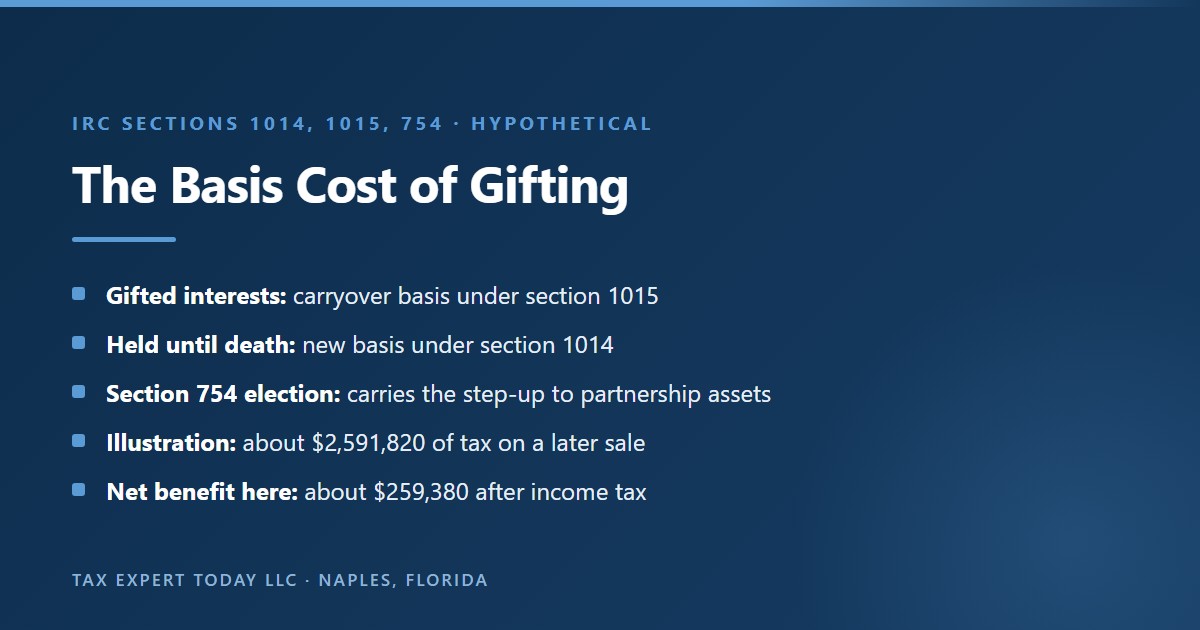
A donee generally takes the donor’s basis in a gifted partnership interest under IRC section 1015. Property held until death generally receives a basis equal to date of death value under section 1014. Gifting interests therefore trades possible estate tax savings for a possible later capital gains tax when appreciated assets are sold.
- Gifted interest: carryover basis, so built-in gain stays with the donee.
- Interest held until death: outside basis generally adjusted to date of death value.
- Inside basis: a section 754 election lets the partnership adjust its asset basis for the heir’s share.
- Tradeoff: 40 percent estate tax saved against up to 23.8 percent federal income tax later.
Under section 1015(a), property acquired by gift generally takes the same basis it had in the hands of the donor. Under section 1014(a), property acquired from a decedent generally takes a basis equal to its fair market value at the date of death. For a partnership interest, those rules apply to the partner’s outside basis, and the partnership’s basis in its own assets, the inside basis, changes only if the partnership has a section 754 election in effect or a substantial built-in loss.
The basis cost is often the deciding factor for estates below the exclusion. In the hypothetical used earlier, the partnership’s assets had a $3,000,000 basis and grew to $14,000,000. If the children received their 99 percent interest by gift and the partnership later sold the assets, their share of the gain is about $10,890,000, and at a 23.8 percent federal rate the income tax is about $2,591,820. Had the parent kept the interest until death, with a section 754 election, that gain would largely have been erased. The table compares the two paths for the same family.
| Item | Interests gifted during life | Interests held until death |
|---|---|---|
| Estate tax | About $2,748,800 | $5,600,000 |
| Heirs’ basis in partnership assets | About $3,000,000 carryover share | About $14,000,000 with a section 754 election |
| Gain on a later sale at $14,000,000 | About $10,890,000 | Near zero |
| Federal income tax at 23.8 percent | About $2,591,820 | Near zero |
| Combined estate and income tax | About $5,340,620 | About $5,600,000 |
In this illustration the lifetime gift program still comes out ahead, but only by about $259,380, and the result reverses if the estate is smaller, the assets grow less, or the heirs sell sooner. If the heirs never sell, and hold the assets until their own deaths, the carryover basis matters much less. That is why the decision about whether to gift or hold interests usually depends on what the heirs are likely to do with the assets, not only on the size of the estate.
How does a section 754 election change the basis picture at death?
When a partner dies, the heir’s outside basis generally steps up under section 1014, but the partnership’s inside basis in its assets does not change unless a section 754 election is in effect or required. With the election, section 743(b) adjusts inside basis for the heir’s share, so later sales of partnership assets reflect the stepped-up value.
- Outside basis: the heir’s basis in the partnership interest itself, set at date of death value.
- Inside basis: the partnership’s basis in each asset, unchanged without an election.
- The election: made by the partnership with its return for the year of the transfer.
- Mandatory adjustments: required when the partnership has a substantial built-in loss.
Under section 754, a partnership may elect to adjust the basis of its property on a transfer of an interest, and under section 743(b), the adjustment on a transfer at death is the difference between the transferee’s outside basis and the transferee’s share of inside basis. Without the election, a partnership that sells appreciated property after a partner’s death allocates gain to the heir based on the old inside basis, even though the heir’s outside basis was stepped up. The heir eventually recovers that basis on liquidation, but often many years later.
The interaction between discounts and basis is worth noting. If the decedent’s interest is valued at a discount for estate tax, the heir’s outside basis under section 1014 is the discounted value, and the section 743(b) adjustment is measured from that discounted figure. The same discount that reduces estate tax therefore reduces the basis step-up. For an estate that owes no tax, a lower value can cost income tax without saving any estate tax, which is one reason some families with existing partnerships are reconsidering their structure under the 2026 exclusion.
| Item | No section 754 election | Section 754 election in effect |
|---|---|---|
| Heir’s outside basis | Date of death value of the interest | Date of death value of the interest |
| Partnership’s inside basis for heir’s share | Unchanged, carryover from before death | Adjusted under section 743(b) |
| Gain allocated to heir on a later asset sale | Based on old inside basis | Based on adjusted inside basis |
| Ongoing administration | Simpler | Requires tracking the adjustment for that partner |
| Effect of an estate tax discount | Lowers outside basis | Lowers outside basis and the 743(b) adjustment |
How is family limited partnership income taxed and allocated?
A family limited partnership generally pays no federal income tax itself. It files Form 1065, generally by the 15th day of the third month after year end, and issues a Schedule K-1 to each partner, who reports a share of income whether or not cash is distributed. Allocations must follow the agreement and the partnership rules.
- Return: Form 1065 with Schedules K-1, March 15 for a calendar year partnership.
- Pass-through: each partner reports a share of income, gain, loss, and deduction.
- Phantom income: partners owe tax on allocated income even if no distribution is made.
- Tax distributions: many agreements provide distributions to cover partners’ tax on allocated income.
The Form 1065 instructions set out the partnership filing requirements, and the About Form 1065 page carries the current form. A family limited partnership that holds a securities portfolio will report dividends, interest, and capital gains; one that holds rental real estate will report rental income and depreciation, which are generally passive to the partners unless a partner qualifies under the rules covered in our guide to real estate professional status. The partners’ shares flow to their own returns, and grandchildren who hold interests may be subject to the kiddie tax on unearned income.
Distribution policy carries both tax and estate tax consequences. If the agreement allows the general partner to withhold all distributions, younger partners may owe tax on income they never receive, which creates family friction and can push the general partner to make ad hoc distributions. Ad hoc distributions, especially to the parent, are exactly what courts have looked at under section 2036(a)(1). A written policy that provides pro rata tax distributions to every partner tends to address both problems.
| Filing | Who files | General due date for a calendar year |
|---|---|---|
| Form 1065, U.S. Return of Partnership Income | The partnership | March 15 |
| Schedule K-1 to each partner | The partnership | With Form 1065 |
| Partner’s individual or trust return | Each partner | April 15 for individuals and most trusts |
| Form 709 for any gifts of interests | Each donor | April 15 of the following year |
| Section 754 election, if made | The partnership | With a timely filed Form 1065 for the year of the transfer |
What does section 704(e) require for gifted partnership interests?
Section 704(e) requires that when a partnership interest is created by gift, the donee’s share of income is respected only to the extent the donor receives reasonable compensation for services to the partnership and the donee’s share of income from donated capital is not proportionately greater than the donor’s share from the donor’s capital.
- Reasonable compensation first: the donor partner must be paid fairly for services before income is shared by capital.
- Proportionate shares: income from donated capital cannot exceed, proportionately, income from the donor’s capital.
- Purchases count: an interest bought from a family member is treated as created by gift.
- Family: spouse, ancestors, lineal descendants, and trusts primarily for them.
The rule in section 704(e)(1) prevents a parent from shifting income to lower bracket children simply by giving them partnership interests while continuing to do the work. It reflects the same idea that drives S corp reasonable compensation: pay for services first, then share the return on capital. Under section 704(e)(2), an interest purchased by one family member from another is treated as created by gift, and the fair market value of the purchased interest is treated as donated capital. The regulations under Treasury Regulation section 1.704-1(e) address when a donee is treated as the real owner of a capital interest.
For a family limited partnership with a parent who manages actively, the practical step is to pay the general partner a reasonable management fee before income is allocated by capital. In the hypothetical below, the partnership earns $600,000, the parent’s services are worth $60,000, and the parent holds 30 percent of capital. The parent receives $60,000 as compensation plus $162,000 as a 30 percent share of the remaining $540,000, for $222,000; the other partners share $378,000. Allocating the whole $600,000 by capital would give the parent only $180,000 and shift $42,000 of income earned by the parent’s services to the other partners, which section 704(e) does not allow.
| Allocation method | Parent | Donee partners |
|---|---|---|
| Reasonable compensation, then by capital (consistent with 704(e)) | $222,000 | $378,000 |
| All income by capital, no compensation (inconsistent with 704(e)) | $180,000 | $420,000 |
| Difference reallocated under 704(e) | $42,000 more to parent | $42,000 less to donees |
Can contributing assets to an FLP trigger income tax?
Contributions to a partnership are generally tax free under IRC section 721(a). Section 721(b) is the main exception: gain can be recognized when the partnership would be an investment company if incorporated and the contributions result in diversification of the partners’ interests, as when several partners contribute different appreciated securities.
- General rule: no gain or loss on contribution of property for a partnership interest.
- Investment company exception: more than 80 percent of assets in stocks, securities, and similar holdings.
- Diversification: the trigger is a partner exchanging a concentrated holding for an interest in a diversified pool.
- Common safe pattern: one contributor, or contributors of identical or already diversified portfolios.
IRC section 721(b) provides that the nonrecognition rule does not apply to gain realized on a transfer to a partnership that would be treated as an investment company under section 351 if it were incorporated. The investment company definition and the diversification test come from the section 351 regulations. A family limited partnership funded by one parent with a single portfolio generally does not diversify anyone, while a partnership funded by three siblings who each contribute a different concentrated stock position may.
In a hypothetical where three branches of a family each contribute $5,000,000 of a different stock with a $1,000,000 basis, and the pooling is treated as diversification, each branch could recognize about $4,000,000 of gain, roughly $952,000 of federal tax at 23.8 percent. That result is avoidable with planning, for example by contributing portfolios that are already diversified or by having one person fund the partnership, but it is the kind of issue that is far cheaper to address before funding than after.
| Funding pattern | Investment company? | Diversification? | Likely result |
|---|---|---|---|
| One parent contributes a diversified portfolio | Possibly | Generally no | Generally tax free under 721(a) |
| Parents contribute rental real estate | Generally no | Not relevant | Generally tax free under 721(a) |
| Several relatives contribute different concentrated stocks | Likely | Likely | Gain may be recognized under 721(b) |
| Several relatives contribute identical diversified portfolios | Likely | Generally no | Generally tax free under 721(a) |
What are the 704(c) and seven-year rules for contributed property?
When appreciated property is contributed, section 704(c) requires the built-in gain to be allocated back to the contributing partner when the property is sold. If the partnership distributes that property to another partner within seven years, section 704(c)(1)(B) can trigger the gain to the contributor, and section 737 can apply when other property goes to the contributor.
- Built-in gain stays with the contributor: tracked asset by asset.
- Seven-year window: distributions of contributed property to another partner can accelerate gain.
- Section 737: distributions of other property to a contributing partner can trigger gain.
- Records: contribution date, fair market value, and basis for every asset.
The rules in section 704(c) matter for family limited partnerships because families often want to distribute specific properties to specific children later, for example a rental property to the child who manages it. If that property was contributed by a parent and is distributed within seven years, the parent can recognize the built-in gain as though the property had been sold. A distribution plan that waits seven years, or distributes property to the partner who contributed it, generally avoids the issue.
Section 704(c) also matters on gifts. A donee of a limited interest steps into the donor’s position for the portion of built-in gain attributable to the gifted interest, so a later sale of contributed property allocates that gain to the donee. Combined with the carryover basis rule, this means a child who receives an interest in a partnership holding low basis assets is receiving a future tax bill along with the asset, which should be explained to the child at the time of the gift.
| Event | Within seven years of contribution | After seven years |
|---|---|---|
| Partnership sells contributed property | Built-in gain allocated to contributor | Built-in gain still allocated to contributor |
| Contributed property distributed to another partner | Contributor may recognize built-in gain | Generally no acceleration under 704(c)(1)(B) |
| Other property distributed to the contributor | Section 737 may apply | Generally no section 737 gain |
| Contributed property distributed back to contributor | Generally no gain | Generally no gain |
Which partnership audit rules apply to a family limited partnership?
Partnerships are examined under the centralized audit regime that began in 2018, in which adjustments are generally assessed at the partnership level and a designated partnership representative acts for all partners. A partnership with 100 or fewer eligible partners may elect out each year, but trusts are not among the eligible partner types.
- Default: the centralized regime applies to every partnership unless it elects out.
- Partnership representative: designated on each return with authority to bind the partnership.
- Election out: 100 or fewer K-1s, and every partner an individual, C corporation, S corporation, eligible foreign entity, or estate of a deceased partner.
- Trust partners: a trust partner is not a listed eligible partner, so the election out is generally unavailable.
The election out is described in IRC section 6221(b). Its list of eligible partners covers individuals, C corporations, foreign entities that would be C corporations, S corporations, and estates of deceased partners. Trusts do not appear on that list, and many family limited partnerships hold gifted interests in trusts. Those partnerships therefore generally remain under the centralized regime, and the choice of partnership representative, and what the agreement says about that person’s duties, becomes a governance decision for the family.
This is primarily an income tax issue rather than a gift or estate tax issue, but the two often meet. An examination of a partnership’s income tax return can surface facts, such as personal expenses paid by the partnership, that later support a section 2036 argument at death. Treating the income tax return as part of the estate plan, not a separate compliance task, keeps the record consistent.
| Partner type | Eligible for the election out? |
|---|---|
| Individual | Yes |
| C corporation or eligible foreign entity | Yes |
| S corporation | Yes, with its shareholders counted |
| Estate of a deceased partner | Yes |
| Trust, including a grantor trust | Not listed; election generally unavailable |
| Another partnership or LLC taxed as a partnership | Not listed; election generally unavailable |
How does a family limited partnership work with trusts like a dynasty trust or SLAT?
Limited partnership interests are often given or sold to trusts rather than to children outright. A dynasty trust can hold interests for several generations, a spousal lifetime access trust can hold them for a spouse, and a grantor retained annuity trust can receive interests at a discount. Each combination adds its own gift, generation-skipping, and income tax rules.
- Dynasty trust: holds interests across generations, often with generation-skipping transfer exemption allocated.
- Spousal lifetime access trust: keeps indirect access through a spouse, with its own retained interest questions.
- Grantor retained annuity trust: discounted interests can make the annuity easier to beat.
- Sale to a grantor trust: interests sold for a note, often at a discount, with no income tax on the sale.
Trusts add protection that outright gifts do not, including spendthrift provisions and control over when beneficiaries receive distributions. They also add complexity. A gift of discounted interests to a trust that skips a generation uses generation-skipping transfer exemption at the discounted value, and the discount must hold for both the gift tax and the generation-skipping tax. Our guides to the dynasty trust, the spousal lifetime access trust, and the grantor retained annuity trust cover each vehicle on its own.
Using a spousal lifetime access trust as the limited partner calls for particular care. If the donor spouse benefits indirectly from partnership distributions to the trust, that indirect benefit can feed into the same implied agreement analysis that section 2036 applies to the partnership itself. Keeping trust distributions to the spouse separate from the household’s ordinary spending, and documenting them, is part of administering the combination.
| Technique | Transfer tax used | Main additional issue |
|---|---|---|
| Gift to a dynasty trust | Gift tax exclusion and GST exemption at discounted value | Discount must hold for both taxes |
| Gift to a spousal lifetime access trust | Donor’s gift tax exclusion | Indirect benefit to donor through the spouse |
| Contribution to a grantor retained annuity trust | Little or none if zeroed out | Annuity payments in kind need repeated valuations |
| Sale to an intentionally defective grantor trust | Little or none if sold at value | Seed gift, note terms, and valuation of the interest sold |
| Annual exclusion gifts to trusts with withdrawal rights | Annual exclusion if present interest exists | Withdrawal notices and the present interest question |
Should a family limited partnership or a family LLC be used?
A family limited partnership and a family LLC are taxed the same way as partnerships for federal income tax and are valued under the same transfer tax rules. The differences are state law: liability of managers, how creditors can reach an interest, default rules on withdrawal and dissolution, and administrative requirements in the state of formation.
- Liability: an LLC protects all members; a limited partnership needs an entity general partner for the same result.
- Management: an LLC can be member managed or manager managed.
- Creditor remedies: depend on the state statute and, in some states, on the number of members.
- Transfer tax: the same section 2036, 2703, and 2704 analysis applies to either entity.
The choice is largely a state law question, and different states answer it differently. In Florida, for example, the limited partnership statute makes a charging order the exclusive remedy of a partner’s judgment creditor, while the LLC statute provides that for a single member LLC a court may order a foreclosure sale if distributions under a charging order will not satisfy the judgment within a reasonable time. Those differences matter for asset protection but not for the federal tax analysis, which looks to the substance of who controls and benefits from the entity.
| Feature | Family limited partnership | Family LLC |
|---|---|---|
| Federal income tax | Partnership, Form 1065 | Partnership, Form 1065, if two or more members |
| Manager liability | General partner liable unless an entity is used | Members and managers generally protected |
| Need for a separate entity as manager | Often used | Not needed |
| Florida creditor remedy | Charging order exclusive under Fla. Stat. 620.1703 | Charging order exclusive for multi-member LLCs; foreclosure possible for single member under Fla. Stat. 605.0503 |
| Transfer tax analysis | Sections 2036, 2703, 2704 | Sections 2036, 2703, 2704 |
| Annual exclusion issue | Present interest test | Present interest test, as in Hackl |
What assets belong in a family limited partnership, and which do not?
Assets that suit a family limited partnership are those that benefit from central management and that the parent does not need for daily living: rental real estate, a diversified investment portfolio, interests in a family business, or farmland. A personal residence, retirement accounts, and assets the parent needs to live on generally do not belong in one.
- Generally suitable: investment real estate, brokerage portfolios, closely held business interests, land held for investment.
- Generally unsuitable: a personal residence, IRAs and 401(k) accounts, personal use property.
- Use with caution: S corporation stock, because a partnership is not an eligible S corporation shareholder.
- Keep outside: enough liquid assets to support the parent for life.
The asset choice affects every part of the analysis. A residence contributed to the partnership and still occupied by the parent is a common source of section 2036(a)(1) inclusion, as Bigelow illustrates. Retirement accounts cannot be contributed without a taxable distribution. S corporation stock cannot be held by a partnership without terminating the S election. A portfolio of marketable securities is easy to contribute but supports smaller discounts and draws attention under section 2703 when the partnership has no other activity.
Real estate is the most common asset in family limited partnerships for good reasons: it needs management, it is hard to divide among heirs, and its value is less liquid than a portfolio’s. A partnership holding real estate that a family exchanges over time can also coordinate with like-kind exchanges, discussed in our guide to 1031 exchange rules, since the partnership itself is the taxpayer for an exchange of property it owns.
| Asset | General suitability | Main issue |
|---|---|---|
| Rental real estate | Often suitable | Separate appraisals, leases, and management records |
| Diversified securities portfolio | Suitable with care | Smaller discounts; section 2703 and 721(b) questions |
| Interest in an operating family business | Often suitable | Business valuation, management roles, and buy-sell terms |
| Personal residence | Generally unsuitable | Retained enjoyment under section 2036(a)(1) |
| IRAs and employer plans | Not possible without a distribution | Contribution would be a taxable distribution |
| S corporation stock | Generally unsuitable | A partnership is not an eligible S corporation shareholder |
| Cash the parent needs to live on | Unsuitable | Dependence on the partnership supports inclusion |
How do you form and run a family limited partnership so it holds up?
A family limited partnership is most defensible when it is formed while the parent is healthy, for a documented nontax reason, funded with proportionate contributions recorded in capital accounts, and then operated like a business: separate accounts, annual returns, pro rata distributions, and an agreement the family actually follows. Records made at the time count most.
- Before formation: write down the nontax reasons and the family problem being solved.
- At formation: file the certificate, sign the agreement, appraise contributed assets, and retitle them promptly.
- Every year: keep books, file Form 1065, issue K-1s, hold a partner meeting, and document decisions.
- On every gift: obtain a new appraisal and file an adequately disclosed Form 709.
The cases discussed above are consistent on one point: what the family does matters as much as what the documents say. A partnership that pays the parent’s bills, that mixes funds, or that ignores its own transfer restrictions invites the argument that it was never a real partnership. A partnership that operates as unrelated partners would expect, with decisions recorded and distributions made according to the agreement, gives an estate a record to stand on. The checklist below is a general summary, not a substitute for advice from the attorney who drafts the agreement, and it is the kind of record our estate and trust planning services help families keep.
| Stage | Step | Purpose |
|---|---|---|
| Planning | Memo of nontax reasons and family goals | Supports the bona fide sale exception |
| Planning | Confirm assets kept outside are enough for life | Reduces section 2036(a)(1) risk |
| Formation | Certificate filed, agreement signed, EIN obtained | Creates the entity under state law |
| Funding | Appraise and retitle contributed assets, credit capital accounts | Proportionate interests and real transfer |
| Operation | Separate bank account, books, Form 1065, K-1s | Partnership respected as an entity |
| Operation | Pro rata distributions under a written policy | Avoids disproportionate benefit to the parent |
| Transfers | New appraisal and Form 709 for each gift | Valuation support and statute of limitations |
| Review | Periodic review of whether the structure still fits | Responds to law changes and family changes |
What happens to a family limited partnership when a partner dies?
When a partner dies, the partnership generally continues under its agreement and the partner’s interest passes under the will or trust. The estate reports the interest at its date of death value, which may reflect a discount, unless section 2036 includes the underlying assets. The partnership should consider a section 754 election.
- Continuity: the agreement usually provides that death does not dissolve the partnership.
- Valuation: the decedent’s remaining interest is appraised as of the date of death.
- Estate tax return: Form 706 reports the interest and any section 2036 position.
- Basis: outside basis steps up; inside basis follows only with a section 754 election.
- Liquidity: estate tax must be paid from somewhere other than the partnership, if possible.
Paying estate tax is a frequent trouble spot. If the estate has little outside the partnership, the family may be tempted to have the partnership pay the tax, which courts have treated as evidence of retained enjoyment. Alternatives include a pro rata distribution to all partners, a redemption of part of the estate’s interest at its appraised value, or a documented loan from the partnership to the estate on arm’s length terms. Deferral under IRC section 6166 is limited to interests in closely held businesses, and a partnership holding only passive investments generally will not qualify; for 2026 the amount used to compute the two percent interest portion under section 6166 is $1,940,000.
If the parent was general partner, the agreement should name a successor, or the general partner entity should have its own succession provisions. A lapse of the parent’s general partner rights at death can bring in section 2704(a). Many agreements handle this by having the general partner interest pass to a named successor with the same rights, so that nothing lapses, which is a drafting detail with a real tax effect.
| Step | Who acts | Why it matters |
|---|---|---|
| Confirm successor general partner | Family, per the agreement | Continuity and avoiding a lapse under section 2704(a) |
| Date of death appraisal of the interest | Executor, with appraiser | Estate tax value and income tax basis |
| Decide on a section 754 election | Partnership | Inside basis adjustment for the heir |
| Plan how estate tax will be paid | Executor and family | Avoid partnership payment of personal liabilities |
| File Form 706 with full disclosure | Executor | Starts the limitations period on the estate return |
Does Florida law add anything for a family limited partnership?
Florida has no state estate tax and no state inheritance tax, so a Florida family limited partnership is mainly a federal tax planning tool. Florida law adds an exclusive charging order remedy for creditors of limited partners under Florida Statutes section 620.1703, and state filing requirements with the Division of Corporations.
- Estate tax: no Florida estate or inheritance tax, so federal law drives the tax analysis.
- Creditor remedy: a charging order is the exclusive remedy against a partner’s interest.
- Foreclosure barred: the statute states that foreclosure on the partner’s interest is not available.
- State filings: certificate of limited partnership and annual reports through the state’s business filing system.
Florida Statutes section 620.1703 provides that a court may charge a partner’s interest with payment of a judgment, that the creditor then has only the rights of a transferee, and that this is the exclusive remedy, with foreclosure on the partner’s interest and similar orders not available. The parallel provision for limited liability companies, Florida Statutes section 605.0503, keeps the charging order exclusive for multi-member LLCs but allows a foreclosure sale for a single member LLC in some circumstances. Business entity filings are handled through the Florida Division of Corporations.
Asset protection and tax planning are separate goals, and they can conflict. A transfer made with intent to defeat an existing creditor can be set aside under fraudulent transfer law regardless of the entity used, and a structure built for protection may still fail the federal estate tax tests. New Florida residents weighing these tools may find our guide to Florida asset protection for new residents useful for the state law side.
| Topic | Florida position | Source |
|---|---|---|
| State estate tax | None | Florida does not impose a separate estate tax |
| Creditor of a limited partner | Charging order is the exclusive remedy | Fla. Stat. 620.1703 |
| Creditor of a single member LLC | Foreclosure sale possible on a showing | Fla. Stat. 605.0503 |
| Entity filings | Certificate and annual reports | Florida Division of Corporations |
| Federal tax analysis | Unchanged by state law | IRC 2036, 2703, 2704 |
What mistakes most often undo a family limited partnership?
The mistakes that most often undo a family limited partnership are forming it shortly before death, contributing nearly all of the parent’s assets, putting the residence inside, paying personal expenses from partnership funds, making disproportionate distributions, skipping appraisals, and filing Form 709 without adequate disclosure. Most are avoidable with planning and steady administration.
- Timing: deathbed formation by an agent under a power of attorney.
- Funding: too much contributed, too little kept outside.
- Operation: commingled funds, personal bills paid, agreement ignored.
- Reporting: no appraisal, no disclosure, or returns inconsistent with the books.
- Income tax: ignoring the basis cost, the 721(b) rule, or the seven-year rules.
Most of these mistakes share a cause: treating the partnership as a document rather than as an entity the family must operate. A partnership that is funded, administered, and reported as a real business is not immune from challenge, but it gives the family a record that courts have accepted. One that is not tends to fail on facts that were visible years before the examination began.
| Mistake | Rule at risk | General consequence |
|---|---|---|
| Formed and funded shortly before death | Bona fide sale exception; section 2036 | Assets included at full value |
| Parent left without enough outside assets | Section 2036(a)(1) | Implied retained enjoyment |
| Residence contributed and still occupied | Section 2036(a)(1) | Inclusion of the residence or more |
| Partnership pays personal expenses or estate tax | Section 2036(a)(1) | Evidence of retained enjoyment |
| Transfer restrictions without a business reason | Section 2703 | Restrictions disregarded in valuation |
| No appraisal or incomplete Form 709 | Section 6501(c)(9) | Gift value open to challenge indefinitely |
| Gifts of interests with no present rights | Section 2503(b) | No annual exclusion |
| Low basis assets gifted to heirs who sell | Sections 1014 and 1015 | Capital gains tax that holding until death might have avoided |
Family Limited Partnership Help in Naples & Southwest Florida
Family limited partnership help Naples families ask for usually starts with three questions: whether the estate is large enough for discounts to matter under the 2026 exclusion, whether the plan can survive section 2036, and how gifts will be valued and reported. Our office in Naples, Florida reviews those questions with the family’s attorney.
Southwest Florida has many families who hold rental properties, investment portfolios, and business interests across several generations, often after moving from a state with its own estate tax. A family limited partnership review is usually part of a wider Naples tax planning engagement that also covers the will or trust, lifetime gifts, and the income tax position of the heirs. The tax side of that work, including the comparison of estate tax saved against basis lost, the Form 709 disclosure, the partnership’s annual Form 1065, and the section 754 decision at death, is where many families benefit from a coordinated review before documents are signed or gifts are made.
- Feasibility review. Estate size, growth, heirs’ plans, and whether discounts are worth their income tax cost.
- Section 2036 review. Nontax reasons, outside assets, control, and distribution policy.
- Gift reporting. Form 709 with adequate disclosure, gift splitting, and appraisal coordination.
- Partnership compliance. Form 1065, Schedules K-1, section 704(e) allocations, and records.
- Trust coordination. Gifts or sales to dynasty trusts, SLATs, and GRATs, with the estate planning attorney.
Tax Expert Today LLC
11983 Tamiami Trail N, Naples FL 34110
Phone: (239) 441-2005
Hours: Monday to Friday, 10:00 to 5:00 ET
Where can I get help with a family limited partnership in Naples, FL? Tax Expert Today LLC, at 11983 Tamiami Trail N in Naples, Florida, helps families with the tax side of a family limited partnership: testing whether discounts make sense under the 2026 exclusion, reviewing section 2036 exposure, preparing adequately disclosed Form 709 gift tax returns, handling the partnership’s Form 1065 and K-1s, and coordinating with the family’s estate planning attorney and appraiser. The firm includes tax advisors, enrolled agents, CPAs, and attorneys, and serves clients in all 50 states. Results depend on each family’s facts.
| Item | Why it helps |
|---|---|
| Current partnership agreement and certificate, if one exists | Shows control, distribution, and transfer terms |
| List of assets inside and outside the partnership, with basis | Shows section 2036 exposure and the basis tradeoff |
| Prior Forms 709 and appraisals | Shows which gifts are closed and which are open |
| Recent Forms 1065 and Schedules K-1 | Shows how the partnership has actually been run |
| Wills, trusts, and powers of attorney | Shows who succeeds to control and how interests pass |
When to Engage a Professional
A family limited partnership involves estate, gift, and income tax rules that interact in ways that are hard to undo. A professional review is worthwhile before forming one, before funding it, before each gift or sale of interests, before changing the agreement, when a partner’s health declines, and when a partner dies.
- Before forming a partnership, to test whether the 2026 exclusion makes discounts worth their basis cost.
- Before funding, to keep enough assets outside and check section 721(b).
- Before each gift, to obtain an appraisal and prepare an adequately disclosed Form 709.
- Before amending the agreement, to check sections 2703 and 2704.
- When health declines, to avoid late changes that look like deathbed planning.
- At a partner’s death, to handle the appraisal, Form 706, and the section 754 decision.
Tax Expert Today LLC is a multidisciplinary practice of tax advisors, enrolled agents, certified public accountants, and attorneys serving clients in all 50 states. To discuss how a family limited partnership fits within a broader Naples tax planning approach, our estate and trust planning services, or our tax planning services, call (239) 441-2005. Readers working through related decisions may also find our guides to the lifetime gift tax exemption, the qualified personal residence trust, the charitable lead trust, and selling a business taxes useful.
This article is general information about federal tax provisions and is not tax, legal, or investment advice for any specific person. Statutory figures were verified against the text of IRC sections 2010, 2036, 2503, 2703, 2704, 704, 721, and 6501, Treasury Regulation section 301.6501(c)-1, Revenue Procedure 2025-32, the IRS Form 709 instructions, and Florida Statutes sections 620.1703 and 605.0503 on October 18, 2026. All dollar examples are hypothetical illustrations, not client outcomes, and the discount levels shown are arithmetic illustrations, not predictions of any appraisal. Court decisions are summarized in simplified form and each turned on its own facts. Tax laws apply differently to each person’s facts, and results always vary. Consult a qualified professional about your situation before taking any action.
Published October 18, 2026 by Dr. Pellumb Kabashi « Back to Learning Center
Have a question this article touches on?
Tax Expert Today LLC, based in Naples, Florida and serving clients across the United States.
Schedule a Consultation (239) 441-2005