
By Dr. Pellumb Kabashi, DBA, MBA, CES, CFE, EA
Founder, Tax Expert Today LLC · Tax advisors, enrolled agents, CPAs, and attorneys · Serving clients in all 50 states
Quick Answer: The Washington capital gains tax can still apply after you move to Florida. Gain on stock, a business interest or crypto is taxed by Washington only if you were domiciled there on the day of the sale, at 7 percent above the standard deduction and 9.9 percent above $1 million. A sale that closes after a completed, documented move is generally outside it. Call (239) 441-2005 for a free consultation.
Published: October 2026
Most people who leave Washington for Florida are not leaving to escape an income tax, because Washington does not have one on wages. They are leaving, or at least thinking about the timing of the move, because of the Washington capital gains tax. Since January 1, 2022, Washington has imposed an excise tax on long-term capital gains under chapter 82.87 RCW, and since tax year 2025 the rate rises from 7 percent to 9.9 percent on taxable gains above $1 million. For a founder holding stock in a company headed for an acquisition, an early employee with a large position in a public company, or an investor with a concentrated portfolio, that tax lands in a single year and can be large.
Florida has no personal income tax and no tax on capital gains. So the question this guide answers is not how a Washington resident computes the tax. It is the question that decides whether the tax applies at all for someone who has left or is about to: was Washington still your domicile on the day the sale happened? The answer turns on a short list of allocation rules, a domicile test with a burden of proof that sits on you, and a few details that the general summaries tend to skip, including installment payments, pass-through entities and the presumption that your Washington domicile continues until you prove otherwise.
The figures and rules below were checked against the Washington Department of Revenue’s published guidance and WAC 458-20-301 on the date of publication. The worked examples illustrate the published method and are not a projection of any particular taxpayer’s result. If you are planning a business sale around a move, our companion guide on moving to Florida before selling a business covers the federal timing mechanics; this page covers the Washington layer.
What Is the Washington Capital Gains Tax in 2026?
It is a Washington excise tax on an individual’s long-term capital gains allocated to Washington. The rate is 7 percent on the first $1 million of taxable gain and 9.9 percent above that, after a standard deduction of $278,000 for 2025. Real estate, retirement accounts and several other asset types are exempt, and it applies only to individuals.
- Base rate: 7 percent, in place since the tax began on January 1, 2022 under ESSB 5096.
- Top rate: an additional 2.9 percent on taxable gains above $1 million, for 9.9 percent combined, starting with tax year 2025.
- Standard deduction: $278,000 for 2025, per individual, married couple or domestic partnership, indexed each year.
- Who pays: individuals only, including owners of pass-through and disregarded entities that sell long-term assets.
The Legislature created the tax in 2021 through ESSB 5096, codified at chapter 82.87 RCW. It applies to the sale or exchange of long-term capital assets, meaning assets held for more than one year, and it starts from the federal net long-term capital gain you report on Schedule D. Washington then adds and subtracts specific items to reach what the statute calls Washington capital gains. Because the starting point is federal long-term gain, short-term gains are outside the tax entirely, and the Department’s FAQ confirms that short-term losses cannot be used to offset long-term gains for Washington purposes.
In 2023 the Washington Supreme Court upheld the tax in Quinn v. State, treating it as an excise tax on the sale or exchange of capital assets rather than as an income tax, which the state constitution has long been read to restrict. That characterization matters for movers in one practical way: an excise is imposed on a transaction, so the rules focus on where and when the transaction occurred and who you were at that moment.
In 2025 the Legislature passed ESSB 5813, chapter 421, Laws of 2025. According to the Department’s special notice on the new tiered rates, the first $1 million of taxable Washington capital gains is taxed at 7 percent and any amount above $1 million is taxed at 7 percent plus an additional 2.9 percent. The change first applies to 2025 returns, which were due April 15, 2026.
| Tax year | Standard deduction | Rate on taxable gain up to $1 million | Rate on taxable gain above $1 million | Family-owned small business revenue cap |
|---|---|---|---|---|
| 2022 | $250,000 | 7% | 7% | $10,000,000 |
| 2023 | $262,000 | 7% | 7% | $10,480,000 |
| 2024 | $270,000 | 7% | 7% | $10,790,000 |
| 2025 | $278,000 | 7% | 9.9% | $11,095,000 |
| 2026 | Indexed; not yet posted by the Department as of publication | 7% | 9.9% | Indexed; not yet posted |
Source: the Department of Revenue’s yearly table on its Do you owe capital gains tax? page and its tiered rate notice. The Department adjusts the deduction for inflation annually, so check the table for the year of your sale rather than carrying a prior figure forward.
Does Washington Capital Gains Tax Apply After You Move to Florida?
It depends on the asset and the date. Washington taxes gain on stock, bonds, business interests and crypto only if you were domiciled in Washington when the sale occurred. Once a move to Florida is complete and documented, later sales of those assets are generally outside the tax. Tangible property kept in Washington can still be reached.
- Intangible assets: follow your domicile on the day of the sale or exchange, not the day you bought them.
- Tangible assets in Washington: taxed if located in Washington at the time of sale, whatever your domicile.
- Real estate anywhere: exempt from this tax entirely, including a Seattle or Bellevue home.
- The proof: your Washington domicile is presumed to continue, and you carry the burden of showing it changed.
The allocation rules live in RCW 82.87.100 and are explained in subsection (6) of WAC 458-20-301. Only gains and losses that are allocated to Washington enter the computation. For intangible personal property, which includes stock, partnership and LLC interests, bonds, mutual fund shares and cryptocurrency, the rule is simple: you must allocate the long-term gain to Washington if you were domiciled in Washington at the time the sale or exchange occurred.
That single sentence is why the move matters. A Florida domiciliary who sells appreciated stock has no Washington capital gains to report on that sale, because the gain is not allocated to Washington. Florida, for its part, cannot tax it: Article VII, Section 5 of the Florida Constitution bars a state tax on the income of natural persons who are residents or citizens of Florida. Federal tax on the gain is unchanged by any of this.
The same sentence is also why the move has to be real. Washington does not ask where your mail goes or which state’s license is in your wallet as a matter of form. It asks where your domicile was on a specific date, and it starts from the presumption that a domicile, once established, continues. If you lived in Washington for years and the sale closes a few weeks after you arrive in Florida, the Department can look at the whole record before it accepts that the domicile moved first. Our guide on how to establish Florida residency walks through the Florida side of building that record.
Which Gains Does Washington Still Tax After a Move?
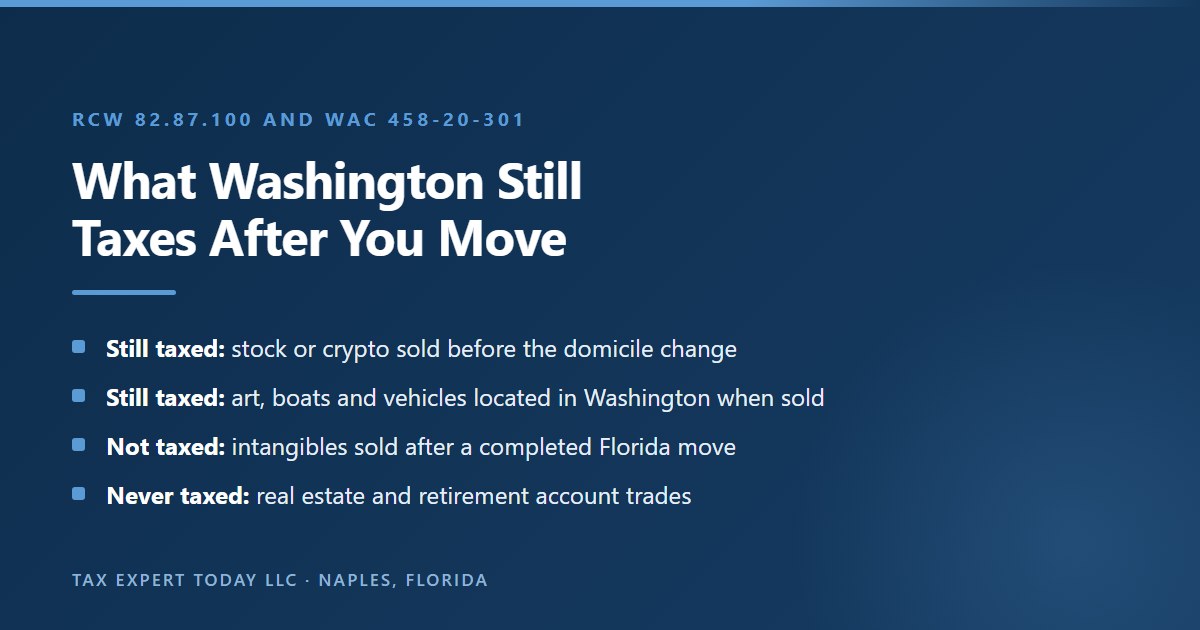
After a completed move, Washington can still tax gain on tangible personal property located in Washington when it is sold, and in limited cases on property moved out the same year. Gain on intangibles sold while you were still a Washington domiciliary also stays taxable, including installment payments on those sales and gains passed through from entities.
- Still taxed: art, collectibles, vehicles, boats and equipment physically in Washington when sold.
- Still taxed: long-term gain on any intangible sold before the domicile change was complete.
- Not taxed: stock, crypto or a business interest sold after a completed move to Florida.
- Never taxed by this levy: real estate, retirement account trades and the other statutory exemptions.
Tangible personal property has two allocation paths under WAC 458-20-301(6)(a). The first is location: if the property was physically in Washington at the time of the sale, the gain is allocated to Washington regardless of where you live. A collector who moves to Naples but sells a painting while it is still hanging in a Seattle gallery has a Washington gain. The second path catches property that has been moved out. Gain is allocated to Washington if the property was in Washington at any time during the year of sale or the prior year, you were a Washington resident at the time of sale, and no other jurisdiction imposed an income or excise tax on the gain. The Department’s own example involves a Washington resident who carried a coin collection to Nevada and sold it there; the gain stayed in Washington because Nevada did not tax it.
For a mover, the practical point is that Florida will not tax the gain either, so the third condition is usually met. The question then becomes whether you were still a Washington resident at the time of the sale, which uses the resident definition discussed below rather than the domicile test alone.
| Asset sold | Washington allocation rule | Sale while still a Washington domiciliary | Sale after a completed move to Florida |
|---|---|---|---|
| Publicly traded stock, bonds, mutual funds | Domicile at the time of sale | Allocated to Washington | Not allocated to Washington |
| Shares or units in your own company | Domicile at the time of sale, owned directly or through a pass-through | Allocated to Washington | Not allocated to Washington |
| Cryptocurrency | Intangible, so domicile at the time of sale | Allocated to Washington | Not allocated to Washington |
| Art, collectibles, vehicles, boats located in Washington | Location at the time of sale | Allocated to Washington | Allocated to Washington if still in Washington when sold |
| Tangible property moved out of Washington in the year of sale or prior year | Prior location, plus residency, plus no tax elsewhere | Allocated to Washington | Generally not allocated if you were no longer a resident when sold |
| Washington real estate | Exempt from this tax | Not taxed by this levy | Not taxed by this levy |
| Trades inside an IRA, 401(k) or similar account | Exempt | Not taxed | Not taxed |
Washington real estate deserves a sentence of its own because it surprises people in both directions. The capital gains tax does not apply to the sale of real estate at all, wherever it is and whoever owns it, according to the Department’s FAQ. A Florida domiciliary who later sells a Mercer Island house owes no Washington capital gains tax on it. The sale is still subject to Washington’s separate real estate excise tax, which is a different levy paid at closing, and the federal rules on the home sale exclusion apply as usual. Investment real estate can still use the federal 1031 exchange rules for federal purposes, and the Washington capital gains tax does not apply to real estate in the first place. Our guide on selling your home after moving to Florida covers the federal side of that sale.
How Does Washington Decide Where You Were Domiciled on the Day of Sale?
Washington weighs the facts. Domicile is a permanent place of abode plus the intent to make it home, judged case by case from a nonexclusive list of factors such as time spent, home, business, licenses, voter registration, schools and where financial transactions originate. Your Washington domicile is presumed to continue, and you bear the burden of proving the change.
- One domicile at a time: you cannot be domiciled in both Washington and Florida on the same day.
- Intent to move is not enough: a Washington domiciliary who plans to move later is still domiciled in Washington.
- Physical presence required: a new domicile needs presence in Florida and intent to make it the permanent home.
- Spouses presumed together: the Department presumes spouses and registered domestic partners share a domicile.
WAC 458-20-301(2)(c) defines domicile as a permanent place of abode coupled with the intent to make the abode one’s home. It is the place you intend to return to even when you visit or temporarily reside elsewhere, and the rule states directly that a Washington domiciliary who intends to move at a future date is still considered domiciled in Washington. Subsection (6)(c) then lists the factors the Department will weigh, with some given more weight than others depending on the facts:
- Length of time spent in a location, and expressed intent.
- Place of business, profession or employment.
- Location of bank accounts and where financial transactions originate.
- Residence and address used for federal income and state tax purposes, and the mailing address.
- Sites of personal and real property owned.
- State of vehicle and other personal property registration, and of the driver license.
- Location of schools attended by children, and payment of in-state tuition.
- State of voter registration and of professional or business licenses.
- Claiming residence for a hunting or fishing license, to hold public office, for judicial actions, or to obtain a property tax benefit such as a homestead exemption.
Two parts of the rule carry most of the weight in a move case. First, continuation: your domicile, once established, is presumed to continue, so if you have been domiciled in Washington you have the burden of proving it changed. Second, the standard for a change: you must be physically present at the new place and intend to make it your permanent home, and the rule says plainly that selling your former home or acquiring a new one is not conclusive. Buying a house in Naples while the family still lives in Kirkland does not move the domicile on its own.
The Florida side of the record matters because it supplies the objective evidence Washington looks for. A Florida driver license, vehicle registration, voter registration and the declaration of domicile filed under Fla. Stat. §222.17 all speak to the factors on Washington’s list. Claiming the Florida homestead exemption is itself listed as a factor. None of those items is decisive alone, which is the point of a facts and circumstances test, but together they are what a credible change of domicile looks like on paper. Day counts can be modeled with our Florida 183 day rule calculator.
The Department also accepts requests for a ruling on where it considers an individual to be domiciled for purposes of this tax. For a large, planned sale, a ruling request before the closing is one of the few ways to reduce the uncertainty in advance rather than defend it afterward.

Can You Sell in the Same Year You Leave Washington?
Yes, but the date of the sale against the date the domicile actually changed decides the result. A sale before the change is complete is a Washington gain; a sale after it generally is not. Because the burden is on you, a sale soon after arrival in Florida needs a strong record showing the move came first.
- Federal recognition date: Washington starts from federal long-term gain, so the closing date usually controls timing.
- Signed deals: a sale agreement fixed before the move can draw scrutiny even if closing follows it.
- Spouse staying behind: the presumption that spouses share a domicile can pull the seller back to Washington.
- Earlier guidance: a 2023 interim statement presumed Washington domicile for any sale in a year you were domiciled there.
The history here is worth knowing. When the tax was new, the Department issued an interim guidance statement on domicile, dated April 27, 2023. It said that if you were a Washington domiciliary at any time during a year, the Department would presume you were domiciled in Washington when you sold personal property that same year, and its example involved a long-time Washington domiciliary who moved to corporate housing in Texas in October and sold stock in December. That interim statement expired on July 29, 2024 and was replaced by WAC 458-20-301. The final rule keeps the presumption that a domicile continues and the burden of proof on the taxpayer, but it does not repeat the full year presumption in the same terms.
Read together, the practical message for a mover is unchanged. A sale in the year of departure is defensible only if the record shows that the domicile had actually changed before the sale date. The more distance between the completed move and the closing, the easier that is. A closing in the same month as the moving truck is the hardest case, and a closing many months after a clean break, with the family, the home, the licenses and the business activity all in Florida, is the easiest.
Timing also has a federal dimension. Washington’s measure begins with federal net long-term capital gain, so the sale date for Washington purposes generally follows the date the gain is recognized federally, which for most sales is the closing. Where a buyer and a price are already locked in before the move, the question of whether the gain had effectively been earned while the seller was still a Washington domiciliary is one an auditor may raise. Our guide on moving to Florida before selling a business covers the federal timing doctrines in more detail, and our guide on Florida domicile for executives covers the sourcing of equity compensation, which is taxed as wages rather than as a capital gain and is outside this Washington tax.
The family dimension is easy to overlook. Under WAC 458-20-301(6)(c), the Department presumes that the domicile of spouses or registered domestic partners is the same. A plan in which one spouse moves to Florida ahead of a sale while the other stays in the Washington home with the children runs directly into that presumption, and into several of the factors on the list at the same time.
What Happens to Installment Payments After You Move?
Washington follows the federal installment method, so gain is reported as payments are received. Allocation of gain on intangibles, however, is fixed by your domicile when the sale occurred. A sale closed while you were domiciled in Washington appears to keep its later payments in Washington even after the move, so the closing date carries the weight.
- Reporting: the Department’s FAQ says installment gain is reported the same way as for federal purposes.
- Allocation: the rule ties intangible gain to domicile at the time of the sale or exchange.
- Pre-2022 sales: payments on sales made before January 1, 2022 are not subject to the tax.
- Open question: we found no Department example on a post-move payment, so a ruling request may be worthwhile.
An installment sale under IRC §453 spreads recognition of gain across the years in which the seller receives payments, which is common when a buyer pays part of a business price with a seller note or an earnout. The Department’s FAQ says that if you report a sale on the installment method for federal purposes, you report the long-term gain the same way for Washington, as the payments are received. WAC 458-20-301 adds that gain from an installment sale made on or after January 1, 2022 is included in the same manner as it is reportable federally, and that gain from a sale made before that date is excluded even when payments arrive later.
The rule does not contain an example of a seller who closed while domiciled in Washington and then moved before collecting the note. What it does say is that intangible gain is allocated to Washington if you were domiciled in Washington at the time the sale or exchange occurred. The sale occurs once, at closing, even though the gain is recognized over several years. Our reading is that the later payments on a Washington era sale remain Washington capital gains when received in Florida, and that a seller who wants the installment gain outside Washington has to complete the move before the sale itself. That is an interpretation of the rule’s text, not a published Department position, which is why a ruling request deserves consideration where the amounts are large.
Earnouts raise the same question with an extra layer, because the federal treatment of contingent consideration can itself vary with the structure. The Washington answer will usually follow the federal characterization and then apply the domicile at sale rule, so the structure should be settled with both tax layers in view before the documents are signed.
How Are Gains From an LLC, Partnership or S Corporation Allocated?
The same way as if you owned the asset yourself. Washington’s rule applies the identical allocation method to gains passed through a pass-through or disregarded entity, so gain on stock sold by your S corporation or partnership is allocated by your own domicile on the date the entity sells. The entity itself never owes the tax.
- Individuals only: the Department confirms business entities do not owe this tax.
- Look-through: owners of pass-through and disregarded entities report their share of long-term gain.
- Real estate inside an entity: gain on an entity interest is exempt to the extent attributable to real estate the entity owns directly.
- Business assets: depreciable or section 179 assets used in a trade or business are exempt.
WAC 458-20-301(6)(e) states that the allocation method is the same whether you owned the property directly or indirectly through a pass-through or disregarded entity. Its example involves a Washington domiciliary who owns half of an S corporation that sells a long-held block of stock; the passed through gain is allocated to Washington because the stock is intangible and the shareholder was domiciled in Washington when the entity sold it. Reverse the facts and put the shareholder’s domicile in Florida on the date of the entity’s sale, and the same rule points the other way.
Two exemptions are particularly relevant to business owners. The first excludes gain on an interest in a privately held entity to the extent the gain is directly attributable to real estate the entity owns directly. The second excludes assets used in a trade or business to the extent they are depreciable under section 167(a)(1) or qualify for expensing under section 179. In an asset sale, that second exemption can take a meaningful part of the price outside the tax, although goodwill and other intangibles are generally not covered by it. Grantor trusts are treated as owned by the grantor, and the rule also reaches the grantor of an incomplete gift nongrantor trust, which closes off a structure some planners used in the early years of the tax. Trust planning around a move is covered in our guide on trust situs after moving to Florida.
Which Washington Capital Gains Tax Exemptions and Deductions Matter for a Seller?
The most valuable are the real estate and retirement account exemptions, the standard deduction, the qualified family-owned small business deduction and the Washington charitable deduction. Gain excluded federally under section 1202 is also outside the tax, while opportunity zone deferral is ignored, so reinvesting in a qualified opportunity fund does not postpone the Washington tax.
- Family-owned small business: deducts the gain on selling substantially all of a qualifying business.
- Charitable: deducts Washington directed gifts above $278,000 for 2025, up to $111,000.
- Section 1202 stock: gain excluded from federal long-term gain is not taxed by Washington.
- Opportunity funds: Washington law disregards the federal deferral and exclusion under section 1400Z-2.
The exemption list on the Department’s capital gains page covers real estate; interests in a privately held entity to the extent the gain is attributable to real estate the entity owns directly; assets held in retirement accounts such as 401(k) plans, IRAs and Roth IRAs; assets condemned or sold under imminent threat of condemnation; certain livestock; depreciable or section 179 business assets; timber and timberlands and related REIT distributions; commercial fishing privileges; and goodwill from the sale of a franchised auto dealership. Exemptions apply transaction by transaction, so one sale in a year can be exempt while another is taxed.
The qualified family-owned small business deduction is the one most often misunderstood, because its conditions are strict. Under RCW 82.87.070 as explained in WAC 458-20-301, all of the following must be true:
| Requirement | What the rule requires |
|---|---|
| Substantially all | A sale of at least 90 percent of the business’s assets by fair market value, or of at least 90 percent of your interest in it |
| Holding period | A qualifying interest held for at least five years immediately before the sale |
| Family ownership | A sole proprietorship, or at least 50 percent family owned, or 30 percent family owned with 70 percent held by two families or 90 percent by three |
| Material participation | You or your family materially participated for at least five of the ten years before the sale, unless the sale is to a family member |
| Size | Worldwide gross revenue in the prior 12 months not above the indexed cap, $11,095,000 for 2025 |
A founder whose company has outside investors or revenue above the cap will usually not qualify, which is why the deduction rarely solves the problem for a venture backed exit. Section 1202 is the more common relief in that setting. The Department’s FAQ confirms that gain excluded from federal net long-term capital gain under section 1202 is not subject to the Washington tax; any part of the gain that is not excluded federally remains in the Washington computation. Our guide on California QSBS explains how a state that does not conform handles the same stock, which is a useful contrast.
The charitable deduction is narrower than its federal counterpart. It is available only for donations to qualified organizations principally directed or managed within Washington, only to the extent the donations exceed the threshold ($278,000 for 2025), and only up to the annual cap ($111,000 for 2025). A gift to a national charity headquartered elsewhere generally does not count, and the rule’s own example denies the deduction for a gift to an organization with no Washington presence. Charitable structures that work alongside a move are covered in our guide on charitable remainder trust taxes.
How Much Is the Washington Capital Gains Tax on a Large Sale?
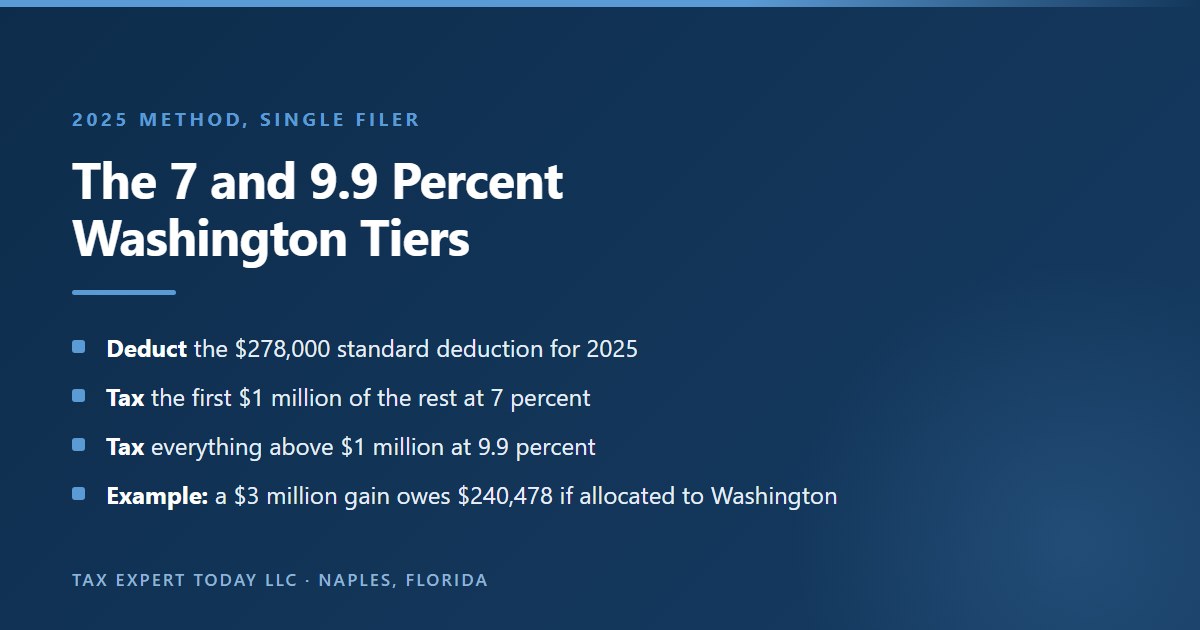
For 2025, subtract the $278,000 standard deduction, tax the first $1 million of what remains at 7 percent and the balance at 9.9 percent. On a $3 million long-term gain with no exemptions, that method gives $240,478. The same gain realized after a completed move to Florida would generally produce no Washington tax.
- Step one: start from federal net long-term capital gain on Schedule D.
- Step two: remove exempt and non-Washington items and apply the standard deduction.
- Step three: apply 7 percent to the first $1 million and 9.9 percent above it.
- Step four: subtract any allowable credits.
The table below applies the published 2025 method to a few illustrative gains for a single filer domiciled in Washington at the time of sale, with no exemptions, no charitable or family business deduction and no credits. The 2026 deduction will be indexed, so the 2026 figures will differ slightly once the Department posts the amount.
| Long-term gain allocated to Washington | Less 2025 standard deduction | Taxable Washington capital gains | Tax at 7% (first $1 million) | Tax at 9.9% (above $1 million) | Total Washington tax | If sold after a completed Florida move |
|---|---|---|---|---|---|---|
| $500,000 | $278,000 | $222,000 | $15,540 | $0 | $15,540 | $0 |
| $1,000,000 | $278,000 | $722,000 | $50,540 | $0 | $50,540 | $0 |
| $3,000,000 | $278,000 | $2,722,000 | $70,000 | $170,478 | $240,478 | $0 |
| $10,000,000 | $278,000 | $9,722,000 | $70,000 | $863,478 | $933,478 | $0 |
The right column assumes intangible assets, a domicile change completed and provable before the sale, and no tangible property in Washington. Federal tax applies in every row regardless of the move. The illustration shows why the timing question is worth real attention for larger sales: the 9.9 percent tier means each additional dollar of gain above the first $1,278,000 of 2025 gain carries almost ten cents of Washington tax.
The deduction applies once per individual, married couple or domestic partnership, according to the Department, so a married couple does not get two deductions by splitting ownership of the shares. Losses follow the same allocation rules as gains, which means a capital loss realized after the move is not allocated to Washington and cannot reduce a Washington gain from earlier in the year.
Can a Washington Seller Claim a Credit for Tax Paid to Another State?
Yes, but Florida never generates one. Washington allows a credit for income or excise tax legally imposed by another jurisdiction on gain also included in Washington capital gains, capped at the Washington tax on those assets. Because Florida taxes no capital gains, a seller caught in a dual claim between the two states owes the full Washington tax.
- The credit: available for tax actually paid to another state, D.C., a territory or a foreign country.
- Payment first: the other tax must be paid before the Washington return claiming the credit is filed.
- Cap: the credit cannot exceed the Washington tax on the same assets for that year.
- B&O overlap: a separate credit applies for Washington business and occupation tax on the same sale.
WAC 458-20-301(6)(d) explains the credit and illustrates it with a Washington domiciliary who spends eight months in a New York second home, is treated by New York as a statutory resident, and pays New York tax on a crypto sale. The gain stays allocated to Washington because she was domiciled there, and the New York tax is credited against the Washington tax. That example matters for a different reason than it first appears. It shows Washington holding firmly to domicile even when the taxpayer spends most of the year elsewhere.
For someone moving to Florida the credit offers no protection. If the Department concludes your domicile was still Washington when you sold, there is no Florida tax to credit, and the full Washington tax applies with interest and penalties if it was not paid on time. Disputes between two states over the same person, and how they arise, are covered in our guide on the dual state residency tax trap.
How Do You File, Extend and Prepay the Washington Return?
The Washington capital gains return is due on the federal individual return due date, generally April 15, and must be filed electronically with a copy of the federal return. An extension requires a federal extension and a request through My DOR. Payment is not extended, and starting with tax year 2026 you may prepay up to six months early.
- Who files: only individuals who owe the tax; no return is needed if gains are exempt or below the deduction.
- Extension: request it electronically in My DOR on or before April 15, with a federal extension in place.
- Payment: electronic only, unless the Department grants a waiver before payment.
- Underpayment: paying less than 80 percent of the tax due triggers the substantial underpayment penalty.
The Department’s capital gains page explains that only individuals who owe the tax must file, along with a copy of their federal return for the same year. Returns and payments are electronic. A filing extension is available only if you received a federal extension, and it must be requested through My DOR on or before April 15; the extension does not move the payment date. If an extension is requested or a payment is made, a return must be filed even if no tax turns out to be due, which is relevant for a mover who prepaid and later concluded that a sale fell after the domicile change.
Beginning with tax year 2026, the Department allows prepayment up to six months before the due date. Its FAQ gives the example that for tax year 2026 payments may be made beginning October 15, 2026 for returns due April 15, 2027. Quarterly estimated payments are not required. For a seller who closed in Washington this year and is moving afterward, a prepayment can limit penalty exposure while the residency file for future sales is being built.
Departing Washington residents frequently have a Washington capital gains return for the year of the move and nothing after it, while the federal return continues as usual. If you have other state filing obligations from a prior home state, our guide on the nonresident state tax return explains how those work.
What Changes in 2028 Under the New Washington Income Tax?
In 2026 the Legislature passed Senate Bill 6346, which the Department says creates a 9.9 percent tax on adjusted gross income above $1 million beginning January 1, 2028, with first returns due in 2029. Guidance is still being developed and legal challenges are expected, but it adds a second reason high earners are timing a move.
- Start date: January 1, 2028, with the first returns due in April 2029, according to the Department.
- Threshold: adjusted gross income above $1 million for individuals and married couples filing jointly.
- Interaction: commentators report modifications for capital gains already subject to the Washington excise; details await guidance.
- Status: commentators expect litigation over whether the tax fits the Washington Constitution.
The Department’s income tax page states that Washington does not currently have an individual income tax and that, beginning January 1, 2028, a new 9.9 percent tax will apply to individuals and married couples filing jointly with annual adjusted gross income exceeding $1 million. It also says the Department will update its guidance on filing requirements, forms and administration as information becomes available. Early professional commentary indicates nonresidents with Washington source income may be within its reach and that capital gains already taxed under chapter 82.87 are among the items adjusted, but those details should be confirmed against final Department guidance before anyone relies on them.
For a Washington family weighing a move, the new tax does not change the capital gains analysis above. It does change the stakes of remaining a Washington resident after 2027 for anyone with large recurring income, which is one reason Florida relocation planning in Washington has broadened from a single sale event to a longer horizon. Florida’s position is the constitutional one described earlier. Our guide on Florida wealth migration describes the broader pattern of high-income households moving to Florida.
Washington is not the only state whose rules reach a departing resident’s gains, and the mechanics differ sharply from state to state. A state with a full income tax usually reaches gain through its residency and sourcing rules rather than through a separate excise, which is the subject of our guides on the California exit tax, the New York exit tax and the Illinois exit tax. The Washington tax is narrower than any of them, because it reaches only long-term gains, but it is also more direct, because one date on one transaction decides it.
What Should a Washington Seller Do Before Moving to Florida?
Sequence the move ahead of the sale, complete it rather than begin it, and document every factor on Washington’s list. Keep tangible assets out of Washington when they are sold, close installment and earnout sales after the move, test any family-owned business deduction, and consider a domicile ruling before a large closing.
- Order: relocate the household and the center of life first, then close the sale.
- Record: build Florida evidence on every Washington factor, including financial activity and licenses.
- Structure: settle installment, earnout and entity questions with both tax layers in view.
- Certainty: weigh a Department ruling request on domicile when the gain is large.
The checklist below maps the Department’s domicile factors to the Florida evidence that typically answers each one. It is a planning aid rather than a test; the Department weighs the factors together and may give some more weight than others.
| Washington domicile factor | Florida evidence that speaks to it | Common gap |
|---|---|---|
| Time spent and expressed intent | Day log, travel records, declaration of domicile under Fla. Stat. §222.17 | Spending most of the sale year in Washington |
| Home and property | Primary Florida residence, homestead exemption claimed | Washington home kept and still used as the family base |
| Business and employment | Work actually performed from Florida, Florida office | Running the company day to day from Washington until closing |
| Licenses and registration | Florida driver license, vehicle and voter registration | Washington license or voter registration not surrendered |
| Family and schools | Spouse and children living in Florida, Florida schools | Spouse remaining in the Washington home |
| Finances and mail | Florida address on federal returns and accounts, transactions originating in Florida | Bank relationships and statements still routed to Washington |
Three practical points come up repeatedly. First, the move should be complete before the sale, not merely announced; the rule’s statement that intent to move later is not enough is aimed squarely at the founder who signs a lease in Naples the month before closing. Second, assets that are tangible, such as art, wine, vehicles or a boat, should be relocated before they are sold, and the residency rules for the year of sale should be checked if they leave Washington the same year. Third, the rest of the move deserves the same attention, including the estate plan and asset protection, which our guides on Florida estate planning for new residents and Florida asset protection cover. Washington also has a separate estate tax that can reach Washington real estate a Florida domiciliary keeps; that is a different tax with its own rules and is outside the scope of this guide.
For a broader view of the taxes on a sale of a company, our guide on selling a business taxes covers the federal computation, and our guide on the Texas capital gains tax covers the same exit analysis for a move to Texas instead.
Washington Capital Gains Tax Help in Naples & Southwest Florida
Tax Expert Today LLC advises business owners, executives and investors relocating from Washington to Naples, Florida and across Southwest Florida on the state tax side of the move, including the timing of a sale against a change of domicile, the allocation of gains under the Washington rules, and the residency record that supports the position. The firm is multidisciplinary, with enrolled agents, CPAs and attorneys, and it handles residency and tax matters nationwide. Our office is at 11983 Tamiami Trail N, Naples, FL 34110, open Monday through Friday, 10 a.m. to 5 p.m. ET, and reachable at (239) 441-2005.
- WA capital gains tax Naples FL: sale timing and domicile analysis for founders, early employees and investors leaving Washington.
- Florida residency records: the declaration of domicile, licenses, homestead and day logs that answer Washington’s factors.
- Business exits: installment, earnout, pass-through and section 1202 questions coordinated across the federal and Washington layers.
Our Naples tax planning practice and our Florida tax services page describe the wider planning work, and our estate and trust planning services cover the documents that should change with the move. If a former state questions the move after the fact, our guide on the Florida residency audit explains how those reviews usually unfold.
We are moving from Seattle to Naples this year and expect to sell company stock next year. Does Washington tax that sale?
Generally not, if the move is complete and provable before the sale. Washington allocates gain on stock to Washington only if you were domiciled there when the sale occurred. The Department presumes a Washington domicile continues and places the burden on you, so the stronger the Florida record before the closing, including where your spouse and children live, the more secure that position is.
When to Engage a Professional
A move that comes well before any sale, with no tangible property left in Washington and no business still run from there, often needs only careful record keeping. Professional help with the Washington capital gains tax earns its cost when a large sale is close to the moving date, when a deal is already negotiated before the move, when the price includes a seller note or an earnout, when the business is held through an entity, when one spouse is staying in Washington, or when a family-owned business deduction or section 1202 exclusion is in play. Those are the points where sequencing and documentation change the result, and where a ruling request may be worth preparing. Tax Expert Today LLC’s enrolled agents, CPAs and attorneys can review the plan before the closing, coordinate with your transaction counsel, and help build the record that answers Washington’s domicile factors. Call (239) 441-2005 to schedule a consultation.
Frequently Asked Questions
Does Washington capital gains tax apply after I move to Florida?
Only to sales allocated to Washington. Gain on stock, bonds, business interests and crypto is allocated to Washington if you were domiciled there on the date of the sale, so a sale after a completed and documented move to Florida is generally outside the tax. Tangible property located in Washington when it is sold remains taxable regardless of your domicile.
What is the Washington capital gains tax rate in 2026?
Seven percent on the first $1 million of taxable Washington capital gains and 9.9 percent on the amount above $1 million, under the tiers enacted by ESSB 5813 for tax years beginning with 2025. The standard deduction was $278,000 for 2025 and is indexed annually; the Department had not posted the 2026 amount as of publication.
Is the sale of my Washington home subject to the capital gains tax?
No. The Department states that the Washington capital gains tax does not apply to the sale or exchange of real estate, regardless of how long you owned it, whether you lived in it, where it is located or who owns it. The sale is still subject to Washington’s separate real estate excise tax and to federal capital gains rules.
Are installment payments received in Florida taxed by Washington?
They may be. Washington reports installment gain the same way as federal law, as payments are received, but allocates intangible gain by your domicile when the sale occurred. Payments on a sale that closed while you were domiciled in Washington appear to remain Washington gain after the move. We found no Department example on that exact case, so a ruling request is worth considering.
Can I avoid Washington capital gains tax by moving after signing a deal?
Not reliably. The tax follows the date the sale occurs, which generally tracks the federal recognition date, and your Washington domicile is presumed to continue until you prove it changed. A deal fixed before the move and closed shortly after it invites scrutiny of whether the domicile had truly changed first. Sequencing the move well ahead of the sale is the stronger approach.
Does Washington allow a credit for taxes paid to Florida?
There is nothing to credit. The Washington capital gains tax allows a credit for income or excise tax legally imposed by another jurisdiction on the same gain, but Florida imposes no personal income tax and no capital gains tax. If Washington concludes you were still its domiciliary on the sale date, the full Washington tax applies.
Published October 11, 2026 by Dr. Pellumb Kabashi « Back to Learning Center
Have a question this article touches on?
Tax Expert Today LLC, based in Naples, Florida and serving clients across the United States.
Schedule a Consultation (239) 441-2005