
By Dr. Pellumb Kabashi, DBA, MBA, EA, CFE, CES
Founder, Tax Expert Today LLC · Tax advisors, enrolled agents, CPAs, and attorneys · Serving clients in all 50 states
A Georgia sales tax exemption is not something a buyer holds. It is a position a seller takes on a specific transaction, and under O.C.G.A. 48-8-38 the seller carries the burden of proving it. Every gross sale is taxable until the contrary is established. A properly completed exemption certificate taken in good faith is what shifts that burden. Call (239) 441-2005 for a free consultation.
What Is a Georgia Sales Tax Exemption?
A Georgia sales tax exemption is a statutory carve out from the tax imposed by Chapter 8 of Title 48 that removes a particular sale, use, or item from the tax base. It is claimed transaction by transaction rather than granted to an organization as a permanent status. In practice the exemption exists only if the seller holds documentation that satisfies O.C.G.A. 48-8-38, which is why the certificate matters as much as the underlying statute.
- The exemptions are statutory, not administrative. The Department of Revenue maintains a List of Sales and Use Tax Exemptions, but the list is a convenience. The authority is the Code.
- Exemption attaches to a transaction. The same buyer can make an exempt purchase in the morning and a taxable one in the afternoon, and the seller has to document each separately.
- The seller is the taxpayer at risk. The Department assesses the seller, not the buyer, when the documentation fails.
- Federal tax status does not control. A 501(c)(3) determination letter is a federal income tax document and it confers no Georgia sales tax exemption on its own.
That last point is where most of the trouble starts. Businesses and charities alike tend to treat a Georgia sales tax exemption as a badge the entity carries, something that can be shown at a register. Georgia does not work that way. The state imposes tax at a 4 percent rate under O.C.G.A. 48-8-30, local jurisdictions layer their own rates on top, and every dollar of gross sales is presumed taxable. What an exemption certificate does is move the risk of being wrong from the seller to the buyer, and only when the certificate meets a specific five part test.
Who Carries the Burden of Proof on an Exempt Sale?
The seller does. O.C.G.A. 48-8-38(a) provides that all gross sales of a retailer are subject to tax until the contrary is established, and that the burden of proving a sale is not a sale at retail rests on the person who makes the sale. The only relief is subsection (b): a certificate, properly completed and taken in good faith, relieves the seller of that burden. Without it, the seller owes the tax even if the buyer genuinely qualified.
- The presumption runs against the seller. The Department does not have to prove a sale was taxable. The seller has to prove it was not.
- A qualifying buyer is not a defense. If the buyer was exempt but the paperwork is missing, the assessment still lands on the seller.
- Good faith is defined, not judged. Subsection (b) sets out five specific conditions rather than leaving good faith to argument.
- Resale sales have their own test. Subsection (c) adds three further conditions that apply only to sales for resale.
This is the single most useful thing a Georgia business can understand about the subject, and it is the thing the ranking pages on this topic tend to skip. The certificate is not a formality collected for the file. It is the seller’s entire defense. A Georgia sales tax exemption that cannot be documented is, for assessment purposes, not an exemption at all.
What Makes an Exemption Certificate Valid in Good Faith?
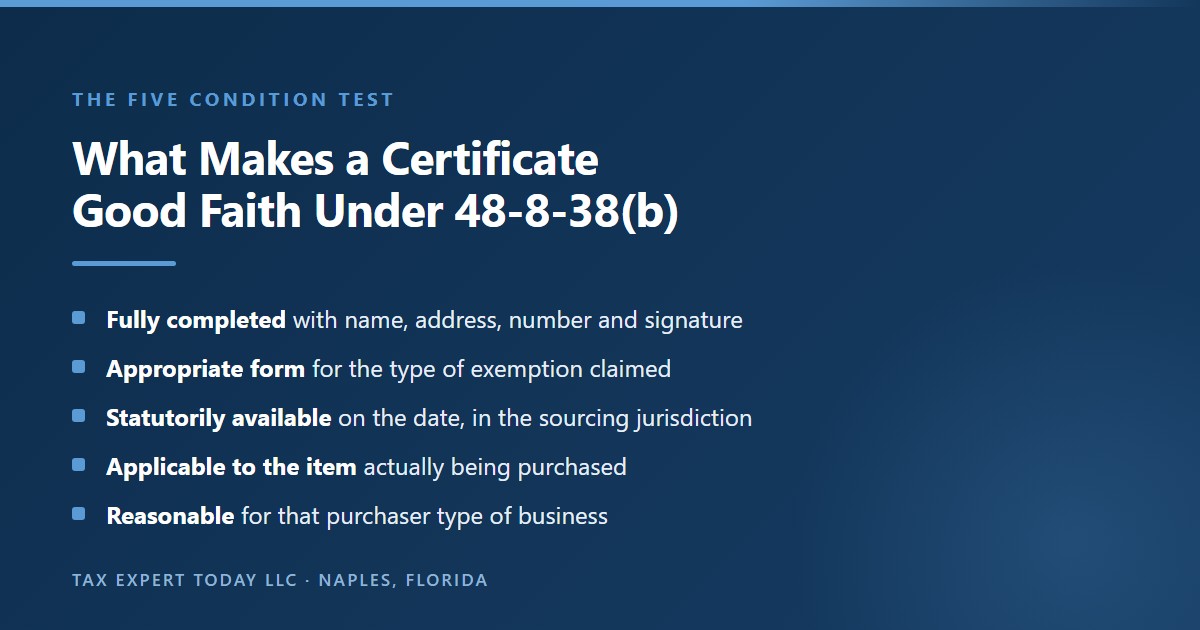
O.C.G.A. 48-8-38(b) defines a properly completed certificate taken in good faith through five conditions, and all five must hold. The certificate has to be fully completed, in a form appropriate to the exemption claimed, claiming an exemption that was statutorily available on the transaction date in the sourcing jurisdiction, applicable to the item purchased, and reasonable for the purchaser’s type of business. A certificate that fails any one of them does not shift the burden.
| Condition under 48-8-38(b) | What it actually requires | Where sellers fail it |
|---|---|---|
| Fully completed | Name, address, a sales tax number, and the signature of the taxpayer where a signature is required | Blank sales tax number field, or an unsigned paper certificate |
| Appropriate form | The certificate form has to match the type of exemption being claimed | An ST-5 used where a manufacturer certificate or an out of state purchaser certificate belongs |
| Statutorily available on the date | The exemption must exist in law on the transaction date, in the jurisdiction where the sale is sourced | Relying on a certificate collected years earlier for an exemption that has since been narrowed |
| Applicable to the item | The exemption claimed has to be capable of covering the specific item sold | A manufacturing exemption applied to office furniture or a company vehicle |
| Reasonable for the business type | The claim must make sense for what the purchaser does | A restaurant presenting a resale certificate for kitchen equipment it will use rather than sell |
The fifth condition deserves attention because it is the one that carries judgment. A seller is not required to audit a customer, but a seller is expected to notice when a claim is implausible on its face. A landscaping company issuing a resale certificate for a commercial mower is claiming that it intends to resell the mower. If the seller knows the customer is a landscaper rather than an equipment dealer, that certificate is not reasonable for the purchaser’s type of business, and accepting it does not produce a valid Georgia sales tax exemption.
Which Georgia Exemption Certificate Do You Actually Need?
Georgia does not use one certificate. Form ST-5 is the general Sales Tax Certificate of Exemption and covers most claims including resale. Form ST-5M is the manufacturer certificate. Form ST-4 is for out of state purchasers. Agricultural buyers use a GATE certificate issued by the Department of Agriculture. Certain nonprofits use a Letter of Authorization issued through the Georgia Tax Center rather than a certificate at all.
| Document | Who uses it | Typical claim | Issued by |
|---|---|---|---|
| Form ST-5 | Registered Georgia dealers and most exempt purchasers | Purchase for resale, and the general statutory exemptions | Completed by the purchaser, held by the seller |
| Form ST-5M | Manufacturers and producers | Machinery, industrial materials, packaging supplies and energy under 48-8-3.2 | Completed by the purchaser, held by the seller |
| Form ST-4 | Out of state purchasers | Property purchased in Georgia for use or resale outside Georgia | Completed by the purchaser, held by the seller |
| GATE certificate | Qualified agricultural producers | Agricultural inputs and equipment | Georgia Department of Agriculture |
| Letter of Authorization | Specific nonprofit categories only | Purchases by a qualifying food bank, health center, volunteer health clinic or job training organization | Department of Revenue through the Georgia Tax Center |
Choosing the wrong document fails the second condition of the good faith test even when the underlying exemption is perfectly real. A manufacturer that hands a supplier a general ST-5 for equipment covered by 48-8-3.2 has claimed an exemption on a form that does not match the exemption, and the seller who accepts it has not secured the protection of 48-8-38(b). The form is not interchangeable paperwork. It is the second element of the statutory test.
How Does a Georgia Resale Exemption Work?
A Georgia business buys inventory free of sales tax by giving its supplier a properly completed Form ST-5 claiming resale. Under O.C.G.A. 48-8-38(c) the certificate protects the seller only if the purchaser is engaged in the business of selling tangible personal property, holds a valid Georgia sales tax registration number at the time of purchase and lists it on the certificate, and the seller has no reason to believe the purchaser does not intend to resell the property in the regular course of business.
- The number must be valid at the time of purchase, not merely valid when the certificate was first signed. A lapsed registration breaks the protection.
- The purchaser must actually be in the selling business. Buying for internal use is a taxable purchase regardless of what the buyer’s certificate says.
- Seller knowledge defeats the certificate. The phrase is “no reason to believe,” which is a lower bar than actual knowledge.
- Diverted inventory triggers use tax on the buyer. Inventory bought under resale and then consumed internally creates a use tax liability for the purchaser.
That last item is the mechanism most buyers never learn until an audit. A retailer who pulls a product off the shelf for the break room has converted exempt inventory into a taxable use. Georgia reaches that through the use tax half of the sales and use tax, and the liability belongs to the business that made the conversion, not to the supplier who accepted a good certificate. Businesses that both sell and consume the same items should be accruing use tax on the consumed portion as a standing practice rather than waiting to be assessed. Sellers that operate in more than one state should note that the documentation rules are not uniform, and our guide to the Texas resale certificate sets out how a neighboring state handles the same question.
Do Nonprofits Get a Georgia Sales Tax Exemption?
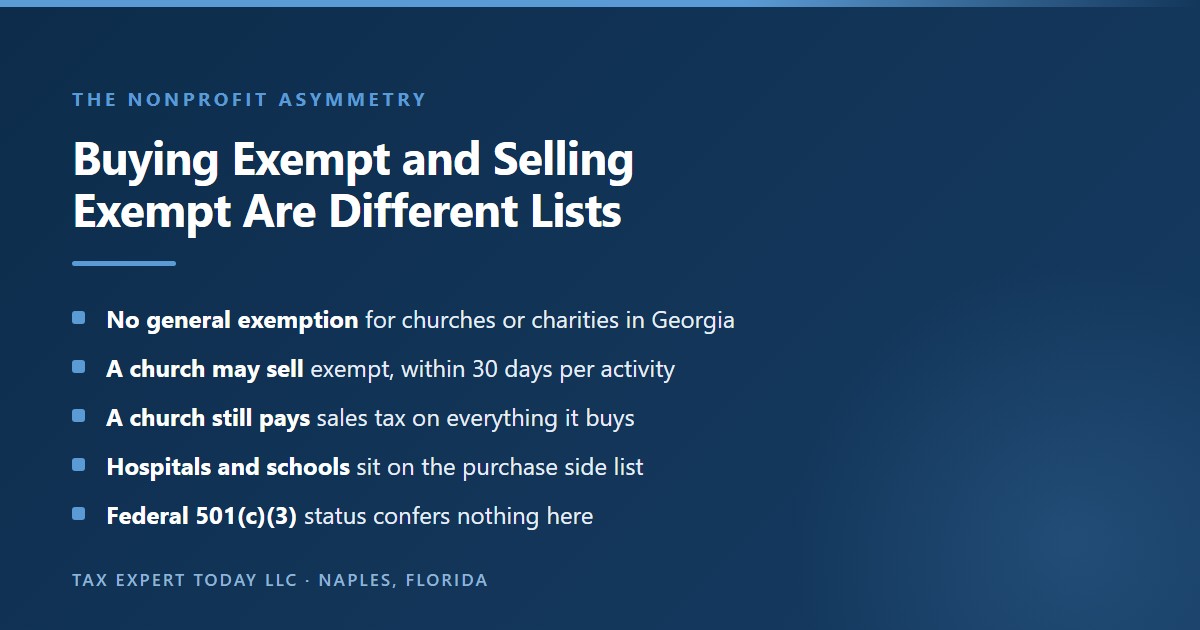
As a general rule, no. The Department of Revenue states plainly that Georgia statute grants no sales or use tax exemption to churches, religious, charitable, civic and other nonprofit organizations, and that these organizations are required to pay tax on all purchases of tangible personal property. The authority is Ga. Comp. R. and Regs. r. 560-12-2-.22. Only a narrow enumerated list of organization types receives a limited exemption.
- A federal 501(c)(3) determination does nothing here. It governs federal income tax exemption and has no effect on Georgia sales tax.
- Churches pay Georgia sales tax on their purchases. This surprises almost every congregation that has operated in a state with a general charitable exemption.
- The exempt categories are listed, not inferred. If an organization type is not on the list, it is taxable.
- Purchase exemptions and collection exemptions are different lists. Qualifying to buy exempt does not mean qualifying to sell without collecting, and the reverse is equally true.
Georgia is a minority state on this question, and that is precisely why it generates so much incorrect advice. An organization that relocates from a state with a broad charitable exemption, or that takes guidance from a national nonprofit resource, will arrive at the wrong answer with complete confidence. The correct starting assumption for any Georgia nonprofit is that its purchases are taxable, and the burden is on the organization to find itself inside one of the enumerated categories.
Which Nonprofits Can Buy Exempt in Georgia?
The Department lists limited purchase side exemptions for a defined set of organizations. They include licensed nonprofit orphanages, adoption agencies and maternity homes; licensed nonprofit in-patient general hospitals, mental hospitals, nursing homes and hospices; nonprofit private schools covering any combination of grades 1 through 12; nonprofit blood banks; nonprofit groups whose primary activity is raising money for public libraries; nonprofit organizations primarily serving the developmentally disabled; nonprofit health centers; nonprofit volunteer health clinics; and nonprofit food banks.
- Construction materials for qualifying private colleges, zoological institutions and aquariums also appear on the purchase side list as a separate category.
- The qualifiers are doing real work. “Licensed” and “in-patient” and “primary activity” are conditions, not description.
- Grades 1 through 12 is a boundary. A nonprofit preschool that does not reach grade 1 is not inside the private school category.
- Several categories require a Letter of Authorization before the exemption can be claimed at the register.
Practitioners should read the list as a statute rather than as a summary. A nonprofit nursing home qualifies. A nonprofit organization that provides in-home supportive services to the elderly is not a nursing home and does not. The distinction is not about mission or worthiness, and arguing the equities produces nothing on audit. The question is whether the organization sits inside a listed category as that category is written.
Which Nonprofits Can Sell Without Collecting Tax?
The collection side list is shorter and carries day limits that the purchase side list does not. It covers Boy Scouts and Girl Scouts; licensed nonprofit orphanages, adoption agencies and maternity homes, limited to 30 days in any one calendar year; parent teacher organizations including nonprofit booster clubs comprised of parents and teachers; religious institutions, limited to 30 days per fundraising activity in any calendar year; nonprofit groups whose primary activity is raising money for public libraries; and public and private schools covering kindergarten through grade 12.
| Organization | Exempt purchases | Exempt sales | Day limit on sales |
|---|---|---|---|
| Religious institution or church | No | Yes, for fundraising | 30 days per fundraising activity per calendar year |
| Licensed nonprofit orphanage or maternity home | Yes | Yes | 30 days in any one calendar year |
| Parent teacher organization or booster club | No | Yes | None stated |
| Nonprofit private school, grades 1 to 12 | Yes | Yes, K through 12 | None stated |
| Nonprofit food bank | Yes | Not listed | Not applicable |
| General 501(c)(3) charity | No | No | Not applicable |
The asymmetry in that table is the practical heart of the topic. A church appears on the collection side but not on the purchase side. It may run a fundraising sale without collecting tax within the day limit, and it still pays Georgia sales tax on the hymnals, the office supplies and the sound system. A booster club is in the same position. Reading one list and assuming the other says the same thing produces a Georgia sales tax exemption claim that fails in exactly one direction, which is the direction nobody thought to check. The Department’s Policy Bulletin SUT-2020-02 addresses fundraising activities conducted by organizations exempt under IRC 501(c)(3) and is the guidance to read before planning an event.
How Do You Apply for a Letter of Authorization?
Four nonprofit categories apply online through the Georgia Tax Center: qualified food banks, job training organizations, nonprofit volunteer health clinics and nonprofit health centers. The organization needs a Georgia Tax Center logon, though it does not need a sales tax number. Inside the account the application sits under the More tab in the Sales Tax Exemptions section. Every other Letter of Authorization category is handled through the Department’s Tax Policy function rather than online.
- No Georgia Tax Center logon and prior Georgia filings: sign up for online access through the Georgia Tax Center sign up process.
- No logon and a need to file Georgia returns: register as a new Georgia business first, then apply.
- No logon and no Georgia filing requirement at all: contact the Department at 877-423-6711 to have an account created.
- Any other exemption letter: contact Tax Policy rather than attempting the online path.
The sequencing matters for organizations working against an event date or a construction schedule. An organization with no Georgia filing history cannot simply log in and apply, because it has no account, and the account creation route runs through a phone call rather than a web form. Building in lead time is the practical answer. The Department’s application instructions set out the screen by screen path once the account exists.
What Is Exempt for Manufacturers in Georgia?
O.C.G.A. 48-8-3.2(b) exempts from all sales and use taxation the sale, use or storage of machinery or equipment that is necessary and integral to the manufacture of tangible personal property, together with the sale, use, storage or consumption of industrial materials and packaging supplies. This is one of the broadest exemptions in the Georgia code, and it is claimed on Form ST-5M rather than on a general certificate.
| Category under 48-8-3.2 | What it covers | The test |
|---|---|---|
| Machinery and equipment | Production machinery, and equipment used in the manufacturing process | Necessary and integral to the manufacture of tangible personal property |
| Industrial materials | Materials that become a component part of the finished product, or are consumed in production | Used in the manufacture of tangible personal property |
| Packaging supplies | Materials used to package the finished product for sale or shipment | Used in packaging tangible personal property |
| Energy | Electricity, natural gas and other energy consumed at the plant | Necessary and integral to manufacture, subject to the education tax carve out |
The phrase that carries the weight is “necessary and integral.” It is not a synonym for “used at the plant.” Administrative equipment, office technology, and property used in activities that sit outside the manufacturing process do not become exempt because the taxpayer happens to be a manufacturer. A Georgia sales tax exemption claimed on an ST-5M for property that fails the necessary and integral test will fail the fourth condition of the good faith test, because the exemption claimed is not applicable to the item purchased.
Why Is the Manufacturing Energy Exemption Not a Full Exemption?
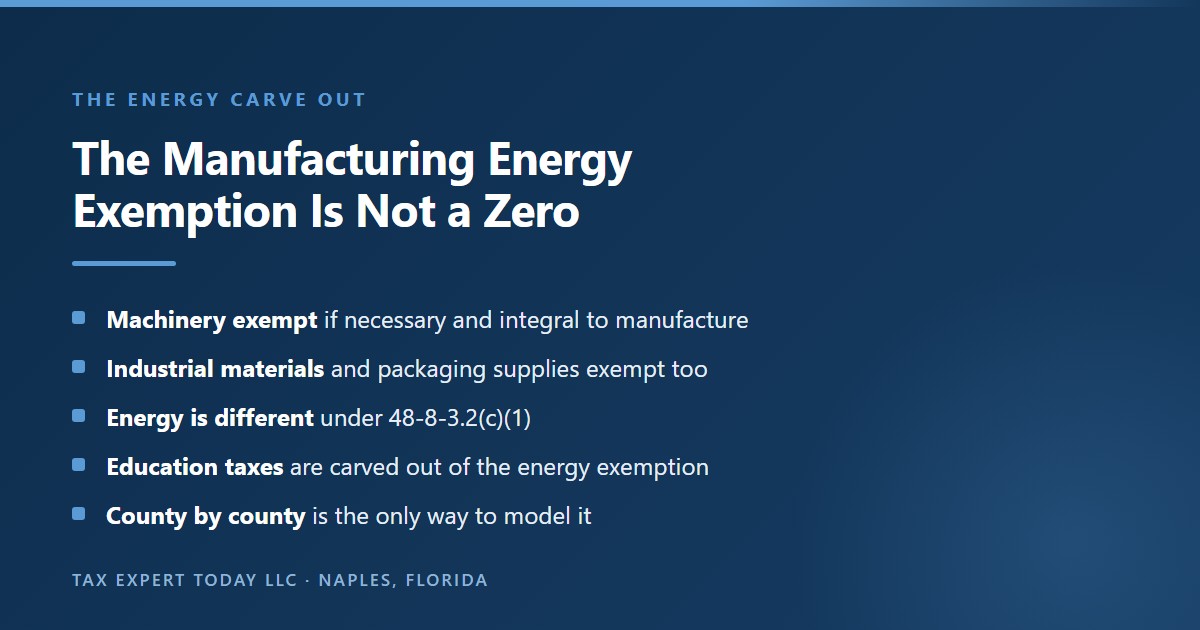
Because O.C.G.A. 48-8-3.2(c)(1) carves out the education tax. The energy exemption applies to all sales and use taxation except the sales and use tax for educational purposes levied under Part 2 of Article 3 of Chapter 8 and Article VIII, Section VI, Paragraph IV of the Georgia Constitution, and except local sales and use taxes for educational purposes authorized by local constitutional amendment. In a county with an education tax, exempt energy still carries that component.
- The exemption is not a zero. Manufacturers in education tax counties keep paying the education portion on energy indefinitely.
- The carve out is constitutional as well as statutory, which is why it did not disappear when the phase in completed.
- Machinery and industrial materials are not affected. The carve out sits in subsection (c) and applies to energy only.
- The county determines the amount. Two plants in different counties can compute different effective rates on identical energy purchases.
Manufacturers routinely budget the energy exemption as though it eliminated the tax, then find a residual liability they did not plan for. The statute originally phased the exemption in over four years beginning January 1, 2013, and the phase in is long complete, but the education tax exception was never part of the phase in. It is a permanent feature of the provision. Any modeling of the energy exemption has to be done jurisdiction by jurisdiction against the current rate chart rather than at a single statewide figure.
Do Georgia Exemption Certificates Expire?
Most do not. The Department states that most certificates of exemption and letters of authorization do not expire, with one stated exception: the Georgia Agricultural Tax Exemption certificate, which expires on an annual basis. That single exception is the one that catches sellers, because an agricultural buyer’s file can look complete while the certificate underlying it has lapsed.
- GATE certificates renew annually and a seller relying on a prior year card is relying on nothing.
- A non-expiring certificate can still go stale. The third good faith condition asks whether the exemption was statutorily available on the transaction date.
- Registration status is separate from certificate validity. A resale claim needs a valid sales tax number at the time of purchase.
- Periodic refresh is a practice, not a rule. Georgia does not require it, and sellers with long customer relationships benefit from doing it anyway.
The distinction worth holding onto is that “does not expire” answers a question about the document and not about the transaction. A certificate signed in 2019 remains a valid document in 2026. Whether the exemption it claims was statutorily available on a 2026 transaction date, in the jurisdiction where that sale is sourced, is a separate question the seller still has to be able to answer. Georgia amends Chapter 8 of Title 48 frequently enough that this is not a theoretical concern.
How Do You Verify a Buyer’s Georgia Sales Tax Number?
Through the Sales Tax ID Verification Tool inside the Georgia Tax Center. From the Home page, under Searches, select Sales Tax IDs, read the instructions, and enter the numbers to verify. Numbers can be entered individually or imported from an Excel template, and the results should be printed and retained. The tool verifies Georgia sales tax numbers only.
- It does not verify state tax identification numbers issued for other purposes.
- It does not verify federal employer identification numbers. An FEIN on a certificate proves nothing about sales tax registration.
- It does not verify out of state sales tax numbers. A certificate carrying another state’s number cannot be checked through this tool.
- It does not verify Social Security numbers.
The out of state limitation is the operationally important one, and it is the reason Form ST-4 exists as a separate document. A Georgia seller shipping to a customer in another state, or selling to a purchaser who will remove the goods from Georgia, cannot validate that purchaser through the Georgia tool. The exposure does not disappear because verification is unavailable, so the seller’s documentation has to do more work: the correct form for the claim, complete information, and a record of why the exemption was reasonable for that purchaser’s business. Keeping a printed verification result for every Georgia number checked is cheap, and it is the evidence that the seller acted in good faith on the date of the sale rather than reconstructing the position later. A seller that has crossed a registration threshold in another state inherits a parallel burden there, and our guide to Texas sales tax nexus explains how an economic threshold creates that obligation.
What Happens When a Seller Accepts a Defective Certificate?
The protection of O.C.G.A. 48-8-38(b) does not attach, the burden of proof stays with the seller under subsection (a), and the Department can assess the seller for the uncollected tax plus applicable penalty and interest. The seller may have a commercial claim against the customer, but that is a contract matter. It does not change who owes Georgia.
| Situation | Who Georgia looks to | Practical result |
|---|---|---|
| Valid certificate, buyer qualified | Nobody | Exempt sale, burden shifted, seller protected |
| Valid certificate, buyer later misuses the property | The buyer | Use tax accrues to the buyer, seller remains protected |
| Defective certificate, buyer actually qualified | The seller | Assessment against the seller despite a real exemption |
| No certificate at all | The seller | Sale presumed taxable under 48-8-38(a) |
| Certificate unreasonable on its face | The seller | Good faith fails, protection does not attach |
Row three is the one worth reading twice. A seller can lose on a transaction that was substantively exempt, because 48-8-38 conditions the relief on the documentation rather than on the underlying facts. This is why an exemption certificate review is worth running before an audit rather than during one. The certificates a business holds today are the entire evidentiary record for years still open, and defects found early can often be cured by obtaining a corrected certificate from a customer who is still doing business with the seller.
Does a Resale Certificate Cover Digital Products?
Yes, within a defined rule added in 2023. O.C.G.A. 48-8-38(f), added by SB 56 effective January 1, 2024, provides that a sale of a specified digital product, other digital good, or digital code is a sale for resale if the item is subsequently sold, licensed, leased, broadcast, transmitted or distributed, in whole or in part, as an integral and inseparable component part of a service or another such product by the purchaser to an ultimate consumer. The purchaser must maintain records substantiating that resale.
- The component part language is broad. A digital good embedded inside a service the purchaser sells can qualify.
- “In whole or in part” matters. Partial incorporation is contemplated by the statute.
- Recordkeeping is on the purchaser, and the statute says so expressly rather than leaving it to general practice.
- The effective date is a boundary. The provision applies to transactions occurring on or after January 1, 2024.
SB 56 also states, in language the General Assembly did not codify, that tax, penalty and interest liabilities and refund eligibility for prior taxable years are not affected by the Act and continue to be governed by Title 48 as it existed for those years. For a business looking backward at digital purchases, that means the resale analysis for 2023 and earlier runs on the law as it stood then, not on the current subsection (f). O.C.G.A. 48-8-30(a)(2) separately imposes the tax on specified digital products sold to an end user who receives the right of permanent use, which is the provision that made the resale rule necessary. States differ sharply on how far the tax reaches beyond tangible goods, and our guide to Texas taxable services shows how differently the same question can be answered.
What Is a Casual Sale in Georgia?
A sale that meets the regulatory definition of a casual sale is not subject to Georgia sales tax. The definition sits in Ga. Comp. R. and Regs. r. 560-12-1-.07, and for purposes of that regulation “business” means any activity engaged in by any person, or caused to be engaged in by any person, with the object of direct or indirect gain, benefit or advantage, per O.C.G.A. 48-8-2(4).
- It is an exclusion rather than a certificate exemption. No form is issued because the transaction is outside the tax.
- The definition of business is deliberately wide. Indirect benefit is enough to take an activity out of casual treatment.
- Frequency and character both matter in applying the regulation to a pattern of sales.
- It is not a general used goods rule. Treating every secondhand sale as casual is a common and incorrect shortcut.
The casual sale rule comes up most often when a business disposes of equipment, and the answer is rarely as simple as the label suggests. Businesses that liquidate assets regularly, or that structure disposals as a revenue activity, are conducting a business within the O.C.G.A. 48-8-2(4) definition. The regulation text is short and should be read directly before a disposal of any size is treated as outside the tax.
How Do Local Rates Change the Exemption Analysis?
They change the amount at stake and, for energy, the result itself. Georgia imposes the state rate under O.C.G.A. 48-8-30 and local jurisdictions add their own, so the combined rate varies by county. The Department republishes a General Rate Chart every quarter, and a chart effective October 1, 2026 through December 31, 2026 is already posted alongside the three earlier 2026 quarters.
- Sourcing decides which chart applies. The good faith test asks about the jurisdiction where the transaction is sourced, not where the seller sits.
- Quarterly republication is the cadence. A rate relied on in March may not be the rate in October.
- Education taxes are the variable in energy claims, because the 48-8-3.2(c) carve out tracks them.
- Multi-location sellers face multiple answers for what looks like one uniform product line.
For a business with any geographic spread, this is the argument for treating exemption certificate management as an ongoing process rather than an onboarding task. The General Rate Charts are the authoritative source for the combined rate in each jurisdiction, and the archive of prior quarters is what supports a position on a transaction that occurred two years ago. Businesses that also carry Georgia entity level obligations should coordinate this work with their Georgia net worth tax filings, since the same registration and jurisdiction facts drive both.
What Records Should a Seller Keep?
The certificate itself, in a form that ties to the transactions it covers; the verification result for any Georgia sales tax number checked; and enough transaction detail to show that the exemption claimed was applicable to the items sold. The statute’s five conditions are the filing index, because each one is a question an auditor can ask about a specific sale.
- Link certificates to customers and to periods, so a certificate obtained in year three is not silently applied to year one.
- Retain the printed verification results. The Department’s own instructions direct sellers to print a copy of the search results.
- Record the form type used, since the appropriate form condition is tested per transaction.
- Keep the substantiation the purchaser owes on digital resales, where the business is the purchaser rather than the seller.
- Flag GATE certificates for annual renewal rather than filing them with the non-expiring documents.
A certificate file organized by customer name alone will not answer the questions 48-8-38 actually poses. The questions are transactional. The file that survives an examination is the one that can produce, for any selected invoice, the certificate in force on that date, the form type, and the reason the exemption fit the item. Businesses that discover gaps while reviewing open years may have a path to correct prior Georgia filings, and the Georgia amended return rules govern the timing of any resulting claim. The full range of Georgia engagements the firm handles is set out on the Georgia tax services page.
Georgia Sales Tax Exemption Mistakes That Cost Money
Most assessments in this area come from a small set of recurring errors, and nearly all of them are documentation failures rather than substantive disagreements about whether an exemption exists. The pattern is consistent: the business was right about the law and wrong about the paper.
- Treating a 501(c)(3) letter as a Georgia exemption. It is not one, and Georgia says so directly.
- Using an ST-5 where an ST-5M or ST-4 belongs. The right exemption on the wrong form fails condition two.
- Budgeting the energy exemption at 100 percent. The education tax carve out is permanent.
- Filing a GATE certificate as permanent. It renews annually and nothing else does.
- Accepting an out of state number as verified. The Georgia tool cannot check it.
- Assuming the nonprofit purchase list and sales list match. They do not, and churches are the clearest example.
- Consuming resale inventory without accruing use tax. The liability moves to the buyer and compounds quietly.
None of these require an aggressive position to go wrong. They are ordinary operating practices that happen not to match what O.C.G.A. 48-8-38 requires. The cost is that the Department assesses the seller for tax it never collected from a customer, on sales that may have been genuinely exempt, and the seller absorbs it. A Georgia sales tax exemption is worth precisely what its documentation can prove. Owners who also draw Georgia sourced retirement income should review the Georgia retirement income exclusion on the individual side of the same household return.
Georgia Sales Tax Exemption Help in Naples & Southwest Florida
Tax Expert Today LLC works from Naples, Florida and handles state tax matters nationwide, including Georgia sales and use tax exposure reviews, exemption certificate file remediation, nonprofit qualification analysis under the enumerated categories, and manufacturing exemption scoping under O.C.G.A. 48-8-3.2. Georgia clients are served from the Naples office and do not need to be present in Georgia or in Florida.
- Georgia tax help Naples covers exemption certificate reviews, resale and use tax accrual practice, and Georgia Tax Center registration questions.
- Multi state sellers are common in Southwest Florida, where a Florida based business ships into Georgia and collects on Georgia sourcing rules.
- Nonprofit engagements turn on whether the organization sits inside a listed category rather than on its federal exemption status.
- Remote engagement is standard. Documents are exchanged through a secure client portal rather than by email.
Tax Expert Today LLC
11983 Tamiami Trail N, Naples, FL 34110
Telephone: (239) 441-2005
Hours: Monday through Friday, 10:00 a.m. to 5:00 p.m. Eastern Time
A local question we are asked often: our company is based in Naples, Florida and we sell equipment to customers in Georgia. Do we have to collect Georgia sales tax, and can we just take their exemption certificate? The two questions are separate and both matter. Whether a Florida seller has to register and collect in Georgia is a nexus question answered by the seller’s own activity and volume in the state. Once registered, the seller becomes a Georgia dealer for these purposes and inherits the O.C.G.A. 48-8-38 burden of proof on every exempt sale it makes, which means it needs the same certificate discipline a Georgia based seller needs. The complication for an out of state seller is that the Georgia Tax Center verification tool checks Georgia numbers only, so certificates carrying another state’s registration cannot be validated through it. Georgia specific engagements are described on our Georgia tax services page, and broader planning for Southwest Florida businesses is covered on our Naples tax planning services page.
When to Engage a Professional
A single-location Georgia retailer collecting a standard ST-5 from a handful of wholesale customers does not need professional help. The situations that do are the ones where the exemption interacts with structure: manufacturing scope, nonprofit qualification, multi-state sourcing, or an open audit period with a thin certificate file.
- A manufacturing exemption is being scoped for the first time, because the necessary and integral test decides how much of a capital program is exempt.
- A nonprofit is deciding whether it fits an enumerated category, where the answer is often no and the cost of assuming yes is an assessment.
- An examination has opened and the certificate file needs to be reconstructed against specific invoices.
- Resale inventory is being consumed internally and use tax accrual has never been set up.
- A business is registering in Georgia from another state and inheriting the seller burden of proof for the first time.
Dr. Pellumb Kabashi is an enrolled agent and the founder of Tax Expert Today LLC, and the firm includes tax advisors, enrolled agents, certified public accountants, and attorneys. Georgia Department of Revenue matters are state tax matters rather than federal ones, and they are handled under Georgia procedure and Georgia authority. Nothing in this article is advice for a particular taxpayer, and the outcome in any specific case depends on facts that a general article cannot know. Businesses operating through a pass-through structure in Georgia should also review the Georgia pass-through entity tax and, where nonresident owners are involved, the Georgia composite return rules, since a sales tax registration often arrives at the same time as the entity’s other Georgia obligations. Call (239) 441-2005 for a free consultation, or reach the Naples, Florida office during business hours.
Frequently Asked Questions
What qualifies for a Georgia sales tax exemption?
The exemptions are codified in Chapter 8 of Title 48 of the Official Code of Georgia and include purchases for resale, machinery and industrial materials necessary and integral to manufacturing under O.C.G.A. 48-8-3.2, and a defined list of nonprofit categories. The Department of Revenue maintains a consolidated List of Sales and Use Tax Exemptions, but the statute is the authority.
Does a 501(c)(3) get a Georgia sales tax exemption?
Not by virtue of its federal status. Georgia statute grants no sales or use tax exemption to churches, religious, charitable, civic and other nonprofit organizations, and those organizations pay tax on their purchases of tangible personal property. Only the specific categories listed by the Department, such as licensed nonprofit hospitals, nonprofit private schools covering grades 1 through 12, and nonprofit food banks, receive a limited exemption.
What form is the Georgia sales tax exemption certificate?
Form ST-5 is the general Sales Tax Certificate of Exemption and covers most claims including resale. Manufacturers use Form ST-5M and out of state purchasers use Form ST-4. Using the wrong form fails the requirement in O.C.G.A. 48-8-38(b)(2) that the certificate be in a form appropriate for the type of exemption claimed.
Who is liable if a Georgia exemption certificate is invalid?
The seller. Under O.C.G.A. 48-8-38(a) all gross sales are taxable until the contrary is established and the burden of proof is on the person making the sale. A defective certificate does not shift that burden, so the Department can assess the seller even where the purchaser would have qualified for the exemption.
Do Georgia sales tax exemption certificates expire?
Most certificates of exemption and letters of authorization do not expire. The stated exception is the Georgia Agricultural Tax Exemption certificate, which expires annually. A non-expiring certificate still has to claim an exemption that was statutorily available on the transaction date in the jurisdiction where the sale is sourced.
Is manufacturing energy fully exempt in Georgia?
No. O.C.G.A. 48-8-3.2(c)(1) exempts energy necessary and integral to manufacturing from all sales and use taxation except the sales and use tax for educational purposes. In a jurisdiction that levies an education tax, a manufacturer continues to pay that component on otherwise exempt energy.
Can a Georgia seller verify an out of state resale number?
Not through the Georgia Tax Center. The Sales Tax ID Verification Tool checks Georgia sales tax numbers only and does not verify out-of-state sales tax numbers, federal employer identification numbers, state tax identification numbers, or Social Security numbers. Out of state purchasers generally belong on Form ST-4.
Does a resale certificate cover digital products in Georgia?
Yes, for transactions on or after January 1, 2024. O.C.G.A. 48-8-38(f), added by SB 56, treats a specified digital product, other digital good, or digital code as purchased for resale where it is subsequently sold, licensed, leased, broadcast, transmitted or distributed as an integral and inseparable component part of a service or another such product to an ultimate consumer, provided the purchaser keeps substantiating records.
Published September 15, 2026 by Dr. Pellumb Kabashi « Back to Learning Center
Have a question this article touches on?
Tax Expert Today LLC, based in Naples, Florida and serving clients across the United States.
Schedule a Consultation (239) 441-2005