
By Dr. Pellumb Kabashi, DBA, MBA, CES, CFE, EA
Founder, Tax Expert Today LLC · Tax advisors, enrolled agents, CPAs, and attorneys · Serving clients in all 50 states
Quick Answer: The self employment tax Texas business owners pay is entirely federal. Texas imposes no state income tax, but that does nothing to the 15.3 percent self employment tax under Internal Revenue Code section 1401, which every Texas sole proprietor, partner, and single member LLC owner still owes on net earnings. For most owners it is the largest single tax they face. Call (239) 441-2005 for a free consultation.
Does Texas Have a Self Employment Tax?
Texas imposes no self employment tax of its own, and no state income tax either. The 15.3 percent that a Texas contractor, consultant, or sole proprietor pays is entirely federal, imposed by Internal Revenue Code section 1401. Moving to Texas removes a state income tax bill. It does not reduce self employment tax by a single dollar.
This is the single most common misunderstanding among people who relocate a business to Texas. The self employment tax Texas arrivals meet in their first filing season is the identical federal tax they paid before the move, computed the same way and at the same rate. The state tax saving is real and it is worth having, but it applies to a different tax than the one most self employed owners actually feel. Our guide to what Texas no state income tax really means covers the state side. This article covers the federal side that follows you regardless of where you live.
- No state layer exists. Texas has no personal income tax, so there is no state self employment surtax stacked on top of the federal one.
- The federal layer is unchanged by residence. Section 1401 applies to self employment income wherever it is earned.
- It is not withheld for you. Nobody deducts it from a payment, which is why it arrives as a lump sum at filing.
- It sits on top of income tax. Self employment tax is separate from and additional to federal income tax on the same earnings.
What Is the Self Employment Tax Rate in 2026?
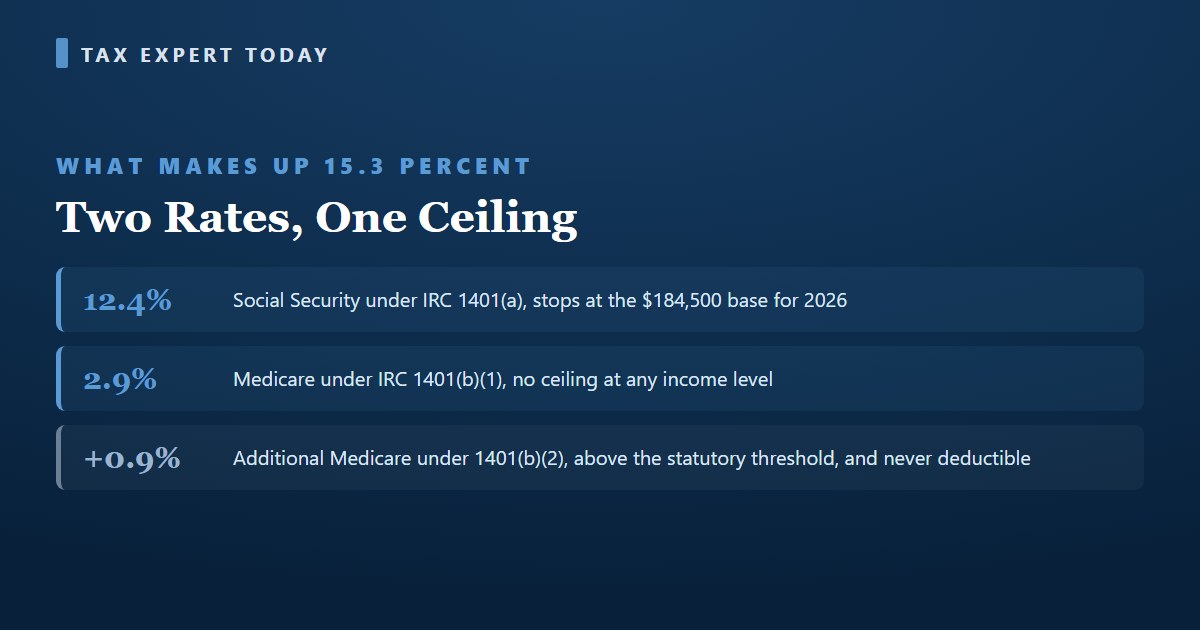
The combined rate is 15.3 percent. Section 1401(a) imposes 12.4 percent for old age, survivors, and disability insurance, and section 1401(b)(1) imposes 2.9 percent for hospital insurance. A further 0.9 percent applies above a threshold under section 1401(b)(2). The 12.4 percent stops at an annual ceiling; the 2.9 percent never does.
| Component | Rate | Ceiling for 2026 | Authority |
|---|---|---|---|
| Social Security (OASDI) | 12.4% | Stops at $184,500 | IRC 1401(a) |
| Medicare (hospital insurance) | 2.9% | No ceiling | IRC 1401(b)(1) |
| Additional Medicare | 0.9% | Applies above the threshold only | IRC 1401(b)(2) |
| Combined base rate | 15.3% | Below the ceiling | IRC 1401 |
The $184,500 figure is the Social Security contribution and benefit base for 2026, published by the Social Security Administration and up from $176,100 for 2025. It is worth reading that figure from the source each year rather than from an article, because the number changes annually and stale copies circulate widely. The IRS self employment tax page itself still illustrates the rule using the 2024 base of $168,600 at the time of writing, which shows how easily an out of date figure survives even on an authoritative page.
The additional 0.9 percent under section 1401(b)(2) applies to self employment income above $250,000 on a joint return, $125,000 for a married taxpayer filing separately, and $200,000 in any other case. Those thresholds are written into the statute and are not indexed for inflation, so they capture more taxpayers each year.
How Is the Tax Actually Calculated?
The rate does not apply to your full profit. Schedule SE first multiplies net earnings from self employment by 92.35 percent, and the 15.3 percent applies to that reduced figure. The reduction exists to mirror the employer side deduction a business would take for its half of payroll taxes, so a self employed person is not taxed on the employer portion.
An LLC or corporation that actually puts someone on payroll moves into a different system, with state unemployment tax owed to the Texas Workforce Commission and quarterly federal returns to file. Our guide to Texas payroll taxes covers the employer side, which is separate from the self employment tax described here.
Working the arithmetic through on a hypothetical makes the mechanism concrete. Assume a Texas consultant with $120,000 of net profit on Schedule C and no wage income.
| Step | Computation | Result |
|---|---|---|
| Net profit from the business | Schedule C bottom line | $120,000 |
| Multiply by 92.35 percent | $120,000 × 0.9235 | $110,820 |
| Apply 15.3 percent | $110,820 × 0.153 | $16,955 |
| Deduct one half above the line | $16,955 ÷ 2 | $8,477 |
Two observations follow from that table. The first is that the effective rate on the full $120,000 is roughly 14.1 percent rather than 15.3 percent, because of the 92.35 percent step. The second is that the deduction reduces income tax rather than self employment tax, so it softens the blow without changing the 15.3 percent itself. Our self employment tax calculator runs the same sequence on your own figures.
The filing trigger is low. Under section 1402(b)(2) and the IRS guidance, Schedule SE is required once net earnings from self employment reach $400, or once church employee income reaches $108.28. There is no minimum profit that makes the tax disappear for an ongoing business.
What Happens If You Also Have W-2 Wages?
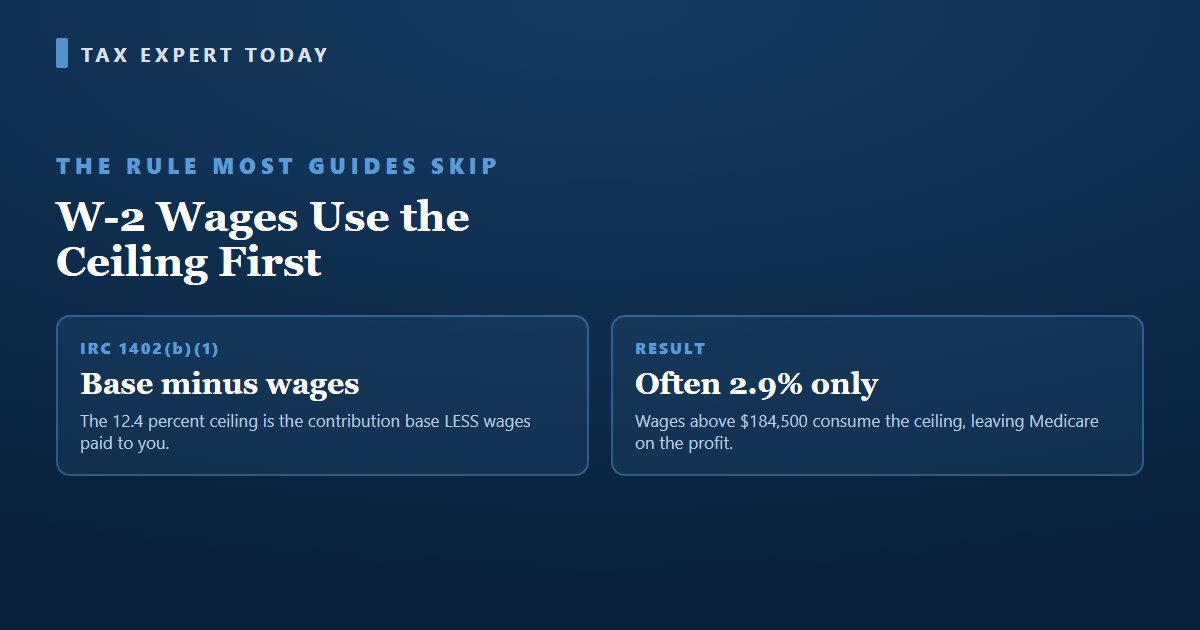
Wages come first, and they use up the Social Security ceiling before your self employment income touches it. Section 1402(b)(1) sets the 12.4 percent ceiling at the contribution and benefit base minus the wages paid to you during the year. An owner with substantial W-2 income may owe only the 2.9 percent Medicare component on the business profit.
This is the most valuable and least explained rule in the whole area, and it changes the answer dramatically for anyone running a side business alongside employment.
- Wages reduce the ceiling directly. If wages already exceed $184,500 for 2026, the entire 12.4 percent ceiling is consumed and none of it remains for self employment income.
- The 2.9 percent still applies. Medicare has no ceiling, so the hospital insurance component continues on every dollar of net earnings.
- The saving is not automatic on paper. Schedule SE has a specific section for taxpayers with wages, and using the wrong part of the form overstates the tax.
- Two jobs do not coordinate. Employers each withhold to the full ceiling independently, which produces excess Social Security withholding that is recovered on the Form 1040 rather than by the employer.
| Situation for 2026 | 12.4 percent applies to | 2.9 percent applies to |
|---|---|---|
| No wages, $120,000 net earnings | The full 92.35 percent adjusted amount | The same amount |
| $100,000 wages, $60,000 net earnings | Only the ceiling that remains after wages | All adjusted net earnings |
| $190,000 wages, $60,000 net earnings | Nothing, the ceiling is already used | All adjusted net earnings |
Why Can You Not Deduct Half of the Additional Medicare Tax?
Section 164(f)(1) allows a deduction equal to one half of the taxes imposed by section 1401, but it expressly excludes the taxes imposed by section 1401(b)(2). That is the additional 0.9 percent. So the deductible half covers the 12.4 percent and the 2.9 percent components only, and the surtax is fully non deductible.
The exclusion is easy to miss because it appears as a parenthetical inside section 164(f)(1) rather than as a separate provision. Section 164(f)(2) then treats the deduction as attributable to a trade or business, which is what makes it an adjustment to gross income rather than an itemized deduction. That matters, because it means the deduction is available whether or not the taxpayer itemizes. The same is true of the self-employed health insurance deduction, although, unlike the deductible half of self-employment tax, it does not reduce net earnings from self-employment at all.
Do You Have to Pay Quarterly in Texas?
Yes, in most cases. Because nobody withholds self employment tax from a payment to a contractor, the federal system collects it through quarterly estimated payments on Form 1040-ES. Texas residents file no state estimates because there is no state income tax, so the federal payment is the only one to schedule.
The practical difficulty is not the concept but the cash flow. A newly self employed Texan often completes a first profitable year with nothing set aside, then meets both the income tax and the 15.3 percent at once. Setting aside a percentage of every payment received, rather than computing it at year end, is the habit that prevents that outcome.
- Four payment dates per year. The federal estimated tax schedule runs on a quarterly basis and does not align neatly with calendar quarters.
- Safe harbor rules exist. Paying a defined percentage of the prior year liability generally avoids an underpayment penalty even when the current year turns out higher, with a higher percentage applying above an income threshold.
- The penalty is computed by period. Catching up in December does not repair an underpayment from an earlier quarter.
- Texas adds no second filing. Unlike a state with an income tax, there is no parallel state estimate to track.
Does an S Corporation Election Reduce Self Employment Tax?
It can, because a shareholder who works in an S corporation takes reasonable compensation as W-2 wages, and the remaining profit passes through as a distribution that is not subject to self employment tax. The saving is real but it is not free, and it is only available where the compensation is genuinely reasonable for the work performed.
The election is frequently oversold. What is often left out is the cost and the risk that sit against the saving, and both matter for a Texas business because the state layer looks different here than it does elsewhere.
| Consideration | What it means for a Texas owner |
|---|---|
| Reasonable compensation | Wages must reflect the value of services actually performed, and an artificially low salary is the central audit exposure |
| Payroll infrastructure | Running wages means employment tax filings and deposits that a sole proprietor never had |
| Texas franchise tax | An entity brings the state franchise tax regime into view, covered in our franchise tax guide |
| Retirement contributions | Plan contribution limits often key off wages, so a lower salary can shrink the amount that may be contributed |
| Social Security credits | Reduced wages reduce the earnings record that later benefits are calculated from |
Whether the election makes sense depends on profit level, the owner’s own compensation profile, and how long the structure will be kept in place. Our guides to Texas LLC taxes and the Texas franchise tax cover the entity side that an election brings with it.
How Does the Texas Franchise Tax Interact With This?
They do not overlap, because they tax different things at different levels. Self employment tax is a federal tax on an individual’s net earnings. The Texas franchise tax is a state tax on a taxable entity’s margin. A sole proprietor pays the first and generally not the second, while an entity can face both at different layers.
Keeping the two separate matters when comparing structures, because a saving at one level can be offset by an obligation at the other. The federal question is about how earnings are characterized. The state question is about whether a taxable entity exists at all and what its margin is.
What About Texas Contractors Working Across State Lines?
Self employment tax does not change when you work in another state, because it is federal and follows the person rather than the location. What can change is state income tax exposure, since some states tax nonresidents on income sourced to work performed inside their borders, and Texas offers no credit mechanism because it has no income tax to credit against.
This is a genuine trap for Texas based consultants who travel. A Texas resident has no home state return in which to claim a credit for taxes paid to another state, so a nonresident state tax becomes an absolute cost rather than an offset. The federal self employment tax is unaffected either way. Our guide to establishing Texas residency covers the residency side, and our comparison of Texas and Florida looks at how the two no income tax states differ in practice.
What Counts as Net Earnings From Self Employment?
Net earnings means the gross income from a trade or business carried on by the individual, less the deductions attributable to that business, plus any distributive share from a partnership carrying on a trade or business. Section 1402(a) then removes several categories entirely, which is why not every dollar reported on a Form 1040 is exposed to the 15.3 percent.
The exclusions matter more than the inclusions, because they are where planning actually lives. A Texas owner with a mixed income profile can find that a meaningful share of it never touches self employment tax at all.
- Rental income is generally excluded. Rents from real estate are carved out of net earnings unless received by a dealer or accompanied by substantial services, which is why a landlord is usually outside the tax.
- Capital gains are excluded. Gain from the disposition of property that is not stock in trade does not enter net earnings.
- Interest and dividends are generally excluded. Unless received in the course of a dealer’s trade or business, investment income sits outside.
- A limited partner’s distributive share is largely excluded. Section 1402(a)(13) removes it, other than guaranteed payments for services actually rendered, which is the provision behind a great deal of partnership structuring.
- Deductions reduce the base. Ordinary and necessary business deductions on Schedule C reduce net earnings before the rate applies, so an unclaimed deduction costs income tax and self employment tax together.
That last point is the one worth acting on. Because a Schedule C deduction reduces both income tax and the 15.3 percent, its true value to a Texas sole proprietor is considerably higher than the marginal income tax rate alone suggests. IRS Publication 334 sets out the deduction rules for small business owners in detail.
Which Texas Business Owners Pay It, and Which Do Not?
Liability follows how the business is classified for federal tax purposes rather than what it is called under Texas law. A sole proprietor and a single member LLC owner both pay it on net profit. A general partner pays it on the distributive share. An S corporation shareholder pays it on nothing, because their compensation runs through payroll instead.
| How the business is taxed | Self employment tax applies to |
|---|---|
| Sole proprietorship | Net profit on Schedule C |
| Single member LLC, no election | Net profit, because the entity is disregarded |
| Multi member LLC or partnership, general partner | The distributive share plus guaranteed payments |
| Limited partner | Generally only guaranteed payments for services |
| S corporation shareholder | Nothing. Wages carry FICA instead, and distributions carry neither |
| C corporation shareholder | Nothing. Wages carry FICA and dividends carry neither |
The single member LLC row is the one that surprises Texas owners most often. Forming an LLC with the Texas Secretary of State provides liability separation under state law, but unless an election is made the entity is disregarded for federal tax purposes and the owner remains fully exposed to the 15.3 percent. The LLC itself changes nothing about self employment tax.
How Much Self Employment Tax Texas Owners Pay at Each Profit Level
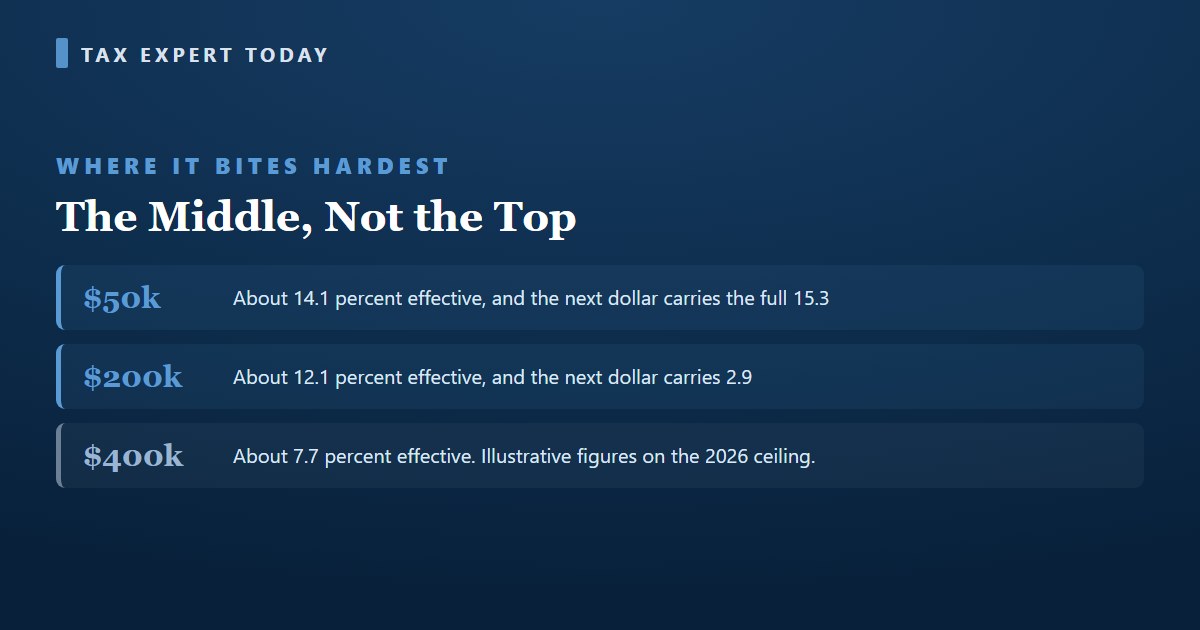
Because the 12.4 percent stops at the Social Security ceiling and the 2.9 percent does not, the effective rate falls as profit rises. Below the ceiling the effective rate on full profit runs near 14.1 percent. Above it, each additional dollar carries only the Medicare components, so the marginal rate drops sharply even though the total bill keeps climbing.
| Net profit, no wage income | Approximate tax | Effective rate on profit | Marginal rate on the next dollar |
|---|---|---|---|
| $50,000 | $7,065 | About 14.1% | 15.3% of the adjusted amount |
| $100,000 | $14,130 | About 14.1% | 15.3% of the adjusted amount |
| $200,000 | About $24,240 | About 12.1% | 2.9% of the adjusted amount |
| $400,000 | About $30,600 | About 7.7% | 2.9%, plus 0.9% above the threshold |
These are illustrative figures computed on the 2026 ceiling of $184,500 and rounded, and they assume no wage income and no other adjustments. They are shown to demonstrate the shape of the curve rather than to predict any particular result. The pattern is what matters: the self employment tax Texas owners face is most punishing in the middle of the income range, not at the top, which is precisely why an entity election tends to become worth modelling as profit grows rather than when it is small.
The same curve explains why quarterly estimates are hard to size in a growing year. A business whose profit crosses the ceiling mid year sees its marginal rate fall part way through, so an estimate built on the first quarter’s rate will overshoot. Federal estimated tax guidance and the penalty rules in IRC section 6654 govern how closely the payments have to track the liability.
Self Employment Tax Help Naples and Southwest Florida
Self employment tax Naples clients and Texas based owners reach our office in Naples, Florida with the same question from opposite directions: how much of the 15.3 percent is actually unavoidable. We look at the wage interaction, the entity question, and the estimated payment schedule together, because changing one without the others tends to move the problem rather than solve it. Because the self employment tax Texas owners pay is federal rather than state, the analysis is identical for a client in Dallas and for one in Collier County, which is why we handle both from the same desk. We work with clients in Texas and in all 50 states.
Tax Expert Today LLC
11983 Tamiami Trail N, Naples, FL 34110
Phone: (239) 441-2005
Hours: Monday through Friday, 10:00 to 5:00 ET
Does moving between Texas and Florida change my self employment tax? No. Both states impose no personal income tax, and self employment tax is federal in either one, so the 15.3 percent is identical in Houston and in Naples. What differs between the two states is the business entity layer rather than the self employment tax, since Texas imposes a franchise tax on taxable entities and Florida imposes a corporate income tax that does not reach most pass through owners. Our Naples tax planning page and our advisory services page describe how we handle owner level planning.
When to Engage a Professional
The self employment tax Texas owners pay is worth professional review once the numbers stop being simple. Consider engaging an advisor when profit is high enough that an entity election might change the result, when you have W-2 wages alongside business income and the Social Security ceiling interaction is in play, when income is irregular enough that estimated payments are hard to size, when you work in states outside Texas, or when a first profitable year has produced a liability you were not expecting. Outcomes depend on the specific facts, and the analysis needs the actual figures rather than a rule of thumb. Our guides to moving a business to Texas and Texas capital gains tax cover the neighbouring questions.
This article is educational and general in nature. It does not constitute tax advice for any particular taxpayer, and outcomes depend on individual facts and circumstances.
Published August 14, 2026 by Dr. Pellumb Kabashi « Back to Learning Center
Have a question this article touches on?
Tax Expert Today LLC, based in Naples, Florida and serving clients across the United States.
Schedule a Consultation (239) 441-2005