
By Dr. Pellumb Kabashi, DBA, MBA, EA, CFE, CES
Founder, Tax Expert Today LLC · Tax advisors, enrolled agents, CPAs, and attorneys · Serving clients in all 50 states
Quick Answer: Georgia use tax is the 4 percent state tax plus the local rate, generally 6 to 9 percent combined on the October 1, 2026 rate chart, owed by a buyer who uses, stores, or consumes taxable property in Georgia when Georgia sales tax was not charged. Individuals report it on Form ST-3 USE, and registered dealers report it on Form ST-3 with a reason code. Call (239) 441-2005 for a free consultation.
What Is Georgia Use Tax?
Georgia use tax is the companion to Georgia sales tax. It applies when taxable property or a taxable service is used, stored, distributed, or consumed in Georgia and Georgia sales tax was not paid at the time of purchase. The buyer, not the seller, owes it and must report it to the Department of Revenue.
- Same tax base as sales tax. Use tax reaches the same property and services that sales tax reaches, at the same combined rate.
- Owed by the buyer. When the seller does not collect Georgia tax, the obligation shifts to the person who brings the item into use in Georgia.
- Two common meanings. The Department uses the term for items brought into Georgia and for any taxable purchase that was not taxed at the point of sale.
- Reported on a return. Individuals and unregistered businesses use Form ST-3 USE; registered dealers use the regular sales and use tax return.
The Department of Revenue describes use tax in two ways on its page What is Subject to Sales and Use Tax? First, it is a tax imposed on non-exempt items brought into Georgia, triggered by the first instance of use, consumption, distribution, or storage in the state of property purchased at retail outside Georgia. Second, the term is commonly used for the tax on taxable goods and services that simply were not taxed when they were bought, whether the seller was in another state or in Georgia. In both cases the statute the Department cites for the accrual duty is O.C.G.A. 48-8-30(g): if a taxpayer purchases taxable goods or services without paying the tax, the taxpayer must accrue and remit it.
Use tax exists so that the place of purchase does not decide whether tax is owed. A buyer who orders equipment from a seller in a state with no sales tax, or from an online seller that does not collect Georgia tax, ends up in the same position as a buyer who walked into a Georgia store. The rate is the same, the base is the same, and the exemptions are the same. The difference is mechanical: the seller collects sales tax, while the buyer self assesses use tax.
That difference is why use tax is easy to overlook. Nobody hands the buyer a bill. A business that is careful about charging sales tax to its own customers can still carry years of unreported use tax on its purchases, and an individual who buys a large item from another state may never have heard of the obligation. This guide is written for that buyer side of the ledger. The seller side, including exemption certificates and what happens when a seller accepts a defective certificate, is covered in our separate guide to the Georgia sales tax exemption rules, and broader Georgia planning is collected on our Georgia tax services page.
Who Owes Georgia Use Tax?
Anyone who uses, stores, or consumes taxable property in Georgia without paying Georgia sales tax on it can owe use tax. That includes individuals, sole proprietors, corporations, partnerships, nonprofits without an exemption, contractors, service providers, and registered retailers that pull items out of inventory for their own use.
- Individuals who buy taxable items from sellers that did not charge Georgia tax.
- Businesses that are not registered dealers, such as many professional service firms, which file Form ST-3 USE.
- Registered dealers, which report use tax on purchases and inventory withdrawals on their regular return.
- Contractors and service providers, which the Department generally treats as end users of the materials and supplies they consume.
The legal incidence of use tax falls on the person who puts the property into use in Georgia. The Department’s own example is plain: a buyer orders a bicycle online, the seller does not charge sales tax, the bicycle is delivered in Georgia, and the buyer now owes use tax on the sales price. The same rule applies to a company that buys a server rack from a vendor in another state, a physician practice that orders exam tables from an out of state supplier, or a law firm that buys office furniture from a seller that is not registered in Georgia.
Being a business that does not sell anything taxable does not remove the obligation. Professional service firms, medical practices, consultants, and many other businesses are not required to register as dealers because they make no taxable sales. They are still consumers of taxable property. The instructions to Form ST-3 USE say the form is to be filed only by persons or firms liable for use tax who are not dealers registered with the Department for the collection and remittance of sales and use tax. Registered dealers must use Form ST-3 instead.
Nonprofit organizations deserve a separate note. Georgia does not grant a general sales and use tax exemption to every nonprofit. Only certain organizations qualify, and many must hold a letter of authorization from the Department. An organization without a valid exemption owes use tax on untaxed purchases in the same way a business does. Our guide to the Georgia sales tax exemption explains which nonprofits can buy exempt and how the letter of authorization works.
Finally, the buyer remains responsible even when the seller made a mistake. If a Georgia seller failed to charge tax that should have been charged, the Department may pursue the seller, but the buyer who used the property without paying tax also has an accrual obligation under O.C.G.A. 48-8-30(g). Paying use tax on a purchase where the seller should have collected is often the cleaner route than relying on the seller to correct its return.
What Is the Georgia Use Tax Rate in 2026?
The Georgia use tax rate is the same as the sales tax rate: a 4 percent state rate plus the local rates in effect where the property is first used or received. On the rate chart effective October 1, 2026, combined rates for general jurisdictions run from 6 percent to 9 percent.
- State portion: 4 percent, reported under jurisdiction code 000.
- Local portion: generally 2 to 5 percent, made up of county, school, special purpose, and transportation taxes.
- Combined range on the October 2026 chart: 6 percent in counties such as Cobb and Gwinnett, up to 9 percent in many others.
- City of Atlanta: 8.9 percent in both the DeKalb and Fulton portions of the city.
The Consumer’s Use Tax Return answers the rate question directly: the use tax rate is the sum of the 4 percent state tax rate and the local tax rate. Line 5 of Form ST-3 USE multiplies total purchases by the 4 percent state rate, and line 6 multiplies the same total by the applicable local rate. The form tells the taxpayer to apply the rate of the jurisdiction where the property was received, or, if the property was transported from another state, the rate of the jurisdiction where the property was first used.
The Department publishes a new general rate chart every quarter. The chart effective October 1, 2026 through December 31, 2026 lists each county by its three digit jurisdiction code and gives the combined state and local rate. The chart also explains that the 4 percent state rate is included in every jurisdiction except two special Fulton County districts listed separately at the bottom of the chart. To isolate the local rate, the ST-3 USE instructions say to subtract 4 percent from the combined rate shown on the chart.
Local rates change. Counties adopt and renew special purpose local option sales taxes, transportation taxes, and education taxes by referendum, and the Department adjusts the chart at the start of each quarter. A rate that was correct for a purchase in March may be wrong for a purchase in October. For that reason, use tax should be computed with the chart in effect for the period in which the property was first used, not with a rate remembered from a prior year or copied from a third party rate page.
The search results for this question still show some third party pages describing Georgia combined rates as ranging from 4 percent upward. On the October 2026 chart, every general county jurisdiction carries at least 2 percent of local tax in addition to the state rate, so a combined rate below 6 percent does not appear for a general county jurisdiction. Rate summaries outside the Department’s own chart should be treated as a starting point, not as the rate to file with.
How Do Local Rates Change the Use Tax You Owe?
Local rates decide most of the variation in Georgia use tax. The same purchase can carry 6 percent in one county and 9 percent in another, so the jurisdiction of use matters as much as the price. The rate follows where the buyer receives the property or, for property brought from another state, where it is first used.
- Receipt or first use controls. The sourcing rule in O.C.G.A. 48-8-77 generally points to where the buyer takes delivery.
- County codes matter. Each county has a three digit jurisdiction code on the rate chart and the return.
- Atlanta is coded separately. DeKalb inside Atlanta is 044A and Fulton inside Atlanta is 060A.
- Special rates exist. Some motor vehicle transactions and energy sold to manufacturers carry different local rates.
The table below shows a sample of combined rates from the Department’s rate chart effective October 1, 2026. It illustrates the spread across the state. It is not a substitute for the chart itself, which lists every jurisdiction and should be checked for the period being reported.
| Jurisdiction (code) | Combined rate on the October 1, 2026 chart | Local portion above the 4 percent state rate |
|---|---|---|
| Cobb County (033) | 6 percent | 2 percent |
| Gwinnett County (067) | 6 percent | 2 percent |
| Chatham County (025) | 7 percent | 3 percent |
| Fulton County outside Atlanta and the listed cities (060) | 7.75 percent | 3.75 percent |
| DeKalb County outside Atlanta (044) | 8 percent | 4 percent |
| Clarke County (029) | 8 percent | 4 percent |
| City of Atlanta, DeKalb or Fulton portion (044A, 060A) | 8.9 percent | 4.9 percent |
| Richmond County (121) | 9 percent | 5 percent |
| Muscogee County (106) | 9 percent | 5 percent |
The Department’s tax rates questions and answers explain that in most instances tax is due at the rate of the county where the customer takes delivery, and that a City of Atlanta delivery generally adds a city tax to the state and county taxes. For use tax, the ST-3 USE instructions add one refinement: when property was transported from another state, the rate is that of the jurisdiction where the property was first used. A business that receives equipment at a warehouse in one county and installs it at a plant in another should document which event came first and where.
Line 2 of Form ST-3 USE exists for this reason. It asks for the county of use if it is different from the county of residence printed on line 1. An individual who lives in Gwinnett County but takes delivery of a boat motor at a lake house in Rabun County would compute local use tax at the Rabun rate, not the Gwinnett rate, because that is where the property was received and used.
Motor vehicles are a special case. The Department’s rate page explains that inside the City of Atlanta and in Clayton County certain local taxes do not apply to motor vehicle sales, and that the first regional transportation tax applies only to the first $5,000 of a vehicle transaction. Most vehicles titled in Georgia are subject to title ad valorem tax instead of sales and use tax, which is discussed later in this guide.
When Does Georgia Use Tax Apply to Online and Out of State Purchases?
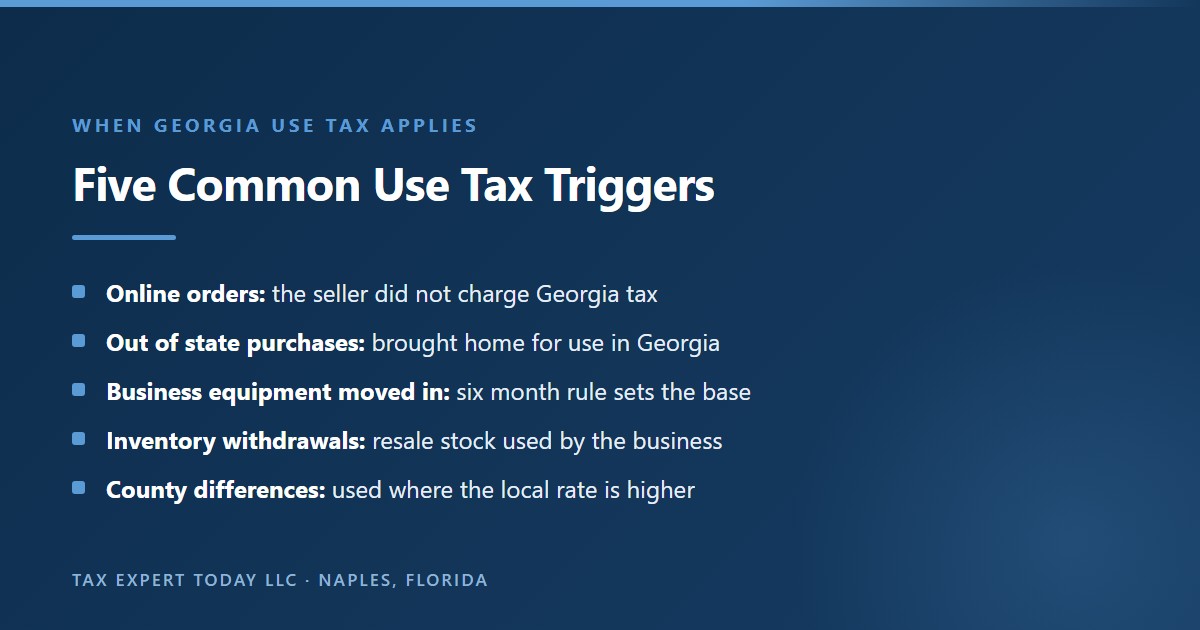
Use tax applies to an online or out of state purchase when the item is taxable in Georgia, it is bought for use, storage, or consumption in Georgia, and the seller did not charge Georgia tax. Delivery location does not save the purchase: the Department says the tax applies whether the item is delivered in Georgia or in another state.
- Online orders from sellers that do not collect Georgia tax are the most common trigger for individuals.
- Purchases made while traveling are taxable in Georgia if the item is brought home for use here.
- Catalog and telephone orders follow the same rule as online orders.
- Tax charged by the other state is credited, but foreign sales tax and value added tax are not.
The questions and answers printed on Form ST-3 USE address this directly. If a person makes purchases of tangible personal property while in another state, and the items are purchased for storage, use, or consumption in Georgia, they are subject to Georgia tax whether the purchases are delivered to the buyer in another state or shipped to the buyer in Georgia. If the buyer paid another state’s sales or use tax on those purchases, that amount may be credited against the Georgia tax due.
Three questions sort most online and out of state purchases. First, is the item taxable in Georgia? Tangible personal property is taxable unless an exemption applies, and the ST-3 USE instructions define tangible personal property to include electricity, water, gas, steam, and prewritten computer software. Second, was the item bought for use in Georgia? A purchase for a Georgia home or a Georgia business location generally is. Third, did the seller charge Georgia tax? If the invoice or receipt shows Georgia state and local tax at the correct rate, nothing further is due. If it shows no tax, the wrong state’s tax, or Georgia tax at too low a rate, a use tax balance may remain.
Many large online retailers now collect Georgia tax, either because they are registered dealers or because they sell through a marketplace that collects for them. That has narrowed, but not closed, the use tax gap for individuals. Purchases from smaller sellers, purchases of equipment and business supplies from specialty vendors, purchases from sellers in states with no sales tax, and purchases that are shipped to a business account without tax remain common sources of use tax.
For a business, the review should not stop at whether tax appears on the invoice. It should also check that the tax charged was Georgia tax at the correct local rate for the delivery address. A vendor that charged its home state’s tax or a flat rate unrelated to the Georgia county of delivery may leave a Georgia balance owed by the buyer, subject to the credit for tax legitimately paid to another state.
Why Did the Seller Not Collect Georgia Sales Tax?
A seller may skip Georgia tax because it has no duty to collect, because the item was sold under an exemption or resale claim, or because of an error. A remote seller without enough Georgia connection cannot be required to collect, and in that case the buyer carries the full Georgia obligation as use tax.
- No collection duty: the seller lacks a physical or economic connection to Georgia that requires registration.
- Marketplace sales: a facilitator above $100,000 of Georgia retail sales must collect on facilitated sales.
- Exemption or resale claims: the buyer gave a certificate, and later use outside the exemption creates use tax.
- Seller error: the wrong rate or the wrong state’s tax still leaves the Georgia balance with the buyer.
The Form ST-3 USE questions and answers give the traditional explanation: if the retailer is located out of state and does not have a physical location or other physical representation in the state, Georgia cannot require it to collect the tax, although some out of state retailers voluntarily collect Georgia tax as a convenience to customers. That answer predates the economic presence rules that now apply to many remote sellers. The Department’s out of state sellers page points remote sellers to Policy Bulletin SUT-2019-02 for their current collection obligations.
Marketplaces add another layer. The Department’s marketplace facilitator page says a marketplace facilitator is a dealer that must collect and remit Georgia state and local sales tax on facilitated retail sales sourced to Georgia if the total sales price of its taxable retail sales sourced to Georgia, combined across all of its marketplace sellers and itself, equals or exceeds $100,000 in the previous or current calendar year. A buyer purchasing through a large marketplace will usually see Georgia tax on the receipt. A buyer purchasing directly from a small seller’s own website may not.
The reason the seller did not collect does not change the buyer’s obligation. Whether the seller had no duty, made a mistake, or relied on an exemption certificate that the buyer provided, the result for the buyer is the same: if Georgia tax was owed and not paid, the buyer accrues it as use tax under O.C.G.A. 48-8-30(g). The reason does matter for one thing, which is whether the buyer has a claim against the seller. A seller that collected tax at the wrong rate may be able to correct the charge. A seller with no Georgia registration cannot.
The exemption certificate case deserves emphasis because it catches registered businesses. A retailer that buys inventory tax free for resale has made a promise that the property will be resold. When it later uses some of that property itself, the resale exemption no longer fits and use tax is due. The same logic applies to manufacturers that buy exempt machinery and later use it for a non-qualifying purpose. These withdrawals are covered in their own section below.
What Is the Six Month Rule for Property Brought Into Georgia?
The six month rule sets the use tax base for property bought outside Georgia and later brought in. Property used outside Georgia for six months or less is taxed on its purchase price. Property used outside Georgia longer than six months is taxed on the lesser of purchase price or fair market value.
- Six months or less outside Georgia: full purchase price at the state and local rate.
- More than six months outside Georgia: the lesser of purchase price or fair market value.
- Statutory basis: O.C.G.A. 48-8-30(c)(1) and (c)(2), as cited by the Department.
- Credit still applies: like taxes paid to another state reduce the Georgia liability under O.C.G.A. 48-8-42(a).
The Department explains the rule on its sales and use tax page. If the property was used for six months or less outside Georgia before its first use inside Georgia, use tax is imposed on the purchase price at the state and local sales tax rate. Property used longer than six months outside Georgia before its first use inside Georgia is taxed at the state and local rate on the lesser of the purchase price or the fair market value of the property.
| Time the property was used outside Georgia before first Georgia use | Use tax base | Authority cited by the Department |
|---|---|---|
| Six months or less | Purchase price | O.C.G.A. 48-8-30(c)(1) and (e) |
| More than six months | Lesser of purchase price or fair market value | O.C.G.A. 48-8-30(c)(2) |
| Either period, when the property arrives with a change of domicile and is not used in a trade or business | Generally exempt | O.C.G.A. 48-8-3(19) |
| Either period, when like tax was paid to another state | Georgia tax reduced by the like tax paid | O.C.G.A. 48-8-30(c)(3) and 48-8-42(a) |
The rule matters most for business equipment that moves between states. Consider a hypothetical: a company buys a piece of equipment in another state for $50,000, uses it there for eight months, and then moves it to a job site in Georgia. If the equipment’s fair market value on arrival is $38,000, the use tax base is $38,000 because the equipment was used outside Georgia for more than six months and fair market value is the lesser figure. Had the equipment come to Georgia after four months, the base would have been the full $50,000. In either case, any sales or use tax the company paid in the other state would reduce the Georgia amount.
The six month rule rewards documentation. A taxpayer relying on the fair market value base should be able to show when the property was first used outside Georgia, how long it stayed there, and how the fair market value was determined on arrival. Placed in service records, shipping documents, job logs, and an appraisal or a recognized pricing guide all help. Without them, the Department may simply apply the purchase price.
Do You Owe Use Tax When You Move to Georgia?
Generally no for personal belongings. Property brought into Georgia as a result of a change of domicile is exempt from use tax as long as it is not brought in for use in a trade, business, or profession. Business equipment that moves with the owner does not share that exemption.
- Household goods and personal items that arrive with a move are generally exempt under O.C.G.A. 48-8-3(19).
- Business property brought in for a trade, business, or profession is outside the exemption.
- Purchases made before residency by a non-resident buyer are not taxed on arrival unless used in a business.
- Purchases made after the move follow the ordinary use tax rules.
The Department states the rule in its explanation of use tax: property brought into Georgia as a result of a change of domicile is generally exempt as long as the property is not brought into Georgia for use in a trade, business, or profession, citing O.C.G.A. 48-8-3(19). The Form ST-3 USE questions and answers put it in slightly different words: use tax is not due on items brought to Georgia by a purchaser who was not a resident of Georgia at the time of purchase but who later becomes a resident, unless the item is used in a business, profession, or trade.
The business use exception is where new residents get caught. A contractor relocating from another state who brings trucks, tools, and heavy equipment, a photographer who brings a studio’s worth of cameras and lighting, or a physician who moves a practice’s equipment into a new Georgia office are bringing property into Georgia for use in a trade or profession. The change of domicile exemption does not cover that property. The six month rule and the credit for tax paid to another state then decide how much Georgia use tax is owed. A business that moves its operations into Georgia should also expect Georgia corporate or pass through filing obligations, outlined in our guides to the Georgia corporate tax rate and the Georgia pass through entity tax.
Timing matters too. A buyer who orders furniture for a new Georgia home while still living in another state, and has it delivered after the move, is purchasing for use in Georgia. That is a Georgia purchase subject to Georgia tax, not property brought in with a change of domicile. The exemption protects belongings the person already owned and used as a non-resident, not new purchases timed around a move.
A move into Georgia also changes the income tax picture. The first Georgia year is usually a part year return with income allocated between the two states, which is explained in our guide to the Georgia part year resident tax return. Use tax and income tax are separate obligations administered by the same Department, and a relocation review should cover both.
How Does the Credit for Sales Tax Paid to Another State Work?
Georgia reduces use tax by like taxes already paid to another state on the same item. If the other state’s tax equals or exceeds the Georgia state portion, no state use tax is due, but Georgia local use tax may still apply. The credit does not extend to sales tax or value added tax paid to another country.
- Like taxes only: sales or use tax legally paid to another state on the same purchase.
- Reported on line 8 of Form ST-3 USE as sales tax paid in other states.
- Local tax often remains: the Department’s examples apply the credit against the state portion and still charge Georgia local tax.
- No foreign credit: tax paid to another country is not creditable.
The Department cites O.C.G.A. 48-8-30(c)(3), 48-8-30(e), and 48-8-42(a) for the rule that a taxpayer’s use tax liability is reduced by like taxes previously paid in another state. Its contractor example shows how the credit interacts with local tax: a contractor buys a bulldozer in another state and pays that state’s sales tax but no local tax, moves it into Georgia the next week, and performs a job in Hall County. The contractor owes Georgia state use tax at 4 percent, reduced by the sales tax paid in the other state, and also owes Hall County use tax at the Hall County rate.
The Department’s instructions for the dealer return give a second example. A Georgia resident or business buys a $900 item in another state, pays that state’s 5 percent sales tax, and brings the item home. The 5 percent paid exceeds Georgia’s 4 percent state rate, so no additional state use tax is due, but the buyer still owes local use tax at the rate where the buyer lives or the business is located.
| Hypothetical purchase brought into a Georgia county with a 3 percent local rate | Tax paid to the other state | Georgia state use tax after credit | Georgia local use tax |
|---|---|---|---|
| $900 item, other state rate 5 percent, no local tax paid | $45 | $0 (4 percent of $900 is $36, fully offset) | $27 |
| $900 item, other state rate 3 percent, no local tax paid | $27 | $9 ($36 less $27) | $27 |
| $900 item bought in a state with no sales tax | $0 | $36 | $27 |
| $900 item bought abroad with value added tax paid | Not creditable | $36 | $27 |
The consumer return presents the credit more simply than the dealer instructions. On Form ST-3 USE, lines 5 and 6 compute state and local use tax, line 7 adds them, and line 8 subtracts sales tax paid in other states from that combined subtotal. Where the other state also charged a local tax, how that local tax interacts with each Georgia local tax can depend on the specific local tax statute. A taxpayer with a large purchase and tax paid at both the state and local level elsewhere should confirm the computation before filing rather than assume the full amount offsets everything.
Proof of the other state’s tax is essential. The credit is for tax actually and legally paid. An invoice showing the tax, the rate, and the jurisdiction is the usual support. A receipt that shows only a total price, or a statement from the seller that tax was included, may not be enough if the Department later reviews the return.
Does Georgia Give Credit for Foreign Sales Tax or VAT?
No. The Department’s guidance on Form ST-3 USE states that a buyer may not claim a credit for sales tax or value added tax paid to another country. Property bought abroad and brought into Georgia for use here is subject to the full Georgia state and local use tax, regardless of foreign tax paid.
- Foreign value added tax does not reduce Georgia use tax, even when it was not refunded at departure.
- Customs duties are federal import charges and are not a Georgia sales tax credit.
- Personal property from an international move may still qualify for the change of domicile exemption.
- Business imports are reported with reason codes 03 and 04 on the dealer return.
The rule surprises business owners who buy equipment or inventory overseas. A Georgia company that buys a machine in Europe and pays value added tax at purchase has paid a tax that Georgia does not recognize for credit purposes. Many foreign systems allow an exporter or a foreign buyer to recover value added tax when goods leave the country, so the practical step is often to structure the purchase so that the foreign tax is not charged or is refunded, and then to pay the Georgia use tax that is owed.
For individuals, the issue usually involves art, jewelry, furniture, or other items bought while traveling and shipped home. If the item was bought for use in Georgia and no Georgia tax was paid, use tax is due on it. An individual who relocates to Georgia from another country with household goods is in a different position: the change of domicile exemption in O.C.G.A. 48-8-3(19) applies to property brought in as a result of the move, as long as it is not for use in a trade, business, or profession.
The Department’s dealer instructions treat imports as their own category. Reason code 03 is import use for the state tax, which must be reported under the state jurisdiction code 000, and reason code 04 is import use for the local tax. The same codes are used whether the property came from another state or from another country; the difference is only whether a credit is available.
What Is Use Tax on Inventory Withdrawn for Your Own Use?
When a business buys items tax free for resale and later uses some of them itself, it owes use tax on those items. The Department’s examples show a retailer taking light bulbs from stock to light her store, and a manufacturer moving a table from inventory into a break room. On the dealer return this is reason code 02.
- The trigger is the withdrawal from resale inventory into the business’s own use.
- The base in the Department’s examples is the purchase price for a retailer and fair market value for a manufactured item.
- The rate is the one in effect where the withdrawal occurs.
- Common examples include samples, displays, giveaways, demonstrators, and items used for repairs.
The Department describes the retailer case on its sales and use tax page: a retailer buys light bulbs tax free under terms of resale to sell in her store, then takes some of them out of inventory to light the store. She owes tax on the price for which she purchased the bulbs. The Department notes that this tax is commonly called use tax because it is not paid at the point of sale but accrued at the time of use. The authority is the general accrual rule in O.C.G.A. 48-8-30(g).
The dealer return instructions give a manufacturer example. A Georgia furniture manufacturer withdraws a table worth $700 from inventory for use in the business’s break room. The manufacturer owes state and local use tax based on the fair market value of the table, at the rate in effect in the jurisdiction where the withdrawal occurs, and reports it with reason code 02. In a county with an 8 percent combined rate, that hypothetical withdrawal produces $56 of use tax.
Withdrawals are easy to miss because nothing is bought at the moment the tax arises. The purchase happened months earlier on a resale certificate. A practical control is to treat every movement out of resale inventory that is not a sale as a use tax event: product samples given to prospects, items placed on display and never sold, merchandise given to employees, parts used to fix the company’s own equipment, and goods donated to charities that do not hold a Georgia exemption. Each should be logged at the time it happens with its cost or value and location.
The Department’s filing tips describe reason code 02 as withdrawal from inventory for the local tax, and the older printed instructions describe the same code for state and local tax combined. A business filing on the Georgia Tax Center should follow the screen layout in effect for the period, entering use tax by jurisdiction code and reason code exactly as the return requests.
What Happens When You Buy in One Georgia County and Use the Item in Another?
If an item is bought tax paid in a Georgia county with a lower local rate and used in a county with a higher rate, the buyer owes the difference as local use tax. On the dealer return this is reason code 01, which covers local tax only because the state tax was already paid.
- Only the difference in local rates is owed, not the full local rate.
- No refund runs the other way under this code when the county of use has a lower rate.
- Contractors and multi site businesses see this most often.
- The county of first use is the jurisdiction reported.
The Department’s example is a contractor that buys an item for $600 in a Georgia county where the total sales tax rate is 6 percent and uses the item to fulfill a contract in a jurisdiction where the total rate is 8 percent. The contractor owes additional use tax of 2 percent, or $12, and reports it with reason code 01. The state portion was already paid at purchase, so only the local difference is due.
This situation is common for businesses with several Georgia locations and for contractors that buy materials near their office and use them at job sites across the state. A company with a warehouse in Cobb County, where the October 2026 combined rate is 6 percent, that sends supplies it bought locally to a project in Richmond County, where the rate is 9 percent, may owe the 3 percent local difference on what is consumed at the Richmond project. Purchasing systems that record only the delivery address of the vendor, and not where the items are ultimately used, make this exposure hard to see.
The reverse case does not produce a use tax refund under this code. A buyer who paid 9 percent at purchase and uses the item in a 6 percent county has simply paid the tax that applied where the sale was sourced. Whether any refund is available in a particular case depends on whether the original sale was sourced to the right jurisdiction, which is a sales tax question for the seller rather than a use tax question for the buyer.
The Department’s general sourcing rule, which it cites as O.C.G.A. 48-8-77, generally sources a sale to the county where the buyer receives the goods. When the buyer receives them at one site and moves them to another, the county differential rule and reason code 01 fill the gap.
Are Shipping and Delivery Charges Part of the Use Tax Base?
Yes. Delivery, shipping, handling, and transportation charges by the seller of taxable property are part of the sales price in Georgia and are subject to use tax in the same way as the item. Separately stated installation charges, separately stated financing charges, unreimbursed discounts, and trade in credit are excluded.
- Included: shipping, handling, freight, and delivery charged by the seller of a taxable item.
- Included: charges by the seller for services necessary to complete the sale.
- Excluded when separately stated: installation charges and financing or interest charges.
- Excluded: cash discounts and coupons not reimbursed by a third party, and trade in credit.
The ST-3 USE instructions define the sales price for use tax as the cost of the property to the purchaser including shipping, handling, and any other service charge, less any cash discount received. The questions and answers on the form confirm that all shipping and handling, transportation, and delivery fees charged by the seller of taxable tangible personal property are subject to Georgia tax.
The Department’s sales and use tax page sets out the statutory definition of sales price in O.C.G.A. 48-8-2(34). The sales price includes the seller’s costs, charges for services necessary to complete the sale, and delivery charges. It excludes discounts that are not reimbursed by a third party, separately stated interest and financing charges, separately stated taxes imposed directly on the consumer, separately stated installation charges, separately stated telecommunications nonrecurring charges, and credit for a trade in. The Department also states that itemized repair labor and installation labor are not taxable.
| Charge on the invoice | Part of the Georgia use tax base? | Note |
|---|---|---|
| Price of the taxable item | Yes | The starting point for the computation |
| Shipping, freight, or delivery charged by the seller | Yes | Even when separately stated |
| Handling or service charge needed to complete the sale | Yes | Part of the sales price under O.C.G.A. 48-8-2(34) |
| Installation labor, separately stated | No | Must appear as a separate line |
| Financing or interest, separately stated | No | Must appear as a separate line |
| Cash discount or coupon not reimbursed by a third party | No | Reduces the base |
| Trade in credit | No | Reduces the base |
The separately stated condition is not a formality. An invoice that shows one lump sum for equipment and installation can expose the whole amount to tax, while the same transaction with installation listed on its own line leaves the installation charge out of the base. When a buyer negotiates a large purchase from an out of state vendor that will not collect Georgia tax, asking for a clean invoice that separates these elements can reduce the use tax that later has to be accrued.
Which Purchases Commonly Trigger Georgia Use Tax for Businesses?
The purchases that most often carry unreported Georgia use tax are equipment and furniture bought from out of state vendors, office and operating supplies ordered online, prewritten software delivered on a medium, promotional items, and items taken from resale inventory. The pattern is any taxable purchase where the vendor did not charge Georgia tax.
- Capital purchases from specialty vendors outside Georgia.
- Recurring supplies ordered from sellers that do not collect Georgia tax.
- Software and electronic equipment where the tax treatment depends on how the product is delivered.
- Self use of inventory by retailers, distributors, and manufacturers.
A use tax review for a business normally starts with the accounts payable ledger rather than the sales side. Each vendor that ships taxable property to a Georgia location is checked for whether it charged Georgia tax, and if so whether it charged the right rate. The categories below are the ones where gaps tend to appear.
| Purchase category | Why use tax is often missed | What to check |
|---|---|---|
| Machinery, equipment, and furniture from out of state vendors | Large one time invoices from vendors not registered in Georgia | Whether an exemption truly applies, and whether tax shown is Georgia tax |
| Office, medical, and operating supplies ordered online | Small invoices that are paid without review | Vendor registration and the rate charged to the delivery address |
| Prewritten computer software | Assumed to be a service or intangible | The ST-3 USE definition includes prewritten software in tangible personal property |
| Promotional items and printed materials bought for free distribution | Treated as marketing expense rather than taxable purchases | Whether the printer or supplier charged Georgia tax |
| Items pulled from resale inventory | No purchase at the moment of use | An internal log of withdrawals by location |
| Equipment moved into Georgia from another state | Seen as an internal transfer | The six month rule and proof of tax paid elsewhere |
The software line needs care. The ST-3 USE instructions list prewritten computer software within tangible personal property, which is why software delivered on a disk or other medium has traditionally been treated as taxable. How software and other digital products delivered electronically are treated is a separate question that depends on the product and the period, and it is one area where a business should confirm current Department guidance before assuming either answer.
A review that finds gaps should not stop at quantifying them. The same review should fix the process going forward, usually by flagging vendors that do not charge Georgia tax in the purchasing system and accruing use tax on their invoices each month. Correcting past periods is discussed later in the sections on assessments and voluntary disclosure. A business correcting income tax returns for the same years at the same time can find the separate amended return rules in our guide to the Georgia amended tax return.
Do Service Businesses Owe Use Tax on Their Supplies?
Usually yes. Georgia taxes few services, so most service providers do not collect sales tax, but the Department treats them as end users of the tangible property they consume. Under O.C.G.A. 48-8-63 a service provider is generally liable for sales or use tax on the property it uses to provide its service.
- Nontaxable service, taxable supplies: the provider pays tax on what it buys and uses.
- Department examples include tattoo artists, salons with tanning beds, and piercing services.
- Professional firms such as medical, legal, and accounting practices follow the same rule.
- Taxable sales of property by a service provider still require collection of sales tax.
The Department’s sales and use tax page explains that most services are exempt in Georgia, with exceptions for accommodations, intrastate transportation of individuals, admissions, and charges to participate in games and amusement activities. Service providers are, in most instances, end users and liable for sales or use tax on all tangible personal property used by them to provide their service, under O.C.G.A. 48-8-63. The Department gives examples: a charge for a tattoo is not taxable, but the tattoo artist owes tax on the tools and materials used; a salon owner does not charge tax for tanning bed sessions but is liable for tax on the purchase or lease of the bed.
The practical consequence is that a service firm with no sales tax account can still have a meaningful use tax obligation. A dental practice that orders equipment and consumables from out of state suppliers, an engineering firm that buys plotters and survey instruments online, and a marketing agency that buys computers from a vendor that does not charge Georgia tax are each consuming taxable property. If the vendor did not charge Georgia tax, the firm owes use tax and reports it on Form ST-3 USE because it is not a registered dealer.
A service provider that also sells property must collect sales tax on those sales. The Department notes that if a provider of a nontaxable service makes sales of tangible personal property, it must collect and remit sales tax as appropriate. A salon selling hair products or a veterinary clinic selling pet food at the front desk is a retailer for those sales and needs a sales tax account, and once registered it reports its own use tax on the regular return instead of Form ST-3 USE.
How Does Use Tax Work for Contractors in Georgia?
Contractors that improve real property are generally the consumers of the materials they install, so they pay sales tax when they buy materials or accrue use tax when they do not. The Department requires all contractors to register for a sales and use tax number, and out of state equipment brought onto Georgia jobs is a frequent use tax item.
- Registration: the Department says all contractors must register for a sales and use account number on the Georgia Tax Center.
- Materials: tax is owed by the contractor on materials it buys and incorporates into real property.
- Equipment brought in: the bulldozer example shows state and local use tax with a credit for tax paid elsewhere.
- Nonresident contractors: a bond of 10 percent of any contract over $10,000 is required.
The Department’s tax guide for contractors defines a contractor as any person who contracts to furnish tangible personal property and perform services in constructing, altering, repairing, or improving real property, and refers contractors to Rule 560-12-2-.26 for the detailed rules. It states that all contractors are required to register for a sales and use account number using the Georgia Tax Center. A nonresident contractor, meaning one that has not maintained an established business location in Georgia for at least one year before bidding, must submit a bond equal to 10 percent of any contract exceeding $10,000.
Contractors meet use tax in three main ways. The first is materials bought from out of state suppliers that did not charge Georgia tax. The second is equipment owned outside Georgia and brought onto Georgia jobs, where the six month rule and the credit for tax paid to another state determine the amount. The third is the county differential: materials bought tax paid near the contractor’s yard in a lower rate county and used on a job in a higher rate county, which the Department illustrates with its $600 reason code 01 example.
Because contractors move materials and equipment among many jobs, the documentation burden is real. Job cost records that tie each material purchase to the county where it was used, and equipment logs that show when a machine entered Georgia, are the records that let a contractor compute use tax correctly and defend it later. A contractor working only in Georgia, buying only from Georgia vendors that charge the job site rate, will have little use tax. One that works across state lines or buys centrally will usually have more.
Is Use Tax Due on Vehicles, Boats, and Aircraft?
Most vehicles titled in Georgia are subject to title ad valorem tax instead of sales and use tax, so no use tax is due on them. Other vehicles require Georgia sales tax at registration. Boats and aircraft are taxable at the rate where the buyer takes delivery unless an exemption, such as a casual sale, applies.
- Vehicles subject to title ad valorem tax: no sales and use tax is due on the vehicle.
- Vehicles not subject to it: Georgia sales tax is paid at registration or proof of payment is shown.
- Boats and aircraft: taxable at the rate of the jurisdiction where the buyer takes delivery.
- Casual sales: a qualifying sale by a non-dealer is excluded under Rule 560-12-1-.07.
The Department’s sales and use tax page addresses motor vehicles directly. If the vehicle is subject to title ad valorem tax, no sales and use tax is due on the vehicle. When a person applies for a Georgia title and plate for a vehicle that was not subject to title ad valorem tax and was purchased from an out of state dealer or business, Georgia sales tax must be paid at registration or proof submitted that it has already been paid, and the title and plate will not be issued until it is paid. The tax is based on the purchase price, or on fair market value if no sales invoice is submitted.
Boats and aircraft are a larger use tax issue because they are often bought out of state. The Department states that aircraft and watercraft sales are taxable in the same manner as any other tangible personal property, with tax due at the rate of the jurisdiction where the buyer takes delivery. A Georgia resident who buys a boat from a dealer in another state, takes delivery there without paying Georgia tax, and brings it to a Georgia lake has a use tax obligation, subject to the six month rule if the boat was used elsewhere first and to the credit for tax paid to the other state.
The casual sale exclusion is the main exception for private party purchases. The Department confirms that a sale of an aircraft or watercraft is not subject to sales tax when it meets the requirements of a casual sale under Rule 560-12-1-.07. Because the rule has conditions about who the seller is and how the sale is conducted, the details are covered in our Georgia sales tax exemption guide rather than repeated here. A buyer relying on the casual sale exclusion for a large purchase should keep the documents that show the seller was not in the business of selling such property.
Who Files Form ST-3 USE, the Consumer’s Use Tax Return?
Form ST-3 USE is for individuals and businesses that owe Georgia use tax but are not registered dealers. Registered dealers report use tax on their regular Form ST-3 return instead. The form lists each untaxed purchase, computes state and local use tax, subtracts tax paid to other states, and is mailed with a check.
- Filed by persons or firms liable for use tax that are not registered for sales and use tax collection.
- Identifier: a Social Security number for individuals or a federal employer identification number for businesses.
- Mailing address printed on the form is the Department’s Cartersville Regional Office.
- Revision: Rev. 03/08/18, effective beginning April 1, 2018.
The Consumer’s Use Tax Return is a two page form. The first page is the return itself, and the second page holds the line instructions and a short set of questions and answers. The instructions open with the filing rule: the form is to be filed only by persons or firms liable for use tax who are not dealers registered with the Department for the collection and remittance of sales and use tax, and registered dealers must use Form ST-3.
The form directs that the check be made payable to the Georgia Department of Revenue and mailed with the return to the Cartersville Regional Office at 314 E Main Street, Suite 150, Cartersville, Georgia 30120. Questions are referred to the Taxpayer Services Division at 1-877-423-6711. Because the form is a paper return with a fixed mailing address, a taxpayer should confirm with the Department before filing that the address and revision are still current for the period being reported.
The form itself does not print a filing frequency. Under O.C.G.A. 48-8-49, as the Department explains on its filing and payment page, sales and use tax returns are due no later than the 20th day of the month following the period being reported. An individual with a single large purchase will usually file one return for the month of first use. A business that is not a dealer but accrues use tax regularly should ask the Department which reporting period applies to its account, or consider whether registering for a sales and use tax number makes its reporting simpler.
A business that already has a sales and use tax number must not use Form ST-3 USE. It reports use tax in the use tax section of its regular return on the Georgia Tax Center, by jurisdiction code and reason code. Using the wrong form can lead to the payment being posted incorrectly, which is avoidable with a quick check of the account status before filing.
How Do You Complete the Consumer’s Use Tax Return Line by Line?
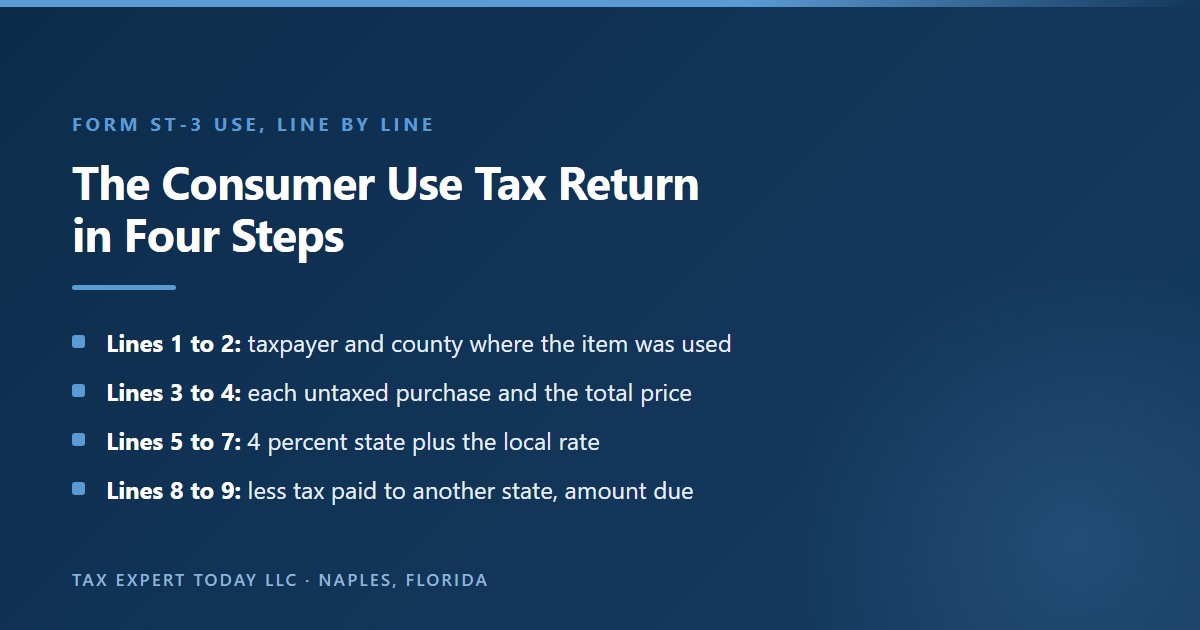
Form ST-3 USE has nine numbered lines. You identify yourself and the county of use, list each untaxed purchase, total the prices, apply the 4 percent state rate and the local rate, add them, subtract sales tax paid in other states, and pay the remainder. The table below follows the Department’s own line instructions.
- Lines 1 and 2 identify the taxpayer and the county where the property was used.
- Lines 3 and 4 list and total the purchases.
- Lines 5 through 7 compute state and local use tax.
- Lines 8 and 9 apply the credit and show the amount due.
| Line | What the Department’s instructions say to enter | Practical point |
|---|---|---|
| 1 | Name and address, including county of residence | Enter the SSN or FEIN in the identification boxes |
| 2 | County where the property was used, if not the county of residence | Drives the local rate on line 6 |
| 3 | Each purchase of tangible personal property subject to use tax: seller, description, date, sales price | Sales price includes shipping, handling, and service charges, less cash discounts |
| 4 | Total of all purchases from line 3 | Attach additional sheets if needed |
| 5 | Line 4 multiplied by the 4 percent state use tax rate | The state portion |
| 6 | Line 4 multiplied by the applicable local tax rate | Combined chart rate minus 4 percent |
| 7 | Lines 5 and 6 added together | Total Georgia use tax before credit |
| 8 | Sales tax paid to another state on any item on line 3 | Keep the invoice showing the tax paid |
| 9 | Line 7 minus line 8 | Total use tax due and payable; sign and date the return |
The instructions to line 6 give the rate method: apply the rate for the jurisdiction where the property was received, or, if the property was transported from another state, the rate of the jurisdiction where it was first used. The combined rate on the rate chart includes the 4 percent state rate, so the local rate is found by subtracting 4 percent. The form’s own example uses Bacon County: if the chart shows a 7 percent total, the county rate is 3 percent. The October 1, 2026 chart lists Bacon County at 8 percent, which is a reminder that the example on a form can be older than the current rate and that the current chart controls.
Line 3 is the line that needs the most care. Each purchase should be listed with the seller’s name and address, a description, the purchase date, and the sales price. The date matters because the local rate in effect for the period applies, and the description matters because it shows the Department what the item was if the return is reviewed. Purchases that were exempt, such as qualifying items covered by a valid exemption, should not be listed.
Line 9 is signed under a declaration that the return has been examined and is true, correct, and complete to the knowledge and belief of the signer. A taxpayer who is unsure whether a purchase is taxable, or how the credit for tax paid elsewhere should apply, should resolve that question before signing rather than after.
How Do Registered Dealers Report Use Tax on Form ST-3?
Registered dealers report use tax inside their regular sales and use tax return on the Georgia Tax Center. They enter the use tax accrued for each jurisdiction code with a reason code from 01 to 04, separated by location if they file a consolidated return. Use tax is added to sales tax to reach the total due for the period.
- Same return, separate section: use tax is reported apart from sales tax collected from customers.
- Jurisdiction code: 000 for the state, three digits for each county, letters for Atlanta and special cases.
- Reason code: required for each use tax entry.
- Electronic filing: required when more than $500 is owed on any sales and use tax return.
The Department’s filing tips list what a dealer needs before filing: total sales sourced to Georgia, exempt sales, sales tax collected, taxable sales by location and jurisdiction code, and use tax accrued, separated by location, jurisdiction code, and reason. It explains that jurisdictions are identified by a three digit number, with the state at 000 and Appling County at 001, and that sales and uses sourced to the City of Atlanta must be reported with the combined codes 044A for DeKalb County inside Atlanta and 060A for Fulton County inside Atlanta.
The older printed instructions for Form ST-3 describe the structure that the electronic return still follows. Part A summarizes the return, with a line for total sales tax and a separate line for total use tax. Part B holds a sales tax distribution table and a use tax distribution table, and transportation special purpose taxes are reported separately in Part C. The use tax table asks, for each entry, the jurisdiction of use, which the instructions define as the county in which the product or service was first used in Georgia, and the reason code.
The Department’s filing guidance adds the electronic filing rule. A taxpayer that owes more than $500 in connection with any sales or use tax return must file and pay electronically, even if later payments fall below $500, under Rule 560-3-2-.26. The penalty table on the Department’s site shows a separate penalty for failing to file electronically and another for failing to pay electronically when required.
Businesses with four or more separate locations are expected to file a consolidated return under a master sales tax number, and in that case the Department asks for sales, collected tax, and use tax accruals to be broken down by each location’s sales tax number. A multi location business accruing use tax centrally should make sure its records can assign each accrual to the location and county where the property was first used.
What Do the Georgia Use Tax Reason Codes Mean?
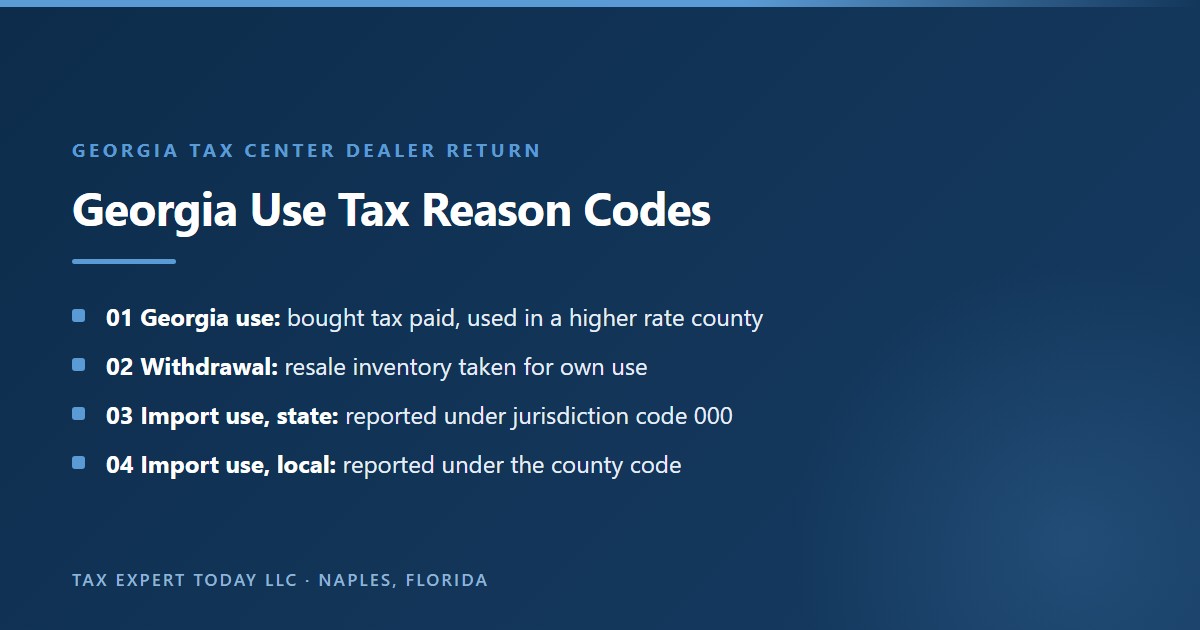
The Georgia use tax reason codes tell the Department why use tax is being reported. Code 01 is a county rate difference, code 02 is a withdrawal from inventory, code 03 is import use for state tax, and code 04 is import use for local tax. Each use tax entry on the dealer return carries one of these codes.
- 01, Georgia use: bought tax paid in Georgia and used in a county with a higher local rate.
- 02, withdrawal from inventory: resale stock taken for the business’s own use.
- 03, import use, state: property brought in or bought without Georgia tax, state portion, code 000.
- 04, import use, local: the local portion of the same import transaction.
| Reason code | Department description | Jurisdiction code to use | Department example |
|---|---|---|---|
| 01 | Georgia use: item purchased tax paid in Georgia and used in another county having a higher local tax rate (local tax only) | The county of use | $600 item bought at 6 percent and used where the rate is 8 percent: $12 of local use tax |
| 02 | Withdrawal from inventory | The jurisdiction where the withdrawal occurs | A $700 table moved from a manufacturer’s inventory to its break room |
| 03 | Import use (state tax only) | Must be the state code 000 | An $800 item bought online with no tax charged: the state portion |
| 04 | Import use (local tax only) | The county where the buyer takes possession | The local portion of the $800 online purchase, or local tax on a $900 item after a full state credit |
Codes 03 and 04 always travel together for an untaxed import, because the state portion must be reported under the state jurisdiction code and the local portion under the county code. The Department’s $800 example shows the split: the purchaser multiplies the state rate by $800 and reports it with reason code 03, then multiplies the applicable local rate by $800 and reports it with reason code 04. When a credit for tax paid to another state wipes out the state portion, as in the $900 example where 5 percent was paid elsewhere, only a code 04 entry remains.
The current Department filing tips describe code 02 as applying to local tax only, while the older printed instructions describe a withdrawal as owing combined state and local use tax. A dealer should follow the fields the Georgia Tax Center return presents for the period and, where the screens are not clear, confirm with the Department rather than guess. Using the wrong code generally does not change the total tax owed, but it can send the local share to the wrong jurisdiction and lead to correspondence.
“Georgia use tax reason code” is one of the related searches that appears for this topic. The short answer is the four line list above. The longer answer is that reason codes are a classification of why tax is owed, and the classification follows from facts the business should already be recording: where the property was bought, whether tax was paid, and where it was first used.
How Do You Calculate Georgia Use Tax? Worked Examples
Multiply the taxable sales price, including shipping, by the 4 percent state rate and by the local rate for the county of use, then subtract like tax paid to another state. The examples below are hypothetical and use rates from the October 1, 2026 rate chart. They illustrate the method only.
- Step one: confirm the item is taxable and was not taxed by the seller.
- Step two: find the sales price including shipping and handling.
- Step three: apply the state rate and the local rate for the county of use.
- Step four: subtract tax legally paid to another state, never foreign tax.
| Hypothetical scenario | Base | State use tax | Local use tax | Total due |
|---|---|---|---|---|
| Laptop bought online for $1,450 plus $50 shipping, delivered in Gwinnett County (6 percent combined) | $1,500 | $60 | $30 | $90 |
| Office furniture from an out of state vendor for $12,000, delivered in Fulton County inside Atlanta (8.9 percent combined) | $12,000 | $480 | $588 | $1,068 |
| Equipment bought in a state with a 5 percent rate for $20,000, tax paid there, used in Chatham County (7 percent combined) | $20,000 | $0 after the $1,000 credit covers the $800 state portion | $600 | $600 |
| Supplies bought tax paid at 6 percent for $5,000 and used on a job in Muscogee County (9 percent) | $5,000 | Already paid | $150 (3 percent difference, reason code 01) | $150 |
| Display units worth $3,000 withdrawn from resale inventory in Clarke County (8 percent) | $3,000 | $120 | $120 | $240 |
The office furniture example shows why the local rate cannot be ignored. Inside the City of Atlanta the local portion, 4.9 percent, is larger than the state portion. A business that accrues only the 4 percent state tax on untaxed purchases will underpay by more than half in that jurisdiction.
The equipment example follows the Department’s approach of applying the other state’s tax against the Georgia state portion. The other state’s $1,000 exceeds the $800 Georgia state portion, so no state use tax remains, but the full Chatham County local rate applies to the $20,000. As noted in the credit section above, Form ST-3 USE nets the credit against the combined subtotal, and a taxpayer with tax paid at both state and local levels elsewhere should confirm the treatment for the specific local taxes involved.
The inventory withdrawal example applies the full combined rate to fair market value, following the Department’s printed manufacturer example. As discussed in the reason code section, the current electronic return should be followed for how the withdrawal is split between state and local fields.
None of these examples involves a client. They are arithmetic illustrations built on the published rate chart, and the result in any actual matter depends on the item, the documents, the county, and the period.
When Is Georgia Use Tax Due?
Georgia sales and use tax returns are due on the 20th day of the month after the period being reported, under O.C.G.A. 48-8-49. Monthly filing is the default, with quarterly or annual filing on request. When the 20th falls on a weekend or holiday, the Department’s due date calendar moves it to the next business day.
- Monthly filers: the 20th of the following month.
- Quarterly filers: the 20th of the month after the quarter ends.
- Annual filers: January 20 of the following year, or the next business day.
- Zero returns: a registered dealer must file even when no tax is due.
The Department’s due date calendar lists the dates for the remainder of 2026. These are the dates printed by the Department; they reflect the weekend adjustment.
| Period | Return and payment due on or before |
|---|---|
| September 2026 and the third quarter of 2026 | October 20, 2026 |
| October 2026 | November 20, 2026 |
| November 2026 | December 21, 2026 |
| December 2026, the fourth quarter of 2026, and the 2026 annual return | January 20, 2027 |
The Department’s filing guidance states that sales tax returns are due no later than the 20th day of the month following the period being reported, under O.C.G.A. 48-8-49 and Rule 560-12-1-.22, that most taxpayers file monthly, and that a taxpayer may submit a written request to change its filing frequency. It also states that a sales tax return must be filed even when no tax is due or no sales were made. Dealers whose state tax liability in the prior calendar year exceeded $60,000, excluding local taxes, must also remit prepaid estimated tax.
For use tax specifically, the period that matters is the period in which the property was first used, stored, or consumed in Georgia. A business that discovers in March an untaxed purchase from the previous November should report it for November, not March, because the tax and the interest both run from the original due date. Reporting it late in the current period understates the interest and can leave the earlier period open.
What Penalties and Interest Apply to Unpaid Georgia Use Tax?
Under O.C.G.A. 48-8-66 the failure to file and failure to pay penalties for sales and use tax are each the greater of 5 percent of the tax or $5 per month, capped at the greater of 25 percent or $25. A false or fraudulent return carries 50 percent. Interest runs at the prime rate plus 3 percent.
- Failure to file: greater of 5 percent or $5, plus the same for each additional month late.
- Failure to pay: computed the same way and assessed separately.
- Fraud: 50 percent of the tax due.
- Interest: Federal Reserve prime rate plus 3 percent, reviewed each January.
The Department’s penalty and interest page lists the sales and use tax penalties and their statute, and it states that multiple penalties may be assessed at the same time. The table below summarizes the items that most often apply to use tax.
| Penalty or charge | Rate | Maximum | Statute cited by the Department |
|---|---|---|---|
| Failure to file a sales and use tax return | Greater of 5 percent of the tax or $5, plus the same for each additional late month | Greater of 25 percent of the tax or $25 | O.C.G.A. 48-8-66 |
| Failure to pay the tax due | Greater of 5 percent of the tax or $5, plus the same for each additional late month | Greater of 25 percent of the tax or $25 | O.C.G.A. 48-8-66 |
| False or fraudulent return | 50 percent of the tax due | None listed | O.C.G.A. 48-8-66 |
| Failure to file electronically when required | Greater of $25 or 5 percent of the tax due | None listed | O.C.G.A. 48-2-44.1 |
| Failure to pay electronically when required | 10 percent of the tax due | None listed | O.C.G.A. 48-2-32(f) |
| Interest on past due tax | Prime rate plus 3 percent per year, accruing monthly | None | O.C.G.A. 48-2-40 |
The interest rule is the one that compounds the cost of an old use tax gap. The Department states that interest on past due taxes accrues monthly from the date the tax was due until it is paid, at an annual rate equal to the Federal Reserve prime rate plus 3 percent for interest accruing since July 1, 2016, reviewed and possibly adjusted each January. Interest is not a penalty and is generally not waived, even in programs that waive penalties.
For a hypothetical $10,000 of use tax that was never reported, the failure to file and failure to pay penalties together can reach 50 percent of the tax once each reaches its 25 percent cap, before interest. That arithmetic is the main reason to address a known gap through the routes discussed below rather than waiting for the Department to find it. Once an assessment is final, unpaid balances move into collection, which is explained in our guide to the Georgia Department of Revenue payment plan.
Why Is Use Tax a Frequent Sales and Use Tax Audit Issue?
A sales and use tax audit looks at purchases as well as sales, and untaxed purchases are often where adjustments arise. A business can collect sales tax perfectly from customers and still be assessed use tax on equipment, supplies, and inventory withdrawals that were never taxed. The Department lists sales and use tax among the audits it conducts.
- Purchase side review: auditors examine fixed asset additions and expense accounts, not only sales.
- Vendor patterns: repeated invoices without Georgia tax from the same vendor are easy to spot.
- Sampling: results from a sample period may be projected across the audit period.
- Proposed assessment: a taxpayer has 45 days from the notice date to protest.
The Department’s audits page states that it conducts a variety of audits, including individual income tax, business tax, and sales and use tax, within Georgia and throughout the country, and that a taxpayer is entitled to protest a proposed assessment within 45 days of the date printed on the Notice of Proposed Assessment. The protest and appeal path that follows an audit is explained in our guide to the Georgia Tax Court and the former Tax Tribunal. For a business, the use tax portion of a sales and use tax audit typically centers on the fixed asset register, the accounts payable detail, and the general ledger accounts where supplies and equipment are recorded.
Use tax findings tend to repeat across periods because they come from a process gap rather than a single mistake. If a vendor never charged Georgia tax, every invoice from that vendor during the audit period is likely to be affected. That is why a business that finds one untaxed vendor in its own review should look at the whole relationship and every similar vendor before deciding how to correct it.
Because use tax depends on facts the taxpayer controls, such as where property was first used, whether an exemption applied, and whether tax was paid elsewhere, the strength of the taxpayer’s records often decides the size of an assessment. A business that can produce the invoice showing tax paid to another state, the equipment log showing more than six months of use outside Georgia, or the exemption certificate that covered a purchase can narrow an adjustment. A business without those records may face an assessment on the full price.
What Records Should You Keep to Support Georgia Use Tax?
Keep purchase invoices, records of where each item was received and first used, proof of tax paid to other states, inventory withdrawal logs, and exemption documents. The Department says sales and use tax records must be kept for at least three years under O.C.G.A. 48-8-52 and 48-8-53.
- Invoices showing the price, shipping, and any tax charged, with the jurisdiction.
- Delivery and use records tying each item to a Georgia county and a date.
- Out of state tax proof for any credit claimed.
- Withdrawal logs for resale inventory used internally.
- Exemption support for purchases claimed as exempt.
The Department’s filing guidance states that records must be maintained for no less than three years, and that they include records of sales and purchases, the books of account needed to determine the tax due, and all invoices and other records of property subject to sales or use tax. Three years is the minimum. When a return was never filed, or when a voluntary disclosure or audit reaches further back, older records can still decide the outcome, so many businesses keep purchase records for longer.
The records that matter most for use tax are the ones that answer the questions the tax turns on. Was tax charged, and was it Georgia tax at the right rate? Where was the property received and where was it first used? Was it used outside Georgia, and for how long? Was it bought for resale or under an exemption, and was it later used another way? An invoice alone answers only the first question. A purchasing process that records the destination location, and a fixed asset system that records the in service date and location, answer most of the rest.
For individuals, the record set is simpler: the receipt or invoice, proof of delivery, and, for a credit, proof of the other state’s tax. For a large purchase such as a boat or aircraft, the bill of sale, delivery documents, registration records, and any documents supporting a casual sale exclusion should be kept with the return.
Can the Voluntary Disclosure Program Fix Years of Unreported Use Tax?
Often, if the Department has not yet contacted you. Georgia’s Voluntary Disclosure Agreement program usually waives penalties and limits how far back you must pay, with a look back for sales and use tax of usually thirty six months. Interest is still charged on all amounts due.
- Eligibility: no prior contact from the Department for enforcement on that tax.
- Penalties: generally waived for all periods in the agreement.
- Look back: usually thirty six months for sales and use tax, longer where tax was collected but not remitted.
- Interest: charged on all amounts due.
- Payment: generally in full within 90 days, with other terms possible on request.
The Department’s Voluntary Disclosure Agreement page says the program encourages taxpayers with unfiled or underreported liabilities who have not yet been contacted to come forward. To qualify, the taxpayer must not have been contacted by the Department for enforcement purposes about that tax obligation, must be compliant with all other Georgia tax obligations not covered by the agreement, and must submit an application. Qualified participants usually receive a waiver of all penalties and a limit on the look back period. For sales and use tax, the look back is usually thirty six months but is extended as far back as necessary to recover taxes that a taxpayer collected but did not remit.
That last condition separates two kinds of sales and use tax problems. A business that failed to accrue use tax on its own purchases never collected anything from anyone, so the extended look back for collected but unremitted tax does not apply to that use tax. A business that collected sales tax from customers and kept it is in a different and more serious position. Use tax gaps are usually the first kind.
The Department’s filing guidance adds that full payment is generally required within 90 days to participate, but that a taxpayer unable to pay in full can propose a monthly amount in the application. Anonymous requests are accepted if they include the name and contact information of a taxpayer representative, which allows a business to learn the terms before identifying itself. The Department also notes that businesses with exposure in several states may consider the Multistate Tax Commission’s voluntary disclosure program as a single point of contact.
Voluntary disclosure is a judgment call, not an automatic answer. A business with a small, recent gap may simply file amended returns or pay the use tax for the open periods. A business with a large or long running gap usually benefits from the penalty waiver and the defined look back. The decision should be made before any contact from the Department, because contact generally ends eligibility for that tax.
What If the Department Assesses Use Tax You Do Not Owe?
Respond to the notice by its deadline. A proposed assessment can be protested within 45 days of the date printed on it, and an official assessment can be appealed to the Georgia Tax Court. If the tax is owed but cannot be paid at once, a payment plan or, in limited cases, an offer in compromise may be available.
- Protest: within 45 days of the Notice of Proposed Assessment date.
- Appeal: official assessments go to the Georgia Tax Court since July 1, 2026.
- Payment plan: for use tax that is owed but cannot be paid in full.
- Refund claim: for use tax paid in error, within three years of payment.
A use tax assessment usually comes out of an audit, and the issues are usually factual: whether an item was taxable, whether tax was paid to the seller or to another state, where the property was first used, whether the six month rule applies, or whether an exemption covered the purchase. A protest is the place to present the documents that answer those questions. Our guide to the Georgia Tax Tribunal and the new Georgia Tax Court explains the protest and appeal deadlines and how a case moves from the Department to the court.
When the tax is correct but the balance is more than the business can pay at once, the Department offers installment arrangements, which are explained in our guide to the Georgia Department of Revenue payment plan. A request for a payment plan can waive the right to protest or appeal the liabilities it covers, so a taxpayer who disputes part of an assessment should decide on the dispute first. In narrower cases where the balance cannot be collected in full, the Georgia offer in compromise program may be an option.
The reverse situation, use tax paid that was not owed, is handled as a refund claim. The Department’s Taxpayer Bill of Rights states that a claim for a refund of taxes other than income tax may be filed within three years after the date the taxes were paid. A business that discovers it accrued use tax on exempt purchases, or paid Georgia tax on items that were used outside Georgia, should review the three year window before it closes.
Use tax disputes are state tax matters handled with the Georgia Department of Revenue, not with the IRS. Representation before the Department and before the Georgia Tax Court follows Georgia’s own authorization and court rules, and our firm coordinates with Georgia licensed counsel where a matter requires it.
How Does Georgia Use Tax Differ From Georgia Sales Tax?
Georgia sales tax and use tax share the same rates, base, and exemptions, but they differ in who reports the tax and when it arises. Sales tax is collected by the seller at the sale. Use tax is self assessed by the buyer when untaxed property is first used, stored, or consumed in Georgia.
- Who collects: the seller for sales tax, the buyer for use tax.
- When it arises: at the sale for sales tax, at first use in Georgia for use tax.
- Return: the seller’s Form ST-3 for sales tax, Form ST-3 or Form ST-3 USE for use tax.
- Same rate and base: 4 percent state plus local, with the same exemptions.
| Feature | Georgia sales tax | Georgia use tax |
|---|---|---|
| Who is responsible for reporting | The registered seller | The buyer |
| Event that triggers the tax | A retail sale sourced to Georgia | First use, storage, distribution, or consumption in Georgia of untaxed property |
| Rate | 4 percent state plus local | 4 percent state plus local |
| Local rate sourced to | Generally where the buyer receives the property | Where received, or where first used for property brought from another state |
| Return | Form ST-3 on the Georgia Tax Center | Form ST-3 for registered dealers, Form ST-3 USE for others |
| Credit for tax paid to another state | Not applicable | Like tax paid to another state reduces the Georgia tax |
| Typical audit focus | Exempt sales and certificates | Untaxed purchases and inventory withdrawals |
The two taxes meet at the exemption certificate. When a buyer gives a seller a resale or exemption certificate, the seller does not collect sales tax, and if the buyer later uses the property in a way the exemption does not cover, the buyer owes use tax. The seller’s side of that transaction, including when a seller can rely on a certificate in good faith, is explained in our Georgia sales tax exemption guide. Businesses that also sell into Texas face a parallel set of seller side questions, which our guide to Texas sales tax nexus covers.
A business that is a registered Georgia dealer handles both taxes on the same return. That convenience is also a trap: because the return already exists and is filed every month, a business may assume it covers everything, when in fact the use tax section is only as complete as the purchase review behind it.
Can You Deduct Georgia Use Tax on Your Federal Return?
For individuals who itemize and elect to deduct general sales taxes instead of state income taxes, a compensating use tax is treated as a general sales tax under IRC 164(b)(5)(E), subject to the state and local tax cap of $40,400 for 2026. For a business, use tax on property is generally part of the cost of that property.
- Individuals: Georgia use tax can count with sales taxes if the sales tax election is made.
- The cap: $40,400 for tax years beginning in 2026, reduced above $505,000 of modified adjusted gross income, never below $10,000.
- Business equipment: use tax is generally capitalized into the asset’s basis.
- Business supplies: use tax is generally deducted with the cost of the supplies.
Under IRC 164(b)(5), an individual may elect to deduct state and local general sales taxes instead of state and local income taxes. Subparagraph (E) provides that a compensating use tax with respect to an item is treated as a general sales tax, where the use tax complements a general sales tax and a deduction would be allowed for similar items sold at retail in the taxing jurisdiction. Georgia use tax is that kind of complementary tax. Because Georgia also imposes an income tax, most Georgia residents compare the two and deduct whichever is larger, and the sales tax election tends to matter in years with a large taxable purchase.
The deduction is subject to the limitation in IRC 164(b)(6) and (7). The applicable limitation amount is $40,000 for tax years beginning in 2025 and $40,400 for tax years beginning in 2026, half that for a married individual filing separately. It is reduced by 30 percent of modified adjusted gross income above a threshold of $500,000 for 2025 and $505,000 for 2026, but not below $10,000. Property taxes count against the same limit.
For a business, the federal treatment generally follows the property. Section 164(a) provides that a tax paid in connection with the acquisition of property is treated as part of the cost of that property, so use tax on equipment is usually added to its depreciable basis rather than deducted at once, while use tax on consumable supplies is generally deducted with the supplies. How the cost is then recovered depends on the depreciation rules that apply to the asset.
What Georgia Use Tax Mistakes Cost Businesses and Individuals Money?
The costly mistakes are accruing only the 4 percent state rate, ignoring shipping in the base, assuming a service business owes nothing, missing inventory withdrawals, applying the wrong county, and claiming a credit for foreign tax. Each one either understates the tax or leaves a record gap that an audit fills against the taxpayer.
- State rate only: local tax is often half or more of the total.
- Shipping left out: delivery charges by the seller are part of the base.
- No dealer account, no tax assumed: service firms still owe use tax on what they consume.
- Withdrawals ignored: resale stock used internally is taxable.
- Wrong credit: foreign value added tax is never creditable.
A few other errors are worth naming. Reporting a past purchase in the current period understates interest and leaves the original period open. Using a rate from a third party site rather than the Department’s quarterly chart can apply a rate that has since changed. Relying on the change of domicile exemption for equipment used in a business misreads O.C.G.A. 48-8-3(19). Treating an invoice that shows tax as proof of Georgia tax, without checking that the tax was Georgia tax at the delivery county’s rate, can leave a balance owed. And assuming that a large online retailer always collected Georgia tax, without looking at the receipt, can miss purchases from its third party sellers or business accounts set up as exempt.
Most of these mistakes come from the same source: use tax is computed after the fact from purchase records that were never designed to answer use tax questions. The fix is usually a small change in process, such as a vendor flag, a destination field on purchase orders, and a monthly accrual, rather than a large project.
Georgia Use Tax Help in Naples & Southwest Florida
Tax Expert Today LLC works from Naples, Florida and handles state tax matters nationwide, including Georgia use tax reviews, Form ST-3 USE preparation, voluntary disclosure applications, and responses to Georgia Department of Revenue sales and use tax audits. Georgia clients are served from the Naples office and do not need to travel to Atlanta.
- Georgia use tax help Naples serves Southwest Florida owners of Georgia businesses and Georgia residents with large out of state purchases.
- Purchase reviews start with the accounts payable ledger and fixed asset additions by Georgia location.
- Disclosure and correction covers voluntary disclosure, amended periods, and refund claims within the three year window.
- Remote engagement is standard. Documents are exchanged through a secure client portal and not by email.
Tax Expert Today LLC
11983 Tamiami Trail N, Naples, FL 34110
Telephone: (239) 441-2005
Hours: Monday through Friday, 10:00 a.m. to 5:00 p.m. Eastern Time
A local question we are asked often: I live in Naples and keep a boat at a marina on Lake Lanier. I bought the boat from a Florida dealer and paid Florida tax. Does Georgia expect use tax too? It may, depending on where the boat was delivered, how long it was used in Florida before it went to Georgia, and how much tax was paid in Florida. Georgia generally credits like tax paid to another state against its use tax, but local Georgia tax at the county of use can still apply, and the six month rule can change the base. The Florida residency side of the question is separate. Our Georgia tax services page describes how Georgia matters are handled from Naples, and our Naples tax planning page covers the Florida side.
When to Engage a Professional
An individual with one untaxed online purchase can usually complete Form ST-3 USE alone. Professional review is worth it when a business has never accrued use tax, equipment moves between states, a large boat or aircraft purchase is involved, a voluntary disclosure is being weighed, or the Department has proposed an assessment.
- A business with no use tax history that buys from out of state vendors.
- Multi state equipment where the six month rule and credits interact.
- A large single purchase such as a boat, aircraft, or production machinery.
- A known gap where voluntary disclosure may limit penalties and the look back.
- A proposed assessment with a 45 day protest window running.
Tax Expert Today LLC brings together tax advisors, enrolled agents, CPAs, and attorneys and serves clients in all 50 states on state tax matters, including Georgia sales and use tax. An engagement for a business usually begins with a review of purchases by vendor and location, a reconciliation of what was taxed at purchase against what should have been, and a recommendation on whether to correct forward only, amend open periods, or apply for voluntary disclosure. Outcomes depend on the facts and the records, and the Department decides assessments, waivers, and agreements. Georgia engagements and related state topics, including the Georgia net worth tax and Georgia withholding tax, are listed on our Georgia tax services page. To discuss a Georgia use tax question, call (239) 441-2005.
Frequently Asked Questions
What is Georgia use tax?
Georgia use tax is the tax a buyer owes when taxable property or a taxable service is used, stored, or consumed in Georgia and Georgia sales tax was not paid at purchase. It is the companion to sales tax, with the same rate, base, and exemptions, and the buyer reports it to the Georgia Department of Revenue.
What is the Georgia use tax rate for 2026?
It is the 4 percent state rate plus the local rate where the property is received or first used. On the Department’s rate chart effective October 1, 2026, combined rates for general jurisdictions range from 6 percent, in counties such as Cobb and Gwinnett, to 9 percent, with the City of Atlanta at 8.9 percent.
Who files Form ST-3 USE?
Individuals and businesses that owe Georgia use tax but are not registered sales and use tax dealers file Form ST-3 USE, the Consumer’s Use Tax Return. Registered dealers report use tax on their regular Form ST-3 return on the Georgia Tax Center, using jurisdiction codes and use tax reason codes.
Do I owe Georgia use tax on online purchases?
You owe it when the item is taxable in Georgia, it is bought for use here, and the seller did not charge Georgia tax at the correct rate. Many large online retailers and marketplaces now collect Georgia tax, so check the receipt. Purchases from sellers that did not collect remain subject to use tax.
Does Georgia give credit for sales tax paid in another state?
Yes. Like sales or use tax legally paid to another state on the same item reduces the Georgia use tax. In the Department’s examples the credit offsets the 4 percent state portion and Georgia local use tax can still be due. No credit is allowed for sales tax or value added tax paid to another country.
Do I owe use tax on belongings I bring when I move to Georgia?
Generally no. Property brought into Georgia because of a change of domicile is exempt under O.C.G.A. 48-8-3(19), as long as it is not brought in for use in a trade, business, or profession. Business equipment that moves with the owner is outside the exemption and can owe use tax.
What are the Georgia use tax reason codes?
Code 01 is Georgia use, an item bought tax paid in Georgia and used in a county with a higher local rate. Code 02 is a withdrawal from inventory. Code 03 is import use for the state tax, reported under jurisdiction code 000. Code 04 is import use for the local tax.
What penalties apply to unpaid Georgia use tax?
Under O.C.G.A. 48-8-66 the failure to file and failure to pay penalties are each the greater of 5 percent or $5 per month, up to the greater of 25 percent or $25. A fraudulent return carries 50 percent. Interest accrues monthly at the prime rate plus 3 percent.
Can I fix years of unreported Georgia use tax?
If the Department has not contacted you about it, the Voluntary Disclosure Agreement program usually waives penalties and limits the look back for sales and use tax to about thirty six months, although interest is still charged. A smaller recent gap can sometimes be corrected by filing or amending the open periods.
I live in Naples, Florida and own a Georgia business. Can you help with Georgia use tax?
Yes. Tax Expert Today LLC handles state tax matters nationwide from its Naples, Florida office at 11983 Tamiami Trail N, including Georgia use tax reviews, Form ST-3 USE preparation, voluntary disclosure, and Georgia sales and use tax audit responses. Call (239) 441-2005 for a free consultation.
Published October 5, 2026 by Dr. Pellumb Kabashi « Back to Learning Center
Have a question this article touches on?
Tax Expert Today LLC, based in Naples, Florida and serving clients across the United States.
Schedule a Consultation (239) 441-2005