
By Dr. Pellumb Kabashi, DBA, MBA, EA, CFE, CES
Founder, Tax Expert Today LLC · Tax advisors, enrolled agents, CPAs, and attorneys · Serving clients in all 50 states
Quick Answer: Georgia Form G-1003 is the annual transmittal employers and payers file with the Georgia Department of Revenue to send copies of the year’s Forms W-2 and 1099 that show Georgia withholding. For 2026, W-2s and 1099-NECs are due with the G-1003 by February 1, 2027, and other 1099s by March 1, 2027. Call (239) 441-2005 for a free consultation.
Georgia Georgia Form G-1003 is a small form with a large job. It does not compute any tax. It tells the Department of Revenue which wage and payment statements back up the Georgia withholding an employer or payer reported during the year, and it delivers those statements so the Department can match them against the individual returns employees and contractors file. When the G-1003 is late, missing, or out of balance with the quarterly returns, the result is usually a per-statement penalty, a mismatch notice to the employer, or a refund hold for an employee whose withholding cannot be found.
Tax year 2026 adds new work. Georgia created limited state subtractions for qualified overtime and cash tips, and the Department now expects that information on the 2026 Forms W-2 and 1099 sent with Georgia Form G-1003. Georgia also stopped accepting 1099 files in the older federal fixed-width format. This guide covers who files, the 2026 and 2027 due dates, the filing methods, the new overtime and tip reporting, the year-end tie-out to Form G-7, corrections, closing a business, and the penalty tiers, with every rule tied to the statute, regulation, or Department guidance behind it.
What Is Georgia Form G-1003?
Georgia Georgia Form G-1003 is the Income Statement Transmittal. Employers and payers file it once a year to send the Department of Revenue copies of the Forms W-2 and 1099 that report Georgia income tax withheld. It is the annual return described in O.C.G.A. 48-7-106, and its totals should agree with the year’s quarterly Forms G-7.
- What it carries: copies of wage and payment statements, not a tax computation.
- Who receives it: the Georgia Department of Revenue, usually through the Georgia Tax Center.
- What it proves: that withholding reported on Form G-7 belongs to named employees and payees.
- Legal basis: O.C.G.A. 48-7-106 for the return and 48-7-105 for the employee copies.
- Related returns: the quarterly Form G-7 and, for some payers, Schedule B.
The statute does not use the name G-1003. O.C.G.A. 48-7-106(b) requires every employer to file “an annual or a final return” on a form prescribed by the commissioner and to attach copies of the statements furnished to employees under Code Section 48-7-105. The same subsection allows the commissioner to accept that information electronically in place of paper copies. Form G-1003 is the form the commissioner prescribed, and the Georgia Tax Center (GTC) is where most of it is now filed.
It helps to see where Form G-1003 sits in the full Georgia payroll cycle. An employee hands the employer a Georgia Form G-4 to set withholding. The employer withholds from each paycheck, deposits on its assigned schedule, and files a quarterly return, which our Georgia Form G-7 guide covers line by line. At year end, the employer issues Forms W-2 to employees and then files Georgia Form G-1003 with copies of those W-2s. The broader rules for registration, rates, and deposit schedules are in our overview of Georgia withholding tax.
| Form | Who completes it | How often | What it does |
|---|---|---|---|
| Form G-4 | Employee | At hire and on changes | Sets the Georgia withholding allowances and filing status |
| Form G-7 | Employer or payer | Quarterly | Reports Georgia tax withheld and paid for the quarter |
| Form GA-V | Monthly payer paying by check | Monthly, when tax is due | Payment voucher, not a return |
| Forms W-2 and 1099 | Employer or payer | Annually | Statement to each employee or payee of pay and tax withheld |
| Form G-1003 | Employer or payer | Annually, or with a final return | Transmits copies of those statements to the Department |
Who Must File Georgia Form G-1003?
Any employer or payer that issued Forms W-2 or 1099 showing Georgia income tax withheld must file Georgia Form G-1003 with copies of those statements. Forms 1099-K and 1099-DA must be sent even without Georgia withholding, and for 2026, Forms 1099 carrying qualified overtime or cash-tip information also go to the Department.
- Employers with Georgia withholding: every W-2 showing Georgia tax in the state boxes.
- Payers with Georgia withholding on 1099s: including 1099-NECs with Georgia tax withheld.
- Forms 1099-K and 1099-DA: required even when no Georgia tax was withheld.
- 2026 overtime and tip information: 1099s reporting it are no longer optional.
- Everyone else: may submit voluntarily but is not required to.
The Department’s 2026 Employer’s Tax Guide states the rule plainly: employers must submit copies of W-2, 1099, and other income statements with Form G-1003 “reflecting payments that are subject to Georgia income tax withholding,” and a substitute form is acceptable if it includes the state wage and tax information. The guide then lists what does not have to be sent. Forms 1099 that do not report Georgia withholding, qualified overtime compensation, or qualified cash tips are not required, and Forms W-2 are not required when the employer has no Georgia withholding to report for its employees.
Two forms are carved out of that relief. The guide says Forms 1099-K and 1099-DA “must be submitted even if there is no Georgia withholding.” For Form 1099-K, Regulation 560-3-2-.26(7)(f) requires anyone who files Form 1099-K with the IRS to file a copy electronically through GTC, either all of the federal 1099-Ks or those for payees with a Georgia address, by the federal filing deadline including extensions. Payment settlement entities and marketplaces should treat that as a Georgia filing obligation in its own right, separate from any withholding account.
The employer side of the rule turns on the withholding account, not on residency. A Florida company with one remote employee living in Georgia, a Georgia company paying a contractor in Georgia who did not provide a taxpayer identification number, and a multistate employer with a single Georgia work site can all owe Form G-1003. A business that registered for a withholding number but withheld nothing still files zero G-7 returns while the account is active, and our guide to the Georgia tax ID number explains how to close an account that is no longer needed.
When Do Forms 1099-NEC Carry Georgia Withholding?
A payer must withhold 6 percent of compensation for labor services physically performed in Georgia and reported on Form 1099-NEC when the contractor gave no taxpayer identification number, gave an incorrect one, or gave an IRS number issued for nonresident aliens. Those 1099-NECs then go to the Department with Form G-1003.
- Rate: 6 percent of the compensation paid.
- Scope: labor services physically performed in Georgia.
- Triggers: missing TIN, incorrect TIN, or a nonresident alien IRS number.
- Reporting: Georgia tax shown on the 1099-NEC and on Form G-7.
- Deadline: with the W-2s, February 1, 2027, for 2026.
Many payers assume 1099-NECs never involve Georgia withholding. Under O.C.G.A. 48-7-101, as summarized in the Department’s guide, a payer must withhold 6 percent of compensation for labor services physically performed in Georgia and reported on Form 1099-NEC when the individual failed to provide a taxpayer identification number, provided an incorrect one under the federal backup withholding standard, or provided an IRS number issued for nonresident aliens. Once a payer withholds under that rule, the 1099-NEC shows Georgia tax and must go to the Department with Form G-1003 by the January deadline.
When Is Georgia Form G-1003 Due for Tax Year 2026?
For tax year 2026, Form G-1003 with Forms W-2 and 1099-NEC is due February 1, 2027, because January 31 falls on a Sunday. Form G-1003 for all other 1099s is due March 1, 2027. A business that stops paying wages files within 30 days after the final wage payment.
- W-2s and 1099-NECs, 2026: February 1, 2027.
- All other 1099s, 2026: March 1, 2027.
- Employee and payee copies: January 31 under O.C.G.A. 48-7-105, moved to the next business day when it falls on a weekend.
- Closed business: 30 days after final wages, with the final Form G-7.
- Tax year 2027: January 31, 2028, and February 29, 2028.
The statute sets January 31 for wage statements and for 1099-NECs that show Georgia withholding, and it keeps the older February 28 date for other 1099s with Georgia withholding. Under O.C.G.A. 48-7-106(a) and (b), the January date applies to calendar years beginning after December 18, 2015. The Employer’s Tax Guide restates the rule and adds that a deadline falling on a weekend or holiday moves to the next business day. The Department’s withholding due date page applies that adjustment and publishes the exact dates.
| Filing | Tax year 2026 | Tax year 2027 | Authority |
|---|---|---|---|
| Form G-1003 with W-2s and 1099-NECs | February 1, 2027 | January 31, 2028 | O.C.G.A. 48-7-106(b); DOR due date page |
| Form G-1003 with all other 1099s | March 1, 2027 | February 29, 2028 | O.C.G.A. 48-7-106(a); DOR due date page |
| Fourth quarter Form G-7 | February 1, 2027 | January 31, 2028 | DOR due date page |
| Statements furnished to employees and payees | January 31, 2027 (a Sunday, so the next business day under the Department’s weekend rule) | January 31, 2028 | O.C.G.A. 48-7-105(a) |
| Form 1099-K copy to Georgia | The federal 1099-K deadline, including extensions | Same rule | Reg. 560-3-2-.26(7)(f) |
| Loan-out company Form G-1003 | On or before February 28 of the following year, electronically | Same rule | 2026 Employer’s Tax Guide |
| Business that stops paying wages | Within 30 days after final wages | Same rule | O.C.G.A. 48-7-106(a) and (b) |
Two of those rows deserve care. The Form 1099-K row follows the regulation, which ties the Georgia copy to the federal deadline including extensions, while the general due date table lists “all other 1099s” for March 1. A payer that relies on a federal extension for Form 1099-K should keep a record of that extension with its Georgia filing. The loan-out row reflects the Employer’s Tax Guide, which says a loan-out company must electronically file Georgia Form G-1003 on or before February 28 of the following calendar year. Where February 28 falls on a weekend, as it does in 2027, the general weekend rule would point to the next business day, but a loan-out company that files by the earlier date avoids the question entirely.
There is no automatic extension for Form G-1003. The guide does allow a written extension request when a business closes and needs more time to file income statements after final wages, but nothing in the guide offers a routine extension for an operating employer. Planning for the deadline is the practical safeguard, and the steps in the January checklist later in this guide are built around that.
Which Forms W-2 and 1099 Go With the G-1003?
Send every Form W-2 that shows Georgia withholding, every Form 1099 that shows Georgia withholding, all Forms 1099-K and 1099-DA, and for 2026 any Form 1099 carrying qualified overtime or cash-tip information. Statements with no Georgia withholding and no 2026 overtime or tip data may be filed voluntarily or through the combined federal and state program.
- Required: W-2s and 1099s with Georgia tax in the state boxes.
- Always required: Forms 1099-K and 1099-DA.
- New for 2026: 1099s with overtime, cash tips, or tipped occupation codes.
- Corrections: Forms W-2c with an amended Form G-1003.
- Not required: statements with none of the above, unless the payer chooses to send them.
| Statement | Send to Georgia with Form G-1003? | 2026 deadline |
|---|---|---|
| Form W-2 with Georgia withholding | Yes | February 1, 2027 |
| Form W-2 when the employer has no Georgia withholding | No, voluntary | Not applicable |
| Form 1099-NEC with Georgia withholding | Yes | February 1, 2027 |
| Form 1099-MISC, 1099-R, 1099-INT, or other 1099 with Georgia withholding | Yes | March 1, 2027 |
| Form 1099 reporting 2026 qualified overtime or cash tips | Yes | By form type, as above |
| Form 1099-K | Yes, electronically, even with no withholding | Federal deadline, including extensions |
| Form 1099-DA | Yes, even with no withholding | Follow the Department’s 1099 schedule |
| Form 1099 with no Georgia withholding, overtime, or tip data | No, voluntary or through the combined program | Not applicable |
| Form G2-FL (loan-out companies) | Yes, attached to the electronic G-1003 | On or before February 28, 2027 |
Form 1099-DA is the federal broker statement for digital asset sales. The Department’s guide lists it next to Form 1099-K as a statement that must reach Georgia whether or not tax was withheld, but the guide does not give it a separate due date, so the safest reading is to file it on the general schedule for “all other 1099s.” Brokers that also face the federal electronic filing threshold will be filing it electronically in any event.
Does the Combined Federal/State Filing Program Cover Georgia?
Only partly. Georgia participates in the IRS Combined Federal/State Filing Program solely for non-wage statements that show no Georgia income tax withheld. Every W-2 and every 1099 with Georgia withholding must be reported directly to the Department of Revenue with Georgia Form G-1003, whatever was filed federally.
- Covered: 1099s with no Georgia withholding.
- Not covered: any statement showing Georgia tax.
- Never covered: Forms W-2.
- Still separate: the Form 1099-K copy through GTC.
- Practical test: if the state box shows Georgia tax, file it with the G-1003.
Georgia participates in the IRS Combined Federal/State Filing Program, but only partly. The Employer’s Tax Guide says only non-wage statements reporting payments that did not have Georgia income tax withheld can be filed through the program, and “all statements containing Georgia income tax withholding must be reported directly to the Department of Revenue.” A payer that relies on the federal program for every 1099 will therefore miss any 1099 that shows Georgia tax. The program never satisfies Form G-1003 for a W-2.
Must You File Georgia Form G-1003 Electronically?
Yes, in most cases. Employers that pay Georgia withholding electronically, whether required or by choice, must file Georgia Form G-1003 and the statements electronically, and anyone federally required to e-file the same statements, generally at 10 or more information returns, must e-file them for Georgia. Paper filing is limited to small payers outside both rules.
- Electronic payers: Regulation 560-3-2-.26(7)(b) names the original and amended G-1003.
- Federal e-file filers: 10 or more information returns in total under IRS rules.
- Form 1099-K filers: always electronic through GTC.
- GTC methods: manual entry, the Excel template, a CSV upload, or a federal format file.
- Paper: Georgia Department of Revenue, PO Box 105685, Atlanta, GA 30348-5685.
Two separate rules push most employers to electronic filing. The first is the payment rule. Under Regulation 560-3-2-.26(7)(b), taxpayers that remit payments by electronic funds transfer, “whether on a mandatory or voluntary basis,” must file associated information returns electronically, including Forms 1099, W-2s, G-2-A, the original G-1003, and the amended G-1003. Because the same regulation requires electronic payment once a withholding return shows more than $500, most active employers are already electronic payers and therefore electronic G-1003 filers. The $500 trigger is explained in our Form G-7 article.
The second is the federal rule. Regulation 560-3-2-.26(7)(c), relying on O.C.G.A. 48-7-54, requires electronic filing of a Georgia document when its federal counterpart must be filed electronically. The IRS e-file information returns page states that starting with tax year 2023, a filer with 10 or more information returns must file them electronically, and that count includes Forms W-2 filed with the Social Security Administration. The Employer’s Tax Guide restates the Georgia result: employers who are federally required to file income statements electronically must file them electronically for Georgia purposes.
Inside GTC, the Department supports four routes for the statements. Smaller employers can key each W-2 or 1099 directly into the online entry screens, which the Department walks through in its G-1003 online entry video. Others import the Department’s Excel template, published on its withholding template page, or a CSV file built to the Department’s layout. Payroll providers usually upload a federal format file. For 2026, every one of those routes has a new version, and the guide is direct about it: “Do not use a prior-year XLS, CSV, or Federal Format layout to report tax year 2026 information.”
| Method | Typical user | 2026 point to watch |
|---|---|---|
| GTC manual entry | Small employers with a handful of statements | Enter Box 12 codes TT and TP, the Box 14b tipped occupation code, and the GA OT field when they apply |
| Excel (XLS) template import | Employers that export from bookkeeping software | Use the tax year 2026 template, not the prior year file |
| CSV upload | Employers and accountants building their own files | Use the new 2026 CSV layouts with the overtime and tip fields |
| Federal format, W-2 (EFW2) | Payroll providers and larger employers | GA OT goes in a Georgia-defined RS record field, since EFW2 has no standard Box 14a field |
| Federal format, 1099 | Payers and transmitters | Georgia no longer accepts the legacy Publication 1220 fixed-width format; use the 2026 IRIS XML format |
| Paper | Small payers outside both electronic rules | Mail to PO Box 105685; certified mail does not speed processing |
A paper filer should use the address the Department publishes for Form G-1003 on its withholding mailing address page, which is different from the boxes used for Form G-7 and Schedule B. The same page warns that certified mail or courier service will not speed processing. Our guide on where to mail a Georgia state tax return collects the other Georgia addresses in one place.
An electronic filer that mails paper instead faces a penalty of its own. The guide summarizes O.C.G.A. 48-2-44.1 this way: a return that was required to be filed electronically and was not is treated as not filed, and the penalty is the greater of $25 per return or 5 percent of the tax due on that return before payments and credits, unless the failure was due to reasonable cause. That rule is written for withholding returns, but it is a good reason not to treat a paper G-1003 as a safe fallback once an employer is an electronic payer.
What Changed on Georgia Form G-1003 for 2026?
For 2026, employers and payers must include qualified overtime and cash-tip information on the Forms W-2 and 1099 sent with Georgia Form G-1003, use the new 2026 templates and file layouts, and submit federal format 1099 files only in the IRIS XML format. The G-1003 form itself has no new overtime or tip total fields.
- New data: overtime and cash-tip information on each statement, not on the transmittal.
- New Georgia code: GA OT in Form W-2 Box 14a for qualifying Railway Labor Act employees.
- New file rules: 2026 XLS, CSV, and federal layouts only.
- Legacy format ended: no Publication 1220 fixed-width 1099 files.
- Unchanged: withholding, Box 16 wages, and Form G-7 for 2026.
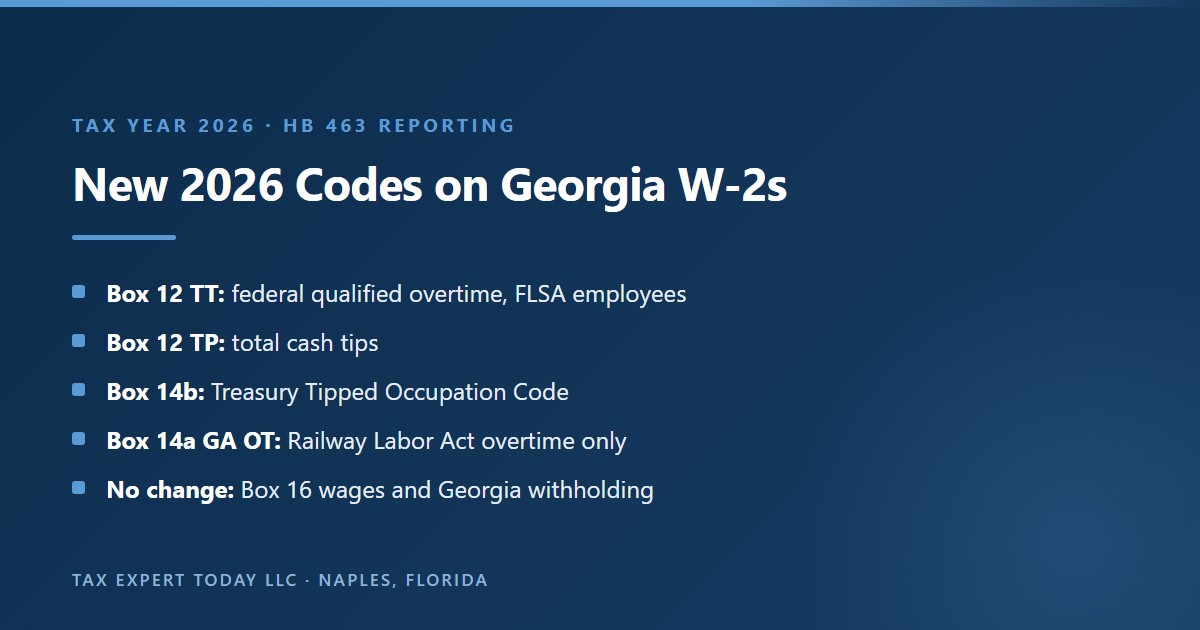
The changes trace to two 2026 laws. According to the Employer’s Tax Guide, HB 1199 updated Georgia’s conformity to the Internal Revenue Code as of January 1, 2026, but Georgia decoupled from the federal exemptions for tips and overtime wages. HB 463, the Georgia Economic Growth and Tax Relief Act of 2026, then created narrower Georgia subtractions for qualified overtime compensation and qualified cash tips. The Department’s Important Tax Updates page summarizes the result for individuals: up to $1,750 of each may be excluded from the calculation of Georgia taxable net income. The same page confirms the 2026 flat rate of 4.99 percent, which is the rate employees will apply on their own returns, as our Georgia state income tax guide explains.
The employer’s role is limited to reporting. The guide says the reporting requirements apply for taxable years beginning on or after January 1, 2026, and ending on or before December 31, 2028, and that reporting the information “does not, by itself, reduce Georgia income tax withholding or the amount reported as Georgia wages in Form W-2, Box 16.” It also says employers should not reduce Georgia withholding because overtime or tips are reported, unless the Department issues separate withholding guidance. In short, the paycheck math for 2026 stays the same, the W-2 carries more detail, and the employee claims the subtraction later on Form 500.
Form G-7 is also unchanged for 2026. The guide tells employers not to report annual overtime or cash-tip totals on Form G-7 for 2026 and says the G-7 forms will be updated beginning in 2027 to collect quarterly employer totals and employee counts. Our Form G-7 article follows that 2027 change as the Department publishes it.
How Do You Report Overtime and Cash Tips on 2026 Georgia W-2s?
Report federal qualified overtime in Form W-2 Box 12 with code TT, total cash tips in Box 12 with code TP, and the Treasury Tipped Occupation Code in Box 14b. For qualifying Railway Labor Act employees, report the full Georgia overtime amount in Box 14a with code GA OT. Never reduce any figure by the $1,750 limit.
- FLSA overtime: Box 12, code TT, when the IRS requires it.
- Railway Labor Act overtime: Box 14a, code GA OT, full amount.
- Cash tips: Box 12, code TP, plus the Box 14b TTOC.
- Georgia cash-tip code: none required.
- The $1,750 limit: applied by the employee, not the employer.
| Item | Where it goes on Form W-2 | Georgia rule from the 2026 guide |
|---|---|---|
| Federal qualified overtime, FLSA employees | Box 12, code TT | Report as the IRS requires; do not reduce by the $1,750 Georgia limit |
| Georgia overtime, qualifying Railway Labor Act employees | Box 14a, code GA OT | Full hourly-component amount under the bargaining agreement, even when Box 12 code TT is blank or zero |
| Total cash tips | Box 12, code TP | Federal field only; Georgia has no separate cash-tip code |
| Tipped occupation | Box 14b, Treasury Tipped Occupation Code | A TTOC must be entered whenever cash tips are reported |
| Georgia wages | Box 16 | Not reduced by overtime or tip reporting |
| Georgia tax withheld | Box 17 | Normal 2026 withholding rules; no reduction for overtime or tips |
The Railway Labor Act rule is the only truly Georgia-specific code. The guide explains that the GA OT amount is based on the applicable collective bargaining agreement, may be reported even when the federal TT amount is blank or zero, and must never be used to report cash tips. The Georgia cash-tip provision does not apply at all to employees whose employment is subject to the Railway Labor Act. Because the federal EFW2 file has no standard field for Box 14a, a payroll provider must carry GA OT in the Georgia-defined RS record field in the Department’s 2026 federal format specifications.
Tipped occupation codes need their own review. The guide notes that when code 000 is reported together with a qualifying TTOC, only the portion of cash tips attributable to the qualifying occupation may be considered for Georgia purposes. An employer with staff who move between tipped and non-tipped roles, such as a server who also works some shifts as a host, should confirm that the payroll system tracks tips by occupation before the W-2s are generated, not after.
How Are Overtime and Tips Reported on Georgia 1099s for 2026?
Payers follow the federal Form 1099 instructions for the overtime and cash-tip boxes and enter the tipped occupation code, then use the matching fields on the 2026 GTC template or CSV layout. Reporting overtime on a 1099 does not by itself qualify the payee for the Georgia overtime subtraction.
- Federal boxes: report as the form instructions require.
- TTOC: required whenever cash tips are reported.
- GTC entry: overtime in the field matching the 1099 box.
- Templates: the 2026 1099 template or CSV layout only.
- Eligibility: decided on the payee’s own Georgia return.
Payers that report overtime or cash tips on Forms 1099 follow the federal form instructions for the applicable box and the TTOC, and in GTC they use the matching overtime and tip fields on the 2026 1099 template or CSV layout. The guide adds an important limit: an overtime amount on a federal Form 1099 does not, by itself, qualify for the Georgia overtime subtraction, because the Georgia provision applies to qualifying compensation paid to a full-time employee paid by an hourly wage. The payer still reports the federal figure, and the recipient’s eligibility is decided on the recipient’s own Georgia return.
How Does Form G-1003 Tie Out to Your Forms G-7?
The Georgia tax withheld on all statements sent with Georgia Form G-1003 should equal the total withholding reported on the four Forms G-7 for the year under the same withholding number. Differences usually come from a voided or manual check, a late correction, or a coding error, and they are cheapest to fix before the fourth quarter return is filed.
- Side one: Box 17 on every W-2 plus Georgia tax on every 1099 under that account.
- Side two: withholding on the four Forms G-7, including adjustments.
- Target: a difference of zero before filing.
- Common causes: reversals, manual checks, late bonuses, wrong state coding.
- Fix: correct the payroll record or amend the G-7, then issue matching statements.
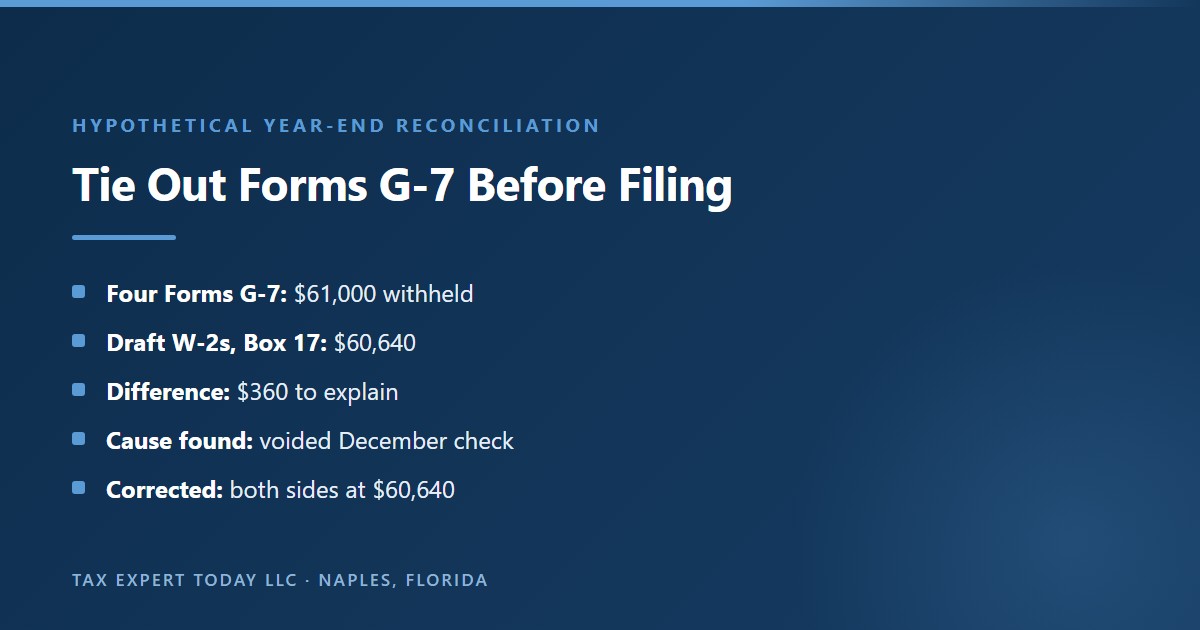
Here is a hypothetical tie-out for a single Georgia withholding account. The four Forms G-7 for 2026 show withholding of $14,200, $15,050, $14,780, and $16,970, for a total of $61,000. The draft Forms W-2 total $60,640 in Box 17, and the account issued no 1099s with Georgia withholding. The $360 difference must be explained before anything is filed. In this example, the payroll register shows a $360 withholding amount on a check that was voided in December and reissued in January, so the December payroll was overstated on the fourth quarter G-7 draft. Correcting the G-7 draft brings both sides to $60,640.
| Step (hypothetical figures) | Amount |
|---|---|
| First quarter Form G-7 withholding | $14,200 |
| Second quarter Form G-7 withholding | $15,050 |
| Third quarter Form G-7 withholding | $14,780 |
| Fourth quarter Form G-7 withholding (draft) | $16,970 |
| Total per Forms G-7 | $61,000 |
| Total Box 17 on draft Forms W-2 | $60,640 |
| Difference to explain | $360 |
| Cause found: voided December check reissued in January | Remove $360 from the fourth quarter draft |
| Corrected total, both sides | $60,640 |
Because the fourth quarter Form G-7 and Form G-1003 share a due date, the order of work matters. Close December payroll, run the reconciliation, correct the fourth quarter G-7 draft or the payroll record, and only then generate the W-2 files. Filing the G-7 first and finding the difference afterward turns a simple draft correction into an amended G-7, a set of W-2c forms, and an amended G-1003.
Multistate employers have one more test to run. The Georgia column on each W-2 should show only Georgia wages and Georgia tax. An employee who moved from Georgia to Florida during the year, or a Georgia resident who worked part of the year in another state, needs state coding that follows the actual work location and residence rules. Our guide to the Georgia part-year resident tax return shows how those employees allocate wages, and a coding error on the W-2 usually surfaces first as a problem on that individual return.
How Do You Correct or Amend a Georgia Form G-1003?
File an amended Form G-1003 with the corrected statements, using the same filing method and standards as the original. All applicable Forms W-2c must accompany an amended G-1003. If the correction also changes Georgia tax withheld or another amount reported on Form G-7, file the matching amended Form G-7 as well.
- Corrected statements: W-2c or corrected 1099 for each affected person.
- Transmittal: an amended Form G-1003, filed the same way as the original.
- Withholding changes: an amended Form G-7 for the affected period.
- Overpayments: Form IT-550 by mail, or a GTC refund request for mandated electronic filers.
- Georgia-only fixes: GA OT corrections must still reach the Department.
The Employer’s Tax Guide sets out the documentation in its frequently asked questions. All applicable Forms W-2c must accompany an amended G-1003. If the amended return creates an overpayment and the refund claim is not required to be filed electronically, a copy of the amended Form G-7 and the applicable W-2c forms are attached to Form IT-550 and mailed to the Withholding Tax Unit, PO Box 105665, Atlanta, GA 30348. Mandated electronic filers request the refund in GTC after the amended return is processed and a credit appears on the account. All amended returns are subject to verification.
The 2026 overtime and tip data adds a correction rule that did not exist before. The guide says that if qualified overtime, cash tips, or TTOC information was omitted or reported incorrectly, the employer submits the corrected statement under federal and Georgia requirements and files an amended Form G-1003 when required. For a Railway Labor Act employee’s GA OT amount, the correction must be reported to the Department “even when the correction is limited to Georgia information” and does not require a federal Box 14a correction. An employer cannot assume that a clean federal file means a clean Georgia file.
Corrections inside the same calendar year are often easier. Under the Form G-7 rules, an error in an earlier quarter of the same year can generally be adjusted on a later return for that year, as our G-7 guide explains. Once the year has closed and Forms W-2 have been issued, the cleaner path is usually the amended G-7 for the affected quarter, Forms W-2c to the employees, and an amended G-1003 to the Department, filed together so the account and the statements agree.
Employees feel these errors first. When a W-2 shows Georgia withholding that never reached the employee’s account, the Department may hold or reduce the employee’s refund while it matches records. If a former employee calls about a Georgia notice, the employer’s best response is a quick reconciliation of that person’s Box 17 against the payroll register and the G-7s, followed by a W-2c and an amended G-1003 if the statement was wrong. Employees whose refund is delayed for other reasons can read our guide to an amended Georgia tax return for the individual side.
What Are the Penalties for a Late Georgia Form G-1003?
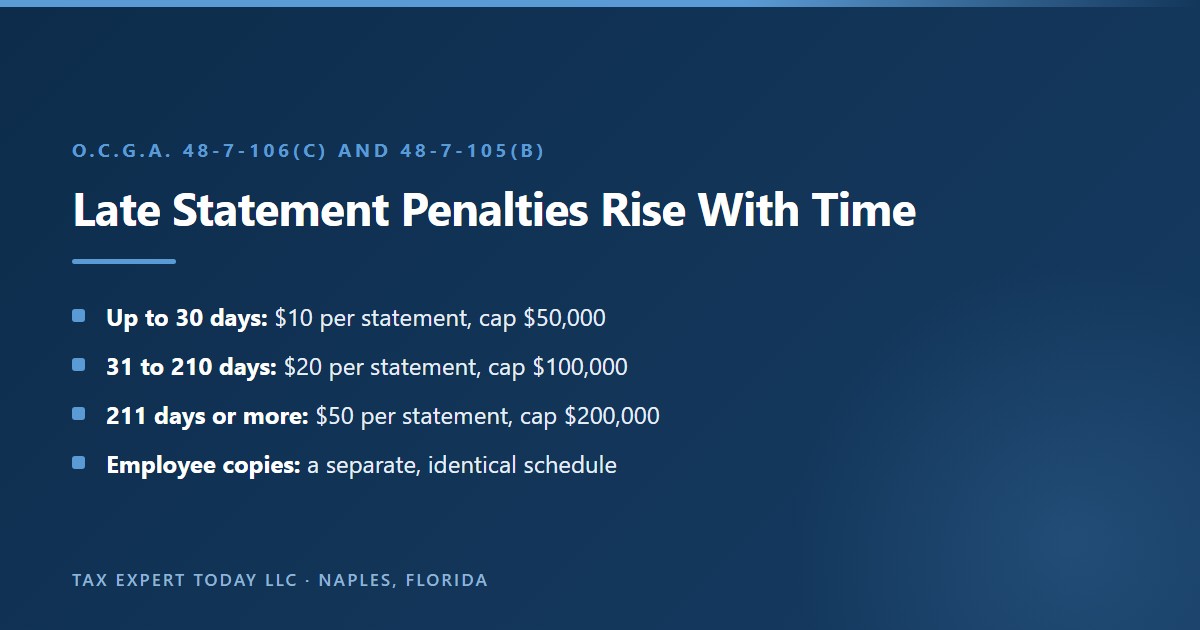
Under O.C.G.A. 48-7-106(c), each statement filed late with the Department costs $10 if filed within 30 days of the due date, $20 if filed 31 to 210 days late, and $50 if filed 211 or more days late, with caps of $50,000, $100,000, and $200,000. A separate, identical schedule applies to late employee copies.
- Up to 30 days late: $10 per statement, capped at $50,000.
- 31 to 210 days late: $20 per statement, capped at $100,000.
- 211 days or more: $50 per statement, capped at $200,000.
- Late employee copies: the same tiers under O.C.G.A. 48-7-105(b).
- False statements: $50 for each fraudulent withholding receipt.
The two penalties are easy to confuse. O.C.G.A. 48-7-106(c) applies when a statement required with the annual or final return “is not filed by an employer with the department” on time. O.C.G.A. 48-7-105(b) applies when the statement is not furnished to the employee on time. The amounts and caps are the same, and the Employer’s Tax Guide lists both schedules in its penalty section. An employer that runs late on both the employee copies and the Department filing can face both.
Here is a hypothetical. An employer with 40 Georgia employees misses the February 1, 2027, deadline and files Georgia Form G-1003 with all 40 Forms W-2 on March 18, 2027, which is 45 days late. Each statement falls in the second tier, so the filing penalty under 48-7-106(c) would be 40 times $20, or $800. If the employees also received their W-2s 45 days late, the employee copy penalty under 48-7-105(b) could add another $800. Had the same employer filed within 30 days, the first tier would have applied at $400 for each penalty.
| Days late (hypothetical 40 statements) | Rate per statement | Filing penalty, 48-7-106(c) | Cap per person |
|---|---|---|---|
| 1 to 30 days | $10 | $400 | $50,000 |
| 31 to 210 days | $20 | $800 | $100,000 |
| 211 days or more | $50 | $2,000 | $200,000 |
Other penalties sit alongside the statement penalties. The fourth quarter Form G-7 shares the February 1 due date, and under O.C.G.A. 48-7-126(c) a late withholding return or payment carries a penalty of $25 plus 5 percent of the tax for the first month and 5 percent for each additional month or fraction, up to $25 plus 25 percent. Section 48-7-126(b) imposes up to $10 per employee per quarter for failing to withhold, and 48-7-126(d) imposes $50 for each false or fraudulent withholding receipt furnished willfully. Interest on unpaid withholding runs under O.C.G.A. 48-2-40, at the rate the Department posts on its penalty and interest rates page.
How Do You Protest or Request a Waiver of a G-1003 Penalty?
Protest a penalty assessment through the Georgia Tax Center or on Form TSD-1, and request a waiver through GTC or by a written explanation that includes a specific waiver request. The Department’s guide says an assessment notice becomes final if no written appeal is filed within 45 days of the notice date.
- Protest: GTC or Form TSD-1, with collection suspended while it is resolved.
- Waiver: GTC or a written request under O.C.G.A. 48-2-43.
- Appeal window: 45 days from the notice date, per the guide.
- Interest: waived only for delays the Department caused.
- Evidence: a dated record of the error and the fix.
The Employer’s Tax Guide describes the process after a penalty is assessed. Notices go by first-class mail to the last known address on the Department’s records, and the guide says the notice becomes final if a written appeal is not filed within 45 days of the notice date. Employers can protest through GTC or on Form TSD-1, and the guide says collection attempts are suspended while the protest is resolved. A penalty waiver can be requested through GTC or by a written explanation that includes a specific waiver request, under O.C.G.A. 48-2-43. Interest is waived only when the Department’s own action or inaction caused the delay.
The reasonable cause language in the statutes matters here. Sections 48-7-126 and 48-2-44.1 both excuse failures due to reasonable cause and not willful neglect. The statement penalties in 48-7-105 and 48-7-106 do not contain the same phrase, so a waiver request for those penalties relies on the general waiver process the guide describes. A dated record of what went wrong, when it was discovered, and how fast it was corrected is the core of any request. Disputes that cannot be resolved with the Department may move to the Georgia Tax Tribunal, and balances that are already assessed may fit a Georgia Department of Revenue payment plan.
What Happens to Form G-1003 When a Business Closes or Is Sold?
A business that stops paying wages must file its final Form G-1003 and income statements within 30 days after the final wage payment, with the final Form G-7. In a sale, O.C.G.A. 48-7-106(d) requires the buyer to hold back enough of the price to cover unpaid withholding until the seller produces a receipt or a clearance certificate.
- Deadline: 30 days after final wages, not the next January.
- Extension: a written request is allowed when a closing business needs more time.
- Final returns: mark the last Form G-7 as final and close the account.
- Buyers: withhold purchase money until withholding is cleared.
- New owners: register a new withholding number.
The 30-day rule surprises owners who wind down in the spring and plan to “do the W-2s in January.” O.C.G.A. 48-7-106(a) and (b) both set the due date for an employer that has ceased to pay wages as the thirtieth day after the final payment of wages. The Employer’s Tax Guide repeats the rule and adds that employers may submit a written extension request if they need more time. Missing that date can start the per-statement penalty clock months before the owner expects any filing to be due.
A sale adds successor exposure. Under O.C.G.A. 48-7-106(d), when an employer liable for withholding tax, interest, or penalties sells the business, its stock of goods, or its equipment, or quits the business, the employer must file the final return, and the successor must withhold enough of the purchase money to cover unpaid withholding amounts until the former owner provides a receipt or a certificate from the commissioner that nothing is due. Subsection (e) goes on to address a purchaser that fails to hold back, which is why buyers usually ask for the certificate at closing. Our guide to Georgia LLC taxes covers the other state accounts an owner should close.
The guide’s filing tips round out the closing steps. An employer must notify the Department to deactivate its withholding number, through GTC or by email to the withholding issues address the guide lists, and a buyer of an ongoing business or an owner who changes entity structure must apply for a new withholding number instead of using the old one. Returns continue to be due while a number is active, so an unclosed account can keep generating zero-return obligations and late filing penalties after the business has stopped.
Which Special Georgia Statements Travel With Form G-1003?
Loan-out companies in the film and interactive entertainment industry attach Forms G2-FL to an electronic Form G-1003 due by February 28. Georgia nonresident withholding statements, such as Forms G2-A, G2-RP, and G2-LP, follow their own rules and addresses, so they should not be assumed to ride along with the wage file.
- Form G2-FL: attached to the loan-out company’s electronic G-1003.
- Form G2-FP: given to the loan-out company, not filed with the Department.
- Form G2-A: named in the electronic filing regulation as an information return.
- Forms G2-RP and G2-LP: mailed to their own PO Box when filed on paper.
- Composite filers: follow the composite return rules instead.
The film withholding system has the clearest link to Form G-1003. The Employer’s Tax Guide says a production company provides Form G2-FP to the loan-out company by January 31, and that form is not submitted to the commissioner. The loan-out company then must electronically file Georgia Form G-1003 on or before February 28 of the following year and attach all Forms G2-FL for the year, which transfer the G2-FP withholding to the loan-out’s employees. The Department explains the two forms on its G2-FP and G2-FL page, and our Georgia film tax credit article covers the credit that drives the system.
Nonresident withholding statements are a different path. Regulation 560-3-2-.26(7)(b) lists Form G-2-A among the information returns that electronic payers must file electronically, and the Department’s mailing page lists a separate box for Forms G2-RP and G2-LP. Partnerships, S corporations, and LLCs withholding on nonresident members under O.C.G.A. 48-7-129 have their own return cycle, which our Georgia composite return guide explains. The point for year-end payroll is simple: confirm which statements belong in the wage file and which belong to another return before a payroll provider builds the upload.
How Long Must Employers Keep G-1003 Records?
Georgia requires employers to keep payroll records for at least four years after the tax is due or paid, whichever is later, under O.C.G.A. 48-7-111. For 2026, the Department adds that the records behind overtime and cash-tip reporting, including bargaining agreements and tipped-occupation records, fall under the same retention rule.
- Retention period: four years after the tax is due or paid, whichever is later.
- Core records: Forms G-4, payroll registers, copies of W-2s and 1099s.
- 2026 additions: overtime computations, TTOC support, bargaining agreements.
- Filing proof: GTC confirmations and upload acknowledgments.
- Reconciliations: the G-7 to W-2 tie-out workpaper for each year.
The guide’s 2026 language on retention is broader than in past years. It says employers should keep “the payroll records, applicable collective bargaining agreements, tipped-occupation records, and other documentation used to support the income statements” under the four-year rule. In practice, that means the support for each TT, TP, TTOC, and GA OT figure should be retrievable by employee and by pay period. If an employee’s Georgia subtraction is questioned, the employer’s records are where the answer will come from.
Filing confirmations deserve the same care. A GTC confirmation number, the file name, the record count, and the total Georgia withholding in the upload are the four facts that resolve most later disputes about whether and when a Georgia Form G-1003 was filed. Saving them in the same folder as the year’s reconciliation takes minutes in February and can save weeks if a notice arrives two years later.
What Mistakes Trigger Georgia W-2 Mismatch Problems?
The most common Georgia Form G-1003 problems are a withholding total that does not match the Forms G-7, statements filed under the wrong withholding number, missing 1099s with Georgia withholding, reliance on the federal combined program for statements that show Georgia tax, prior year file layouts, and late filings after a business closes.
- Unreconciled totals: W-2s and G-7s disagree.
- Wrong account: statements filed under another entity’s number.
- Missed 1099s: 6 percent contractor withholding forgotten at year end.
- Old layouts: 2025 templates or fixed-width 1099 files.
- Closing errors: no final filing within 30 days of final wages.
Each of these has a simple control. Reconcile before generating files. Confirm that the federal employer identification number and the Georgia withholding number on the upload belong to the entity that actually paid the wages, which matters most for groups with several companies and a shared payroll provider. Search the accounts payable system for any 1099 payee with Georgia withholding. Download the tax year 2026 template or layout fresh in late January, since the guide said the 2026 versions would be posted in late October 2026. And calendar a final filing date the day a closing decision is made.
A note on employee records helps prevent the next year’s errors. Ask employees to refresh Form G-4 when their filing status or residence changes, and make sure remote workers’ state coding follows where they actually work. Employers that also owe Georgia unemployment insurance should run a similar year-end tie-out for wages on that side, which our guide to Georgia unemployment tax describes.
Georgia Form G-1003 Checklist for January 2027
Close December payroll, reconcile the year’s Forms G-7 to Box 17 on the draft W-2s, confirm the 2026 overtime and tip fields, download the 2026 GTC template or layout, furnish employee copies, file Georgia Form G-1003 and the fourth quarter G-7 by February 1, 2027, and save the confirmations with the reconciliation.
- Close December payroll and post all voids, manual checks, and year-end bonuses.
- Reconcile the four Forms G-7 against total Box 17 withholding and any 1099 Georgia tax.
- Correct the fourth quarter G-7 draft or the payroll record until the difference is zero.
- Review 2026 codes: Box 12 TT and TP, Box 14b TTOC, and Box 14a GA OT where it applies.
- Confirm the filing method: electronic if you pay electronically or file 10 or more information returns.
- Use 2026 files only: the 2026 XLS template, CSV layout, or federal format, and IRIS XML for 1099s.
- Furnish statements to employees and payees by the January 31 deadline, moved to the next business day in 2027.
- File Form G-1003 with W-2s and 1099-NECs and the fourth quarter G-7 by February 1, 2027.
- File Form G-1003 for other 1099s by March 1, 2027, and Forms 1099-K on the federal schedule.
- Save the GTC confirmation, record counts, and the reconciliation workpaper for at least four years.
Employers who outsource payroll should still run steps two through four themselves or ask the provider for the reconciliation in writing. The provider files what the payroll system holds, and the employer remains the party responsible for the account. Asking for the G-7 to W-2 tie-out, a sample of the 2026 overtime and tip coding, and the file acknowledgment is a reasonable request before February 1.
Georgia Form G-1003 Help in Naples & Southwest Florida
Tax Expert Today LLC advises on Georgia payroll reporting questions from its office in Naples, Florida, and serves Georgia employers and payers nationwide and remotely. We review year-end reconciliations, late or incorrect Form G-1003 filings, Forms W-2c and amended returns, penalty notices, closing filings, and the multistate issues that come with Georgia employees.
- Office: 11983 Tamiami Trail N, Naples FL 34110.
- Phone: (239) 441-2005.
- Hours: Monday through Friday, 10 a.m. to 5 p.m. Eastern.
- Georgia Form G-1003 help Naples: Naples and Southwest Florida in person, Georgia and all 50 states remotely.
Many Southwest Florida business owners employ people in Georgia, pay Georgia contractors, or hold an interest in a Georgia company, and the year-end filing often lands on a Florida bookkeeper who has never handled a Georgia account. We work as tax advisors on state tax matters nationwide, and a review of a Georgia year-end filing often connects to the owner’s Georgia nonresident return, entity structure, and Florida planning. For the full range of our Georgia work, see the Georgia tax services page. Owners who want to plan around multistate payroll can start with our Naples tax planning page.
When to Engage a Professional
Engage a tax professional if your Forms G-7 and W-2s do not reconcile, you missed a G-1003 deadline, you received a Department of Revenue notice, you must report 2026 overtime or tip data, you are closing or buying a business, or you need to correct statements from a prior year. Early review can limit avoidable penalties.
- Reconciliation gaps: differences that payroll records do not explain.
- Late filings: each 30 days can move statements into a higher tier.
- 2026 coding: TT, TP, TTOC, and GA OT decisions by employee.
- Ownership changes: final filings and successor holdbacks overlap.
- Notices: appeal periods run from the notice date.
Tax Expert Today LLC reviews Georgia withholding and income statement filings as part of our wider state and federal tax practice. Our Georgia tax help covers filing reviews, correction plans, penalty waiver requests, and coordination with payroll providers, with the same care for a five-person office as for a multistate employer. We are tax advisors, enrolled agents, CPAs, and attorneys serving clients in all 50 states. Call (239) 441-2005, Monday through Friday, 10 a.m. to 5 p.m. Eastern.
Frequently Asked Questions About Georgia Form G-1003
What is Georgia Form G-1003?
Georgia Georgia Form G-1003 is the Income Statement Transmittal. Employers and payers file it each year to send the Georgia Department of Revenue copies of the Forms W-2 and 1099 that report Georgia income tax withheld. It is the annual return required by O.C.G.A. 48-7-106.
When is Georgia Form G-1003 due for 2026?
Form G-1003 with Forms W-2 and 1099-NEC is due February 1, 2027, because January 31 falls on a Sunday. Form G-1003 for all other 1099s is due March 1, 2027. A business that stops paying wages files within 30 days after the final wage payment.
Do I have to file Form G-1003 if I withheld no Georgia tax?
Generally no. Forms W-2 and most Forms 1099 without Georgia withholding are not required, although they may be filed voluntarily. Forms 1099-K and 1099-DA must be sent even without withholding, and for 2026, Forms 1099 carrying qualified overtime or cash-tip information must also be submitted.
Must Form G-1003 be filed electronically?
It must be filed electronically if you pay Georgia withholding electronically, whether required or by choice, or if federal rules require you to e-file the same statements, generally at 10 or more information returns. Form 1099-K copies are always filed electronically through the Georgia Tax Center.
How do I report 2026 overtime and tips for Georgia?
Use the federal fields: Box 12 code TT for qualified overtime, Box 12 code TP for cash tips, and the tipped occupation code in Box 14b. For qualifying Railway Labor Act employees, report Georgia overtime in Box 14a with code GA OT. Do not reduce any amount by the $1,750 limit.
What is the penalty for filing Form G-1003 late?
Under O.C.G.A. 48-7-106(c), each late statement costs $10 if filed within 30 days, $20 if filed 31 to 210 days late, and $50 if filed 211 or more days late, subject to caps of $50,000, $100,000, and $200,000. Late employee copies carry the same schedule under 48-7-105(b).
How do I amend a Georgia Form G-1003?
File an amended Form G-1003 with the corrected statements, using the same method as the original, and include all applicable Forms W-2c. If the correction changes Georgia tax withheld or another Form G-7 amount, file an amended Form G-7 for the affected period as well.
Does the federal combined filing program satisfy Georgia?
Only for non-wage statements that show no Georgia withholding. The Department requires every statement containing Georgia income tax withholding to be reported directly to it with Georgia Form G-1003, so the combined program never covers a W-2 or a 1099 with Georgia tax.
Can a Naples, Florida tax firm help with a Georgia Form G-1003?
Yes. Tax Expert Today LLC works from its office at 11983 Tamiami Trail N in Naples, Florida, and serves Georgia employers and payers remotely. We review reconciliations, late or incorrect filings, amended statements, and Department of Revenue notices. Call (239) 441-2005, Monday through Friday, 10 a.m. to 5 p.m. Eastern.
This article is general information about Georgia tax rules as of its publication date and is not tax or legal advice for any particular situation. Figures in examples are hypothetical. Results depend on the facts of each case, and Georgia law and Department guidance may change.
Published November 13, 2026 by Dr. Pellumb Kabashi « Back to Learning Center
Have a question this article touches on?
Tax Expert Today LLC, based in Naples, Florida and serving clients across the United States.
Schedule a Consultation (239) 441-2005