
By Dr. Pellumb Kabashi, DBA, MBA, EA, CFE, CES
Founder, Tax Expert Today LLC · Tax advisors, enrolled agents, CPAs, and attorneys · Serving clients in all 50 states
Quick Answer: Georgia unemployment tax is a quarterly payroll tax paid only by employers to the Georgia Department of Labor. For 2026 it applies to the first $9,500 of each employee’s wages, new employers pay a total rate of 2.70 percent, and experienced employers receive an annual rate notice based on their own claims history. Reports are due April 30, July 31, October 31, and January 31. Call (239) 441-2005 for a free consultation.
Georgia unemployment tax is one of the first state obligations a new Georgia employer meets and one of the least explained. Search the phrase and you will find payroll software help pages that tell you which box to type your rate into, a claims management firm explaining how to fight benefit claims, a state agency landing page, and news items from earlier years with rates that have since changed. What is hard to find is a plain explanation of the whole system from the employer’s side: who owes the tax, how the rate on your annual notice is actually built, what happens to that rate when you buy a business or restructure, how the state tax interacts with the federal unemployment tax on Form 940, and what to do when a late report, an audit letter, or a claim determination arrives. This guide covers each of those questions with the figures the Georgia Department of Labor publishes as of October 2026, including the rule changes the Department announced on October 7, 2026. It is educational, not advice for any particular business, and every example is hypothetical.
Tax Expert Today LLC handles state tax matters nationwide from its office in Naples, Florida. Georgia unemployment tax questions reach us most often from Florida owners who have opened a Georgia location, hired a remote employee who lives in Georgia, or bought a Georgia business and inherited its payroll accounts. Our Georgia tax services overview explains how this topic fits with the rest of a Georgia employer’s filings.
What Is Georgia Unemployment Tax?
Georgia unemployment tax is the state unemployment insurance contribution that liable employers pay on employee wages to fund unemployment benefits for workers who lose jobs through no fault of their own. Only the employer pays it. It cannot be withheld from wages, and it is reported and paid quarterly to the Georgia Department of Labor.
- Who pays: the employer alone; the Department states that employers pay the entire cost of benefits.
- What it funds: the state Unemployment Insurance Trust Fund, from which benefits are paid.
- Common names: SUTA, SUI, state unemployment insurance, or UI contributions.
- Federal partner: the federal unemployment tax, FUTA, paid separately to the IRS on Form 940.
The Georgia Department of Labor describes unemployment insurance as temporary income for workers who are unemployed through no fault of their own and who are looking for work, have a definite recall date within six weeks, or are in approved training. The money for those benefits comes from employers. On its Learn About Unemployment Taxes and Benefits page the Department says plainly that in Georgia employers pay the entire cost of unemployment insurance benefits. That single fact explains most of the system. Because the employer pays, the Department rewards employers whose former workers rarely draw benefits with lower rates, and it charges employers whose former workers draw more with higher rates. The rate is, in effect, a running account between your business and the trust fund.
The Employer Handbook adds that the taxes are paid by the employer and cannot be deducted from the wages of any employee. That separates Georgia unemployment tax from Georgia income tax withholding, which is the employee’s own tax that the employer collects and remits to a different agency. Mixing up the two is one of the most common sources of confusion for new Georgia employers, and the next section takes it head on.
Georgia unemployment tax is also distinct from workers’ compensation insurance, which covers workplace injuries, and from the federal unemployment tax, which is a separate federal return with its own wage base and its own deadline. All three show up on the same payroll register, but each runs on its own rules.
Who Administers Georgia Unemployment Tax: the Department of Labor or the Department of Revenue?
The Georgia Department of Labor administers unemployment tax, not the Georgia Department of Revenue. The Department of Labor registers the account, issues the annual rate notice, receives the quarterly tax and wage reports, decides benefit claims, and runs audits. The Department of Revenue handles income tax withholding, which is a different tax with different forms and deadlines.
- Department of Labor (GDOL): unemployment insurance tax, Form DOL-4N quarterly reports, the DOL-626 rate notice, and claims.
- Department of Revenue (DOR): state income tax withholding, Form G-7, and the annual G-1003 reconciliation.
- Separate account numbers: a GDOL account number and a DOR withholding number are issued independently.
- Separate portals: the GDOL Employer Portal and the DOR Georgia Tax Center do not share filings.
This split matters in practice for Georgia unemployment tax. A payroll provider may file both for you, but if it misses one, the notices come from different agencies with different addresses, different penalty rules, and different appeal paths. An owner who pays the Department of Revenue diligently can still be delinquent with the Department of Labor, and vice versa. We explain the income tax side, including the withholding tables, deposit schedules, and reconciliation, in our separate guide to Georgia withholding tax for employers. This article stays on the unemployment side.
The split also changes who can help with a dispute. Georgia Department of Revenue matters, such as an income tax withholding assessment, run through the Department of Revenue and, if needed, the Georgia Tax Court. Unemployment tax and benefit claim disputes run through the Department of Labor’s own appeals system. That system has hearing officers, a Board of Review, and judicial review in superior court, and employers frequently work with Georgia employment counsel or an authorized agent when a hearing is involved. Tax Expert Today LLC is careful about that line: we help employers understand their notices, reconcile their payroll records, and coordinate the tax side, and we work alongside Georgia counsel when a matter turns into a contested hearing.
Which Employers Must Pay Georgia Unemployment Tax?
Most private employers become liable once they pay $1,500 or more in wages in any calendar quarter or employ at least one worker in 20 different calendar weeks of a year. Separate thresholds apply to agricultural, domestic, and nonprofit employers, and buying a liable Georgia business makes the buyer liable immediately.
- Private business: $1,500 in quarterly payroll, or one worker in 20 different weeks.
- Agricultural employer: $20,000 in gross payroll in a quarter, or 10 or more workers on any day in 20 different weeks.
- Domestic employer: $1,000 or more in cash wages in any calendar quarter.
- 501(c)(3) nonprofit: four or more workers in each of 20 different weeks.
- Successor: an employer that acquires all or substantially all of a liable Georgia business.
The Georgia unemployment tax thresholds are low on purpose. A business with a single part time employee who works most weeks of the year will cross the 20 week test, and a business that pays one employee $500 a month crosses the $1,500 quarterly test in its first quarter. The Department of Labor’s employer FAQ lists the general, agricultural, and domestic tests, and the Department’s one page summary of tax reporting and liability adds the rest of the list: employee leasing companies and temporary help firms that supply workers to clients, employers who elect voluntary coverage with the Commissioner’s approval, and any employer that is liable for the federal unemployment tax.
The nonprofit test has a detail that surprises boards. When counting the four workers, the Department includes officers who perform services, and if no officer performs services, at least one officer must still be counted whether paid or not. A small charity with three staff members and an active volunteer treasurer can therefore be closer to the line than it thinks.
| Employer type | Georgia liability threshold | Reporting frequency |
|---|---|---|
| Private business (general) | $1,500 in wages in any calendar quarter, or at least one worker in 20 different calendar weeks | Quarterly, Form DOL-4N |
| Agricultural employer | $20,000 in gross payroll in a quarter, or 10 or more workers on any day in 20 different weeks | Quarterly, Form DOL-4N |
| Domestic employer (private home, college club, fraternity, sorority) | $1,000 in cash wages in any calendar quarter | Annually, Form DOL-4A, due January 31 |
| 501(c)(3) nonprofit | Four or more workers in each of 20 different weeks, counting officers who perform services | Quarterly, contributory or reimbursable |
| Successor employer | Acquires all or substantially all of a liable Georgia business | Quarterly, from the date of acquisition |
Georgia unemployment tax liability, once triggered, covers the whole calendar year. The Employer Handbook states that an employing unit that becomes liable within any calendar year must file quarterly reports for the entire year, including the quarters before the threshold was crossed. A business that hires its first employee in September and crosses the 20 week test only in the following year can still owe reports for every quarter of that following year in which it had employment.
Who Counts as an Employee for Georgia Unemployment Tax?
Georgia treats any person performing services for wages under a contract of hire as being in employment, whether full time, part time, temporary, or long term. Corporate officers who perform services are employees by statute. Sole proprietors, partners, and certain family members, commission only real estate and insurance agents, and qualifying independent contractors are not.
- Included: full time, part time, seasonal, and temporary workers paid wages.
- Included by statute: officers of a corporation, including S corporation officers, who perform services.
- Excluded: a sole proprietor and the proprietor’s spouse, parent, or child under 21.
- Excluded: partners in a business operated as a partnership.
- Excluded if the tests are met: independent contractors under Georgia’s two part test or an IRS SS-8 determination.
The Employer Handbook quotes the Georgia Employment Security Law definition of employment as any services, including services in interstate commerce, performed for wages or under any contract of hire, written or oral, expressed or implied, and adds that there is no distinction between part time, full time, long term, or temporary employees. The definition of wages is equally broad. It includes commissions, bonuses, vacation pay, tips to the same extent as the federal unemployment tax, the cash value of board and lodging, and employee deferrals into a 401(k) plan at the time they are made.
Some payments are not wages for Georgia unemployment purposes. The handbook lists, among others, the employer’s own 401(k) contributions, workers’ compensation payments, real estate commissions paid by a broker to a salesperson exclusively for the sale of real property, accounted for business expense reimbursements, and Section 125 cafeteria plan premiums. Those amounts are reported as gross wages where the form calls for it but are excluded from the taxable figure. Getting the line between gross and taxable wages right on each quarterly report is a recurring source of small errors that compound over time.
The list of excluded services is longer than most owners expect. It also covers employees of churches and certain church related schools, students in recognized work study programs, newspaper carriers under 18, student nurses, and casual labor outside the usual course of business unless cash pay reaches $50 in a quarter. Each exclusion has conditions, and the Department’s Adjudication Unit decides close questions.
Are Business Owners and Corporate Officers Covered by Georgia Unemployment Tax?
It depends on the entity. Officers of a corporation, including an S corporation, who perform services are employees, so their wages are subject to Georgia unemployment tax. A sole proprietor, the proprietor’s close family members listed in the law, and partners in a partnership are not employees, so their draws and distributive shares are not taxed.
- S corporation owner officer: salary paid for services is wages; distributions are not.
- C corporation officer: salary is wages and counts toward the $9,500 base.
- Sole proprietor: not an employee of the proprietor’s own business.
- Partnership or multi member LLC taxed as a partnership: partners are not employees.
- Single member LLC: follow how the LLC is treated, and confirm with the Department when unsure.
For Georgia unemployment tax, the S corporation case is the one that matters most in practice. Many small business owners elect S corporation status partly to split income between a salary and distributions. The salary is wages for federal payroll tax and for Georgia unemployment tax, and it is reported on the quarterly DOL-4N like any other employee’s pay. Because the Georgia taxable wage base is only $9,500, the dollar cost for one owner officer is modest, but leaving the officer off the report is still a reporting error, and it can matter if the owner later closes the business and files a claim. We cover the state return side of S corporations in our guide to Georgia Form 600S.
Partnerships and LLCs taxed as partnerships work differently. Partners are not employees, so guaranteed payments to a partner are not reported as wages to the Department of Labor. The employees of the partnership, of course, are covered. When a partnership has both partner owners and staff, the quarterly report lists only the staff. Our Georgia Form 700 guide covers the income tax side of guaranteed payments.
Officer coverage also affects the liability count. A corporation with no employees other than an officer who draws a salary is still an employer for these purposes once the general threshold is met, because the officer is an employee by statute.
How Do You Register for a Georgia Unemployment Tax Account?
A new Georgia employer registers through the Department of Labor’s online employer tax registration or by filing Form DOL-1A, the Application for GDOL Tax Account or Status Change. The Department asks for the application immediately after the first Georgia payroll. Ownership changes, mergers, acquisitions, and reactivations use Form DOL-1N instead.
- New employer: online employer tax registration or Form DOL-1A.
- When: immediately following the payment of the first Georgia payroll.
- Changes in ownership, mergers, asset acquisitions, reactivations: Form DOL-1N, the Employer Status Report.
- Governmental organizations: Form DOL-1G.
- After registration: set up the Employer Portal, which is now the only route for tax filing services.
The employer FAQ states that all employing units with individuals performing services in Georgia should complete the DOL-1A immediately following the payment of the first Georgia payroll. The Department’s file and pay page now routes most employers through online registration and the Employer Portal, and it states that tax related services are accessible only by registering and using the Portal. Payroll vendors typically ask for the resulting account number and the rate from your notice, and they cannot file for you until both exist.
Form DOL-1N is the form to watch when a business changes hands. The Department requires it for registration of nonprofit organizations, reactivation of a previously liable account, changes in ownership structure, mergers, and acquisition of assets from other businesses. That is how the Department learns that a successor has taken over a predecessor’s experience, which in turn decides the successor’s rate. We cover that rule in detail below because it is where acquisitions most often go wrong.
Registering a Georgia unemployment tax account also starts the clock on the 2.70 percent new employer rate and on the 36 months of history the Department needs before it computes an individual rate. Registering late does not shorten that period, and it adds late report penalties for every quarter that was missed.
What Is the Georgia Unemployment Tax Wage Base for 2026?
The Georgia taxable wage base for 2026 is $9,500 per employee per calendar year. Employers report all wages paid, but the tax applies only to the first $9,500 paid to each employee in the year. The figure has been $9,500 since January 1, 2013, under 2012 House Bill 347.
- 2026 Georgia wage base: $9,500 per employee.
- Set by: 2012 Georgia House Bill 347, effective January 1, 2013.
- Federal comparison: the FUTA wage base is $7,000 per employee.
- Reporting: all wages are still reported every quarter, even above the base.
The Department’s file and pay page states that employers must report all wages paid to employees, but taxes are due only on the first $9,500 per employee per year. The FAQ answers the follow up question directly: after an employee passes $9,500, you continue reporting that employee’s wages each quarter, because reported wages are used to decide whether a laid off worker qualifies for benefits, whether or not tax was due on them.
Because the base is per employee and resets every January, turnover drives Georgia unemployment tax cost more than salary level does. Two employers with identical total payroll can owe very different amounts. An employer with ten long tenured staff earning $80,000 each pays tax on $95,000 of wages a year. An employer with the same total payroll spread across forty short tenure workers who each earn more than $9,500 pays tax on $380,000 of wages. The rate is applied to the taxable wages, so turnover multiplies the bill.
The base also resets for a worker who changes employers in the middle of the year. A new employer starts at zero for that worker even if the prior employer already paid tax on the first $9,500. The one exception involves successors: when a business is acquired, wages the predecessor paid may count toward the base in the successor’s hands, and the treatment should be confirmed with the Department during the DOL-1N process.
What Is the Georgia Unemployment Tax Rate for a New Employer?
A new or newly covered Georgia employer is assigned a total tax rate of 2.70 percent. That rate stays in place until the account has enough history for an individual computation, which generally requires 36 months, or 12 quarters, of chargeability as of the June 30 computation date. The total rate includes the administrative assessment.
- 2026 new employer total rate: 2.70 percent, per the Department’s employer FAQ.
- Annual cost per employee at the base: $9,500 times 2.70 percent, or $256.50.
- How long it lasts: until the account qualifies for an experience rated computation.
- Composition: a contribution rate plus the administrative assessment, shown separately on the notice.
The employer FAQ says new or newly covered employers are assigned a total tax rate of 2.70 percent until they are eligible for a rate calculation based on their experience rating history. The Employer Handbook adds that the rate cannot be reduced below 2.7 percent until the account has been chargeable for 36 consecutive months ending on the computation date. Some payroll vendor pages list the new employer figure as 2.64 percent; that number is the contribution portion before the administrative assessment is added back, which is why the Department’s own figure is the total of 2.70 percent.
| Item | 2026 figure | Source |
|---|---|---|
| Taxable wage base | $9,500 per employee per calendar year | GDOL employer FAQ and file and pay page |
| New employer total rate | 2.70 percent | GDOL employer FAQ |
| Maximum annual tax per employee at the new rate | $256.50 | Computed: $9,500 times 2.70 percent |
| Administrative assessment | 0.06 percent, reinstated January 1, 2024 under House Bill 518 | GDOL rate release and DOL-626 sample notice |
| Experienced employer rate | Individually computed each June 30, shown on the DOL-626 notice | GDOL Employer Handbook |
| Federal FUTA rate after full credit | 0.6 percent on the first $7,000 | IRS Topic No. 759 |
For a business with a handful of employees, Georgia unemployment tax at the new employer rate is rarely a large number on its own. It becomes meaningful in combination with turnover and growth, and its real importance is that it is a starting point. What happens to the rate from year four onward depends on how the account is managed in years one through three.
How Does Georgia Set an Experienced Employer’s Unemployment Tax Rate?
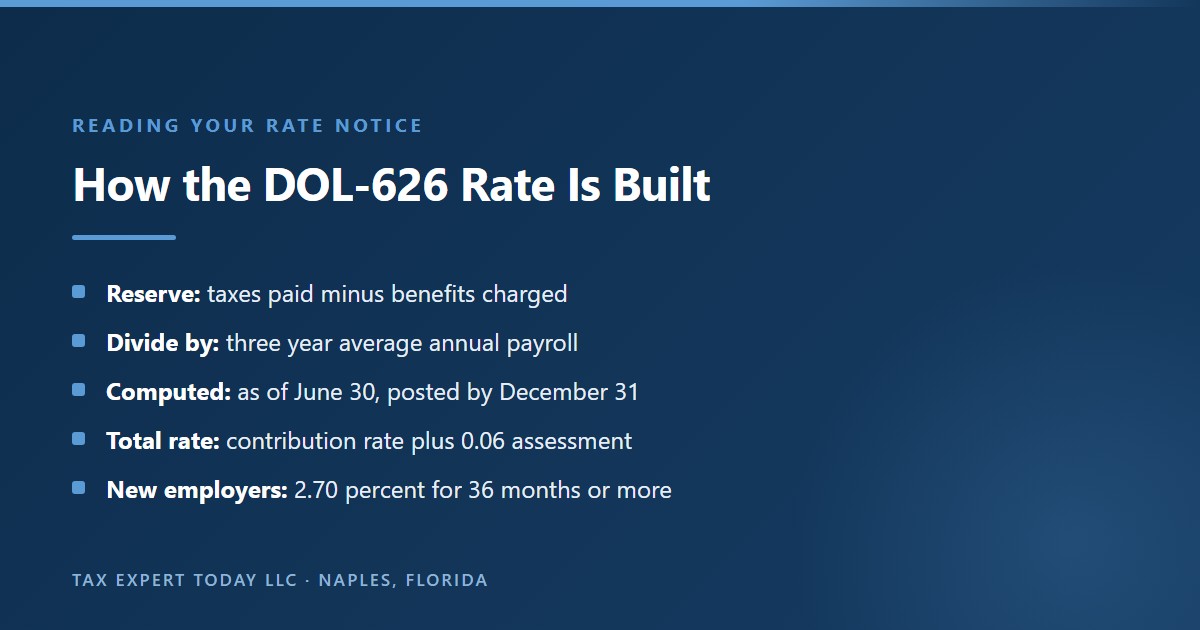
Georgia uses a reserve ratio method. As of June 30 each year, the Department subtracts all benefits charged to the account from all unemployment taxes paid, divides the result by the employer’s three year average annual taxable payroll, and applies that percentage to rate tables in the Employment Security Law. The resulting rate applies to the next calendar year.
- Computation date: June 30 of each year.
- Formula: (taxes paid minus benefits charged) divided by three year average annual payroll.
- Rate tables: set in the Employment Security Law at O.C.G.A. 34-8-155 and 34-8-156.
- Statewide adjustment: a statewide reserve ratio can raise or lower all table rates.
- Effective period: taxable wages paid in the calendar year after the computation date.
The Employer Handbook lays out the formula in one line: UI taxes paid minus total benefits charged, divided by the three year average annual payroll. The result is a percentage, often called the reserve ratio or the percent applied. A positive and growing reserve means taxes paid have exceeded benefits charged by a comfortable margin relative to payroll, and the tables assign a lower rate. A negative reserve, where benefits charged have exceeded taxes paid, produces a higher rate.
Two features of the Georgia unemployment tax formula catch employers off guard. First, payroll growth alone can raise a rate. The handbook says so directly: an increase in taxable payroll may cause an increase in tax rate although no claims were paid. Because the denominator is average payroll, a fast growing employer whose reserve has not kept pace with its payroll can see its ratio fall even with a clean claims history. Second, the history is cumulative. Taxes paid and benefits charged are counted from the date of liability, including amounts attributable to a predecessor, so a bad year does not disappear when the calendar turns.
The handbook lists other factors that feed the computation: timeliness of quarterly reports, missing reports, delinquent taxes, the employer’s reserve balance, and the trust fund balance. It also notes that employers who consistently respond on time to the Department’s requests for claim information, with adequate information, may have lower rates than employers who frequently miss those deadlines. The statewide piece works through the State-wide Reserve Ratio, which the Department computes each June 30 by dividing the trust fund balance by total covered wages paid in Georgia in the previous calendar year. Depending on the result, a base rate adjustment factor or a solvency factor is applied to every employer’s table rate.
How Do You Read the Georgia Tax Rate Notice (DOL-626)?
Form DOL-626, the Employer Tax Rate Notice, shows the contribution rate, the administrative assessment, and the total tax rate for the coming year, along with the payroll, taxes paid, benefits charged, and reserve figures used to compute it. The Department releases it on the Employer Portal by December 31 each year and no longer mails it.
- Where to find it: the Employer Portal; it is not mailed.
- When: released annually by December 31 for the following year.
- Top line: contribution rate plus administrative assessment equals total tax rate.
- Worksheet lines A through K: payroll, cumulative taxes, cumulative charges, reserve, and adjustments.
- Questions: the Department’s Rate Unit handles rate questions.
The sample notice reproduced in the Employer Handbook is a useful map. Line A is three years of taxable payroll and line B is that figure divided by three. Line C is cumulative tax paid from the date of liability, including taxes paid by any predecessor, and line D is cumulative benefit charges, also including any predecessor. Line E is the total tax reserve, C minus D. Line F divides E by B to produce the percent applied, and line G is the rate that percentage produces on the base table. Lines H, I, and J show the statewide reserve ratio and whichever statewide adjustment applies, and line K is the resulting contribution rate. The notice cites O.C.G.A. 34-8-155 for the table and O.C.G.A. 34-8-156 for the statewide adjustments.
Reading the notice line by line each January is a Georgia unemployment tax habit worth building. The Department’s one page employer summary tells employers who did not receive a notice, or who have questions about a rate, to contact the Rate Unit. Practical checks include whether the taxable payroll on line A matches what your payroll records show for the same three years, whether line D includes charges for former employees you do not recognize, and whether a predecessor’s history appears where it should, or where it should not. If the total rate on the notice differs from the rate your payroll provider is using, the notice controls, and the provider’s setting needs to change before the first quarter report.
The handbook is careful to say that the notice is not a bill. It is the rate you will apply to taxable wages paid during the year shown on the notice. Because the notice is only on the Portal, an employer who never set up Portal access may not see it at all, which is one reason the Department encourages every employer to register.
What Is the Georgia Administrative Assessment?
The administrative assessment is a separate charge added to an employer’s contribution rate to fund the Department of Labor’s administration, rather than benefits. It was reinstated at 0.06 percent effective January 1, 2024 under Georgia House Bill 518, and it appears as its own line on the DOL-626 notice, added to the contribution rate to produce the total.
- Rate reinstated in 2024: 0.06 percent of taxable wages for most employers.
- Authority: Georgia House Bill 518, effective January 1, 2024.
- Purpose: deposited to a state account and appropriated back to the Department for administration.
- Reporting: computed separately on the quarterly report and included in the total tax rate.
The Department’s rate release for 2024 states that, effective January 1, 2024, the administrative assessment of 0.06 percent was reinstated under House Bill 518. The sample DOL-626 in the current handbook carries the same message. The assessment has been switched on and off by the legislature over the years, which is why older payroll pages sometimes show it at zero and why some vendor setup screens ask for it as a separate rate.
For an employer, the practical point is that the rate you enter in payroll must be the total rate from the notice. The Department’s one page reporting summary tells employers to use the total tax rate, which includes the administrative assessment portion, when they calculate the tax on the quarterly report. The handbook adds that employers are required under federal mandate to make a separate calculation for the administrative assessment when computing their total taxes, which is why the DOL-4N and the DOL-3C correction form each show contribution tax and administrative assessment on separate lines. Because the assessment can change by legislation, confirm the current figure on your own notice each year rather than relying on any article, including this one.
What Range of Unemployment Tax Rates Do Experienced Georgia Employers See?
Experienced Georgia employers receive individually computed rates from the statutory tables, so there is no single experienced rate. Payroll industry summaries for 2026 report a range of roughly 0.04 to 8.1 percent. The Department’s FAQ pages do not publish the table, so the rate on your own DOL-626 notice is the only figure that controls.
- Low end: accounts with large positive reserves relative to payroll.
- High end: deficit accounts, and accounts assigned the maximum rate for delinquency.
- Penalty rate: employers caught in SUTA dumping receive the highest rate plus at least two percentage points.
- Authority: the rate tables in O.C.G.A. 34-8-155 and the adjustments in 34-8-156.
Georgia unemployment tax ranges are useful for context and dangerous for budgeting. A business that plugs the bottom of a published range into a projection can be off by a factor of fifty. The figures that actually drive your cost are your own reserve ratio, the table that applies to it, and whichever statewide adjustment is in effect for the year. That is why this guide uses the published new employer rate and the formula rather than a guessed experienced rate.
Two administrative events can push an employer to the top of the scale regardless of its claims history. The first is delinquency. The Department mails a special notice, Form DOL-1509, in late August or early September to employers with delinquent reports, and if reports remain delinquent 30 days after that notice, the employer is not eligible for a computed rate and is assigned the maximum rate allowable. The second is SUTA dumping, covered below, which carries a penalty rate for four years. Both are avoidable, and both cost far more than the reports or the restructuring they were meant to skip.
Can a Georgia Employer Lower Its Unemployment Tax Rate With a Voluntary Contribution?
Sometimes. Each year the Department reviews accounts and sends eligible employers a Voluntary Contribution letter through the Employer Portal, with the annual rate notice, by December 31. The letter explains how much could be paid to move into a lower rate bracket. Payment is due by certified check or money order within 30 days of the notice.
- Who receives the letter: employers the Department identifies as eligible to lower the year’s rate.
- When: uploaded to the Portal with the rate notice by December 31.
- Deadline: no later than 30 days from the issuance date of the notice.
- Payment method: certified check or money order.
- Not eligible: employers already at the lowest rate, with unfiled DOL-4N reports, or without enough history.
A voluntary contribution works by adding to the reserve on line C of the computation, which raises the reserve ratio enough to cross into a lower bracket on the table. Whether it pays depends on arithmetic the letter itself lays out: the contribution is a one time payment, and the savings are the reduction in the rate multiplied by the coming year’s taxable payroll. For an employer with a large and stable workforce sitting just below a bracket threshold, the savings can exceed the contribution. For a small employer, they rarely do.
The 30 day window is short and falls over the holidays, which is when many owners are not watching the Portal. The handbook is clear on the three disqualifiers, and the middle one, unfiled quarterly reports, is the one that most often blocks an employer that would otherwise qualify. If you expect a letter, confirm in early December that every DOL-4N for the year has been filed and accepted.
A voluntary contribution does not reduce the next quarter’s bill directly. It is a separate payment into the employer’s reserve, and its benefit arrives through the lower rate. It also does not earn federal credit: the Instructions for Form 940 state that the state contributions eligible for the FUTA credit do not include voluntary amounts paid to get a lower assigned state experience rate, or penalties, interest, or special administrative taxes. Run both effects through the numbers before paying.
How Do Unemployment Benefit Charges Reach an Employer’s Account?
When a former employee draws benefits, the Department charges those benefits to the most recent employer or employers who paid the claimant at least ten times the weekly benefit amount, if the separation was one the law treats as chargeable. The charge cannot exceed the wages that employer paid the claimant, and charges feed directly into next year’s rate computation.
- Who is charged: the claimant’s most recent employer, if it paid at least ten times the weekly benefit amount.
- Cap: charges cannot exceed the wages the employer actually paid the claimant.
- Statement: charges appear on the Employer Quarterly Statement of Benefit Charges, Form DOL-620.
- Rate effect: each charge reduces the reserve on line D of the next computation.
The Employer Handbook explains that benefits are charged to the employer most directly related to the claimant’s unemployment, which is what makes the rating an experience rating. The employer FAQ puts it in plain terms: if you are the most recent employer, as defined by law, you will be charged for the total amount paid, up to the maximum amount of wages you actually paid your former employee.
Because charges compound into a multiyear rate effect, the quarterly benefit charge statement deserves the same attention as a bank statement. Check that each claimant actually worked for you, that the separation reason matches your records, that charges stop when a claimant returns to work, and that a favorable appeal decision actually removed the charges it should have. Errors left in place for a year end up in the June 30 computation and stay in the cumulative history after that.
The charge rule also explains why many employers care more about benefit claims than about the Georgia unemployment tax rate itself. The tax is the lagging indicator. The claims history is what moves it.
What Happens When a Georgia Employer Ignores an Unemployment Claim Notice?
An employer that fails to respond adequately and on time to the Department’s written requests for information on three separate claims established during a calendar year is charged for benefits on all later claims paid that year. Those charges stand even if the benefit decision is later reversed on appeal or an overpayment is collected.
- The trigger: three inadequate or late responses to claim information requests in one calendar year.
- The consequence: charges on all subsequent claims paid that year.
- No relief later: charges apply even if the decision is reversed or an overpayment is recovered.
- Effective date: October 22, 2013, under federal requirements in the Trade Adjustment Assistance Extension Act of 2011.
The Department’s FAQ describes the rule and ties it to Section 3303(f) of the Federal Unemployment Tax Act, as amended in 2011, and to the Commissioner’s authority under O.C.G.A. 34-8-93. Every state was required to adopt a version of it, because the federal government wanted employers to share responsibility for improper payments that result from missing employer information.
The practical fix is operational rather than legal. Claim information requests have short deadlines printed on the notice. The handbook encourages employers to register for SIDES or SIDES E-Response, which let employers and their third party administrators receive and answer requests electronically. An employer with several locations should decide who receives the notices, who answers them, and who checks that each answer went in on time. A business that relies on one person’s inbox for these notices is the business most likely to hit the three strike rule in a busy year.
How Do Georgia Employers Appeal an Unemployment Claim Decision?
An employer that disagrees with a Department determination on a claim may appeal in writing within 15 calendar days of the date on the determination, online, by email, by fax, or by hand delivery. An administrative hearing officer hears the case first, with further review by the Board of Review and then the superior court.
- Deadline: 15 calendar days from the date on the determination or decision.
- Filing methods: online through the Portal, by email, by fax, or by hand delivery.
- First level: an administrative hearing, usually by telephone, before a hearing officer.
- Further review: the Board of Review, then judicial review in superior court.
- No intervention: the Commissioner of Labor does not intervene in the appeals process.
The employer FAQ states that the only way for a decision to be reviewed and potentially reversed is to file an appeal within 15 calendar days of the date on the determination or decision. The handbook adds that there is no general good cause exception for late protests and appeals, and that a company must make it a priority to file timely. The hearing is the real evidentiary stage. Testimony from the supervisor who saw the conduct or made the decision, signed policy acknowledgments, written warnings, and the separation notice are what hearing officers weigh.
Benefit claim appeals are employment law proceedings, and many employers handle them with Georgia employment counsel or a claims administrator acting under a Department power of attorney. The tax consequence, though, lands on the rate notice months later, which is where an employer’s tax adviser comes back in. Tax Expert Today LLC does not appear at Department of Labor hearings; we help employers connect claim outcomes to the rate computation and keep the tax and wage reporting consistent with the facts presented.
Disputes about the tax itself, such as a field audit finding or a liability determination, follow a different path with deadlines printed on the specific notice. Read the notice for the deadline rather than assuming 15 days.
What Is the Georgia Separation Notice Rule, and What Changed in October 2026?
Georgia employers must give every separated employee a Separation Notice, Form DOL-800, regardless of the reason for the separation. Under the Department’s October 7, 2026 rules update, electronic delivery is encouraged, a signed paper copy is still allowed, and the notice must reach the employee on the last day of work or within three days if the employee is unavailable.
- Form: DOL-800, Separation Notice, for every separation, for any reason.
- Timing: on the last day of work, or within three days if the employee is unavailable.
- Delivery: electronic delivery encouraged; a signed hard copy still allowed.
- Posters: remote and hybrid employers may use electronic options for required posters where permitted.
The Department’s October 7, 2026 announcement describes the change as part of a broader modernization of how the Department works with employers, including remote and hybrid workforces. The employer FAQ continues to describe the core obligation: the notice must be completed, signed by the employer or an authorized agent, dated, and delivered on the last day of work.
The separation notice is not a tax form, but it shapes the tax result. It is the first written record of why employment ended, and when a former employee files a claim, the Department compares the employer’s later response with what the worker was told at separation. A notice that says lack of work, followed by a claim response that says misconduct, undermines the employer’s position and tends to produce a chargeable claim. Keep a copy of every notice with the personnel file and the payroll records for the same period.
The same announcement introduced a reporting change for new hires, covered in the section on correcting wage reports below.
When Are Georgia Unemployment Tax Reports Due?
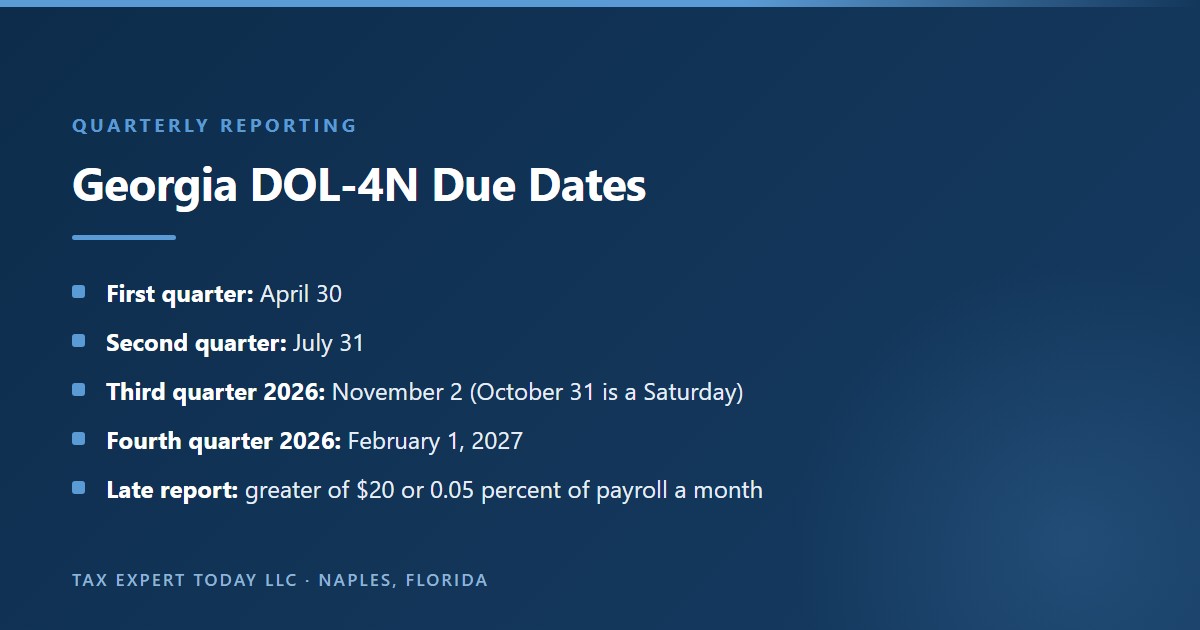
Georgia quarterly tax and wage reports, Form DOL-4N, and the tax due are filed by the last day of the month after each quarter: April 30, July 31, October 31, and January 31, or the next business day after a weekend or legal holiday. Domestic employers file once a year by January 31.
- First quarter (January to March): due April 30.
- Second quarter (April to June): due July 31.
- Third quarter (July to September): due October 31.
- Fourth quarter (October to December): due January 31.
- Domestic employers only: annual Form DOL-4A due January 31, with wages shown by quarter.
The Department’s file and pay page sets out the four dates and the weekend and holiday rule. The current Employer Handbook adds an electronic filing requirement: employers with 25 or more employees must file the quarterly report and payment electronically in a format approved by the Commissioner. Employers with fewer than 25 employees may still file paper reports, though the Department encourages everyone to file through the Employer Portal, which offers direct entry for smaller employers, a CSV or Excel upload for mid sized payrolls, and an SFTP process for very large employers and payroll service providers.
| Period | Georgia DOL-4N due date | Federal FUTA deposit due if over $500 |
|---|---|---|
| January to March 2026 | April 30, 2026 | April 30, 2026 |
| April to June 2026 | July 31, 2026 | July 31, 2026 |
| July to September 2026 | November 2, 2026 (October 31 is a Saturday) | November 2, 2026 |
| October to December 2026 | February 1, 2027 (January 31 is a Sunday) | February 1, 2027, with Form 940 |
The third quarter report for 2026 is the one coming due as this guide is written. October 31, 2026 falls on a Saturday, so under the next business day rule the report and payment are timely on Monday, November 2, 2026. The same rule moves the fourth quarter date, because January 31, 2027 is a Sunday. Payroll providers apply these shifts automatically, but an employer filing directly should calendar the actual date rather than the nominal one, and should not assume a holiday shift applies without checking the calendar.
Federal Form 940 has a different rhythm. FUTA tax is deposited quarterly only when the undeposited amount exceeds $500, and the annual return is due January 31, with an extension to February 10 when all FUTA tax was deposited on time. The federal table column above uses the same next business day rule. The Georgia report, by contrast, is due every quarter in which you had employment, whatever the amount.
How Are Georgia Unemployment Tax Payments Made, and Can Small Amounts Be Deferred?
Payments are made through the Employer Portal by ACH debit, credit or debit card, or electronic check, or by mailing a printed payment voucher. Employers whose total quarterly charge is $5.00 or less may defer it to January 31 of the next year, provided all reports are filed and nothing else is owed. Fourth quarter amounts cannot be deferred.
- Online options: ACH debit at no Department fee, card, or electronic check through a vendor for a fee.
- Mail: a printed online payment voucher with the GDOL account number on every document.
- De minimis deferral: quarterly totals of $5.00 or less may wait until January 31.
- Conditions: no unfiled reports and no unpaid balance beyond the deferred amount.
- Revocation: late filing later in the year revokes the deferral, with interest from the original date.
The Georgia unemployment tax deferral rule dates to Georgia House Bill 581, effective July 1, 2009, and the Department’s FAQ describes its conditions in detail. It is a convenience for very small accounts, typically a domestic employer or a business whose only employee crossed the wage base early in the year. Interest accrues retroactively to the original due date for any deferred amount not paid by January 31, and later late filings in the same year revoke the deferral.
The handbook notes one practical trap with ACH debit: if your bank account has an ACH block, the bank must lift it before the Department’s debit will clear. Employers who move banks or change payroll providers mid year should test the payment route before a due date rather than on it.
Payment through a payroll provider deserves its own check. Most providers debit the employer for the tax and remit it to the Department. If the provider’s rate setting is wrong, if the account number on file is wrong, or if the provider fails, the liability remains the employer’s. Reconcile the Department’s payment history on the Portal against the provider’s reports at least once a year.
What Penalties and Interest Apply to Late Georgia Unemployment Tax Reports?
A late quarterly report draws a penalty of $20 or 0.05 percent of gross payroll, whichever is greater, for each month or part of a month it is late. Unpaid tax accrues interest at 1.5 percent per month. The Commissioner may add a 20 percent cost of collection fee, and unpaid liabilities can become a lien on the employer’s property.
- Late report penalty: the greater of $20 or 0.05 percent of gross payroll, per month or part of a month.
- Interest: 1.5 percent per month or part of a month on unpaid tax.
- Collection fee: up to 20 percent of any deficiency.
- Legal action: taken when a report is more than 60 days delinquent.
- Lien: on all real and personal property of the liable employer or responsible parties.
These figures come from the employer FAQ and the handbook’s section on failure to comply. The penalty for a late report is computed on gross payroll, not on the tax, so for a mid sized employer the late filing penalty can exceed the tax due for the quarter. The handbook’s advice is direct: if you cannot pay all or part of the tax, still file the report by the due date to avoid late filing penalties and possible legal action.
| Event | Georgia consequence |
|---|---|
| Report filed late | Greater of $20 or 0.05 percent of gross payroll for each month or part of a month |
| Tax paid late | Interest at 1.5 percent per month or part of a month until paid |
| Deficiency assessed | Possible cost of collection fee of 20 percent of the deficiency |
| Report more than 60 days delinquent | Legal action against the company |
| Liability left unpaid | Lien on all real and personal property of the employer or responsible parties |
| Reports still delinquent 30 days after the DOL-1509 notice | No computed rate; the maximum rate is assigned for the year |
The rate consequence in the last row is often the most expensive part of late Georgia unemployment tax reporting. A missing report in the spring can, through the late summer DOL-1509 notice and its 30 day window, cost an employer its computed rate for the entire following year. That is a strong reason to clear any missing quarters before the end of August.
The handbook’s reference to responsible parties is worth noting. Unpaid unemployment tax is not purely an entity problem. Owners who also deal with federal payroll tax problems should read our guide to the federal trust fund recovery penalty, which works on different rules but shows how payroll tax debts can follow individuals.
How Do You Correct a Georgia Unemployment Tax Wage Report?
Corrections to a filed quarterly report use Form DOL-3C, the Report to Add New Wages and/or Correct Reported Wages, not a second DOL-4N. Additional tax and any interest are computed at the rate in effect for the quarter in which the wages were paid. Since October 2026, a placeholder Social Security number may be used temporarily for a new hire.
- Correction form: DOL-3C, with the reason for the correction.
- Rate used: the total rate in effect for the quarter the wages were paid.
- Placeholder numbers: 000-00-0001, 000-00-0002, and so on for missing SSNs.
- Correct promptly: generally within 30 days after obtaining the valid SSN.
- Where to send: GDOL Employer Accounts, 148 Andrew Young International Blvd NE, Suite 752, Atlanta.
The handbook states that the quarterly and annual report forms cannot be used to correct a prior report, and that the DOL-3C must show the identifying information and the reason for the change. The form separates gross wage corrections, non taxable wage corrections, and taxable wage corrections, then computes contribution tax and administrative assessment on the corrections separately.
The October 7, 2026 rules update added a practical option for new hires who have not yet supplied a Social Security number. Employers filing through the Employer Portal may enter a placeholder of leading zeros plus a sequence number, for example 000-00-0001 for the first employee record with a missing number, so the quarterly report can still be filed on time. The employer must document reasonable, timely efforts to obtain the number and then correct the report on a DOL-3C promptly, which the Department generally reads as within 30 days after the valid number is obtained. The announcement ties the requirement to Georgia Rules 300-2-2-.02 and 300-2-7-.01 and says placeholders are for occasional use. A business that uses placeholders routinely, or never follows up with corrections, invites penalties and wage investigations.
Corrections also matter for the Georgia unemployment tax rate. Wages added for a prior quarter change taxable payroll on the next computation, and wages removed change it the other way. If you discover a reporting error that spans several years, correct every affected quarter rather than only the latest one.
What Happens to the Georgia Unemployment Tax Rate When You Buy a Business?
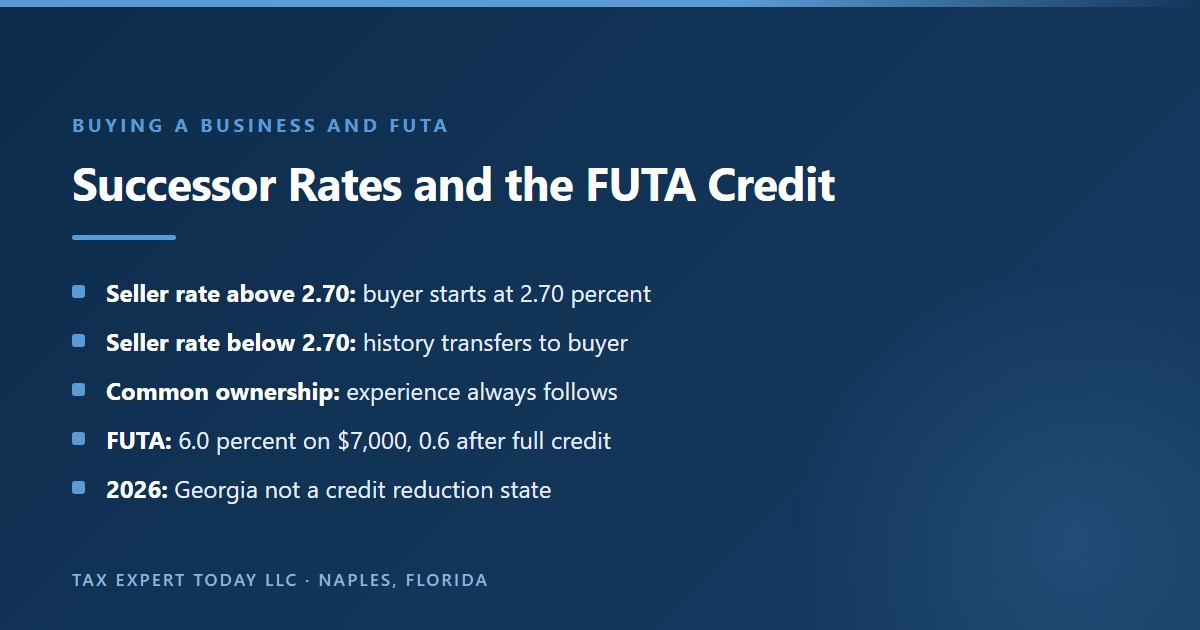
A buyer that acquires an existing Georgia business normally becomes a successor and takes over the seller’s rate and liability. If the seller’s rate is higher than the 2.70 percent new employer rate, its history is not transferred and the buyer starts at 2.70 percent. If the seller’s rate is lower, the history transfers and is combined with the buyer’s.
- General rule: the successor assumes the predecessor’s tax rate and liability.
- Seller’s rate above 2.70 percent: history not transferred; new employer rate applies.
- Seller’s rate below 2.70 percent: history transfers; combined history drives future years.
- Common ownership: transfers between commonly owned or controlled employers always carry the experience.
- Report it: on Form DOL-1N, and file the seller’s final reports within ten days of the sale.
The Employer Handbook describes both branches. When the predecessor’s rate is above the new employer rate, the buyer is assigned 2.70 percent and keeps it until it qualifies for its own computation. When the predecessor’s rate is lower, the experience transfers, the buyer keeps that rate for the rest of the calendar year, and later years are computed on the combined history of both. The sample DOL-626 shows the same idea, with predecessor taxes and predecessor charges built into lines C and D.
| Acquisition scenario | Rate result under the handbook | Practical point |
|---|---|---|
| Unrelated buyer, seller rate 4.5 percent (hypothetical) | Seller history not transferred; buyer assigned 2.70 percent | A high rate seller’s history does not follow an arm’s length buyer |
| Unrelated buyer, seller rate 0.5 percent (hypothetical) | History transfers; buyer keeps 0.5 percent for the rest of the year | Future rates reflect the combined history of both businesses |
| Transfer between commonly owned companies | Experience must transfer under O.C.G.A. 34-8-153(g)(1) | Restructuring cannot be used to leave a high rate behind |
| New entity buys a business mainly to obtain its low rate | New employer rate assigned under O.C.G.A. 34-8-153(g)(2) | Penalties apply to knowing violations and to advisers |
Georgia unemployment tax diligence on an acquisition should include the seller’s current DOL-626, its benefit charge statements for the last three years, confirmation that every quarterly report has been filed and paid, and any open audit or appeal. Because the successor normally assumes liability as well as rate, an unpaid balance or an unfiled quarter in the seller’s account can become the buyer’s problem. Purchase agreements commonly address this with representations and a holdback, which is a question for the deal’s counsel.
The seller has its own obligation. The handbook requires an employer to file any outstanding quarterly reports within ten days of the sale or discontinuance of a business and to pay any tax due at that time.
What Is SUTA Dumping, and What Are the Penalties in Georgia?
SUTA dumping is manipulating business structure to escape a high unemployment tax rate, such as shifting payroll to a related company or buying a shell for its rate. Georgia treats it as fraud. Violators receive the highest rate for that year and the next three years, and knowing advisers face civil penalties up to $5,000 per violation.
- Common ownership transfers: experience must follow the workers and assets, O.C.G.A. 34-8-153(g)(1).
- Rate shopping acquisitions: a new employer buying mainly for the rate gets the new employer rate, 34-8-153(g)(2).
- Penalty rate: the highest rate for the transaction year and the next three years.
- Minimum increase: at least two percentage points above the rate that would otherwise apply.
- Advisers: civil monetary penalty of up to $5,000 per violation for knowingly advising a violation.
The handbook gives two examples of the pattern the law targets: transferring payroll to a shell company with a low rate, and registering a new company that reports a small payroll each year until it earns a low rate, then moving a larger payroll into it. Both shift the cost of benefits from the employer that generated the claims to every other Georgia employer, which is why federal law required states to adopt these rules in the mid 2000s and why the Department’s one page employer summary singles the practice out.
Legitimate restructuring is not SUTA dumping. Businesses form new entities, merge, and move employees between affiliates for ordinary reasons all the time. What the law requires is that the unemployment experience moves with the workforce when ownership, management, or control is common. When a reorganization is planned, the safe approach is to report it on Form DOL-1N and let the Department assign the experience, rather than to open a fresh account and hope the history does not follow. Our guides to the Georgia pass through entity tax election and the Georgia corporate tax rate cover the income tax side of entity choices.
How Does Georgia Unemployment Tax Work for Employees in More Than One State?
A worker who performs services in more than one state is reported to a single state, chosen by four tests applied in order under O.C.G.A. 34-8-35: where the service is localized, then the base of operations, then the place of direction and control, then the worker’s residence. All of that worker’s wages are reported to the one state that wins.
- Test 1, localization: service entirely in one state, or outside work only incidental.
- Test 2, base of operations: for workers who travel, such as salespeople and drivers.
- Test 3, direction and control: where the work is directed from, if some service is performed there.
- Test 4, residence: the worker’s home state, if some service is performed there.
- Fallback: reciprocal coverage arrangements when no test resolves it.
The handbook walks through each test. Under the first, if a multistate employee’s service is performed entirely within one state, or the service outside that state is incidental, meaning temporary, transitory, or isolated, the whole of the employee’s service is reported to the state where it is localized. Most remote work cases are decided here. A Georgia company with an employee who lives and works full time from home in Florida generally reports that employee’s wages to Florida for unemployment purposes, not Georgia, because the service is localized in Florida. The reverse also holds: a Florida company with a full time remote employee in Georgia generally needs a Georgia unemployment account.
Georgia unemployment tax coverage and income tax withholding do not always land in the same state. Georgia income tax withholding follows its own sourcing and residency rules. A worker can be covered for unemployment in one state while wages are subject to withholding in another, so the two questions should be answered separately for each employee.
The wage base also interacts with moves between states. When an employee transfers mid year, many states let employers count wages already subject to another state’s unemployment tax toward the new state’s base. How that applies to a specific Georgia transfer is worth confirming with the Department before the first report for the employee.
How Do PEOs, Leasing Companies, and Common Paymasters Fit Into Georgia Unemployment Tax?
A professional employer organization or employee leasing company that meets Georgia’s definition and posts the required security is the employer of the workers it leases and files under its own account. If it fails either test, the client becomes the liable employer and the PEO files under the client’s account. Temporary help firms are always the employer of record.
- Qualifying PEO or leasing company: employer of record; files and pays under its own account.
- Non qualifying PEO: the client is liable; reports are filed under the client’s number.
- Temporary help firm: employer of record and liable for the tax.
- Common paymaster: related corporations may have one designated employer report a shared worker, with Department approval.
The handbook explains that leasing companies and PEOs must post a security deposit, which may be a surety bond or cash, to cover potential unemployment tax liability. A business that joins a PEO should confirm which account its workers are reported under, because that decides whose experience rating the claims hit and what happens to the business’s own account when it later leaves the PEO.
The common paymaster rule helps related corporations that share employees. When one individual works at the same time for two or more related corporations, the Department can approve one of them as the common paymaster, which then reports and pays tax on that individual’s wages up to the $9,500 base. Approval depends on showing the corporations are related through common financial interests, stock ownership, and shared officers and employees. Until approval arrives, each legal entity keeps filing its own reports. A payroll department can process payroll for related employers without that approval, but it must report under each employer’s own account number.
Can Nonprofits Reimburse Instead of Paying Georgia Unemployment Tax?
Yes. Section 501(c)(3) nonprofits and governmental employers may elect to reimburse the Department for benefits actually paid to their former employees instead of paying quarterly contributions. The election is made on Form DOL-11, must be approved by the Commissioner, requires a deposit or bond, and stays in effect for at least two calendar years.
- Who may elect: 501(c)(3) organizations and governmental employers.
- Form: DOL-11, Election to Reimburse Benefits Paid in Lieu of Contributions, under O.C.G.A. 34-8-158.
- New organizations: file within 30 days of registration.
- Security: a cash deposit, surety bond, or acceptable securities.
- Minimum term: two calendar years; changes require written notice before the year begins.
Reimbursable employers still file quarterly wage reports, but they pay only when former employees draw benefits, through a Reimbursable Employer Quarterly Bill, Form DOL-621, due within 30 days. Whether the election beats paying Georgia unemployment tax is a cash flow and risk question. An organization with stable staffing may pay far less than contributions would cost. One that has a layoff pays the full cost of every benefit dollar, with no pooling. The handbook requires a contributory employer switching to reimbursable status to submit Form DOL-11 no later than 30 days before the calendar year in which the change takes effect.
Nonprofits should also remember the officer counting rule and the four worker threshold described earlier. Many small 501(c)(3) organizations are not liable at all, and some are liable without realizing it.
How Does Georgia Unemployment Tax Interact With Federal FUTA?
Most Georgia employers also owe federal unemployment tax at 6.0 percent of the first $7,000 of each employee’s wages. Paying Georgia unemployment tax in full and on time earns a federal credit of up to 5.4 percent, which brings the net FUTA rate to 0.6 percent, or $42 per employee per year.
- FUTA rate: 6.0 percent on the first $7,000 per employee.
- Maximum credit: 5.4 percent for state tax paid in full by the Form 940 due date.
- Net rate with full credit: 0.6 percent, or $42 per employee at the federal base.
- What does not count: voluntary contributions, penalties, interest, and special administrative taxes.
- Additional credit: available when the state experience rate is below 5.4 percent.
IRS Topic No. 759 sets out the federal side. Employers are entitled to the maximum credit if they paid their state unemployment taxes in full, by the due date of Form 940, on all the same wages as are subject to FUTA tax, and if the state is not a credit reduction state. Paying Georgia late can reduce the federal credit, which means a missed Georgia payment costs twice: once in Georgia interest and penalties, and again on Form 940.
The Form 940 instructions also explain the additional credit. Because Georgia gives many employers an experience rate below 5.4 percent, the federal law treats them as if they had paid at 5.4 percent, so a low Georgia rate does not cost the employer its federal credit. The instructions are equally clear that voluntary amounts paid to get a lower assigned state rate, penalties, interest, and special administrative taxes are not state contributions for this purpose. The Georgia administrative assessment is computed separately on the DOL-4N for exactly this kind of reason.
| Item | Georgia SUTA | Federal FUTA |
|---|---|---|
| Agency | Georgia Department of Labor | Internal Revenue Service |
| Wage base | $9,500 per employee | $7,000 per employee |
| Rate | 2.70 percent new employer total; experience rated afterward | 6.0 percent, generally 0.6 percent after the 5.4 percent credit |
| Return | Quarterly DOL-4N (annual DOL-4A for domestic employers) | Annual Form 940, due January 31 or February 10 |
| Payment timing | With each quarterly report | Quarterly deposits when the undeposited amount exceeds $500 |
| Paid by | Employer only | Employer only |
Is Georgia a FUTA Credit Reduction State for 2026?
No. The U.S. Department of Labor’s list of potential 2026 FUTA credit reduction states, dated January 15, 2026, names only California and the U.S. Virgin Islands. Georgia employers who pay Georgia unemployment tax in full and on time should therefore receive the full 5.4 percent federal credit on their 2026 Form 940, subject to the final determination in November.
- 2026 potential credit reduction states: California and the U.S. Virgin Islands only.
- Final list: set after the November 10 repayment deadline each year.
- Georgia history: credit reductions applied in 2011 to 2013; loans repaid in 2014.
- Pandemic borrowing: repaid by the federal deadline, so no credit reduction for Georgia employers.
The Department of Labor’s FUTA credit reduction page, updated September 11, 2026, links to the potential 2026 list. A credit reduction applies when a state has had an outstanding federal loan balance on January 1 of two or more consecutive years and has not repaid it by November 10. Georgia employers paid extra federal tax for 2011 through 2013 after the trust fund was depleted in the last recession, and the Employer Handbook notes that the state repaid its pandemic era borrowing by the federal deadline, so no credit reduction resulted.
The credit reduction question can still matter to a Georgia employer with workers in another state. Under the multistate rules above, wages reported to California unemployment tax are subject to California’s credit reduction on Form 940 Schedule A, even when the employer is headquartered in Georgia. Employers with remote workers in a credit reduction state should budget for the extra federal tax.
What Happens in a Georgia Unemployment Tax Audit?
Each year the Department randomly selects a percentage of contributory employers for field tax audits and asks them to produce wage and payroll records. The employer receives a written summary of findings and may appeal an adverse result by the deadline on the notice. Audits commonly test worker classification, unreported wages, and the taxable wage computation.
- Selection: a specified percentage of contributory employers each year, chosen at random.
- Records requested: wage and payroll records, and often contractor payments.
- Result: a written summary of audit findings.
- Appeal: by the deadline appearing on the notice.
- Identification: ask Department staff for proper identification during site visits.
The handbook describes the program’s goals as verifying that employers keep accurate records, checking compliance with the tax provisions, fostering understanding of the law, and maintaining a good working relationship with employers. In practice the audit compares quarterly reports to payroll registers, the general ledger, federal Forms 941 and 940, and payments to individuals reported on Form 1099. Payments to workers treated as contractors receive the closest look, which is why classification is the next topic.
Preparation for a Georgia unemployment tax audit is straightforward if the records exist. Gather the quarterly reports for the audit period, the payroll registers that support them, the federal returns for the same quarters, and a list of everyone paid as a contractor with the agreements and invoices that support that treatment. Reconcile gross wages on the DOL-4N to Form 941 before the auditor does, and have an explanation ready for any difference. If the findings include reclassified workers or additional wages, the deadline to appeal is printed on the notice and is short.
How Do Worker Classification Questions Affect Georgia Unemployment Tax?
Payments to someone treated as an independent contractor are outside Georgia unemployment tax only if the employer proves one of two things: the worker is free from control or direction and customarily engaged in an independent business, or the IRS decided against employee status in an SS-8 determination. A professional license alone is not enough.
- Two part test: freedom from control in contract and in fact, and an independently established trade or business.
- Alternative: an IRS Form SS-8 determination that the worker is not an employee.
- Licensed workers: must actually serve other clients in the same line of work.
- Burden: on the employer to prove the exemption.
- Cost of getting it wrong: back tax, interest, penalties, and charges if the worker files a claim.
The handbook states that to prove contractor status the employing unit must show that the individual meets either the two pronged test or the alternative SS-8 requirement. It adds that when the second prong is applied, holding a professional or occupational license is not sufficient on its own; the employer must show the person performs the licensed services for other clients, patients, or customers. The Department’s one page summary repeats the same two conditions.
Georgia unemployment tax classification problems often surface through a claim rather than an audit. A worker paid on a Form 1099 who loses the engagement may file for unemployment benefits, and the Department then has to decide whether the person was in covered employment. If the answer is yes, the business can face a liability determination covering past quarters and charges for the claim. Businesses that rely heavily on contractors should document the basis for each relationship before the question is asked.
Georgia Unemployment Tax Example: A Growing Atlanta Employer
Consider a hypothetical Atlanta services company in its second year of Georgia payroll, still at the 2.70 percent new employer rate, with 12 employees all earning more than $9,500. Its annual Georgia unemployment tax is about $3,078, its net FUTA about $504, and every new hire who replaces a departing worker adds up to $256.50 more.
- Georgia taxable wages: 12 employees times $9,500, or $114,000.
- Georgia tax at 2.70 percent: $3,078.
- FUTA at 0.6 percent: 12 times $7,000 times 0.6 percent, or $504.
- Turnover cost: each replacement hire restarts the $9,500 base.
This example is hypothetical and simplified. Suppose the company also replaces six employees during the year, and each replacement earns more than $9,500 before year end. Georgia taxable wages rise by six times $9,500, or $57,000, which adds $1,539 of Georgia tax at 2.70 percent and $252 of FUTA at 0.6 percent. Total payroll may barely change, but the Georgia unemployment tax cost rises by half.
| Hypothetical scenario | Georgia taxable wages | Georgia tax at 2.70 percent | Net FUTA at 0.6 percent |
|---|---|---|---|
| 12 stable employees | $114,000 | $3,078 | $504 |
| 12 positions with 6 replacements during the year | $171,000 | $4,617 | $756 |
| Same 18 workers if Georgia tax were paid late (illustration only) | $171,000 | $4,617 plus interest and penalties | Up to $7,560 if the full 5.4 percent credit were lost |
The third row shows why timing matters. If the state tax is not paid by the Form 940 due date, the federal credit can be reduced. The Form 940 instructions allow a partial credit for late state payments, so the full loss in the table is an outer bound for illustration, not a prediction. The point is that a few hundred dollars of late Georgia tax can create a much larger federal problem.
The rate effect arrives later. Once the company has 36 months of chargeability, its rate will reflect taxes paid against benefits charged. If several of those six departures produce chargeable claims, the reserve shrinks while payroll grows, and the first computed rate may be higher than 2.70 percent. If departures are voluntary and documented, and claim requests are answered on time, the reserve grows and the first computed rate may be lower. This is why the claims discipline described earlier is, in substance, tax planning.
What Records Must a Georgia Employer Keep for Unemployment Tax?
Under O.C.G.A. 34-8-121, as summarized in the Employer Handbook, employers must keep, for at least seven years, each employee’s full name and Social Security number, hire and rehire dates, separation dates and reasons, payroll periods, and total wages paid each quarter, including the cash value of other pay, tips, and certain reimbursements.
- Identity: full name and Social Security number as shown on the card.
- Dates: hire, rehire, return from temporary layoff, and separation, with the reason.
- Wages: by quarter, including non cash pay, gratuities, tips, and flat fee expenses.
- Retention: at least seven years from the date payments were due or paid.
- Access: records must be available to authorized Department representatives.
Seven years is longer than many businesses keep payroll detail, and longer than some payroll providers keep it in an easily accessible form after a contract ends. When changing providers, export the full payroll history and the filed reports rather than relying on access to the old system. The same records support the federal returns, the separation notice file, and any claim response, so a single well organized archive serves every purpose.
What Should a Georgia Employer Do When Closing or Selling the Business?
File every outstanding quarterly report and pay any tax due within ten days of the sale or discontinuance, give each departing employee a DOL-800 separation notice, and report the change on Form DOL-1N when there is a successor. Former employees may still file claims, and charges can follow for some time after closing.
- Ten day rule: outstanding reports and tax due within ten days of sale or discontinuance.
- Separation notices: one for every employee, on the last day of work.
- Successor reporting: Form DOL-1N for a sale, merger, or asset acquisition.
- Federal side: mark the final Form 940 and Form 941 as final returns.
- Keep the records: the seven year retention period continues after closing.
A closing is also the point at which unpaid liabilities become hardest to resolve, because the business no longer has income. If a closing business owes both Georgia Department of Revenue taxes and Department of Labor taxes, the two agencies run separate collection processes. Our guide to the Georgia Department of Revenue payment plan covers the revenue side; unemployment tax balances are handled with the Department of Labor directly.
Are Georgia Unemployment Benefits Taxable to the Worker?
Yes. The Georgia Department of Labor states that unemployment benefits are fully taxable income for anyone required to file a tax return. Claimants may elect state and federal withholding when they file and can change it online. The Department issues Form 1099-G at the end of January showing benefits paid and any tax withheld.
- Taxable: benefits are taxable income on the federal and Georgia returns.
- Withholding: optional state and federal withholding, elected at filing and changeable online.
- Form 1099-G: released at the end of January for the prior year.
- Different tax: this is the worker’s income tax, not the employer’s unemployment tax.
The Department’s individuals FAQ describes the withholding election and the 1099-G. Employers sometimes receive questions about this from former employees. The short answer is that the employer’s unemployment tax is not deducted from the worker’s pay and does not make benefits tax free; benefits are reported on the worker’s own return.
What Are the Most Common Georgia Unemployment Tax Mistakes?
The most common problems are using an outdated rate in payroll software, leaving owner officers off the report, missing quarters before the August delinquency notice, ignoring claim information requests, mishandling a business acquisition, and treating workers as contractors without meeting Georgia’s test. Each one has a direct effect on cost or on the rate.
- Stale rate: the payroll system still uses last year’s total rate.
- Missing officer wages: S corporation officer salaries left off the DOL-4N.
- Unfiled quarters: which can bring the maximum rate after the DOL-1509 notice.
- Silent on claims: three missed responses trigger charges on all later claims that year.
- Acquisition surprises: inheriting a predecessor’s unpaid balance or history.
A few further mistakes show up often enough to list. Some employers report taxable wages above $9,500 for an employee, overpaying tax, or forget to report wages above the base at all, which can complicate a later claim. Some confuse the Department of Labor account number with the Department of Revenue withholding number in payroll setup. Some correct prior quarters on a new DOL-4N instead of a DOL-3C. And some multistate employers report a remote employee to Georgia because the company is based there, when the localization test points to another state. All of these are fixable, and most are cheaper to fix sooner.
What Should Be on a Georgia Unemployment Tax Checklist for 2026?
A 2026 Georgia unemployment tax checklist covers five areas: confirm liability and registration, load the current total rate from the DOL-626 notice, file every DOL-4N on time with correct taxable wages, manage claims and separation notices, and reconcile the Georgia filings to Form 940 and Form 941 before year end.
- Liability and registration: account number active, Employer Portal access for at least two people.
- Rate: total rate from the current DOL-626 entered in payroll.
- Reports: four DOL-4N filings, or one DOL-4A for domestic employers, with correct taxable wages.
- Claims: separation notices issued; claim requests answered by their deadlines.
- Reconciliation: Georgia wages tied to federal Forms 941 and 940.
| Timing | Task |
|---|---|
| January | Download the DOL-626 from the Employer Portal; update the payroll rate; review any Voluntary Contribution letter within its 30 day window; file the fourth quarter DOL-4N and Form 940 |
| April 30, July 31, October 31 (next business day if needed) | File each quarterly DOL-4N and pay the tax |
| Each quarter | Review the DOL-620 benefit charge statement for errors |
| Before late August | Confirm no missing quarterly reports before the DOL-1509 delinquency notice |
| At every separation | Deliver the DOL-800 separation notice, electronically or on paper |
| Any new hire without an SSN | Use the placeholder only when needed; correct on a DOL-3C within about 30 days of receiving the number |
| Any acquisition or restructuring | File Form DOL-1N and review the predecessor’s rate, history, and balance |
For a Georgia employer, this checklist sits alongside income tax withholding, the annual W-2 and G-1003 reconciliation, and the business’s own Georgia income tax return. Our Georgia tax services page shows how those pieces fit together.
Georgia Unemployment Tax Help in Naples & Southwest Florida
Tax Expert Today LLC works with Georgia employers and their owners from our office in Naples, Florida, at 11983 Tamiami Trail N, Naples FL 34110. We handle state tax matters nationwide, including Georgia unemployment tax reviews, rate notice analysis, payroll reconciliations, and coordination with Georgia counsel when a matter reaches a hearing.
- Georgia unemployment tax help Naples: DOL-626 rate notice reviews and payroll rate checks.
- Reconciliations: Georgia DOL-4N reports tied to Forms 941 and 940.
- Acquisitions: reviewing a seller’s Georgia unemployment account before closing.
- Multistate staff: which state an employee’s wages belong in.
Many of our Georgia clients are Florida business owners who now have Georgia employees, or Georgia businesses whose owners have moved to Southwest Florida. Florida has its own reemployment tax, and an owner with staff in both states files with both agencies, often on the same day. Our office is open Monday through Friday, 10 a.m. to 5 p.m. Eastern time, and you can reach us at (239) 441-2005. Georgia clients are served nationwide from Naples, by phone and secure document exchange, without needing to visit. To see the full range of Georgia work we do, visit our Georgia tax services page, and for Florida owners planning across both states, our Naples tax planning services page explains how we approach it.
One point of scope, stated plainly: Department of Labor unemployment matters are not IRS matters, and benefit claim hearings are employment law proceedings. Our role is the tax side, meaning the rate, the reports, the reconciliation, and the federal FUTA consequences. When a claim or a liability determination goes to a hearing, we work alongside the employer’s Georgia counsel or authorized agent rather than in place of them.
When to Engage a Professional
Consider professional help when a DOL-626 rate looks wrong, when quarterly reports are missing or the DOL-1509 notice arrives, when you are buying or restructuring a business with Georgia employees, when a field audit letter or liability determination arrives, or when workers paid as contractors begin filing claims.
- Rate questions: a total rate that jumped without an obvious claims reason.
- Delinquency: missing quarters, or a DOL-1509 notice with its 30 day window.
- Transactions: acquisitions, mergers, and affiliate transfers of employees.
- Audits: a field audit or a reclassification finding with a deadline on the notice.
- Federal spillover: late Georgia payments that may reduce the Form 940 credit.
Georgia unemployment tax is rarely the largest tax a business pays, but it is one of the easiest to let drift, and the drift shows up a year later on a rate notice. If you have Georgia employees and any of the situations above, talk with us before the next quarterly due date. You can learn more about our Georgia state tax services or call (239) 441-2005 for a free consultation.
This article is general educational information about Georgia unemployment tax as of October 12, 2026, based on Georgia Department of Labor pages, the Employer Handbook (DOL-224, R-11-24), the Department’s October 7, 2026 rules announcement, IRS Topic No. 759, the 2025 Instructions for Form 940, and the U.S. Department of Labor’s potential 2026 FUTA credit reduction list, read on that date. It is not tax or legal advice for any specific employer. All examples are hypothetical. Georgia rates, forms, and rules change; confirm current requirements with the Georgia Department of Labor or a qualified professional before filing.
Frequently Asked Questions About Georgia Unemployment Tax
What is Georgia unemployment tax?
Georgia unemployment tax is the state unemployment insurance contribution that liable employers pay to the Georgia Department of Labor on employee wages. It funds benefits for workers who lose jobs through no fault of their own. Only the employer pays it; it cannot be withheld from wages.
What is the Georgia unemployment tax rate for 2026?
New and newly covered employers pay a total rate of 2.70 percent. Experienced employers receive an individual rate each year on Form DOL-626, computed from taxes paid, benefits charged, and three year average payroll as of June 30, plus the administrative assessment.
What is the Georgia unemployment taxable wage base?
The Georgia taxable wage base is $9,500 per employee per calendar year, unchanged since January 1, 2013. Employers report all wages each quarter, but tax applies only to the first $9,500 paid to each employee in the year.
When are Georgia unemployment tax reports due?
Quarterly tax and wage reports, Form DOL-4N, and payment are due April 30, July 31, October 31, and January 31, moving to the next business day when a date falls on a weekend or holiday. Domestic employers file an annual DOL-4A by January 31.
Who administers Georgia unemployment tax?
The Georgia Department of Labor, not the Department of Revenue. The Department of Labor registers accounts, issues rate notices, receives quarterly reports, decides benefit claims, and audits employers. Georgia income tax withholding is a separate tax handled by the Department of Revenue.
Do S corporation owners pay Georgia unemployment tax on their salary?
Yes. Officers of a corporation, including an S corporation, who perform services are employees by statute, so their salary is reported on the quarterly report and counts toward the $9,500 base. Distributions are not wages. Sole proprietors and partners are not employees.
What happens to the Georgia unemployment rate when I buy a business?
A buyer of an existing Georgia business normally becomes a successor. If the seller’s rate is above 2.70 percent, its history does not transfer and the buyer starts at 2.70 percent. If the seller’s rate is lower, the history transfers and is combined with the buyer’s.
What is the penalty for filing a Georgia unemployment tax report late?
The penalty is the greater of $20 or 0.05 percent of gross payroll for each month or part of a month the report is late. Unpaid tax accrues interest at 1.5 percent per month, and a 20 percent cost of collection fee may be added.
Is Georgia a FUTA credit reduction state for 2026?
No. The U.S. Department of Labor list of potential 2026 credit reduction states names only California and the U.S. Virgin Islands. Georgia employers who pay state unemployment tax in full and on time generally keep the full 5.4 percent credit, for a net FUTA rate of 0.6 percent.
I live in Naples, Florida, and have employees in Georgia. Can you help with Georgia unemployment tax?
Yes. Tax Expert Today LLC handles state tax matters nationwide from its Naples, Florida office at 11983 Tamiami Trail N, including Georgia unemployment tax rate notice reviews, quarterly report reconciliations, multistate employee questions, and acquisition reviews. Call (239) 441-2005 for a free consultation.
Published October 12, 2026 by Dr. Pellumb Kabashi « Back to Learning Center
Have a question this article touches on?
Tax Expert Today LLC, based in Naples, Florida and serving clients across the United States.
Schedule a Consultation (239) 441-2005