
By Dr. Pellumb Kabashi, DBA, MBA, EA, CFE, CES
Founder, Tax Expert Today LLC · Tax advisors, enrolled agents, CPAs, and attorneys · Serving clients in all 50 states
Quick Answer: A Georgia tax ID number is the state tax account number the Georgia Department of Revenue issues when a business registers for a tax such as sales and use tax or payroll withholding. You register online through the Georgia Tax Center, and the number usually arrives by email within 15 minutes. It is separate from your federal EIN. Call (239) 441-2005 for a free consultation.
Search for a Georgia tax ID number and page one is a short AI summary, a sales tax software blog, the IRS page for Georgia, a five year old YouTube clip, a 2021 forum thread from a preparer hunting for an EIN, an old payroll vendor PDF, a Department of Labor login screen, a paid filing service, and a page about registering a company in the country of Georgia. None of them answers the question most business owners actually have: Georgia does not issue one tax ID. It issues a separate account number for each tax you register for, and each one is used in a different place.
This guide covers the Georgia tax ID number from the tax side. It explains which numbers exist, who issues each one, who needs a Georgia tax ID number for sales tax or payroll, how registration through the Georgia Tax Center works, what to gather first, how sole proprietors register, what the State Taxpayer Identification Number is, how to look a number up, when a number has to be replaced, who the responsible party is and why that matters, what happens to a business that operates without registering, how to close an account, and which number goes on which form. Every rule below was checked against the Department of Revenue and the text of O.C.G.A. Title 48 on November 4, 2026. For the wider picture of Georgia income, sales, and business taxes, see our Georgia tax services overview.
What Is a Georgia Tax ID Number?
A Georgia tax ID number is a state tax account number assigned by the Georgia Department of Revenue to a business that registers for a specific tax, such as sales and use tax or withholding. Georgia issues one number per tax type, so a business with sales and employees usually holds two Georgia tax ID numbers, not one.
- Issued by: the Georgia Department of Revenue, through the Georgia Tax Center.
- One per tax type: sales and use tax, withholding, and other accounts each get their own number.
- Delivered by: email, usually within 15 minutes of an online registration.
- Not the same as: the federal EIN, the Secretary of State control number, or the Department of Labor account.
The Department’s Tax Registration page puts it plainly: any entity that conducts business within Georgia may be required to register for one or more tax specific identification numbers, permits, or licenses. The words “tax specific” are the key. When a bank, a supplier, a payroll company, or a landlord asks for your Georgia tax ID number, they almost always mean one particular account, and the right answer depends on why they are asking.
That is why so many owners end up confused. A supplier selling to you tax free for resale wants your Georgia sales tax number. A payroll company wants your Georgia withholding number. A state agency or utility may ask for your State Taxpayer Identification Number, which the Department prints on your sales tax certificate. The IRS, a bank opening a business account, and anyone sending you a Form 1099 want your federal EIN. Each request has a different correct answer, and giving the wrong one is how returns get misapplied and exemption certificates get rejected.
Which Georgia Tax ID Number Does Your Business Need?
The Georgia tax ID number your business needs depends on what it does. Selling taxable goods or services requires a sales and use tax number, paying employees requires a withholding number and a Department of Labor account, and an entity also needs a federal EIN and, for corporations and LLCs, a Secretary of State control number.
- Sales of taxable goods: a Georgia sales and use tax number and certificate of registration.
- Employees: a Georgia withholding payroll number plus an unemployment tax account with the Department of Labor.
- Specialty activities: separate accounts for hotel-motel fees, fireworks, prepaid wireless 911 charges, IFTA, motor fuel, alcohol, and tobacco.
- Every entity: a federal EIN from the IRS, unless a sole proprietor with no employees uses a Social Security number.
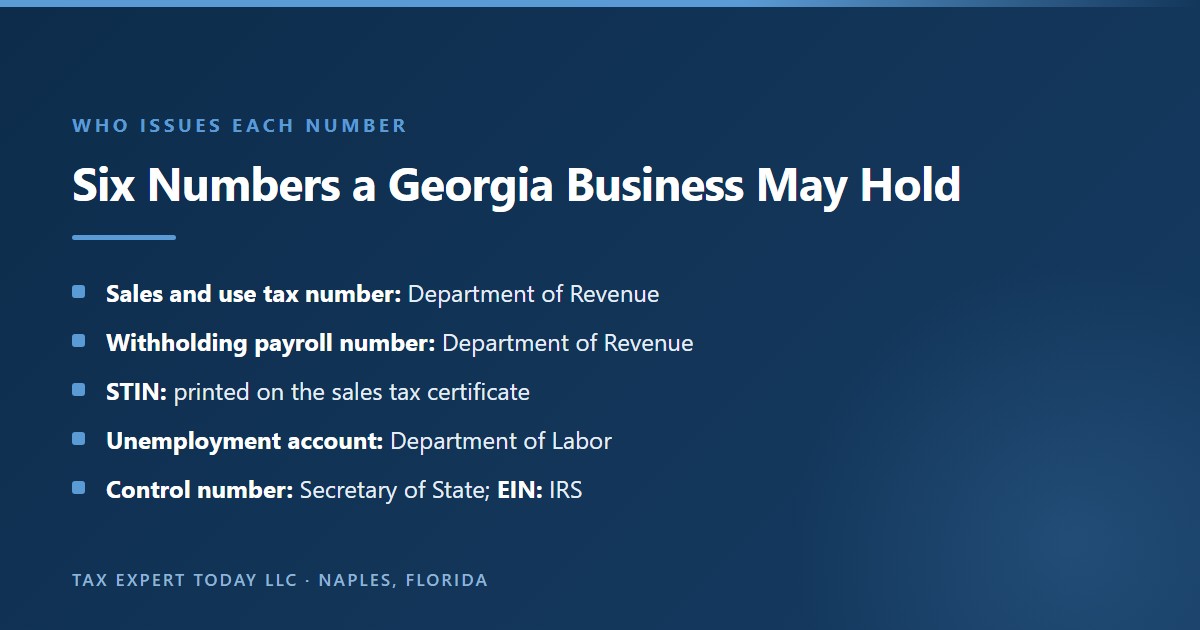
The table below maps each number to its issuer and its use. It is the single most useful thing to keep in your company file, because it answers the question every time a vendor or agency asks for “your tax ID.”
| Number | Issued by | Who needs it | Where it is used |
|---|---|---|---|
| Georgia sales and use tax number | Georgia Department of Revenue | Dealers making taxable sales, including wholesale and exempt sellers | Sales tax returns, resale and exemption certificates |
| Georgia withholding payroll number | Georgia Department of Revenue | Employers with Georgia employees | Form G-7, Form G-1003, payroll provider setup |
| State Taxpayer Identification Number (STIN) | Georgia Department of Revenue | Businesses asked for a state taxpayer ID | Printed on the sales tax certificate; utility and agency forms |
| Unemployment insurance account | Georgia Department of Labor | Employers paying Georgia wages | Quarterly unemployment tax and wage reports |
| Control number | Georgia Secretary of State | Corporations, LLCs, and registered partnerships | Entity filings and annual registration, not tax returns |
| Employer Identification Number (EIN) | Internal Revenue Service | Entities, and any business with employees | Federal returns, Forms W-9, W-2, and 1099, bank accounts |
Most small Georgia businesses hold three to five of these at once. A retail shop with two employees, for example, usually has an EIN, a Secretary of State control number if it is an LLC or corporation, a Georgia sales and use tax number, a Georgia withholding number, and a Department of Labor unemployment account. Each has its own filing schedule. Our guides to Georgia withholding tax and Georgia unemployment tax cover the payroll accounts in detail, so this guide focuses on how the numbers fit together.
Is a Georgia Tax ID Number the Same as an EIN?
No. A Georgia tax ID number is issued by the Georgia Department of Revenue for a state tax account, while an Employer Identification Number, often called a federal tax ID or FEIN, is issued by the IRS. Georgia asks for your EIN during state registration, but the state then assigns its own separate account numbers.
- EIN: nine digits, issued free by the IRS, used on federal returns, Forms W-2 and 1099, and bank accounts.
- Georgia account numbers: issued by the Department of Revenue, used on Georgia returns and certificates.
- Order: get the EIN first if your entity needs one, then register with Georgia.
- Sole proprietors: may register with Georgia as an individual for business taxes.
The Department’s Register a New Business page lists the EIN as an early step, noting that you may also see it called the Federal Tax Identification Number or FEIN. The IRS application asks for the legal name, location, and mailing address of the business and the name and taxpayer identification number of the principal officer, partner, owner, member, or other responsible person. The IRS issues EINs at no charge through its Employer ID Numbers page. Any website that charges a fee to “get your EIN” is a paid filing service, not the IRS.
The two numbers do different jobs. Your EIN identifies the business to the IRS and goes on federal payroll returns, federal income tax returns, and information returns. Your Georgia account numbers identify your sales and withholding accounts to the state. The two are linked, though. The 2026 Employer’s Tax Guide states that when a structure change results in a new FEIN, the employer should close the prior Georgia withholding account and register the business under the new structure before it keeps withholding. So when a sole proprietor incorporates, or a partnership converts, the new EIN usually means new Georgia tax ID numbers as well.
The single member LLC is a common source of confusion. Georgia follows the federal rule that a disregarded single member LLC must pay its own employment taxes and file its own reports, which means it needs its own EIN and its own Georgia withholding number even though its income lands on the owner’s personal return. Our guide to Georgia LLC taxes explains how the LLC label interacts with each account.
Who Must Register for a Georgia Sales Tax Number?
Any person who meets the definition of a dealer in O.C.G.A. 48-8-2 must register for a Georgia sales and use tax number, even if every sale is online, out of state, wholesale, or exempt. A seller outside Georgia must register once it has over 200 Georgia transactions or $100,000 in Georgia sales in a calendar year.
- Physical presence in Georgia: register, unless every sale runs through a marketplace facilitator.
- Remote seller: register after more than 200 separate Georgia transactions or at least $100,000 in Georgia sales in the last calendar year.
- Taxable products: tangible goods, digital goods, expressly taxable services, admissions, and amusement charges.
- Exempt or wholesale sellers: still register; the exemption does not remove the duty.
The Department’s Tax Registration page states that a dealer must register for a sales and use tax number and certificate of registration regardless of whether all sales will be online, out of state, wholesale, or exempt from tax. That sentence surprises wholesalers who assume that because they never charge sales tax, they never need a number. They do, and they need it for a second reason: a supplier selling to them for resale must collect a resale certificate showing a valid Georgia sales tax number, or the supplier is exposed to the tax itself.
The Department’s registration decision page walks through four questions: whether the customers are in Georgia, whether the product is taxable, whether the business is physically in Georgia, and, for a business outside Georgia, whether its sales cross the 200 transaction or $100,000 threshold. A seller physically in Georgia must register unless all of its sales are made through a marketplace. A seller outside Georgia that later crosses the threshold must register at that point.
The sales tax registration also brings some related accounts with it. The Department states that a dealer must also register for a state hotel-motel fee account if it is an innkeeper charging the fee under O.C.G.A. 48-13-50.3, a fireworks excise tax account if it sells consumer fireworks, a prepaid wireless 911 charge account if it sells prepaid wireless service at retail, or a non-prepaid 911 charge account if it is a telephone service supplier. Each is its own account number. Sales of exempt items, and the certificates that support them, are covered in our guide to the Georgia sales tax exemption.
Who Needs a Georgia Withholding Number?
Any employer with employees as defined in O.C.G.A. 48-7-100 needs a Georgia withholding payroll number. That covers employers located in Georgia, employers with Georgia resident employees, and out of state employers whose employees earn more than 5 percent of their wages, or more than $5,000, in Georgia.
- Georgia employers: register before the first payroll.
- Resident employees: someone who lived in Georgia 183 days in the past year or regularly lives there.
- Nonresident employees working in Georgia: over 5 percent of wages or more than $5,000 attributable to Georgia.
- Household employers: domestic employees are included.
The Department’s withholding registration page lists who must register: any employer that has employees, controls what work is done and how, and that may be an individual, corporation, LLC, partnership, estate, trust, association, joint venture, or a religious, educational, charitable, government, or social organization. It also states that an employer whose employees fall below the wage allocation test may still need a nonresident or miscellaneous withholding account.
Timing matters more than most owners expect. The Department’s 2026 Employer’s Tax Guide states that tax withheld before you receive a withholding account number is still due on the normal filing schedule. Registering late does not move the due date; it only makes the first deposit harder to make on time. Once the number is active, the guide also requires a Form G-7 for each period, showing zero if nothing was withheld, so an employer who registers early and then delays hiring still has returns to file.
Payroll withholding is only half of the payroll setup. The Georgia Department of Labor issues a separate unemployment insurance account, and its rules, forms, and rates are different. The two agencies do not share registrations, so an employer registered with the Department of Revenue is not registered with the Department of Labor until it files there too.
How Do You Get a Georgia Tax ID Number Through GTC?
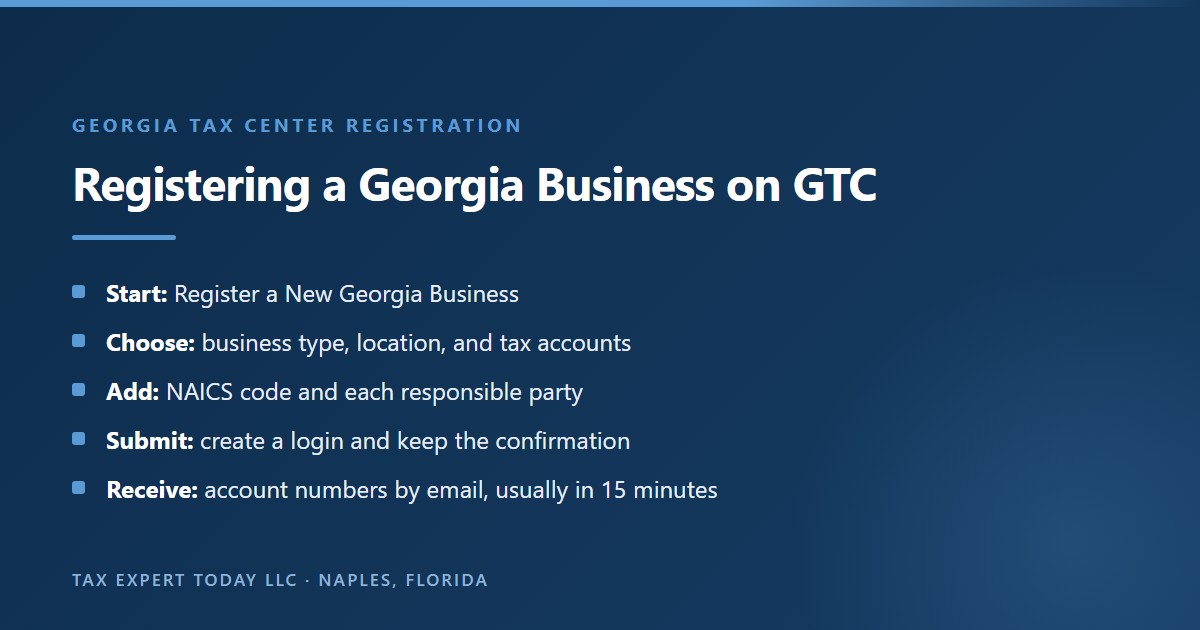
You get a Georgia tax ID number by registering online through the Georgia Tax Center at gtc.dor.ga.gov. Choose Register a New Georgia Business, select the business type and the accounts you need, add your NAICS code and responsible parties, create a login, and submit. The account number usually arrives by email within 15 minutes.
- Where: the Georgia Tax Center, the Department’s secure self-service portal.
- Who: partnerships, corporations, and LLCs use the new business path; sole proprietors have their own path.
- Result: a confirmation number on screen, then an email with GTC login details and the new Georgia tax ID numbers.
- Fees: depend on the tax type; some licenses, such as alcohol and IFTA, carry fees or bonds.
The Department’s step by step instructions for a partnership, corporation, or LLC follow the same sequence every time:
- Go to the Georgia Tax Center and, under Registration, click Register a New Georgia Business.
- Review the requirements, then select the business type.
- Enter the business location and verify the address.
- Select the accounts you are registering for, then answer the yes or no questions for each account.
- Enter your NAICS code.
- Add each officer or responsible party, with an effective date, name, ID, address, phone, job title, and email.
- Create a GTC logon, review everything, and submit.
- Write down or print the confirmation number. The email from No Reply follows with your login information and new Georgia tax ID numbers.
The Department’s Business Registration FAQ lists the tax types available online through GTC: adult entertainment, alcohol license, composite tax, corporate income tax, fireworks excise tax, international fuel tax, motor fuel distributor tax, non-prepaid 911 charge, prepaid wireless 911 charge, sales and use tax, state hotel-motel fee, tobacco license, withholding tax, and withholding miscellaneous film. Alcohol licenses require an investigation, a bond, and a local license as well, as our guide to the Georgia alcohol license explains, so the 15 minute email is not the end of the process for them.
Before you register, check with the Georgia Secretary of State. The Department states that corporations, LLCs, and partnerships doing business in Georgia should confirm their Secretary of State registration requirements first. A business formed in another state that operates in Georgia usually needs to register with the Secretary of State as a foreign entity, and the control number it receives there is not a tax account. The Secretary of State’s First Stop Business Information Center, linked from the Department’s registration page, lists those steps.
What Information Do You Need Before You Register?
Before registering, gather the legal name and addresses of the business, its EIN if it has one, the business type, the names, addresses, and Social Security numbers of owners, officers, partners, or members, a NAICS code, and a contact email. Sole proprietors also need their most recent federal adjusted gross income.
- Entity details: legal name, physical location, mailing address, and business type.
- Federal number: the EIN, if the entity has one.
- People: owners, officers, and responsible parties with their identification numbers.
- Activity code: a NAICS code, which the Department requires for every registration.
| Item | Entities | Sole proprietors |
|---|---|---|
| Legal name, location, and mailing address | Required | Required |
| Federal EIN | If the entity has one | Optional; a Social Security number may be used |
| Owners, officers, partners, or members with ID numbers | Required | Owner only |
| NAICS code | Required | Required if applicable |
| Most recent federal adjusted gross income | Not used | Used to set up GTC access |
| Contact email and GTC login details | Required | Required |
| Tax types needed | Sales, withholding, or others | Sales, withholding, or others |
Two items cause most of the delays we see. The first is the NAICS code. The Department requires one on every registration, and you can look it up through the U.S. Census Bureau NAICS search before you start. Choose the code that describes what the business actually does, because a code that does not match the accounts you request can trigger questions. The second is the start date. Enter the date the business first made Georgia sales or first paid Georgia wages, not the date you happen to be registering. A start date that is later than the first sale or the first payroll hides periods that were already taxable, and those periods do not go away.
How Do Sole Proprietors Get a Georgia Tax ID Number?
A sole proprietor who has filed a Georgia return first creates a Georgia Tax Center login for the individual income tax account, then registers as a sole proprietor and adds the business tax accounts. A sole proprietor who has never filed a Georgia return uses Register a New Georgia Business and picks Sole Proprietor as the business type.
- Prior Georgia filer: sign up for GTC access, then select Register as a Sole Proprietor.
- Never filed in Georgia: complete a new business registration as a sole proprietor.
- Needed: Social Security number, most recent federal adjusted gross income, NAICS code, and the tax types.
- Then: log out and back in before registering for each tax account.
The Department’s sole proprietor instructions describe a two stage process for an owner who already files Georgia individual returns. First the owner establishes a GTC logon to the individual income tax account, which is where the prior year federal adjusted gross income is used to confirm identity. Then, from the “I want to” section, the owner selects Register as a Sole Proprietor. Once that request finishes processing, the owner selects Register New Tax Account and picks the sales, withholding, or other accounts needed. The Department notes that you should exit and log back in before registering any other account.
A sole proprietor with no employees often does not need an EIN at all and may register with Georgia using a Social Security number. Many still get an EIN, because it keeps the owner’s Social Security number off Forms W-9 given to customers and off resale certificates handed to suppliers. That choice is a privacy and administration decision, and the EIN costs nothing from the IRS.
What Is a Georgia STIN and Where Do You Find It?
A Georgia State Taxpayer Identification Number, or STIN, is the identifier some businesses, utilities, and agencies ask for. The Department of Revenue says it appears on your sales tax certificate of registration. If your business has no sales tax certificate, ask Taxpayer Services for a verification of account registration letter.
- Where it is printed: on the Georgia sales and use tax certificate of registration.
- No sales tax account: request a verification of account registration letter.
- Who asks: utilities, vendors, and agencies onboarding a business.
- Not the same as: the federal EIN or the withholding number.
This is the question that sends people searching for “Georgia tax ID number” in the first place. A utility or a state contract portal asks for a “State Taxpayer ID,” and the owner has an EIN and a withholding number but no idea which one fits. The Department’s Business Registration FAQ answers it directly: the STIN is located on the sales tax certificate of registration, and a business that is not required to file sales and use tax returns, and therefore has no certificate, should contact Taxpayer Services and request a verification of account registration letter.
That letter is also useful in a second situation: when a lender, landlord, or buyer wants proof that the business is registered with the state. If they want proof that the business is current, not just registered, the right document is a tax clearance letter, which the Department issues through GTC after it checks every account for balances and missing returns. We cover that below.
How Do You Look Up a Georgia Tax ID Number?
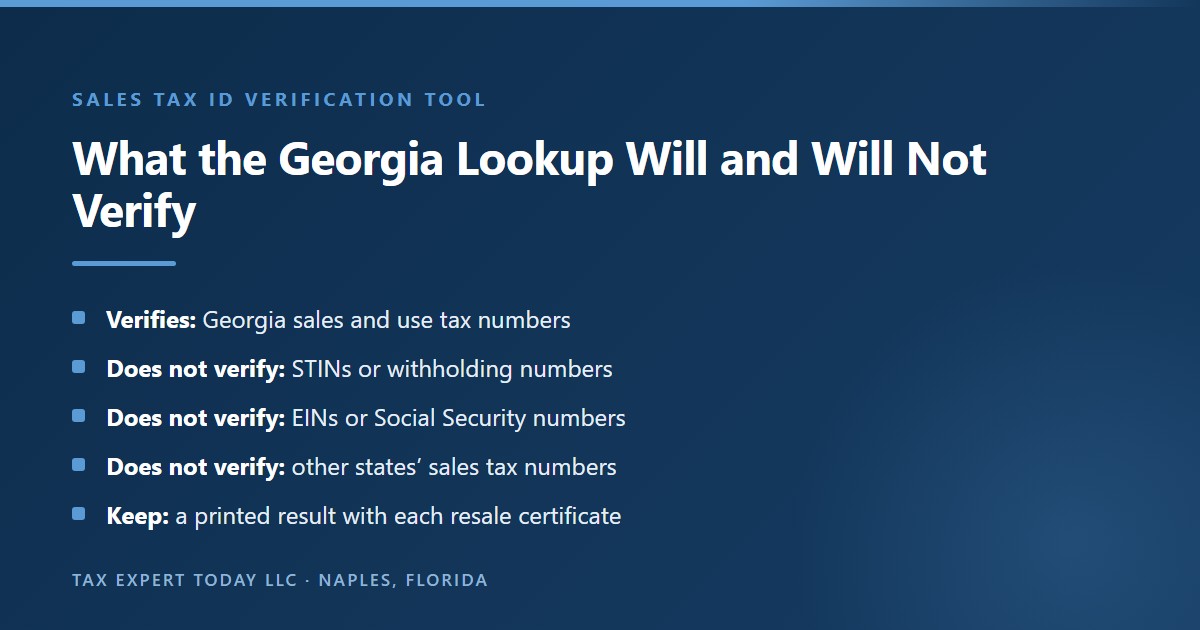
You can verify another business’s Georgia sales tax number with the Department’s Sales Tax ID Verification Tool in the Georgia Tax Center. The tool does not verify withholding numbers, State Taxpayer Identification Numbers, EINs, or out of state numbers. To find your own numbers, check GTC, your registration email, your certificate, or prior returns.
- Checking a customer: GTC home page, Searches, Sales Tax IDs; one number or a batch through the Excel template.
- Not covered: STINs, EINs, Social Security numbers, and other states’ sales tax numbers.
- Your own number: the GTC account summary, the original email, the certificate, or a filed return.
- Lost access: call the Department at 877-423-6711.
The Department’s Sales Tax ID Verification Tool page explains why the lookup exists. All sales are subject to sales tax until the contrary is established, and the burden of proof is on the seller unless the seller, in good faith, takes a valid certificate of exemption from the buyer. For a sale for resale, the buyer must hold a valid sales tax number at the time of purchase and list it on the certificate. A seller that checks the number and prints the result has a record that it acted in good faith.
The steps are short. Go to the Georgia Tax Center, and on the home page under Searches, click Sales Tax IDs. Read the instructions, enter one or more numbers, or import the Department’s Excel template for a batch, and print the results for your records. The Department is specific about the limits: the tool only verifies Georgia sales tax numbers, and it does not verify state tax identification numbers, federal employer identification numbers, out of state sales tax numbers, or Social Security numbers.
Finding your own number is a different problem. The fastest sources are the GTC account list after you log in, the original email from the Department, the sales tax certificate on the wall, and any return you have filed. If none of those is available, and you cannot log in to GTC, call the Department at 877-423-6711. A payroll company or bookkeeper asking for the number on your behalf generally needs a power of attorney on file before the Department will discuss the account with them. There is no public lookup for withholding numbers, and there should not be: unlike a resale certificate, nobody outside your payroll process has a reason to check one.
Does a Georgia Tax ID Number Expire or Need Renewal?
Most Georgia tax ID numbers do not expire. The Department states that sales and use tax and withholding registrations do not require renewal and stay in effect as long as the business exists without a change in ownership or structure. IFTA, alcohol, and tobacco registrations renew every year.
- No renewal: sales and use tax, withholding, and motor fuel distributor registrations.
- Annual renewal: IFTA licenses and decals, alcohol licenses, and tobacco licenses.
- Still ends: when ownership or structure changes, or the account is closed.
- Active means returns: an open account keeps generating filing obligations.
| Registration | Renewal | What ends it |
|---|---|---|
| Sales and use tax | None | Change in ownership or structure, or closing the account |
| Withholding | None | No more employees with Georgia wages, a structure change, or closing |
| Motor fuel distributor | None; bond required | Cancellation, suspension, or revocation by the state |
| IFTA license and decals | Every year | Nonrenewal or account termination |
| Alcohol license | Every year, after an initial investigation | Nonrenewal, suspension, or revocation |
| Tobacco license | Every year | Nonrenewal |
The renewal rules come from the Department’s Tax Registration page, which describes each registration in turn. The point owners miss is the flip side of “no renewal.” A sales tax or withholding account stays open until someone closes it, and an open account keeps generating returns. A withholding account with no payroll still owes a zero Form G-7 for each period. A sales tax account with no sales still owes a zero return on the assigned schedule. Businesses that stop operating without closing their accounts are where most of the delinquency notices we see begin.
For the accounts that do renew, the renewal itself can turn on your other Georgia accounts. Our guides to Georgia IFTA and the Georgia alcohol license explain how a balance on an unrelated Georgia tax account can hold a renewal until it is paid or placed on a payment plan.
When Do You Need a New Georgia Tax ID Number?
You need a new Georgia tax ID number when the business changes ownership or structure, such as a sole proprietor incorporating, a partnership converting to an LLC, or a buyer taking over a business. A new physical location keeps the same sales tax account but needs its own certificate of registration.
- Ownership change: a buyer registers its own accounts; the seller’s number does not transfer.
- Structure change with a new EIN: close the old withholding account and register the new entity.
- New location: a separate certificate of registration for each place of business.
- Same entity, new activity: add the new account type in GTC; the existing numbers stay.
O.C.G.A. 48-8-59 sets the sales tax rules. Every person who wants to do business as a seller or dealer in Georgia files an application for a certificate of registration for each place of business. A business that operates in more than one county needs only one certificate of registration under the article, covering all operations in Georgia, but the Commissioner issues a separate certificate for each place of business. The certificate is not assignable, is valid only for the person named on it and for the place designated, and must be displayed conspicuously at that place.
That “not assignable” language is why buying a business never includes the seller’s sales tax number. The buyer registers its own accounts, under its own EIN, effective the date it takes over. For withholding, the 2026 Employer’s Tax Guide states that when a business ceases to have employees, or goes through a structure change that requires a new withholding number, the employer must file a final Form G-7 and pay any tax withheld within 30 days of the change, file copies of the income statements with the final return, close the prior account, and register under the new structure before withholding again. A buyer should also ask for a tax clearance letter from the seller before closing, because unpaid trust taxes are the liability that most often follows a business through a sale.
What Is the Responsible Party on a Georgia Registration?
A responsible party is the person who controls or supervises collecting trust taxes, such as sales tax and withholding, for the business. The Department says a responsible party may be held personally liable for certain unpaid taxes. O.C.G.A. 48-2-52 makes such a person liable for taxes willfully not collected or paid over.
- Officer versus responsible party: an officer holds a title; a responsible party controls tax collection and payment.
- Same person: one person can be both, and often is in a small company.
- Partnerships: more than one partner may be listed.
- Exposure: personal liability for trust taxes willfully not collected or not paid over.
The Business Registration FAQ draws the line. An officer is a person the corporation has chosen to be an officer. A responsible party is a person who has control or supervision of collecting trust taxes, such as sales tax and withholding tax, and the Department states that the responsible party may be held liable for certain unpaid taxes of the business.
The statute behind that warning is O.C.G.A. 48-2-52. It applies to any officer or employee of a corporation, any member, manager, or employee of an LLC, and any partner or employee of a limited liability partnership who controls or supervises collecting these amounts and paying them over. If that person willfully fails to collect, account for, or pay over the tax, or willfully attempts to evade it, the person is personally liable for an amount equal to what was not paid. The liability is assessed and collected the same way as the underlying tax.
The practical point is that the names you enter in GTC matter. Listing a bookkeeper, a minority owner, or a manager who has no real authority over payments as the responsible party does not shield the person who actually decides which bills get paid, and it may draw the listed person into a collection case. List the people who actually control payment, and update the registration with a cease date when someone leaves. The Department’s registration instructions describe the cease date as the date the officer leaves the company, is no longer responsible, or ends their status with the company. If a balance is already building, our guide to the Georgia Department of Revenue payment plan explains the options.
What Happens if You Do Business Without a Georgia Tax ID Number?
Operating without a required Georgia tax ID number does not remove the tax. Sales tax on taxable sales and income tax withheld from wages are still due for every period, with penalties and interest. Buyers may refuse resale certificates, and responsible parties can face personal liability for trust taxes not paid over.
- Tax still owed: registration is the mechanism for paying, not the source of the duty.
- Withholding: tax withheld before the number arrives is due on the normal schedule.
- Exemptions denied: a supplier cannot accept a resale certificate without a valid number.
- Personal exposure: O.C.G.A. 48-2-52 for trust taxes willfully not paid over.
The duty to collect and pay comes from the tax statutes, not from the registration. O.C.G.A. 48-8-59 requires a dealer to apply for a certificate of registration before engaging in business, and the 2026 Employer’s Tax Guide states that tax withheld before receipt of a withholding number is due under the established filing requirements. A business that registers late therefore owes every past period, and the Department applies penalties and interest to those periods as it would to any late return. For withholding, the guide treats late filing and late payment separately, so both can apply at once.
The commercial cost often shows up before the tax bill. A supplier that cannot verify your sales tax number through the verification tool has no basis for accepting your resale certificate, so it charges tax on inventory you meant to buy tax free. A payroll provider cannot file Georgia withholding without the account. A lender or a buyer that asks for a tax clearance letter receives a denial letter instead. If you have already operated without registering, the order of operations matters: register, reconstruct each period, and file before the Department contacts you. Our guide to the Georgia use tax covers the purchase side of the same cleanup.
How Do You Close a Georgia Tax ID Number?
Close a Georgia sales and use tax or withholding account through the Georgia Tax Center, by phone, or by a signed letter on company letterhead. In GTC, open the account, choose Request to Close Account, and enter the cease date. All required returns must be on file, and closing does not stop collection of balances.
- In GTC: account, See more, Management, Request to Close Account, enter the cease date.
- Processing: allow up to 48 hours for the account to update.
- By letter: owner or an authorized power of attorney, on letterhead, with the effective date.
- Before closing: file every return due, including final returns.
The Department’s closing a business page sets out the order. The taxpayer must be compliant, with all required returns on file, and the Department warns that closing an account will not stop collections or the obligation to pay liabilities. Final income tax returns go on Form 600, 600S, or 600T for corporations and LLCs taxed as corporations, Form 700 for partnerships, and Form 500 for sole proprietors, with the final return box checked and a written explanation attached.
| Account or item | How to close or end it | Notes |
|---|---|---|
| Sales and use tax account | GTC Request to Close Account, phone, or signed letter | Enter the cease date; allow up to 48 hours |
| Withholding account | GTC Request to Close Account, phone, or signed letter | File the final Form G-7 and income statements |
| Income tax | Final Form 600, 600S, 600T, 700, or 500 | Check the final return box and attach an explanation |
| Permits, licenses, business names | Cancel with the Department | Separate from the tax accounts |
| Secretary of State and Department of Labor | Dissolution or closing filings with each agency | Not closed by the Department of Revenue |
Closing the Department of Revenue accounts does not close anything else. The Department of Labor unemployment account, the Secretary of State registration, any local business license, and the federal EIN accounts each have their own closing steps. The Department’s page also notes that you may need to cancel permits, licenses, and business names, and that you may claim refunds of overpayments within the statute. A tax clearance letter from GTC, which checks every account for balances and delinquent periods, is a sensible last step, because it confirms in writing that the state shows nothing open.
Which Georgia Tax ID Number Goes on Which Form?
Use the Georgia sales tax number on resale and exemption certificates and sales tax returns, the Georgia withholding number on Form G-7, Form G-1003, and payroll setup, the federal EIN on Forms W-9, W-2, and 1099 and federal returns, and the STIN where an agency or utility asks for a state taxpayer ID.
- Buying for resale: your Georgia sales tax number on the certificate you give the supplier.
- Running payroll: your Georgia withholding number with your payroll provider.
- Getting paid as a vendor: your EIN on Form W-9.
- State or utility onboarding: the STIN from your sales tax certificate.
| Situation | Number to give | Common mistake |
|---|---|---|
| Buying inventory for resale | Georgia sales and use tax number | Giving the EIN, which the verification tool cannot read |
| Setting up payroll | Georgia withholding number and Department of Labor account | Giving the sales tax number |
| Completing a customer Form W-9 | Federal EIN | Giving a Social Security number when an EIN exists |
| Utility or agency asks for a state taxpayer ID | STIN from the sales tax certificate | Giving the withholding number |
| Lender or buyer asks for proof of good standing | Tax clearance letter from GTC | Sending only the registration email |
The most common mix-ups are predictable. A business puts its EIN on a resale certificate, and the supplier’s verification check fails because the tool only reads Georgia sales tax numbers. A payroll provider is given the sales tax number instead of the withholding number, and the first quarter’s deposits post to the wrong account. A new hire’s state withholding form is filled out correctly, but the employer has not yet registered, so the provider has nowhere to send the tax. The fix in each case is the same one page list of accounts described above, kept where whoever does the books can find it. The employee side of payroll setup is covered in our guide to Georgia Form G-4.
Does an Out of State Business Need a Georgia Tax ID Number?
An out of state business needs a Georgia sales tax number once it crosses 200 Georgia transactions or $100,000 in Georgia sales in a calendar year, or has a physical presence in Georgia. It needs a Georgia withholding number if its employees earn more than 5 percent of their wages, or more than $5,000, in Georgia.
- Remote sellers: the 200 transaction or $100,000 threshold.
- Marketplace sellers: no registration if every Georgia sale runs through a marketplace facilitator.
- Remote employees in Georgia: the 5 percent or $5,000 wage test.
- Entity filings: foreign registration with the Secretary of State may also apply.
These thresholds come from the Department’s sales tax registration decision page and its withholding registration page, both cited above. For many Florida based clients, the Georgia question arises in two familiar ways: an online store whose Georgia orders grow past the threshold, or a Florida company that hires an employee who lives and works in Georgia. In both cases the Georgia tax ID number is just the first step; the filing schedule, the Georgia return, and, for owners of pass-through entities, the Georgia income tax consequences follow. Our guides to the Georgia composite return and the Georgia part-year resident tax return cover the income side.
One more out of state trap is worth naming because it shows up on the search results page itself: Georgia, the U.S. state, and Georgia, the country, both issue tax identification numbers. A page about obtaining a “Georgia TIN” in Tbilisi or Batumi has nothing to do with the Georgia Department of Revenue. If an article mentions the Revenue Service of Georgia, a public service hall, or lari, it is about the country.
Georgia Tax ID Number Mistakes to Avoid
The most common Georgia tax ID number mistakes are registering late, entering a start date after the first sale or payroll, listing the wrong responsible party, giving the EIN where a Georgia number belongs, letting a buyer use the seller’s accounts, and leaving accounts open after the business stops operating.
- Late start date: hides taxable periods that are still owed.
- Wrong number on a certificate: fails the supplier’s verification.
- Inherited accounts: a certificate of registration is not assignable.
- Zombie accounts: open accounts keep generating zero returns and late notices.
Each of these is cheaper to prevent than to fix. A registration done before the first sale and the first payroll, with accurate dates and the right people listed, avoids almost all of them. A business that already has one of these problems usually needs to reconstruct the affected periods from bank records, sales reports, and payroll registers before filing, so that the returns match what the Department will eventually see.
Georgia Tax ID Number Help in Naples & Southwest Florida
Tax Expert Today LLC helps businesses register for and manage their Georgia tax accounts from its office in Naples, Florida. We serve Georgia clients nationwide and remotely, setting up sales and withholding accounts, untangling which number belongs where, cleaning up late registrations, and closing accounts properly when a business is sold or wound down.
- Office: 11983 Tamiami Trail N, Naples FL 34110.
- Phone: (239) 441-2005.
- Hours: Monday through Friday, 10 a.m. to 5 p.m. Eastern.
- Georgia tax ID help Naples: Naples and Southwest Florida in person, Georgia and all 50 states remotely.
Many of our clients run businesses in more than one state, and Florida and Georgia are a common pair. We work as tax advisors on state tax matters nationwide, and a Georgia registration is often one piece of a wider setup that also includes entity choice, payroll, and the owner’s own returns. For our wider Georgia services, see the Georgia tax services page, and for planning work in Florida, our Naples tax planning page.
When to Engage a Professional
Engage a tax professional if your business has operated in Georgia without registering, needs to change ownership or structure, has been asked for a tax clearance letter it cannot get, has received a Department of Revenue notice about a missing return, or is unsure which Georgia accounts it needs. Fixing registration early usually costs less.
- Late registration: back periods need to be reconstructed and filed.
- Sale or conversion: accounts must close and reopen in the right order.
- Clearance denied: find and fix the open period or balance.
- Responsible party questions: personal liability is at stake.
Tax Expert Today LLC handles Georgia registrations and account cleanups as part of our wider state and federal tax work nationwide. Call (239) 441-2005 for a free consultation. This guide is general information about Georgia rules as of November 4, 2026, and is not legal or tax advice for your situation. Results depend on the facts of each case.
Frequently Asked Questions About the Georgia Tax ID Number
How do I get a Georgia tax ID number?
Register online through the Georgia Tax Center at gtc.dor.ga.gov. Choose Register a New Georgia Business, select the business type and the tax accounts you need, enter your NAICS code and responsible parties, create a login, and submit. The Department of Revenue says the account number usually arrives by email within 15 minutes.
Is a Georgia tax ID number the same as an EIN?
No. The EIN, or federal tax ID, is issued by the IRS and used on federal returns and Forms W-9, W-2, and 1099. A Georgia tax ID number is a state tax account number issued by the Georgia Department of Revenue for a specific tax, such as sales and use tax or withholding.
How do I look up a Georgia tax ID number?
To check a customer’s Georgia sales tax number, use the Sales Tax ID Verification Tool under Searches in the Georgia Tax Center. It does not verify withholding numbers, State Taxpayer Identification Numbers, EINs, or out of state numbers. To find your own numbers, check GTC, your registration email, your certificate, or a filed return.
Where do I find my Georgia State Taxpayer Identification Number?
The Department of Revenue says the State Taxpayer Identification Number, or STIN, is printed on your sales tax certificate of registration. If your business is not required to file sales and use tax returns and has no certificate, contact Taxpayer Services and ask for a verification of account registration letter.
Does a Georgia tax ID number expire?
Sales and use tax and withholding registrations do not require renewal and stay in effect as long as the business exists with no change in ownership or structure. IFTA, alcohol, and tobacco registrations renew each year. An open account keeps requiring returns, including zero returns, until it is closed.
Do I need a new Georgia tax ID number if I buy a business?
Yes. A Georgia certificate of registration is not assignable under O.C.G.A. 48-8-59, so the buyer registers its own accounts under its own EIN from the date it takes over. Ask the seller for a Georgia tax clearance letter before closing, because unpaid trust taxes can follow the business.
Does an out of state business need a Georgia sales tax number?
An out of state seller must register once it has more than 200 separate Georgia sales transactions or at least $100,000 in Georgia sales in the last calendar year, unless every Georgia sale runs through a marketplace facilitator. A business with a physical presence in Georgia must register regardless of those thresholds.
I live in Naples, Florida, and my business sells into Georgia. Can you help with a Georgia tax ID number?
Yes. Tax Expert Today LLC sets up Georgia sales and withholding accounts, cleans up late registrations, and closes accounts properly from its Naples, Florida office at 11983 Tamiami Trail N, Naples FL 34110, and serves Georgia clients nationwide. Call (239) 441-2005, Monday through Friday, 10 a.m. to 5 p.m. Eastern.
Published November 4, 2026 by Dr. Pellumb Kabashi « Back to Learning Center
Have a question this article touches on?
Tax Expert Today LLC, based in Naples, Florida and serving clients across the United States.
Schedule a Consultation (239) 441-2005