
By Dr. Pellumb Kabashi, DBA, MBA, EA, CFE, CES
Founder, Tax Expert Today LLC · Tax advisors, enrolled agents, CPAs, and attorneys · Serving clients in all 50 states
The Georgia quality jobs tax credit gives an employer $2,500 to $5,000 a year, for up to five years, for each new Georgia job paying at least 110 percent of the county average wage, once it creates 50 such jobs (10 or 25 in qualifying rural counties). It offsets Georgia income tax, and any excess can reduce payroll withholding through Form IT-WH. Call (239) 441-2005 for a free consultation.
This guide is written for the business owner, controller, or tax advisor who has heard that Georgia pays a credit for well paid new jobs and wants to know whether a planned expansion actually fits the rules. Most pages on this credit stop at the headline: $2,500 to $5,000 per job, 50 jobs, 110 percent of the county wage. The credit is decided in the details underneath those numbers. Which month starts the clock, what the prior twelve month baseline is, which county wage report applies, what happens when headcount dips in year three, and why the claim has to be made within one year instead of the usual three are the questions that determine whether the money is ever received.
The guide follows the credit from the first hire through the Form IT-QJ claim, the Form IT-WH election that turns excess credit into reduced payroll withholding, the ten year carryforward, and an audit. It relies on the Department of Revenue’s own summary, Revenue Regulation 560-7-8-.51 as amended in 2025, the current Form IT-QJ, and the state agencies that publish the county lists and wage averages the credit depends on. For the wider set of Georgia matters this firm handles, see our Georgia tax advisory services page.
What Is the Georgia Quality Jobs Tax Credit?
The Georgia quality jobs tax credit is an income tax credit under O.C.G.A. 48-7-40.17 for a business that creates new jobs in Georgia paying at least 110 percent of the county average wage. Each qualifying job earns $2,500 to $5,000 a year for up to five years, and excess credit can reduce Georgia payroll withholding.
- Statute and rule: O.C.G.A. 48-7-40.17, implemented by Revenue Regulation 560-7-8-.51.
- Department code: the Department of Revenue lists it as Tax Credit Code 130.
- Core test: 50 new quality jobs, or 10 or 25 in qualifying rural counties.
- Use of the credit: up to 100 percent of Georgia income tax, then payroll withholding through Form IT-WH.
The Code section is O.C.G.A. 48-7-40.17, and the Department of Revenue’s Quality Jobs Credit page describes the credit as available for tax years beginning on or after January 1, 2009 to a taxpayer creating at least 50 new quality jobs, provided certain conditions are met. Unlike Georgia’s older job tax credit, which depends on the county tier and the type of business, the quality jobs credit is open to any industry. What it rewards is pay: a job only counts if it pays at or above 110 percent of the average wage of the county where it is located, and the credit per job rises as the average pay of all new quality jobs rises.
The credit is measured job by job, year by year. Jobs created in the first credit year earn credit in that year and in each of the four following years, so long as they are maintained. Additional jobs created in years two through seven earn their own five year run. That structure means a single expansion can generate credit for up to eleven tax years. The credit first offsets the employer’s Georgia income tax. Where the credit is larger than the tax, the excess can be carried forward for ten years or, by an irrevocable election, applied against future Georgia payroll withholding payments.
The credit is administered entirely by the Department of Revenue. There is no preapproval application with an economic development agency, no competitive award, and no cap on the number of employers that can claim it. The employer files Form IT-QJ with its Georgia income tax return for the first year it qualifies and keeps filing it for each year it claims the credit. That self assessed design is convenient, but it puts the full burden of proof on the employer when the Department audits the claim.
How Much Is the Georgia Quality Jobs Tax Credit Worth in 2026?
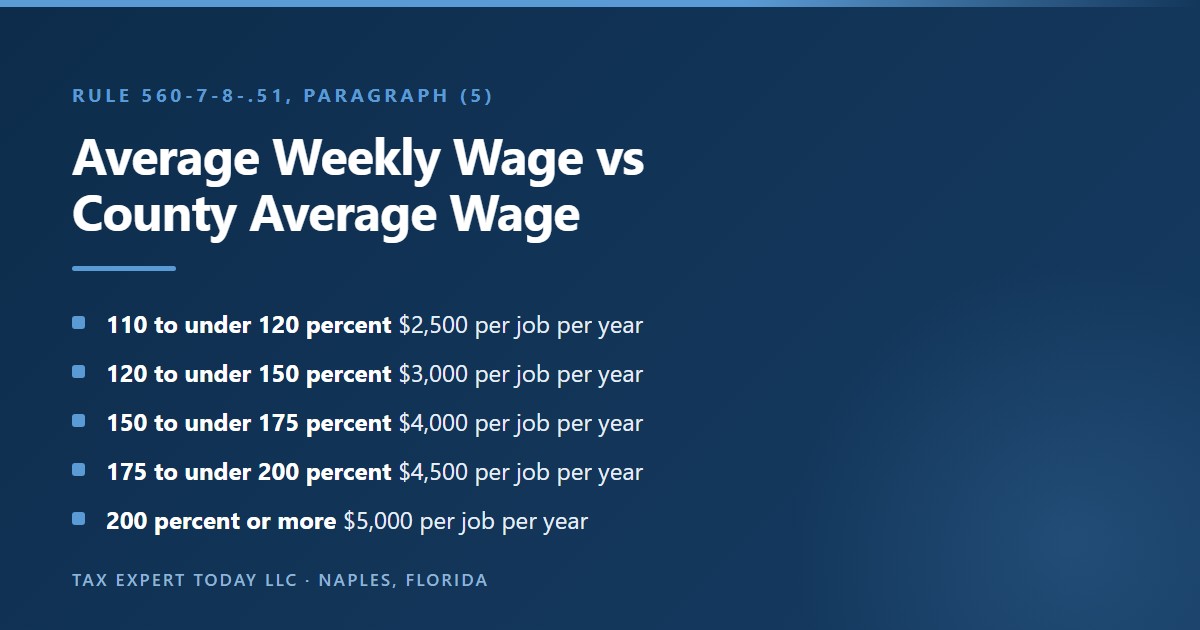
The credit is $2,500, $3,000, $4,000, $4,500, or $5,000 per new quality job per year, depending on how the average weekly wage of all new quality jobs compares with the county average wage. Every job created in the same tax year receives the same amount, and the tier is recalculated each year.
- Lowest tier: $2,500 per job at 110 percent but less than 120 percent of the county average wage.
- Highest tier: $5,000 per job at 200 percent or more of the county average wage.
- One rate per creation year: all jobs created in the same year share one credit amount.
- Annual recalculation: the tier for each group of jobs is redetermined every year it is claimed.
Paragraph (5) of Rule 560-7-8-.51 sets out the schedule. The comparison is between the average weekly wage for all new quality jobs and the county average wage reported in the most recent annual issue of the Georgia Department of Labor’s Employment and Wages Averages report available as of the last day of the tax year in which the jobs were created.
| Average weekly wage of all new quality jobs, as a share of the county average wage | Credit per new quality job, per year | Five year value per job at that tier |
|---|---|---|
| 110 percent but less than 120 percent | $2,500 | $12,500 |
| 120 percent but less than 150 percent | $3,000 | $15,000 |
| 150 percent but less than 175 percent | $4,000 | $20,000 |
| 175 percent but less than 200 percent | $4,500 | $22,500 |
| 200 percent or more | $5,000 | $25,000 |
The five year column assumes the jobs are maintained and the tier does not change, which is a simplification. The tier for a group of jobs can move up or down from one year to the next, because the rule requires the credit amount for jobs created in the same year to be recalculated each year using that year’s average weekly wage for all new quality jobs against the county average wage from the year the jobs were created. The regulation’s own example shows jobs created in year one at the $2,500 tier moving to the $3,000 tier in year two because average pay rose while the year one county benchmark stayed fixed.
Form IT-QJ adds one point the summary tables on most websites leave out. Its credit calculation instructions state that if, in years two through seven, the average weekly wage for new quality jobs falls below 110 percent of the applicable county average wage, the taxpayer is entitled to $2,500 for each additional new quality job created in that year. Each job still has to meet the 110 percent test individually to be counted at all, so this floor matters mainly where a few very high paid roles drop out of the average.
There is no annual dollar cap per employer in the Department’s summary or the regulation, and the credit can be used against up to 100 percent of the taxpayer’s Georgia income tax in a year. Large employers can therefore generate credit well beyond their Georgia income tax, which is why the withholding offset and the ten year carryforward matter so much in practice.
What Counts as a New Quality Job in Georgia?
A new quality job is a Georgia position with a regular work week of 30 hours or more, paying at or above 110 percent of the county average wage, that is not a job that is or was already located in Georgia for any employer. For credits first claimed before 2012, the job also needed no predetermined end date.
- Location: the job must be located in Georgia, though a temporary Georgia location during construction is allowed.
- Hours: a regular work week of 30 hours or more.
- Pay: at or above 110 percent of the county average wage for the job’s county.
- Newness: not a job that is or was already in Georgia, regardless of which employer it was with.
The definition in paragraph (2)(b) of the regulation is applied to each job individually. A business does not reach the 50 job threshold by averaging a group of well paid managers with a group of lower paid hourly workers. A position paying 105 percent of the county average wage is simply not a new quality job, and it is excluded from both the threshold count and the credit, even if the overall payroll is generous.
| Test | What the rule requires | Where it trips employers |
|---|---|---|
| Located in Georgia | Employment for an individual located in this state | Remote employees living outside Georgia do not create Georgia jobs |
| 30 hours | A regular work week of 30 hours or more | Seasonal or variable hour roles that average under 30 |
| 110 percent wage | Pay at or above 110 percent of the county average wage, measured against the benchmark fixed in the first election year | Using the wrong county or the wrong year of the wage report |
| New to Georgia | Not a job that is or was already located in Georgia, for any employer | Jobs moved from another Georgia site, or acquired with a Georgia business |
| No end date (older credits only) | Applies only where the credit was first claimed in a tax year beginning before January 1, 2012 | Rarely relevant for a new claim in 2026 |
Wages for this test are broader than base salary. The regulation defines wage as the total dollars paid during the year to an employee, including bonuses, incentive pay, and amounts the employee elects to defer, such as 401(k) and cafeteria plan contributions. It excludes amounts the employer contributes on the employee’s behalf to health insurance, retirement, or other benefit programs. Bonuses are treated as paid ratably over the months the job existed during the year the bonus was paid, which smooths out a single large payment.
The 110 percent benchmark has a useful feature. Under paragraph (2)(b)3 of the rule, the county average wage used for the 110 percent test in years one through seven is the figure from the wage report available as of the last day of the tax year in which the taxpayer first elected jobs to qualify. The threshold therefore stays constant over the life of the credit. If county wages rise sharply in later years, the employer’s qualifying line does not move with them. The credit tier is a separate comparison, discussed below.
How Many New Quality Jobs Must a Business Create?
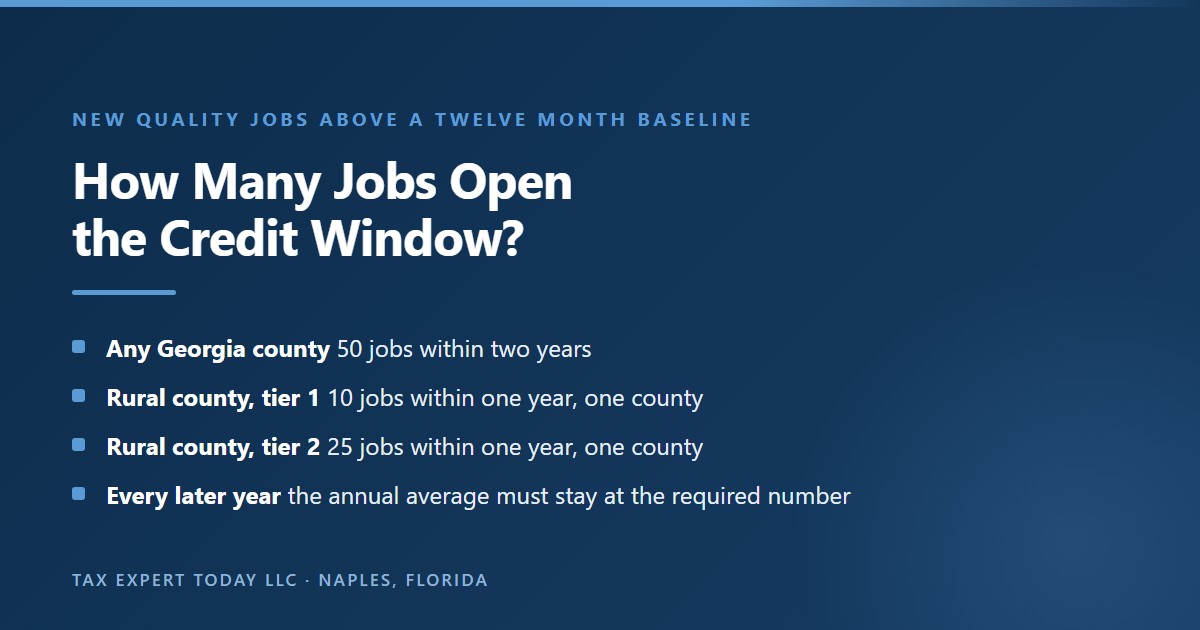
Most employers must create at least 50 new quality jobs within two years of the first date they withhold Georgia wages for new quality jobs. Employers in a rural county designated tier 1 need 10 new quality jobs within one year, and in a rural county designated tier 2 they need 25 within one year.
- Standard test: 50 new quality jobs within two years, for job creation starting in tax years beginning on or after January 1, 2017.
- Rural tier 1: 10 new quality jobs in a single rural county within one year.
- Rural tier 2: 25 new quality jobs in a single rural county within one year.
- Older claims: creation before 2017 tax years required 50 jobs within one year.
The threshold is measured as an increase over a baseline, not as total headcount. The regulation compares the number of new quality jobs in a month during the measurement window with the monthly average of jobs that would have qualified in the twelve months before the window started. When the difference reaches 50 (or 10 or 25 in qualifying rural counties), the requirement is met.
| Where the jobs are and when creation began | Jobs required above the baseline | Window to reach the count |
|---|---|---|
| Any Georgia county, first withholding for new quality jobs in a tax year beginning before January 1, 2017 | 50 | One year |
| Any Georgia county, first withholding in a tax year beginning on or after January 1, 2017 | 50 | Two years |
| A single rural county designated tier 1, first withholding in a tax year beginning on or after January 1, 2020 | 10 | One year |
| A single rural county designated tier 2, first withholding in a tax year beginning on or after January 1, 2020 | 25 | One year |
Several search results still describe the standard test as 50 jobs in twelve months. That was the rule for job creation that began in tax years starting before 2017. For a business beginning to create jobs in 2026, the standard window is two years, which gives a phased hiring plan considerably more room. The rural thresholds kept the one year window when they were added for tax years beginning in 2020.
Reaching the threshold is a one time event that opens the credit, but it is not the end of the counting. In each later year the average number of new quality jobs must stay at or above the same required number for any jobs to be claimed that year. That maintenance rule is covered in its own section below, because it is where many multi year credit plans lose a year of benefit.
The threshold is measured per taxpayer. Since 2016, the taxpayer is any person required to file a return or pay taxes, but a taxpayer can elect to count the jobs inside its disregarded entities as its own. Related corporations filing separately do not combine their jobs, so a group that spreads hiring across several separate entities can fall short of 50 in each one while easily exceeding 50 in total. Entity structure is worth reviewing before the first hire, not after.
How Do the Rural County Thresholds Work in 2026?
The reduced thresholds apply only when the jobs are in a single county that is both on the rural county list and designated tier 1 or tier 2 for the job tax credit. A rural county has fewer than 50,000 residents with at least 10 percent in poverty, and the Department of Community Affairs publishes both lists each year.
- Two lists, both required: the rural county list and the job tax credit tier designation.
- Single county: the 10 or 25 jobs must be created within one rural county.
- 2026 rural list: 108 counties appear on the Department of Community Affairs list for 2026.
- Tier source: the tier comes from the annual job tax credit ranking under O.C.G.A. 48-7-40.
Paragraph (2)(g) of the regulation defines a rural county as one with a population of less than 50,000 and 10 percent or more of that population living in poverty, based on the most recent reliable Census Bureau data, and it directs the Commissioner of Community Affairs to publish a list of those counties by December 31 each year. The 2026 list names 108 counties, from Appling and Atkinson through Wilkinson and Worth.
Being on the rural list is not enough on its own. Subparagraphs (4)(c) and (4)(d) of the rule tie the reduced thresholds to counties designated tier 1 or tier 2 by the Commissioner of Community Affairs under Code Section 48-7-40, the job tax credit statute. The Department of Community Affairs ranks counties by unemployment, per capita income, and poverty, and publishes the 2026 tier ranking and the 2026 tier map through its job tax credits page. A county on the rural list that is ranked tier 3 or tier 4 for the year does not carry a reduced threshold, and the standard 50 job test applies there.
The single county requirement is strict. A manufacturer that opens two plants in two neighboring rural tier 1 counties, with six new quality jobs in each, has twelve new quality jobs in total but has not created ten in a single rural county. Planning the headcount by site, not by company, is what makes the rural thresholds usable.
The tier and rural designations are annual, and the regulation ties the reduced threshold to the year in which the taxpayer first withholds wages for new quality jobs. Before relying on a reduced threshold, confirm the county’s status on the list and ranking for that year, and keep a copy of both documents in the credit file. Counties move between tiers, and a later change in designation is a predictable audit question.
The rural tests also interact with the wage test. Rural counties often have lower average wages, so the 110 percent line is reached at a lower dollar figure. For example, the Georgia Department of Labor reports a 2025 average weekly wage of $1,188 in Appling County, which puts the 110 percent line at about $1,307 a week, compared with $1,938 and about $2,132 a week in Fulton County.
How Is the Prior Twelve Month Baseline Calculated?
The taxpayer elects the month in which jobs begin to qualify. The baseline is the monthly average, over the twelve months before that month, of jobs that would have met the new quality job definition apart from the new to Georgia test. A business new to Georgia uses a baseline of zero.
- Election month: the taxpayer chooses the month that starts the measurement window.
- Look back: the twelve months before that month set the baseline average.
- Counting rule: count jobs that would have qualified on hours and wage, ignoring the new to Georgia test.
- New entrant: a business not located in Georgia during the look back uses zero.
The baseline protects the credit from rewarding jobs that already existed. For an existing Georgia employer, the baseline can be substantial. The regulation’s example uses a calendar year taxpayer that elects July 2009, finds an average of 89 qualifying type jobs from July 2008 through June 2009, and meets the 50 job test in August 2009 when it has 140 new quality jobs, since 140 minus 89 is 51.
Section F of Form IT-QJ is the worksheet for this calculation. It lists each of the twelve prior months and the number of jobs that would have qualified, totals them, and divides by twelve. Section G then records the election month, the month in which the count exceeded the baseline by the required number, and the difference, which must be at least 50, 25, or 10 as applicable.
| Hypothetical step | Figure | How it is used |
|---|---|---|
| Election month | March 2026 | Starts the two year window under the standard test |
| Average qualifying type jobs, March 2025 through February 2026 | 20 | The baseline |
| New quality jobs at the end of November 2026 | 72 | 72 minus 20 is 52, so the 50 job test is met |
| Average new quality jobs for calendar 2026 | 58 | 58 minus 20 gives 38 jobs credited in year one |
The last row surprises many employers. Meeting the 50 job test in November does not mean 50 jobs are credited for the year. Year one credit is based on the average number of new quality jobs for the whole tax year, less the baseline. In the example, only 38 jobs are credited in 2026, even though the threshold was met. Paragraph (4)(e) of the rule allows that: in the first year the required number is reached, the credit can be claimed even if the annual average is below the required number. From year two on, the average must reach it.
The choice of election month is strategic and should be modeled. An earlier month can lengthen the window to reach the threshold, but it also fixes the twelve month look back and the year one county wage report. A later month can shrink the baseline if older qualifying jobs were lost, but it may push year one into a tax year with fewer months of new headcount. Once the return is filed, the month is set.
Which County Average Wage Applies to the Georgia Quality Jobs Tax Credit?
The county average wage comes from the most recent annual issue of the Georgia Department of Labor’s Employment and Wages Averages report available on the last day of the relevant tax year. The 110 percent test uses the report for the first election year, and the credit tier uses the report for the year the jobs were created.
- Source: Georgia Employment and Wages Averages, published annually by the Department of Labor.
- Current issue: the 2025 Averages report, which lists every county’s average weekly wage.
- 110 percent test: fixed at the report available at the end of the first election year.
- Credit tier: measured against the report for the year each group of jobs was created.
The 2025 Averages report shows a statewide average weekly wage of $1,404 for all industries and lists each county on its county summary pages. Fulton County leads at $1,938 a week. Burke County reports $1,533. Many rural counties report averages below $950 a week, and Glascock County reports $716. Because the county figure is the denominator in every comparison, the same salary can earn a different credit tier in different counties.
| County (2025 Averages report) | County average weekly wage | 110 percent line, weekly | 150 percent line, weekly | 200 percent line, weekly |
|---|---|---|---|---|
| Fulton | $1,938 | $2,131.80 | $2,907.00 | $3,876.00 |
| Chatham | $1,189 | $1,307.90 | $1,783.50 | $2,378.00 |
| Hall | $1,228 | $1,350.80 | $1,842.00 | $2,456.00 |
| Appling (on the 2026 rural list) | $1,188 | $1,306.80 | $1,782.00 | $2,376.00 |
| Coffee (on the 2026 rural list) | $917 | $1,008.70 | $1,375.50 | $1,834.00 |
The table is illustrative. The figures are the 2025 annual averages as published, and the report that actually applies to a claim is the one available on the last day of the relevant tax year. For a calendar year 2026 claim, check whether a newer issue has been published before December 31, 2026. The weekly lines are simple multiples of the published averages and are not rounded the way any Department worksheet might round them.
Two different benchmarks are in play, and confusing them is a common error. The qualifying line for each individual job, 110 percent, is fixed at the report available at the end of the tax year in which the taxpayer first elected jobs to qualify. The tier comparison for the credit amount uses the report available at the end of the tax year in which each group of jobs was created. For jobs created in year one, the two are the same. For additional jobs created in year four, the tier benchmark is the year four report, while the qualifying line is still the year one figure.
How Is the Average Weekly Wage Calculated for the Credit Tier?
Add the actual wages paid for all new quality jobs in the tax year, divide by the average number of new quality jobs, then divide by 52. Compare that average weekly wage with the county average wage from the year each group of jobs was created to find the tier for that group.
- Numerator: total wages actually paid for all new quality jobs in the year.
- Divisor: the average number of all new quality jobs, then 52 weeks.
- All periods included: jobs from any prior and subsequent creation periods are included in the average.
- Separate benchmarks: each creation year’s jobs are compared with that year’s county figure.
Paragraph (5)(c) of the regulation spells out the three steps, and the credit calculation instructions on Form IT-QJ repeat them. The method uses one average weekly wage for all new quality jobs in the year, not a separate average for each creation year. What differs by creation year is the county benchmark. That is why the same average pay can put year one jobs in one tier and year two jobs in another.
The regulation’s example makes the point. Year one has 50 new quality jobs with an average weekly wage of $725 against a county average of $652, a ratio of 111 percent, so the credit is $2,500 per job, or $125,000. In year two the company has 70 new quality jobs, and the average weekly wage rises to $785. The year one jobs are compared with the year one county figure of $652, a ratio of 120 percent, so they move to $3,000 each, or $150,000. The 20 year two jobs are compared with the year two county figure of $660, a ratio of 119 percent, so they earn $2,500 each, or $50,000. The year two credit is $200,000.
Three practical consequences follow. First, a raise for the whole new quality workforce can lift the tier for earlier groups of jobs, because their benchmark is frozen while pay moves. Second, adding a large group of lower paid but still qualifying roles can pull the average down and drop earlier groups into a lower tier for that year. Third, the tier boundaries are sharp: 119.9 percent earns $2,500, while 120 percent earns $3,000. Employers near a boundary often review compensation timing, such as when an annual bonus is paid, with the ratable bonus rule in mind.
The wage data comes from payroll, but it has to be organized by new quality job, by month, and by county. Most payroll systems do not tag employees that way automatically. The employee schedule required by Section E of Form IT-QJ asks for each employee’s name, the last four digits of the Social Security number, wages for the year, average weekly wage, and percentage above the county average. Building that schedule month by month during the year is far easier than reconstructing it at return time.
How Does the Credit Work When Jobs Are in More Than One County?
When new quality jobs are created in more than one county in a year, the credit tier uses a weighted county average wage. Each county’s average wage is multiplied by its share of that year’s new quality jobs, and the results are added. The weighted figure sets the tier but is not used for the 110 percent test.
- Weighting: each county’s wage is weighted by its share of new quality jobs created that year.
- Tier only: the weighted figure decides the credit amount, not whether a job qualifies.
- Job test stays local: each job must still pay 110 percent of its own county’s average wage.
- New project exception: a subsequent creation period in a different county is treated as that county alone.
Paragraph (5)(f) of the regulation describes the computation. For a company with 40 new quality jobs in Fulton County and 20 in Hall County in the same year, using the 2025 averages for illustration, the weighted county average wage would be two thirds of $1,938 plus one third of $1,228, or about $1,701.33 a week. The average weekly wage of all new quality jobs is then compared with that weighted figure to select the tier.
The weighted figure is not used to decide whether a particular job qualifies. A Hall County role paying $1,400 a week clears Hall’s 110 percent line of about $1,351, and a Fulton role paying $2,000 a week does not clear Fulton’s line of about $2,132, no matter what the weighted average looks like. Multi site employers need a qualification test by site and a tier calculation for the company, and both have to be documented.
The rule includes one exception. If a taxpayer starts a subsequent seven year job creation period for a new qualified project located in a different county from the counties in its earlier periods, all new quality jobs created in that subsequent period are treated as created in that different county, and the weighting rule does not apply to them.
How Long Can the Georgia Quality Jobs Tax Credit Be Claimed?
Jobs created in year one earn credit in year one and in each of the next four years if maintained. Additional jobs created in years two through seven each earn their own five year run. A single seven year creation period can therefore produce credit across as many as eleven tax years.
- Five years per group: each creation year’s jobs can be claimed for five years.
- Seven year creation window: new jobs added in years two through seven start their own five year run.
- Up to eleven years: jobs added in year seven can be claimed through year eleven.
- Maintenance required: credit for any year depends on the jobs still existing in that year.
The Department’s summary puts it this way: the taxpayer may claim the credit in years one through five for new quality jobs created in year one and may continue to claim newly created new quality jobs through year seven, claiming the credit on each of those jobs for five years. Form IT-QJ tracks this on its “5 year rule” chart, which has eleven year columns and a line for each creation year from one to seven.
One description that appears in search results says the jobs a company creates during its first seven years of business in Georgia can earn credit. That is not how the window works. The seven years are counted from the taxpayer’s year one for the credit, the year in which it first reaches the required number of new quality jobs, not from the date the business started operating in Georgia. A company with a long Georgia history can start a credit window in 2026 if it meets the tests.
Additional jobs are measured as increases in the monthly full time employment average above the prior year. Under paragraph (6) of the rule, increases and decreases in years two through seven are computed on twelve month periods only, even when the taxpayer has a short tax year, so the credit calculation period can differ from the tax year. A company that changes its fiscal year end during a credit window needs to keep two calendars.
What Happens if the Job Count Drops Below the Minimum?
After the first credit year, the average number of new quality jobs must be at least the required number, 50 or the rural 10 or 25, for any jobs to be claimed that year. If it falls short, the credit for that year is forfeited, but the schedule resumes in a later year when the average recovers.
- First year relief: the year the threshold is first met, a lower annual average still allows a claim.
- Later years: the annual average must meet the required number every year a claim is made.
- Forfeit, not end: a short year loses that year’s credit only.
- No catch up: the schedule resumes from when the credit was first claimed, so lost years are not added back.
Paragraph (4)(e) of the regulation states the rule. In the year the taxpayer first employs the required number of persons in new quality jobs, it can claim the credit even if its average for that year is below the required number. In later years, the average must be at least the required number. If it is not, the taxpayer forfeits the right to claim the credit for those jobs in that year. If the requirement is met again in a later year, the taxpayer may continue taking the credit and resumes the credit schedule from when the credit was initially claimed.
Resuming the schedule from the original start means the five year clock keeps running through the short year. A group of jobs created in year one whose fifth year is year five does not gain a sixth year because year three was forfeited. The lost year is simply lost. Form IT-QJ reinforces this on its job tracking chart: line 8, the total average number of new quality jobs eligible for the credit, must be at least the required number in each year the credit is claimed.
The maintenance test is an average, so the timing of turnover matters. A layoff in January weighs on all twelve months of the year’s average, while the same reduction in December affects only one month. Employers working near the threshold should model the annual average monthly, not just look at year end headcount, and should know that replacing a departed employee with a new hire in the same qualifying role keeps the job in the count.
The maintenance rule interacts with the individual job test. If wages for some roles drift below the fixed 110 percent line, those roles stop counting as new quality jobs, which can pull the average below the threshold even when total headcount is unchanged. Annual compensation reviews and the credit calculation should be done together.
Does the Georgia Quality Jobs Tax Credit Require a $2.5 Million Investment?
Not for a first claim, based on the Department’s summary and its regulation. The $2.5 million qualified investment property requirement belongs to the rules for starting a subsequent seven year job creation period with a new qualified project. A first credit window depends on the job count, hours, and wage tests.
- First window: the Department’s summary lists job tests only, not an investment minimum.
- Subsequent window: requires completing a qualified project with at least $2.5 million of qualified investment property.
- Placed in service: the property must be in service by the end of the two year job creation window.
- Leases count: a lease of three years or longer is treated as a purchase for this test.
Some summaries of this credit, including an AI generated overview seen in search results on October 2, 2026, present a $2.5 million investment as a general eligibility requirement. That reading does not match the Department’s description. The Department’s summary states that in 2017 the statute was changed so that only a taxpayer that completes the creation of a qualified project in a tax year beginning on or after January 1, 2017 is eligible to begin a subsequent seven year job creation period. Paragraph (8) of the regulation then requires that taxpayer to create at least 50 new quality jobs above its single previous high yearly average. Form IT-QJ asks for qualified investment property costs only in Section H, which is completed for a subsequent creation period.
The regulation defines qualified investment property in paragraph (2)(c) as all real and personal property purchased or acquired for use in a qualified project, including land, improvements, buildings, building improvements, and personal property used in the facility. A qualified project, under paragraph (2)(e), meets the $2.5 million requirement and involves the lease or construction of one or more new facilities in Georgia or the expansion of existing ones. The term project is defined by cross reference to Rule 560-7-8-.37, and the quality jobs rule itself is also published by the Legal Information Institute with its amendment history.
Because the statute itself could not be read directly on publish day, this guide states the point as the Department and its regulation present it. A taxpayer whose plan depends on the distinction should confirm it against the current text of O.C.G.A. 48-7-40.17 before filing.
What Is a Subsequent Seven Year Job Creation Period?
For tax years beginning on or after January 1, 2017, a taxpayer that completes a new qualified project and creates at least 50 new quality jobs above its single previous high yearly average can open a new seven year creation window. Jobs from earlier windows keep their credit if they are maintained.
- Trigger: a completed qualified project plus 50 new quality jobs above the prior high yearly average.
- Notice: made by completing the subsequent period sections of Form IT-QJ.
- Oldest first: jobs are attributed to the oldest window first, up to that window’s high average.
- Alternative baseline: an irrevocable election can use the average of completed prior years instead of the single high.
Paragraph (8) of the regulation describes how jobs are allocated among windows. Starting with the first window, the taxpayer attributes new quality jobs up to that window’s single high yearly average, then moves to the next window, and so on. Jobs left after all earlier windows are filled are attributed to the most recent window. A taxpayer must keep the jobs from earlier windows to claim jobs in later ones, and no new jobs can be added to an earlier window once a later one begins.
Form IT-QJ includes two worked examples on its last page. In the first, a company with 50, 60, 70, and 65 jobs in years one through four reaches 120 jobs in year five with a new facility. The first window’s high average is 70, so 70 jobs stay with the first window and 50 begin the second. In the second example, the company elects to use the average of its completed prior years, 61, instead of the single high of 70, so it needs only 111 jobs to open the second window with 50 new ones.
That election is irrevocable and must be made on the initial qualifying return for the new window, or within one year of the earlier of the date that return was filed or its due date with extensions. It is useful for an employer whose first window peaked early and then shrank. It also caps the number of jobs that can be counted in the remaining years of the earlier window at that average.
A subsequent window is a separate claim. The Department asks for a separate Form IT-QJ for each seven year creation period, and the employee schedules must cover all new quality jobs in any prior and subsequent periods. Employers with two or three windows running at once need a single reconciliation that ties every employee to one window.
Which Taxes Can the Georgia Quality Jobs Tax Credit Offset?
The credit offsets up to 100 percent of the taxpayer’s Georgia income tax liability for the year. It is not limited to corporate income tax: a pass through entity’s credit flows to its owners for use against their Georgia income tax. Any excess can be carried forward or, by election, applied against payroll withholding.
- Income tax first: up to 100 percent of the Georgia income tax liability for the year.
- Not only corporations: owners of S corporations, partnerships, and LLCs can use passed through credit.
- Withholding second: excess credit can reduce future payroll withholding through Form IT-WH.
- Not other taxes: the credit does not reduce sales and use tax or the net worth tax.
Some summaries describe the credit as offsetting 100 percent of corporate income tax. The Department’s own wording is broader: the credit may be used to offset 100 percent of the taxpayer’s Georgia income tax liability in the taxable year. For a C corporation, that is the corporate income tax computed on Form 600. For an S corporation, partnership, or multi member LLC with no income tax of its own, paragraph (10) of the regulation passes the credit through to shareholders, partners, or members based on the year end profit and loss percentages.
The credit is an income tax credit. It does not reduce Georgia sales and use tax, which has its own exemption rules discussed in our Georgia sales tax exemption guide, and it does not reduce the corporate net worth tax covered in our Georgia net worth tax guide. The payroll withholding benefit is a separate statutory mechanism that lets excess income tax credit be applied against a different tax, and it is available only by election.
Georgia’s income tax rate affects how quickly a credit is absorbed, but it does not change the credit amount. A company with modest Georgia taxable income and a large hiring plan can generate credit far beyond its liability, and that excess is the reason the withholding offset exists. Our Georgia corporate tax rate guide covers the current rate schedule and filing rules for corporations.
How Does the Excess Credit Offset Georgia Payroll Withholding?
A taxpayer with quality jobs credit left after income tax can make an irrevocable election, by filing Form IT-WH in the Georgia Tax Center, to apply all or part of the excess against its future monthly or quarterly Georgia withholding payments. The Department reviews the claim and issues a letter stating the amount and start date.
- Election: Form IT-WH, filed electronically through the Georgia Tax Center.
- Deadline: within the three year limitations period after the return due date, including extensions.
- Review: the Department has 120 days to determine the eligible amount.
- Future only: the benefit reduces later withholding deposits and does not refund past ones.
Paragraph (7)(b) of the regulation governs the withholding benefit. It can be applied only against the withholding tax account the taxpayer uses for payroll. When the taxpayer is a pass through entity and makes the election, the excess credit covered by the election does not pass through to the owners. The election may be made only once for each tax year’s credit, for all or part of the excess remaining at that time. For a credit earned over more than one tax year, the election is available for the credit earned in each later year.
The quality jobs credit is one of many Georgia credits that use the same Form IT-WH. Our Georgia R&D tax credit guide walks through the Georgia Tax Center screens, the letter of eligibility, and how the offset appears on withholding returns, so that material is not repeated here. What is specific to the quality jobs credit is that the excess can reach 100 percent of the eligible amount after income tax is fully used, there is no separate percentage limit on the withholding side in the Department’s summary, and large employers with modest Georgia taxable income often rely on the withholding route for most of the benefit.
The withholding benefit reduces what the employer remits. It does not reduce what employees owe or change their Forms W-2. Employees’ withheld amounts are still credited to them in full, because the employer is applying a credit it earned against its deposit obligation. Our Georgia withholding tax guide covers the underlying deposit and reporting rules that the offset works within.

What Does Form IT-WH Require for the Quality Jobs Credit?
Form IT-WH must be filed through the Georgia Tax Center from the corporate income tax account. The withholding account must be valid and compliant, with no missing returns and no outstanding liabilities, and the notice must be filed within three years after the income tax return due date, including extensions.
- Electronic only: paper IT-WH filing ended for tax years beginning on or after January 1, 2017.
- Account level: the request is made from the corporate account in the Georgia Tax Center.
- Clean accounts: no missing returns and no outstanding liabilities.
- Disregarded entities: an annual attachment allocates the benefit among qualifying disregarded entities.
The Department’s IT-WH Electronic Notice of Intent page lists the account conditions and the information to gather: the business’s legal name, location, and mailing address, its federal identification number and Georgia tax account number, and the names, addresses, and Social Security numbers of owners, partners, or officers. In the Georgia Tax Center, the request is made through Manage My Credits next to the corporate income tax account, then Claim Withholding Tax Benefit, where the quality jobs credit is one of the credit types in the list.
Paragraph (7)(b)1 of the regulation sets the deadline: the IT-WH must be filed within the three year statute of limitations period after the due date of the Georgia income tax return, including extensions. Failure to file it as provided results in disallowance of the withholding benefit. That three year window is separate from, and much longer than, the one year window to claim the credit itself on the income tax return.
Where the taxpayer has made the disregarded entity election discussed below, it must include an attachment each year showing the amounts to be used against its own withholding and against the withholding of each qualifying disregarded entity. Without the election, if the entity that earned the credit is a single member LLC disregarded for income tax purposes, the withholding benefit can be applied only against withholding on wages paid by that LLC. That limitation catches groups that run payroll through a separate employer entity.
The clean account condition is practical, not technical. A missing withholding return for a single quarter, or an unpaid assessment on any account, can hold up the election. Before filing, reconcile every Georgia account. A business with an open Georgia balance may first need to resolve it, for example through a Georgia Department of Revenue payment plan, and confirm with the Department how an active plan affects the compliance check.
What Happens During the 120 Day Review?
After Form IT-WH is received, the Department has 120 days to review the credit and decide how much can be used against withholding. It then sends a letter of eligibility stating the amount and when the taxpayer may begin applying it. The amount is applied only to future withholding payments.
- Review period: up to 120 days from the date the Department receives the IT-WH.
- Letter of eligibility: states the approved amount and the start date for applying it.
- No refund of past deposits: withholding already paid is not refunded.
- Audit still possible: the letter does not end the Department’s ability to examine the underlying credit.
Paragraphs (7)(b)2 and (7)(b)3 of the regulation set out the review and the letter. The letter states the tax credit amount that may be applied against withholding and when the taxpayer may begin to claim it. The Department treats that amount as a credit against future withholding tax payments and will not refund any previous withholding payments.
The cash flow effect depends on payroll size. A company with a large Georgia payroll can absorb a substantial letter amount within a few deposit periods, while a smaller employer may need many months. The credit is a reduction of deposits, so the employer still files its withholding returns and reports the credit applied as the Department directs.
The review can produce a lower amount than requested. The Department may question the baseline, the qualification of particular jobs, the county wage used, or the tier. Keep the full IT-QJ workpapers, the employee schedule, and the payroll registers ready to answer questions quickly, because the 120 day period is the Department’s review window, not a deadline for the taxpayer’s responses.
How Long Can an Unused Georgia Quality Jobs Tax Credit Be Carried Forward?
Credit that is claimed but not used in a year can be carried forward for ten years from the close of the tax year in which the new quality jobs were created. Credit from jobs created in year one, if unused that year, can be used in years two through eleven.
- Ten years: measured from the close of the year the jobs were created, not the year the credit was claimed.
- Each group has its own clock: credit from year four jobs expires on a later date than credit from year one jobs.
- Tracked on the form: Form IT-QJ line 9 carries the prior year carryover into the total.
- Withholding interaction: credit applied against withholding is no longer available to carry forward.
Paragraph (9) of the regulation sets the carryforward and gives the example: credits created by an employment increase in year one, but not used in year one, may be carried forward to years two through eleven. Because the carryforward runs from the year the jobs were created, the credit earned in year five for year one jobs has less carryforward life left than the credit earned in year one for the same jobs. A carryforward schedule by creation year and by year earned avoids losing older credit.
For many employers, the decision is between waiting for future Georgia income tax and electing the withholding offset now. The withholding route converts credit to cash sooner but is irrevocable for the amount elected and, for a pass through entity, keeps that credit at the entity level. The carryforward route keeps flexibility but risks expiration if Georgia taxable income does not materialize.
| Deadline or period | Length | Source |
|---|---|---|
| Reach the standard 50 job count | Two years from the first withholding for new quality jobs | Rule 560-7-8-.51(4)(b) |
| Reach the rural 10 or 25 job count | One year | Rule 560-7-8-.51(4)(c) and (d) |
| Claim the credit on the income tax return | Within one year of the earlier of the filing date or the due date with extensions | Rule 560-7-8-.51(7) |
| Credit life of each group of jobs | The creation year plus four more years | Rule 560-7-8-.51(5)(a) |
| Job creation window | Years one through seven | Department summary; Rule 560-7-8-.51(5)(b) |
| File Form IT-WH | Within three years after the return due date with extensions | Rule 560-7-8-.51(7)(b)1 |
| Department review of IT-WH | 120 days from receipt | Rule 560-7-8-.51(7)(b)2 |
| Carry forward unused credit | Ten years from the close of the year the jobs were created | Rule 560-7-8-.51(9) |
How Do You Claim the Credit on Form IT-QJ?
File Form IT-QJ electronically with the Georgia income tax return for the first year the taxpayer qualifies and each year it claims the credit. Attach the schedule of new quality job employees with names, the last four digits of each Social Security number, and wages. Software filed versions of the form satisfy the requirement.
- With the return: the form is submitted electronically with the return when it is filed.
- Employee schedule: name, last four digits of the Social Security number, wages, and average weekly wage.
- Baseline and count: Sections F and G show the prior twelve month average and the threshold month.
- Credit calculation: the tracking chart and credit lines compute the year’s credit and carryover.
The current version on the Department’s IT-QJ page is the 2023 form, revised August 25, 2023, for taxpayers that create the required number of new quality jobs in a tax year beginning on or after January 1, 2023. Earlier versions remain posted for 2022, 2020, and 2017, along with an undated earlier version, and each version states the tax years it is meant for. The form states that it must be submitted electronically with the return at the time the return is electronically filed.
The form gathers the type of business and federal identification number, the nature of the business and its six digit NAICS code, the county and tier, projected and actual payroll for new quality jobs, the average weekly wage and county average wage by year, and the project category, either establishing new quality jobs at a Georgia address or relocating them from another location into Georgia. Section D asks the taxpayer to list all incentives and inducements for the project, including other tax credits, which bears directly on the exclusivity rules discussed below.
Paragraph (7)(a) of the regulation allows the taxpayer to ask the Commissioner for permission to use internal employee identification numbers instead of Social Security digits, and the form warns that the Department may request full Social Security numbers on audit. Payroll records and the schedule must agree, so the schedule should be produced from payroll data rather than typed by hand.
The form also carries a special rule for projects on certain regional industrial development authority property described in Code Section 36-62-5.2. Taxpayers in that situation check a box and must keep records supporting the credit amount claimed, because the form says failure to maintain or provide those records may lead to denial of the credit with tax, interest, and penalties.
Why Is the Quality Jobs Credit Claim Deadline Only One Year?
The regulation requires the quality jobs credit to be claimed within one year of the earlier of the date the original return was filed or its due date, including extensions. The usual three year amendment period does not apply, so a credit missed on the original return can be lost quickly.
- Short window: one year from the earlier of the filing date or the extended due date.
- Not three years: the Department’s summary contrasts this with the normal three year period.
- Early filers lose time: filing early starts the clock earlier.
- Elections share the clock: several irrevocable elections must also be made on the initial return or within one year.
The Department’s summary says the credit must be claimed within one year instead of the normal three year statute of limitation period, and paragraph (7) of the regulation states the measuring dates. For a calendar year C corporation that extends to October 15 and files on October 1, the window runs from October 1, the earlier of the two dates. Filing in April starts it in April.
That short window affects how amended returns are used. A business that discovers in year three that it qualified in year one cannot rely on the ordinary refund period described in our Georgia amended tax return guide to add the credit. If the one year window has closed, the year one credit is gone, although later years may still be claimed if the windows for those years remain open and the jobs are maintained.
The same timing applies to elections that shape the whole credit. The disregarded entity election, the election to use the average of completed years for a subsequent window, and the selection of the election month all take effect through the initial qualifying return. Planning those choices before the first return is filed is far easier than trying to correct them afterward. An extension on Form IT-303, covered in our Georgia Form IT-303 guide, extends the due date and therefore the latest possible end of the window, but filing earlier than the extended date shortens it.
How Does the Credit Work for S Corporations, Partnerships, and LLCs?
A pass through entity with no Georgia income tax of its own files Form IT-QJ to establish the credit, then passes it to owners by their year end profit and loss percentages. Owners use it against their own Georgia income tax but cannot apply excess against their own withholding. The entity can instead elect the withholding offset.
- Entity establishes: the credit forms are filed with the entity’s return first.
- Owners use: the credit is available for the owner’s tax year in which the entity’s year ends.
- No owner withholding offset: owners cannot apply excess credit against their own withholding.
- Entity election: if the entity elects IT-WH, the elected excess stays with the entity.
Paragraph (10) of the regulation covers pass through entities. The regulation’s example is a partnership that earns the credit for its tax year ending January 31, 2010 and passes it to a calendar year partner, who can use it beginning with the 2010 calendar year. For an S corporation with a calendar year, owners use the credit on the return for the same year.
The choice between passing the credit through and electing the entity level withholding offset is significant. Owners with large Georgia income tax liabilities may absorb the credit efficiently. Owners who are nonresidents with little Georgia source income, or whose Georgia tax is already reduced by other credits, may not. In that case, the entity level withholding offset may convert more of the credit to value, but the election is irrevocable and removes the elected amount from the owners.
Georgia’s elective pass through entity tax adds a further layer. When a partnership or S corporation elects to pay tax at the entity level, the question of how entity level credits interact with that tax, and how they flow to owners, should be confirmed against the Department’s current instructions for the year, since the rules for that election have their own credit provisions. Our Georgia pass through entity tax guide covers the election, and our Georgia composite return guide covers nonresident owners.
| Entity type | Who uses the credit against income tax | Who can use excess against withholding |
|---|---|---|
| C corporation | The corporation, on its Georgia corporate return | The corporation, by Form IT-WH |
| S corporation | Shareholders, by year end ownership percentages | The S corporation only, by election; shareholders cannot |
| Partnership or multi member LLC | Partners or members, by year end profit and loss percentages | The entity only, by election; partners cannot |
| Single member LLC, disregarded | The owner, as the taxpayer | Limited to withholding on the LLC’s own wages, unless the disregarded entity election is made |
| Tax exempt organization | The organization, only for a trade or business producing unrelated business income | The organization, for that trade or business |
What Is the Disregarded Entity Election?
For taxpayers first qualifying in tax years beginning on or after January 1, 2016, a taxpayer may elect to count the jobs inside its disregarded entities as its own new quality jobs. The election is irrevocable, is made on the initial qualifying Form IT-QJ or within one year, and makes those entities ineligible to claim separately.
- Purpose: combine jobs in disregarded single member LLCs with the owner’s jobs.
- Timing: on the initial qualifying return or within one year of the earlier of filing or due date.
- Form detail: page one of Form IT-QJ is completed for each disregarded entity included.
- Trade off: the included entities cannot claim the credit on their own.
Paragraph (2)(h) of the regulation and the Department’s summary both describe this election. Disregarded entities are defined by reference to the Internal Revenue Code, which in practice means eligible entities treated as disregarded under the federal classification rules in Treasury Regulation 301.7701-3. A company that runs separate LLCs for separate sites can use the election to aggregate jobs toward the 50 job threshold.
The election also changes how the withholding benefit can be used. With the election, the taxpayer allocates the benefit among its own withholding account and those of its qualifying disregarded entities on an annual attachment to Form IT-WH. Without it, a disregarded single member LLC that earned the credit can apply the benefit only against withholding on wages it paid itself.
The election does not reach separate corporations or partnerships. Related entities that file their own returns remain separate taxpayers for the job count. If a group’s Georgia hiring is spread among several corporations, the threshold may need to be met in one of them, which is an entity planning question worth settling before a project begins.
Can Tax Exempt Organizations Claim the Credit?
Yes, in a limited way. For tax years beginning on or after January 1, 2023, an organization exempt under Code Section 48-7-25 is a taxpayer only to the extent a trade or business it operates generates unrelated business income. It can claim the credit only for that trade or business’s projects, investments, and jobs.
- Effective date: tax years beginning on or after January 1, 2023.
- Scope: only a trade or business generating unrelated business income.
- Jobs: only jobs in that trade or business can be elected as new quality jobs.
- Federal reference: unrelated business income is defined by Internal Revenue Code section 512.
The Department’s summary and the 2023 Form IT-QJ both state this rule. The definition of unrelated business income comes from Internal Revenue Code section 512. A hospital system or university that operates a taxable line of business in Georgia, for example, may be able to claim the credit for qualifying jobs in that business, but not for jobs in its exempt operations.
Exempt organizations considering the credit should also look at Georgia’s other targeted credits, such as the program described in our Georgia rural hospital tax credit guide, which works very differently because it rewards donations rather than hiring.
Can You Combine the Quality Jobs Credit With the Georgia Job Tax Credit?
Not for the same jobs or the same project. A taxpayer claiming the quality jobs credit must elect not to take the job tax credit under Code Sections 48-7-40 and 48-7-40.1 for those jobs, and not to take the investment credits under Sections 48-7-40.2 through 48-7-40.9 for that project.
- Job tax credit: jobs claimed under 48-7-40 or 48-7-40.1 are excluded from all quality jobs calculations.
- Investment credits: only one of the investment, optional investment, or quality jobs credits per project.
- Deemed election: claiming the quality jobs credit on the return is the election.
- Not interchangeable: a taxpayer cannot switch between credits from year to year for a project.
Paragraph (4)(g) of the regulation is explicit that these credits are not interchangeable. Jobs for which the job tax credit under 48-7-40 and 48-7-40.1 is claimed are excluded from all quality jobs credit calculations. For investment credits, the taxpayer cannot claim the investment tax credit or the optional investment tax credit in one year and the quality jobs credit in the next for a given project.
The job tax credit is a different program. It is tied to the county tier designations published by the Department of Community Affairs, generally limited to certain industries outside the least developed counties, and governed by its own Department of Community Affairs rules in Chapter 110-9-1. The 2026 legislative session amended the job tax credit and related investment credits through HB 134, so a comparison between the programs should use current law. Which credit produces more value depends on the county, the wages, the industry, and how the employer expects to use the credit.
Not every Georgia incentive is excluded. The research credit, the film credit, and other credits have their own rules, and Section D of Form IT-QJ asks the taxpayer to list every incentive and inducement for the project. Our Georgia film tax credit and Georgia R&D tax credit guides cover two credits that are often in the same conversation.
Do Jobs Moved From Another Georgia Location Qualify?
No. New quality jobs must be new to Georgia. Jobs transferred from another Georgia location of the taxpayer or an affiliate do not qualify, and jobs that were already in Georgia with any employer do not qualify. The regulation states the Commissioner has no authority to waive this requirement.
- Internal moves: a job moved from Macon to Savannah within the same company is not new.
- Affiliate moves: a job moved from an affiliate’s Georgia location is not new.
- Acquisitions: buying a Georgia business does not turn its existing jobs into new ones.
- Relocations into Georgia: jobs relocated from outside the state can qualify.
Paragraphs (3) and (11) of the regulation state these rules. The definition requires that the job not be a job that is or was already located in Georgia, regardless of which taxpayer the individual performed services for. Because that language comes from the statute, the Commissioner cannot grant a waiver. The rule does allow an employee in a new quality job to work at a temporary Georgia location while construction or renovation is completed.
Form IT-QJ separates the two project categories. Establishing new quality jobs asks for the Georgia site. Relocating new quality jobs asks where the jobs came from, including the country, and where they went. A business moving a headquarters or a division into Georgia from another state, or from abroad, can count those positions if they meet the other tests.
This rule is the reason an acquisition rarely produces credit by itself. If a buyer acquires a Georgia company with 200 employees, those 200 jobs were already in Georgia. Only jobs created after the acquisition, above the baseline, can count. Purchase price allocations and integration plans sometimes assume otherwise.
What Changed in the Georgia Quality Jobs Tax Credit for 2026?
For 2026, the substantive rules did not change. The 2026 General Assembly’s code revision bill, HB 1268, amended O.C.G.A. 48-7-40.17 effective July 1, 2026 as part of an editorial cleanup, and HB 463 repealed several other credits but not this one. The regulation was last amended in 2025.
- HB 1268: editorial amendments across the Code, effective July 1, 2026.
- HB 463: repealed several other Georgia credits; 48-7-40.17 is not on its repeal list.
- Rule update: Rule 560-7-8-.51 was amended effective June 24, 2025, for tax years beginning in 2025.
- Current form: the 2023 Form IT-QJ remains the latest version posted.
The General Assembly’s summary of 2026 legislation lists Code Section 48-7-40.17 as amended by HB 1268, Act 723, which it describes as making extensive editorial amendments to correct typographical, stylistic, capitalization, punctuation, and other errors and omissions, effective July 1, 2026. That is why some code sites now label the section as effective July 1, 2026. The same summary lists HB 463 as repealing a number of other credit sections, including 48-7-40.1A, 48-7-40.1B, 48-7-40.15, 48-7-40.18, 48-7-40.20, and 48-7-40.22, but not 48-7-40.17.
| Tax years beginning on or after | Change described by the Department or the regulation |
|---|---|
| January 1, 2009 | Credit available for 50 new quality jobs |
| January 1, 2012 | The no predetermined end date test applies only to credits first claimed before this date |
| January 1, 2016 | Taxpayer definition and the disregarded entity election |
| January 1, 2017 | Two years to create 50 jobs; subsequent seven year windows after a completed qualified project; IT-WH filed electronically |
| January 1, 2020 | Reduced thresholds of 10 or 25 jobs in rural tier 1 or tier 2 counties |
| 2020 and 2021 | Option to use the 2019 new quality job count for taxpayers that claimed the credit in 2019 |
| January 1, 2023 | Tax exempt organizations eligible only for trades or businesses with unrelated business income |
| January 1, 2025 | Regulation amended, effective June 24, 2025 |
| July 1, 2026 (effective date) | Editorial amendments to the Code section by HB 1268 |
Because the statute text itself was not retrieved on publish day, this guide does not claim that HB 1268 made no substantive change; the General Assembly’s description is editorial. Anyone relying on a precise statutory phrase should read the current section before filing.
How Does a Full Georgia Quality Jobs Tax Credit Calculation Work?
A hypothetical example shows the sequence: set the baseline, meet the threshold, compute the annual average increase, find the tier from the average weekly wage, multiply, apply the credit against Georgia income tax, and then decide between carrying the excess forward and electing the withholding offset.
- Baseline: average qualifying type jobs in the twelve months before the election month.
- Annual increase: the year’s average new quality jobs less the baseline or prior year average.
- Tier: average weekly wage of all new quality jobs against the creation year county wage.
- Use: income tax first, then carryforward or the IT-WH election.
The following example is hypothetical and illustrative only. It is not drawn from any client, and it simplifies payroll data that would in practice be tracked monthly by employee and county. Assume a calendar year C corporation opens a Fulton County operation, elects March 2026 as its election month, and has a baseline of 20. It meets the 50 job test in November 2026. The county average weekly wage from the applicable report is assumed to be $1,938 for both years for simplicity, so the 110 percent line is $2,131.80 and every counted job pays at least that.
| Hypothetical line | 2026 (year one) | 2027 (year two) |
|---|---|---|
| Average new quality jobs for the year | 58 | 95 |
| Less baseline or prior year average | 20 | 58 |
| Jobs created in the year | 38 | 37 new, plus 38 maintained |
| Average weekly wage, all new quality jobs | $2,400 (124 percent of $1,938) | $2,950 (152 percent of $1,938) |
| Credit per job | $3,000 | $4,000 for both groups |
| Credit for the year | 38 x $3,000 = $114,000 | 75 x $4,000 = $300,000 |
| Assumed Georgia income tax before credit | $60,000 | $90,000 |
| Excess credit available | $54,000 | $210,000 plus any 2026 carryforward not elected |
Three points in this example are worth noticing. In 2026 the company met the 50 job test but was credited with only 38 jobs, because year one uses the annual average less the baseline. In 2027 the average of 95 less the baseline of 20 gives 75 new quality jobs, comfortably above 50, so the maintenance test is met. And because pay rose to 152 percent of the frozen county figure, both groups of jobs moved to the $4,000 tier in 2027. Had the year two county report risen, the year two group alone would be compared with the higher figure.
The excess credit then becomes a cash flow decision. The company could carry the $54,000 forward, subject to the ten year limit, or file Form IT-WH within three years after the extended due date of the 2026 return to apply some or all of it against future withholding. If it elects, the Department has 120 days to review and issue a letter of eligibility. A company expecting Georgia taxable income to grow quickly might prefer to carry forward; one expecting continued losses from expansion might prefer the withholding route.
What Records Support a Georgia Quality Jobs Tax Credit Claim?
The claim rests on payroll records showing every new quality job by month, county, hours, and wages; the twelve month baseline; the wage report and county lists used; the election month; and proof that each job is new to Georgia. Keep them for the full credit life plus the carryforward period.
- Monthly counts: new quality jobs subject to Georgia withholding as of the last payroll of each month.
- Wage detail: total wages per employee, with bonuses treated ratably and employer benefits excluded.
- Benchmarks: copies of the Department of Labor report and the county lists for each relevant year.
- Newness evidence: hiring records showing each role did not exist in Georgia before.
The regulation’s counting method in paragraph (4)(f) uses the number of new quality jobs subject to Georgia withholding as of the last payroll period of each month. A credit file built around that rule has one schedule per month listing each counted employee, the county of the job, the regular weekly hours, and wages to date. At year end, the monthly totals are added and divided by the number of months to get the annual average.
| Record | What it proves | Rule or form reference |
|---|---|---|
| Monthly payroll registers by employee and county | Job counts, hours, and location | Rule (4)(f); IT-QJ Section K |
| Annual wage totals with bonus allocation | The 110 percent test and the tier | Rule (2)(a) and (5)(c); IT-QJ Section E |
| Prior twelve month job schedule | The baseline | Rule (4)(a) to (d); IT-QJ Section F |
| Department of Labor wage report for each year used | The county benchmarks | Rule (2)(a) and (5) |
| Rural county list and tier ranking for the year | Eligibility for the 10 or 25 job threshold | Rule (2)(g), (4)(c), and (4)(d) |
| Offer letters, job descriptions, and site records | Each job is new to Georgia | Rule (3) and (11) |
| Project cost records and leases | The $2.5 million test for a subsequent window | Rule (2)(c) to (e); IT-QJ Sections H to J |
| IT-WH confirmation and letter of eligibility | The withholding benefit and its start date | Rule (7)(b) |
Retention should match the life of the credit. Jobs created in year seven can produce credit through year eleven, and that credit can be carried forward ten years from its creation year. Records for the baseline and year one counts may therefore be needed more than a decade after they were created, long after the payroll provider or the staff who prepared them have changed.
What Happens if the Department of Revenue Audits the Credit?
The Department can examine the job counts, wages, baseline, county benchmarks, and newness of each job, and can disallow credit claimed on the return or applied against withholding. Disallowed credit becomes a tax assessment with interest and possible penalties, handled through the normal Georgia protest and appeal process.
- Common focus: whether each counted job met the 110 percent and new to Georgia tests.
- Full Social Security numbers: the form says these may be requested on audit.
- Assessment path: a proposed assessment can be protested within the period stated on the notice.
- Appeal path: an official assessment can be appealed to the Georgia Tax Court.
Because the credit is self assessed on Form IT-QJ, an audit is where the Department tests it. Typical questions are whether part time or variable hour roles were counted, whether a job paid 110 percent of the correct county benchmark, whether a role was moved from another Georgia site, how bonuses were allocated, and whether the baseline included all jobs that would have qualified. A clean monthly schedule tied to payroll answers most of them.
A disallowance can also reach withholding offsets already taken. If the letter of eligibility was based on credit later reduced on audit, the difference can be assessed. A business that receives a proposed assessment has a short window to protest, and the procedure, including the move of Georgia appeals to the new court in 2026, is covered in our Georgia Tax Tribunal and Georgia Tax Court guide. Georgia Department of Revenue disputes are state tax matters handled under Georgia procedure.
How Do Florida Owners of Georgia Businesses Use the Credit?
A Florida resident who owns part of a Georgia S corporation or partnership can receive a passed through quality jobs credit, but it is useful only against Georgia income tax, generally on a Georgia nonresident return reporting Georgia source income. Florida has no personal income tax for it to reduce.
- Georgia only: the credit reduces Georgia income tax, not Florida tax or federal tax.
- Nonresident return: the owner uses the credit on the Georgia return that reports Georgia source income.
- Composite filing: how a composite or entity level filing uses the credit should be confirmed for the year.
- Entity election: the entity level withholding offset may be more valuable when owners have little Georgia tax.
Many Southwest Florida business owners still run operations in Georgia, and a Georgia expansion can produce a credit that passes to owners living in Naples, Florida. A nonresident owner’s Georgia tax is limited to Georgia source income, so a large passed through credit may exceed what the owner can use. In that case the entity’s choice to elect the withholding offset, made before the credit passes through, can matter more than any planning at the owner level.
The credit is not a federal deduction in itself. Its federal effect, if any, comes through the reduction in state income tax paid or the treatment of the withholding offset at the entity, which depends on the facts and should be reviewed with the owner’s federal return preparer. Our Naples tax planning page describes how the firm coordinates state and federal planning for business owners in Southwest Florida.
What Are the Most Common Georgia Quality Jobs Tax Credit Mistakes?
Common mistakes include counting jobs that miss the 110 percent line, using the wrong county wage report, ignoring the baseline, claiming year one credit on the threshold count rather than the annual average, missing the one year claim window, and assuming acquired or transferred jobs are new.
- Wage test: averaging pay across roles instead of testing each job against 110 percent.
- Benchmark year: using the current report for the qualifying line instead of the first election year report.
- Deadline: treating the claim like a normal three year amendment item.
- Entity structure: spreading hiring across separate corporations that each fall short of 50.
| Mistake | Consequence | Better approach |
|---|---|---|
| Counting all new hires, not new quality jobs | Overstated count, disallowance on audit | Test hours and wage for each job individually |
| No baseline, or an incomplete one | Threshold and year one credit overstated | Build the twelve month look back before choosing the election month |
| Year one credit on the threshold month count | Credit overstated | Use the annual average less the baseline |
| Assuming a $2.5 million investment is needed for a first claim | Eligible employers never claim | Apply the investment test to subsequent windows, as the Department describes |
| Claiming after the one year window | Credit for that year is lost | Calendar the earlier of the filing date or the extended due date |
| Claiming the job tax credit and quality jobs credit for the same jobs | Quality jobs credit disallowed for those jobs | Model both programs and choose before filing |
| Filing IT-WH with a missing withholding return | Withholding benefit held up | Reconcile every Georgia account first |
| Relying on a rural threshold without checking the tier | The 50 job test applies instead | Confirm both the rural list and the tier for the year |
Most of these mistakes come from treating the credit as a headline number rather than a calculation. The credit is generous, but it is measured month by month, job by job, and county by county, and the employer carries the burden of proof for as long as the credit and its carryforward are alive.
Georgia Quality Jobs Tax Credit Help in Naples & Southwest Florida
Tax Expert Today LLC works from Naples, Florida and handles state tax matters nationwide, including Georgia credit qualification reviews, Form IT-QJ preparation, IT-WH elections, and Georgia Department of Revenue audits of credits. Georgia clients are served from the Naples office and do not need to travel to Atlanta.
- Georgia tax credit help Naples serves Southwest Florida owners of Georgia operations and Georgia employers planning an expansion.
- Qualification modeling starts with payroll by month and county, the baseline, and the wage reports.
- Entity planning covers the disregarded entity election and pass through choices before the first return.
- Remote engagement is standard. Documents are exchanged through a secure client portal and not by email.
Tax Expert Today LLC
11983 Tamiami Trail N, Naples, FL 34110
Telephone: (239) 441-2005
Hours: Monday through Friday, 10:00 a.m. to 5:00 p.m. Eastern Time
A local question we are asked often: I live in Naples and own half of a Georgia manufacturing company that is adding about 60 well paid jobs near Savannah next year. Will the quality jobs credit help me personally? It may, but the answer turns on how the company is organized and how much Georgia income tax you owe. If the company is an S corporation or partnership, the credit generally passes to you by your ownership share and can be used only against Georgia income tax on your nonresident return. If that tax is small, the company may get more value by electing the withholding offset before the credit passes through. The full range of Georgia engagements is described on our Georgia tax services page.
When to Engage a Professional
An employer adding a handful of jobs well below the thresholds rarely needs a credit study. Professional review is worth it when the hiring plan is near the 50, 25, or 10 job line, wages sit near a tier boundary, several entities or counties are involved, or excess credit will need the withholding route.
- A planned expansion that may reach the threshold within the two year or one year window.
- A multi entity group deciding whether the disregarded entity election helps.
- A pass through business weighing owner level use against the entity level withholding offset.
- A company under audit on a credit already claimed or applied against withholding.
- An employer in a rural county relying on the reduced threshold and needing the tier confirmed.
Dr. Pellumb Kabashi is the founder of Tax Expert Today LLC, and the firm includes tax advisors, enrolled agents, certified public accountants, and attorneys. Georgia Department of Revenue matters are state tax matters, and they are handled under Georgia law and Georgia procedure. Whether a particular employer qualifies, and how much credit it can use, depends on its payroll, its structure, and the facts of its project. Nothing in this article is advice for a particular taxpayer, and no credit amount or audit result can be promised. To review a Georgia hiring plan before the first return is filed, call (239) 441-2005 or review our Georgia tax advisory services.
Frequently Asked Questions
What is the Georgia quality jobs tax credit?
It is a Georgia income tax credit under O.C.G.A. 48-7-40.17 for employers that create new Georgia jobs paying at least 110 percent of the county average wage. Each qualifying job earns $2,500 to $5,000 a year for up to five years once the employer meets the job count test.
How much is the Georgia quality jobs tax credit per job?
$2,500, $3,000, $4,000, $4,500, or $5,000 per job per year. The amount depends on how the average weekly wage of all new quality jobs compares with the county average wage, from 110 percent up to 200 percent or more, and it is recalculated each year.
How many jobs are needed for the Georgia quality jobs tax credit?
Most employers need 50 new quality jobs above a twelve month baseline within two years. In a rural county designated tier 1 the requirement is 10 jobs within one year, and in a rural county designated tier 2 it is 25 jobs within one year, in a single county.
What wage must a new quality job pay?
At least 110 percent of the average wage of the county where the job is located, based on the Georgia Department of Labor annual Employment and Wages Averages report. The job must also have a regular work week of 30 hours or more and be new to Georgia.
Can excess quality jobs credit reduce payroll withholding?
Yes. Credit left after Georgia income tax can be applied against future Georgia withholding payments by filing Form IT-WH in the Georgia Tax Center within three years after the return due date. The Department reviews it within 120 days and does not refund past withholding.
How long do I have to claim the Georgia quality jobs tax credit?
The credit must be claimed within one year of the earlier of the date the original return was filed or its due date, including extensions. That is shorter than the usual three year period, so a credit missed on the original return can be lost.
Can I claim the Georgia job tax credit and the quality jobs tax credit for the same jobs?
No. Claiming the quality jobs credit is an election not to take the job tax credit under O.C.G.A. 48-7-40 and 48-7-40.1 for those jobs, and not to take the investment credits under 48-7-40.2 through 48-7-40.9 for the same project.
Do jobs moved from another Georgia location count as new quality jobs?
No. A new quality job cannot be a job that is or was already located in Georgia with any employer. Transfers from another Georgia site of the company or an affiliate do not count, and the Commissioner has no authority to waive that rule.
Is a $2.5 million investment required for the Georgia quality jobs tax credit?
Not for a first claim, as the Department and its regulation describe the credit. The $2.5 million qualified investment property requirement applies when a taxpayer completes a new qualified project to start a subsequent seven year job creation period.
I live in Naples, Florida. Can I get help with a Georgia quality jobs credit from Florida?
Yes. Georgia credit reviews, Form IT-QJ preparation, and IT-WH elections are handled remotely from the Tax Expert Today LLC office in Naples, Florida. Owners of Georgia businesses living in Southwest Florida can call (239) 441-2005 to discuss a hiring plan.
Published October 2, 2026 by Dr. Pellumb Kabashi « Back to Learning Center
Have a question this article touches on?
Tax Expert Today LLC, based in Naples, Florida and serving clients across the United States.
Schedule a Consultation (239) 441-2005