
By Dr. Pellumb Kabashi, DBA, MBA, CES, CFE, EA
Founder, Tax Expert Today LLC · Tax advisors, enrolled agents, CPAs, and attorneys · Serving clients in all 50 states
Quick Answer: In a Roth IRA divorce, the account is divided by a transfer under the decree into a Roth IRA owned by the receiving spouse. Under IRC §408(d)(6) the transfer is not taxable to either spouse, and the transferred share becomes the receiving spouse’s own Roth IRA. Cashing the account out first can create income tax and a 10 percent additional tax. Call (239) 441-2005 for a free consultation.
A Roth IRA divorce looks simple on paper. Every guide repeats the same sentence: move the money directly from one Roth IRA to another under the decree and there is no tax. That sentence is correct, and it is also where most guidance stops. The harder questions arrive later, sometimes years later, when the receiving spouse takes a withdrawal and has to prove that the earnings are tax free. Whose 5-year clock applies? Whose age counts? How much of the transferred balance is contribution basis that can come out first, and how much is earnings? What happens to the conversion amounts inside the account? This Roth IRA divorce guide answers those questions from the statute, the Treasury regulations, and the IRS form instructions, and it is candid about the one question the IRS has never directly answered. It explains tax mechanics only. Whether the Roth IRA is a marital asset, what share each spouse receives, and how the settlement is drafted are questions for your family law attorney, and we work alongside that attorney as the tax side of the divorce team.
How Is a Roth IRA Divided in a Divorce?
A Roth IRA is divided by transferring all or part of the account to the other spouse under a divorce or separation instrument. The IRS recognizes two methods: retitling the entire account in the receiving spouse’s name, or a direct trustee-to-trustee transfer of the awarded share into a Roth IRA owned by that spouse.
- The governing rule: IRC §408(d)(6) treats the transferred interest as the receiving spouse’s IRA from the moment of the transfer.
- No QDRO is used: a qualified domestic relations order divides employer plans such as a 401(k); an IRA is divided by the decree and the custodian’s own transfer paperwork.
- Roth to Roth: the receiving account must be a Roth IRA so the transferred dollars keep their Roth character.
- Paper matters: the transfer must be made under the divorce or separation instrument, so custodians usually ask for a copy of the relevant pages of the decree.
IRS Publication 590-A describes the two common transfer methods in its section on transfers incident to divorce. The first is changing the name on the IRA, which works when the entire account goes to the other spouse. The second is a direct transfer, in which the owner directs the custodian to move the awarded assets straight to a new or existing IRA in the receiving spouse’s name. Publication 590-A also describes a variation: if the receiving spouse is allowed to keep their portion in the existing account, the owner can move the share they keep to a new account in their own name, and the original account is then retitled to the receiving spouse.
Publication 590-A writes those methods in the context of a traditional IRA. A Roth IRA reaches the same result through the statute itself. IRC §408A(a) provides that a Roth IRA is treated in the same manner as an individual retirement plan except as §408A says otherwise, and nothing in §408A displaces §408(d)(6). The Form 8606 instructions confirm the point directly for Roth accounts: the transfer of part or all of a Roth IRA to a spouse under a divorce or separation agreement is not taxable to either spouse.
What the custodian needs varies by firm. Most require a letter of instruction or a transfer form signed by the owner, a copy of the decree or settlement agreement showing the award, and an open Roth IRA in the receiving spouse’s name, either at the same firm or at the receiving firm. Some custodians will not accept an instruction that divides the account by a formula they cannot calculate, such as a marital share fraction, so the decree language and the custodian’s requirements should be compared before the decree is entered. That drafting work belongs to your family law attorney. The tax point is narrower: the money must move from Roth IRA to Roth IRA without passing through either spouse’s hands.
Is a Roth IRA Divorce Transfer Taxable?
No. A transfer of a Roth IRA interest to a spouse or former spouse under a divorce or separation instrument is not a taxable transfer under IRC §408(d)(6). Neither spouse reports income, the 10 percent additional tax does not apply, and the transferred share is treated as the receiving spouse’s Roth IRA from the date of the transfer onward.
- Not a distribution: the statute says the transfer is not to be considered a taxable transfer made by the owner, notwithstanding any other provision of the Code.
- Not a rollover: because the money never leaves the IRA system, the one-rollover-per-year limit and the 60-day clock are not involved.
- Ownership shifts at once: after the transfer the account is maintained for the benefit of the receiving spouse for every purpose of the income tax.
- The instrument is required: a transfer made without a qualifying divorce or separation instrument is a distribution to the owner, followed by a gift or payment to the spouse.
The statutory language is unusually strong. Section 408(d)(6) says the transfer of an individual’s interest in an IRA to a spouse or former spouse under a divorce or separation instrument “is not to be considered a taxable transfer made by such individual notwithstanding any other provision of this subtitle.” It then says the interest, at the time of the transfer, “is to be treated as an individual retirement account of such spouse, and not of such individual.” That second sentence is the one that drives every later question in this guide, because once the account belongs to the receiving spouse, the distribution rules are applied to that spouse.
The qualifying instrument is defined by cross-reference to IRC §121(d)(3)(C), which covers a decree of divorce or separate maintenance and a written instrument incident to such a decree. In practice that means the transfer should be ordered by, or made pursuant to, the decree or the marital settlement agreement incorporated into it. A transfer made informally while the divorce is pending, before any instrument exists, is the classic trap. The custodian processes it as a distribution to the owner, the owner receives the tax consequences of a distribution, and the receiving spouse holds cash rather than a Roth IRA.
This rule sits inside a broader framework. IRC §1041 makes most property transfers between spouses, or between former spouses incident to the divorce, nontaxable events with carryover basis, and our guide to whether a divorce settlement is taxable walks through that framework asset by asset. Section 408(d)(6) is the IRA-specific rule, and it is the one that keeps the Roth character intact. For employer plans, including a designated Roth account inside a 401(k), the division runs through a QDRO instead, which our guide to QDRO taxes in divorce covers in detail.
| Method | Taxable to owner? | Taxable to receiving spouse? | 10 percent additional tax? | Roth character kept? |
|---|---|---|---|---|
| Retitle entire Roth IRA under the decree | No | No | No | Yes |
| Direct trustee-to-trustee transfer of the awarded share under the decree | No | No | No | Yes |
| Owner withdraws cash and pays the spouse | Possibly, on earnings in a nonqualified distribution | No, cash received in a property division | Possibly, if under 59½ and no exception applies | No, the dollars leave the Roth |
| Transfer before any divorce or separation instrument exists | Treated as a distribution to the owner | No | Possibly | Only if the spouse can complete a valid rollover of their own, which is generally not available |
Does the Roth IRA 5-Year Clock Follow the Account to the Receiving Spouse?
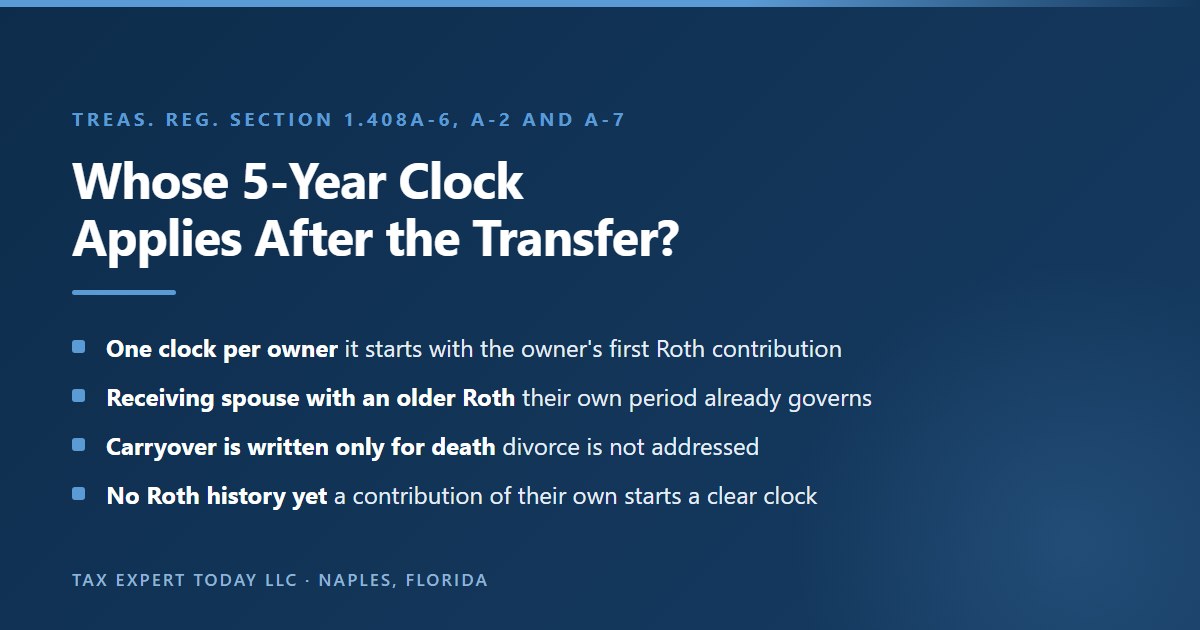
The IRS has never answered this directly. The regulations give the receiving spouse one 5-year period that starts with their own first Roth IRA contribution, and they carry an owner’s period over to another person only after death. Many practitioners apply the death rule by analogy, but that is an interpretation, not a written rule.
- The statute: §408A(d)(2)(B) measures the period from the first taxable year for which “the individual” made a Roth IRA contribution.
- The regulation: Treas. Reg. §1.408A-6, A-2 gives each Roth IRA owner one period for all of their Roth IRAs.
- The only express carryover: A-7 says the period is not redetermined when an owner dies, so a beneficiary inherits the decedent’s start date.
- Divorce is silent: no regulation, publication, or form instruction addresses the period for an account received under §408(d)(6).
A distribution of earnings from a Roth IRA is tax free only if it is a qualified distribution. Under §408A(d)(2)(A), a qualified distribution must be made on or after age 59½, to a beneficiary after death, on account of disability, or for a qualified first-time home purchase. Under §408A(d)(2)(B), it also must not be made within the 5-taxable-year period beginning with the first taxable year for which the individual made a contribution to a Roth IRA established for that individual. Both tests must be met. A distribution that fails either one is nonqualified, and the earnings portion of it can be taxable.
Treasury Regulation §1.408A-6, A-2, fills in the mechanics. The period “begins on the first day of the individual’s taxable year for which the first regular contribution is made to any Roth IRA of the individual” or, if earlier, the first day of the year of the individual’s first conversion contribution. It ends on the last day of the fifth consecutive taxable year. The regulation then adds the sentence that matters most in a divorce: “each Roth IRA owner has only one 5-taxable-year period described in A-1 of this section for all the Roth IRAs of which he or she is the owner.” The clock belongs to the person, not to the account.
Now apply that to a transfer incident to divorce. After the transfer, §408(d)(6) says the account is the receiving spouse’s IRA. The receiving spouse is therefore the owner whose single 5-year period governs. If the receiving spouse has made their own Roth IRA contribution in an earlier year, their period already started then. If the receiving spouse has never made a Roth contribution of their own, the plain text of A-2 leaves a gap: a transfer under §408(d)(6) is not a regular contribution or a conversion contribution, so nothing in the regulation starts a clock for them, and nothing in it hands them the transferor’s start date.
The regulation does contain one rule that carries a period from one person to another. Treasury Regulation §1.408A-6, A-7, provides that the 5-year period “is not redetermined when the Roth IRA owner dies,” and that the period a Roth IRA is held by a beneficiary, or by a surviving spouse who treats it as their own, includes the period it was held by the decedent. Wealth management commentary on Roth IRAs in divorce generally reasons from that rule by analogy, concluding that a former spouse who receives a Roth IRA should likewise count the transferor’s holding period. That reading is sensible, and it is consistent with the policy that a transfer incident to divorce should be tax neutral. It is still an analogy. A-7 is written for death, and the regulation contains no parallel sentence for divorce.
In a typical Roth IRA divorce, the practical consequence is narrower than it first appears. The question only matters for a receiving spouse who meets the age 59½ test or another qualifying event, who takes out more than their contribution basis, and who has no Roth IRA history of their own that already satisfies the 5-year period. For everyone else, the answer is the same under either reading. The next two sections show how to identify which group a receiving spouse falls into, and how to remove the uncertainty entirely in most cases.
What If the Receiving Spouse Already Owns a Roth IRA?
Then the receiving spouse’s own 5-year period governs the transferred dollars. Treasury Regulation §1.408A-6, A-2, gives each owner one period for all of their Roth IRAs, and it begins with that owner’s first Roth contribution to any Roth IRA. If that first contribution was made five or more taxable years ago, the clock question is already settled.
- One owner, one clock: the transferred share joins every other Roth IRA the receiving spouse owns for purposes of the 5-year test.
- Earlier start wins: a receiving spouse who opened a Roth in, say, 2015 has satisfied the period for every Roth dollar they own, including dollars received in a 2026 divorce.
- No separate account needed: the transferred share can go into a new Roth IRA or an existing one; the clock is the same either way.
- Proof is the receiving spouse’s own record: keep the Form 5498 or the return showing that first contribution year.
This is the most common Roth IRA divorce situation in practice, and it is the one the commentary often skips. Many divorcing spouses each have their own Roth IRA, sometimes funded through spousal contributions during the marriage. Under §408A(d)(2)(B), a contribution made by an individual’s spouse to a Roth IRA established for that individual also starts the individual’s period, so a receiving spouse whose Roth was funded years ago by spousal contributions is in the same position as one who funded it personally. In either case, the only question is the year of the first contribution to any Roth IRA of the receiving spouse.
Consider a hypothetical. Dana opened a Roth IRA in 2016 and contributed to it most years. Under the 2026 decree, Dana receives a direct transfer of half of Sam’s Roth IRA, which Sam opened in 2022. Dana’s 5-year period began on January 1, 2016, and ended on December 31, 2020. When Dana reaches 59½, every distribution from every Roth IRA Dana owns, including the dollars that came from Sam, is a qualified distribution on the 5-year test. It does not matter whether Sam’s period carries over, because Dana’s own period is older and already complete.
The reverse case is where planning matters. Suppose Sam receives a share of Dana’s older Roth IRA, and Sam has never made a Roth contribution of their own. Under the analogy to A-7, Sam might count Dana’s 2016 start date. Under the plain text of A-2, Sam might have no period running at all. A careful plan does not leave Sam dependent on which reading the IRS would adopt. The next section explains how.
How Can a Receiving Spouse Start Their Own 5-Year Clock?
By making a regular Roth IRA contribution of their own, if eligible. Under Treasury Regulation §1.408A-6, A-2, the period begins on the first day of the taxable year for which the first regular contribution is made, so a prior-year contribution made by the filing deadline starts the clock on January 1 of that prior year.
- Any amount counts: the regulation keys the start date to the first regular contribution, not to its size.
- Prior year contributions reach back: a 2026 contribution made by the April 2027 filing deadline starts the period on January 1, 2026.
- Eligibility is required: the contributor needs taxable compensation and must be under the Roth income limits for their filing status.
- Conversions also start it: A-2 counts the first conversion contribution if it comes earlier, which can help a receiving spouse who also holds a traditional IRA.
This step converts an open interpretive question into a dated fact. If the receiving spouse makes even a modest regular contribution to a Roth IRA in their own name, their own 5-year period starts under the plain words of A-2, whatever the IRS might eventually say about carryover in divorce. Five taxable years later, the clock question disappears. If the transferor’s period does carry over by analogy, the receiving spouse lost nothing by contributing. If it does not, the receiving spouse has started the only clock the regulation clearly recognizes.
Eligibility in the divorce year deserves care, because the Roth income limits depend on filing status, and filing status depends on marital status on December 31 under IRC §7703. Our guide to filing status in the year of divorce explains that rule. For 2026, IRS Publication 590-A lists these limits.
| 2026 filing status | Roth contribution begins to phase out at modified AGI of | No Roth contribution allowed at modified AGI of |
|---|---|---|
| Married filing jointly or qualifying surviving spouse | $242,000 | $252,000 |
| Single, head of household, or married filing separately and did not live with spouse at any time in 2026 | $153,000 | $168,000 |
| Married filing separately and lived with spouse at any time in 2026 | More than $0 | $10,000 |
The overall 2026 IRA contribution limit is $7,500, or $8,600 for individuals age 50 or older, according to IRS Publication 590-A. The limit is shared between traditional and Roth IRAs, and it cannot exceed the contributor’s taxable compensation for the year. The third row of the table is the one that catches separated spouses: a person who is still married on December 31, files separately, and lived with their spouse at any point in the year is effectively shut out of direct Roth contributions above a very low income. For that person, waiting until the first year in which they file as single or head of household may be the cleaner path.
Compensation is the other condition, and it interacts with alimony. Publication 590-A explains that for IRA purposes, compensation includes taxable alimony and separate maintenance payments only under divorce or separation instruments executed on or before December 31, 2018, that have not been modified to exclude them. Alimony under a post-2018 instrument is neither taxable nor compensation, so a receiving spouse whose only income is post-2018 alimony cannot make a regular Roth contribution on the strength of that alimony. Our guide to alimony taxes after divorce explains the 2018 dividing line. A receiving spouse without compensation may still start a period with a conversion of a traditional IRA, because a conversion does not require compensation, although a conversion of pretax dollars is taxable in the year it is made. Our guide to the backdoor Roth IRA and Form 8606 explains how conversions are reported.
How Does the Age 59½ Test Work After a Roth IRA Divorce Transfer?
The age test is applied to the receiving spouse, because after a transfer under §408(d)(6) the account is that spouse’s Roth IRA. A distribution is qualified only if made after the receiving spouse reaches 59½, dies, or becomes disabled, or for a qualified first-time home purchase, and the 5-year test is met.
- The transferor’s age is irrelevant: a 62-year-old’s Roth IRA transferred to a 48-year-old former spouse is a 48-year-old’s account.
- Disability and death follow the new owner: the qualifying events in §408A(d)(2)(A) are measured by the individual who owns the account.
- First home: the qualified first-time homebuyer distribution is limited to $10,000 over a lifetime.
- Contribution basis is different: amounts that are a return of regular contributions come out tax free regardless of age, as the ordering rules explain.
The age test is where an asymmetry in the settlement becomes visible. Suppose the older spouse owns the Roth IRA and is already past 59½. In that spouse’s hands, every distribution may be qualified. After a transfer to a younger former spouse, the same dollars become subject to the younger spouse’s age. If the younger spouse needs money from the account before 59½, only the contribution basis and certain conversion amounts can come out without tax, and earnings withdrawn early can be taxable and can carry the 10 percent additional tax under IRC §72(t) unless an exception applies.
That asymmetry is not a reason to avoid a Roth IRA divorce transfer. It is a reason to understand what is being received. A Roth IRA balance that the receiving spouse expects to use for living expenses in the next few years is worth less to that spouse than the same balance held for retirement, and it may be worth less than an equal amount of cash or taxable brokerage assets. How the settlement values that difference is the family law attorney’s call. Our role is to show each spouse the after-tax value of what they would receive, which is the subject of a later section.
How Are Roth Contributions, Conversions, and Earnings Split Between Spouses?
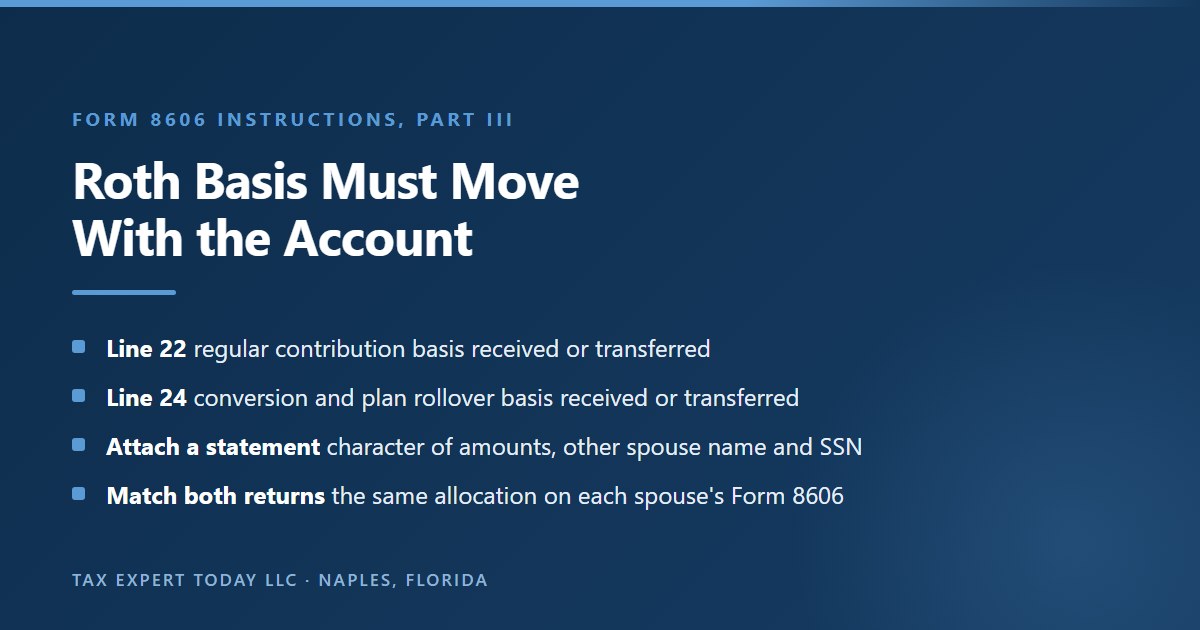
Every Roth IRA dollar is one of three types: regular contributions, conversion and rollover contributions, or earnings. The receiving spouse needs to know how much of each type came across, because distributions come out in that order under §408A(d)(4)(B). The Form 8606 instructions require both spouses to adjust their basis and attach a statement explaining the transfer.
- Regular contributions first: they come out tax free and free of the 10 percent additional tax at any age.
- Conversions second: they come out income tax free, oldest first, but a conversion withdrawn within its own 5-year period may carry the 10 percent additional tax.
- Earnings last: they are tax free only in a qualified distribution.
- Two adjustments on Form 8606: line 22 for basis in regular contributions, and line 24 for basis in conversions and rollovers from qualified plans.
The ordering rule is statutory. Section 408A(d)(4)(B) provides that a distribution from a Roth IRA is treated as made first from contributions, to the extent the distribution and all earlier distributions do not exceed aggregate contributions, and among contributions, first from regular contributions and then from qualified rollover contributions on a first-in, first-out basis. Treasury Regulation §1.408A-6, A-8, states the same order as regular contributions, then conversion contributions oldest first, then earnings, determined as of the end of the taxable year. A-9 adds that all of an individual’s Roth IRAs are aggregated for this purpose.
Aggregation is what makes the divorce allocation important. After the transfer, the receiving spouse’s Roth IRAs are aggregated, so the basis that came across in the divorce joins whatever basis the receiving spouse already had. If the receiving spouse is credited with too little basis, a later early withdrawal can be taxed as earnings when it should have been a tax free return of contributions. If the transferring spouse keeps too much basis on their own records, the same dollars could be counted twice. The Form 8606 instructions address this directly. Line 22 is increased or decreased “by any basis in regular contributions received or transferred incident to divorce,” and line 24 is adjusted in the same way for basis in conversions and qualified plan rollovers. In each case the instructions call for an attached statement similar to the one described for traditional IRAs, which includes the character of the amounts and the name and Social Security number of the other spouse.
The instructions say the basis must be adjusted, but neither the statute nor the regulations prescribes a single method for deciding how much basis travels with a partial transfer. Two approaches are common in practice. A proportional allocation moves basis in the same ratio as the account value, so a transfer of 40 percent of the account moves 40 percent of the regular contribution basis, 40 percent of each conversion layer, and 40 percent of the earnings. A specific allocation, written into the settlement, might instead move a stated dollar amount of contribution basis. Whichever method is used, the two spouses’ Forms 8606 should match each other, and the method should be written down at the time of transfer, because neither custodian tracks Roth basis for tax purposes. A proportional allocation is the more conservative default when the instrument is silent, because it is the easiest to defend from the account records.
| Layer in the Roth IRA | Hypothetical balance before transfer | Transferred to receiving spouse (40 percent, proportional) | Kept by owner | Form 8606 line affected |
|---|---|---|---|---|
| Regular contributions | $60,000 | $24,000 | $36,000 | Line 22 |
| 2023 conversion (taxable amount) | $40,000 | $16,000 | $24,000 | Line 24 |
| Earnings | $100,000 | $40,000 | $60,000 | None (not basis) |
| Total | $200,000 | $80,000 | $120,000 |
The table is hypothetical and simplified, but it shows why records matter in a Roth IRA divorce. In this example the receiving spouse could withdraw up to $24,000 of regular contribution basis at any age with no tax at all, plus the $16,000 conversion layer free of income tax, although that layer could carry the 10 percent additional tax if withdrawn before 59½ and within five taxable years of the 2023 conversion. Only the $40,000 of earnings depends on the qualified distribution tests. Without the basis records, the receiving spouse might be unable to prove any of the first $40,000, and the IRS starting point for an undocumented Roth distribution is not favorable. The owner’s prior Forms 8606 and the Form 5498 contribution history for each year are the evidence, and the settlement can require the owner to hand them over.
What Is the Conversion 5-Year Rule, and Does It Matter in a Divorce?
It is a separate clock for each conversion. Under Treasury Regulation §1.408A-6, A-5, a nonqualified distribution allocable to a conversion made within the past five taxable years can carry the 10 percent additional tax, even though no income tax is due. It matters when a Roth IRA with recent conversions is divided and the receiving spouse is under 59½.
- Penalty only: conversion amounts were taxed when converted, so withdrawing them later is not income again, but the 10 percent additional tax can apply.
- One clock per conversion: A-5(c) determines the period separately for each conversion contribution.
- Different from the qualified distribution clock: A-5(c) says the conversion period need not match the period used for qualified distributions.
- Exceptions still work: the usual §72(t) exceptions, including age 59½, apply to these distributions.
The conversion period exists to stop a younger taxpayer from converting a traditional IRA and then withdrawing the converted amount right away, which would sidestep the early withdrawal tax that would have applied to the traditional IRA. A-5(b) applies the 10 percent additional tax to a nonqualified distribution to the extent it is allocable to a conversion contribution, if the distribution is made within the 5-taxable-year period beginning with the first day of the taxable year in which the conversion was made. Only the part of the conversion that was includible in income when converted is taken into account.
Divorce does not appear in A-5, so a Roth IRA divorce runs into the same interpretive gap discussed above: no regulation says whether a conversion layer received in a divorce keeps the transferor’s conversion year for this purpose. The commentary generally assumes it does, by the same analogy to the death rule. The practical answer is to know the conversion years in the account before the transfer, and to avoid planning on early access to a conversion layer that is less than five taxable years old if the receiving spouse is under 59½. Once a conversion is more than five taxable years old, or once the receiving spouse reaches 59½, the question has no effect.
What Happens If the Roth IRA Is Cashed Out to Pay the Settlement?
A withdrawal is a distribution to the owner, not a transfer under §408(d)(6). The owner reports it on their own return. Contribution basis comes out first and tax free; earnings in a nonqualified distribution are taxable, and the 10 percent additional tax can apply under 59½. The QDRO exception does not apply to IRAs.
- The owner keeps the tax: paying the cash to the former spouse afterward does not move the tax to that spouse.
- No QDRO escape: §72(t)(3)(A) says the alternate payee exception in §72(t)(2)(C) does not apply to an individual retirement plan.
- Basis can soften it: a withdrawal that does not exceed regular contribution basis is not taxable at any age.
- Qualified distributions are clean: if the owner is past 59½ and the 5-year test is met, the withdrawal is tax free, although the money is then outside the Roth for good.
In a Roth IRA divorce, cashing out the account to fund an equalization payment is sometimes proposed because it looks simpler than opening a new account. For a Roth IRA, the tax result depends on the owner’s age, the 5-year period, and the basis layers. An owner past 59½ with a satisfied 5-year period can withdraw everything without tax, and the only cost is the loss of future tax free growth inside the Roth. An owner under 59½ faces the ordering rules: regular contributions come out first with no tax, conversion amounts come out next with no income tax but a possible 10 percent additional tax inside their five-year windows, and earnings come out last, taxable and generally subject to the 10 percent additional tax unless an exception in §72(t) applies. The IRS keeps a chart of those exceptions to the tax on early distributions, which shows which ones reach IRAs.
The exception most people expect to help is the one that does not. Section 72(t)(2)(C) exempts distributions to an alternate payee under a qualified domestic relations order, and it is a real benefit for a former spouse who takes cash from a 401(k) through a QDRO. Section 72(t)(3)(A) states that this exception does not apply to distributions from an individual retirement plan, which includes a Roth IRA. So a former spouse who wants cash is usually better served by receiving the Roth IRA share by transfer first. Once it is their own account, any withdrawal is measured by their own age, their own basis share, and their own clock, and the transferring spouse is not taxed on it.
A 60-day rollover can sometimes repair a mistaken withdrawal. If the owner receives a Roth IRA distribution and redeposits it into a Roth IRA within 60 days, it is generally a tax free rollover, subject to the one-rollover-per-year rule described in Publication 590-A. That rollover goes back into the owner’s own Roth IRA. It does not convert a withdrawal into a transfer to the former spouse, and a former spouse who receives cash from the owner cannot roll it into their own Roth IRA as if it were a transfer under the decree.
How Should a Roth IRA Be Valued Against a Traditional IRA in a Buyout?
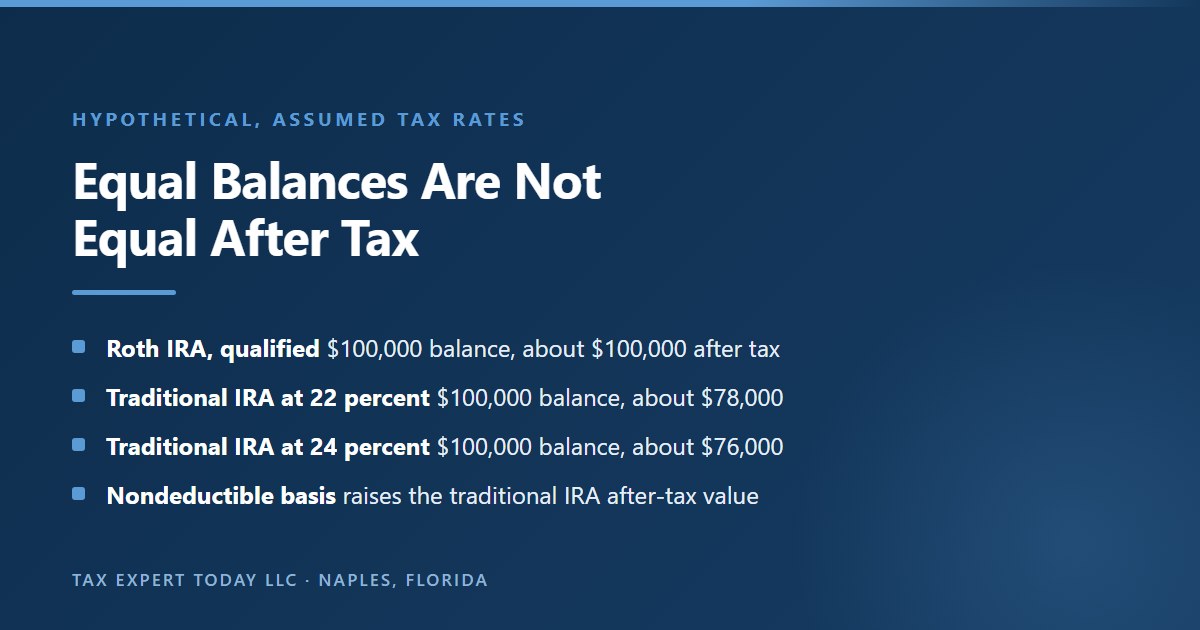
On an after-tax basis. A dollar in a Roth IRA that will come out as a qualified distribution carries no future income tax, while a dollar in a traditional IRA will be taxed as ordinary income when withdrawn. Trading equal face values usually leaves the spouse holding the traditional IRA with less spendable value.
- Face value hides the tax: a traditional IRA balance includes an embedded future income tax that a qualified Roth balance does not.
- The rate is an estimate: the right discount depends on each spouse’s expected tax bracket at withdrawal, which nobody knows with certainty.
- Basis changes the math: nondeductible contributions in a traditional IRA, tracked on Form 8606, are not taxed again.
- Time horizon matters: a Roth share that the receiving spouse will tap before 59½ can lose part of its advantage.
Settlements in a Roth IRA divorce often list retirement accounts at their statement balances and divide the total. That approach treats a $100,000 Roth IRA and a $100,000 traditional IRA as equal, and for tax purposes they are not. The table below uses hypothetical figures and assumed tax rates to show the size of the gap. It is an illustration of the arithmetic, not a forecast of any person’s tax rate.
| Account (hypothetical) | Statement balance | Assumed tax rate at withdrawal | Estimated tax on withdrawal | Estimated after-tax value |
|---|---|---|---|---|
| Roth IRA, qualified distribution expected | $100,000 | 0 percent | $0 | $100,000 |
| Traditional IRA, all pretax | $100,000 | 22 percent federal | $22,000 | $78,000 |
| Traditional IRA, all pretax | $100,000 | 24 percent federal | $24,000 | $76,000 |
| Traditional IRA with $20,000 of nondeductible basis | $100,000 | 22 percent on the $80,000 pretax part | $17,600 | $82,400 |
Whether a settlement should tax-effect retirement accounts at all, and at what rate, is a negotiation question for the family law attorneys and, if it comes to that, the court. Courts in different states approach tax-effecting differently, and Florida’s equitable distribution statute leaves room for the court to consider the circumstances of each case. Our role is narrower and more useful to both sides: computing the after-tax value of each account under stated assumptions, so the attorneys negotiate with accurate numbers rather than statement balances. For a broader view of how retirement accounts, the home, and other assets carry different embedded taxes in a property division, see our guides to divorce house buyout taxes and dividing stock options in divorce.
Basis inside the Roth IRA can also differ between two Roth accounts of the same size. A Roth IRA that is mostly contribution basis is more liquid for a younger spouse than one that is mostly earnings, because basis can be withdrawn at any age without tax. If one spouse expects to need access to funds before 59½, the composition of the Roth share, not just its balance, affects what it is worth to that spouse.
Can a Roth IRA Be Moved Into a Traditional IRA, or a Traditional IRA Into a Roth, in a Divorce?
A Roth IRA share should move only into a Roth IRA, and a traditional IRA share only into a traditional IRA, so each keeps its character. Moving pretax traditional IRA dollars into a Roth IRA is a conversion, which is taxable. Custodians generally require the transfer incident to divorce to be between accounts of the same type.
- Roth into traditional is not available: Roth dollars cannot be recharacterized or rolled into a traditional IRA.
- Traditional into Roth is a conversion: the pretax amount is included in income in the year of conversion.
- Two steps are cleaner: transfer the traditional IRA share into the receiving spouse’s traditional IRA first, and let that spouse decide later whether to convert on their own return.
- Basis carries with it: any nondeductible basis in a transferred traditional IRA is reported on both spouses’ Forms 8606.
Settlements sometimes describe the retirement division in a way that mixes account types, for example by awarding a spouse “half of the IRAs” when one is a Roth and one is traditional. The cleanest tax result keeps each account’s character intact: half of the Roth goes to a Roth, half of the traditional goes to a traditional. A direct move of traditional IRA dollars into a Roth IRA owned by the other spouse raises a question the guidance does not squarely address, namely whose income the conversion is. Separating the steps avoids that question. Once the traditional IRA share is the receiving spouse’s own account under §408(d)(6), any conversion is made by that spouse and reported on that spouse’s return, at that spouse’s tax rate, in a year that spouse chooses. If the receiving spouse later converts a traditional IRA that holds nondeductible basis, the pro rata rule applies across all of that spouse’s traditional, SEP, and SIMPLE IRAs, as our backdoor Roth IRA guide explains.
A designated Roth account inside an employer plan is a different animal. A Roth 401(k) or Roth 403(b) is divided through a QDRO, not under §408(d)(6), and its own five-year rules and rollover rules apply. The alternate payee can often roll the Roth share into a Roth IRA, but the details turn on the plan document and on the rollover rules for designated Roth accounts. Our QDRO taxes guide covers that path, and our mega backdoor Roth guide explains how after-tax and Roth amounts inside a 401(k) are tracked.
What Happens to Roth IRA Beneficiary Designations After a Divorce?
The custodian pays whoever is named on the beneficiary form, so each spouse should update their designation after the divorce. Florida adds a safety net: Fla. Stat. §732.703 generally voids a designation of a former spouse on a Roth IRA when the marriage is dissolved, unless an exception applies, such as a decree requiring that designation.
- Update the form: the beneficiary designation, not the will and not the decree, normally controls who receives an IRA at death.
- Florida revocation: §732.703(3)(c) lists IRAs described in §408 or §408A among the assets covered.
- Important exceptions: the statute does not apply if the decree requires the designation, if it was signed after the divorce naming the former spouse, or if another state’s law governs the account.
- Tax status changes too: a former spouse who inherits is not a surviving spouse for the inherited IRA rules.
Florida Statute §732.703(2) provides that a designation made before a dissolution, providing for the transfer at death of an interest in an asset to a former spouse, is void as of the dissolution, and the asset passes as if the former spouse had predeceased. Subsection (3)(c) expressly covers an individual retirement account described in §408 or §408A of the Internal Revenue Code. Subsection (4) lists exceptions, including where controlling federal law provides otherwise, where the governing instrument is governed by the law of another state, and where the dissolution order requires the decedent to maintain the asset for the former spouse or the children. Because of those exceptions, the statute is a backstop, not a substitute for changing the form. Estate planning questions should go to the estate planning attorney.
There is a tax angle as well. IRS Publication 590-B gives a surviving spouse beneficiary options that other beneficiaries do not have, including treating an inherited Roth IRA as their own, and A-7 of the regulation then blends the decedent’s 5-year period with the surviving spouse’s. A former spouse who remains the named beneficiary is generally not a surviving spouse for these purposes, because the marriage ended. Publication 590-B also notes that for required minimum distribution purposes, marital status is determined as of January 1 of each year, so a change in beneficiary after a divorce takes effect for the following year. Roth IRA owners do not take lifetime required minimum distributions, but the rule matters if the owner dies in the year of the divorce.
Can I Still Contribute to a Roth IRA in the Year of a Divorce?
Yes, if you have taxable compensation and your modified AGI is under the limit for your filing status. Your filing status depends on whether you are married on December 31. A spousal Roth contribution based on the other spouse’s earnings requires a joint return, so it is generally unavailable once the divorce is final before year end.
- December 31 controls: under §7703, a person divorced under a final decree by year end is unmarried for the whole year.
- Spousal contributions end: Publication 590-A notes that after a divorce or legal separation, a person can deduct only contributions to their own IRA, under the rules for single individuals; the same joint return requirement governs spousal Roth contributions.
- Excess contributions cost money: a contribution made when the income limit or compensation test is not met is an excess contribution, subject to a 6 percent excise tax each year it remains in the account unless corrected.
- Corrections have a deadline: an excess contribution and its earnings withdrawn by the due date of the return, including extensions, are treated as never contributed.
The divorce year is the year contribution mistakes happen. A couple who funded both Roth IRAs every January on the strength of one spouse’s salary may not realize that, once the decree is final, the nonworking spouse can no longer make a spousal contribution, because the spousal rule in IRC §219(c) applies only to an individual who files a joint return. A spouse who expected to file jointly may end up filing separately, with the very low phase-out range that applies when spouses lived together during the year. The remedy for an excess contribution is straightforward if it is caught before the filing deadline: withdraw the excess and its net income, and the contribution is treated as if it had never been made, although the earnings withdrawn are taxable. If it is not caught, the 6 percent excise tax under IRC §4973 is reported on Form 5329 for each year the excess remains.
A Roth IRA contribution that was properly made during the marriage stays properly made after the divorce. Nothing in §408(d)(6) unwinds prior contributions, and the contribution basis transfers with the account in whatever proportion the parties and the Form 8606 statements reflect.
How Is a Roth IRA Divorce Reported on the Tax Return?
The transfer itself generally creates no taxable income line on either return. Each spouse adjusts Roth IRA basis on Form 8606, Part III, lines 22 and 24, when that part of the form is next completed, and attaches a statement describing the transfer. Check that the custodians’ Forms 1099-R and 5498 show a transfer, not a distribution.
- Form 8606, line 22: increase or decrease basis in regular Roth contributions received or transferred incident to divorce.
- Form 8606, line 24: increase or decrease basis in conversions and qualified plan rollovers received or transferred incident to divorce.
- The statement: describe the character of the amounts transferred and give the other spouse’s name and Social Security number.
- Information returns: if a custodian issues a Form 1099-R that codes the transfer as an ordinary distribution, ask for a corrected form before filing.
Part III of Form 8606 is completed in a year in which the taxpayer takes a nonqualified Roth IRA distribution, and its job is to separate the tax free return of basis from any taxable earnings. A receiving spouse who takes no Roth distribution in the divorce year may not need Part III that year, but the basis figures should still be fixed and documented at the time of transfer, because they will be needed the first time the receiving spouse takes a nonqualified distribution, which could be many years later. The same is true for the transferring spouse, whose basis is reduced by the amount that moved.
| Document | Who keeps it | Why it matters later |
|---|---|---|
| Decree or settlement agreement pages awarding the Roth IRA share | Both spouses | Shows the transfer was made under a divorce or separation instrument for §408(d)(6) |
| Custodian transfer confirmation and statements before and after | Both spouses | Shows the amount moved and that it moved trustee to trustee |
| Owner’s prior Forms 8606, Part III, and Forms 5498 for each contribution year | Copies to receiving spouse | Proves regular contribution basis and conversion layers, with their years |
| Written basis allocation, signed or incorporated into the agreement | Both spouses | Supports matching line 22 and line 24 adjustments on each Form 8606 |
| Receiving spouse’s own first Roth contribution record | Receiving spouse | Establishes their own 5-year start date under Treas. Reg. §1.408A-6, A-2 |
| Updated beneficiary designation confirmations | Each owner | Confirms the post-divorce beneficiary, independent of state revocation rules |
IRS Publication 504, Divorced or Separated Individuals, is the IRS overview of the federal tax issues in a divorce, including filing status, dependency, alimony, and property transfers, and the IRS also maintains a plain-language page on filing taxes after divorce or separation. Neither discusses Roth IRA basis in detail, which is why the Form 8606 instructions and the §408A regulations are the working sources for this part of the return.
How Does Florida Law Treat a Roth IRA in a Divorce?
Florida treats retirement funds accrued during the marriage as marital assets under Fla. Stat. §61.075, subject to equitable distribution by the court or by agreement. Florida has no personal income tax, so the tax consequences of dividing a Roth IRA are federal only. Which part of the account is marital is a question for your family law attorney.
- Marital assets: §61.075(6)(a)1.e. includes funds accrued during the marriage in retirement, pension, profit-sharing, annuity, and deferred compensation plans and programs.
- Premarital contributions: classifying contributions made before the marriage, and growth on them, is a family law question that the attorney resolves.
- No state income tax layer: a Florida resident pays no state tax on a nonqualified Roth distribution, unlike residents of states with an income tax.
- Beneficiary revocation: §732.703 separately addresses former spouse designations on IRAs at death.
Florida’s equitable distribution statute begins from the premise that marital assets are divided equally unless there is a justification for an unequal distribution based on the factors listed in §61.075(1), which end with any other factors necessary to do equity and justice between the parties. The statute’s definition of marital assets in §61.075(6)(a)1.e. expressly reaches vested and nonvested benefits, rights, and funds accrued during the marriage in retirement plans and programs. A Roth IRA funded during the marriage generally falls inside that definition. A Roth IRA funded before the marriage may be partly or wholly nonmarital, which is exactly the kind of question the family law attorney answers before the tax analysis starts.
For a Florida resident, the federal analysis in this guide is the whole tax picture. That changes if a former spouse moves to a state with an income tax before taking distributions. A nonqualified Roth distribution of earnings taxed federally may also be taxed by that state, and some states have their own rules for IRA basis. Our guide to retiring to Florida covers how residency affects retirement income generally.
What Are the Most Common Roth IRA Divorce Tax Mistakes?
The most common mistakes are cashing the account out instead of transferring it, transferring before the decree or settlement exists, losing the contribution basis records, ignoring the receiving spouse’s own 5-year clock, valuing Roth and traditional IRAs at face value, and leaving the former spouse named as beneficiary.
- Cash instead of transfer: the owner can owe income tax on earnings and the 10 percent additional tax, with no QDRO exception for IRAs.
- Transfer too early: a transfer before a qualifying instrument exists is a distribution to the owner.
- Lost basis: without the owner’s Form 8606 history, the receiving spouse may be unable to prove tax free contribution basis.
- Clock assumed: relying on a carryover the regulations do not state, when a small contribution of the receiving spouse’s own could settle it.
- Face value trades: exchanging a Roth for an equal traditional balance without considering the embedded tax.
Each of these Roth IRA divorce mistakes is preventable at the drafting stage, and each becomes expensive or impossible to fix after the decree is entered and the accounts are moved. A short tax review of the retirement provisions before the agreement is signed is usually the most efficient point to involve a tax adviser. Questions about legal fees for that work are covered in our guide on whether divorce legal fees are tax deductible, and the effect of the divorce on Social Security taxation is covered in our guide to divorce and Social Security benefits.
Roth IRA Divorce: Help in Naples & Southwest Florida
Tax Expert Today LLC is based in Naples, Florida, and works with divorcing and recently divorced clients across Collier and Lee counties and in all 50 states. Southwest Florida has a large population of retirees, near-retirees, and business owners whose Roth IRAs hold years of contributions and conversions, and a gray divorce often puts a Roth IRA, a traditional IRA, and a pension on the same settlement worksheet. The questions we see are federal and practical: how much basis travels with the transfer, whose 5-year clock applies, and what each account is worth after tax.
- Divorce tax Naples FL: computing the after-tax value of Roth and traditional IRA shares under stated assumptions before the settlement fixes the split.
- Roth IRA divorce help in Naples: reconstructing Roth contribution and conversion basis from prior Forms 8606 and 5498, and preparing the matching basis statements for both spouses.
- Receiving spouse planning: confirming whether the receiving spouse already has a completed 5-year period, and whether a contribution of their own makes sense.
- Coordination with your attorney: giving the family law attorney the tax result of each proposed division, without advising on the negotiation itself.
You can read more on our divorce tax consulting page, and about the broader practice at Naples FL tax planning.
Tax Expert Today LLC
11983 Tamiami Trail N, Naples, FL 34110
Phone: (239) 441-2005
Hours: Monday through Friday, 10:00am to 5:00pm ET
Does Florida tax a Roth IRA withdrawal after a Naples divorce? No. Florida has no personal income tax, so a Naples resident who takes a Roth IRA distribution after a divorce deals only with the federal rules. A transfer under the decree is not taxable federally, and a later withdrawal is taxed, if at all, only on the federal return.
When to Engage a Professional
A divorce in which each spouse simply keeps their own Roth IRA, with no transfer and no offset, may need little tax work on this issue. Professional involvement tends to earn its cost when one or more of the following is present.
- A partial transfer of a Roth IRA with conversions: the basis layers and conversion years need to be allocated and documented on both spouses’ Forms 8606.
- A receiving spouse under 59½ who may need the money: the ordering rules decide how much can come out without tax.
- A receiving spouse with no Roth history: the 5-year question can often be settled by a contribution of their own, if they are eligible.
- A trade of Roth assets against traditional IRAs, a pension, or the home: after-tax values may differ substantially from statement balances.
- A withdrawal already made, or a Form 1099-R that looks wrong: the reporting can sometimes be corrected, and the timing matters.
We work as the tax side of the divorce team, alongside your family law attorney, who remains responsible for the settlement terms and the decree. To discuss your situation, call (239) 441-2005 or visit our divorce tax consulting page. Every outcome depends on the facts, including each spouse’s age, Roth IRA history, basis records, and filing status.
Frequently Asked Questions About Roth IRA Divorce
Is a Roth IRA transfer in a divorce taxable? No. A transfer of all or part of a Roth IRA to a spouse or former spouse under a divorce or separation instrument is not a taxable transfer under IRC section 408(d)(6). Neither spouse reports income, and the transferred share becomes the receiving spouse’s own Roth IRA from the date of transfer.
Does the 5-year rule restart when a Roth IRA is transferred in a divorce? The IRS has not said. The regulations give each owner one 5-year period starting with their own first Roth contribution, and carry a period over to another person only at death. If the receiving spouse already has an older Roth IRA, their own period governs. If not, a contribution of their own starts a clock the regulation clearly recognizes.
Do I need a QDRO to divide a Roth IRA? No. A QDRO is used for employer plans such as a 401(k), including a Roth 401(k). A Roth IRA is divided under the divorce decree or settlement agreement, using the custodian’s transfer paperwork, by retitling the account or by a direct transfer to a Roth IRA in the receiving spouse’s name.
Can I cash out a Roth IRA to pay my spouse in a divorce? You can, but the withdrawal is your distribution and stays on your return. Contribution basis comes out tax free, but earnings in a nonqualified distribution are taxable and may carry the 10 percent additional tax if you are under 59 and a half. The QDRO exception does not apply to IRAs.
How is Roth IRA basis split in a divorce? Both spouses adjust their basis on Form 8606, line 22 for regular contributions and line 24 for conversions, and attach a statement describing the transfer. No regulation prescribes the method, so a proportional allocation is common, and the method should be written down and matched on both returns.
Does Florida tax a Roth IRA withdrawal after a Naples divorce? No. Florida has no personal income tax, so a Naples resident who takes a Roth IRA distribution after a divorce deals only with the federal rules. A transfer under the decree is not taxable federally, and a later withdrawal is taxed, if at all, only on the federal return.
Published October 14, 2026 by Dr. Pellumb Kabashi « Back to Learning Center
Have a question this article touches on?
Tax Expert Today LLC, based in Naples, Florida and serving clients across the United States.
Schedule a Consultation (239) 441-2005