
By Dr. Pellumb Kabashi, DBA, MBA, EA, CFE, CES
Founder, Tax Expert Today LLC · Tax advisors, enrolled agents, CPAs, and attorneys · Serving clients in all 50 states
Quick Answer
GILTI is the annual inclusion that makes a 10 percent United States shareholder of a controlled foreign corporation pay current tax on the company’s low-taxed foreign earnings. For tax years beginning after 2025 the statute calls it net CFC tested income. An individual owner pays ordinary rates unless a section 962 election applies. Call (239) 441-2005 for a free consultation.
What is GILTI?
GILTI, short for global intangible low-taxed income, is the amount a United States shareholder of a controlled foreign corporation must include in income each year under section 951A, whether or not the company pays a dividend. Starting with tax years beginning after December 31, 2025, the statute renames it net CFC tested income and drops the old tangible asset return.
- It taxes profits before they are distributed. The foreign company does not need to pay a dividend for the owner to owe tax.
- It reaches active business income. Unlike older anti-deferral rules, it is not limited to passive or related-party income.
- It only applies to 10 percent owners of a CFC. Small portfolio holders of foreign stock are outside it.
- The name changed, the concept did not. Search engines, advisers, and older IRS forms still say GILTI.
Congress created the regime in 2017 as part of the Tax Cuts and Jobs Act, and it lives in 26 U.S.C. section 951A. The 2025 budget reconciliation law, Public Law 119-21, commonly called the One Big Beautiful Bill Act or OBBBA, rewrote the section for tax years beginning after December 31, 2025. The section heading now reads “Net CFC tested income included in gross income of United States shareholders,” and the phrase “global intangible low-taxed income” no longer appears in the operative text. This article keeps the focus on GILTI because that is still the word most people search for, most prior-year returns use, and the IRS still prints on Form 8992.
Most of what ranks for GILTI is written for multinational corporations. Corporations get a deduction and a foreign tax credit that make the regime tolerable. Individuals who own a foreign company directly get neither unless they make an election most of them have never heard of. That gap is the subject of this guide: the individual owner of a foreign operating company, whether a consultant with a company abroad, a family that inherited a stake in a business overseas, or a retiree in Naples, Florida who still holds shares in the company they built before moving here.
The companion question of how the foreign company is reported, rather than how its income is taxed, belongs to our guide to Form 5471. This page does not repeat that form. It explains the income inclusion that Form 5471 feeds.
What changed for GILTI in 2026?
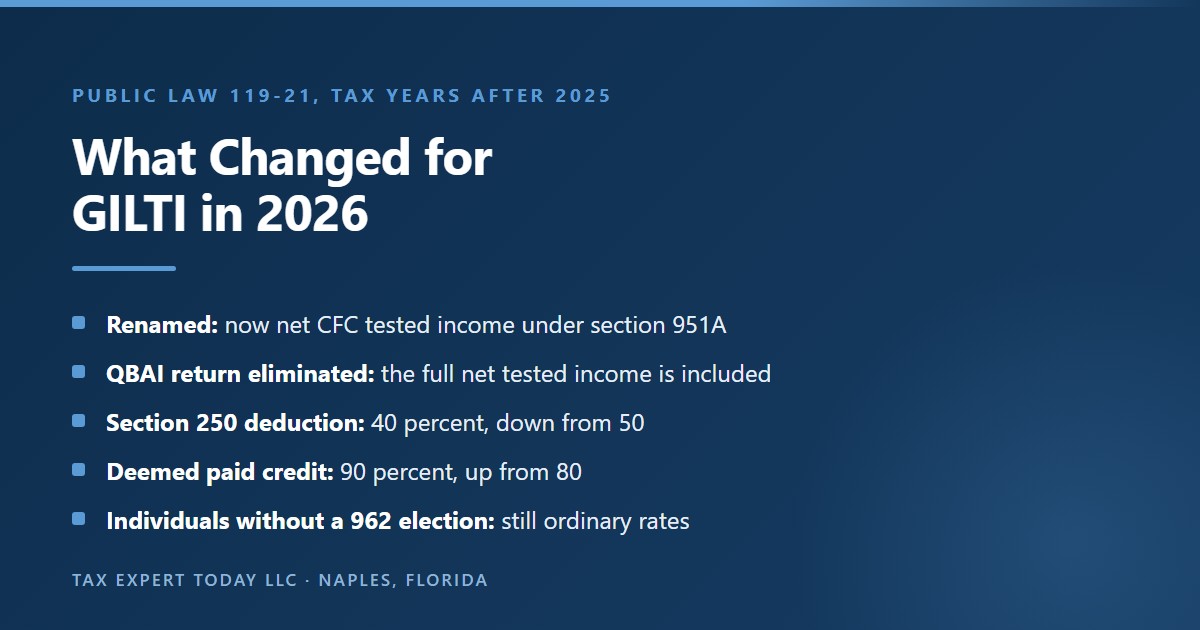
For tax years beginning after December 31, 2025, the GILTI rules changed in four ways: the inclusion is renamed net CFC tested income, the 10 percent return on tangible assets is eliminated, the corporate section 250 deduction falls from 50 to 40 percent, and the deemed paid foreign tax credit rises from 80 to 90 percent.
- No more QBAI carve-out. The deemed return on qualified business asset investment no longer reduces the inclusion.
- A smaller deduction. The section 250 deduction for corporations and section 962 electors is 40 percent, not 50.
- A larger credit. 90 percent of the foreign taxes tied to tested income can be deemed paid, up from 80.
- Ownership on any day. A shareholder who owns stock on any day of the year can now be pulled in.
Each change is written into the Code and can be checked against the amendment notes. The rename and the removal of the qualified business asset investment rules are in section 70323 of Public Law 119-21, shown in the notes to section 951A. The deduction percentage change from 50 to 40 percent is in section 70321, shown in the notes to section 250, which also struck the scheduled drop to 37.5 percent that the 2017 law had built in for 2026. The credit change from 80 to 90 percent is in section 70312, shown in the notes to section 960. All three apply to taxable years beginning after December 31, 2025.
| Rule | Tax years beginning in 2025 and earlier | Tax years beginning after December 31, 2025 |
|---|---|---|
| Statutory name | Global intangible low-taxed income (GILTI) | Net CFC tested income |
| Tangible asset return | 10 percent of qualified business asset investment (QBAI), less certain interest, reduced the inclusion | Eliminated; the full net tested income is included |
| Section 250 deduction (corporations and 962 electors) | 50 percent | 40 percent |
| Deemed paid credit under section 960(d) | 80 percent of tested foreign income taxes | 90 percent of tested foreign income taxes |
| Effective federal rate at 21 percent (before credits) | 10.5 percent | 12.6 percent |
| Foreign rate at which credits fully offset (simplified) | About 13.125 percent | About 14 percent |
| Individual without a 962 election | Ordinary rates up to 37 percent, no deduction, no deemed paid credit | Unchanged: ordinary rates up to 37 percent, no deduction, no deemed paid credit |
The last row is the one that matters most for this article. Every one of the 2026 changes to the deduction and the credit is a change to rules that apply to domestic corporations. An individual only reaches those rules through a section 962 election. An individual who does not elect is taxed exactly as before: the full inclusion at ordinary rates. What did change for that individual is the loss of the tangible asset return, which means a company with a large factory, fleet, or real estate footprint abroad now produces a larger inclusion than it did under the 2025 rules.
Timing matters too. A 2025 calendar-year return filed in 2026 still uses the old GILTI rules, the 50 percent deduction, and the 80 percent credit. The new rules first apply to a 2026 calendar tax year, which most individuals will report on a return filed in 2027. The 12.6 and 14 percent figures in the table are simplified rates that ignore expense allocation and the foreign tax credit limitation, and they are useful only as a first screen.
Who is a U.S. shareholder subject to GILTI?
You are subject to GILTI if you are a United States person who owns, directly, indirectly, or by attribution, 10 percent or more of the vote or 10 percent or more of the value of a foreign corporation that is a controlled foreign corporation, meaning United States shareholders together own more than 50 percent of its vote or value.
- Two tests, both at 10 percent. Vote or value, whichever gets you there first.
- Attribution counts. Stock owned by a spouse, parent, child, trust, or entity can be treated as yours under section 958.
- The company must be a CFC. Only United States shareholders count toward the more than 50 percent test.
- Citizens abroad are included. An American living overseas who owns a local company is a United States person.
The United States shareholder definition is in section 951(b): a United States person “who owns (within the meaning of section 958(a)), or is considered as owning by applying the rules of ownership of section 958(b), 10 percent or more of the total combined voting power” or “10 percent or more of the total value of shares” of the foreign corporation. The controlled foreign corporation definition is in section 957(a): a foreign corporation in which United States shareholders own “more than 50 percent” of the vote or value. A foreign company that is not a controlled foreign corporation, or a stake below 10 percent, can instead be a passive foreign investment company if its income or assets are mostly passive, a separate regime explained in our guide to Form 8621 and PFIC reporting.
| Ownership fact pattern | United States shareholder? | Is the company a CFC? | GILTI exposure |
|---|---|---|---|
| United States citizen owns 100 percent of a foreign consulting company | Yes | Yes | Yes, on 100 percent of tested income |
| Two United States siblings each own 30 percent; foreign relatives own 40 percent | Yes, each | Yes, 60 percent United States owned | Yes, each on 30 percent |
| United States resident owns 8 percent; spouse owns 5 percent | Likely yes through attribution | Depends on total United States ownership | Possible; attribution must be tested |
| United States person owns 40 percent; foreign persons own 60 percent | Yes | No, 40 percent is not more than 50 | No GILTI; other reporting may still apply |
| United States person owns 3 percent of a listed foreign company | No | Not relevant | No GILTI; passive foreign investment company rules may apply instead |
Two points trip up individual owners more than any others. The first is attribution. A green card holder who owns 8 percent of a family company in another country, with the rest held by parents and siblings who are not United States persons, may think they are safely under 10 percent. Attribution among family members, and the downward attribution rules that can treat a United States entity as owning stock held by its foreign owner, can change that answer. The second is value. Since 2018 the value test has sat alongside the vote test, so non-voting shares with a large share of the equity can make someone a United States shareholder.
The 2025 law also tightened timing. For controlled foreign corporation years beginning after December 31, 2025, section 951A(c)(2) treats a person as a United States shareholder for the year “only if such person owns (within the meaning of section 958(a)) stock in such foreign corporation on any day in such taxable year.” A sale or gift partway through the year no longer lets the owner on the last day carry the whole inclusion by default, and the pro rata rules now follow the owner through the year. Anyone who bought, sold, or gifted shares in 2026 should have the allocation computed rather than assumed.
How is GILTI calculated for an individual shareholder?
An individual adds up their pro rata share of the tested income of each controlled foreign corporation, subtracts their share of any tested losses, and includes the net amount in gross income as ordinary income. Without a section 962 election there is no 40 percent deduction and no credit for foreign taxes the company paid.
- Tested income is net of foreign tax. The company’s foreign income taxes are one of the deductions that reduce it.
- Some income is carved out. Subpart F income, effectively connected income, related-party dividends, and oil and gas extraction income are excluded.
- Losses net across companies. A tested loss in one CFC can offset tested income in another.
- The result is ordinary income. It is taxed at the individual rate schedule, currently up to 37 percent.
The mechanics come straight from section 951A(b). Net CFC tested income is the excess of “the aggregate of such shareholder’s pro rata share of the tested income of each controlled foreign corporation” over the aggregate pro rata share of tested losses. Tested income is the company’s gross income, excluding the listed categories, minus “the deductions (including taxes) properly allocable to such gross income.”
For an individual, the calculation stops there. The inclusion is reported on Form 8992 and flows to the individual return as other income; the Instructions for Form 8992 direct an individual shareholder to carry the result to Schedule 1 (Form 1040). It is taxed at the regular rate schedule in section 1, whose top bracket of 37 percent the 2025 law made permanent by striking the 2025 sunset from section 1(j).
Two things an individual does not get are what make GILTI costly. The section 250 deduction is available only to a “domestic corporation.” The deemed paid credit in section 960(d) is likewise written for a domestic corporation: “if any amount is includible in the gross income of a domestic corporation under section 951A, such domestic corporation shall be deemed to have paid foreign income taxes.” An individual who owns the same company directly is taxed on income that has already borne foreign tax, with no credit for that tax at the time of inclusion.
The individual does get one thing later. When the company eventually distributes the earnings that were already taxed as GILTI, those earnings are previously taxed earnings and profits. Section 959 excludes them from gross income a second time. So the cost of GILTI for an individual is not double income tax; it is full ordinary-rate tax paid early, with no relief for the foreign tax already paid by the company.
Why is GILTI so expensive for individual shareholders?
GILTI is expensive for individuals because the rules that soften it for corporations, the 40 percent deduction and the 90 percent deemed paid foreign tax credit, do not apply to an individual who owns the foreign company directly. The individual pays up to 37 percent on income the company has already paid foreign tax on, before receiving any cash.
- Tax without cash. The inclusion arrives whether or not a dividend is paid.
- No credit for the company’s foreign tax. An individual cannot claim the corporate deemed paid credit.
- Stacking of taxes. Foreign corporate tax plus United States individual tax on the same profit.
- A modest company can trigger it. There is no minimum size, and the tangible asset return that once sheltered some income is gone.
Consider the simple shape of it. A foreign company earns $500,000 and pays $62,500 of local tax at a 12.5 percent rate, leaving $437,500 of tested income. A 100 percent United States individual owner in the top bracket includes all $437,500 and owes $161,875 of federal income tax on it, on top of the $62,500 the company paid abroad. That is about 44.9 percent of the pre-tax profit gone before a single dollar is distributed, and the owner may need to pull cash out of the company just to pay the United States tax.
The same company owned through a domestic C corporation would owe far less at the United States level, because the corporation gets the 40 percent deduction and the 90 percent credit. That contrast is the reason section 962 exists. It lets an individual be taxed as if they were a corporation, for this income only.
What does the section 962 election do for GILTI?
A section 962 election lets an individual United States shareholder be taxed on GILTI and other section 951(a) inclusions at the 21 percent corporate rate instead of individual rates, claim the corporate section 250 deduction of 40 percent, and claim the 90 percent deemed paid credit for the foreign company’s taxes. It is made year by year.
- Corporate rate on the inclusion. Tax is computed under section 11 at 21 percent.
- The section 250 deduction. The regulations allow the 40 percent deduction for 2026 tax years.
- The deemed paid credit. Section 962(a)(2) treats the inclusion as received by a domestic corporation for section 960.
- A second layer later. When the earnings are distributed, part of the distribution becomes taxable again.
The statute, 26 U.S.C. section 962, is short. Under subsection (a)(1), the tax on amounts included under section 951(a) “shall (in lieu of the tax determined under sections 1 and 55) be an amount equal to the tax which would be imposed under section 11 if such amounts were received by a domestic corporation.” Under subsection (a)(2), for foreign tax credit purposes “such amounts shall be treated as if they were received by a domestic corporation.” Because section 951A(d) treats the GILTI inclusion like a section 951(a) inclusion for section 962 purposes, the election reaches GILTI as well as subpart F income.
The regulations fill in the rest. Treasury Regulation section 1.962-1(b)(1)(i)(B)(3) allows the portion of the section 250 deduction that a domestic corporation would get, tied to “the percentage applicable to global intangible low-taxed income for the taxable year under section 250(a)(1)(B).” That percentage is now 40. The regulation’s own example still uses 50 percent because it was written for earlier years, which is a good illustration of why older worked examples found online overstate the benefit for 2026.
How the election is made matters. Under Treasury Regulation section 1.962-2, the shareholder files a statement with the return for the year of the election listing each controlled foreign corporation, the inclusions, the shareholder’s share of earnings and profits and foreign taxes, and distributions. The election “shall be applicable to all controlled foreign corporations” for which the shareholder has an inclusion that year “and shall be binding for the taxable year for which such election is made.” It is not a permanent choice for all future years; it is made or not made each year. Revoking it for a year already elected requires the Commissioner’s consent and “a material and substantial change in circumstances.”
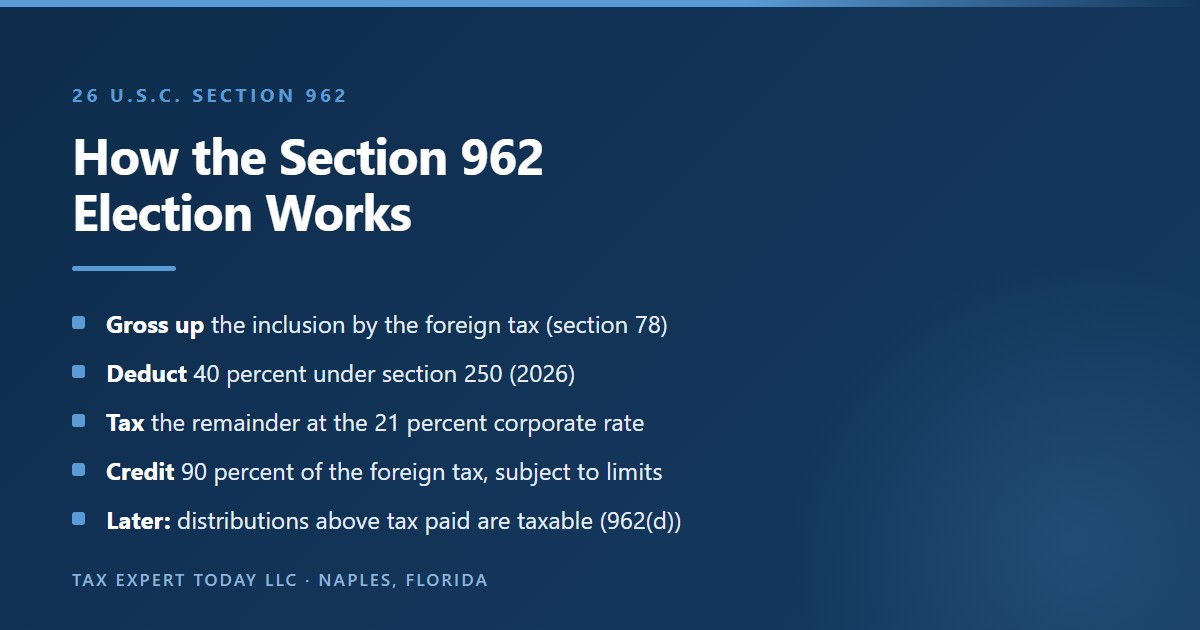
Mechanically, an electing individual adds a section 78 gross-up to the inclusion. Section 78 treats the foreign taxes deemed paid, “determined without regard to the phrase ’90 percent of'” in section 960(d)(1), as an additional dividend. In plain terms, the inclusion is grossed up by the full foreign tax, the 40 percent deduction applies to the grossed-up amount, tax is computed at 21 percent, and 90 percent of the foreign tax is credited against it, subject to the foreign tax credit limitation.
What does the section 962 election cost when the company pays a dividend?
The cost of a section 962 election comes when the company distributes the earnings. Under section 962(d), the part of the distribution that exceeds the United States tax already paid under the election is taxable again as a dividend, at qualified dividend rates only if the company qualifies, and possibly subject to the 3.8 percent net investment income tax.
- Not fully previously taxed. Only the amount of United States tax actually paid comes out tax-free.
- Treaty country matters. Qualified dividend rates generally require a company eligible for a comprehensive United States income tax treaty.
- Net investment income tax. The taxable portion is generally a dividend for the 3.8 percent tax.
- Deferral is the real benefit. The election pays off most when the earnings stay in the company for years.
Section 962(d) says that earnings attributable to amounts included under the election shall, when distributed, “notwithstanding the provisions of section 959(a)(1), be included in gross income to the extent that such earnings and profits so distributed exceed the amount of tax paid under this chapter on the amounts to which such election applied.” For a company in a low-tax country where the election produced little or no United States tax, almost the entire distribution is taxable on the way out.
Whether that dividend enjoys the 20 percent qualified dividend rate depends on the company. Under section 1(h)(11)(C), a foreign corporation is generally a “qualified foreign corporation” if it is eligible for the benefits of a comprehensive income tax treaty with the United States that the Treasury has approved for this purpose, or if the stock is readily tradable on an established United States securities market. A privately held company in a jurisdiction without such a treaty generally pays out ordinary dividends, taxed at up to 37 percent. Whether a particular company qualifies can turn on the treaty’s limitation on benefits article, so it should be confirmed for the specific company, and our guide to treaty-based return positions on Form 8833 explains when a treaty claim must be disclosed.
The net investment income tax adds another layer. Under Treasury Regulation section 1.1411-10(c)(1), for a shareholder who has not made the special election in paragraph (g) of that regulation, a distribution of previously taxed earnings is treated as a dividend for net investment income tax purposes. That rule applies whether or not a section 962 election was made, so the 3.8 percent tax generally reaches the distributed earnings in both paths for taxpayers above the income thresholds in section 1411.
How do the numbers compare in a worked example?
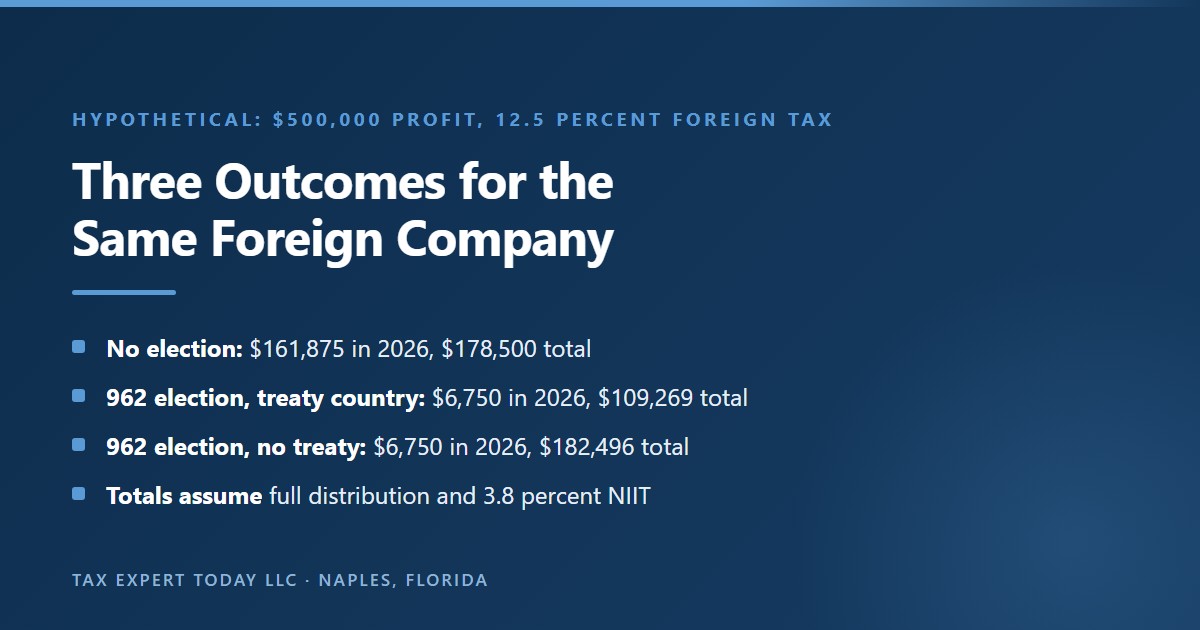
In a simplified 2026 example, a Naples resident who owns 100 percent of a foreign company earning $500,000 and paying 12.5 percent local tax owes about $161,875 with no election, or about $6,750 with a section 962 election. On a later distribution, the election path totals about $109,269 in a treaty country and about $182,496 without one.
- The election is a clear win while earnings stay abroad. The current United States tax drops from $161,875 to $6,750.
- Distribution changes the picture. The second layer brings the election path back up.
- The treaty question decides it. With ordinary dividend rates, the election can cost more than not electing.
- These are illustrations only. Real computations involve expense allocation, currency, and the foreign tax credit limitation.
Hypothetical facts. A single individual living in Naples, Florida owns 100 percent of a foreign operating company with a calendar tax year. In 2026 the company earns $500,000 before tax and pays $62,500 of local income tax, a 12.5 percent rate, leaving $437,500 of tested income. The individual is in the top bracket and above the net investment income tax threshold. The example assumes all income is taxed at the 37 percent top rate, ignores expense allocation, currency translation, any foreign withholding tax on dividends, and the alternative minimum tax, and assumes the full $437,500 is later distributed. It is a simplified illustration of how the rules interact, not a projection for any taxpayer.
Path A: no election. The $437,500 inclusion is ordinary income: 37 percent of $437,500 is $161,875. When the $437,500 is later distributed, section 959 excludes it from income tax, but under the net investment income tax regulation it is a dividend for that tax: 3.8 percent of $437,500 is $16,625. Total United States tax: $178,500.
Path B: section 962 election. The inclusion of $437,500 is grossed up by the $62,500 of foreign tax to $500,000. The 40 percent section 250 deduction is $200,000, leaving $300,000 taxed at 21 percent, or $63,000. The deemed paid credit is 90 percent of $62,500, or $56,250. United States tax in 2026 is $63,000 minus $56,250, or $6,750. When the $437,500 is later distributed, section 962(d) makes taxable the amount above the $6,750 already paid, which is $430,750. At the 20 percent qualified dividend rate that is $86,150, plus net investment income tax of 3.8 percent, $16,369, for a total of $109,269. At the 37 percent ordinary rate, the distribution tax is $159,378 plus the same $16,369, for a total of $182,496.
| Line item (2026, hypothetical) | Path A: no election | Path B: 962, treaty country | Path B: 962, no treaty |
|---|---|---|---|
| Foreign company pre-tax income | $500,000 | $500,000 | $500,000 |
| Foreign income tax at 12.5 percent | $62,500 | $62,500 | $62,500 |
| Tested income (after foreign tax) | $437,500 | $437,500 | $437,500 |
| Amount taxed in 2026 | $437,500 at 37 percent | $300,000 at 21 percent (after gross-up and 40 percent deduction) | $300,000 at 21 percent |
| Credit for foreign tax | None | $56,250 (90 percent) | $56,250 (90 percent) |
| United States tax in 2026 | $161,875 | $6,750 | $6,750 |
| Income tax on later distribution | $0 (previously taxed) | $86,150 (20 percent of $430,750) | $159,378 (37 percent of $430,750) |
| Net investment income tax on distribution | $16,625 | $16,369 | $16,369 |
| Total United States tax | $178,500 | $109,269 | $182,496 |
Three lessons come out of the example. First, the election is almost always better in the year of inclusion when the foreign rate is near or above about 14 percent, because the credit then covers most or all of the 21 percent corporate tax on 60 percent of the grossed-up income. Second, the value of the election depends on how long the earnings stay in the company. The roughly $155,000 of United States tax deferred in year one can be invested inside the business, and the second layer arrives only when cash comes out. Third, for a company that does not qualify for treaty benefits and distributes everything quickly, the election can produce a slightly higher total than doing nothing.
The example also shows why the answer is rarely the same two years in a row. A company that reinvests in 2026 and pays a large dividend in 2029 may favor the election in 2026 and not in 2029. Because the election is made annually, it can be tested each year against that year’s facts. It should be tested before the return is filed, because the election statement must accompany the return.
What is the GILTI high-tax exclusion?
The GILTI high-tax exclusion lets a controlled foreign corporation’s controlling domestic shareholders elect to exclude from tested income any income that bore foreign tax at an effective rate above 90 percent of the 21 percent corporate rate, which is 18.9 percent. Excluded income is not part of the GILTI inclusion at all, for individuals or corporations.
- The threshold is 18.9 percent. That is 90 percent of the maximum corporate rate under section 11.
- It is an election. The controlling domestic shareholders make it, and it binds the CFC group.
- It can be made late. An amended return filed within 24 months of the unextended due date can make or revoke it.
- It helps individuals directly. No section 962 election is needed to benefit.
The rule is in Treasury Regulation section 1.951A-2(c)(7), which follows the statutory carve-out in section 951A(b)(2)(A)(i)(III) for income excluded under section 954(b)(4). An item qualifies when the “tentative tested income item” was “subject to an effective rate of foreign tax … that is greater than 90 percent of the maximum rate of tax specified in section 11.” With the section 11 rate at 21 percent under section 11(b), the threshold is 18.9 percent.
| Feature | Section 962 election | High-tax exclusion election |
|---|---|---|
| Who makes it | Each individual United States shareholder | The controlling domestic shareholders of the CFC |
| What it does | Taxes the inclusion as if received by a corporation | Removes high-taxed income from tested income |
| Foreign rate where it helps | Any rate; strongest near or above 14 percent | Only above 18.9 percent effective rate |
| Scope | All CFCs of the shareholder for the year | All members of the CFC group |
| Timing | Statement with the return for the year | Original return, or amended return within 24 months of the unextended due date |
| Later distribution | Taxable above the United States tax paid, under section 962(d) | Taxed as an ordinary distribution from untaxed earnings |
The high-tax exclusion is the cleaner answer for owners of companies in higher-tax countries such as much of Western Europe, where corporate rates commonly exceed 18.9 percent. It removes the income from GILTI entirely, with no second computation and no section 962(d) layer. The earnings remain untaxed in the United States until they are distributed, at which point the dividend is taxed under the normal rules. The election is made under the rules in paragraph (c)(7)(viii) of the regulation, by filing the required statement with a timely filed original return or with an amended return filed within 24 months of the unextended due date of the original return, and it can be revoked the same way.
Effective rate here is measured item by item under the regulation’s tested unit rules, not by looking at the headline corporate rate of the country. A company in a country with a 25 percent headline rate can still fall below 18.9 percent on some income if local incentives or timing differences reduce its actual tax, so the computation needs the company’s local return and the United States earnings and profits figures side by side.
How do you choose between no election, a 962 election, and the high-tax exclusion?
The choice usually turns on three facts: the foreign effective tax rate, whether the company qualifies for treaty benefits, and how soon the earnings will be distributed. Above 18.9 percent, the high-tax exclusion is often simplest. Between roughly 14 and 18.9 percent, a section 962 election often helps. Below that, the answer depends on distribution plans.
- Effective foreign rate. Measured item by item, not by the headline statutory rate.
- Treaty status of the company. Drives whether a later dividend gets the 20 percent rate.
- Distribution timing. Long deferral favors the election; immediate payouts weaken it.
- The rest of the return. Other foreign tax credits, losses, and state residence change the math.
| Typical scenario | Usually worth modeling first | Why |
|---|---|---|
| Company taxed above 18.9 percent effective, earnings reinvested | High-tax exclusion | Removes the income from GILTI with no second layer until distribution |
| Company taxed between about 14 and 18.9 percent, treaty country | Section 962 election | The 90 percent credit covers most of the 21 percent tax on the reduced base |
| Low-tax company, treaty country, long reinvestment horizon | Section 962 election | Large deferral, and qualified rates on the eventual dividend |
| Low-tax company, no treaty, cash distributed every year | No election, compared against the election | The section 962(d) layer at ordinary rates can erase the benefit |
| Tested losses in one CFC offset income in another | Model all CFCs together | The netting and the election apply across the shareholder’s companies |
None of these rows is a rule; they are starting points for a model. The foreign tax credit limitation under section 904, the separate category for this income, the allocation of the individual’s own expenses, and foreign currency gain or loss on distributions all move the result. Our guide to Form 1116 and the foreign tax credit explains the limitation mechanics, and the guide to the foreign earned income exclusion versus the foreign tax credit covers the separate question of salary earned abroad. Salary an owner draws from the company is not GILTI; it is wages, and it follows those rules instead.
There is also a structural option: holding the foreign company through a domestic C corporation, which gets the deduction and credit without an election but adds a corporate layer of its own. That is an entity planning decision with legal, estate, and state tax consequences well beyond GILTI, and it should be made with counsel and a full projection rather than to solve one year’s inclusion.
Which forms does an individual file for GILTI?
An individual United States shareholder of a CFC generally files Form 5471 with Schedule I-1 for each company, Form 8992 with Schedule A to compute the inclusion, and, with a section 962 election, the election statement and Form 8993 for the deduction. Form 1116 may be needed for any creditable foreign taxes.
- Form 5471. The information return for the foreign corporation, including Schedule I-1 for tested income.
- Form 8992 and Schedule A. The shareholder-level GILTI computation.
- Section 962 statement. Required with the return in any year the election is made.
- Form 8993. The section 250 deduction, used by electing individuals.
| Form or statement | What it does | Who files it |
|---|---|---|
| Form 5471, including Schedule I-1 | Reports the CFC’s financial information and the tested income figures each shareholder uses | Each United States shareholder required to file for the CFC |
| Form 8992 and Schedule A (Form 8992) | Computes the shareholder’s GILTI inclusion across all CFCs | Every United States shareholder with a pro rata share of tested income or loss |
| Schedule 1 (Form 1040) | Carries the inclusion to the individual return as other income | Individual shareholders |
| Section 962 election statement | Makes the election and reports the required detail under Regulation 1.962-2(b) | Electing individuals, each year elected |
| Form 8993 | Computes the section 250 deduction | Corporations and section 962 electors |
| Form 1116 | Computes the foreign tax credit and its limitation | Individuals claiming a foreign tax credit, including electors |
The About Form 8992 page states that “U.S. shareholders of controlled foreign corporations use Form 8992 and Schedule A to figure their global intangible low-taxed income inclusions under section 951A.” The current Instructions for Form 8992 are the December 2024 revision and still use the GILTI name. Forms for 2026 tax years will need to reflect the new name and the removal of the tangible asset computation, so check the IRS page for the current revision before preparing a 2026 return.
The Instructions for Form 5471 explain that Schedule I-1 reports “information determined at the CFC level with respect to amounts used in the determination of income inclusions by U.S. shareholders under section 951A,” and that Schedule E matters even for individuals because “timely information reporting is important to the extent the U.S. shareholder chooses to amend its return in a later year to make the election under section 962.” That sentence is a practical reminder: the foreign tax figures on Form 5471 are what make a later election possible.
What happens if GILTI or Form 5471 was never reported?
An unreported GILTI inclusion is unpaid income tax with interest and possible accuracy penalties. A missing Form 5471 carries a $10,000 penalty per year, up to $50,000 more after an IRS notice, and keeps the assessment period for the related return open until three years after the information is furnished.
- Form 5471 penalties are separate. They apply even if no tax is owed.
- The statute of limitations stays open. Section 6501(c)(8) ties it to when the information is filed.
- A lost election opportunity. Without timely Form 5471 data, a later section 962 or high-tax election is harder to support.
- Non-willful paths exist. The Streamlined procedures are available only where the failure was non-willful.
The penalty is in section 6038(b): “a penalty of $10,000 for each annual accounting period with respect to which such failure exists,” increased by $10,000 for each 30-day period the failure continues more than 90 days after an IRS notice, with the increase capped at $50,000. Under section 6501(c)(8), when information required under section 6038 is not furnished, the time for assessment “shall not expire before the date which is 3 years after the date on which the Secretary is furnished the information.” The open period can reach the entire return, not only the foreign items.
Owners who discover a gap usually have more than one missed form. A foreign company almost always means a foreign bank account, which brings in the FBAR and often Form 8938. Where the failure was non-willful, the Streamlined Filing Compliance Procedures may be available, but only for taxpayers who can truthfully certify under penalty of perjury that the failure was non-willful; a willful taxpayer who uses that path risks a false certification. The penalty exposure on the account side is explained in our guide to FBAR penalties, and the general rules for asking the IRS to reduce penalties are in how IRS penalty relief works. None of these procedures assures a particular result; each depends on the facts and the IRS’s review.
A missed Form 5471 also has a consequence many owners do not see coming. Anyone thinking about giving up citizenship or a long-term green card must certify five years of full compliance on Form 8854, and an unfiled Form 5471 is exactly the kind of gap that can make a person a covered expatriate regardless of wealth. Our guide to Form 8854 and the U.S. exit tax walks through that certification.
Do states tax GILTI, and what does it mean in Florida?
State treatment of GILTI varies because each state decides whether to conform to federal income, and several states tax some or all of it while others exclude it. Florida has no personal income tax, so an individual shareholder who is a Florida resident generally faces only the federal GILTI inclusion.
- Federal first. The inclusion, the election, and the credits are all federal questions.
- State residence matters. A move to Florida from a state that taxes the income changes the total.
- Part-year residents need care. Allocation of the inclusion between states can be disputed.
- Corporate owners differ. A domestic corporation that owns the CFC faces its own state rules.
For an individual shareholder in Naples, Florida, the absence of a state personal income tax simplifies the computation. The work is entirely federal: the inclusion, the section 962 or high-tax election, the foreign tax credit, and the reporting. That makes the federal elections relatively more valuable, because there is no state layer to reduce or complicate. A shareholder who moved to Florida from a state with an income tax during the year should confirm how the prior state treats a GILTI inclusion for a part-year resident, since that is a question of the other state’s law.
Southwest Florida has a particular version of this issue. Many residents here built or inherited businesses in Canada, Europe, or Latin America, then became United States residents under the substantial presence test or by obtaining a green card. The moment they became United States persons, a foreign company they had owned for years could become a controlled foreign corporation, and GILTI could begin to apply in the first full year of residence. Recognizing that change before the first return is filed is far easier than unwinding missed inclusions afterward.
GILTI Help in Naples & Southwest Florida
Tax Expert Today LLC works with international clients from an office in Naples, Florida, and serves clients in all 50 states. Collier and Lee counties are home to business owners who hold operating companies abroad, to new residents who arrived with a family stake in a foreign company, and to United States citizens who run a consulting or trading company through an overseas entity.
- GILTI tax help Naples: computing the inclusion, testing the section 962 election, and modeling a later distribution.
- International tax Naples FL: reviewing CFC status, attribution, and the any-day ownership rule after a purchase, sale, or gift.
- Form 5471 Naples: preparing Form 5471, Form 8992, and Form 8993 so the elections are supported.
- Foreign tax Naples: measuring effective foreign tax rates for the high-tax exclusion and the foreign tax credit limitation.
Our international and expat tax services page explains how we approach cross-border engagements for individual owners of foreign companies, and our Naples tax planning page covers the broader planning work for Southwest Florida residents.
Office: 11983 Tamiami Trail N, Naples FL 34110
Phone: (239) 441-2005
Hours: Monday through Friday, 10:00 to 5:00 ET
Frequently Asked Questions
I moved to Naples from Canada and still own 60 percent of my Canadian company. Does GILTI apply to me now?
If you are now a United States person, whether through a green card or the substantial presence test, you are generally a United States shareholder of that company, and at 60 percent United States ownership it is generally a controlled foreign corporation. GILTI can then apply to its tested income, and Form 5471 and Form 8992 are generally required. Canada’s corporate rates and the treaty make the high-tax exclusion and the section 962 election both worth modeling.
Is GILTI going away?
No. The 2025 law renamed it net CFC tested income for tax years beginning after December 31, 2025, removed the tangible asset return, reduced the corporate deduction to 40 percent, and raised the deemed paid credit to 90 percent. The inclusion itself continues, and for individuals without a section 962 election it is taxed at ordinary rates as before.
What is the GILTI tax rate for an individual?
Without a section 962 election, the inclusion is ordinary income taxed at the individual rates up to 37 percent, with no section 250 deduction and no deemed paid credit. With the election, the inclusion is taxed at 21 percent after a 40 percent deduction for 2026 tax years, and 90 percent of the related foreign taxes can be credited, subject to the limitation.
Can I make a section 962 election on an amended return?
The regulations require the election statement to be filed with the return for the year of the election. The Form 5471 instructions contemplate a shareholder choosing to amend a return in a later year to make the election, which is why they stress timely reporting of the foreign tax information. Whether an amended return election is available for a given year should be confirmed against the current regulations and the assessment period.
Do I owe GILTI if my foreign company lost money?
A company with a tested loss produces no inclusion, and its loss can offset tested income from your other controlled foreign corporations for the same year. Form 5471 and Form 8992 are still generally required, because the loss must be reported to be used.
Is my salary from my foreign company GILTI?
No. Wages you receive for services are compensation, taxed under the normal rules for earned income, and may qualify for the foreign earned income exclusion or the foreign tax credit. GILTI is the owner’s inclusion of the company’s own profits after expenses, including your salary.
When to Engage a Professional
GILTI is rarely a do-it-yourself computation, even for a small company. It depends on foreign financial statements converted to United States tax principles, earnings and profits in the foreign currency, and elections that are made on the return and cannot easily be revisited. The cost of getting it wrong shows up years later, in penalties on Form 5471, in an open statute of limitations, or in a section 962 election that was never made when it would have saved significant tax.
Consider a consultation if any of the following applies: you own 10 percent or more of any foreign company and have not filed Form 5471; you became a United States resident while owning a foreign company; you bought, sold, or gifted foreign company shares in 2026; your foreign company pays tax near or above 14 percent; you are planning a large dividend from a foreign company; or you are considering giving up citizenship or a green card while owning one. The most useful time to review these facts is before the return is filed, because the elections that matter are made with it.
Tax Expert Today LLC is a tax advisory firm in Naples, Florida serving clients in all 50 states. Call (239) 441-2005 to discuss your facts.
Primary Sources
- 26 U.S.C. section 951A (net CFC tested income, formerly GILTI)
- 26 U.S.C. section 962 (election by individuals to be taxed at corporate rates)
- 26 U.S.C. section 250 (40 percent deduction for tax years beginning after 2025)
- 26 U.S.C. section 960 (90 percent deemed paid credit)
- IRS: About Form 8992, U.S. Shareholder Calculation of GILTI
- Treasury Regulation section 1.951A-2 (tested income and the high-tax exclusion)
This article is general information, not advice for any particular taxpayer, and does not create a client relationship. The Naples company figures are hypothetical illustrations only and simplify the computation by ignoring expense allocation, currency translation, foreign withholding on dividends, the alternative minimum tax, and the foreign tax credit limitation. The 2026 rules described here apply to tax years beginning after December 31, 2025 under Public Law 119-21; IRS forms, instructions, and regulations had not all been updated for the new rules when this article was written. Entity restructuring and treaty eligibility questions require review of the specific facts. Verify current rules and confirm your own facts with a qualified tax professional before filing or making an election.
Published September 28, 2026 by Dr. Pellumb Kabashi « Back to Learning Center
Have a question this article touches on?
Tax Expert Today LLC, based in Naples, Florida and serving clients across the United States.
Schedule a Consultation (239) 441-2005