
By Dr. Pellumb Kabashi, DBA, MBA, EA, CFE, CES
Founder, Tax Expert Today LLC · Tax advisors, enrolled agents, CPAs, and attorneys · Serving clients in all 50 states
Quick Answer: FBAR signature authority means you can control the disposition of money in a foreign financial account by communicating directly with the institution, even though the money is not yours. Under 31 CFR 1010.350(f), that control alone makes the account reportable on FinCEN Form 114 once your foreign accounts exceed $10,000 in the aggregate. A narrow set of officers and employees of regulated entities is excepted, and their deadline has been extended again.
Published: July 28, 2026
What Is FBAR Signature Authority?
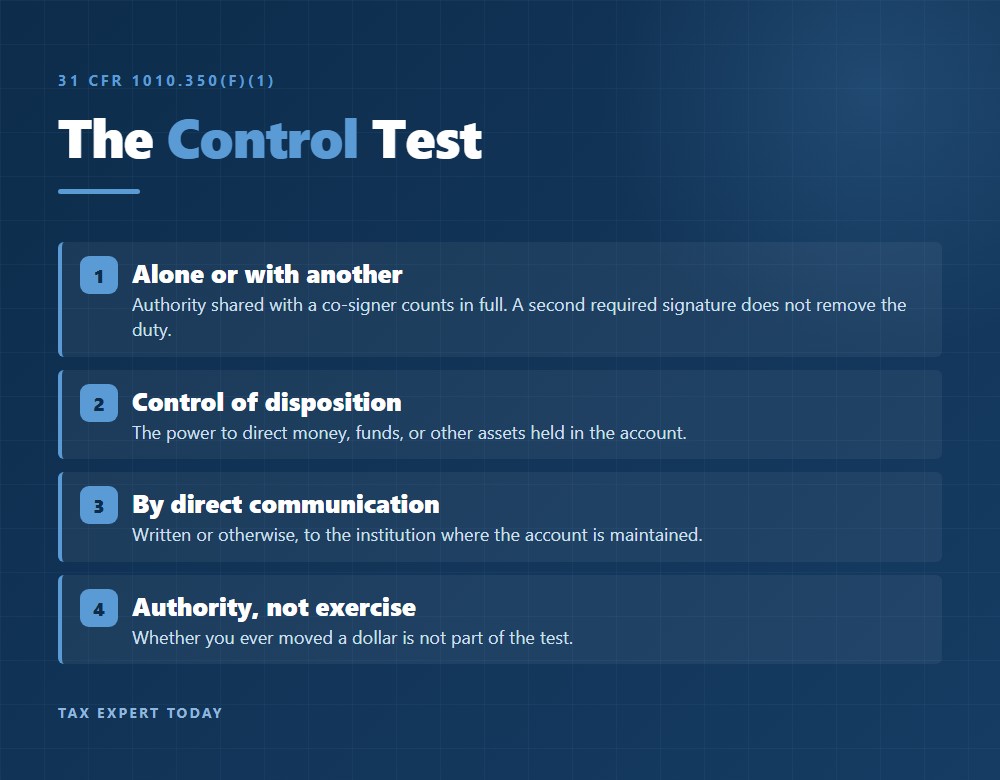
Signature or other authority is defined at 31 CFR 1010.350(f)(1) as the authority of an individual, alone or in conjunction with another, to control the disposition of money, funds, or other assets held in a financial account by direct communication to the person with whom the account is maintained. The test is control, not ownership, and the communication may be written or otherwise.
Two features of that definition do most of the work in practice. The first is that authority shared with someone else still counts. A treasurer who can move funds only with a second signer holds signature authority just as surely as a sole signer does. The second is that the definition speaks to authority, not to exercise. Whether you ever actually moved a dollar is not part of the test. A person who was added as a signer on a parent’s account overseas five years ago and has never touched it holds signature authority for every one of those years.
This is the single most commonly missed FBAR trigger, because the intuition that guides most people is ownership. The report asks a different question. If you can pick up the phone or log in and direct the bank to move the money, the account is in scope for you regardless of whose money it is.
| Question | Financial interest | Signature or other authority |
|---|---|---|
| Whose money is it? | Yours, legally or beneficially | Someone else’s |
| What creates the duty? | Ownership or record title | Power to direct disposition |
| Counts toward the $10,000 test? | Yes | Yes |
| Reported where on Form 114? | Parts II and III | Part IV |
| Any officer or employee exception? | No | Yes, five narrow categories |
Who Is a U.S. Person Subject to the FBAR Rules?
The reporting duty reaches a United States person, which the IRS describes as a citizen, a resident, and also a corporation, partnership, limited liability company, trust, or estate. Residency for this purpose is not a matter of where you feel at home. It follows the tax residency tests, so lawful permanent residents and individuals who satisfy the substantial presence test are inside the definition.
Several groups are caught by this more often than they expect. Green card holders remain United States persons for as long as the card is valid, including years spent living entirely abroad. Dual citizens are United States persons by virtue of the American citizenship, whatever their other passport says and wherever they file a return. Individuals who meet the substantial presence test on a work visa become United States persons for those years, which can pull a home-country account they have held since childhood into the reporting system.
Domestic entities matter too, and they are the usual reason an ordinary employee ends up in Part IV of a report. When a United States company holds a foreign account, the company files as to its own financial interest, and separately, each individual who can direct that account holds signature authority in a personal capacity. The company’s filing does not discharge the individual’s duty unless one of the exceptions below applies. If you are still working out whether you are inside the reporting population at all, the threshold analysis is covered separately in our guide to whether you need to file an FBAR.
Does Signature Authority Alone Require You to File?
Yes, in the ordinary case. FinCEN states that a United States person with a financial interest in or signature authority over foreign financial accounts must file if the aggregate value of those accounts exceeded $10,000 at any time during the calendar year. The word or is doing real work. Authority by itself is a sufficient trigger, and no ownership is required.
The aggregation step is where filings most often go wrong. The $10,000 test is applied to the combined maximum value of every foreign account you have a duty to consider, both the accounts you own and the accounts you merely sign on. A person with a $4,000 personal account abroad and authority over an employer account that peaked at $80,000 has crossed the threshold, even though the personal holdings never came close on their own. The account balances are not netted, reduced, or prorated by your degree of control.
A related point causes real confusion. Authorizing your accountant to submit the report for you is not signature authority. That authorization is recorded on FinCEN Form 114a, which is retained in your files rather than filed, and it says nothing about who controls the underlying account. The two concepts share the word signature and nothing else.
Which Officers and Employees Are Exempt From Reporting Signature Authority?
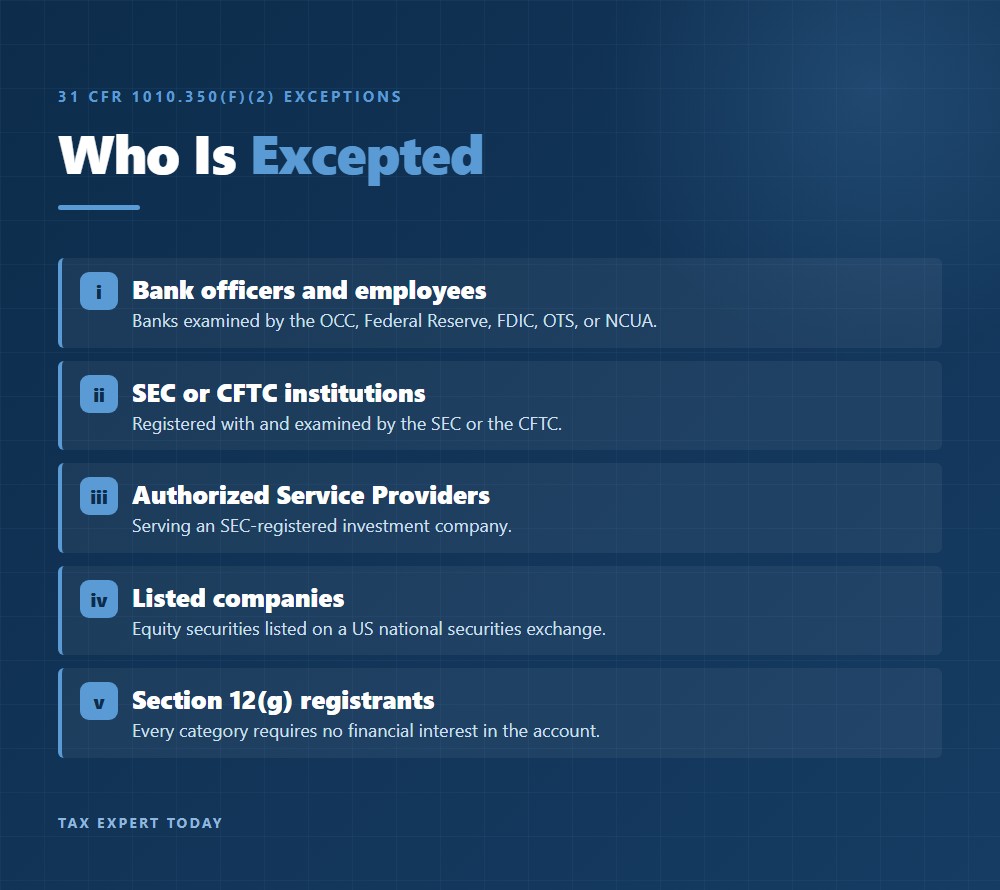
Five categories of officers and employees are relieved from reporting signature authority over their employer’s foreign accounts under 31 CFR 1010.350(f)(2). Every one of them carries the same condition, which is that the officer or employee has no financial interest in the account. The exceptions are drawn around regulated entities, so they are narrower than most employees assume.
| Provision | Who is excepted |
|---|---|
| 1010.350(f)(2)(i) | Officers and employees of a bank examined by the OCC, the Federal Reserve Board, the FDIC, the Office of Thrift Supervision, or the NCUA, as to accounts owned or maintained by that bank |
| 1010.350(f)(2)(ii) | Officers and employees of a financial institution registered with and examined by the SEC or the CFTC, as to accounts owned or maintained by that institution |
| 1010.350(f)(2)(iii) | Officers and employees of an Authorized Service Provider, as to accounts of an SEC-registered investment company |
| 1010.350(f)(2)(iv) | Officers and employees of an entity with equity securities listed on a United States national securities exchange, and of a United States subsidiary included in the parent’s consolidated report |
| 1010.350(f)(2)(v) | Officers and employees of an entity with equity securities registered under section 12(g) of the Securities Exchange Act |
Notice what is absent from that list. There is no exception for an officer of a private operating company, for a partner in a professional firm, for an officer of a nonprofit, or for a family member holding a power of attorney. A controller at a privately held manufacturer who signs on the company’s account in Mexico reports that authority personally. So does a volunteer treasurer of a charity with an account in Canada. The exceptions were written for regulated financial institutions and public companies, and they do not generalize beyond that.
One further relief provision is procedural rather than substantive. Under 31 CFR 1010.350(g)(2), a United States person with signature authority over 25 or more foreign financial accounts may report the number of accounts and certain basic information rather than the full detail for each one, subject to producing the detail if the government asks for it. The duty to file does not go away. Only the volume of detail on the form is reduced, and the underlying records still need to be maintained.
Has the Filing Deadline Been Extended for Signature-Authority Filers?
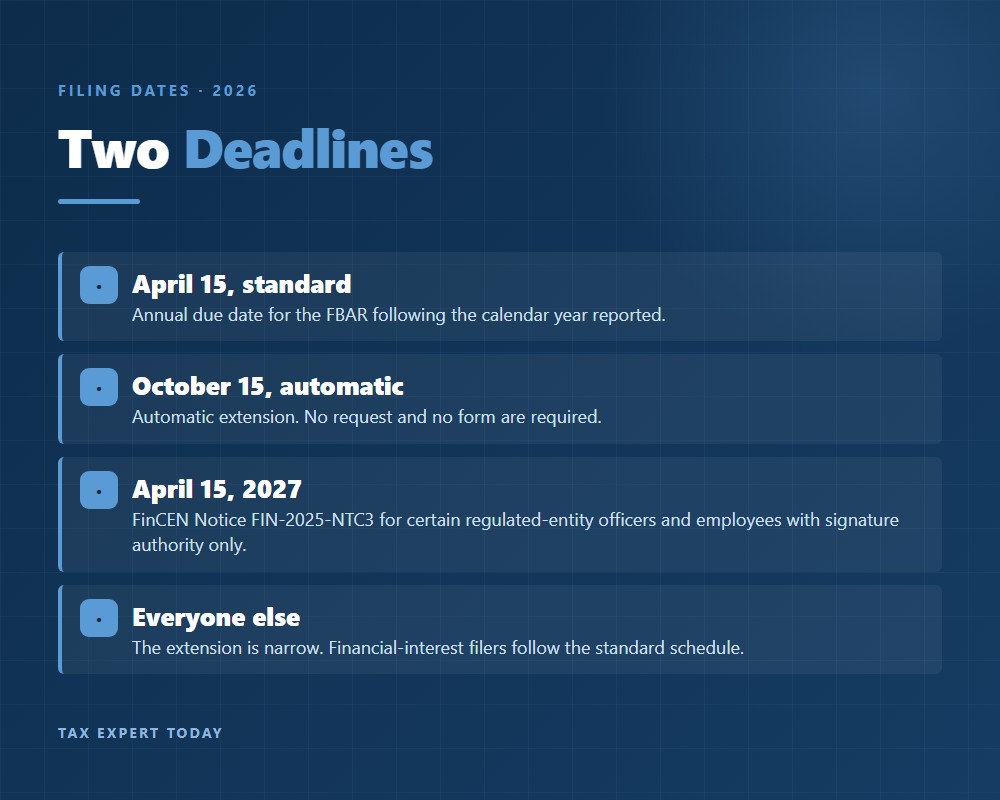
For a narrow group, yes. FinCEN issued Notice FIN-2025-NTC3 on December 8, 2025, extending the FBAR filing date to April 15, 2027 for certain United States individuals with signature authority over, but no financial interest in, one or more foreign financial accounts. The extension also carries forward the deadlines previously extended by FIN-2024-NTC7 and the notices before it.
The reason this keeps happening is that a notice of proposed rulemaking published on March 10, 2016, which would expand and clarify the exemptions for individuals with signature authority, has never been finalized. Rather than enforce a rule it has proposed to change, FinCEN has deferred the deadline for the affected population, and the December 2025 notice was the sixteenth such deferral since 2011.
The scope of the relief is where mistakes happen. It reaches employees and officers of the specified regulated entities described in the notice who have signature authority only. It does not extend the deadline for anyone reporting a financial interest in a foreign account, and it does not extend the deadline for the private company controller, the charity treasurer, or the adult child on a parent’s account. For everyone outside the notice, the ordinary schedule governs.
That ordinary schedule is straightforward. The FBAR is an annual report due April 15 following the calendar year reported, with an automatic extension to October 15 that requires no request and no form. Reports are filed electronically through the BSA E-Filing System and are not attached to the income tax return. For the 2025 calendar year, that means the report is due by October 15, 2026 for filers relying on the automatic extension.
What Are the Penalties for an Unreported Signature-Authority Account?
The penalty regime does not distinguish between an account you own and an account you merely sign on. Both sit under 31 U.S.C. §5321, and both draw from the same inflation-adjusted ceilings at 31 CFR 1010.821. The distinction that matters is between non-willful and willful conduct, not between ownership and authority.
| Violation | Statutory ceiling | How it accrues |
|---|---|---|
| Non-willful | Up to $16,536 | Per report, meaning per year, following Bittner |
| Willful | Greater of $165,353 or 50% of the account balance | Per account, per year |
The Supreme Court held in Bittner v. United States in 2023 that the non-willful penalty accrues per report rather than per account. That holding is particularly consequential for signature-authority filers, because an employee who signs on a dozen foreign accounts for an employer would otherwise face a multiple of the ceiling for a single year of non-filing. The decision did not disturb the willful penalty, which continues to be measured account by account. Our guide to FBAR penalties works through the willful and non-willful distinction in more detail, and the FBAR penalty calculator illustrates how the ceilings stack across years.
These are statutory maximums rather than expected outcomes. A penalty against a non-willful filer is discretionary, and 31 U.S.C. §5321(a)(5)(B)(ii) provides a reasonable-cause exception where the failure was due to reasonable cause and the balance in the account was properly reported. It is worth keeping the source of law straight here, because FBAR penalties arise under Title 31 rather than Title 26. First-Time Abate, which is an administrative concession for certain income tax penalties, has no application to an FBAR.
What If You Have Missed Signature-Authority Reports in Prior Years?
The correct route depends on one question, which is whether income was also left off your returns. Where a signer never had any income to report, because the money belongs to an employer or a relative, the situation is generally a pure reporting failure. Where foreign income of your own went unreported, a different and more formal path is usually indicated.
Pure reporting failures changed in character on July 1, 2026, when the IRS eliminated the penalty-free Delinquent FBAR Submission Procedures. Late reports may still be filed through the BSA E-Filing System at any time, but they are now evaluated case by case rather than accepted without penalty as a matter of program design. The mechanics of filing in that environment, including how far back to go under the six-year statute of limitations, are set out in our guide to filing a late or delinquent FBAR.
Where foreign income was also unreported and the failure was non-willful, the Streamlined Filing Compliance Procedures remain open in 2026 and require three years of amended returns, six years of FBARs, and a certification of non-willfulness signed under penalty of perjury. That certification is not a formality. A taxpayer whose conduct may have been willful risks a false certification by using the program, which is why the eligibility question deserves a careful look before anything is filed. Our guide to the Streamlined Filing Compliance Procedures covers the qualifying conditions. If your foreign holdings also raise a FATCA question, the separate reporting regime is compared in our guide to FBAR versus Form 8938.
FBAR Signature Authority Help in Naples and Southwest Florida
Tax Expert Today LLC advises individuals and business owners in Naples, Florida and across Southwest Florida on foreign account reporting, including the signature-authority questions that arise for corporate officers, controllers, nonprofit treasurers, and family members holding a power of attorney over a relative’s account abroad. That work usually begins by mapping every account you can direct, testing each one against the exceptions in 31 CFR 1010.350(f)(2), and then deciding which years actually required a report. Where prior years were missed, the firm helps choose between a direct late filing and the Streamlined procedures and documents the reasonable-cause narrative. The firm is multidisciplinary, with enrolled agents, CPAs, and attorneys, and represents taxpayers before the IRS nationwide through its international and expat tax services. Dr. Pellumb Kabashi is the founder of Tax Expert Today LLC. The office is at 11983 Tamiami Trail N, Naples, FL 34110, and the team can be reached at (239) 441-2005, Monday through Friday, 10am to 5pm ET.
Frequently Asked Questions
Do I have to file an FBAR if I only have signature authority?
Generally yes. A United States person with signature or other authority over foreign financial accounts must file FinCEN Form 114 if the aggregate value of the accounts exceeded $10,000 at any point in the calendar year, whether or not any of the money belongs to you. A narrow set of officers and employees of banks, SEC-registered or CFTC-registered institutions, and publicly traded companies is excepted under 31 CFR 1010.350(f)(2), provided they hold no financial interest in the account.
What counts as signature authority for FBAR purposes?
Signature or other authority is the ability of an individual, alone or together with another person, to control the disposition of money or assets in a foreign account by communicating directly with the institution where the account is held. Authority shared with a co-signer still counts. So does authority you have never used. The test looks at what you are permitted to direct, not at what you actually directed during the year.
Does signature authority count toward the $10,000 threshold?
Yes. The threshold is applied to the combined maximum value of all foreign accounts you must consider, which includes accounts you own and accounts over which you hold only signature authority. A small personal account abroad combined with authority over a larger employer account can cross the threshold even though neither one would on its own. Balances are aggregated at their highest point during the year rather than netted or prorated.
Has the FBAR deadline been extended for signature authority?
For a limited group, yes. FinCEN Notice FIN-2025-NTC3, issued December 8, 2025, extended the filing date to April 15, 2027 for certain employees and officers of specified regulated entities who hold signature authority over, but no financial interest in, foreign accounts. Everyone else follows the standard schedule, which is an April 15 due date with an automatic extension to October 15 that requires no request.
What is the penalty for failing to report signature authority?
The same ceilings apply as for an account you own. In 2026 a non-willful violation carries a penalty of up to $16,536, assessed per report rather than per account following the Supreme Court decision in Bittner, while a willful violation can reach the greater of $165,353 or 50% of the account balance per account per year. These are maximums, and 31 U.S.C. §5321(a)(5)(B)(ii) provides a reasonable-cause exception for non-willful failures where the balance was properly reported.
Where can I get help with FBAR signature authority in Naples, FL?
Tax Expert Today LLC, located at 11983 Tamiami Trail N, Naples, FL 34110, assists individuals and businesses in Naples and across Southwest Florida with identifying reportable signature authority, applying the officer and employee exceptions, and bringing missed years current. The firm is multidisciplinary, with enrolled agents, CPAs, and attorneys, and represents taxpayers before the IRS nationwide. Consultations can be arranged at (239) 441-2005.
When to Engage a Professional
Many signature-authority filings are routine once the accounts have been identified. The difficulty is almost always in the identification and in the years that were missed before anyone asked the question. Three situations tend to warrant a professional review. The first is an employment arrangement where you sign on accounts of an entity that may or may not fall inside the regulated-entity exceptions, because that determination decides whether you file personally at all. The second is a history of missed years, where choosing between a direct late filing and the Streamlined procedures turns on a willfulness assessment that should be made deliberately rather than in hindsight. The third is any situation involving a relative’s account held under a power of attorney, which frequently combines signature authority with a possible beneficial interest and needs both questions answered.
Outcomes in this area depend on the specific facts, including the reason the reports were missed and what the record shows about your knowledge of the requirement. Nothing above is a prediction about any particular case. If you hold authority over a foreign account and are not certain whether it has been reported correctly, a review before filing is generally more productive than a correction afterward. Tax Expert Today LLC can be reached at (239) 441-2005 or through its international and expat tax practice.
Published July 28, 2026 by Dr. Pellumb Kabashi « Back to Learning Center
Have a question this article touches on?
Tax Expert Today LLC, based in Naples, Florida and serving clients across the United States.
Schedule a Consultation (239) 441-2005