
By Dr. Pellumb Kabashi, DBA, MBA, EA, CFE, CES
Founder, Tax Expert Today LLC · Tax advisors, enrolled agents, CPAs, and attorneys · Serving clients in all 50 states
Quick Answer: The Georgia low income tax credit (credit code 211) is a nonrefundable credit for Georgia residents whose federal adjusted gross income is under $20,000. It is worth $26 down to $5 per exemption, doubled for a filer 65 or older, and is claimed on Form 500 Line 17. Because it cannot exceed your Georgia tax, many low income filers get no benefit from it. Call (239) 441-2005 for a free consultation.
Search for the Georgia low income tax credit and page one splits in two. An AI summary explains that the phrase can mean either a small credit on an individual return or the Low Income Housing Tax Credit for affordable housing developers, and then lists a flat credit table from a tax software help page. Below it sit a private school scholarship page, a 2016 policy fact sheet, a 2017 forum thread, a 2017 legislative analysis of a state earned income credit that Georgia never adopted, and several housing finance pages. None of them does the arithmetic a filer actually needs.
That arithmetic matters, because the table most people see is incomplete. The credit is multiplied by the number of exemptions on the return and doubled for anyone 65 or older, and it can only reduce Georgia tax that is actually owed. Once you apply the Georgia standard deduction, a large share of people under the $20,000 limit owe no Georgia tax at all, so the credit is worth nothing to them. For 2026, when the standard deduction rises to $15,000 for single filers and $30,000 for married couples filing jointly, that share grows.
This guide explains the Georgia low income tax credit in full: who qualifies, how much it is, how exemptions and age change the amount, why it is often worth zero, how to claim it on Form 500, the rules for married couples, part-year residents, and people who are barred, and the deadline. It then covers the other Georgia credits that matter to low and moderate income households, including the new $250 Qualifying Child Credit for 2026, the Child and Dependent Care Expense Credit, and the absence of a Georgia earned income credit, and it closes with the separate Georgia housing credit that shares the name. Every figure below was checked against the Georgia Department of Revenue and the Georgia Code on November 6, 2026. If you work with us from Naples, Florida, or anywhere else, the same Georgia rules apply, because the credit follows the Georgia return.
What Is the Georgia Low Income Tax Credit?
The Georgia low income tax credit is a small, nonrefundable credit against Georgia individual income tax for residents whose federal adjusted gross income is under $20,000. It is set by O.C.G.A. 48-7A-3, carries credit code 211, is figured per exemption on a worksheet, and is entered directly on Form 500 Line 17.
- Who it is for: Georgia residents with federal AGI under $20,000 who are not someone else’s dependent.
- How much: $26 down to $5 per exemption, depending on the income bracket.
- Age boost: a filer 65 or older counts twice.
- Limit: it can only reduce Georgia tax owed; it never creates a refund.
- Where: Form 500 Lines 17a, 17b, and 17c, not Schedule 2 or Form IND-CR.
The credit is old, and its dollar amounts have not been indexed. The schedule in O.C.G.A. 48-7A-3 still lists the same five brackets and the same five amounts that appear on the 2025 Low Income Credit Worksheet in the Department’s IT-511 instruction booklet. Over the same period, Georgia replaced its graduated income tax with a flat rate and raised its standard deduction several times. The result is a credit whose eligibility window and whose usefulness have drifted apart, which is the main point of this guide.
The Department’s Low Income Tax Credit page summarizes the rules in one paragraph: federal AGI under $20,000, not claimed or eligible to be claimed as a dependent, part-year residents only if they were residents at the end of the year, a joint return rule for married couples who file separately, a bar for inmates of correctional facilities, a claim deadline at the end of the twelfth month after the tax year, and a cap at the taxpayer’s income tax liability. Each of those rules is covered in its own section below.
It is worth separating this credit from the much larger program that shares its name. The Georgia Low Income Housing Credit, credit code 109, is a credit for owners of affordable rental housing projects that also receive the federal housing credit under section 42 of the Internal Revenue Code. It has nothing to do with the income of the person claiming it. That credit is covered near the end of this guide.
Who Qualifies for the Georgia Low Income Tax Credit?
You qualify for the Georgia low income tax credit if you file a Georgia individual return as a resident, your federal adjusted gross income is under $20,000, nobody claims or could claim you as a dependent, and you were not confined in a correctional institution during the year. Part-year residents must be residents on December 31.
- Residency: full-year residents, or part-year residents who are residents at the end of the tax year.
- Income test: federal AGI from Form 500 Line 8 must be under $20,000.
- Dependency test: you cannot be claimed, or be eligible to be claimed, on another person’s federal or Georgia return.
- Inmate bar: anyone confined in a jail or prison for any part of the year cannot claim it.
- Timely claim: it must be claimed within twelve months after the end of the tax year.
The income test uses federal adjusted gross income, not Georgia adjusted gross income. The worksheet tells you to start with Form 500 Line 8, and the Form 500 instructions define Line 8 as federal adjusted gross income from Form 1040, adding that you must not use federal taxable income. That distinction matters in both directions. Georgia subtractions, such as the retirement income exclusion, do not lower the number tested against the $20,000 limit, and Georgia additions, such as interest on another state’s municipal bonds, do not raise it.
The dependency test is broader than it first appears. It is not enough that nobody actually claimed you. If another person was eligible to claim you as a dependent on a federal or Georgia return, the credit is not available to you, even if that person chose not to claim you. A college student with part-time wages, or a young adult living at home, is the typical case. Under the federal rules for a qualifying child or qualifying relative, that person is often eligible to be claimed by a parent, which ends the inquiry for this credit.
The statute also deems each spouse on a joint return to be a dependent for purposes of the credit, which is how the worksheet can count both spouses as exemptions. That is a counting rule inside the credit; it does not mean a spouse on a joint return fails the dependency test.
How Much Is the Georgia Low Income Tax Credit?
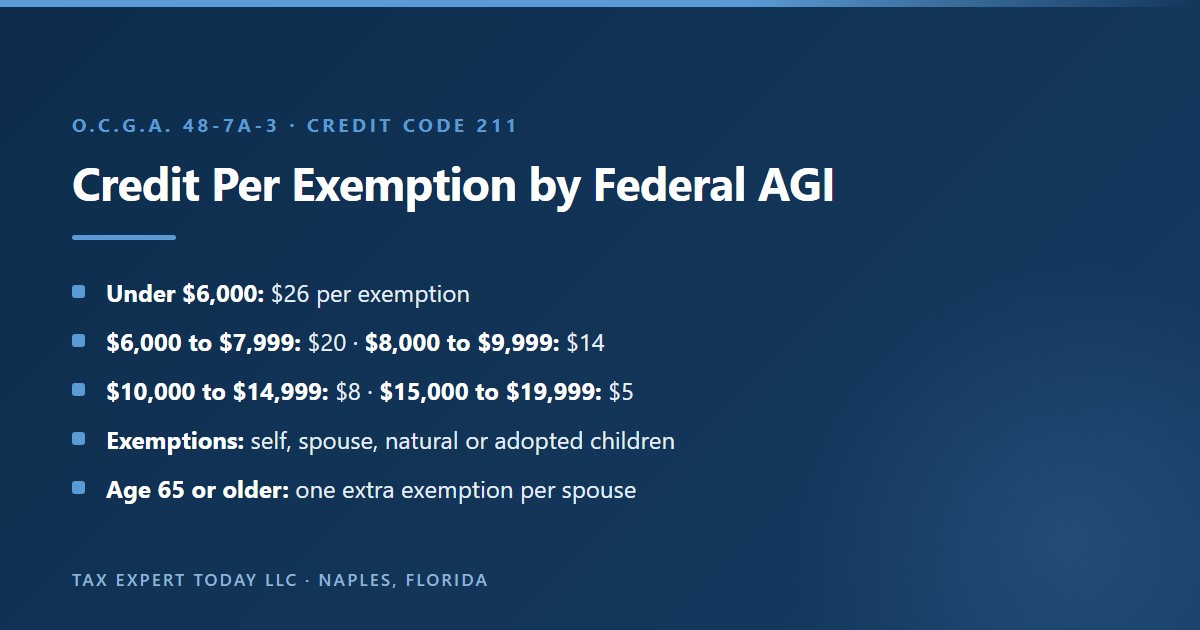
The Georgia low income tax credit is $26 per exemption when federal AGI is under $6,000, then $20, $14, $8, and $5 as income rises through four brackets that stop at $19,999. The amount is multiplied by your exemptions, with an extra exemption for each spouse 65 or older, and is capped at the Georgia tax you owe.
- Under $6,000: $26 per exemption.
- $6,000 to $7,999: $20 per exemption.
- $8,000 to $9,999: $14 per exemption.
- $10,000 to $14,999: $8 per exemption.
- $15,000 to $19,999: $5 per exemption.
| Federal adjusted gross income | Credit per exemption | Two exemptions | Four exemptions |
|---|---|---|---|
| Under $6,000 | $26 | $52 | $104 |
| $6,000 to $7,999 | $20 | $40 | $80 |
| $8,000 to $9,999 | $14 | $28 | $56 |
| $10,000 to $14,999 | $8 | $16 | $32 |
| $15,000 to $19,999 | $5 | $10 | $20 |
| $20,000 or more | None | None | None |
The schedule is printed in the statute and repeated on the 2025 worksheet. The statute says the amount for each bracket is multiplied by the number of dependents the taxpayer is entitled to claim, and that each taxpayer 65 years of age or over may claim double the credit. The worksheet turns those words into lines: Line 2 is the number of exemptions, Line 3 adds one for each spouse 65 or older, Line 4 is the total, Line 5 is the bracket amount, and Line 6 multiplies Line 4 by Line 5.
The brackets are cliffs, not phase outs. A filer with federal AGI of $9,999 uses $14 per exemption, and a filer with $10,000 uses $8. At $20,000 the credit disappears entirely. Because the amounts are small, the cliffs rarely change a decision, but they do matter when you check a software calculation, because a one dollar change in federal AGI can move the credit by several dollars per exemption.
How Do Exemptions and the Age 65 Rule Multiply the Credit?
The Georgia low income tax credit counts yourself, your spouse, and your natural or legally adopted children as exemptions, then adds one more for each spouse who is 65 or older. A married couple, both over 65, with two children under $6,000 of AGI would count six exemptions, or $156 before the tax liability cap.
- Self: one exemption.
- Spouse on a joint return: one exemption.
- Children: one each for natural or legally adopted children.
- Age 65 or older: one more for each spouse who qualifies.
- Not counted: unborn dependents, for purposes of this credit.
The definition comes from O.C.G.A. 48-7A-2, which defines a dependent for this chapter as the taxpayer, the taxpayer’s spouse, and a natural or legally adopted child of the taxpayer. The 2025 worksheet repeats that definition on Line 2 and adds a note that, for purposes of the low income credit, dependents do not include those unborn with a detectable heartbeat. Georgia allows a dependent exemption for an unborn child on Form 500 in some cases, so this is a place where the general Form 500 count and the low income credit count differ.
The definition is also narrower than the federal dependent rules in another way. It speaks of natural or legally adopted children. A stepchild, a foster child, a grandchild, or another relative who is your dependent on the federal return is not listed. If your Form 500 dependent count includes such a person, do not assume the worksheet count is the same number.
The age rule needs a birth date. The worksheet note says the taxpayer’s or spouse’s date of birth must be entered on Line 6 of Form 500 for the extra exemption. Software usually fills this in from the federal return, but a hand prepared return without the dates can lose the age 65 increase on review.
| Household | Worksheet Line 2 | Line 3 (age 65) | Line 4 total |
|---|---|---|---|
| Single, under 65, no children | 1 | 0 | 1 |
| Single, age 70 | 1 | 1 | 2 |
| Married filing jointly, both under 65, two children | 4 | 0 | 4 |
| Married filing jointly, both 65 or older | 2 | 2 | 4 |
| Single parent with one adopted child | 2 | 0 | 2 |
| Single, with a grandchild as a federal dependent | 1 | 0 | 1 (grandchild not counted) |
Why Is the Georgia Low Income Tax Credit Often Worth Zero?
The Georgia low income tax credit is often worth zero because it can only offset Georgia income tax actually owed, and most people with federal AGI under $20,000 owe none. The standard deduction and dependent exemptions usually wipe out taxable income first, and the unused credit cannot be refunded or carried to another year.
- Nonrefundable: the statute caps the credit at your income tax liability.
- No carryforward: any unused amount is lost; it cannot go to a later year.
- No carryback: it cannot be applied to a prior year’s tax.
- Standard deduction first: $12,000 single and $24,000 joint for 2025.
- Dependent exemptions: $4,000 each on the 2025 Form 500.
Subsection (c) of the statute says the credit is deductible from the resident taxpayer’s individual income tax liability, if any, and that in no event may it exceed that liability. Any unused credit may not be carried forward to later years or applied against prior years. The Department’s page says the same thing in one sentence: the credit cannot exceed the taxpayer’s income tax liability. The IT-511 booklet adds that the total of the low income credit, the other state tax credit, the IND-CR credits, and the Schedule 2 credits together cannot exceed the tax on Line 16.
Now put that next to the 2025 Form 500. A single filer subtracts a $12,000 standard deduction. A married couple filing jointly subtracts $24,000. Each dependent listed on Line 7c is worth a further $4,000 on Line 14. Tax is then 5.19 percent of what remains for 2025. For a married couple, the standard deduction alone is larger than the $20,000 ceiling on the credit, so a couple who meets the income test will normally owe no Georgia tax unless Georgia additions push Georgia income above federal income. A single parent with one child has $16,000 of deductions and exemptions before any tax is owed.
The filers who can actually use the credit are mostly single filers, and married people filing separately, with federal AGI between about $12,000 and $19,999 and no dependents. Even then, the credit in that range is $5 or $8 per exemption. The worked examples in the next table show how this plays out for typical households for tax year 2025.
| 2025 household (no Georgia adjustments unless noted) | Georgia tax before credit | Worksheet credit | Credit actually used |
|---|---|---|---|
| Single, under 65, federal AGI $5,500 | $0 (below $12,000 deduction) | $26 | $0 |
| Single, under 65, federal AGI $11,000 | $0 | $8 | $0 |
| Single, under 65, federal AGI $16,000 | $208 (5.19 percent of $4,000) | $5 | $5 |
| Single, age 66, wages $17,500, $5,000 earned income exclusion | $26 (5.19 percent of $500) | $10 | $10 |
| Head of household, one child, federal AGI $14,000 | $0 ($12,000 plus $4,000 exemption) | $16 | $0 |
| Married filing jointly, two children, federal AGI $19,500 | $0 ($24,000 plus $8,000) | $20 | $0 |
None of this means the credit should be skipped. The worksheet costs nothing to complete, and for a single filer, or for an older filer with wages, it reduces tax a little. It does mean that a household under $20,000 should not expect this credit to produce a refund. A refund for a low income Georgia filer almost always comes from Georgia income tax that was withheld from wages, which is returned when the return shows little or no tax.
How Do the 2026 Rate and Standard Deduction Change the Credit?
For tax year 2026 the Georgia rate falls to a flat 4.99 percent and the standard deduction rises to $15,000 for single filers and $30,000 for married couples filing jointly. Those changes shrink the group that owes any Georgia tax under $20,000, so the low income tax credit will help even fewer filers in 2026.
- 2026 rate: 4.99 percent flat, down from 5.19 percent for 2025.
- Single, head of household, separate: $15,000 standard deduction in 2026.
- Joint: $30,000 standard deduction in 2026.
- Credit schedule: unchanged; the brackets and amounts are set in the statute.
- Usable range for a single filer: roughly $15,000 to $19,999 of federal AGI.
The Department’s Important Tax Updates page lists the 2026 changes: the rate reduced to a flat 4.99 percent, and the standard deduction increased to $15,000 for single taxpayers, heads of household, and married taxpayers filing separately, or $30,000 for married taxpayers filing jointly. The same page notes a one time credit of up to $500 for residents who paid taxes in 2024 and 2025 and the new employer child care credit, which are separate programs.
Run the 2026 numbers for the same households. A single filer with federal AGI of $18,000 and no Georgia adjustments has $3,000 of taxable income, about $150 of tax at 4.99 percent, and a $5 low income credit. A single filer with $14,000 has no taxable income and no use for the credit. A married couple filing jointly with $19,500 is $10,500 below the standard deduction. A head of household with one child, assuming the $4,000 dependent exemption continues at the 2025 amount, needs at least $19,000 of income before any tax is owed, which leaves a band of less than $1,000 in which the credit could apply.
The 2026 booklet and worksheet had not been published when this guide was checked. The 2026 figures here come from the Department’s update page and the statute, and the dependent exemption assumption is labeled as such. Confirm the 2026 Form 500 when it is released before relying on these examples for a filed return.
| Item | Tax year 2025 | Tax year 2026 |
|---|---|---|
| Flat income tax rate | 5.19 percent | 4.99 percent |
| Standard deduction, single, head of household, separate | $12,000 | $15,000 |
| Standard deduction, married filing jointly | $24,000 | $30,000 |
| Low income credit schedule | $26 to $5 per exemption, under $20,000 | Unchanged in the statute |
| Single filer income band that can use the credit | About $12,000 to $19,999 | About $15,000 to $19,999 |
| Qualifying Child Credit, children under six | Not available | $250 per child |
How Do You Claim the Georgia Low Income Tax Credit on Form 500?
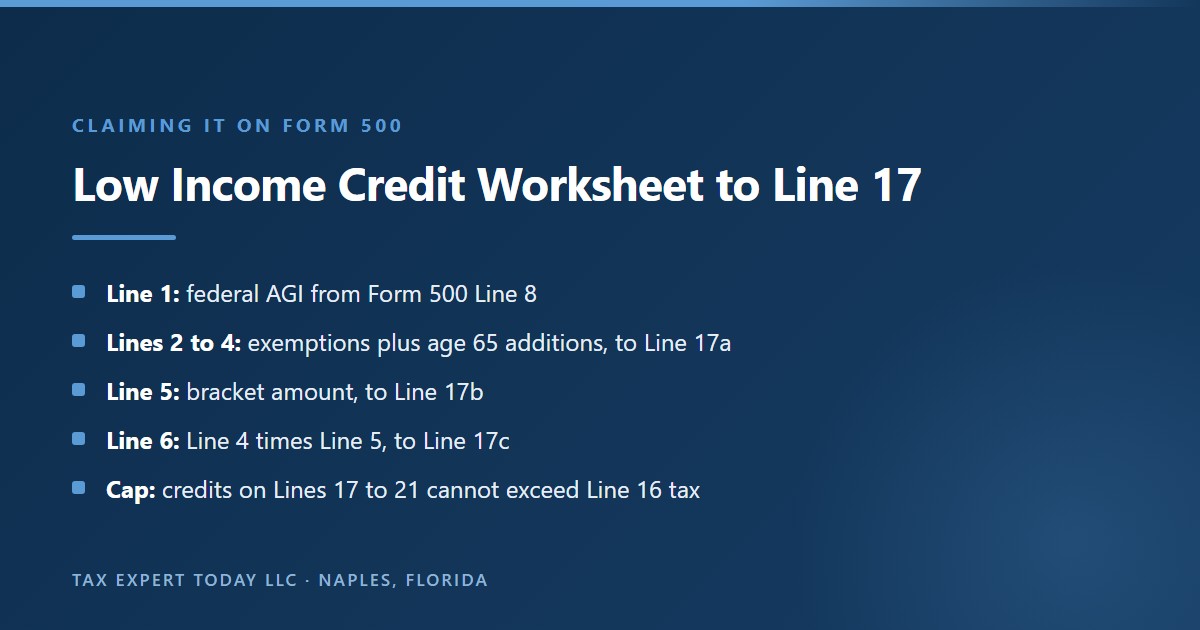
You claim the Georgia low income tax credit by completing the Low Income Credit Worksheet in the IT-511 booklet and carrying three numbers to Form 500: the exemption count to Line 17a, the bracket amount to Line 17b, and the product to Line 17c. It is not entered on Schedule 2 or on Form IND-CR.
- Worksheet Line 1: federal AGI from Form 500 Line 8.
- Worksheet Lines 2 to 4: exemptions, plus one for each spouse 65 or older.
- Worksheet Line 5: the bracket amount from the credit table.
- Worksheet Line 6: Line 4 times Line 5, entered on Form 500 Line 17c.
- Cap: total credits on Lines 17 through 21 cannot exceed Line 16.
The 2025 IT-511 instructions for Line 17 say to complete the Low Income Credit Worksheet on page 35, enter the amount from worksheet Line 4 on Line 17a, the credit amount from Line 5 on Line 17b, and the result from Line 6 on Line 17c. The tax itself is on Line 16, which is Line 15c multiplied by 5.19 percent for 2025 and rounded to the nearest dollar. Line 22 then totals Lines 17 through 21, and that total cannot exceed Line 16. Line 23 is the balance of tax after credits, and it cannot go below zero.
The booklet’s credit section adds a detail that trips up some software users: the other state tax credit and the low income credit are claimed directly on Form 500, while the Series 100 business credits go on Schedule 2 and the individual credits such as the child and dependent care credit go on Form IND-CR. A preparer who looks for the low income credit on IND-CR will not find it there.
Filing method matters less for this credit than for some others. The booklet requires electronic filing when a return generates, allocates, claims, or uses a Series 100 credit, and the low income credit is a 200 series code claimed directly on Form 500, so a paper return can still claim it. Electronic filing is still the faster route to any refund of withholding, and the free filing options listed by the Department are aimed at the same income levels this credit covers. If you do mail a paper return, our guide on where to mail a Georgia state tax return lists the box for each form.
How Does the Credit Work for Married Couples?
Married couples filing jointly count both spouses as exemptions for the Georgia low income tax credit, and each spouse 65 or older adds one more. Couples who file separately when they could have filed jointly can claim only the credit they would have received on a joint return, so splitting returns cannot double it.
- Joint return: each spouse counts as an exemption.
- Separate returns: limited to the credit a joint return would have produced.
- Income test on separate returns: the joint return comparison governs the credit amount.
- Practical result: joint filers almost never owe tax under $20,000, so the credit rarely applies.
Subsection (a)(2) of the statute says a husband and wife filing separate returns for a taxable year in which a joint return could have been filed shall claim only the tax credit to which they would have been entitled had a joint return been filed. The Department’s page and the 2025 booklet repeat the rule. In practice it stops a couple whose combined income is above $20,000 from filing separately to bring each spouse under the limit, and it stops a couple under the limit from claiming the credit twice.
The joint return comparison makes separate filing a poor tool for this credit. Separate filing can still be the right choice for other reasons, such as keeping liability for one spouse’s tax debt separate, but the low income credit will not be the reason. Any decision about filing status should be made on the federal return first, since Georgia generally follows the federal filing status.
Can Part-Year Residents and Nonresidents Claim the Credit?
Part-year residents can claim the Georgia low income tax credit only if they were Georgia residents at the end of the tax year. Someone who moved out of Georgia during the year cannot claim it, and nonresidents cannot claim it at all, because the statute limits the credit to resident taxpayers.
- Moved into Georgia during the year: eligible if still a resident on December 31.
- Moved out of Georgia during the year: not eligible for that year.
- Nonresident with Georgia income: not eligible.
- Income test: still federal AGI, which includes income earned before the move.
The statute grants the credit to each resident taxpayer who files an individual return, and the Department’s page states the year end rule for part-year residents. The income test still looks at total federal AGI, not just the Georgia portion. A person who moved to Georgia in October after earning $30,000 elsewhere fails the test even if only $4,000 of income was earned as a Georgia resident.
Part-year residents also compute their Georgia tax differently. They skip Lines 9 through 14 of Form 500 and use Schedule 3, which prorates deductions and exemptions by the ratio of Georgia income to total income. Our guide to the Georgia part-year resident tax return walks through Schedule 3. Because the prorated deductions are smaller, a part-year resident who moved in late in the year is one of the few low income filers who may owe a little Georgia tax and be able to use the credit.
For a Floridian who moved from Georgia, the timing rule usually decides the question. If the move happened before December 31, the final Georgia part-year return cannot claim this credit, whatever the income.
Who Is Barred From Claiming the Georgia Low Income Tax Credit?
The Georgia low income tax credit is barred for anyone who can be claimed as a dependent on another return, anyone confined in a correctional institution during any part of the year, nonresidents, and part-year residents who left Georgia before year end. A food stamp bar in the statute text is not repeated by the Department.
- Dependents: claimed or eligible to be claimed on a federal or Georgia return.
- Inmates: confined for all or any part of the year.
- Nonresidents: the credit is limited to resident taxpayers.
- Late claims: the right to claim is waived after the twelve month deadline.
Subsection (e.1) of the statute bars any individual incarcerated or confined in any city, county, municipal, state, or federal penal or correctional institution for all or any part of a taxable year. The Department’s page puts this simply: you cannot claim the credit if you are an inmate in a correctional facility. Even a short confinement during the year is enough under the statute’s “any part” wording.
The food stamp question needs care. The copy of O.C.G.A. 48-7A-3 published by FindLaw, which states that it is current as of March 28, 2024, contains a subsection (e) providing that any individual who receives a food stamp allotment for all or any part of a taxable year is not entitled to the credit. Neither the Department’s credit page nor the 2025 IT-511 instructions mention that bar; they list only the dependency, residency, joint return, inmate, and deadline rules. We could not confirm the current official text of subsection (e) on November 6, 2026. A household that received SNAP benefits during the year should have a preparer check the current code before claiming the credit, and should not rely on either reading alone.
Whatever the answer on SNAP, the amounts involved are small, and the larger risk for a benefits household is elsewhere. A Georgia return filed to recover withholding is usually worth filing, and the credit question does not change that.
What Is the Deadline to Claim the Georgia Low Income Tax Credit?
The Georgia low income tax credit must be claimed on or before the end of the twelfth month after the close of the tax year, and the deadline also applies to claims on amended returns. For a 2025 calendar year return, that means December 31, 2026. Missing it waives the credit for that year.
- 2025 tax year: claim by December 31, 2026.
- 2026 tax year: claim by December 31, 2027.
- Amended returns: the same twelve month limit applies to amended claims.
- Waiver: the statute says failure to claim in time waives the right to the credit.
Subsection (d) of the statute says all claims for the credit, including amended claims, must be filed on or before the end of the twelfth month following the close of the taxable year, and that failure to comply constitutes a waiver of the right to claim the credit. The 2025 worksheet prints the same rule in bold above Line 1. This is much shorter than the general three year window for a Georgia refund claim, so the credit can be lost even when the rest of an amended return is still timely.
That short window matters most for people who file late. A low income filer who files a 2025 Georgia return in 2027 to recover withholding can still get the withholding back within the general refund limits, but cannot add the low income credit. If you need to correct a prior return, our guide to the Georgia amended tax return covers Form 500X and the refund windows.
Because the credit is capped at tax owed, missing the deadline usually costs little. The cases where it matters are single filers and older filers who owed some tax and forgot the worksheet. For them, a 500X filed before the end of the following year recovers a few dollars per exemption.
How Does the Low Income Credit Interact With Other Georgia Credits?
The Georgia low income tax credit shares one ceiling with every other nonrefundable credit on Form 500: Lines 17 through 21 together cannot exceed the tax on Line 16. Low income filers rarely have enough Georgia tax to absorb more than one credit, so the order of claims rarely matters, but the cap does.
- Line 17: the low income credit.
- Line 18: credit for tax paid to another state.
- Line 19: the eligible itemizer credit, up to $300 per taxpayer for 2025.
- Line 20: credits from Form IND-CR, such as child and dependent care.
- Line 21: Schedule 2 credits, such as the Georgia qualified education expense credit, which require electronic filing.
The 2025 booklet says the total amount used from the low income credit, the other state tax credit, all IND-CR schedules, and all Schedule 2 credits cannot exceed the tax liability on Line 16. Only the timber tax credits, codes 145 and 155, are refundable, and only to the taxpayer who suffered the loss, so every credit a typical low income household might claim is limited to the tax shown on the return.
| Credit | Code and where claimed | Refundable? | Low income relevance |
|---|---|---|---|
| Low Income Tax Credit | 211, Form 500 Line 17 | No | Federal AGI under $20,000 |
| Child and Dependent Care Expense Credit | 202, Form IND-CR to Line 20 | No | 50 percent of the federal credit |
| Qualifying Child Credit | 215, from tax year 2026 | No | $250 per child under six |
| Eligible Itemizer Credit | Form 500 Line 19 (2025) | No | Itemizers only, up to $300 per taxpayer |
| Other State Tax Credit | 210, Form 500 Line 18 | No | Income taxed by another state |
| Timber Tax Credit | 145 and 155, Schedule 2B | Yes, to the taxpayer with the loss | Not a household credit |
| State earned income credit | None in the 2025 credit list | Not applicable | Use the federal credit |
For a household that owes some tax, the practical effect is that credits stack until tax reaches zero and then stop. A single filer who owes $150 of Georgia tax and qualifies for a $5 low income credit and a $100 child and dependent care credit uses both. A single filer who owes $50 uses only $50 of the two together. Nothing is refunded and nothing carries over.
For a fuller list of Georgia credits and how residents are taxed, see our guide to Georgia state income tax.
Does Georgia Have a State Earned Income Tax Credit?
No. Georgia does not currently offer a state earned income tax credit. The Department’s tax credit index and the 2025 IT-511 credit list contain no such credit, so the federal earned income credit is the only refundable work credit available to most low income Georgia workers.
- Georgia: no state earned income credit in the 2025 credit list.
- Federal: the earned income credit is refundable and claimed on Form 1040.
- Low income credit: not a substitute; it is nonrefundable and small.
- Refundable Georgia credits: only the timber tax credits, which do not apply to most households.
Some of the pages that rank for this topic are policy papers from 2016 and 2017 that discuss proposals for a Georgia earned income credit. Those proposals did not become part of the credit list. The Department’s current tax credits index lists individual credits from code 201 through 215, including the low income credit and the qualifying child credit, and no earned income credit appears among them.
The federal credit is where the money is for low income workers. The IRS explains the earned income tax credit, which is refundable, so it can be paid even when no federal tax is owed. A Georgia worker who files a federal return to claim it should also check whether Georgia tax was withheld, because filing the Georgia return is what returns that withholding.
Federal rules are outside the scope of this state guide, but the point for Georgia filers is simple: do not look for a Georgia version of the earned income credit, and do not skip the federal return because the Georgia credit is small.
What Is the New Georgia Qualifying Child Credit for 2026?
Starting with tax years beginning on or after January 1, 2026, Georgia allows a $250 Qualifying Child Credit, credit code 215, for each qualifying child who has not reached age six during the year. Like the low income credit, it cannot exceed Georgia income tax liability and cannot be carried forward or back.
- Amount: $250 per qualifying child.
- Age: the child must not have attained age six during the taxable year.
- Definition: qualifying child as defined in section 24(c) of the Internal Revenue Code.
- One claim per child: only one taxpayer may claim the credit for a child.
- Nonrefundable: limited to tax liability, with no carryforward or carryback.
The Department’s Qualifying Child Credit page cites O.C.G.A. 48-7-29.27 and says the credit applies for taxable years beginning on or after January 1, 2026. It uses the federal child tax credit definition of a qualifying child in 26 U.S.C. 24(c), with Georgia’s own under six age limit added to it.
The custody rules follow a familiar pattern. When parents or guardians do not file jointly, the custodial parent or guardian who had custody for more than six months of the year may claim the credit. A noncustodial parent can claim it only by attaching a court order awarding the credit, or a written statement from the custodial parent assigning the credit and agreeing not to claim it. Nonresidents and part-year residents prorate the credit by the ratio of Georgia income on Schedule 3, Line 9.
For low income families the same ceiling applies. In 2026, a head of household with one child under six and $19,000 of federal AGI has no Georgia taxable income after the $15,000 standard deduction and a $4,000 dependent exemption, so neither the $250 child credit nor the low income credit produces any benefit. A head of household with the same child and $40,000 of income owes about $1,048 before credits and can use the full $250. The new credit is designed for families with some Georgia tax, not for the lowest incomes.
How Does the Georgia Child and Dependent Care Credit Work?
The Georgia Child and Dependent Care Expense Credit, code 202, equals 50 percent of the federal credit allowed under section 21 of the Internal Revenue Code for tax year 2025 and later. It is claimed on Form IND-CR, cannot exceed Georgia tax liability, and cannot be carried forward or back.
- Amount: 50 percent of the federal child and dependent care credit actually allowed.
- Change: the booklet lists the increase to 50 percent as new for 2025.
- Form: Form IND-CR, carried to Form 500 Line 20.
- Federal schedule: include the federal child care credit schedule with the return.
- Nonrefundable: limited to Georgia tax liability.
The Department’s credit page cites O.C.G.A. 48-7-29.10 and states that the credit is 50 percent of the credit claimed and allowed under section 21 and claimed on the federal return. Because it is a percentage of the federal credit, a household with no federal child care credit has no Georgia credit either. The federal credit is itself nonrefundable and depends on federal tax, so the lowest income families often have neither.
The federal rules for the credit are in 26 U.S.C. 21. For Georgia purposes, the only extra work is completing Form IND-CR and keeping the federal schedule with the return.
What About the Surplus Refunds and the One-Time Credit?
Georgia’s surplus tax refunds and the one-time credit announced for 2026 are separate from the Georgia low income tax credit. The Department’s update page says residents who paid taxes in 2024 and 2025 are eligible for a one-time credit of up to $500, which, like the earlier surplus refunds, depends on Georgia tax having been paid.
- Separate program: not claimed on the low income credit worksheet.
- Tied to tax paid: eligibility depends on having Georgia tax liability in the reference years.
- Not taxable to Georgia: the booklet says surplus refunds are not taxable for Georgia purposes.
- Same limit in practice: a household with no Georgia tax usually receives little or nothing.
The 2025 booklet notes that surplus refunds are not taxable for Georgia purposes. The Department’s update page describes the one-time credit in one line, and the details for each round are posted on its surplus refund page. Our guide to the Georgia surplus tax refund explains how the earlier rounds were calculated and why some filers received less than the headline amount.
For low income households, the common thread is the same as with the low income credit. Georgia’s relief programs have been built around tax actually paid. A family that owes no Georgia income tax gets its money back through withholding refunds, not through these credits.
Do You Need to File a Georgia Return to Claim These Credits?
Yes. Every Georgia credit, including the low income tax credit, is claimed on a filed Georgia return. Many people under $20,000 are not required to file, but anyone who had Georgia tax withheld from wages should file anyway, because filing is the only way to get the withholding refunded.
- Required if: you must file a federal return, have Georgia income not taxed federally, or income above the standard deduction.
- 2025 thresholds: $24,000 joint and $12,000 for other statuses.
- Withholding refunds: available only by filing Form 500.
- First-time filers: the Department says they receive a paper refund check.
The 2025 IT-511 booklet says full-year residents must file a Georgia return if they are required to file a federal return, have income subject to Georgia tax that is not subject to federal tax, or have income that exceeds the standard deduction: $24,000 for married filing jointly and $12,000 for single, married filing separately, head of household, and qualifying surviving spouse. A resident below those levels with no federal filing requirement does not have to file, but loses any Georgia withholding by not filing.
The Department’s update page says most refunds are issued within three weeks of receipt but may take up to twelve weeks, and that first-time filers and those who have not filed in five or more years receive a paper check. Our guide to Georgia withholding tax explains how employers calculate that withholding. If too much tax is being withheld from your pay in the first place, adjusting Georgia Form G-4 with your employer reduces the amount you have to wait for.
What Is the Georgia Low Income Housing Tax Credit?
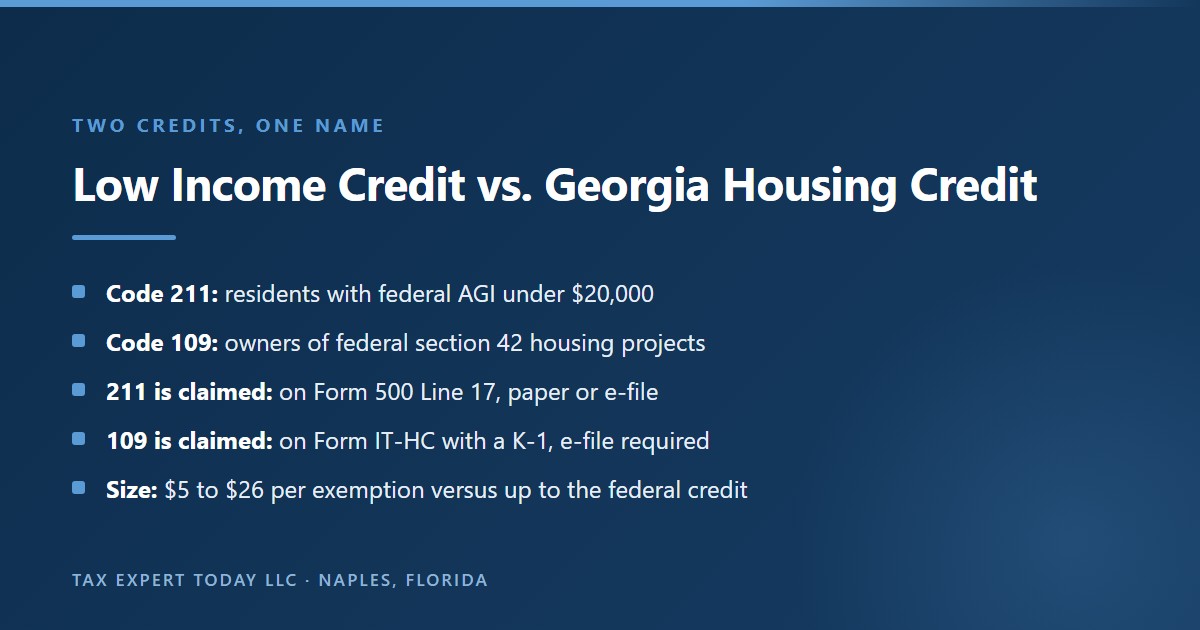
The Georgia Low Income Housing Tax Credit, formally the Georgia housing tax credit and credit code 109, is a state credit for owners of qualified low-income rental projects in Georgia that receive the federal housing credit under section 42. Combined with the related insurance premium credit, it cannot exceed the federal credit for the project.
- Who claims it: owners and investors in qualified Georgia projects, not low income households.
- Projects: qualified low-income buildings placed in service after January 1, 2001.
- Size: up to the amount of the federal housing credit, combined with the insurance premium credit.
- Form: Form IT-HC, with the federal K-1 and a building allocation schedule.
- Agencies: the Department of Revenue, the Department of Community Affairs, and the Insurance Commissioner.
The Department’s Low Income Housing Credit page describes it as a credit against Georgia income taxes for taxpayers owning developments that receive the federal Low Income Housing Tax Credit and are placed in service on or after January 1, 2001, claimed on Form IT-HC with the federal K-1 from the providing entity and a schedule of the building allocation. The statute, O.C.G.A. 48-7-29.6, ties the definitions to 26 U.S.C. 42 and defines a qualifying project by the familiar rent and income set asides: at least 40 percent of units for households at or below 60 percent of median income, or at least 20 percent for households at or below 50 percent, with restricted rents.
The state credit is layered over the federal one. Under subsection (b)(1), the Georgia credit, combined with credits under the insurance premium tax provision in O.C.G.A. 33-1-18, cannot exceed the federal housing credit allowed for the project. Georgia’s Department of Audits and Accounts published a tax incentive evaluation of the program describing it as a 100 percent match of the federal credit, which is why it is a significant part of the financing for many Georgia affordable housing projects.
Allocations are made through the state housing credit agency designated by the Governor for section 42 purposes, which the Department identifies as the Department of Community Affairs. A household looking for affordable housing deals with the property and with DCA’s programs, not with this credit. The credit belongs to the owners.
How Is the Georgia Housing Credit Claimed and Allocated?
Owners claim the Georgia housing credit on Form IT-HC filed with their return, using the K-1 from the project entity, and the return must be filed electronically because code 109 is a Series 100 credit. The entity may allocate the state credit among partners, members, or shareholders in any agreed manner, even differently from the federal credit.
- Schedule 2: code 109 is listed with the Series 100 credits on Form 500 Schedule 2.
- Electronic filing: required for returns that claim a Series 100 credit.
- Flexible allocation: owners may agree to an allocation that differs from the federal one.
- Recapture: proportional to any federal recapture, but not triggered by a sale of interests alone.
- Carryforward: unused credit carries to later years under the statute; confirm the current period.
Subsection (b)(4) of the statute lets the entity allocate the Georgia credit, and any recaptured credit, among some or all of its partners, members, or shareholders in any manner they agree, whether or not those persons receive any of the federal credit. That flexibility is why state credit investors and syndicators exist. Subsection (b)(2) requires a proportional recapture of the state credit when federal credit is recaptured because the qualified basis falls, and it says there is no recapture solely because of a sale or transfer of an interest in the project.
The credit is limited to the taxpayer’s Georgia income tax liability, and unused credit carries forward. The FindLaw copy of the statute, current as of March 2024, allows a carryforward to the next three succeeding years. The 2025 booklet notes that Georgia reduced carryforward years for several credits beginning in 2025 and refers taxpayers to the Department’s tax credit pages, so investors should confirm the period that applies to their credit year before planning around it.
| Point | Low Income Tax Credit (211) | Low Income Housing Credit (109) |
|---|---|---|
| Who claims it | Residents with federal AGI under $20,000 | Owners of qualified section 42 projects |
| Statute | O.C.G.A. 48-7A-3 | O.C.G.A. 48-7-29.6 |
| Typical amount | $5 to $26 per exemption | Up to the federal credit, with the insurance premium credit |
| Where claimed | Form 500 Line 17 | Form IT-HC and Schedule 2 |
| Filing method | Paper or electronic | Electronic required for Series 100 credits |
| Unused credit | Lost; no carryforward | Carries forward under the statute |
If you invest in a Georgia housing fund, your share arrives on a K-1, and the Georgia return work is mostly about getting Form IT-HC, the allocation schedule, and Schedule 2 right and filing electronically. That is a different job from the one a low income household faces, and the two credits should never be confused on a return.
Georgia Low Income Tax Credit Mistakes to Avoid
The common mistakes with the Georgia low income tax credit are using Georgia AGI instead of federal AGI, counting stepchildren or other dependents as exemptions, missing the age 65 increase, claiming it after moving out of Georgia, expecting a refund from it, and missing the twelve month deadline on an amended return.
- Wrong income figure: the test is federal AGI from Form 500 Line 8.
- Wrong exemption count: only self, spouse, and natural or legally adopted children.
- Missing birth dates: the age 65 increase depends on Line 6 of Form 500.
- Wrong form: it goes on Form 500 Line 17, not IND-CR or Schedule 2.
- Wrong expectation: it reduces tax owed; it never produces a refund by itself.
Two further mistakes come from the name. One is treating the housing credit as something a low income household can apply for. The other is treating the low income credit as Georgia’s version of the earned income credit. Neither is right, and both lead people to spend time on a credit that will not help them while missing the federal refundable credits and the Georgia withholding refund that will.
Finally, do not let the credit drive filing status. The joint return rule means separate returns cannot increase it, and any choice about filing status should be made on the whole return, not on a credit worth a few dollars per exemption.
Low Income Tax Credit Help in Naples & Southwest Florida
Tax Expert Today LLC prepares Georgia returns and reviews Georgia credits from its office in Naples, Florida, and serves Georgia clients nationwide and remotely. We handle resident, part-year, and nonresident Georgia returns, amended returns that add missed credits, Form IT-HC housing credit filings, and Department of Revenue notices.
- Office: 11983 Tamiami Trail N, Naples FL 34110.
- Phone: (239) 441-2005.
- Hours: Monday through Friday, 10 a.m. to 5 p.m. Eastern.
- Georgia tax credit help Naples: Naples and Southwest Florida in person, Georgia and all 50 states remotely.
Many of our clients moved from Georgia to Florida in retirement, still have family filing Georgia returns, or hold interests in Georgia real estate partnerships, and each of those situations can raise a Georgia credit question. We work as tax advisors on state tax matters nationwide, and a Georgia credit review usually sits inside a wider review of the federal return, the Georgia return, and Florida planning. For our full range of Georgia work, see the Georgia tax services page. Retirees should also read our guide to the Georgia retirement income exclusion, which often matters far more than the low income credit for older filers, and planning clients in Florida can start with our Naples tax planning page.
When to Engage a Professional
Engage a tax professional if you are unsure whether you could be claimed as a dependent, moved into or out of Georgia during the year, received SNAP benefits and want the low income credit, need to amend before the twelve month deadline, invest in a Georgia housing credit project, or have unfiled Georgia returns with withholding to recover.
- Dependency questions: the eligible to be claimed test decides the credit.
- Residency changes: the year end rule and Schedule 3 change the result.
- Benefit households: the SNAP question needs a check of the current code.
- Housing credit investors: IT-HC, allocation, recapture, and e-file rules apply.
- Unfiled years: withholding refunds have their own time limits.
Tax Expert Today LLC reviews Georgia credits as part of our wider state and federal tax practice. Our Georgia tax help covers original and amended returns, credit claims, and Department of Revenue correspondence. Call (239) 441-2005 for a free consultation. This guide is general information about Georgia rules as of November 6, 2026, and is not legal or tax advice for your situation. Results depend on the facts of each case.
Frequently Asked Questions About the Georgia Low Income Tax Credit
What is the Georgia low income tax credit?
It is a nonrefundable Georgia income tax credit, code 211, for residents whose federal adjusted gross income is under $20,000 and who cannot be claimed as a dependent. It is worth $26 down to $5 per exemption, doubled for a filer 65 or older, and is claimed on Form 500 Line 17.
How much is the Georgia low income tax credit?
Per exemption, it is $26 if federal AGI is under $6,000, $20 from $6,000 to $7,999, $14 from $8,000 to $9,999, $8 from $10,000 to $14,999, and $5 from $15,000 to $19,999. The total cannot exceed the Georgia tax you owe.
Is the Georgia low income credit refundable?
No. O.C.G.A. 48-7A-3 caps the credit at your Georgia income tax liability and does not allow unused credit to be carried forward or back. If you owe no Georgia tax, the credit is worth nothing, although any Georgia tax withheld from your pay is still refunded when you file.
Who counts as an exemption for the Georgia low income credit?
You, your spouse on a joint return, and your natural or legally adopted children. Each spouse who is 65 or older adds one more exemption. The 2025 worksheet says unborn dependents are not counted for this credit.
What is the deadline to claim the Georgia low income tax credit?
The claim, including a claim on an amended return, must be filed by the end of the twelfth month after the tax year ends. For a 2025 calendar year return, that is December 31, 2026. A late claim waives the credit.
Does Georgia have an earned income tax credit?
No. The Department of Revenue’s tax credit index and the 2025 IT-511 credit list contain no state earned income credit. Low income workers in Georgia can still claim the refundable federal earned income tax credit on their federal return.
What is the Georgia Qualifying Child Credit?
For tax years beginning on or after January 1, 2026, Georgia allows a $250 credit, code 215, for each qualifying child under the federal definition who has not reached age six during the year. It is nonrefundable and cannot be carried forward or back.
Is the Georgia low income housing tax credit the same credit?
No. The Georgia housing tax credit, code 109, is for owners of qualified low-income rental projects that receive the federal section 42 credit. It is claimed on Form IT-HC with a K-1 and has nothing to do with the claimant’s own income.
I live in Naples, Florida, and still file in Georgia. Can you help with Georgia credits?
Yes. Tax Expert Today LLC prepares Georgia resident, part-year, nonresident, and amended returns and reviews Georgia credits from its Naples, Florida office at 11983 Tamiami Trail N, Naples FL 34110, and serves Georgia clients nationwide. Call (239) 441-2005, Monday through Friday, 10 a.m. to 5 p.m. Eastern.
Published November 6, 2026 by Dr. Pellumb Kabashi « Back to Learning Center
Have a question this article touches on?
Tax Expert Today LLC, based in Naples, Florida and serving clients across the United States.
Schedule a Consultation (239) 441-2005