
By Dr. Pellumb Kabashi, DBA, MBA, CES, CFE, EA
Founder, Tax Expert Today LLC · Tax advisors, enrolled agents, CPAs, and attorneys · Serving clients in all 50 states
Quick Answer: A New Jersey bulk sale is any sale of business assets, including rental or commercial real estate, outside the ordinary course of business. The buyer files Form C-9600 at least 10 business days before closing, and the Division of Taxation can order part of the price held in escrow until the seller files final returns and pays any State tax owed. Call (239) 441-2005 for a free consultation.
What Is a New Jersey Bulk Sale?
A New Jersey bulk sale is the sale, transfer or assignment of a person’s business assets outside the ordinary course of business. Business assets include equipment, inventory, goodwill and real estate used to produce income, so selling a company or a rental building usually qualifies. The rule is a tax collection notice, not a separate tax.
- The law: N.J.S.A. 54:50-38, administered by the Division of Taxation’s Bulk Sale Section.
- The trigger: a transfer of business assets that is not part of normal day-to-day selling.
- The notice: Form C-9600, filed by the buyer, with a copy of the executed contract.
- The result: an escrow letter, a request for returns, or a clearance letter, usually within 10 business days.
The Division of Taxation describes the purpose of the statute in one sentence on its bulk sale FAQ: the law exists to protect a purchaser from inheriting the tax debt of a seller of business assets. To make that protection work, the purchaser has to tell the State about the deal before money changes hands. The State then checks the seller’s accounts, every tax the Division administers, and decides whether part of the price must be held back to cover what the seller may owe.
That framing explains why almost every page that ranks for New Jersey bulk sale rules is written for the buyer. The buyer is the party the statute puts at risk, and the buyer’s attorney is the person who files the form. But the seller is the person whose money is held. For a business owner or landlord who is closing out New Jersey and moving to Naples, the bulk sale process decides how much of the sale price arrives at the Florida bank account on closing day, and how long the rest sits in an attorney trust account in New Jersey.
The Division’s Technical Bulletin TB-60(R), reissued on April 29, 2024, sets out the working definitions. “Bulk sale, transfer, or assignment” means any sale, transfer or assignment, in whole or in part, of a person’s business assets, not made in the ordinary course of business. “Business” means any endeavor from which revenue or consideration is realized for the purpose of generating a profit or loss. “State tax debts” means deficiencies, delinquencies (unfiled returns), assessments, penalties, interest, fees and costs. Each of those words matters to a seller, because each one widens what the escrow can cover.
| Transaction | Bulk sale notice required? | Why |
|---|---|---|
| Owner sells an auto repair shop, tools and inventory to another mechanic | Yes | Transfer of business assets outside the ordinary course (the Division’s own example) |
| Owner gives all bakery assets to another person as a gift | Yes | A transfer, not only a sale, is covered (the Division’s own example) |
| Paint store sells brushes and floor stain to a contractor | No | Retail sale in the ordinary course of business |
| Established developer that regularly buys and sells New Jersey properties sells a lot | No | The sale is within that developer’s ordinary course of business |
| Individual sells a six-unit apartment building | Yes | Income-producing real estate is a business asset, and the one or two family exemption does not reach it |
| Two siblings sell an inherited two-family rental | No | One or two family residence owned by individuals, estates or trusts, in any combination, since January 9, 2018 |
Why Does a New Jersey Bulk Sale Matter to a Seller Moving to Florida?
It matters because the seller’s leftover New Jersey taxes are settled out of the sale price before the seller leaves. Any unfiled return, unpaid sales or payroll tax, open audit or old assessment can become an escrow, and that escrow stays in New Jersey until the Division issues a clearance letter, often weeks after the move to Florida.
- Cash timing: part of the price can be held back at closing rather than wired to the seller.
- Final returns: the Division can require a business to file its closing returns before it releases the money.
- Distance: every Division letter goes by first-class mail, so a forwarding address and an attorney contact matter.
- Two systems at once: on real estate, the GIT/REP estimated income tax payment is collected at the same closing.
A seller who stays in New Jersey has time to fix a problem the New Jersey bulk sale review uncovers. A seller who is moving to Florida usually does not. The business has stopped operating, the bookkeeper may have been let go, the office is closed and the owner is driving south. If the Division’s review finds a missing quarterly sales tax return from two years ago or an employer withholding reconciliation that was never filed, the fix requires records that may already be in a storage unit. Until the fix is made, the escrow does not move.
There is also a planning point that many sellers miss. The bulk sale process is not limited to taxes that relate to the asset being sold. The Division’s FAQ says the Division is trying to collect all taxes and fees the seller is subject to that the Division administers, plus any delinquent or deficient taxes the seller owes. A landlord selling a building can see an escrow driven by an old individual income tax balance. A business owner selling equipment can see an escrow driven by a corporation business tax minimum payment that was never filed for a dormant affiliate under the same tax identification number.
For a household that is moving its domicile, the sale is often one of the last New Jersey events on the calendar. It sits alongside the domicile steps covered in our guide on how to establish Florida residency and the New Jersey departure issues in our New Jersey exit tax guide. A clean bulk sale is one of the few places where the order of operations directly controls how quickly the seller gets paid.
Which Assets Trigger the New Jersey Bulk Sale Notice?
Any asset that generates income or loss can trigger the notice when it is sold outside the ordinary course. The Division lists goodwill, materials, supplies, licenses, patents, copyrights, equipment, leases, merchandise, inventory, realty and vacant land held as a business asset. Stock and membership interests owned by individuals are not business assets.
- Tangible property: furniture, fixtures, equipment, vehicles, inventory and materials.
- Real property: land and buildings used in a business or rented to others, including vacant land held as a business asset.
- Intangible property: goodwill, customer lists, licenses, patents, copyrights and leases.
- Not covered: stock or LLC interests held by individuals, estates or trusts, because the entity itself sells nothing.
Form C-9600 asks the buyer to break the price into three lines: furniture, fixtures and equipment; land and building; and other assets, with a schedule attached. That breakdown is worth agreeing with the buyer before the form is filed, because it also drives the federal allocation on IRS Form 8594 under IRC §1060, which both sides file with their federal returns. A seller who signs a contract with one allocation and lets the buyer report another on the C-9600 creates a mismatch that a careful examiner will notice.
The definitions in TB-60(R) treat realty as a business asset “if a use of the realty is to support a business on its premises which includes, but is not limited to, renting space to another.” That last phrase is the reason so many landlords are caught. A family that owns a small strip of stores, a mixed-use building with an apartment over a shop, or a three-family house that has always been rented is holding a business asset for this purpose, even if nobody in the family thinks of it as a business.
| Asset being sold | Business asset under the Division’s definition? | Notes for the seller |
|---|---|---|
| Restaurant equipment, furniture and goodwill | Yes | Sales tax and payroll accounts are reviewed as part of clearance |
| Commercial office building leased to tenants | Yes | Renting space to another is expressly a business use |
| Three- or four-family rental owned by an individual | Yes | The residential exemption stops at two units |
| Vacant land held for investment or business use | Yes, if a business asset | The Division’s FAQ answers yes for vacant land that is a business asset |
| Shares of an S corporation owned by the founder personally | No | The entity is not selling anything, so no notice is required |
| Membership interests held by a holding company LLC | Yes, unless that company is in the business of trading interests | Interests owned by a business entity are that entity’s business assets |
| EDA grants or tax credits | No bulk sale notice | A separate Business Assistance and Incentive Clearance Certificate is required |
Is a Rental Property Sale a New Jersey Bulk Sale?
Often yes. Income-producing real estate is a business asset, so the sale of a rental building, a commercial property or a mixed-use property generally needs a C-9600. The main exception is a one or two family residence owned by individuals, estates or trusts, which is exempt even if it was rented or used as a home office.
- Exempt: a one or two family residence owned by an individual, an estate, a trust, or any combination of them.
- Not exempt: the same house if it is owned by an LLC, a partnership or a corporation.
- Not exempt: commercial space attached to the residential units, such as a storefront below the apartments.
- Not exempt: three or more residential units, even if the owners are individuals.
The Division’s bulk sale page says the exemption covers any single or two family residential unit owned by an individual, estate or trust, including any combination or multiple of individuals, estates and trusts, regardless of whether the unit was used for rental or home office purposes. It adds that the exemption does not include commercial property attached to the residential unit. The FAQ explains that the exemption was expanded, effective January 9, 2018, to cover combinations of individuals, estates and trusts, so a family that owns a rental duplex jointly, or a parent and a family trust that hold it together, is now inside the exemption. The FAQ is also direct that the exemption does not apply to businesses.
That last sentence is where Florida movers most often trip. Many New Jersey landlords moved their rentals into single member LLCs years ago for liability reasons. The LLC may be disregarded for income tax purposes, but the Division’s FAQ answers the question “Does a purchaser have to submit a bulk sale notice if the seller is a disregarded entity?” with a single word: yes. A two-family rental that would have been exempt in the owners’ own names is not exempt when the deed is held by the LLC.
| Property and owner | Bulk sale notice | GIT/REP form at closing (nonresident seller) |
|---|---|---|
| Former principal residence, owned by the couple | Not required | GIT/REP-3, box 2, if it qualifies under IRC §121; otherwise GIT/REP-1 |
| Two-family rental, owned by the couple | Not required (residential exemption) | GIT/REP-1 payment unless another exemption applies |
| Two-family rental, owned by a single member LLC | Required (the exemption does not apply to businesses, and a disregarded entity seller still needs a notice) | Confirm treatment of the LLC owner with the closing attorney |
| Four-family rental, owned by the couple | Required | GIT/REP-1 payment unless an exemption applies |
| Retail building, owned by a multi-member LLC | Required | GIT/REP-3, box 5 (seller is not an individual, estate or trust) |
Selling a rental after the move also carries federal mechanics that the bulk sale rules do not touch: depreciation recapture, suspended passive losses and the investment income tax. Our guide on selling rental property after moving covers that side. This page stays on the New Jersey notice, escrow and clearance.
Who Files Form C-9600, the Buyer or the Seller?
The buyer files. The purchaser or the purchaser’s attorney must submit Form C-9600, and the Division says a filing by the seller or a third party does not protect the purchaser. The seller still has work to do: supplying tax identification numbers, a clean contract, and accurate contact details so the Division’s letters reach the right person.
- Filer: the purchaser or the purchaser’s attorney signs the C-9600.
- Seller’s role: provide the seller’s New Jersey tax ID, federal ID, home address and attorney details.
- Representatives: a CPA, title agent or realtor needs a signed Form M-5008-R to deal with the Division.
- Contract: an executed copy showing the price and all terms, including amendments and assignments.
Because the New Jersey bulk sale form belongs to the buyer, a seller can be surprised by what it says. The C-9600 asks for the seller’s home address, and a seller who is moving should give the new Florida address and the seller’s New Jersey attorney, so the escrow letter and any returns required letter do not go to a closed storefront. It also asks for the date the seller acquired the business and the scheduled date of sale, which must be at least 10 business days after the Division receives the form.
The FAQ adds a practical point for sellers who are not yet registered or whose numbers are missing. If the purchaser cannot obtain the seller’s New Jersey tax ID number, the purchaser may file without it, and the Division will contact the seller to obtain it. That route works, but the C-9600 cover page warns that if the business is unregistered or the information is incomplete, there may be a delay in response time. For a seller on a moving schedule, a delay in the New Jersey bulk sale response is a delay in the escrow release.
The only agents the Division recognizes automatically are the buyer’s attorney and the seller’s attorney. Everyone else, including the seller’s CPA or enrolled agent, needs a signed Appointment of Taxpayer Representative, Form M-5008-R. A seller who expects to resolve open returns from Florida should have that form signed before leaving, so the firm doing the cleanup can speak with the caseworker directly.
How Does the New Jersey Bulk Sale 10 Day Clock Work?
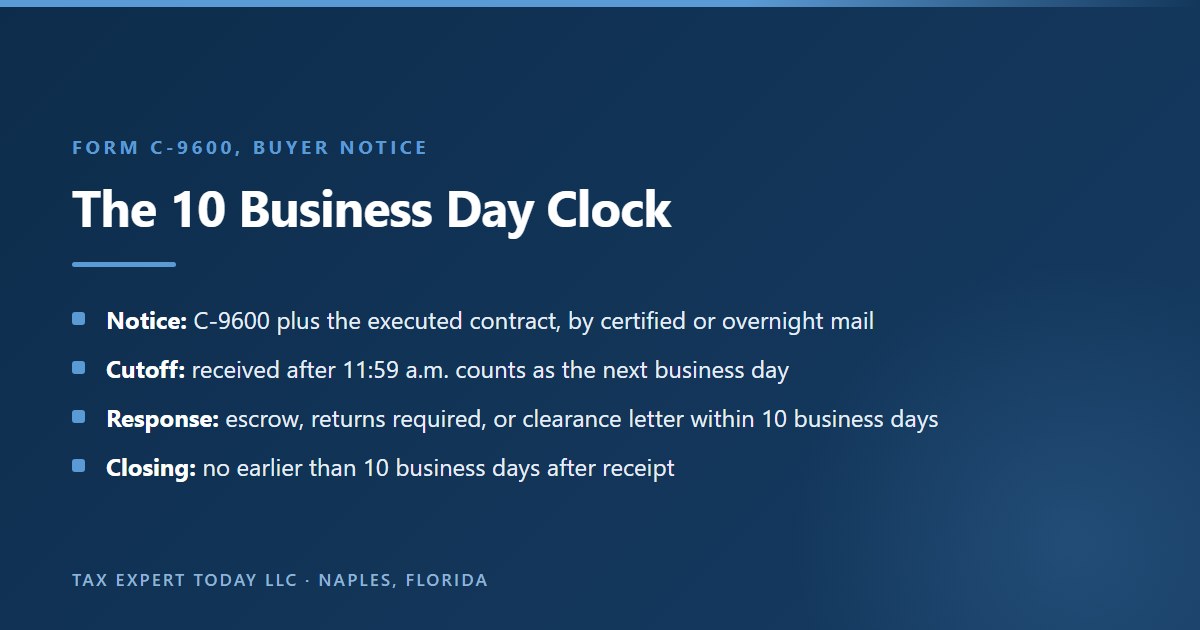
The Division must receive the C-9600 and the contract at least 10 business days before closing, counting no weekends or holidays, and a form received after 11:59 a.m. counts as received the next business day. The Division then responds within 10 business days. If it misses that deadline on a complete notice, the buyer is not liable.
- Delivery: registered, certified or overnight mail, or a carrier such as FedEx or UPS. No hand delivery, fax or email.
- Proof: the buyer must be able to show delivery to 3 John Fitch Way in Trenton.
- No rush service: the Division does not expedite and will not answer status questions before 10 business days.
- Mail only: every response letter is sent by first-class mail, never by fax or email.
The C-9600 cover page is specific: applications received after 11:59 a.m. are considered received the following business day, the Division will not respond to status inquiries until 10 business days after receipt, and there is no expedited service. Responses go out through the U.S. Postal Service, so the form recommends allowing ample time for mail delivery. A closing scheduled exactly 10 business days out, on a notice that arrives at noon, is already one day short.
If the closing happens before the 10 business days have run and the Division has not assigned an escrow, the FAQ calls it a bulk sale violation, and the purchaser is held responsible for the seller’s tax obligations. Buyers know this, which is why a well-advised buyer will move the closing date rather than take the risk. For the seller in a New Jersey bulk sale, the lesson is that the closing calendar should be built backward from the notice date. If the seller needs the money in Florida by a particular date, the C-9600 has to go out well before the 10 business day minimum.
| Step | Timing rule | Source |
|---|---|---|
| Contract signed | Executed copy must accompany the notice | C-9600 and FAQ |
| C-9600 mailed | Registered, certified or overnight; receipt after 11:59 a.m. counts as the next business day | C-9600 cover page |
| Division receipt | Starts the 10 business day period | FAQ and TB-60(R) |
| Division response | Within 10 business days, by first-class mail | FAQ |
| Insufficient notice | The 10 days restart from receipt of all required information | FAQ |
| Earliest safe closing | At least 10 business days after receipt, with any escrow held as directed | C-9600 and FAQ |
| Division misses its deadline | Purchaser is not liable for the seller’s State taxes | FAQ |
What Letters Can the Division Send After a C-9600?
The Division answers a C-9600 with five possible letters: an escrow letter to the buyer, a returns required letter to the seller, a clearance letter to the buyer, an insufficient notice to the buyer, or a bulk sale violation notice to the buyer. A departing seller should expect to see the returns required letter if anything is open.
- Escrow letter: the amount the buyer must hold at closing, with a copy to the seller.
- Returns required letter: the returns the seller must file and the taxes the seller must pay for clearance.
- Clearance letter: no escrow, and the buyer assumes none of the seller’s obligations.
- Insufficient notice or violation: problems with the buyer’s filing that can delay or derail the closing.
The FAQ lists the five responses in plain terms, and the distinction between them decides who has to act. The escrow letter and the clearance letter go to the purchaser, because the purchaser is the party holding the money. The returns required letter goes to the seller, because only the seller can file the seller’s returns. For a seller who has just moved, that letter is the one that controls how long the money stays in New Jersey.
| Letter | Sent to | What it means for a departing seller |
|---|---|---|
| Escrow Letter | Purchaser, copy to seller | A stated amount will be withheld from the price at closing |
| Returns Required Letter | Seller | A list of returns and payments that must be completed before the escrow is released |
| Clearance Letter | Purchaser | No escrow is required, and the full price can be paid at closing |
| Insufficient Notice | Purchaser | Items are missing from the buyer’s filing; the 10 business days restart once they are supplied |
| Bulk Sale Violation | Purchaser | The purchaser has assumed the seller’s tax obligation for the sale |
A clearance letter at the outset is the best result for a seller, and it is available to a seller whose accounts are clean. TB-60(R) says that if the transferor has no State tax debts, the Division will issue a letter of clearance permitting the release of any previously requested escrow. The work a seller does before the buyer files, checking that every return is on file and every balance is paid, is the work that makes that outcome possible.
How Is the New Jersey Bulk Sale Escrow Calculated?
The Division sets the escrow from the seller’s established tax obligations, audit information and unfiled returns. TB-60(R) says the amount includes deficiencies, delinquencies, fixed or pending audit assessments, and costs of collection and fees. It is an estimate built from the Division’s records, so missing returns can drive an amount far above what the seller actually owes.
- Deficiencies: underpayments on returns that were filed.
- Delinquencies: returns the Division expected and never received.
- Assessments: audit results, whether final or still pending.
- Add-ons: penalties, interest, fees and collection costs.
Delinquencies are the part of the formula a seller can most directly influence. When a return is missing, the Division does not know what the right number is, so it estimates. A seller who stopped filing a quarterly sales tax return when sales fell, or who closed a payroll account without filing the final reconciliation, can find an escrow based on an estimate rather than on actual activity. The FAQ notes that the escrow may be reduced when the caseworker receives information that affects it, and it gives two examples: payment of deficiencies or audit assessments, and filing and payment of delinquent returns.
That is why the most valuable step for a seller happens before the contract is signed. A seller who pulls the business’s account history before a New Jersey bulk sale, confirms that every period is filed, and pays any balance can go into the bulk sale review with nothing for the Division to estimate. The Division’s business tax pages list the tax types a New Jersey business may be registered for, and each registration is something the bulk sale review can look at.
| Component in TB-60(R) | Typical cause for a closing business | How a seller can shrink it |
|---|---|---|
| Deficiencies | Underreported sales tax, an underpaid estimate, a math error | Pay the balance before the notice is filed |
| Delinquencies | Unfiled sales tax, withholding or business tax returns | File every open period, including zero returns |
| Fixed audit assessments | A completed audit with a balance due | Pay it or document an agreed payment plan |
| Pending audit assessments | An audit that is still open at the time of sale | Push the audit to a conclusion or expect a larger escrow |
| Costs, fees, penalties, interest | Late filing and late payment additions | File and pay early so they stop accruing |
Can the Escrow Exceed the Purchase Price?
Yes. The Division’s FAQ cites the New Jersey Tax Court in Bunting v. Director, Division of Taxation, 1 N.J. Tax 189 (T.C. 1980), for the point that a purchaser may assume liability for the seller’s delinquent taxes beyond the price paid. If sale proceeds are too small, the buyer and seller must decide who funds the shortfall at closing.
- No cap at the price: the escrow reflects the seller’s tax exposure, not the deal size.
- Shortfall: when proceeds are insufficient, the parties still must hold the full escrow.
- Negotiation: who supplies the extra funds is a matter between purchaser and seller.
- Practical effect: a small asset sale by a seller with large old balances can stall entirely.
For most sellers in a New Jersey bulk sale, this is a remote possibility. It becomes real for a business owner who is selling a small piece of a larger operation, such as a delivery van or a second location, while carrying old tax balances on the main business. The escrow attaches to the seller’s tax account, not to the asset, so a small sale can surface a large liability. The FAQ is clear that when there are no proceeds, or the proceeds are insufficient to fund the Division’s required escrow, it remains the purchaser’s responsibility to hold the escrow, and the purchaser and seller decide between themselves who provides the additional funds at closing.
Buyers who understand this write contracts that make the seller responsible for any escrow shortfall, and many contracts let the buyer walk away if the escrow letter exceeds a stated amount. A seller should read those clauses with the same care as the price. When the seller’s own records show the old balances, the better course is usually to resolve them before the buyer files the notice.
Which Final Returns Will the Division Ask a Departing Seller For?
The Division asks for whatever returns are needed to close every account it administers for the seller. TB-60(R) releases the remaining escrow only after all final returns are filed and all final State tax debts are paid. For a closing business that usually means final sales tax, employer withholding and business tax returns, plus any open individual returns.
- Sales and use tax: the last period’s return, plus tax on any taxable items sold as part of the bulk sale.
- Employer withholding: the final quarterly returns and the annual reconciliation for the final year.
- Business taxes: the final corporation business tax return, or the final partnership filing and nonresident partner payments.
- Individual income tax: any unfiled resident, part-year or nonresident returns tied to the seller’s ID.
The FAQ says a business liquidating assets may need to make final payments of sales taxes, withholding taxes, minimum payments and similar items, and that delinquent or deficient taxes may also be collected. The returns required letter is the Division’s way of telling the seller which of those it still needs. The letter is mailed to the seller at the address on file, which is another reason to put the Florida address and the seller’s attorney on the C-9600.
The exact list depends on how the seller was registered. The table below is a practical map for planning, not a substitute for the letter itself, which controls. A seller who ran the business through a pass-through entity should also review the entity’s New Jersey partnership filing; the Division’s publication GIT-9P on partnership income describes the entity’s obligations for nonresident partners, and those obligations do not end because the partners moved.
| Seller profile | Returns likely to be reviewed | Planning note |
|---|---|---|
| Retail or restaurant business | Final sales and use tax return; final employer withholding returns; business tax return for the final year | Taxable tangible assets in the sale may carry sales tax of their own |
| Professional practice sold to a successor | Final employer withholding returns; final entity return | Goodwill and patient or client lists are business assets |
| Landlord selling a commercial building in an LLC | Final partnership or entity filing; nonresident partner payments; any open individual returns | Rent-only businesses often have no sales tax account, so the review centers on income taxes |
| Individual selling a three- or four-family rental | Individual returns for the years the property was held | A missing part-year return for the move year is a common gap |
| Holding company selling membership interests it owns | Entity returns for the holding company | Interests owned by a business entity are that entity’s business assets |
Two points are easy to miss. First, a business that stopped operating months before the sale still needs to file returns, often zero returns, for every period it remained registered. Second, the move year itself creates a New Jersey individual filing. The NJ-1040NR instructions state that there is no part-year resident return; a household that moved during the year may have to file Form NJ-1040 for the resident period and Form NJ-1040NR for New Jersey source income in the nonresident period. Our guide to the nonresident state tax return walks through that structure in general terms.
Is Form TTD Still Required?
No. The Division’s bulk sale FAQ, last updated October 28, 2025, says the Asset Transfer Tax Declaration, Form TTD, is no longer required to be submitted by a seller and has been discontinued. Older articles and closing checklists still tell sellers to file it, so a seller should confirm the current requirement before relying on a template.
- Status: discontinued, according to the Division’s own FAQ.
- What replaced it in practice: the Division’s review of the seller’s accounts and the returns required letter.
- Risk of old checklists: templates written before the change may still list it.
- Still required: the buyer’s C-9600 with the executed contract.
Many of the pages that rank for New Jersey bulk sale questions were written years ago. One commentary piece in the current search results dates to 2016, a law firm article on the Division’s FAQ guidance dates to 2016, and a ranking video dates to 2015 and walks through the Asset Transfer Tax Declaration for real estate investors. Those pages were accurate when they were published. They are not accurate today on this point. The Division’s current FAQ answers the question “Is the Asset Transfer Tax Declaration (Form TTD) required?” with “No” and states that the form has been discontinued.
The practical result for a seller is that the seller’s side of a New Jersey bulk sale now runs entirely through the Division’s review and the letters it sends. The seller does not submit a declaration up front. The seller responds to what the Division asks for. That makes the pre-contract cleanup described above more important, not less, because there is no seller form on which to explain an open item before the Division sees it.
How Does a Seller Get the Escrow Released?
The seller files every return and pays every balance the Division lists. Once the Division is assured that all the seller’s obligations are met, it issues a clearance letter to the purchaser or the purchaser’s agent, authorizing release of the remaining escrow to the seller. Before that, the Division may demand payment of known debts directly out of the escrow.
- Step one: read the escrow letter and the returns required letter side by side.
- Step two: file every listed return and pay every listed balance.
- Step three: send proof to the caseworker named on the letter, by mail or as the letter directs.
- Step four: the Division issues a clearance letter, and the escrow agent releases the balance.
TB-60(R) describes the sequence in detail. After the transaction closes, the Division will demand from the attorney or designee of the transferee payment out of the escrow for any State tax debts that exist. After all final returns have been filed and all final payments of State tax debts are remitted, the Division authorizes the release of the remaining portion of the escrow by issuing its letter of clearance. The FAQ adds that the escrow may be reduced along the way when the caseworker receives information that changes the amount, such as payment of a deficiency or the filing and payment of a delinquent return.
A seller can speed up a New Jersey bulk sale release in three ways. First, by filing the final returns before closing wherever the timing allows, so they are already in the Division’s system when the caseworker looks. Second, by keeping one contact for the case, normally the seller’s New Jersey attorney, so that letters are not split between an old office address and a new Florida one. Third, by having the seller’s tax representative authorized on Form M-5008-R, so the representative can deal with the caseworker directly instead of relaying messages.
| Stage | Who acts | Document |
|---|---|---|
| Escrow set | Division | Escrow letter to purchaser, copy to seller |
| Escrow funded | Purchaser or purchaser’s escrow agent | Closing statement showing the held amount |
| Open items listed | Division | Returns required letter to seller |
| Open items resolved | Seller and seller’s representative | Filed returns, payments, and proof sent to the caseworker |
| Known debts paid from escrow | Purchaser’s attorney or designee, on the Division’s demand | Division demand for payment |
| Balance released | Purchaser’s escrow agent, after the Division’s letter | Clearance letter |
Does a Clearance Letter End the Seller’s Exposure?
No. A clearance letter protects the buyer and frees the escrow, but TB-60(R) says it does not release the seller from liabilities that may be determined at a future date through an audit of the seller’s books and records. A seller who moves to Florida should keep the New Jersey business records for the full assessment period after the sale.
- Buyer: relieved of further liability once the clearance letter issues.
- Seller: still answerable for anything a later audit finds.
- Records: keep sales, payroll and entity records after the move, not only the closing file.
- Address: keep the Division’s records current so later notices reach Florida.
The bulletin’s language is specific: the letter of clearance pertains solely to and permits the release of the balance of funds held, as directed by the escrow notice, to the transferor and relieves the transferee of any further liability. It does not release the transferor from any liabilities determined later. A seller who treats the clearance letter as a final closing of the New Jersey chapter, and discards the records, may have nothing to work with if an audit letter arrives later.
This connects to a broader point for anyone leaving New Jersey with assets still in the State. Departure does not end New Jersey’s reach over New Jersey source income or New Jersey property, and a later inheritance tax question can follow assets as well, as our guide on New Jersey inheritance tax for nonresidents explains. A good file at the time of the sale makes every one of those later questions easier.
How Does the Bulk Sale Escrow Interact With GIT/REP on the Same Closing?
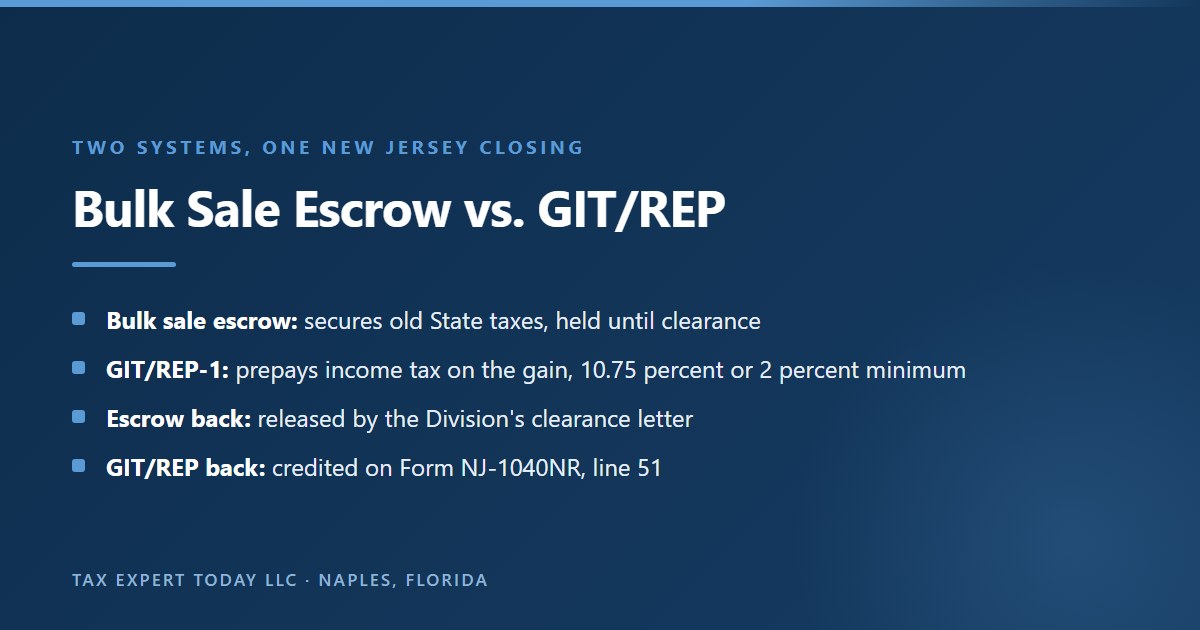
They are two separate systems that can apply to the same deed. The bulk sale escrow secures the seller’s existing New Jersey tax debts and is held by the buyer’s side until clearance. The GIT/REP payment is a prepayment of the nonresident seller’s income tax on the gain, collected with the deed and credited on the seller’s New Jersey return.
- Bulk sale escrow: covers old taxes; held in escrow; released or applied by the Division’s letters.
- GIT/REP-1 payment: covers the new gain; paid to the State through the county clerk; credited on Form NJ-1040NR.
- Different triggers: the escrow follows business assets, GIT/REP follows nonresident sellers of New Jersey real property.
- Both possible: a nonresident individual selling a four-family rental can face both at one closing.
Sellers often assume the New Jersey bulk sale escrow and GIT/REP are the same thing, and the confusion leads to two opposite mistakes. Some sellers expect the GIT/REP payment to satisfy the bulk sale review, and are surprised when an escrow is also held. Others expect a bulk sale clearance letter to excuse the GIT/REP payment, and are surprised when the county clerk will not record the deed without it. The GIT/REP-1 instructions are blunt on the second point: if the form is not completed in its entirety, the county clerk will not record the deed.
Our New Jersey exit tax guide covers GIT/REP on the sale of a former principal residence, where the bulk sale rules do not apply. This page picks up where that one ends: the income-producing property, where both systems can sit on the same closing statement.
| Feature | Bulk sale escrow | GIT/REP-1 estimated payment |
|---|---|---|
| Legal basis | N.J.S.A. 54:50-38 | N.J.S.A. 54A:8-9 (the estimated payment requirement cited on GIT/REP-3) |
| What triggers it | Sale of business assets outside the ordinary course | Sale of New Jersey real property by a nonresident individual, estate or trust |
| Who files | The buyer, on Form C-9600 | The seller completes GIT/REP-1 and delivers it with payment at closing |
| What it secures | The seller’s existing State tax debts of every type | The seller’s income tax on the gain from this sale |
| Amount | Set by the Division from its records | 10.75 percent of the gain, but not less than 2 percent of the consideration |
| Where the money goes | Held by the buyer’s escrow agent, then paid to the State or released to the seller | Sent by the county clerk to the Division’s Revenue Processing Center |
| How the seller recovers any excess | Clearance letter releases the balance | Credit on Form NJ-1040NR, line 51, with any overpayment refunded |
What Is the GIT/REP-1 Payment for a Nonresident Seller?
It is a New Jersey Gross Income Tax estimated payment that a nonresident individual, estate or trust makes when selling New Jersey real property. The amount is the gain multiplied by the highest rate, 10.75 percent, but it cannot be less than 2 percent of the consideration. Part-year residents are treated as nonresidents for this purpose.
- Rate: 10.75 percent of the gain, the top Gross Income Tax rate.
- Floor: never less than 2 percent of the consideration received.
- Consideration: includes any mortgage assumed by the buyer and other liens not paid off.
- Prepay option: file GIT/REP-2 with the payment at a Regional Information Center before closing.
The GIT/REP-1 instructions say that a nonresident individual, estate or trust selling or transferring property in New Jersey must make the estimated payment unless an exemption applies on GIT/REP-3, a waiver applies on GIT/REP-4, or the deed is a corrective deed with no additional consideration on GIT/REP-4A. The seller can either prepay the Division by submitting Form GIT/REP-2 with the payment and voucher at a Regional Information Center before closing, or complete GIT/REP-1 and make the payment at closing through the settlement agent.
The address line is where Florida movers need to be careful. The instructions tell the seller to enter the seller’s primary residence or place of business, not the address of the property being sold, and they state that the seller is considered a nonresident unless a new residence has been established in New Jersey. They also state that part-year residents are considered nonresidents. A seller who moved to Naples in the spring and sells a New Jersey rental in the fall is a nonresident seller for GIT/REP even though a part-year resident return will be filed for the same year.
The GIT/REP-1 payment is an estimate at the top rate, not the final tax. The seller’s actual New Jersey tax on the gain is computed on the nonresident return, and the GIT/REP payment is claimed as a credit there. When the actual tax is lower, which is common for sellers whose total income does not reach the top bracket, the difference is refunded when the return is processed. A seller planning cash flow should treat the GIT/REP amount as money that will come back in part, months later, rather than as the cost of the sale.
Which GIT/REP-3 Exemptions Can a Florida Seller Use?
GIT/REP-3 lists sixteen seller assurances. The ones a Florida seller most often uses are box 2 for a principal residence that qualifies under IRC §121, box 5 for a seller that is not an individual, estate or trust, and box 7a for a gain not recognized under IRC §721, §1031 or §1033. Box 1 is for New Jersey residents only.
- Box 1: the seller is a New Jersey resident, so it is not available after the move.
- Box 2: property used exclusively as a principal residence under 26 U.S.C. §121.
- Box 5: the seller is an entity, not an individual, estate or trust.
- Box 7a and 7b: nonrecognition under §721, §1031 or §1033, or only like-kind property received.
The current Form GIT/REP-3 (8-25) states that boxes 2 through 16 apply to both residents and nonresidents. Box 1, the resident assurance, is the box many New Jersey sellers checked on earlier sales, and it is not available to a seller whose domicile is now in Florida. A seller who checks it anyway is making a declaration that the form says may be punished by fine, imprisonment, or both if false.
Box 5 deserves a closer look for business owners. A seller that is not an individual, estate or trust is not required to make the estimated payment, so a multi-member LLC taxed as a partnership or a corporation that sells its building checks box 5 instead of paying at closing. The bulk sale notice still applies to that same sale, and the entity’s own filings, including any payments on behalf of nonresident owners, carry the tax. A single member LLC that is disregarded for income tax purposes is harder; how the Division treats the owner of a disregarded seller for GIT/REP is a question to settle with the closing attorney before the closing date rather than at the table.
| GIT/REP-3 box | Assurance | Use for a Florida seller |
|---|---|---|
| 1 | Seller is a New Jersey resident | Not available after the domicile change |
| 2 | Property used exclusively as a principal residence under IRC §121 | The former home; gain above the exclusion can be paid later on Form NJ-1040-ES |
| 5 | Seller is not an individual, estate or trust | Property held in a partnership LLC or corporation |
| 6 | Total consideration of $1,000 or less | Rare in a sale, more common in a family transfer |
| 7a and 7b | Gain not recognized under §721, §1031 or §1033; only like-kind property received | A like-kind exchange; any boot is paid at 2 percent of the nonexempt amount or later |
| 12 | Transfer between spouses or incident to divorce under §1041 | Property settlements |
| 14 | Seller receives no net proceeds | A sale where the settlement sheet shows nothing due to the seller |
The GIT/REP-3 instructions add an important detail for exchanges. A nonresident claiming box 7 for a §1031 transaction must show the value of the like-kind property received, and if the exchange includes money or other non-like-kind property, the seller may either complete GIT/REP-1 and pay 2 percent of the nonexempt amount at recording, or make an estimated payment on Form NJ-1040-ES after recording. If a deferred exchange fails, the qualified intermediary completes a GIT/REP-1. Our guide to the 1031 exchange rules covers the federal requirements that decide whether the exemption holds.
How Is the Gain Taxed on the New Jersey Nonresident Return?
New Jersey taxes a nonresident on New Jersey source income, including gain on New Jersey real property and business assets. Form NJ-1040NR computes tax on total income at resident rates, then multiplies it by an income percentage: New Jersey income in column B divided by total income in column A. GIT/REP payments are credited on line 51.
- Column A: income from everywhere, as if the seller were a resident.
- Column B: New Jersey source income only, including the gain on the New Jersey property.
- Line 41: the income percentage, column B divided by column A, to four decimal places.
- Line 51: estimated payments, including GIT/REP-1 or GIT/REP-2, with a copy of the form enclosed.
The 2025 NJ-1040NR instructions describe the computation line by line. Line 41 is the income percentage, found by dividing line 29, column B, by line 29, column A. Line 42 multiplies the tax on the full income by that percentage. Line 51 picks up estimated payments, and the instructions specifically say to include payments made in connection with the sale or transfer of real property in New Jersey and to enclose a copy of Form GIT/REP-1 or GIT/REP-2.
Business owners who sold through an entity will also need the business allocation rules. Schedule NJ-NR-A is the business allocation schedule a nonresident uses when a business operates both inside and outside New Jersey, and the instructions note that a nonresident who sold S corporation shares must use the New Jersey adjusted basis rather than the federal one. The state and federal bases can differ by a large amount after years of New Jersey adjustments, so the seller’s preparer should rebuild the New Jersey basis before the return is filed rather than copy the federal figure.
The rate schedule matters as much as the percentage. Under the 2025 schedule for married couples filing jointly in the NJ-1040NR instructions, income over $500,000 and up to $1,000,000 is taxed at 8.97 percent less a subtraction of $17,042.50, and only income of $1,000,000 and over reaches 10.75 percent, less $34,842.50. A GIT/REP payment computed at 10.75 percent of the whole gain will often exceed the tax that the nonresident return actually produces.
What Happens If the Sale Closes Before or After the Move?
The date of the move changes which New Jersey return reports the gain, not whether New Jersey taxes it. A New Jersey property or business sold while the seller is a resident is reported on Form NJ-1040; the same sale after the move is New Jersey source income on Form NJ-1040NR. The bulk sale notice applies either way.
- Sale before the move: resident return, resident GIT/REP-3 box 1 available, bulk sale notice still required.
- Sale after the move: nonresident return, GIT/REP-1 payment unless an exemption applies.
- Move year: both NJ-1040 and NJ-1040NR may be filed, since New Jersey has no part-year return; the Division’s publication GIT-6 covers part-year residents.
- Either way: the gain on New Jersey real property remains New Jersey source income.
For a landlord, timing a New Jersey bulk sale around the move changes the form and the cash at closing more than the tax. Gain on New Jersey real property is New Jersey source income whether the seller lives in Montclair or Naples. What the move does change is the treatment of the seller’s other income for the rest of the year, which stops being taxed by New Jersey once the domicile has changed. The relocation and timing questions for an operating business, where the answer can be very different because some business sale income can be sourced to the owner’s home state, are the subject of our guide on moving to Florida before selling a business.
| Timing | New Jersey return for the gain | Closing forms | Bulk sale notice |
|---|---|---|---|
| Sale closes while still domiciled in New Jersey | Form NJ-1040 for the resident period | GIT/REP-3, box 1 | Required for business assets |
| Sale closes in the move year, after the move | Form NJ-1040NR for the nonresident period | GIT/REP-1 payment, or a GIT/REP-3 exemption other than box 1 | Required for business assets |
| Sale closes in a later year | Form NJ-1040NR | GIT/REP-1 payment, or a GIT/REP-3 exemption other than box 1 | Required for business assets |
| Installment sale with payments after the move | Each year’s New Jersey source portion, as reported for the year received | GIT/REP at the original closing | Required at the original transfer |
The domicile itself has to be real for the nonresident treatment to hold. A seller who claims Florida domicile for the sale year while keeping the New Jersey house, the New Jersey doctors and a New Jersey driver’s license is inviting a residency inquiry. A recorded Florida declaration of domicile under Fla. Stat. §222.17 is one piece of evidence among many; the full set of steps is in our guide on establishing Florida residency, and the day count tool on our Florida 183 day rule calculator page helps track the time spent in each State.
What Does a Hypothetical Four-Unit Sale Look Like?
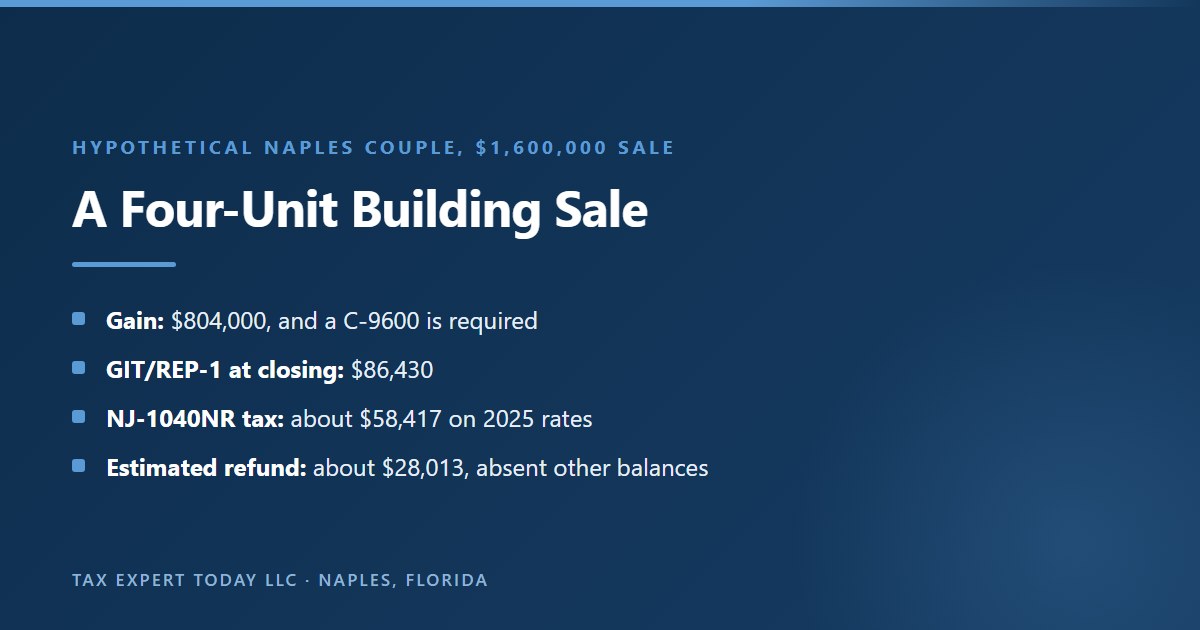
In this hypothetical, a Naples couple who changed domicile in 2025 sells a Jersey City four-unit building in 2026 for $1,600,000 with an $804,000 gain. The buyer files a C-9600, GIT/REP-1 takes $86,430 at closing, and the nonresident return later shows about $58,417 of New Jersey tax, leaving roughly $28,013 to be refunded.
- Bulk sale: four units owned by individuals are outside the one or two family exemption, so notice is required.
- GIT/REP-1: 10.75 percent of $804,000 is $86,430, above the 2 percent floor of $32,000.
- NJ-1040NR: tax on $1,000,000 at resident rates, times an income percentage of 80.40 percent.
- Escrow: any separate bulk sale escrow depends on what the Division finds in the couple’s accounts.
This is a hypothetical for illustration only. It uses the 2025 rate schedule because the 2026 schedule has not been published as of this writing, it ignores exemptions, deductions and any other New Jersey income, and it assumes the couple owns the building in their own names, not through an LLC. Real numbers will differ.
| Line item | Amount | How it is computed |
|---|---|---|
| Sale price (consideration) | $1,600,000 | Contract price; no mortgage assumed by the buyer |
| Adjusted basis after depreciation, plus selling costs | $796,000 | Assumed figures for the illustration |
| Gain | $804,000 | $1,600,000 minus $796,000 |
| GIT/REP-1 at 10.75 percent of gain | $86,430 | $804,000 times 0.1075 |
| GIT/REP-1 floor at 2 percent of consideration | $32,000 | $1,600,000 times 0.02 |
| GIT/REP-1 payment at closing | $86,430 | The greater of the two |
| Total income, column A (gain plus $196,000 of other income) | $1,000,000 | Assumed for the illustration |
| Tax on column A at 2025 joint rates | $72,657.50 | $1,000,000 times 0.0897, minus $17,042.50 |
| Income percentage, column B over column A | 80.40 percent | $804,000 divided by $1,000,000 |
| New Jersey tax on Form NJ-1040NR | About $58,417 | $72,657.50 times 0.8040 |
| GIT/REP credit on line 51 | $86,430 | Copy of GIT/REP-1 enclosed |
| Estimated overpayment | About $28,013 | Refunded after the return is processed, absent other balances |
Two things in this New Jersey bulk sale illustration are easy to miss. First, the GIT/REP payment and any bulk sale escrow are separate amounts. If the Division’s review finds that the couple’s 2025 move-year return was never filed, it can send an escrow letter for an estimated amount on top of the $86,430, and that escrow will not move until the return is filed. Second, the overpayment on the nonresident return is real money, but it arrives on the State’s processing schedule, not the seller’s. A seller who needs the full proceeds in Florida for a home purchase should plan around the cash actually received at closing.
Does Selling LLC Interests or Stock Avoid the New Jersey Bulk Sale Notice?
Sometimes. The Division’s FAQ says corporate stock and membership interests owned by individuals, estates or trusts are not business assets, so a sale of those interests needs no notice because the entity itself sells nothing. Interests owned by another business entity are business assets of that entity, and their sale generally requires a notice.
- Owned by individuals: no bulk sale notice for a sale of the shares or membership interests.
- Owned by a holding company: a notice is generally required unless the holder trades interests in the ordinary course.
- Combined groups: unitary transfers between members of a New Jersey combined group are exempt from January 1, 2021.
- The tradeoff: the buyer inherits the entity and its tax history directly.
The reason the stock sale escapes the New Jersey bulk sale notice is the same reason buyers are wary of it. When a buyer purchases the shares or membership interests, the company keeps its own tax accounts, and every old liability stays with the company the buyer now owns. There is no bulk sale review because the buyer is buying the liabilities, not walking away from them. Buyers in that position ask for representations, indemnities and holdbacks that serve the same purpose as the escrow. A seller who chooses an equity sale to avoid the bulk sale review may find a private holdback in its place, often for longer.
The federal consequences of the asset versus equity choice are usually larger than the New Jersey ones. An asset sale lets the buyer step up the basis of the assets and gives the seller a mix of ordinary and capital results; an equity sale gives the seller capital treatment on the shares and the buyer no step-up. The choice of entity also matters; our comparison of S corporations and C corporations and our guide on the taxes on selling a business cover those decisions.
How Do Installment Sales and 1031 Exchanges Fit the Bulk Sale Rules?
The bulk sale notice follows the transfer, not the payment terms, so an installment sale or a like-kind exchange of business assets still needs a C-9600 before closing. What changes is the income tax: an installment sale under IRC §453 spreads the gain over the years payments are received, and a valid §1031 exchange defers it.
- Installment sale: notice at the original transfer; New Jersey source gain reported as payments arrive.
- Escrow from a note: a seller paid mostly by note may have little cash at closing to fund an escrow.
- Like-kind exchange: notice still required; GIT/REP-3 box 7a can cover the deferred gain.
- Failed exchange: the qualified intermediary completes GIT/REP-1 and the seller reports the gain.
An installment sale is attractive to a seller who is moving, even inside a New Jersey bulk sale, because it spreads the gain over several tax years. It creates a specific bulk sale problem, though. The Division’s FAQ says that when the proceeds are insufficient to generate the required escrow, it is still the purchaser’s responsibility to hold it, and the parties decide between them who provides the extra funds. A seller who takes a small down payment and a long note can face an escrow demand larger than the cash at closing. The federal installment method under §453 and IRS Form 6252 govern the reporting, but they do nothing to change the bulk sale timing.
The New Jersey side of an installment sale also continues after the move. Each year’s payments carry a New Jersey source portion for a sale of New Jersey real property, so a seller in Naples receiving note payments on a New Jersey building should expect to keep filing Form NJ-1040NR until the note is paid off. Planning for that before the closing is far easier than discovering it the first April in Florida.
A like-kind exchange under IRC §1031 raises a related question when the replacement property is outside New Jersey, such as a Florida rental. The GIT/REP-3 box 7a language warns that if the indicated section does not ultimately apply, the seller acknowledges the obligation to file a New Jersey return for the year of the sale and report the recognized gain. Sellers who plan an exchange into Florida property should keep records that tie the replacement property to the relinquished New Jersey property, since the deferred gain can matter again when the Florida property is sold. Federal reporting runs through IRS Form 8824.
How Should the Federal Side of the Sale Be Coordinated?
The federal return reports the same sale with its own forms: Form 8594 for the purchase price allocation in an asset sale of a business, Form 4797 for business property and depreciation recapture, and Form 6252 for an installment sale. The allocation on the C-9600 should match the allocation both sides report federally.
- Form 8594: both buyer and seller report the allocation of the price among asset classes under §1060.
- Form 4797: sales of business property, including recapture on depreciated buildings and equipment.
- Form 6252: installment sale income, year by year.
- Closing a business: final federal employment and income returns, as the IRS closing checklist lists.
The IRS page for Form 8594 explains that both the seller and the purchaser of a group of assets that makes up a trade or business use the form to report the sale when goodwill or going concern value could attach. IRS Publication 544 covers sales of business property and recapture, and Form 4797 is where much of it is reported. Publication 537 covers installment sales in detail, and IRS Topic 409 summarizes how capital gains are taxed. The IRS also keeps a closing a business checklist that lists the final federal returns.
The C-9600 asks for the sales price of furniture, fixtures and equipment, the sales price of land and building, and other assets on an attached schedule. A seller should make sure those figures are consistent with the allocation in the contract, which in turn should be consistent with the Form 8594 both sides will file. When the numbers agree, the bulk sale file, the New Jersey return and the federal return tell the same story. When they disagree, each one becomes evidence against the others.
The federal side also decides the character of the gain, and character feeds the New Jersey computation. Depreciation recapture on equipment, gain on the building and gain on goodwill can each carry a different federal result. Our broader guide to taxes on selling a business walks through those categories, and owners with a pass-through business may want to review how the qualified business income deduction interacts with a final year of operations.
What Mistakes Delay the Escrow Release?
Most delays trace to the seller’s records, not the Division. Common causes are unfiled zero returns for a dormant period, a payroll account closed without its final reconciliation, letters mailed to a closed business address, a CPA without an M-5008-R on file, and a contract amendment or price change that was never sent to the caseworker.
- Dormant periods: a registered account expects a return even when nothing was sold.
- Wrong address: Division letters go by first-class mail to the address on file.
- No authorization: a representative without M-5008-R cannot work the case.
- Unreported changes: the FAQ says to notify the caseworker of any change in price or date.
Each New Jersey bulk sale mistake in the table below comes from a rule on the Division’s own pages. None of them is exotic, and each can be fixed in advance by a seller who knows to look.
| Mistake | Why it delays the release | Fix |
|---|---|---|
| Zero returns never filed for slow months | Missing periods count as delinquencies, which the Division estimates | File every open period before the contract is signed |
| Final payroll reconciliation never filed | The withholding account stays open and on the returns required list | File the final quarter and the annual reconciliation |
| Seller’s address on file is the closed business | All Division letters go by first-class mail; none by email or fax | Update the address and list the seller’s attorney on the C-9600 |
| Seller’s CPA or enrolled agent not authorized | Only attorneys are recognized as agents without a form | Sign Form M-5008-R before the move |
| Price or closing date changed after the notice | The caseworker’s numbers no longer match the deal | Notify the caseworker of every adjustment |
| Buyer assigned the contract to a new entity | The Division must be told, and the assignee takes on the escrow duty | Send the assignment to the caseworker |
| Seller relied on an old checklist listing Form TTD | Effort goes to a discontinued form instead of the open returns | Work from the Division’s current FAQ and its letters |
The FAQ covers the assignment point directly. When a purchaser files the C-9600 and then assigns its rights to another party before closing, the assignee does not file a new C-9600 if nothing else changed, but the Division must be notified. The assignee takes the place of the original purchaser and becomes responsible for holding the escrow stated in the Division’s notice. Sellers often see this when a buyer forms a new LLC to take title.
What Should a Seller Do Before Leaving New Jersey?
Start four to eight weeks before the contract. Pull every New Jersey tax account tied to the seller, file any open periods, pay known balances, sign M-5008-R for the seller’s representative, agree the price allocation with the buyer, give the buyer a Florida address and an attorney contact for the C-9600, and plan cash for both the escrow and GIT/REP.
- Accounts: list every registration under the seller’s tax ID, active or dormant.
- Returns: file every open period and pay every known balance.
- Paperwork: M-5008-R signed, contract executed, allocation agreed.
- Cash: budget for an escrow and a GIT/REP payment that both come out of the proceeds.
The New Jersey bulk sale checklist below is a planning sequence, not legal advice for any particular deal. It assumes the buyer will file the C-9600 promptly once the contract is signed and that the seller wants the escrow released as soon after closing as possible.
| When | Seller task | Why |
|---|---|---|
| Eight weeks before contract | Pull account histories for every New Jersey registration | Find delinquencies before the Division does |
| Six weeks before contract | File open periods, including zero returns; pay balances | Reduce the escrow to what is actually owed |
| Four weeks before contract | Sign Form M-5008-R for the seller’s tax representative | Let the representative work the caseworker directly |
| At contract | Agree the asset allocation and escrow shortfall terms with the buyer | Keep the C-9600, contract and Form 8594 consistent |
| At contract | Give the buyer a Florida mailing address and the seller’s attorney contact | Make sure the returns required letter reaches the seller |
| Before closing | Decide between GIT/REP-2 prepayment and GIT/REP-1 at closing | Control cash timing on the income tax estimate |
| Closing | Confirm the escrow amount on the closing statement | Match it to the Division’s escrow letter |
| After closing | File final returns listed in the returns required letter | Trigger the clearance letter |
| Following April | File Form NJ-1040NR, or NJ-1040 and NJ-1040NR in the move year, claiming GIT/REP credits | Recover any GIT/REP overpayment |
| Years after | Keep business records through the assessment period | A clearance letter does not bar a later audit of the seller |
The checklist also fits inside the wider move. A household that is leaving New Jersey is usually also closing a New Jersey home, changing voter and vehicle registrations, and updating estate documents. Our guides on selling your home after moving to Florida, the dual state residency trap, and Florida residency audits cover the pieces that sit next to the business sale. Owners leaving other high-tax states can compare the approach in our guides to the New York exit tax, the Illinois exit tax, the Maryland exit tax and the Massachusetts capital gains tax for Florida movers, and New Yorkers can review the New York City residency tax as well.
What Does Florida Change After the Sale Closes?
Florida has no personal income tax, so once domicile has changed, the seller’s income from other sources stops being taxed by any state. Florida does not tax the sale proceeds when they arrive, and it no longer has an intangible tax on investments. New Jersey still taxes New Jersey source gain and any remaining New Jersey property or business.
- No state income tax: interest, dividends and gains on the reinvested proceeds are not taxed by Florida.
- No intangible tax: Florida repealed it, so investment accounts carry no annual state tax.
- Still New Jersey: installment payments, rents and gain on any remaining New Jersey property.
- Estate planning: a Florida domicile changes which estate documents and probate rules apply.
The proceeds of a New Jersey bulk sale often fund the Florida chapter: a home purchase, a reinvestment, or a portfolio that will produce income for years. That income is outside the reach of any state income tax once domicile is in Florida, which is the main reason many owners time their exits around the move. Our note on the Florida intangible tax explains why investment accounts no longer carry a Florida tax, and owners with substantial proceeds should review Florida asset protection for new residents and Florida estate planning for new residents. Our estate and trust planning and business consulting practices coordinate those pieces with the New Jersey exit.
Frequently Asked Questions
What is a New Jersey bulk sale?
A New Jersey bulk sale is any sale, transfer or assignment of business assets outside the ordinary course of business, including equipment, inventory, goodwill and income-producing real estate. Under N.J.S.A. 54:50-38 the buyer must notify the Division of Taxation on Form C-9600 at least 10 business days before closing.
Does the seller file Form C-9600?
No. The purchaser or the purchaser’s attorney files Form C-9600 with an executed copy of the contract. The Division says a filing by the seller or a third party does not protect the purchaser. The seller supplies tax ID numbers, an address and attorney details, and answers any returns required letter.
Is the sale of a rental property a bulk sale in New Jersey?
Usually, because income-producing real estate is a business asset. A one or two family residence owned by individuals, estates or trusts, in any combination, is exempt even if it was rented. The exemption does not apply when the property is owned by a business, including a disregarded LLC.
How does a seller get the bulk sale escrow released?
The seller files every return and pays every balance listed in the Division’s letters. Once the Division is assured all obligations are met, it issues a clearance letter to the purchaser or the purchaser’s agent, who then releases the remaining escrow to the seller.
Is Form TTD still required for a New Jersey bulk sale?
No. The Division’s bulk sale FAQ, last updated October 28, 2025, says the Asset Transfer Tax Declaration, Form TTD, is no longer required to be submitted by a seller and has been discontinued.
Can a Naples firm help with a New Jersey bulk sale after I move?
Yes. The Division works by mail and through authorized representatives, so location is not a barrier. Tax Expert Today LLC, at 11983 Tamiami Trail N in Naples, Florida, helps Southwest Florida residents review New Jersey accounts before a sale, file final returns, and claim GIT/REP credits on Form NJ-1040NR.
New Jersey Bulk Sale Help in Naples & Southwest Florida
Tax Expert Today LLC works with business owners and landlords who have moved, or are moving, from New Jersey to Naples, Florida and across Southwest Florida on the New Jersey side of the exit: the account review before the contract, the open returns a bulk sale review is likely to surface, the response to the Division’s returns required letter, the GIT/REP payment and the nonresident return that recovers it. The firm is multidisciplinary, with enrolled agents, CPAs and attorneys, and it handles residency and tax matters nationwide, coordinating with the buyer’s attorney, the seller’s New Jersey counsel and the title company when a closing is involved. Our office is at 11983 Tamiami Trail N, Naples, FL 34110, open Monday through Friday, 10 a.m. to 5 p.m. ET, and reachable at (239) 441-2005.
- New Jersey bulk sale help Naples: pre-contract account reviews so the escrow reflects only what is owed.
- Returns required letters: preparing and filing the final business and individual returns the Division lists.
- GIT/REP and NJ-1040NR: estimating the payment at closing and claiming the credit afterward.
- Federal coordination: aligning the C-9600 allocation with Form 8594, Form 4797 and Form 6252.
Our Naples tax planning practice describes the wider relocation planning work, and our Florida tax services page covers the ongoing filings that follow a move.
When to Engage a Professional
A seller whose New Jersey accounts are fully filed and paid, selling a single asset to a buyer with experienced counsel, may move through the bulk sale process with little more than the closing attorney’s help. Professional help earns its cost when the business had more than one registration, when any return period is unfiled, when an audit is open, when the property is owned through an LLC, when the deal is an installment sale or an exchange, when the seller is moving in the same year as the sale, or when a returns required letter has already arrived in Florida. Tax Expert Today LLC’s enrolled agents, CPAs and attorneys can review the accounts before the contract, prepare the final returns, work with the Division’s caseworker and file the nonresident return that recovers any GIT/REP overpayment. Call (239) 441-2005 to schedule a consultation.
Published November 24, 2026 by Dr. Pellumb Kabashi « Back to Learning Center
Have a question this article touches on?
Tax Expert Today LLC, based in Naples, Florida and serving clients across the United States.
Schedule a Consultation (239) 441-2005