
By Dr. Pellumb Kabashi, DBA, MBA, EA, CFE, CES
Founder, Tax Expert Today LLC · Tax advisors, enrolled agents, CPAs, and attorneys · Serving clients in all 50 states
Quick Answer: An IRS CP523 notice tells you that your installment agreement is in default and that the IRS intends to terminate it and levy your assets. The plan does not end on the notice date. You generally have 30 days to cure the default or appeal, and IRS procedures bar levies on the covered periods for 90 days after the notice is mailed. Call (239) 441-2005 for a free consultation.
What is an IRS CP523 notice?
An IRS CP523 notice is the Installment Agreement Default Notice. It tells you that you have defaulted on an existing IRS payment plan and that the IRS intends to terminate the agreement and levy your wages, bank accounts or other property. The IRS also issues the same message as CP523 (SP) in Spanish and as CP623.
- It is a default notice, not a bill. The IRS CP523 page states that the IRS is informing you of its intent to terminate your installment agreement and seize (levy) your assets because you have defaulted.
- It is also a levy warning. IRM 5.14.11.4 titles it the Installment Agreement Default Notice, Notice of Intent to Levy, the notice required before levy under section 6331(d).
- It arrives by certified mail. The IRM directs that it be sent by certified mail to a domestic address and by registered mail to a foreign address.
- Joint filers each get one. Where the agreement covers a joint liability, the notice goes to both spouses separately, even at the same address.
The notice matters because an installment agreement is one of the strongest shields a taxpayer has against enforced collection. While a plan is in effect, the IRS generally cannot levy for the taxes it covers, the failure-to-pay penalty rate is cut in half for timely filers, and the account sits in a stable status. The IRS CP523 notice is the IRS telling you that this shield is about to come down. Everything that follows in this guide is about what the notice actually starts, how long each window lasts, and what the law requires the IRS to do before the protection is gone. If you are still deciding which type of plan fits your balance, our guide to IRS installment agreement options covers setup; this page covers what happens when a plan breaks down.
Why did the IRS put my payment plan in default?
IRM 5.14.11.3 lists the only grounds on which the IRS may propose to terminate an installment agreement: a missed installment, a new tax liability not paid when due, a financial update not provided on request, inaccurate information given before the agreement, or a missed payment on a modified amount. No other reason may be used.
- A missed or late installment. Non-receipt of a scheduled payment is grounds for proposing default, and many defaults are generated systemically when a payment does not post.
- A new balance due. Failing to pay another tax liability when it is due, such as a balance on next year’s return, is a separate ground. The IRM notes this includes related taxpayer identification numbers, such as a sole proprietor’s business account and the owner’s individual account.
- A financial update you did not send. If the IRS requests an updated collection information statement and does not receive it, that is grounds for default.
- Bad information at the start. Section 6159(b)(2) lets the IRS terminate an agreement if information provided before it was entered into was inaccurate or incomplete.
- A significant change in finances. Section 6159(b)(3) separately allows the IRS to alter, modify or terminate an agreement if it determines your financial condition has significantly changed.
The notice tells you which of these reasons applies, and the reason decides the fix. A missed payment is usually cured by paying the arrears. A new balance due is usually cured by paying that liability or folding it into a revised agreement. A missing financial statement is cured by sending one. Reading the reason line carefully before calling the IRS saves time, because the person on the phone will start from that reason. The IRM also carves out one item worth knowing: an individual shared responsibility payment under the Affordable Care Act does not default an existing installment agreement, and a separate notice, the CP523H, applies to plans that cover that payment.
| Default reason on the notice | Authority | What usually cures it |
|---|---|---|
| Missed or late monthly installment | IRC §6159(b)(4)(A); IRM 5.14.11.3 | Pay the missed amount before the termination date, then confirm with the IRS that the payment posted |
| New tax balance not paid when due | IRC §6159(b)(4)(B); IRM 5.14.11.3 | Pay the new balance in full, or ask to add it to a revised agreement |
| Requested financial update not provided | IRC §6159(b)(4)(C); IRM 5.14.11.3 | Submit the requested collection information statement, such as Form 433-F or Form 433-A |
| Inaccurate or incomplete information before the agreement | IRC §6159(b)(2)(A) | Provide corrected information showing the reason is wrong or does not change the terms |
| Missed payment on a modified amount | IRM 5.14.11.3 | Pay the modified amount, or document why the modification cannot be met |
| Significant change in financial condition | IRC §6159(b)(3) | Provide current financial information and negotiate revised terms |
How long do I have to respond to a CP523 notice?
The IRS asks you to contact it as soon as possible and no later than 30 days from the date of the CP523 notice. That 30 day period is also the statutory minimum: section 6159(b)(5) bars the IRS from terminating an agreement for default unless it gives written notice at least 30 days before acting and explains why.
- The agreement is not terminated yet. IRM 5.14.11.4 states that the agreement will not be terminated until the 30 day period beginning on the notice date expires.
- The notice must give a reason. Section 6159(b)(5)(B) requires the notice to include an explanation of why the IRS intends to act.
- You can dispute the reason. Treas. Reg. §301.6159-1(e)(4) allows you, on receiving the notice, to provide information showing the reason for the proposed termination is incorrect.
- Jeopardy is the only shortcut. The 30 day notice does not apply where the IRS believes collection is in jeopardy, and IRM 5.14.11.2 permits termination without advance notice in that case.
In practice, the 30 days should be treated as a hard deadline for action, not a grace period. A payment that is mailed on day 29 may not post in time, and the IRS itself tells taxpayers to allow one to three weeks for a payment to be credited. If the default was a missed payment, paying electronically through IRS Direct Pay or your IRS Online Account and then calling to confirm is the most reliable way to stop the termination before its date. If you disagree with the reason, the same 30 days is your first window to appeal, as explained below.
What happens after the 30 days on a CP523 notice?
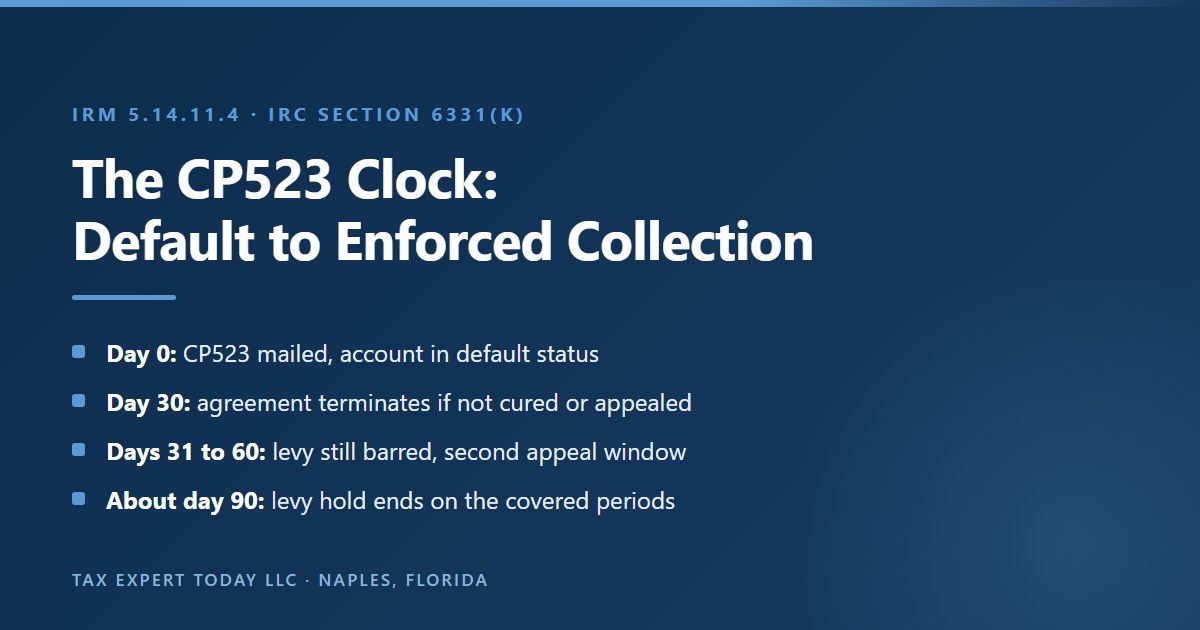
If you do not cure the default or appeal within 30 days, the agreement terminates. Termination does not permit an immediate levy. Section 6331(k)(2)(D) bars levy for another 30 days after termination, and longer if you file a timely appeal. IRS procedures hold levies on the covered periods for 90 days after the notice is mailed.
- Day 0 to 30: default status. The account moves from installment status 60 to status 64 when the CP523 is issued, and the plan can still be saved by curing the default.
- Day 30: termination. The termination date of record is 30 days from the notice date if the default is not cured or appealed.
- Day 30 to 60: second appeal window. You keep the right to appeal for 30 days after termination, and the IRM allows an extra 15 days for mailed appeals.
- Day 90: the levy hold ends. The IRM says no levies may be issued on periods in the agreement for 90 days after mailing, and the account moves to balance due or collection status after 13 weekly cycles.
| Approximate day after the notice date | What happens | Source |
|---|---|---|
| Day 0 | CP523 mailed by certified mail; account enters default status 64; a lien may be filed now if your agreement warned it could be | IRM 5.14.11.4 and 5.14.11.6 |
| Days 1 to 30 | Cure the default, provide information showing the reason is wrong, or request a CAP appeal of the proposed termination | IRC §6159(b)(5); Treas. Reg. §301.6159-1(e)(4); Pub. 1660 |
| Day 30 | Agreement terminates if not cured or appealed | IRM 5.14.11.4 |
| Days 31 to 60 | Levy still barred; you may still appeal the termination under CAP (plus 15 days for mailing under the IRM) | IRC §6331(k)(2)(D); IRM 5.14.11.7 |
| Around day 90 | Levy hold on the covered periods ends; status changes to 22 or 26 after 13 cycles; failure-to-pay rate returns to 0.5 percent; systemic levies allowed | IRM 5.14.11.4 |
The timeline is one of the most misunderstood parts of the IRS CP523 notice. Many taxpayers assume that the day after the 30 day deadline brings a bank levy. The statute and the IRM say otherwise. That extra time is not a reason to wait, because every day past the termination date makes the path back harder and more expensive, but it does mean that a taxpayer who opens the notice late still usually has room to act before any levy is issued. If the account does move into enforced collection, our guides to releasing an IRS bank levy and stopping an IRS wage garnishment cover what comes next.
Can the IRS levy my bank account while I am on a payment plan?
Generally no. Section 6331(k)(2) bars a levy for the taxes covered by an installment agreement while a request is pending, while the agreement is in effect, for 30 days after it is terminated, and while a timely appeal of the termination is pending. The exceptions are jeopardy, a written waiver, and a request made solely to delay collection.
- The protection is statutory. Section 6331(k)(2)(C) and (D) set out the in-effect and post-termination bars in the Code itself.
- The regulation confirms the exceptions. Treas. Reg. §301.6159-1(f)(2) lifts the bar only for a written waiver, a proposal submitted solely to delay collection, or jeopardy.
- Refund offsets are not levies. Section 301.6159-1(f)(3) lets the IRS apply a refund to the balance under section 6402 even while levy is barred.
- A lien can still be filed. The same paragraph allows the IRS to file or refile a notice of federal tax lien while levy is prohibited.
This is why the IRS payment plan page warns taxpayers to make every scheduled payment even when a refund has been applied to the balance. A refund offset is permitted during a plan, but it does not count as a monthly installment, and skipping a payment on the assumption that the refund covered it is one of the more common ways a plan slides into default. The bar on levy also protects only the person named in the agreement. Under the regulation, the IRS may still pursue another person who is liable for the same tax but is not a party to the plan.
Is a CP523 the same as a Collection Due Process notice?
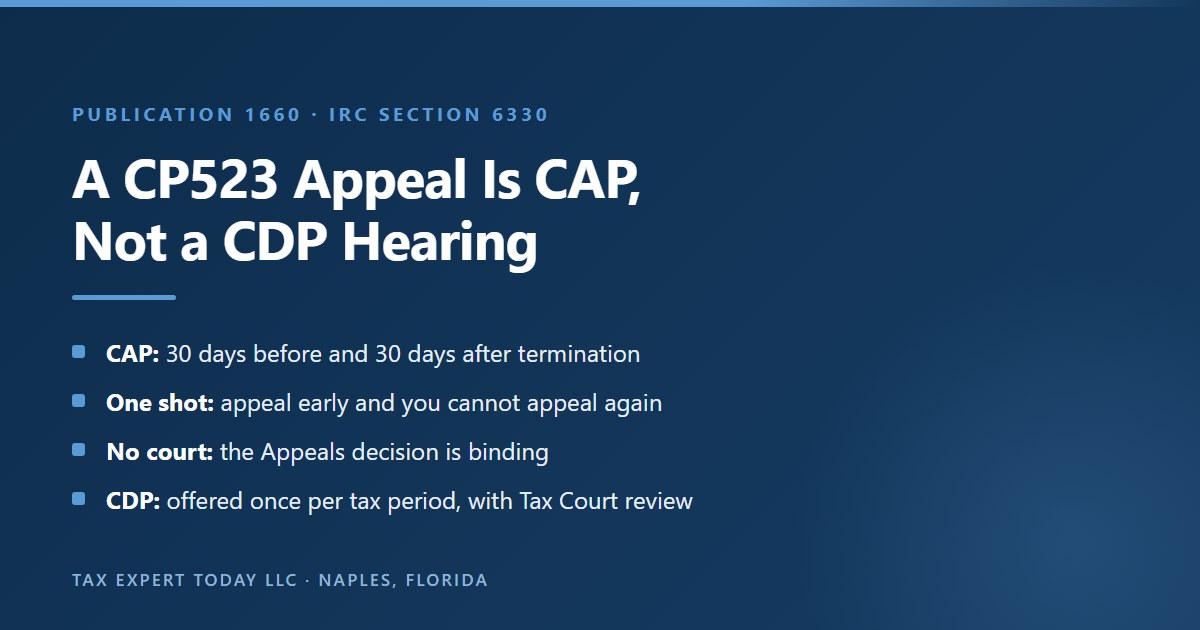
No. A CP523 is a notice of intent to levy under section 6331(d) and carries a Collection Appeals Program right, but it is not a Collection Due Process notice. Under section 6330(a)(1), the CDP notice is required only once for each tax period, and section 6330(b)(2) allows only one CDP hearing per period.
- CDP notices have their own names. The CDP levy notice is typically Letter 1058 or LT11, and the IRS CP90 page describes that notice as informing you of your right to a Collection Due Process hearing.
- Many plans follow a CDP notice. If you received a CDP levy notice for a period before your plan began, that right was already offered and the CP523 does not reopen it.
- If no CDP notice was ever issued. Section 6330 still requires one before the first levy on that period, which is a point worth checking on your account transcript.
- The appeal the CP523 offers is CAP. IRM 5.14.11.7 states that the right to a CAP appeal of a proposed or actual termination is provided in the CP523.
The distinction matters because the two hearings work very differently. A timely CDP hearing request can lead to review by the United States Tax Court, lets you raise collection alternatives, and in some cases lets you challenge the underlying tax. A CAP appeal is faster, but its decision is final. Treating a CP523 as if it opened a new CDP hearing can lead a taxpayer to wait for a Tax Court path that does not exist. For the full CDP process, including when the 30 day request window runs, see our guide to the Collection Due Process hearing and our explainer on Letter 1058 and LT11.
| Feature | CAP appeal of a CP523 termination | CDP hearing after a Letter 1058, LT11 or CP90 |
|---|---|---|
| Statutory basis | IRC §6159(e) and Treas. Reg. §301.6159-1(e)(5) | IRC §6330 |
| How often available | For each proposed or actual termination, but one appeal per termination | Once per tax period |
| Time to request | 30 days from the CP523, or 30 days after termination | 30 days from the CDP notice |
| How to request | By phone, or in writing on Form 9423 if a revenue officer sent the notice | Form 12153 in writing |
| Can you dispute the tax owed? | No | Sometimes, under section 6330(c)(2)(B) |
| Court review | None; the Appeals decision is binding | Petition to the United States Tax Court |
| Effect on levy | Levy barred while the appeal is pending, unless jeopardy | Levy generally suspended during a timely hearing |
How do I appeal the termination of my installment agreement?
You request a Collection Appeals Program hearing. Publication 1660 says to call the number on the notice and, if the matter is not resolved, explain that you want to appeal. The request must be in writing, preferably on Form 9423, if a revenue officer sent the notice. You have 30 days from the notice, plus 30 days after termination.
- The right comes from the Code. Section 6159(e) requires the IRS to provide an independent administrative review of installment agreement terminations for taxpayers who request one.
- One appeal, not two. Publication 1660 warns that if you appeal before termination, you may not appeal the decision again once the termination takes effect.
- The tax itself is off the table. Unlike CDP, a CAP appeal cannot challenge the existence or amount of the tax liability.
- The decision is final. Publication 1660 states that the Appeals decision in a CAP case is binding on both you and the IRS, and you cannot take it to court.
The one appeal rule is the trap that most summaries of the CP523 leave out. Because an early appeal uses up the right, a taxpayer whose reason for default is easy to fix is often better served by curing it first and reserving the appeal for a genuine dispute, such as a payment that was made but misapplied, a financial update that was sent but not logged, or a determination that finances significantly changed when they did not. Where the dispute is real, the appeal should be supported with records: bank statements showing the payment cleared, certified mail receipts, or the collection information statement the IRS says it never received. An appeal also affects timing in your favor. Under the regulation, no levy may be made while a timely appeal of a termination is being considered by Appeals.
How do I reinstate an installment agreement after a CP523 notice?
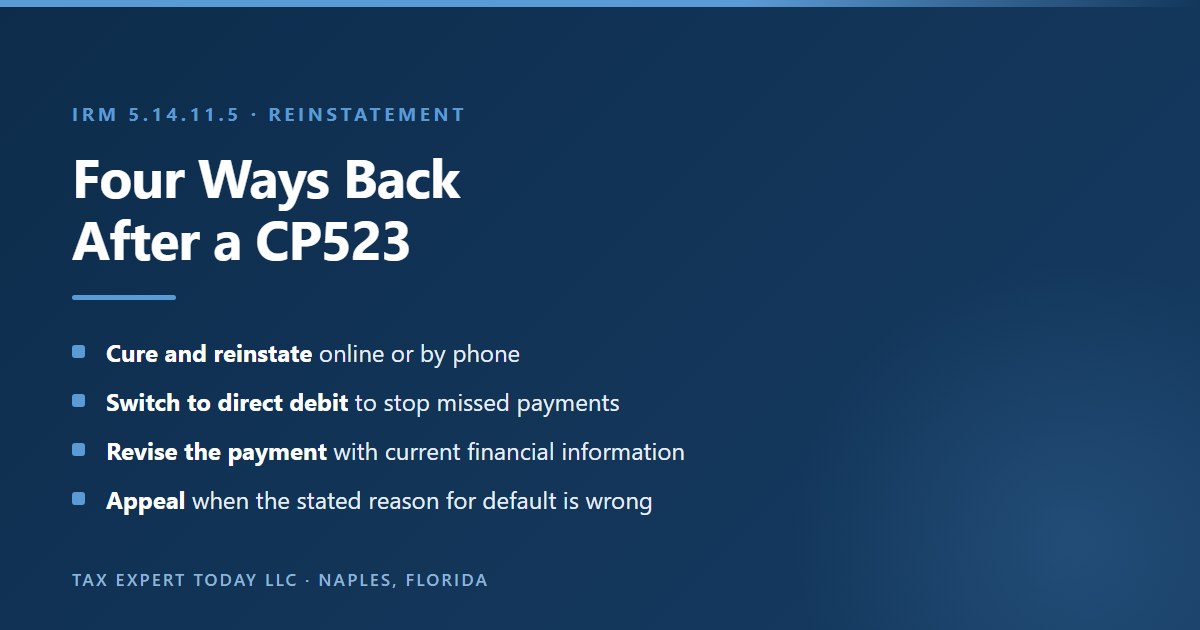
If the agreement is still in default and not yet terminated, IRM 5.14.11.5 says it must be reinstated if you remedy the default, unless another reason for default exists. Individuals can often reinstate through their IRS Online Account, and otherwise by calling the number on the notice. A reinstatement fee may apply.
- Online first. The IRS lists “reinstate after default” among the changes individuals can make in their Online Account, alongside changing the payment amount, due date and direct debit details.
- By phone if online fails. The IRS directs taxpayers who received a notice of default and cannot make changes online to follow the instructions on the notice and contact the IRS right away.
- Confirm even if you already fixed it. The IRS CP523 page says that if you already took corrective action, you should still call so the IRS has a record and can reinstate the agreement.
- A new balance may need full payment. The IRS notes you may have to pay any new tax liability in full to reinstate.
The IRM draws a sharp line between a plan that is in default and a plan that has been terminated. Before termination, reinstatement after a cured default is required, not discretionary. After termination, the IRS has more room to ask for updated financial information and to set new terms. Some reinstatements need no managerial approval and no financial analysis at all: IRM 5.14.11.5(2) allows that where the default came from a new liability that adds no more than two monthly payments and the plan still finishes before the collection statute expiration date, or where the plan meets the simplified criteria now called a Simple Payment Plan and you have not defaulted in the prior 12 months. In other cases, the IRS generally requires a financial statement to re-evaluate your ability to pay.
| Path back after a CP523 | When it fits | IRS fee listed for changing an existing plan |
|---|---|---|
| Cure and reinstate online | Individual with online access and a simple default, such as a missed payment | $6 online (may be reimbursed for low-income taxpayers) |
| Cure and reinstate by phone, mail or in person | Online reinstatement is unavailable, or a revenue officer manages the case | $89 ($43 for low-income taxpayers, which may be reimbursed) |
| Revise to a direct debit agreement | Missed payments caused by manual payment timing | $0 for changes to an existing direct debit agreement |
| New or revised agreement with financial statement | Finances changed, or the agreement was terminated and does not qualify for simple reinstatement | Depends on the plan type and how you apply |
| CAP appeal | The stated reason for default is wrong | No IRS fee to appeal |
Fees are from the IRS payment plans page as of the publication date and can change. Section 6159(f)(2) waives or reimburses installment agreement fees for individuals whose adjusted gross income does not exceed 250 percent of the applicable poverty level, subject to the conditions the IRS applies.
Can I change my payment amount instead of just curing the default?
Yes, where your finances have changed. Treas. Reg. §301.6159-1(e)(3) lets you ask the IRS to modify or terminate an agreement if your financial condition has significantly changed. Individuals who owe $50,000 or less and have filed all returns can usually revise the payment amount online; others may need a collection information statement.
- Keep paying while you ask. The regulation states that while the IRS considers your request, you must comply with the existing agreement.
- The request does not pause the clock. A taxpayer request to modify does not suspend the collection statute under section 6502.
- Online has limits. If the new payment does not meet IRS requirements, the online tool directs you to Form 433-F, Form 433-H or, for businesses, Form 433-B.
- Expenses are measured by standards. A revised payment is generally tested against the IRS allowable living expenses standards.
A payment amount that was affordable two years ago may not be affordable now, and a CP523 caused by repeated missed payments is often a sign that the original terms no longer fit. Asking for a lower payment on day one of the default window, with a complete financial statement, generally leads to a better conversation than asking after a second or third default. If the numbers show that even a reduced payment will not pay the balance before the collection statute expires, the right answer may be a partial payment installment agreement rather than a full pay plan. Our guide to Form 433-A explains how the IRS reads a financial statement.
Will the IRS file a tax lien after a CP523 notice?
It can, and sometimes immediately. IRM 5.14.11.6 says that if your agreement warned that a notice of federal tax lien may be filed if the agreement defaults, the IRS may file one as soon as the CP523 is mailed. Without that warning, a lien is normally not filed for 90 days unless the government’s interest is at risk.
- Check your original agreement. Form 433-D and Form 2159 contain a box indicating whether a lien has been filed, will be filed, or may be filed if the agreement defaults.
- A lien is not a levy. A lien is a public claim against your property; a levy takes the property. A lien filed during default does not end the levy bar.
- Liens can be withdrawn later. Some taxpayers on direct debit agreements may qualify to ask for withdrawal under section 6323(j), covered in our guide to tax lien withdrawal with Form 12277.
For many taxpayers, the lien is the most lasting consequence of a default, because it appears in the public record and has to be addressed before property can be sold or refinanced with clear title. That is one more reason to respond inside the first 30 days. A cured default that keeps the plan in effect avoids the question of whether the IRS will file, and a direct debit arrangement set up during reinstatement can make a later withdrawal request more realistic, subject to the IRS criteria.
Does a CP523 change my penalties and interest?
Termination can raise the monthly failure-to-pay penalty. Section 6651(h) cuts the rate from 0.5 percent to 0.25 percent per month for individuals who filed on time while an installment agreement is in effect. IRM 5.14.11.4 says that when a defaulted agreement is terminated, the rate returns to 0.5 percent. Interest continues either way.
- The reduced rate is conditional. Section 6651(h) applies only if the return was filed on or before its due date, including extensions.
- The penalty is capped. The failure-to-pay addition under section 6651(a)(2) and (a)(3) is limited to 25 percent in the aggregate.
- Interest cannot be waived for reasonable cause. Interest runs daily on the unpaid balance and, unlike penalties, is not removed for reasonable cause.
| Hypothetical unpaid tax balance | Monthly failure-to-pay penalty at 0.25 percent (plan in effect) | Monthly failure-to-pay penalty at 0.5 percent (plan terminated) | Added cost over 12 months |
|---|---|---|---|
| $10,000 | $25 | $50 | $300 |
| $20,000 | $50 | $100 | $600 |
| $40,000 | $100 | $200 | $1,200 |
The table is a simplified illustration. It holds the balance constant and ignores the declining balance as payments are made, the 25 percent cap, and interest, so the actual figures on any account will differ. It shows the direction of the cost: a terminated plan generally costs more each month than a plan in effect, before any collection action. Where penalties have already accrued, first-time penalty abatement or reasonable cause relief may reduce the balance in qualifying cases, and our explainer on the failure-to-pay penalty walks through the calculation.
Does a defaulted payment plan affect the 10-year collection statute?
Briefly. Under Treas. Reg. §301.6159-1(g), the collection statute is suspended for 30 days after an agreement is terminated, and for the entire time a timely appeal of the termination is pending. It is not suspended while an agreement is simply in effect. The IRS payment plan page describes the same 30 day suspension for a proposed termination.
- The base period is ten years. Section 6502(a) generally allows the IRS ten years after assessment to collect by levy or court proceeding.
- A pending plan request also suspends it. The same regulation suspends the statute while a proposed agreement is pending and for 30 days after a rejection.
- Reinstatement cannot add a waiver. IRM 5.14.11.5 says collection statute waivers may be secured only with new partial payment agreements, not with reinstatements of existing ones.
For most taxpayers the effect of a single CP523 on the collection statute is small, measured in weeks, not years. It matters more for older balances close to expiration, where every suspended day extends the IRS’s window. Our guide to the IRS 10-year rule for tax debt explains how the expiration date is calculated and what else can suspend it.
Can a CP523 lead to passport problems?
It can be part of the picture. The IRS CP523 page states that the notice also explains denial or revocation of a United States passport under the FAST Act for seriously delinquent tax debt. A debt covered by an installment agreement in effect is excluded from that certification, so a terminated agreement can remove that exclusion.
- The threshold is indexed. Seriously delinquent tax debt is defined in section 7345 and adjusted for inflation each year.
- Certification requires a lien or levy. A debt qualifies only if a notice of lien has been filed and CDP rights are exhausted or lapsed, or a levy has been made.
- A plan is an exclusion. Section 7345(b)(2)(A) excludes a debt being paid in a timely manner under an installment agreement.
For taxpayers who travel, this is a practical reason not to let a plan terminate. Our guide to IRS passport revocation explains the certification process and how it is reversed.
What should I do first when a CP523 notice arrives?
Read the reason for default and the termination date on the notice, pull your IRS account transcript to confirm what posted, then cure or dispute the default inside the 30 days. If you cannot afford the current payment, request a revision with a financial statement rather than letting the plan terminate.
- Find the reason and the date. The notice states why the IRS is acting and when termination takes effect.
- Check the account. Your IRS Online Account shows payments and balances; confirm whether a payment was received or misapplied.
- Cure the default if it is simple. Pay the missed amount or the new balance electronically, then call to confirm the plan is reinstated.
- Dispute it if the IRS is wrong. Provide records showing the reason is incorrect, and request a CAP appeal if that does not resolve it.
- Revise the terms if they no longer fit. Ask for a lower payment with current financial information, or explore an alternative.
- Stay compliant going forward. File every return on time and pay current-year taxes through withholding or estimated payments, because a new balance is itself a ground for default.
If paying anything is not realistic, the IRS itself points to other options on its CP523H page, including an offer in compromise and a temporary collection delay for hardship. Those are covered in our guides to currently not collectible status and the offer in compromise. Eligibility for either depends on documented income, expenses and assets, and neither is automatic.
Can a CP523 notice be a scam?
A genuine CP523 comes by mail, usually certified, and refers you to the phone number printed on the notice or to your IRS Online Account. The IRS does not demand payment by gift card, wire transfer or cryptocurrency. To verify, log into your Online Account or call a number listed on IRS.gov, not one from an unsolicited message.
- Match it to your account. A real CP523 refers to an installment agreement you actually have, and the balance should match your Online Account.
- Pay only through IRS channels. Payments belong at IRS.gov/payments, IRS Direct Pay, EFTPS, or by check payable to the United States Treasury.
- Look for the certified mail trail. The IRM directs certified mail for domestic addresses, so a CP523 that arrives only by text or email is a red flag.
Receiving more than one CP523 is not in itself a sign of fraud. Joint filers each receive a separate notice, and a taxpayer with several tax periods in one agreement may see the notice reference all of them. If the notices do not match an agreement you recognize, contact the IRS through official channels before paying anything.
How does the CP523 fit into the IRS notice sequence?
The CP523 sits outside the usual balance due ladder. The CP14, CP501, CP503 and CP504 notices lead up to a final notice of intent to levy for a balance that is not on a plan. The CP523 is sent later, only to taxpayers who already have an installment agreement and have defaulted on it.
- Before a plan: the CP14 balance due notice, then the CP501 and CP503 reminders.
- The escalation: the CP504 notice of intent to levy, then the CDP levy notice, Letter 1058 or LT11.
- After a plan defaults: the CP523, then termination and, if unresolved, enforced collection on the periods in the agreement.
Because the CP523 comes after a plan is in place, the taxpayer who receives it has usually already been through the balance due ladder once. That history shapes the options. A CDP right that was used or allowed to lapse before the plan does not come back, while the protections that come with an installment agreement, the levy bar and the reduced penalty rate, are worth preserving. Our Fresh Start program guide explains how the IRS’s broader payment options fit together.
IRS CP523 notice help Naples: tax resolution Naples and Southwest Florida
Tax Expert Today LLC works with individuals and business owners in Naples, Florida and across Southwest Florida whose IRS payment plans have gone into default. Common situations here include seasonal income that makes a fixed monthly payment hard to keep, business owners whose installment agreement defaulted because a quarterly estimated payment or payroll deposit was missed, retirees whose required distributions created a new balance, and part-year residents whose mail was forwarded late and who opened the CP523 well into the 30 day window. The most useful work happens early, while the plan can still be reinstated rather than rebuilt.
People searching for IRS CP523 notice help in Naples usually want to know whether their bank account is about to be levied, whether they can keep the plan they have, and whether an appeal is worth filing. The short answers are that the IRS generally cannot levy the covered periods for weeks after the notice, that a cured default before termination should lead to reinstatement, and that an appeal is valuable where the reason for default is wrong but uses up a one-time right. Our IRS resolution and audit support service and our Naples tax resolution page describe how these matters are handled, including preparing the financial statement a revised agreement may require.
Tax Expert Today LLC
11983 Tamiami Trail N, Naples, FL 34110
Phone: (239) 441-2005
Hours: Monday through Friday, 10:00 to 5:00 ET
Where can I get help with an IRS CP523 notice in Naples, FL? A CP523 is handled by phone, online or by mail with the IRS campus or revenue officer named on the notice, so help does not depend on a local IRS office. A representative authorized on Form 2848 can speak with the IRS for you, review your account transcript, and request reinstatement, a revised agreement or a CAP appeal. Tax Expert Today LLC is located at 11983 Tamiami Trail N in Naples and works with taxpayers in Collier and Lee Counties and nationwide.
When to Engage a Professional
Many CP523 notices can be resolved with a single payment and a phone call. Consider engaging a representative where the reason for default on the notice appears to be wrong, where you have received more than one CP523 within a year, where the default came from a new balance you cannot pay in full, where your income or expenses have changed enough that the current payment no longer works, where the agreement has already terminated, where a lien has been filed or threatened, or where a business account and an individual account are tied together. Those are the situations in which the choice between curing, revising and appealing matters most, and in which a one-time appeal right can be used well or wasted. Dr. Kabashi is an Enrolled Agent authorized to represent taxpayers before the IRS in all 50 states, and every engagement starts from the statute, the regulation and the IRS’s own procedures rather than assumptions about what the IRS will do.
This article is educational and general in nature. It does not constitute tax or legal advice for any particular taxpayer, and outcomes depend on individual facts and circumstances. IRS fees, procedures and inflation-adjusted thresholds are current as of the publication date and are subject to change.
Published September 28, 2026 by Dr. Pellumb Kabashi « Back to Learning Center
Have a question this article touches on?
Tax Expert Today LLC, based in Naples, Florida and serving clients across the United States.
Schedule a Consultation (239) 441-2005