
By Dr. Pellumb Kabashi, DBA, MBA, EA, CFE, CES
Founder, Tax Expert Today LLC · Tax advisors, enrolled agents, CPAs, and attorneys · Serving clients in all 50 states
Quick Answer: Tax preparation Sarasota households need is federal work, because Florida has no individual income tax. For a Sarasota County household living on retirement income, the decisions that matter are how Social Security is taxed, the new $6,000 senior deduction, Roth conversion timing before required distributions begin, and the Medicare IRMAA surcharge, which reads income from two years earlier. Call (239) 441-2005 for a free consultation.
What does tax preparation in Sarasota involve for a retiree household?
Tax preparation Sarasota households need is almost entirely federal, because Florida imposes no individual income tax and Sarasota County levies no local income tax. For the many households here living on pensions, IRA withdrawals, and Social Security, the work is coordinating those income sources so that one decision does not quietly raise the tax or the Medicare premium on another.
Sarasota County stretches from the City of Sarasota and Siesta Key south through Osprey, Venice, and North Port to Englewood, which straddles the line with Charlotte County. Longboat Key is split between Sarasota and Manatee counties. The county has long drawn retirees from the Midwest and the Northeast, and a growing number of younger households have followed into North Port and the newer communities east of Interstate 75. The tax profile that results is distinctive: a large share of filers whose income is no longer a paycheck.
That changes the nature of the tax preparation Sarasota retirees need. A wage earner’s return is mostly a record of what already happened. A retiree’s return is the result of choices made during the year: how much to withdraw from an IRA, whether to convert some of it to a Roth, when to claim Social Security, and how to give to charity. Each of those choices interacts with the others.
- No Florida return. There is no state income tax return, no Florida withholding, and no county or city income tax in Sarasota County.
- Retirement income is federal income. Pension, IRA, and annuity income is taxed on Form 1040 exactly as it was before the move.
- Medicare reads the return. The adjusted gross income on this year’s return sets the Medicare premium two years from now.
- Choices drive the result. Withdrawal amounts, conversions, and gifting are decided during the year, not on the return.
This is the fourth guide in our set of Southwest Florida city guides. The Fort Myers tax advisor guide covers small businesses and storm casualty losses, the Cape Coral tax preparation guide covers the relocation year and the federal bar on a former state taxing pension income, and the Bonita Springs guide covers seasonal residents who keep a home up north. This page does not repeat those. It works the retirement income questions that dominate Sarasota County returns.
How is retirement income taxed for a Sarasota County retiree?
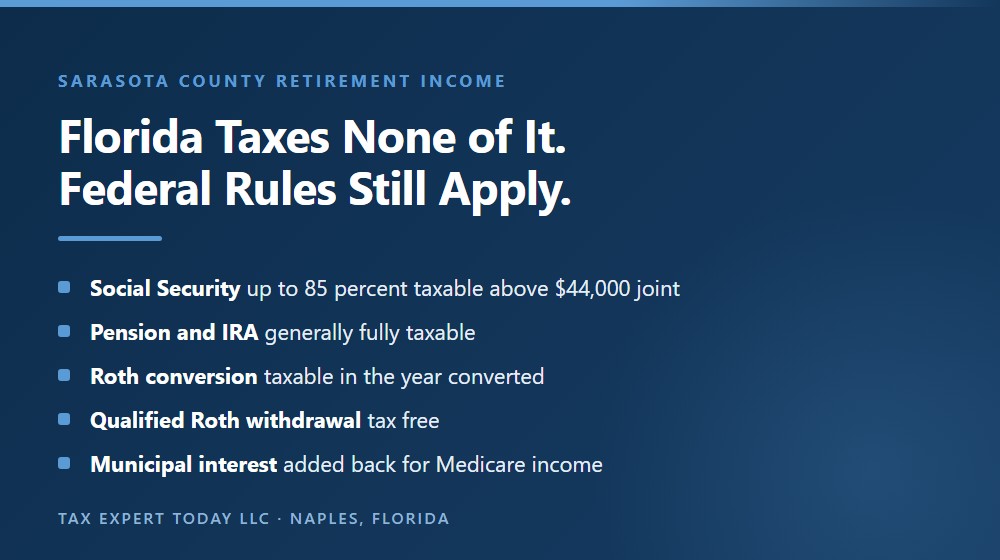
Each retirement income source follows its own federal rule. Pension and traditional IRA withdrawals are generally fully taxable, qualified Roth withdrawals are tax free, and up to 85 percent of Social Security benefits can be taxable depending on other income. Florida taxes none of them, so the federal rules are the whole picture.
The interaction between these sources is where most of the planning sits. Social Security is the clearest example. Under 26 U.S.C. § 86 and IRS Publication 915, the taxable share of a benefit depends on provisional income, which is other income plus half of the benefit. For a married couple filing jointly the base amount is $32,000, and above $44,000 up to 85 percent of the benefit can become taxable. Those thresholds are not indexed for inflation, so a household with moderate IRA withdrawals often finds most of its benefit taxable.
- Social Security. Up to 85 percent can be taxable once provisional income passes $44,000 on a joint return; a divorce changes the analysis, as our guide to divorce and Social Security benefits explains.
- Pensions and annuities. Generally taxable as ordinary income, except for any after-tax contributions recovered under the simplified method.
- Traditional IRA and 401(k) withdrawals. Fully taxable as ordinary income, and each extra dollar can also raise the taxable share of Social Security.
- Qualified Roth withdrawals. Tax free and excluded from the income that sets the Medicare premium.
- Investment income. Qualified dividends and long-term gains receive preferential rates but still count toward provisional income and Medicare income.
| Income source | Federal treatment | Counts toward Medicare IRMAA income | Florida tax |
|---|---|---|---|
| Social Security benefits | Up to 85 percent taxable | The taxable portion counts | None |
| Pension income | Generally fully taxable | Yes | None |
| Traditional IRA withdrawal or required distribution | Fully taxable | Yes | None |
| Roth conversion | Taxable in the year converted | Yes, in the conversion year | None |
| Qualified Roth withdrawal | Tax free | No | None |
| Municipal bond interest | Generally tax free | Yes, it is added back | None |
The last row surprises many Sarasota retirees. Tax-exempt interest is excluded from taxable income, yet it is added back when Medicare measures income for the premium surcharge, and it also counts in the provisional income test for Social Security. A portfolio built around municipal bonds for a high-tax northern state may serve a Florida resident less well than it once did, which is a portfolio question to raise with an investment adviser.
How does the new $6,000 senior deduction work for Sarasota retirees?
For tax years 2025 through 2028, each taxpayer age 65 or older may claim an extra $6,000 deduction, or $12,000 for a married couple when both qualify. It is available whether or not the household itemizes, and it phases out once modified adjusted gross income passes $75,000, or $150,000 on a joint return.
The IRS guidance on the new senior deduction confirms that it is in addition to the existing additional standard deduction for taxpayers age 65 and older, not a replacement for it. A taxpayer must reach age 65 by the last day of the tax year. For a Sarasota household that takes the standard deduction, the result is a meaningful increase in income that is never taxed, stacked on the 2026 standard deduction of $32,200 for a married couple filing jointly.
- Per person, not per return. Each spouse who is 65 or older qualifies separately, so a couple where only one spouse has reached 65 claims one deduction.
- The phase-out is the planning point. Income above $150,000 on a joint return begins to reduce the deduction, and a Roth conversion or a large capital gain can push a household into that range.
- Temporary by statute. The deduction applies for 2025 through 2028 only, which makes those four years an unusual window for income planning.
- Filing requirements. Married couples must file jointly to claim it, and the return must include the Social Security number of each qualifying individual.
The phase-out matters most for households near the line. A Sarasota couple with $140,000 of pension and IRA income who adds a $40,000 Roth conversion will lose part of the deduction in that year, which raises the true marginal cost of the conversion. That does not make the conversion wrong. It means the conversion amount should be chosen with the phase-out in view rather than in isolation.
When does a Roth conversion make sense for a Sarasota retiree?
A Roth conversion tends to make sense in the years between retirement and the start of required minimum distributions, when taxable income is lowest. The converted amount is taxed now under 26 U.S.C. § 408A, and in exchange future qualified withdrawals are tax free and excluded from the income Medicare uses to set premiums.
Many Sarasota retirees arrive with most of their savings in traditional IRAs and 401(k) plans. Required minimum distributions under the rules described in IRS Publication 590-B generally begin at age 73, rising to 75 for individuals who reach age 74 after December 31, 2032. Once they start, the household loses control over how much income it reports each year. The years before that point are the window to move money into a Roth at a lower bracket.
- The bracket fill. The usual approach is to convert enough each year to fill the current bracket without spilling into the next one.
- Florida adds no layer. A conversion done after Florida domicile is established carries no state income tax, which is a reason some households wait until the move is complete. The Cape Coral guide covers the move-year rules.
- Three costs, not one. A conversion can raise the tax on Social Security, reduce the senior deduction, and raise the Medicare premium two years later.
- Pay the tax from outside the IRA. Using IRA money to pay the conversion tax shrinks the amount that grows tax free.
- No undo. Recharacterizing a conversion back to a traditional IRA has not been permitted since 2018, so the amount should be settled before year end.
| What a Roth conversion can touch | The rule | When it shows up |
|---|---|---|
| Federal income tax | The converted amount is ordinary income under section 408A(d)(3) | The conversion year |
| Taxable Social Security | Higher provisional income can make up to 85 percent of the benefit taxable | The conversion year |
| Senior deduction | The $6,000 deduction phases out above $150,000 of modified AGI on a joint return | The conversion year, for 2025 through 2028 |
| Net investment income tax | The conversion is not investment income, but it raises modified AGI toward the $250,000 joint threshold in section 1411 | The conversion year |
| Medicare IRMAA | Modified AGI above $218,000 on a joint return, using the 2026 table | Two years later |
The net investment income tax row is the one most often missed. Under 26 U.S.C. § 1411, a 3.8 percent tax applies to the smaller of net investment income or the amount by which modified adjusted gross income exceeds $250,000 on a joint return, and that threshold is not indexed. A Sarasota couple with a large taxable portfolio can find that a conversion, while not itself investment income, pulls dividends and gains that were previously untouched into the tax. Reading all five rows together, rather than the bracket alone, is what sets a sensible conversion amount.
Conversions are different from the contribution route described in our guide to the backdoor Roth IRA, which is used by working taxpayers whose income is too high for a direct Roth contribution. For a retired Sarasota household, the question is not whether money can get into a Roth, but how much to move each year and in which years, and the answer depends heavily on the Medicare surcharge described next.
How does the IRMAA two-year lookback affect Sarasota retirees?
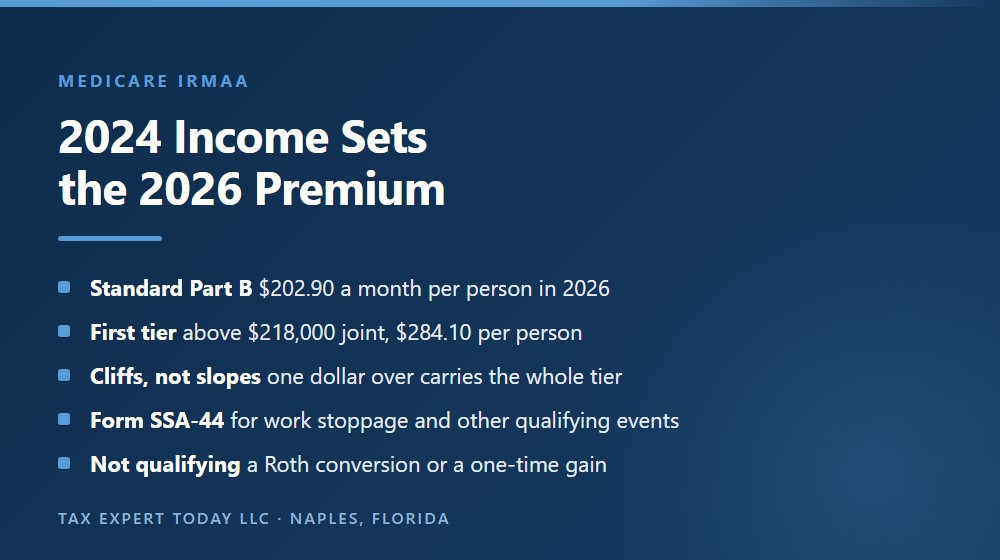
Medicare sets the income-related monthly adjustment amount, known as IRMAA, from the tax return filed two years earlier. A 2026 premium is generally based on 2024 income. For 2026, a married couple filing jointly with modified adjusted gross income above $218,000 pays more than the $202.90 standard Part B premium per person.
The two-year lag is what catches people. A Sarasota household that converts a large IRA balance, sells a northern home at a gain above the exclusion, or realizes a large investment gain in one year will see the premium increase two years later, often after the event has been forgotten. The surcharge applies to Part B and, separately, to Part D drug coverage. The brackets below come from the CMS 2026 premium announcement and the underlying rule is in 42 U.S.C. § 1395r.
| 2024 modified AGI, joint return | 2024 modified AGI, individual return | 2026 Part B premium per person, per month |
|---|---|---|
| $218,000 or less | $109,000 or less | $202.90 |
| Above $218,000 up to $274,000 | Above $109,000 up to $137,000 | $284.10 |
| Above $274,000 up to $342,000 | Above $137,000 up to $171,000 | $405.80 |
| Above $342,000 up to $410,000 | Above $171,000 up to $205,000 | $527.50 |
| Above $410,000 and below $750,000 | Above $205,000 and below $500,000 | $649.20 |
| $750,000 or more | $500,000 or more | $689.90 |
A hypothetical shows the scale. Suppose a married couple, both on Medicare, normally reports $190,000 of modified adjusted gross income and adds a $50,000 Roth conversion, reaching $240,000. Using the 2026 table as an illustration, each spouse would move from $202.90 to $284.10 a month, an extra $81.20 per person, or $1,948.80 a year for the couple, plus any Part D adjustment. The brackets are cliffs rather than gradual phase-ins, so a conversion that crosses a threshold by a small amount carries the whole surcharge for that tier. Sizing a conversion to stop just below a threshold is often worth the effort.
- Modified adjusted gross income. Adjusted gross income plus tax-exempt interest, as shown on the return two years back.
- One year at a time. A single high-income year raises the premium for one year only, and the premium returns to the standard amount once income falls.
- Couples pay twice. The surcharge applies to each enrolled spouse separately.
- Home sales count. Gain on a northern home above the exclusion in 26 U.S.C. § 121 is income for IRMAA purposes.
Can a Sarasota retiree ask Medicare to use a more recent year?
Yes, when the income drop follows a qualifying life-changing event. Form SSA-44 asks the Social Security Administration to use a more recent year’s income. Qualifying events include stopping or reducing work, marriage, divorce, the death of a spouse, and the loss of pension income. A one-time gain or a Roth conversion is not a qualifying event.
This matters for the many Sarasota households who retire and move in the same year. The final working year usually carries the highest income of a career, sometimes with a bonus or severance on top, and that is precisely the year Medicare will read two years later. A retiree who stopped working can file Form SSA-44 with evidence of the work stoppage and an estimate of current income, and the premium can be recalculated on the lower figure.
- Work stoppage or reduction. The most common qualifying event for new retirees, documented by an employer letter or final pay records.
- Loss of income-producing property. Applies when the loss was beyond the owner’s control, such as a disaster, not a voluntary sale.
- Not a qualifying event. A Roth conversion, a voluntary home sale, or a one-time capital gain will not reopen the premium.
- Estimates are checked. Social Security compares the estimate with the actual return later, so the estimate should be realistic.
How do required distributions and charitable giving fit together in Sarasota?
A qualified charitable distribution lets an IRA owner age 70½ or older send money directly from the IRA to a charity. The distribution is excluded from income and counts toward the required minimum distribution, which keeps it out of the income that drives Social Security taxation, the senior deduction phase-out, and IRMAA.
Sarasota has a deep philanthropic culture, from the arts organizations downtown to the hospital, church, and conservation groups that rely on retiree support. For households that give regularly and take the standard deduction, a check written from a bank account often produces no tax benefit at all. The same gift routed through the IRA reduces adjusted gross income directly. Our guide to the qualified charitable distribution covers the annual limit, the reporting on Form 1099-R, and the common errors.
- Direct transfer only. The funds must go from the IRA custodian to the charity; a withdrawal that is later donated does not qualify.
- Counts toward the required distribution. Once distributions are required, a qualified charitable distribution satisfies part or all of the amount.
- Lowers several numbers at once. Adjusted gross income, provisional income, and Medicare income all fall together.
- Donor-advised funds do not qualify. The charity must be an eligible public charity, not a donor-advised fund.
What sales and rental taxes apply in Sarasota County?
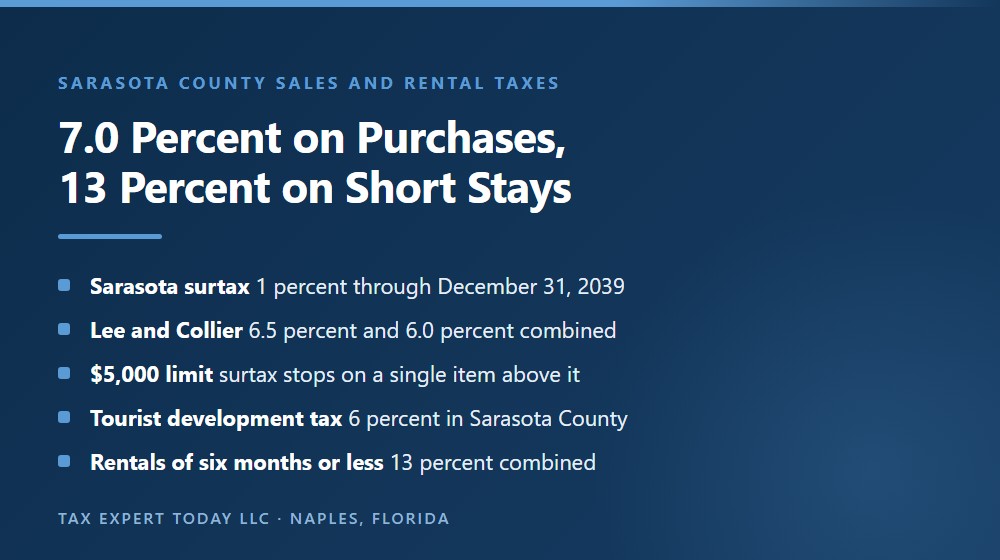
Sarasota County levies a 1 percent discretionary sales surtax that runs through December 31, 2039, so the combined sales tax rate is 7.0 percent. That compares with 6.5 percent in Lee County and 6.0 percent in Collier County. A short-term rental in Sarasota County carries 13 percent in combined state and county taxes.
The surtax figures come from the Department of Revenue’s calendar year 2026 surtax schedule, which lists Sarasota at 1 percent from September 1, 1989 through December 31, 2039. Under section 212.054, Florida Statutes, the surtax applies only to the first $5,000 of a single item of tangible personal property, and a vehicle purchase is taxed by the county of residence shown on the registration. The rental figure adds the state’s 6 percent transient rental tax and the Sarasota County tourist development tax of 6 percent, as listed on the Department of Revenue’s Form DR-15TDT.
| County | Discretionary surtax (2026 schedule) | Combined sales tax | Short-term rental, six months or less |
|---|---|---|---|
| Sarasota | 1 percent through December 31, 2039 | 7.0 percent | 13.0 percent, with a 6 percent tourist development tax |
| Charlotte | 1 percent through December 31, 2026 | 7.0 percent | Check the county rate for the rental year |
| Lee | 0.5 percent through December 31, 2028 | 6.5 percent | 11.5 percent, with a 5 percent tourist development tax |
| Collier, including Naples | None | 6.0 percent | 11.0 percent, with a 5 percent tourist development tax |
| Homestead filing | Relevant here only as evidence of Florida domicile, alongside a driver license, voter registration, and a declaration of domicile | ||
Two local details follow from the table. Englewood straddles the Sarasota and Charlotte county line, and while both counties levy 1 percent today, the 2026 schedule shows Charlotte’s levy ending December 31, 2026, so a later schedule should be checked before relying on a rate after that date. And the 6 percent Sarasota tourist development tax is higher than the 5 percent levied in Lee and Collier, so an owner who rents a Siesta Key or Venice condominium for short stays collects a full percentage point more than an owner of a similar unit further south. The federal rules for those rentals, including the personal-use day count, are covered in our Cape Coral guide and our guide to the short-term rental rules.
Which Sarasota County filings reach a household or small business?
A Sarasota household living only on retirement and investment income generally has no county filing. A business, a self-employed professional, or an owner of a furnished rental may owe the DR-405 tangible personal property return to the Sarasota County Property Appraiser by April 1, which also claims the exemption of up to $25,000.
The Sarasota County Property Appraiser confirms that the DR-405 serves as the application for the exemption and must be filed by April 1 or within an approved extension. Many retirees in Sarasota run a consulting practice or a small business after leaving a career, and the furniture, computers, and equipment used in that work are tangible personal property. The filing mechanics are covered in our Fort Myers guide, which works the Lee County version of the same return.
- Retirement consulting. A Schedule C business with office equipment generally files the DR-405, even when no tax is due after the exemption.
- Furnished rentals. Furniture and appliances in a rental unit are generally reportable tangible personal property.
- Storm losses. Hurricane Milton made landfall near Siesta Key in October 2024, and the IRS relief for it postponed deadlines to May 1, 2025. As of the date of this article there is no open Florida filing postponement, and the casualty loss rules are worked in our Fort Myers guide.
- Declaration of domicile. Under section 222.17, Florida Statutes, a new resident may file a sworn declaration with the Sarasota County Clerk of the Circuit Court.
What records should a Sarasota retiree keep for the return?
A retiree return depends on records that rarely arrive on one form. The essential set is every Form 1099-R and SSA-1099, the cost basis for any account or property sold, confirmation of each Roth conversion and charitable distribution, and the Medicare premium notices that show whether a surcharge is being applied.
- Form 1099-R for every account, with a check that any qualified charitable distribution is identified correctly on the return.
- Form SSA-1099, which also shows the Medicare premiums deducted from the benefit during the year.
- Roth conversion confirmations and Form 8606 from every year a conversion was made, which track basis and the five-year clocks.
- Basis records for a northern home sale, including the purchase closing statement and documented improvements.
- Medicare premium notices, to confirm the income year used and whether an SSA-44 request is worth filing.
Good tax preparation Sarasota retirees can rely on starts with that record set, but the record set alone is not the plan. A short planning conversation in the autumn, before the year closes, is usually worth more than any amount of work in April. Conversions, charitable distributions, and the timing of gains can still be adjusted in November. By the time the return is prepared, those numbers are fixed.
Tax preparation Sarasota FL from Tax Expert Today
Tax Expert Today is based in Naples, Florida, roughly 100 miles south of Sarasota. We work with Sarasota County clients remotely, through a secure document portal, phone, and video meetings, and in-person meetings are available at our Naples office by appointment. We do not have a Sarasota office. Our team includes tax advisors, enrolled agents, CPAs, and attorneys, and we handle federal returns and planning for clients in all 50 states.
Searches such as tax preparation Sarasota FL and retirement tax planning Sarasota tend to come from three situations. One is a household in its first year of retirement, wondering whether to convert part of an IRA before required distributions begin. Another is a retiree who opened a Medicare notice showing a surcharge and wants to know why. The third is a recent arrival from the North who sold a home and wants to see what that sale does to the next two years. Each of these is a planning engagement first and a return second, which is how we approach tax preparation Sarasota clients bring to us.
Tax Expert Today LLC, 11983 Tamiami Trail N, Naples, FL 34110. Telephone (239) 441-2005. Office hours Monday through Friday, 10:00 to 5:00 Eastern time. Our Naples tax planning practice handles the conversion, distribution, and gifting work described above, and our Florida tax services page sets out the full range of work we handle across the state. Households establishing residency should also see our guide to establishing Florida residency.
Do Sarasota clients need to visit the Naples office?
No. Most Sarasota County engagements are handled entirely through the secure portal and scheduled calls, which also suits clients who spend part of the year away from Florida. Clients who prefer to meet in person are welcome at the Naples office on Tamiami Trail North by appointment.
When should you bring in a professional?
A Sarasota retiree with a pension, Social Security, and modest required distributions, and no conversions or large sales, has a return that many people handle comfortably on their own. Florida’s absence of an income tax genuinely simplifies the picture, and it would not be honest to suggest otherwise.
The situations that reward professional attention are the ones where a number has to be chosen. How much to convert to a Roth this year, given the senior deduction phase-out and the Medicare thresholds. Whether a home sale or a large gain will push the premium two years from now into a higher tier, and whether anything can be done about it. Whether a final working year qualifies for an SSA-44 request. How to route charitable gifts so that they reduce income rather than simply leave the bank account. Where a matter has already turned into a notice or an assessment, our Naples tax resolution practice and our IRS resolution and audit support service handle that side of the work.
If any of those describe your year, a conversation about the tax preparation Sarasota households need is worth having before December rather than after it. Call (239) 441-2005 to arrange a consultation, and have the last two years of returns and your most recent Medicare premium notice at hand.
Published October 2, 2026 by Dr. Pellumb Kabashi « Back to Learning Center
Have a question this article touches on?
Tax Expert Today LLC, based in Naples, Florida and serving clients across the United States.
Schedule a Consultation (239) 441-2005