
By Dr. Pellumb Kabashi, DBA, MBA, EA, CFE, CES
Founder, Tax Expert Today LLC · Tax advisors, enrolled agents, CPAs, and attorneys · Serving clients in all 50 states
Quick Answer: IRS passport revocation is the process by which the U.S. State Department can deny, revoke, or limit a passport after the IRS certifies a taxpayer as having a seriously delinquent tax debt. For 2026 that means legally enforceable federal tax debt, including penalties and interest, totaling more than $66,000 under IRC Section 7345. The IRS sends a CP508C notice when it certifies. Fully paying the debt, or entering an installment agreement or accepted offer in compromise, reverses the certification.
Published: July 16, 2026
Few IRS enforcement tools feel as personal as one that can reach your passport. For frequent travelers, dual nationals, and Americans living abroad, the prospect of a passport being denied or revoked over a tax balance turns an accounting problem into a travel emergency. The good news is that the rule is narrow, procedural, and reversible. This 2026 guide explains what IRS passport revocation actually means, what counts as a seriously delinquent tax debt, how the CP508C notice works, how certification is reversed, how to move quickly when travel is imminent, and how the rule applies to expats. Because certification follows unpaid assessed balances, it sits at the end of the same collection story that begins with an IRS CP14 notice.
Can the IRS Revoke My Passport for Unpaid Taxes?
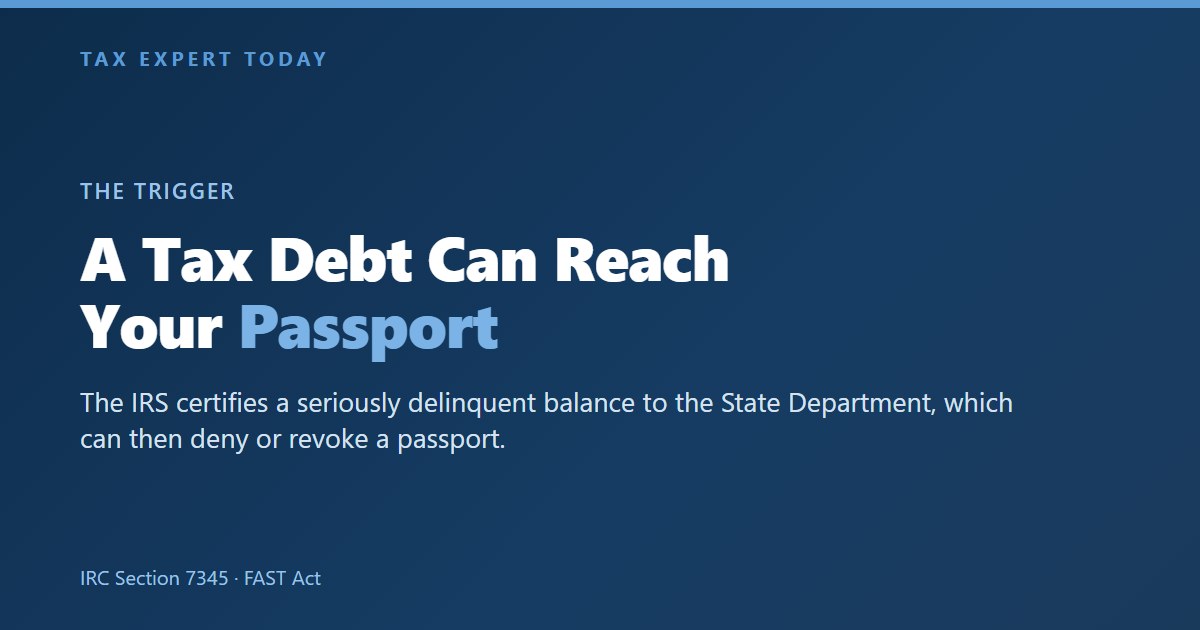
The IRS does not revoke passports directly. Under IRC Section 7345, the IRS certifies a seriously delinquent tax debt to the U.S. State Department, and the State Department is then generally required to deny a new passport application or renewal, and it may revoke or limit an existing passport. So IRS passport revocation is really a two-agency process the tax debt triggers.
This authority comes from the Fixing America’s Surface Transportation (FAST) Act, which added Section 7345 in late 2015. When a debt is certified, the State Department will hold a passport application open for 90 days to give the taxpayer time to resolve the issue or dispute the certification, but it will not issue the passport while the certification stands. In practice, most people first learn of the problem when a renewal stalls or when the CP508C notice arrives. The important framing is that certification is a consequence of an unresolved assessed balance, not a separate penalty, and resolving the balance removes it.
What Is Seriously Delinquent Tax Debt in 2026?
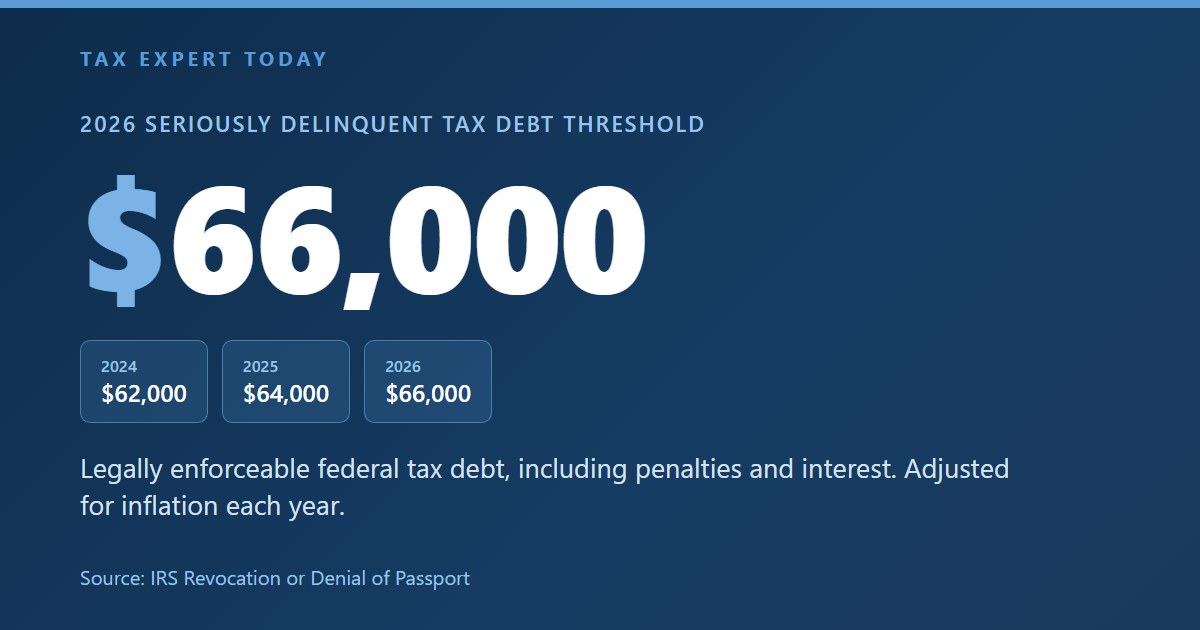
A seriously delinquent tax debt is an individual’s unpaid, legally enforceable federal tax debt, including assessed penalties and interest, that totals more than a threshold amount the IRS adjusts each year for inflation. For 2026, that threshold is $66,000, and the IRS must also have filed a Notice of Federal Tax Lien with appeal rights exhausted or lapsed, or issued a levy, before certification.
The dollar figure is the part that changes annually, so it is worth confirming against the live IRS page. The threshold has climbed steadily with inflation, as the IRS table shows.
| Tax year | Seriously delinquent tax debt threshold |
|---|---|
| 2023 | $59,000 |
| 2024 | $62,000 |
| 2025 | $64,000 |
| 2026 | $66,000 |
Certain debts are excluded even when the balance is above the threshold. According to the IRS Revocation or Denial of Passport page, a debt is not seriously delinquent if it is being paid on time through an IRS-approved installment agreement, is being paid on time under an accepted offer in compromise, is the subject of a timely requested Collection Due Process hearing on a levy, or is suspended because of a pending innocent spouse relief request. Notably, FBAR penalties, child support, and debts under a settlement agreement with the Department of Justice are also outside the definition. This is why entering one of these arrangements is so central to avoiding or clearing certification.
What Is a CP508C Notice?
A CP508C notice is the letter the IRS sends to tell you it has certified your account as a seriously delinquent tax debt and notified the State Department. It is not a bill and it does not by itself demand a new payment. It is a warning that your passport is now at risk, and it explains that a new application or renewal can be denied while the certification stands.
The CP508C notice is the formal starting point of IRS passport revocation for most people, and it is sent to your last known address at the same time the IRS transmits the certification, so the State Department may already have the information when the letter reaches you. The IRS does not send a separate advance warning before certification beyond the collection notices that preceded it, which is one reason unresolved balances should never be ignored at the lien or final-notice stage. If you believe the certification is wrong, for example because the debt is already being paid under an installment agreement or the amount is incorrect, you can contact the IRS to correct it, and in some cases file suit in the Tax Court or a U.S. District Court to challenge whether the certification was erroneous. Keep the notice, because it contains the phone number and reference details needed to act.
How Do I Reverse an IRS Passport Certification?
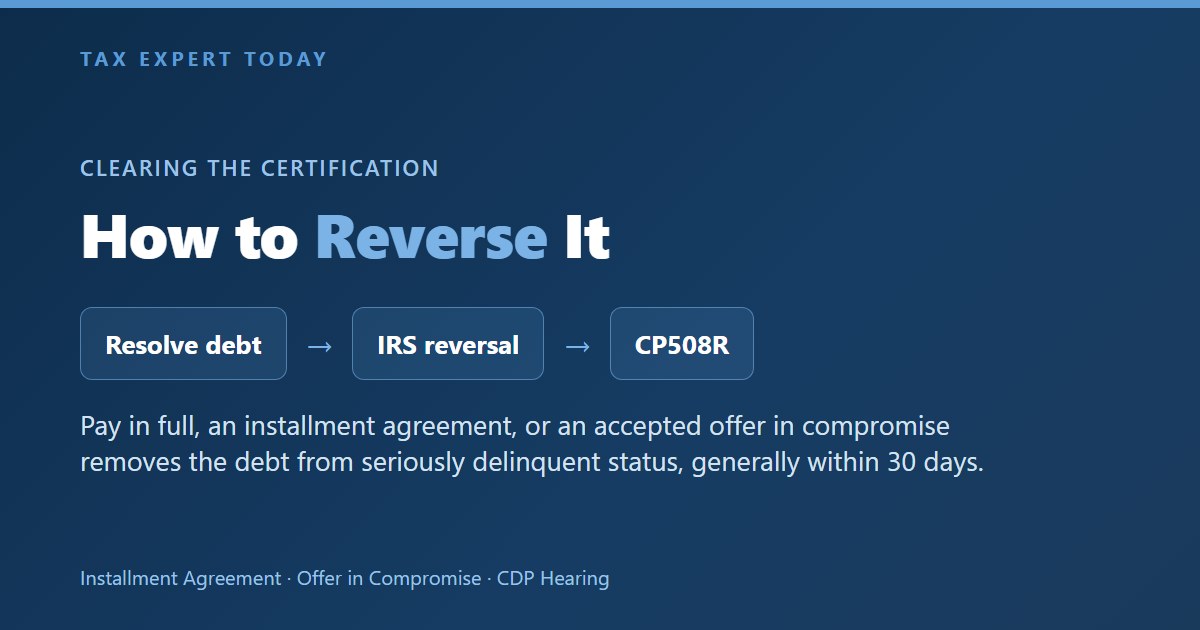
You reverse an IRS passport certification by removing the debt from seriously delinquent status. The IRS reverses a certification when the debt is fully paid or becomes legally unenforceable, when it is no longer seriously delinquent because you have entered a qualifying arrangement, or when the certification was erroneous. It then notifies the State Department and sends you a CP508R notice, generally within 30 days of the resolving event.
There are several qualifying paths, and the right one depends on your ability to pay and the facts of the debt. The table below summarizes the common routes back to a clear passport status.
| Path | How it clears certification |
|---|---|
| Pay in full | The debt is satisfied, so it is no longer seriously delinquent |
| Installment agreement | An IRS-approved plan removes the debt from the definition while payments stay current |
| Offer in compromise | An accepted offer takes the debt out of seriously delinquent status |
| Timely CDP hearing | A timely requested levy hearing under Section 6330 suspends certification |
| Innocent spouse request | A pending request suspends the debt from the definition |
Beyond these, the IRS states that it will not certify, or will hold off certifying, certain taxpayers even when the balance is large. That discretionary list includes accounts the IRS has placed in currently not collectible status due to hardship, taxpayers with a pending installment agreement or offer in compromise request, victims of tax-related identity theft, taxpayers in bankruptcy, those in a federally declared disaster area, and cases where an accepted IRS adjustment will fully satisfy the debt. Currently not collectible status is not a statutory exclusion the way an approved installment agreement is, so it should be confirmed with the IRS rather than assumed. The most reliable protection remains a formal arrangement that squarely fits one of the excluded categories.
How Fast Can a Passport Certification Be Reversed for Urgent Travel?
IRS passport revocation is reversible on an accelerated timeline when travel is close. The IRS offers an expedited reversal for taxpayers with imminent travel. If you have international travel plans within the next 45 days and an open or pending passport application or renewal, you should contact the IRS promptly and ask for an expedited decertification. When it applies, the IRS can shorten the usual timeline and notify the State Department more quickly.
Two conditions matter for the expedited route. First, the IRS will only help expedite a reversal if you actually have an open passport application or renewal request on file with the State Department, so starting that application is part of the process. Second, to be decertified you must fully resolve the certified debt, which for the fastest path usually means paying it or getting a qualifying arrangement approved. Even so, the reversal and the State Department’s processing still take time, so expedited handling is best understood as a way to compress the timeline rather than a same-day fix. Anyone with fixed travel dates and a certified balance should treat it as urgent and begin well before the trip, because the sequence of resolving the debt, IRS reversal, and State Department action cannot be rushed past its steps.
Does IRS Passport Revocation Apply to Expats and Americans Abroad?
Yes. IRS passport revocation applies to U.S. citizens regardless of where they live, because IRC Section 7345 reaches every citizen, so Americans abroad and expats are fully within its scope, and for many the stakes are higher because a passport is essential to daily life and legal residence overseas. A certified debt can stall a renewal filed from a consulate just as it would one filed at home.
For expats, certification often intertwines with international compliance issues. Unfiled returns or foreign-account reporting gaps can produce the assessed balances that eventually cross the threshold, and those taxpayers frequently have a separate route back into compliance through the Streamlined Filing Compliance Procedures. It is worth repeating that FBAR penalties themselves are excluded from the seriously delinquent definition, so the passport risk for expats generally flows from income tax assessments rather than the foreign-account penalties directly. If your passport is revoked while you are outside the United States, the State Department may issue a limited-validity passport good only for direct return to the country. Because the interaction of overseas filing, assessments, and certification is intricate, expats with a large IRS balance should address it deliberately rather than wait for a renewal to fail.
IRS Passport Revocation Help in Naples and Southwest Florida
Tax Expert Today LLC helps individuals in Naples and across Southwest Florida respond to IRS passport certification, from confirming whether a CP508C notice is correct to arranging the installment agreement, offer in compromise, or other resolution that clears the debt from seriously delinquent status and prompts a CP508R reversal. The firm is multidisciplinary, with enrolled agents, CPAs, and attorneys, and works to match the fastest qualifying path to your travel timeline and financial situation. The office is at 11983 Tamiami Trail N, Naples, FL 34110, and the team can be reached at (239) 441-2005, Monday through Friday, 10am to 5pm ET.
Frequently Asked Questions
Can the IRS really take away my passport?
The IRS does not take passports itself. Under IRC Section 7345 it certifies a seriously delinquent tax debt to the State Department, which is then generally required to deny a new passport application or renewal and may revoke or limit an existing passport. It is a two-agency process the unpaid balance triggers, and resolving the debt removes the certification, so the passport risk is tied to the tax debt rather than being a standalone penalty.
What is the seriously delinquent tax debt threshold for 2026?
For 2026 the threshold is $66,000 in legally enforceable federal tax debt, including assessed penalties and interest. The figure is adjusted for inflation each year, up from $64,000 in 2025 and $62,000 in 2024. The IRS must also have filed a Notice of Federal Tax Lien with appeal rights exhausted, or issued a levy, before it certifies the debt to the State Department.
What should I do when I receive a CP508C notice?
A CP508C notice means the IRS has certified your debt and notified the State Department. Verify the balance is correct, and if it is, resolve it through payment, an installment agreement, or an offer in compromise so the IRS can reverse the certification. If the certification is wrong, for example because you already have an approved payment plan, contact the IRS to correct it, and in some cases you can challenge an erroneous certification in court.
How long does it take to reverse a passport certification?
The IRS generally reverses a certification and notifies the State Department within 30 days after the debt is resolved, then sends a CP508R notice. If you have international travel within 45 days and an open passport application, you can request an expedited reversal to compress the timeline. Even expedited, the combined IRS and State Department steps take time, so it is best to begin resolving a certified debt well before any fixed travel date.
Does an installment agreement stop passport revocation?
Yes. A debt being paid on time under an IRS-approved installment agreement is excluded from the seriously delinquent definition, so entering and staying current on a plan removes the passport risk. An accepted offer in compromise, a timely requested Collection Due Process levy hearing, and a pending innocent spouse relief request also take the debt out of certification. Defaulting on the arrangement, however, can return the debt to seriously delinquent status.
Where can I get help with IRS passport revocation in Naples, FL?
Tax Expert Today LLC, located at 11983 Tamiami Trail N, Naples, FL 34110, assists individuals in Naples and across Southwest Florida with IRS passport certification, including reviewing a CP508C notice, arranging an installment agreement or offer in compromise, and requesting expedited reversal for urgent travel. The firm is multidisciplinary, with enrolled agents, CPAs, and attorneys, and represents taxpayers before the IRS nationwide. Consultations can be arranged at (239) 441-2005.
When to Engage a Professional for IRS Passport Revocation
A certified tax debt combines a hard dollar threshold, a strict list of qualifying arrangements, and a travel clock that rarely bends, which is exactly the mix where experienced representation matters: confirming whether the certification is even correct, selecting the resolution path that fits both your finances and your travel dates, and coordinating the timing so the CP508R reversal reaches the State Department before you need to fly. Acting at the lien or final-notice stage, before certification, is easier than unwinding it afterward. Tax Expert Today LLC, founded by Dr. Pellumb Kabashi, represents individuals and businesses in IRS collection matters nationwide.
Call (239) 441-2005 or schedule a consultation to review a CP508C notice and build a plan to clear the certification. Tax advisors, enrolled agents, CPAs, and attorneys serving clients in all 50 states.
Published July 16, 2026 by Dr. Pellumb Kabashi « Back to Learning Center
Have a question this article touches on?
Tax Expert Today LLC, based in Naples, Florida and serving clients across the United States.
Schedule a Consultation (239) 441-2005