
By Dr. Pellumb Kabashi, DBA, MBA, EA, CFE, CES
Founder, Tax Expert Today LLC · Tax advisors, enrolled agents, CPAs, and attorneys · Serving clients in all 50 states
The IRS Fresh Start program is not a form, an application, or a forgiveness policy. It is a set of administrative changes the IRS announced across 2011 and 2012 that loosened lien filing, widened installment agreement access, and softened the math behind an offer in compromise. You apply for the underlying relief, never for Fresh Start itself. Call (239) 441-2005 for a free consultation.
What is the IRS Fresh Start program?
The IRS Fresh Start program is a marketing shorthand for a series of collection policy changes the IRS rolled out in 2011 and 2012. It was never codified, never given an application form, and never given an approval process of its own. It changed how the IRS files liens, who qualifies for a payment plan without submitting financials, and how offer in compromise settlements are calculated.
- Not a statute. No provision of the Internal Revenue Code contains the words Fresh Start.
- Not a form. There has never been a Form to apply for Fresh Start.
- Not forgiveness. Nothing in the initiative erases a balance by itself.
- An umbrella term. It covers three separate announcements, two of which have since been superseded in part.
The IRS itself used the phrase in three news releases and then largely stopped. The term survives today mostly in advertising, which is why searching for the IRS Fresh Start program returns pages selling representation rather than pages explaining mechanism. Understanding what each announcement actually did is what tells you which relief you can pursue.
What did the Fresh Start initiative actually change?
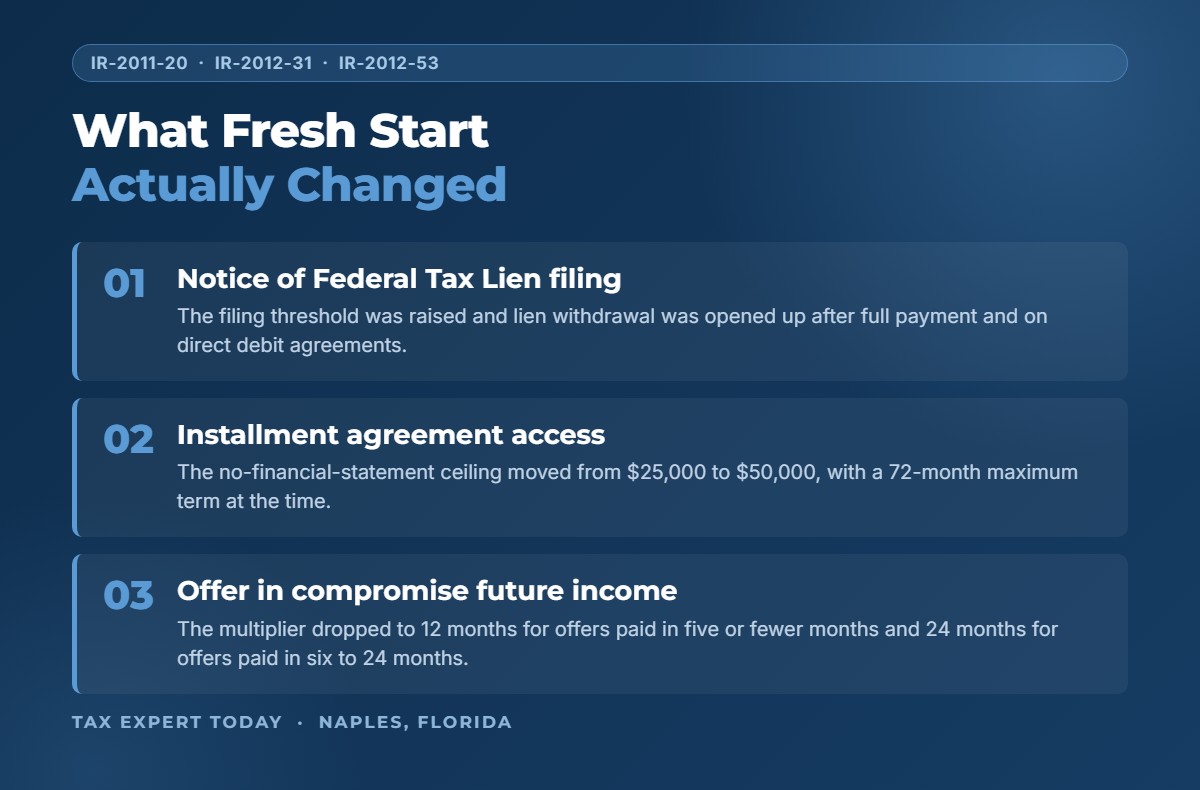
Three announcements did the work. IR-2011-20 changed lien filing and withdrawal practice and widened access to payment plans for small businesses. IR-2012-31 raised the installment agreement threshold that triggers a financial statement and extended the maximum term. IR-2012-53 rewrote how the IRS values future income when it evaluates an offer in compromise.
- February 2011. Lien filing thresholds raised, lien withdrawal opened after full payment, and withdrawal made available on direct debit agreements.
- March 2012. The no-financial-statement installment agreement ceiling doubled from $25,000 to $50,000, and the maximum term moved from 60 months to 72 months.
- May 2012. The future income multiplier in an offer in compromise fell from four years to 12 months, and from five years to 24 months, depending on payment terms.
| Fresh Start change | Before | After the announcement | Source |
|---|---|---|---|
| Small business streamlined payment plan | Under $10,000 in unpaid tax | $25,000 or less, payable over 24 months, direct debit required | IR-2011-20 |
| Lien withdrawal on a direct debit agreement | Not routinely available | Available for unpaid assessments of $25,000 or less | IR-2011-20 |
| Streamlined offer in compromise access | Liability of $25,000 or less | Income up to $100,000 and liability under $50,000 | IR-2011-20 |
| Payment plan without a financial statement | $25,000 | $50,000 | IR-2012-31 |
| Maximum payment plan term | 60 months | 72 months | IR-2012-31 |
| Future income, offer paid in five or fewer months | 48 months of future income | 12 months of future income | IR-2012-53 |
| Future income, offer paid in six to 24 months | 60 months of future income | 24 months of future income | IR-2012-53 |
One detail deserves emphasis because nearly every competing page gets it wrong. IR-2011-20 never states a $10,000 lien threshold. The release says only that the IRS would significantly increase the dollar thresholds at which liens are generally filed, and that the new amount kept pace with inflation. The $10,000 figure that gets attributed to Fresh Start comes from the Internal Revenue Manual at IRM 5.12.2, not from the news release, and it functions as an operational reference point rather than a promise.
Do the 2012 Fresh Start rules still apply in 2026?
Partly. The offer in compromise changes survived and remain in force. The installment agreement rules did not survive in their 2012 form. As of the July 21, 2026 revision of IRM 5.14.5, the IRS replaced the streamlined installment agreement with the Simple Payment Plan, dropped the two-tier structure, and removed the 72-month rule entirely.
- The term changed. IRM 5.14.5 now says Simple Payment Plan wherever it used to say streamlined installment agreement.
- The tiers are gone. The old split between balances up to $25,000 and balances from $25,001 to $50,000 was removed.
- The 72-month rule is gone. The plan must now full pay by the collection statute expiration date instead.
- The ceiling held. The $50,000 aggregate unpaid balance of assessment threshold from 2012 is still the line.
Under the current IRM 5.14.5, a Simple Payment Plan may be granted where the aggregate unpaid balance of assessment is $50,000 or less, counting tax, assessed penalties, interest, and other assessments, but not accrued and unassessed penalties and interest. Every such plan must be calculated with the IAT Compliance Suite Payment Calculator, and that calculation has to full pay all balances, including accruals, by the collection statute expiration date. Monthly amounts may rise or fall over the life of the plan so long as the balance clears before that date.
Two further changes matter to anyone dealing with a revenue officer. A Notice of Federal Tax Lien determination is no longer required in order to grant a Simple Payment Plan, though a revenue officer retains discretion to file one and must document the justification. Managerial approval is no longer required to grant the plan at all.
The change is visible on the public side too. The IRS Online Payment Agreement page now describes a simple payment plan for taxpayers who owe $50,000 or less in combined tax, penalties, and interest and who have filed all required returns. A short-term plan, meaning 180 days or less, is available to taxpayers who owe less than $100,000 combined. The 72-month figure that fills page after page of Fresh Start content no longer appears there at all.
| Rule | As announced in 2012 | As it stands in 2026 |
|---|---|---|
| Name | Streamlined installment agreement | Simple Payment Plan |
| Balance ceiling | $50,000 | $50,000 aggregate unpaid balance of assessment |
| Internal tiers | Up to $25,000, then $25,001 to $50,000 | Removed |
| Maximum term | 72 months | No fixed term; must full pay by the CSED |
| Direct debit | Required for the expanded threshold | Not required across the board |
| Lien determination | Case by case | Not required, discretionary with documentation |
| Managerial approval | Required in parts of the range | Not required |
This is the single most common way Fresh Start content goes stale. A page written from the 2012 press release, and then refreshed each year by changing the year in the title, will still tell a reader to expect a 72-month streamlined agreement. A revenue officer working the file in 2026 is running a different calculation.
Is there a Fresh Start application form?
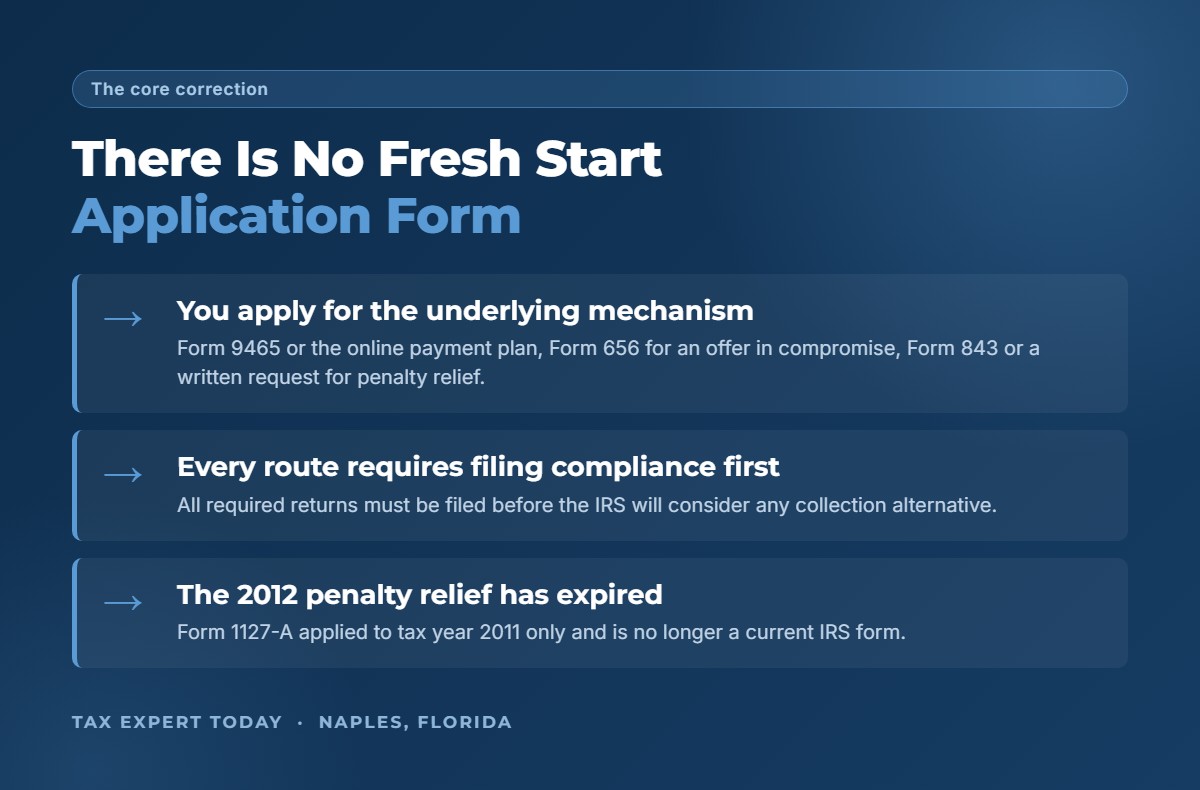
No. There is no Fresh Start form, no Fresh Start application, and no Fresh Start approval letter. Every route described under the Fresh Start umbrella has its own form and its own eligibility test. Anyone offering to submit a Fresh Start application on your behalf is describing one of the underlying mechanisms in different words.
- Payment plan. Apply through the Online Payment Agreement tool or on Form 9465.
- Offer in compromise. Apply on Form 656 with Form 433-A (OIC) or Form 433-B (OIC).
- Penalty relief. Request first-time abatement or reasonable cause relief by phone, in writing, or on Form 843.
- Currently not collectible. Request it through Collection with a Form 433-F or Form 433-A financial statement.
The practical consequence is that the question to ask is never whether you qualify for the IRS Fresh Start program. The question is which collection alternative your financial facts support, because that is the determination the IRS actually makes.
Which relief actually applies to your situation?
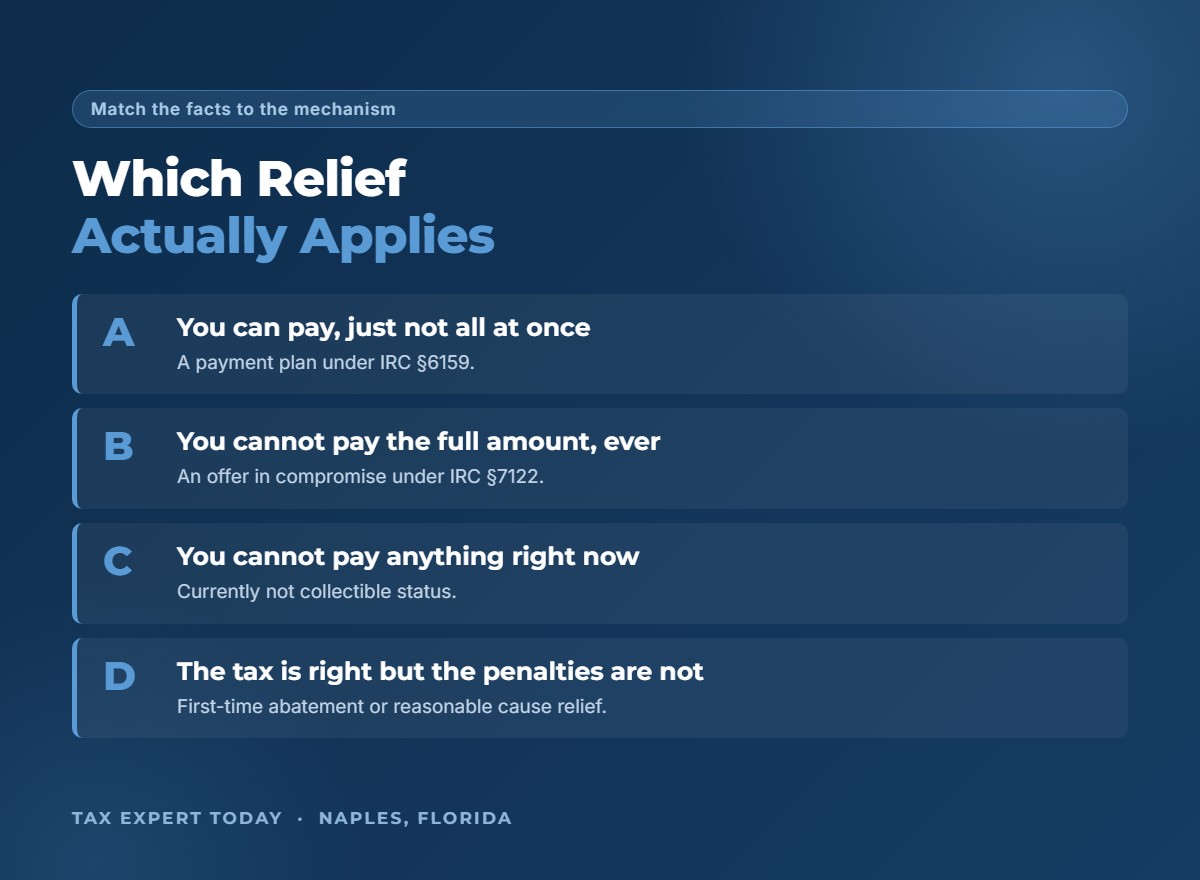
Route by capacity to pay, not by label. If you can pay in full over time, you want a payment plan. If your assets and future income together cannot reach the balance, an offer in compromise is the candidate. If you cannot pay anything now, currently not collectible status is the fit. If the tax is correct but the penalties are not, you want penalty relief.
| Your situation | The mechanism | Authority | Where it leads |
|---|---|---|---|
| You can pay the balance, just not all at once | Installment agreement or Simple Payment Plan | IRC §6159 | Monthly payments through the CSED |
| Assets plus future income fall short of the balance | Offer in compromise | IRC §7122 | Settlement of the liability if accepted |
| Paying anything would prevent basic living expenses | Currently not collectible | IRM 5.16.1 | Collection paused while the clock keeps running |
| The tax is right but penalties inflated it | First-time abatement or reasonable cause | IRM 20.1.1 | Penalty removal, interest follows the penalty |
| You have not filed for several years | Filing the missing returns | IRC §6020 | The precondition for every option above |
| A levy or lien notice already arrived | Collection due process hearing | IRC §§6320, 6330 | Appeals review before enforcement |
Each row is a different evidentiary burden. An offer in compromise requires a full financial disclosure and an application fee of $205, waived for taxpayers who meet the low income certification guidelines, along with an initial payment that is similarly waived. The future income multipliers set in 2012 are still the operative rule, and IRM 5.8.5 continues to direct that the IRS use 12 months of collectible income for an offer paid in five or fewer payments and 24 months for an offer payable in six to 24 months. A Simple Payment Plan requires far less. Choosing the harder route when the easier one fits wastes months.
What does the IRS require before granting any of it?
Filing compliance comes first, without exception. The IRS will not grant an offer in compromise, and will generally not finalize a collection alternative, while required returns are missing. The IRS offer in compromise page states the eligibility conditions directly, and the first of them is that all required returns are filed and all required estimated payments are made.
- All required returns filed. This is the gate on every route.
- Estimated payments current. Required for the year in progress.
- No open bankruptcy. An open proceeding blocks an offer in compromise outright.
- Employers current on deposits. Deposits must be made for the current and prior two quarters.
- A valid extension. Needed where the application covers the current year.
If you have unfiled returns, the sequence is not negotiable. Filing comes first, then the collection alternative. That is also why an advertisement promising relief without mentioning filing compliance is describing something the IRS does not do.
What happened to the Fresh Start penalty relief for the unemployed?
It expired. The penalty relief announced in IR-2012-31 was a six-month grace period on the failure to pay penalty, claimed on Form 1127-A, and it applied to tax year 2011 only. The relief required the tax, interest, and other penalties to be fully paid by October 15, 2012. Form 1127-A is no longer a current IRS form.
- Tax year 2011 only. The relief did not carry forward to later years.
- Narrow eligibility. Wage earners unemployed at least 30 consecutive days, or self-employed individuals whose business income fell 25 percent or more.
- Income limits applied. Not over $200,000 married filing jointly, or $100,000 single or head of household.
- Balance capped. The 2011 balance due could not exceed $50,000.
- Interest never waived. The IRS stated it lacked authority to waive interest.
This matters because hardship-based penalty language in Fresh Start advertising often traces back to a measure that closed more than a decade ago. Penalty relief today runs through first-time abatement or reasonable cause, which are separate administrative routes with their own criteria. Our guide to getting IRS penalties removed walks through both.
How does the lien threshold work today?
The IRS files a Notice of Federal Tax Lien under IRC §6323 to establish priority against other creditors. The Internal Revenue Manual treats an aggregate unpaid balance of assessment below $10,000 as a case where not filing is a typically expected action, and a balance below $2,500 as similar. Neither figure is a taxpayer entitlement.
- A threshold, not a rule. Revenue officers retain discretion to file above or below it.
- Documentation shifts. Departing from the expected action is what requires a written rationale.
- Withdrawal is separate. A withdrawal removes the public notice; it does not release the lien.
- Payment plans interact. A lien determination is no longer required to grant a Simple Payment Plan.
If a lien notice or a final notice of intent to levy has already arrived, the Fresh Start framing stops being useful and deadlines take over. Those notices carry appeal rights with fixed windows, and missing the window narrows the options that remain.
Why do companies advertise Fresh Start as a program you can be approved for?
Because a named program with an approval step converts better than an accurate description of collection procedure. Framing routine relief as a limited initiative creates urgency, and framing it as an application creates a role for a paid intermediary. The Federal Trade Commission has brought enforcement actions against tax relief firms over outcome claims of this kind.
- Urgency framing. Deadlines are implied where none exist.
- Approval framing. Suggests a gate that only a firm can open.
- Outcome framing. Settlement figures are quoted without the financial analysis behind them.
- Qualification framing. A free qualification check is often a sales call.
None of this makes professional representation unnecessary. It makes the basis for engaging one different. Representation is worth paying for when the financial analysis is contested, when a revenue officer is assigned, when an appeal window is open, or when the mechanics of an offer in compromise call for judgment. It is not worth paying for as a fee to submit a form that does not exist.
Frequently Asked Questions
Is the IRS Fresh Start program legitimate?
The underlying relief is legitimate and the name is real, but the framing usually is not. The IRS did publish three Fresh Start news releases, and installment agreements, offers in compromise, and penalty relief are genuine programs with statutory or administrative authority. What is not legitimate is the suggestion that Fresh Start is an application you can be approved for, or that a limited window is closing.
What is IRS one time forgiveness?
There is no IRS program by that name. The phrase is generally used to describe either first-time penalty abatement, which removes certain penalties for a taxpayer with a clean compliance history, or an offer in compromise, which can settle a liability for less than the full balance where the financial analysis supports it. The two are unrelated and have different criteria.
Can you apply for the IRS Fresh Start program yourself?
You can apply for every underlying mechanism yourself. A payment plan can be requested online, an offer in compromise can be submitted on Form 656, and penalty relief can be requested by phone or in writing. Representation tends to earn its cost where the financial analysis is contested, where a revenue officer is assigned, or where an appeal deadline is running.
How long does Fresh Start relief take to resolve?
It depends entirely on the mechanism. An online payment plan can be approved immediately. An offer in compromise commonly takes many months to investigate, and every accepted offer must be fully paid within 24 months of acceptance. Currently not collectible status is usually decided faster than an offer but is reviewed periodically as income changes.
Does the IRS Fresh Start program stop interest from accruing?
No. Interest continues to accrue on an unpaid balance throughout an installment agreement, and the IRS has stated it lacks the authority to waive it. Penalties may be reduced or removed through abatement, and the failure to pay penalty rate is lower while an agreement is in force, but interest runs until the balance is paid or otherwise resolved.
Tax Resolution Naples: Fresh Start Help in Naples & Southwest Florida
Tax resolution Naples: Tax Expert Today LLC represents taxpayers in Naples, Florida and across all fifty states in IRS collection matters, including payment plans, offers in compromise, currently not collectible requests, and penalty abatement. Most people who arrive asking about the IRS Fresh Start program are really asking which collection alternative their numbers support, and that question is answered by running the financial analysis rather than by naming a program. Our IRS resolution and audit support practice handles collection and appeals work, and our Naples tax resolution page describes how local engagements are structured.
The firm is located at 11983 Tamiami Trail N, Naples, FL 34110. Call (239) 441-2005, Monday through Friday, 10am to 5pm ET.
Does living in Florida change which Fresh Start relief applies?
Not for the federal balance. Collection alternatives under IRC §6159 and IRC §7122 are federal and apply identically in Naples and everywhere else. Florida does affect the analysis indirectly, because the allowable living expense standards used to compute your ability to pay are geographic, and Collier County housing and utility figures differ from national averages. Florida also imposes no personal income tax, so a Southwest Florida taxpayer usually has one balance to resolve rather than a state balance running alongside it.
When to Engage a Professional
Consider representation if a revenue officer has been assigned, if a lien or levy notice has arrived, if an offer in compromise is under consideration, if several years of returns are unfiled, or if a prior request was rejected and an appeal window is still open. Outcomes depend on the specific facts, and no route assures relief. What a representative can do is make sure the financial analysis is prepared correctly the first time, that the right mechanism is selected, and that no deadline passes while the wrong application is pending.
Tax Expert Today LLC, founded by Dr. Pellumb Kabashi, works these matters from the mechanism outward. If you received a CP14 balance due notice and want to know which collection alternative fits before the next notice arrives, call (239) 441-2005 for a free consultation.
This article is educational and general in nature. It is not tax advice for any particular taxpayer, and it does not create a client relationship. Tax results depend on individual facts and on IRS discretion.
Published August 10, 2026 by Dr. Pellumb Kabashi « Back to Learning Center
Have a question this article touches on?
Tax Expert Today LLC, based in Naples, Florida and serving clients across the United States.
Schedule a Consultation (239) 441-2005