
By Dr. Pellumb Kabashi, DBA, MBA, EA, CFE, CES
Founder, Tax Expert Today LLC · Tax advisors, enrolled agents, CPAs, and attorneys · Serving clients in all 50 states
Quick Answer: Form 433-A is the IRS Collection Information Statement for wage earners and self-employed individuals. It reports income, living expenses, and assets so the IRS can calculate what it believes you can pay. The figures are not accepted as written. They are measured against the Allowable Living Expense standards and against a forced valuation of your assets. Call (239) 441-2005 for a free consultation.
What Is Form 433-A?
Form 433-A is the Collection Information Statement the IRS uses for wage earners and self-employed individuals. It is a sworn financial disclosure covering household income, monthly living expenses, bank and investment accounts, real property, vehicles, and business assets. The IRS uses it to compute a monthly payment figure and to decide whether any collection alternative is available to you.
The form itself is not the decision. It is the input. What matters is the analysis the IRS runs on the numbers you report, and that analysis is governed by Internal Revenue Manual 5.15.1, which was last revised on June 29, 2026. Understanding that analysis before you fill in the boxes is the difference between a statement that supports the outcome you want and one that argues against it.
- It is a sworn document. The signature block carries a penalties of perjury declaration, so an inaccurate figure is not a negotiating position.
- It drives every collection alternative. An installment agreement, currently not collectible status, and an offer in compromise all run off the same financial picture.
- It is time sensitive. The IRS treats a statement as current for a limited period, and a stale form is routinely returned for an update.
- It is verified, not taken on trust. The IRS compares what you report against internal transcripts, wage data, and public records before it accepts anything. Where records are missing, a revenue officer can obtain them from banks and other third parties with an IRS summons.
Form 433-A vs 433-F vs 433-A (OIC): Which One Do I File?
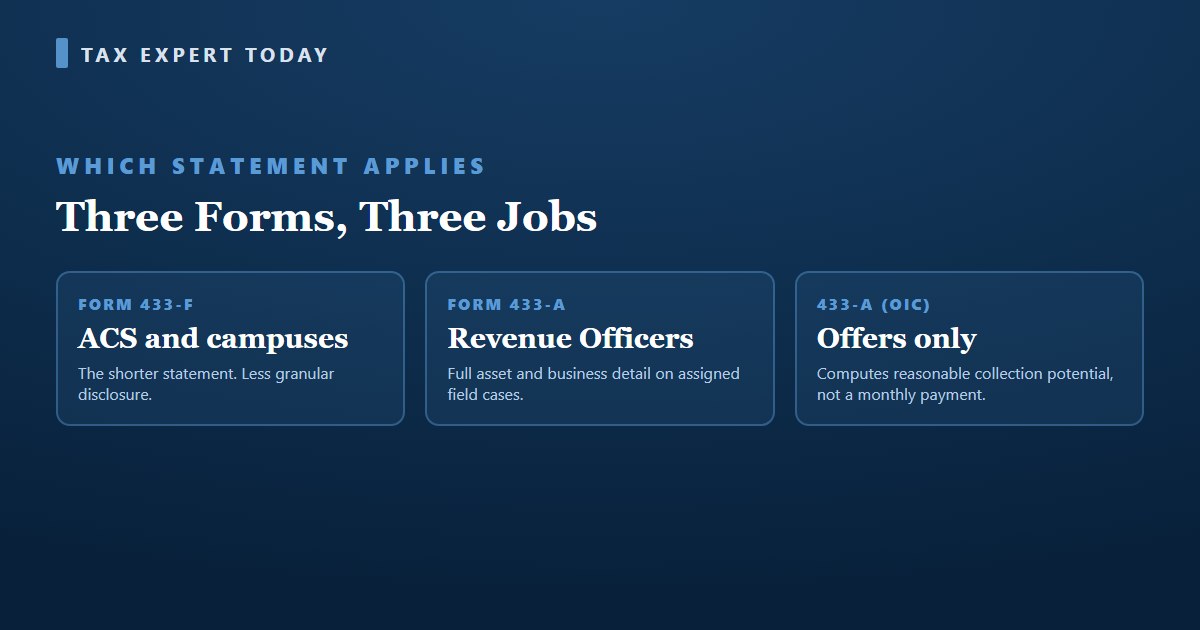
File the form the IRS asks for, because each one belongs to a different part of the collection function. Form 433-F is the shorter statement used by the Automated Collection System and the campuses. Form 433-A is the longer statement a Revenue Officer uses. Form 433-A (OIC) is used only with an offer in compromise and computes a different number entirely.
IRM 5.15.1 states the distinction plainly. Financial information may be secured on Form 433-A for wage earners and self-employed individuals, Form 433-B for businesses, and Form 433-F for the Automated Collection System and the campuses. Revenue Officers may also use Form 433-F in Trust Fund Recovery Penalty investigations.
| Form | Who uses it | What it produces |
|---|---|---|
| 433-F | Automated Collection System and campus staff | A monthly payment figure, on a shorter and less granular disclosure |
| 433-A | Revenue Officers, assigned field cases | A monthly payment figure, with full asset and business detail |
| 433-B | Businesses, including corporations and partnerships | The entity financial picture, separate from any owner |
| 433-A (OIC) | Individuals submitting an offer in compromise | Reasonable collection potential, not a monthly payment |
The last row is the one that trips people up. Form 433-A (OIC) is not a longer version of Form 433-A. It computes reasonable collection potential, which is net realizable equity in assets plus a multiple of monthly disposable income. That is a lump sum concept, not a payment concept, and it is governed by IRM 5.8.5 rather than by IRM 5.15.1. Our guide to the IRS offer in compromise covers that calculation in full.
What Does the IRS Do With the Numbers?
The IRS does not accept your reported expenses at face value. It applies the necessary expense test from IRM 5.15.1, then caps most categories at the Collection Financial Standards. Whatever income remains after allowable expenses is what the IRS expects you to pay each month, and that remainder is the entire point of the exercise.
The standards in force were made effective on June 29, 2026 for purposes of federal tax administration. They come in two layers. National standards are fixed nationwide amounts that you receive without having to prove you actually spend that much. Local standards vary by geography and are capped at the lesser of the standard or what you actually pay.
| National standard category | One person | Two persons | Three persons | Four persons |
|---|---|---|---|---|
| Food | $496 | $893 | $1,073 | $1,278 |
| Housekeeping supplies | $44 | $85 | $94 | $95 |
| Apparel and services | $98 | $175 | $211 | $249 |
| Personal care products | $54 | $90 | $104 | $118 |
| Miscellaneous | $175 | $315 | $375 | $436 |
| Total | $867 | $1,558 | $1,857 | $2,176 |
Out of pocket health care is a separate national standard, allowed per person at $90 for taxpayers under 65 and $163 for taxpayers 65 and older, in addition to health insurance premiums. Housing and utilities and transportation are local standards. Transportation splits into ownership costs, meaning the monthly loan or lease payment, and operating costs, which the IRS describes as covering maintenance, repairs, insurance, fuel, registrations, licenses, inspections, parking, and tolls.
- Necessary expenses are allowed. These provide for the health and welfare of the family or the production of income.
- Conditional expenses are sometimes allowed. They do not meet the necessary expense test but may be permitted where the liability can still be paid within the statutory period.
- Shared households are prorated. Where a non liable person contributes to the household, IRM 5.15.1 applies the taxpayer proportionate share of household income to the shared expenses.
- Credit card payments are not an expense. The IRS treats a credit card as a method of payment, and allows only the underlying necessary expense.
The number that survives this analysis drives what happens next. If a monthly amount remains, the case points toward an installment agreement. If nothing remains after allowable expenses, the case may point toward currently not collectible status instead.
How Does the IRS Value My Assets?
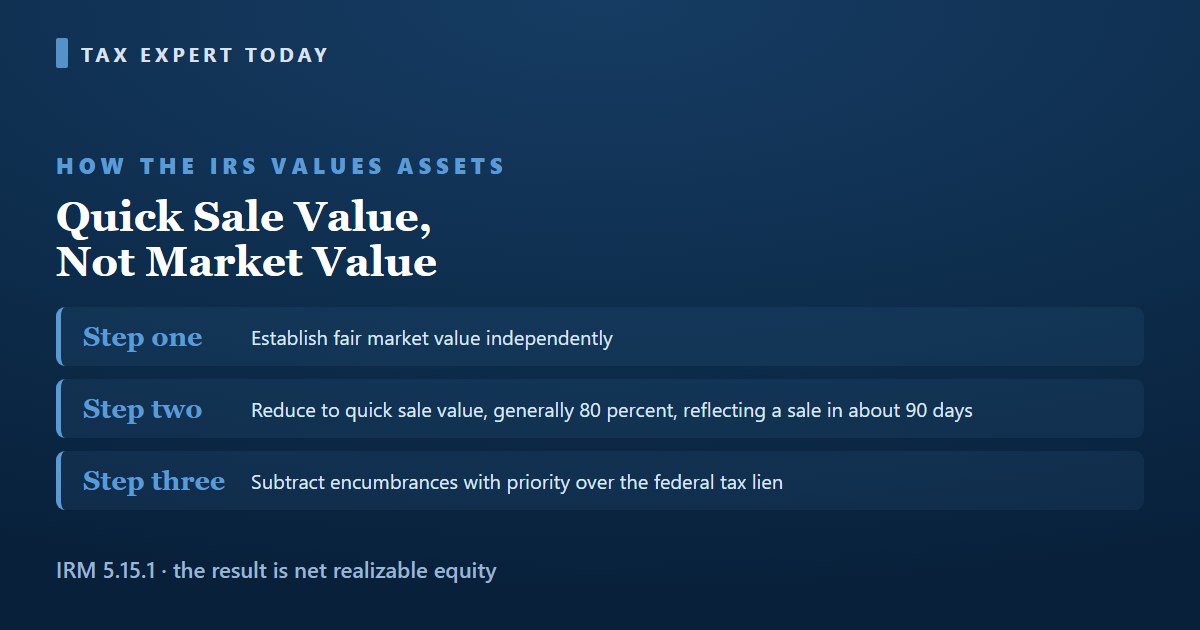
The IRS does not use fair market value. It uses quick sale value, which IRM 5.15.1 defines as an amount reduced from fair market value to reflect the pressure on a seller who must sell within roughly 90 days or less. Quick sale value is generally calculated at 80 percent of fair market value, and equity is what remains after encumbrances.
This single rule explains a large share of the surprise in collection cases. A taxpayer reports a house at its market value and assumes the mortgage cancels it out. The IRS applies the 80 percent haircut, subtracts the loan, and finds equity the taxpayer did not think existed. The manual notes that a higher or lower percentage may be appropriate depending on the type of asset and current market conditions, so the 80 percent figure is a starting point rather than a fixed rule.
| Step | What the IRS does |
|---|---|
| 1. Establish fair market value | Research the asset independently rather than relying only on your figure |
| 2. Apply the quick sale reduction | Generally 80 percent of fair market value, reflecting a sale in about 90 days |
| 3. Subtract encumbrances | Only debts with priority over the federal tax lien reduce the number |
| 4. Result | Net realizable equity, which feeds the collection decision |
A further layer applies in the offer context. IRM 5.8.5 addresses dissipated assets, meaning assets that were sold, transferred, or spent after the tax liability arose. Where the IRS concludes an asset was dissipated rather than genuinely consumed on necessary expenses, the value can be added back into the calculation even though the asset no longer exists.
What Documentation Must I Attach?
A Collection Information Statement without substantiation is an incomplete submission. IRM 5.15.1 directs the IRS to review wage statements for the prior three months for a wage earner, and to compare average earnings against the income declared on the statement. Bank statements, proof of the expenses you claim above the standards, and asset documentation follow the same pattern.
- Income substantiation. Wage statements for the prior three months, or a statement showing current year to date figures, which the manual accepts as an alternative.
- Bank records. Statements covering the recent months, which the IRS reads for both balances and undisclosed deposits.
- Expenses above the standard. Amounts within the national standards need no proof, but anything you claim beyond a cap has to be documented.
- Asset documentation. Mortgage statements, loan balances, and vehicle information sufficient to establish encumbrances.
- Self employment records. Profit and loss information where business income is reported on the statement.
IRM 5.15.1 also instructs employees to tailor the request to the specific situation and not to require information the IRS can obtain from internal or online sources. That instruction is worth knowing, because an unusually broad document demand is not always required by the manual.
What Gets a Form 433-A Rejected or Sent Back?
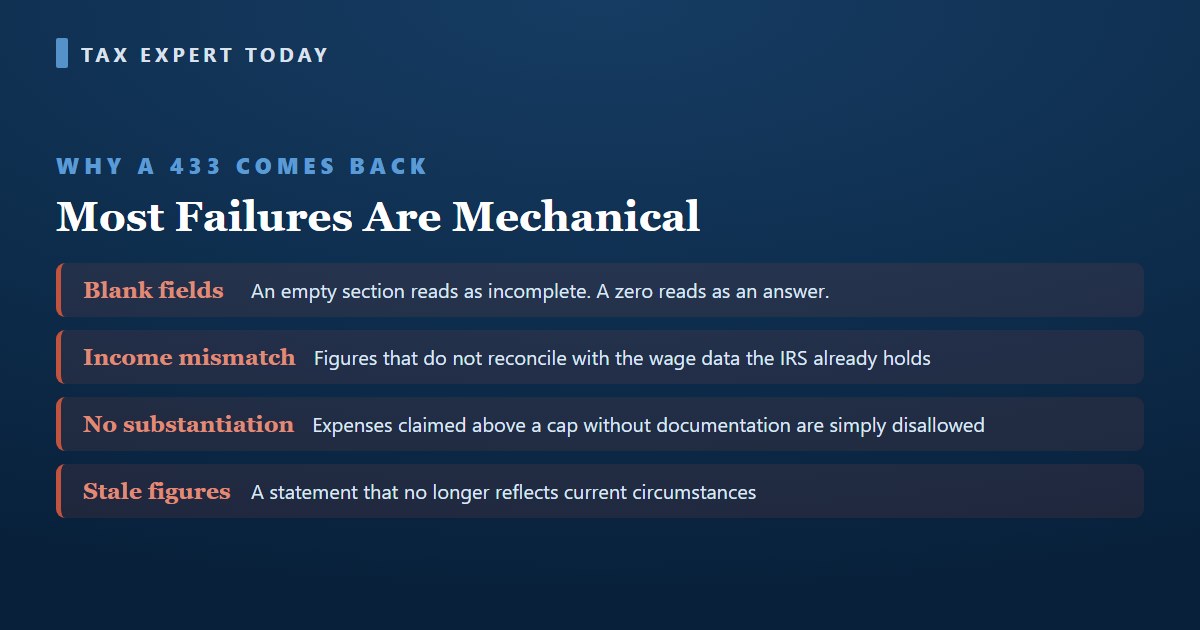
Most returned statements fail for mechanical reasons rather than for the underlying finances. Unsigned forms, missing substantiation, stale figures, blank sections, and internal inconsistencies between the reported income and the IRS own wage data are the recurring causes, and each one restarts the clock on a case that may already be under collection pressure.
- Blank fields rather than zeros. A section left empty reads as incomplete; a zero reads as an answer.
- Income that does not match the transcript. The IRS compares your figures against its own wage and income data before accepting them.
- Undisclosed accounts or assets. Deposits visible in the bank statements that do not appear anywhere on the form.
- Expenses claimed above the caps with no proof. The excess is simply disallowed, which raises the payment figure.
- A statement that has gone stale. Financial information ages, and an old submission is commonly returned for a current one.
There is a further consideration that has nothing to do with the form itself. Filing a Collection Information Statement gives the IRS a detailed map of your finances. In some situations that is exactly the right move, and in others the better path is to resolve the balance without ever submitting one. The collection statute is part of that calculation, and our guide to the 10 year collection period explains why timing matters. The Fresh Start provisions also changed when a full financial disclosure is required at all.
Do I Always Have to File One?
Not always. The IRS offers several agreements that do not require a Collection Information Statement, generally where the balance is below an administrative threshold and the taxpayer agrees to a payment term the IRS considers acceptable. Where a streamlined path is available, providing a full financial statement volunteers information the IRS did not require.
The thresholds and the qualifying terms are administrative rather than statutory, which means they are revised from time to time and should be confirmed against current guidance rather than against an older article. This is one of the areas where published information goes out of date quickly, and where a figure that was correct last year may no longer be. Our guide to installment agreement options is kept current on which paths require a financial statement and which do not.
How Is Form 433-A Different for the Self Employed?
A self employed taxpayer completes the same Form 433-A, but the business sections change the analysis substantially. Business income is reported net of ordinary and necessary business expenses, business assets are listed separately from personal ones, and the IRS applies the necessary expense test to the business as well, allowing only what is required to produce income.
The recurring difficulty is that a sole proprietor treats gross receipts as income and personal draws as salary, and neither maps onto the form. The IRS wants the net figure and it wants the business assets disclosed even where they are pledged. Two specific issues arise more than any other.
- Irregular income needs a period, not a snapshot. A single strong month or weak month misrepresents the figure, so an averaged period supported by records is more defensible.
- Business assets are still assets. Equipment and receivables appear in the calculation, subject to the same quick sale reduction as personal property.
- Ongoing compliance is a precondition. Current estimated tax payments and filed returns are generally expected before any alternative is agreed.
- An entity may need its own statement. Where the business is a separate entity rather than a proprietorship, the IRS may request Form 433-B in addition.
How Long Is a Form 433-A Good For?
There is no fixed statutory shelf life, but the IRS treats a Collection Information Statement as a picture of current circumstances, and a statement that no longer reflects them is routinely returned for an update. Where months have passed, or where income, employment, or household composition has changed, expect to submit current figures rather than the original ones.
This matters more than it first appears, because collection cases move slowly and a taxpayer can find that the statement submitted at the start of a case is out of date by the time it is reviewed. IRM 5.15.1 also notes that where the taxpayer or the IRS believes three months of expenses are not representative of actual yearly expenditure, additional months up to a full year may be reviewed, which cuts in both directions depending on the facts.
What Happens After You Submit It?
The IRS verifies the statement against information it already holds, applies the expense standards and the asset valuation rules, and arrives at a monthly figure. That figure then determines which collection alternative is offered. The taxpayer is told what the IRS expects and how the amount was calculated, but the taxpayer decides what spending changes to make.
IRM 5.15.1 is explicit on that last point. The employee is directed to advise the taxpayer that the IRS expects payment equal to the income remaining after necessary and allowable conditional expenses, and to explain how that amount was calculated, while leaving the taxpayer responsible for deciding which spending changes are needed. The manual instructs employees not to tell taxpayers how to spend their money.
| Result of the analysis | Typical path | Authority |
|---|---|---|
| A monthly amount remains | Installment agreement | IRC section 6159 |
| Nothing remains after allowable expenses | Currently not collectible | IRM 5.16 |
| Assets and future income fall short of the balance | Offer in compromise | IRC section 7122 |
| Equity exists that can be borrowed against | Full payment expected | IRM 5.15.1 |
What If the IRS Disagrees With Your Numbers?
A disagreement over allowable expenses is not the end of the matter. The figures rest on the Collection Financial Standards and on the necessary expense test, both of which allow documented departures in defined circumstances. Where a proposed collection action follows, separate appeal rights attach to the action itself rather than to the financial analysis.
Two distinct routes exist and they are often confused. The first is a substantive argument within the financial analysis, where an expense above a cap is allowed because it is documented and necessary for health, welfare, or the production of income. The second is a procedural appeal against a lien or levy, which is a separate right with its own deadlines.
- Document the departure. An expense above a standard is allowed where it is substantiated and meets the necessary expense test, not merely because it is real.
- Check the local standard actually applied. Housing, utilities, and transportation vary by county, and the wrong geography produces the wrong cap.
- Watch the shared household proration. Where a non liable person contributes, the allocation of shared expenses is a frequent source of error.
- Keep the appeal rights separate. A challenge to a levy runs on its own timetable and is not answered by resubmitting a financial statement.
The IRS publishes the underlying figures, so the caps applied to your case can be checked directly against the national standards, the out of pocket health care standard, the housing and utilities standards, and the transportation standards. Confirming that the correct figures were used is one of the more productive checks available, because an incorrect cap changes the payment figure directly.
Form 433-A Help in Naples and Southwest Florida
Tax resolution Naples clients most often reach our office in Naples, Florida after a Collection Information Statement has already been requested, and sometimes after one has been returned. We review the statement before it goes in, because the analysis the IRS runs is predictable and the figures can be presented accurately in a way that reflects the standards rather than fighting them.
Tax Expert Today LLC
11983 Tamiami Trail N, Naples, FL 34110
Phone: (239) 441-2005
Hours: Monday through Friday, 10:00 to 5:00 ET
Does living in Southwest Florida change the numbers on a Form 433-A? The national standards do not change, because they are fixed nationwide. The local standards do. Housing and utilities and transportation figures are set by geography, so a Collier County or Lee County taxpayer is measured against Florida local figures rather than national ones. Florida also imposes no state individual income tax, which affects the tax line on the statement. Our IRS resolution and audit support service page and our Naples tax resolution page describe how we handle these cases.
When to Engage a Professional
A Collection Information Statement is worth professional review when the facts are not simple. Consider engaging a representative when a Revenue Officer is assigned, when the balance is large enough that a streamlined agreement is unavailable, when you hold real property or business assets, when self employment income makes the monthly figures irregular, when a statement has already been returned once, or when an offer in compromise is under consideration and the reasonable collection potential calculation controls the outcome. Outcomes depend on the specific facts, and the analysis needs the actual figures rather than a rule of thumb.
This article is educational and general in nature. It does not constitute tax advice for any particular taxpayer, and outcomes depend on individual facts and circumstances.
Published August 14, 2026 by Dr. Pellumb Kabashi « Back to Learning Center
Have a question this article touches on?
Tax Expert Today LLC, based in Naples, Florida and serving clients across the United States.
Schedule a Consultation (239) 441-2005