
By Dr. Pellumb Kabashi, DBA, MBA, EA, CFE, CES
Founder, Tax Expert Today LLC · Tax advisors, enrolled agents, CPAs, and attorneys · Serving clients in all 50 states
Quick Answer: The IRS failure to pay penalty under IRC Section 6651(a)(2) is 0.5% of the unpaid tax for each month or part of a month the balance remains unpaid, capped at 25% of the unpaid amount. The rate drops to 0.25% per month during an approved IRS payment plan and rises to 1% per month after the IRS issues a final notice of intent to levy. The penalty may be removed under First-Time Abatement or reasonable cause where the facts support relief.
Published: June 1, 2026
A failure to pay penalty appears the moment tax shown on a return goes unpaid past its due date. It is separate from the failure to file penalty, it accrues every month the balance sits open, and the IRS adds daily interest on top of it. This 2026 guide explains how the penalty is calculated under Internal Revenue Code Section 6651, when the rate changes, how interest compounds the cost of waiting, and the administrative paths that remove or reduce the penalty where the facts support relief.
What Is the IRS Failure to Pay Penalty?
The failure to pay penalty is an addition to tax that the IRS charges when a taxpayer does not pay the tax owed by the due date. It is set at 0.5% of the unpaid tax for each month or part of a month the tax remains unpaid, and it stops growing once it reaches 25% of the unpaid balance. The penalty applies to the tax shown on a filed return and to tax the IRS later determines is owed but was not reported. The governing authority is IRC Section 6651(a)(2), with the implementing rules in Treasury Regulation 301.6651-1.
The penalty is distinct from the failure to file penalty, which runs at 5% per month for a late return. Many taxpayers owe both at once, because filing late and paying late commonly happen together. The failure to pay penalty is the smaller of the two by rate, but it is the one that keeps running for years after a return is filed, which is why an unpaid balance can drift to the 25% ceiling even when the return itself was timely.
How Much Is the Failure to Pay Penalty?
The failure to pay penalty is 0.5% of the unpaid tax per month or partial month, capped at 25% of the unpaid amount. The IRS applies a full monthly charge even when the balance is paid off partway through a month. The table below shows how the penalty accrues on a hypothetical unpaid balance, using the statutory rate only and excluding interest.
| Months unpaid | Penalty rate applied | Penalty on a $20,000 balance |
|---|---|---|
| 1 month | 0.5% | $100 |
| 6 months | 3.0% | $600 |
| 12 months | 6.0% | $1,200 |
| 50 months (cap reached) | 25% maximum | $5,000 |
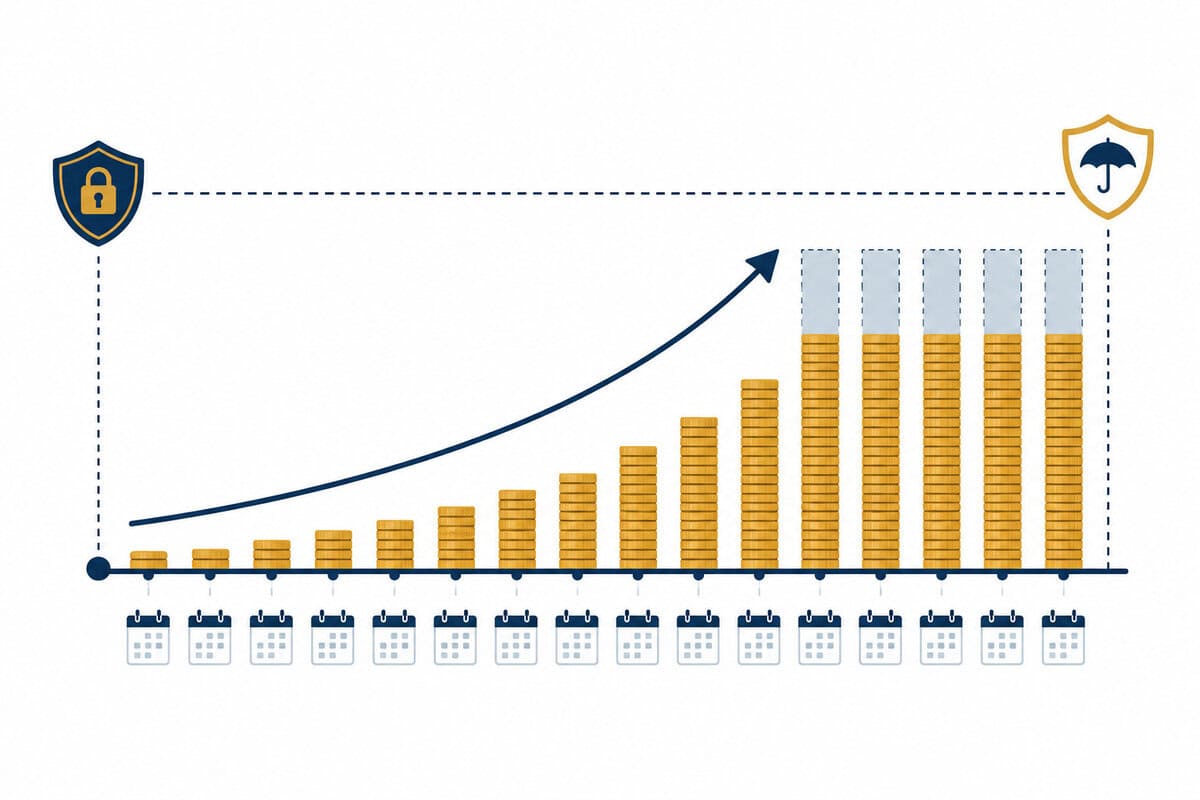
The cap matters: on a $20,000 balance, the failure to pay penalty alone cannot exceed $5,000, and it reaches that ceiling at 50 months. Interest, however, has no such cap and continues to accrue on both the tax and the penalty until the balance is paid in full.
When a return is both filed late and paid late, the two penalties interact. Under IRC Section 6651(c), the failure to file penalty is reduced by the failure to pay penalty for any month both apply. The combined charge runs at 5% per month rather than 5.5%, broken out as a 4.5% failure to file penalty plus a 0.5% failure to pay penalty, until the failure to file penalty reaches its own 25% cap after five months.
When Does the Failure to Pay Penalty Increase or Decrease?
The 0.5% monthly rate is the baseline. Two events change it, one reducing the rate and one raising it. The structured list below sets out the adjustments that apply under IRC Section 6651 and the IRS calculation rules.
- Reduced to 0.25% per month: approved payment plan
- For an individual who filed the return on time and has an approved installment agreement under IRC Section 6159, the failure to pay penalty is cut in half, to 0.25% per month, for every month the payment plan stays in effect. Setting up a plan is the most direct way to slow the penalty while a balance is paid down.
- Increased to 1% per month: notice of intent to levy
- If the tax is still unpaid 10 days after the IRS issues a final notice of intent to levy, the failure to pay penalty doubles to 1% per month under IRC Section 6651(d). This is the IRS escalation step that precedes wage garnishment and bank levies, and it is a signal that the account has moved into active collection.
- Unreported tax: the clock starts after notice and demand
- For tax the IRS determines is owed but was not reported on the return, the penalty begins running if the balance is not paid by the date in the notice. That date is generally 21 calendar days after the notice is sent, or 10 business days if the amount owed is $100,000 or more.
How Does Interest Make the Failure to Pay Penalty Grow?

Interest is charged on top of the penalty and on the underlying tax, and it does not stop at the 25% cap. The IRS sets the underpayment interest rate quarterly under IRC Section 6621 and compounds it daily under IRC Section 6601. For the quarter beginning April 1, 2026, the underpayment rate for individuals is 6% per year, down from 7% in the first quarter of 2026. The current figure is published on the IRS Quarterly Interest Rates page and changes every quarter.
Because interest compounds daily and has no ceiling, the cost of an open balance keeps climbing long after the penalty itself has maxed out. On a $20,000 balance carried for a full year at a 6% annual underpayment rate, interest alone adds roughly $1,200 on top of the failure to pay penalty for that year. The mechanics of that compounding, with a worked calculation, are covered in our IRS penalty interest calculator guide. The takeaway is structural: paying or formally resolving the balance is the only way to stop interest, and the IRS cannot remove interest unless the underlying penalty is first removed or reduced.
How Do You Remove or Reduce a Failure to Pay Penalty?

The IRS removes or reduces a failure to pay penalty through administrative relief, not negotiation. Three paths apply, and the right one depends on the taxpayer’s compliance history and the reason the tax went unpaid. Each is described below with the governing authority.
- First-Time Abatement (FTA). Under the IRS First-Time Abate program described at Administrative Penalty Relief and Internal Revenue Manual 20.1.1, a taxpayer with a clean compliance history may have the penalty removed for a single tax period. Qualifying conditions are no penalties in the prior three years, all required returns filed, and the current tax paid or under an approved payment arrangement. Where FTA applies, the penalty is removed in full and related interest is abated proportionally.
- Reasonable cause. Under IRS reasonable cause relief and Internal Revenue Manual 20.1.2, the penalty may be removed where the taxpayer exercised ordinary care and prudence but was nevertheless unable to pay on time. The IRS lists qualifying reasons that include serious illness, death or unavoidable absence of the taxpayer or an immediate family member, fire or natural disaster, and an inability to obtain records. Lack of funds by itself is not reasonable cause, though the facts that caused the shortage may be.
- Installment agreement to cut the ongoing rate. An approved payment plan does not remove the penalty already accrued, but it halves the rate going forward to 0.25% per month and stops most collection escalation. A plan is requested on Form 9465 or through the IRS Online Payment Agreement application.
A written reasonable cause request is made on Form 843, Claim for Refund and Request for Abatement, and should set out what happened, the dates involved, how the circumstances prevented timely payment, and the supporting documentation. The IRS specifically looks for records such as a hospital or doctor’s letter with start and end dates, disaster documentation, or correspondence showing the taxpayer tried to comply.
Sample reasonable cause statement (illustrative template)
The following is an illustrative hypothetical a taxpayer could adapt to their own facts. It is not a real client’s letter and is not tied to any dollar outcome or approval claim.
I am requesting abatement of the failure to pay penalty assessed for the [tax year] tax period. The tax shown on my return was not paid by the due date because I was hospitalized for [condition] from [start date] to [end date] and remained unable to manage my financial affairs through [date]. During this period I was incapacitated and could not access my records or arrange payment. I have enclosed a letter from my treating physician confirming the dates of hospitalization and incapacity, along with discharge records. I exercised ordinary care and prudence in my tax matters before and after this period, and I paid the balance in full once I was able to do so. I respectfully request that the penalty be abated for reasonable cause under the standard described in IRS guidance and Internal Revenue Manual 20.1.2.
This is an illustrative example only. Whether abatement is granted depends on the specific facts, the supporting documentation, and IRS review of the account. Reasonable cause is determined case by case, and the same wording does not guarantee the same result for a different taxpayer. The broader strategy for sequencing these requests is covered in our guide on how to get IRS penalties removed and, for the standard itself, our reasonable cause IRS penalty guide.
Failure to Pay Penalty Help in Naples and Southwest Florida
Tax Expert Today LLC works with individuals and businesses across Southwest Florida and nationwide on failure to pay penalties, installment agreements, and penalty abatement requests. The firm is multidisciplinary, with enrolled agents, CPAs, and attorneys, and Dr. Kabashi is an Enrolled Agent authorized to represent taxpayers before the IRS in all 50 states. The office is at 11983 Tamiami Trail N, Naples, FL 34110, and the team can be reached at (239) 441-2005, Monday through Friday, 10am to 5pm ET. Engagements cover the full resolution path, from analyzing a CP14 or notice of intent to levy to preparing the abatement request and supporting documentation.
Failure to pay is the penalty the IRS reverses most often in absolute terms. It accounted for 3,149,546 of the 3,884,049 individual penalty abatements recorded in fiscal year 2025, which is 81.1 percent of the total, per our research report on IRS civil penalties assessed and abated.
Frequently Asked Questions
Can the IRS failure to pay penalty be removed?
Yes, in qualifying cases. The penalty may be removed in full under First-Time Abatement when the taxpayer has a clean compliance history, or under reasonable cause when circumstances beyond the taxpayer’s control prevented timely payment. Relief is requested by phone, in writing, or on Form 843, and is subject to IRS review of the facts and documentation. The IRS abates related interest proportionally only when the underlying penalty is removed or reduced.
How much is the failure to pay penalty per month?
The failure to pay penalty is 0.5% of the unpaid tax for each month or partial month the balance remains unpaid, up to a maximum of 25% of the unpaid amount. The rate is reduced to 0.25% per month for an individual who filed on time and has an approved payment plan, and increased to 1% per month if the tax stays unpaid more than 10 days after a final notice of intent to levy.
What is the difference between the failure to file and failure to pay penalties?
The failure to file penalty is 5% per month for a late return, capped at 25%. The failure to pay penalty is 0.5% per month for a late payment, also capped at 25%. When both apply in the same month, the failure to file penalty is reduced so the combined charge is 5% per month rather than 5.5%. Filing on time, even without paying, limits exposure to the much smaller failure to pay penalty.
Does a payment plan stop the failure to pay penalty?
A payment plan does not stop the penalty already accrued, but it reduces the ongoing rate from 0.5% to 0.25% per month for an individual who filed the return on time, and it halts most collection escalation. Interest continues to accrue on the balance until it is paid in full. A plan is requested on Form 9465 or through the IRS Online Payment Agreement application.
Where can I get help with a failure to pay penalty in Naples, FL?
Tax Expert Today LLC, located at 11983 Tamiami Trail N, Naples, FL 34110, assists individuals and businesses in Naples and across Southwest Florida with failure to pay penalties, abatement requests, and installment agreements. The firm is multidisciplinary, with enrolled agents, CPAs, and attorneys, and represents taxpayers before the IRS nationwide. Consultations can be arranged at (239) 441-2005.
When to Engage a Professional for Failure to Pay Penalties
The failure to pay penalty looks simple on paper, but the choices around it carry real consequences: whether to claim First-Time Abatement or reserve it for a larger penalty year, how to document reasonable cause to the IRS standard, and whether an installment agreement or an Offer in Compromise is the better fit for the underlying balance. A poorly supported abatement request is denied, and First-Time Abatement can generally be used only once across a clean compliance window, so spending it on the wrong year is a costly mistake. Tax Expert Today LLC represents individuals and businesses in IRS penalty and collection matters nationwide. Dr. Kabashi is an Enrolled Agent authorized to represent taxpayers before the IRS in all 50 states.
Call (239) 441-2005 or schedule a consultation to review your notice and the relief options that fit your facts. Interest accrues daily until the balance is resolved, so the review is worth starting sooner rather than later. Tax advisors, enrolled agents, CPAs, and attorneys serving clients in all 50 states.
Self-employed? Estimate your Social Security and Medicare bill first with our free self-employment tax calculator.
Published June 1, 2026 by Dr. Pellumb Kabashi « Back to Learning Center
Have a question this article touches on?
Tax Expert Today LLC, based in Naples, Florida and serving clients across the United States.
Schedule a Consultation (239) 441-2005