
By Dr. Pellumb Kabashi, DBA, MBA, EA, CFE, CES
Founder, Tax Expert Today LLC · Tax advisors, enrolled agents, CPAs, and attorneys · Serving clients in all 50 states
Quick Answer: The IRS 10-year rule refers to the collection statute of limitations under IRC Section 6502, which generally gives the IRS ten years from the date a tax is assessed to collect it. When that Collection Statute Expiration Date, or CSED, passes, the remaining balance is written off and becomes legally unenforceable. Certain events, such as a pending offer in compromise, a bankruptcy filing, or a Collection Due Process hearing, pause the clock and push the date later.
Published: July 20, 2026
One of the most common questions taxpayers ask about a lingering IRS balance is whether it ever simply goes away. It can. Federal tax debt is not permanent, and the IRS 10-year rule is the reason why. Under a collection statute written into the tax code, the IRS has a limited window to collect an assessed tax before its legal right to pursue it expires. Understanding that window, when it starts, what pauses it, and how to find your own expiration date, changes how a large balance should be handled. This 2026 guide explains how the collection statute works, how it differs from the audit clock, and why waiting it out is sometimes viable and often not. Because the ten-year clock only starts once a balance is assessed and the IRS begins collecting, it runs alongside the collection story that opens with an IRS CP14 notice.
Does the IRS 10-Year Rule Really Erase Tax Debt?
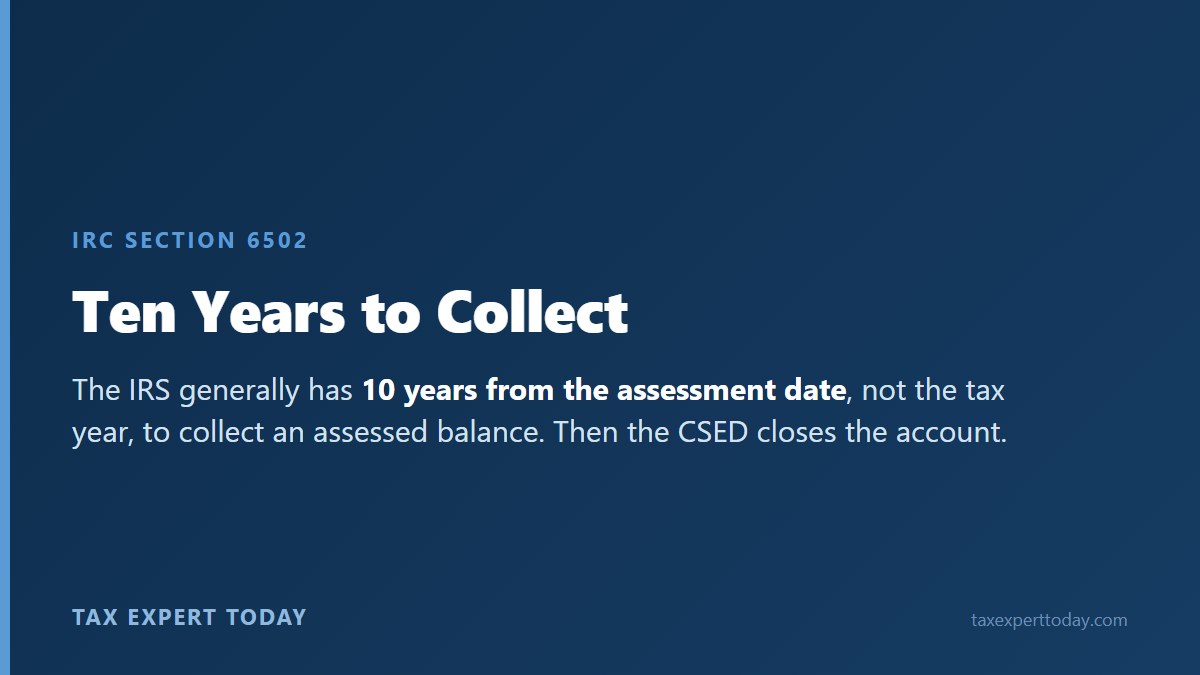
Yes, in most cases. The IRS 10-year rule means the IRS generally has ten years from the date a tax is assessed to collect it, and when that Collection Statute Expiration Date passes, the agency must stop collection and write off the remaining balance. The debt becomes legally unenforceable, so no further levies, liens, or lawsuits can be used to pursue it. One payment plan is built entirely around this date: an IRS partial payment installment agreement sets a monthly payment that is not expected to retire the balance before the CSED arrives.
This authority comes from IRC Section 6502, which sets a ten-year limit on collection after assessment. The rule is real and it is applied automatically: the IRS tracks a CSED for every assessed liability, and once it arrives the account is closed to collection. There are important caveats, though. The ten years does not run from the year you earned the income or filed the return, but from a later assessment date, and a list of specific events can pause the clock and move the date further out. A balance that looks close to expiring on a calendar basis may in fact have years left once those suspensions are counted. So while the answer to the headline question is yes, the practical answer depends entirely on the correct expiration date, not a rough count from the tax year.
When Does the 10-Year Collection Clock Start?
The collection clock starts on the date the tax is assessed, not the date the return was due or filed. Assessment is the formal act of the IRS recording the liability on its books, and for a timely filed return that usually happens within a few weeks of filing. The CSED is then generally ten years from that assessment date.
This distinction matters because different balances on the same account can have different expiration dates. An original return creates one assessment. A later audit adjustment, an amended return, or a Substitute for Return the IRS files for a non-filer each create their own assessment with their own ten-year clock. Someone who files late, or who has years reconstructed through unfiled return processing, can therefore have a much later CSED than the tax year suggests, because the clock did not start until the assessment posted. The IRS Publication 594 describes the collection process that follows assessment, and the assessment date itself is the single most important figure for calculating when a debt expires.
Joint returns complicate this further, because a balance from a joint filing year remains collectible from both spouses for the full ten years even after a divorce decree assigns it to one of them. The filing decisions that create that exposure are covered in our guide to divorce filing status.
What Pauses the IRS Collection Clock?
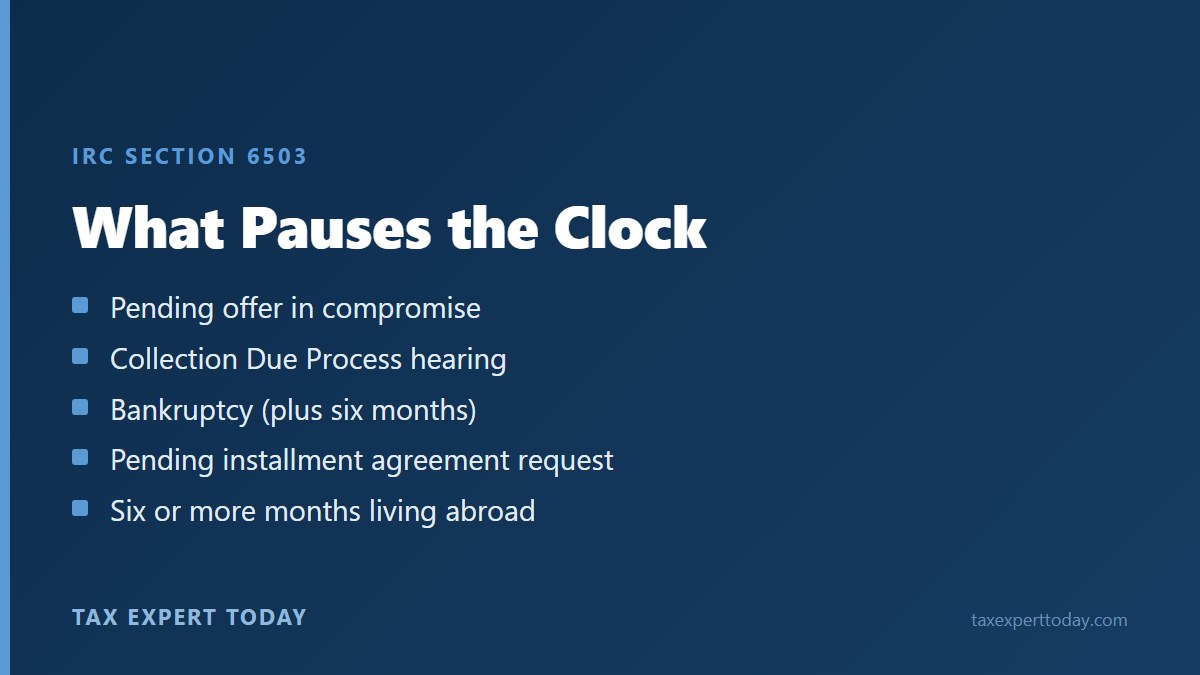
Several events suspend the collection statute, meaning the clock stops running while the event is active and often for an additional period afterward. Under IRC Section 6503 and related rules, each suspension extends the CSED by the length of the pause, so actions taken to resolve a debt can lengthen the very period taxpayers hope to run out.
The most common suspending events are summarized below. Each one delays the expiration date rather than resetting it, and several can stack across the life of a single balance.
| Event | Effect on the collection clock |
|---|---|
| Pending offer in compromise | The clock is suspended while an offer in compromise is under review, plus 30 days after rejection |
| Collection Due Process hearing | A timely CDP request tied to an LT11 final notice suspends the clock until the hearing is resolved |
| Bankruptcy | The automatic stay suspends collection during the case, plus six months afterward |
| Pending installment agreement request | The clock pauses while a proposed installment agreement is pending, and while a rejection or termination is appealed |
| Living outside the United States | A continuous absence of at least six months suspends the clock for the full period abroad |
| Innocent spouse request | A pending request for innocent spouse relief suspends collection on the balance at issue |
Because these suspensions add time, a strategy built purely on waiting can backfire: filing an offer in compromise or requesting a hearing to buy breathing room also extends the collection window. That trade-off is not a reason to avoid those options, which often resolve a debt for far less than running out the clock would require, but it is a reason to calculate the real CSED with the suspensions included rather than assuming a flat ten years.
How Do I Find My CSED?
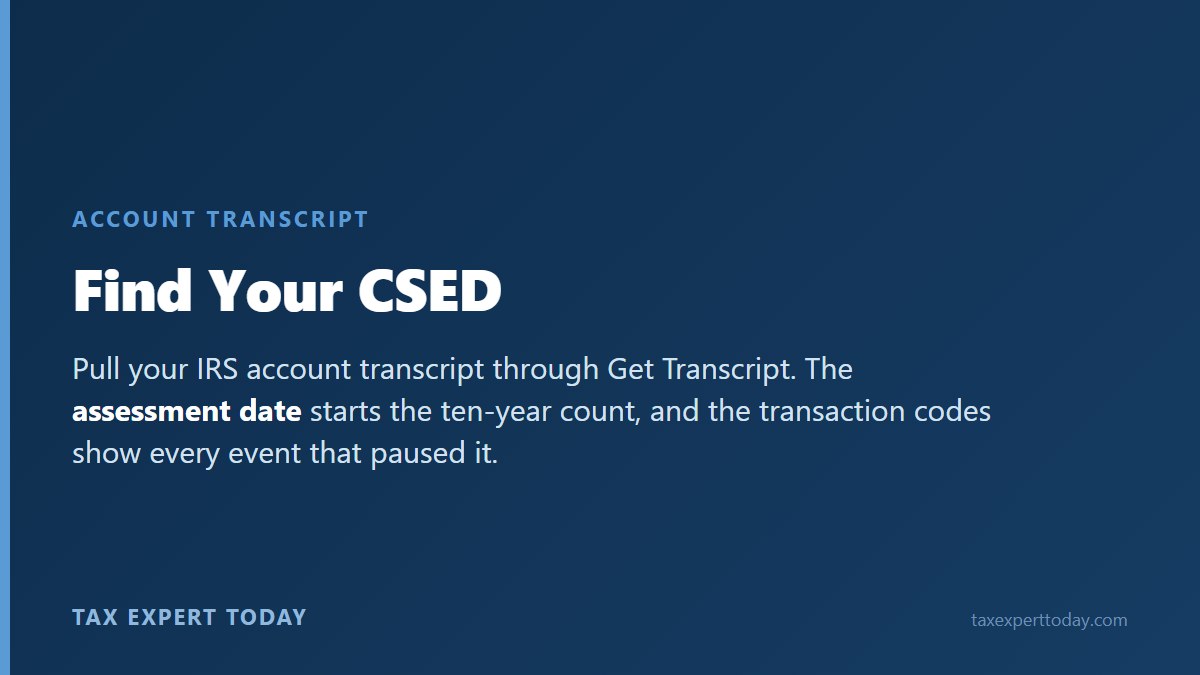
You find your CSED by pulling your IRS account transcript, which shows the assessment date for each balance and the transaction codes for events that suspended collection. The ten-year count begins at the assessment date, and the transcript is the authoritative record the IRS itself uses to track the expiration.
Account transcripts are available through the IRS Get Transcript service online or by mail, and they list each assessment with its date, along with codes for events such as bankruptcy filings, offer submissions, and hearing requests. Translating those codes into an exact expiration date can be intricate, especially when multiple assessments and multiple suspensions overlap on one account, which is why many taxpayers ask a representative to compute the CSED for them. The IRS can also provide the CSED directly on request. Getting this figure right is essential, because every collection decision, whether to pay, settle, or wait, depends on how much time actually remains.
Should I Just Wait Out the Collection Statute?
Sometimes waiting is viable, but often it is not, and the decision depends on the facts. If a balance is genuinely close to its CSED and the taxpayer has few collectible assets, letting the statute expire, frequently paired with currently not collectible status, can be a reasonable path. In many other situations, though, waiting exposes the taxpayer to years of active collection with no assurance of relief.
The reason is that the IRS does not pause collection while the clock runs. Until the CSED arrives, the agency can file a federal tax lien, levy wages and bank accounts, and seize refunds, and interest and penalties continue to accrue on the balance the entire time. A debt with several years left on its statute is a debt the IRS can actively pursue for several more years. Waiting also assumes no new suspensions will be triggered, yet ordinary steps such as requesting a payment plan or filing for bankruptcy restart the pauses described above. For taxpayers who qualify, an offer in compromise or a manageable installment agreement often resolves the matter sooner and with more certainty than betting on the statute. The right answer is a calculated one: it weighs the verified time remaining, the taxpayer’s exposure to levy, and the cost of the alternatives, rather than defaulting to delay.
CSED vs the Assessment Statute: Two Different Clocks
The collection statute is often confused with the assessment statute, but they are separate clocks that run at different times. The CSED under Section 6502 limits how long the IRS has to collect a tax after it is assessed. The assessment statute under IRC Section 6501 limits how long the IRS has to assess additional tax in the first place, generally three years after a return is filed, or six years when income is substantially understated.
The two connect in sequence. The assessment clock governs the audit window, the period during which the IRS can examine a return and add tax. Once tax is assessed, whether on the original return or after an audit, the collection clock begins and the ten-year period starts. A fraudulent or unfiled return has no assessment deadline at all, which is why very old non-filing situations can still be assessed and then collected. Keeping the two clocks distinct avoids a common and costly mistake: assuming a debt is near expiring based on the tax year, when the collection clock did not even start until a much later assessment. Our guide to the IRS audit statute of limitations covers the assessment side of that pair in full, including the six year omission rule and the exceptions that leave a year open indefinitely.
| Feature | Assessment statute (Section 6501) | Collection statute / CSED (Section 6502) |
|---|---|---|
| What it limits | Time to assess additional tax | Time to collect an assessed tax |
| Length | Generally 3 years, 6 years if income is substantially understated | 10 years |
| Clock starts | When the return is filed | When the tax is assessed |
| No deadline when | Return is fraudulent or never filed | Statute runs, but suspensions extend it |
IRS 10-Year Rule Help in Naples and Southwest Florida
Tax Expert Today LLC helps individuals and businesses in Naples and across Southwest Florida understand exactly how the IRS 10-year rule applies to their accounts, from pulling and reading account transcripts to computing an accurate CSED across multiple assessments and suspensions. Where waiting out the statute is realistic, the firm helps position the account, often alongside currently not collectible status, and where it is not, it evaluates whether an installment agreement or offer in compromise resolves the balance sooner. The office is at 11983 Tamiami Trail N, Naples, FL 34110, and the team can be reached at (239) 441-2005, Monday through Friday, 10am to 5pm ET.
Frequently Asked Questions
Does IRS tax debt really expire after 10 years?
Generally yes. Under IRC Section 6502, the IRS has ten years from the date a tax is assessed to collect it, and when that Collection Statute Expiration Date passes the balance becomes legally unenforceable and is written off. The important caveat is that the ten years runs from the assessment date, not the tax year, and specific events such as a pending offer in compromise or a bankruptcy filing pause the clock and push the expiration date later.
When does the IRS 10-year collection clock start?
The clock starts on the assessment date, which is when the IRS formally records the liability, not when the return was due or filed. For a timely return, assessment usually posts within a few weeks of filing. Because audit adjustments, amended returns, and Substitute for Return assessments each create their own assessment date, a single account can carry balances with different expiration dates.
What events extend the CSED?
A pending offer in compromise, a timely Collection Due Process hearing request, a bankruptcy filing, a pending installment agreement request, a continuous absence from the United States of at least six months, and a pending innocent spouse request all suspend the collection statute. Each suspension stops the clock while it is active and often for an added period afterward, so these events extend the CSED rather than resetting it.
How can I find out when my tax debt expires?
Pull your IRS account transcript through the Get Transcript service. It lists the assessment date for each balance and the transaction codes for events that suspended collection, which together determine the CSED. Because overlapping assessments and suspensions make the math intricate, many taxpayers have a representative compute the exact date, and the IRS can also provide the CSED on request.
Is it a good idea to just wait out the 10-year rule?
Sometimes, but often not. If a balance is close to its CSED and there are few collectible assets, letting the statute expire can be reasonable. But the IRS can levy wages and bank accounts, file liens, and take refunds for the entire remaining period, and interest keeps accruing. For many taxpayers an offer in compromise or installment agreement resolves the debt sooner and with more certainty than waiting, so the choice should follow a calculation of the verified time left against the alternatives.
Where can I get help with a CSED analysis in Naples, FL?
Tax Expert Today LLC, located at 11983 Tamiami Trail N, Naples, FL 34110, helps individuals and businesses in Naples and across Southwest Florida read account transcripts, compute an accurate Collection Statute Expiration Date, and decide whether to wait out the statute or resolve the balance through a payment plan or offer in compromise. The firm is multidisciplinary, with enrolled agents, CPAs, and attorneys, and represents taxpayers before the IRS nationwide. Consultations can be arranged at (239) 441-2005.
When to Engage a Professional for a Collection Statute Question
The IRS 10-year rule is simple to state and easy to miscalculate. The expiration date turns on an assessment date most taxpayers never see, and a single misread suspension can shift it by months or years, which is exactly where experienced representation earns its place: reading the account transcript correctly, computing the real CSED across every assessment and pause, and then deciding whether the account is better served by waiting, by currently not collectible status, or by a formal resolution. Acting on a verified date rather than a rough guess is what separates a sound strategy from a costly assumption. Tax Expert Today LLC, founded by Dr. Pellumb Kabashi, represents individuals and businesses in IRS collection matters nationwide.
Call (239) 441-2005 or schedule a consultation to review your account transcript and build a plan around your actual collection statute date. Tax advisors, enrolled agents, CPAs, and attorneys serving clients in all 50 states.
Published July 20, 2026 by Dr. Pellumb Kabashi « Back to Learning Center
Have a question this article touches on?
Tax Expert Today LLC, based in Naples, Florida and serving clients across the United States.
Schedule a Consultation (239) 441-2005