
By Dr. Pellumb Kabashi, DBA, MBA, EA, CFE, CES
Founder, Tax Expert Today LLC · Tax advisors, enrolled agents, CPAs, and attorneys · Serving clients in all 50 states
Quick Answer: A partial payment installment agreement is an IRS payment plan under IRC §6159(a) that accepts monthly payments smaller than the balance owed, so the agreement is expected to end with tax still unpaid when the collection statute expires. Equity in assets must be addressed before the IRS approves one, and the agreement is reviewed at least every two years. Call (239) 441-2005 for a free consultation.
What is a partial payment installment agreement?
A partial payment installment agreement, commonly abbreviated PPIA, is a formal IRS installment agreement whose monthly payment is set by ability to pay rather than by the balance due. Because the payment is lower than the amount needed to retire the liability, the agreement is expected to expire with a balance still outstanding. That remaining balance then ceases to be collectible when the collection statute runs.
The authority sits in IRC §6159(a), which permits the Secretary to enter into a written installment agreement where the agreement will facilitate full or partial collection of the liability. That single word, partial, is the statutory root of the whole arrangement. The IRS reads it as authority for a plan that is never intended to pay the tax in full, and IRM 5.14.2 records that the American Jobs Creation Act of 2004 amended §6159 to provide this authority. Before that amendment the Service had no clean statutory basis for accepting an agreement it knew would fall short.
- It is an installment agreement, not a settlement. No portion of the debt is compromised or written off at the outset, which is the structural difference from an offer in compromise.
- The collection statute does the work. The balance survives the agreement and then expires with the statute rather than being forgiven by agreement.
- Full financial disclosure is mandatory. The payment cannot be set without a complete picture of income, expenses, and assets.
- Filing compliance is a precondition. Required returns must be filed, and current obligations must be kept current.
- It is reviewed, not fixed. The payment can rise if the financial picture improves.
A partial payment installment agreement sits between the two options most taxpayers have heard of. It is more accessible than an offer in compromise, because it does not require the taxpayer to fund a lump sum or short term settlement, and it is more demanding than a standard installment agreement, because it requires the full financial analysis a streamlined plan avoids. It is also distinct from currently not collectible status, which involves no payment at all.
How does the IRS calculate the monthly payment?
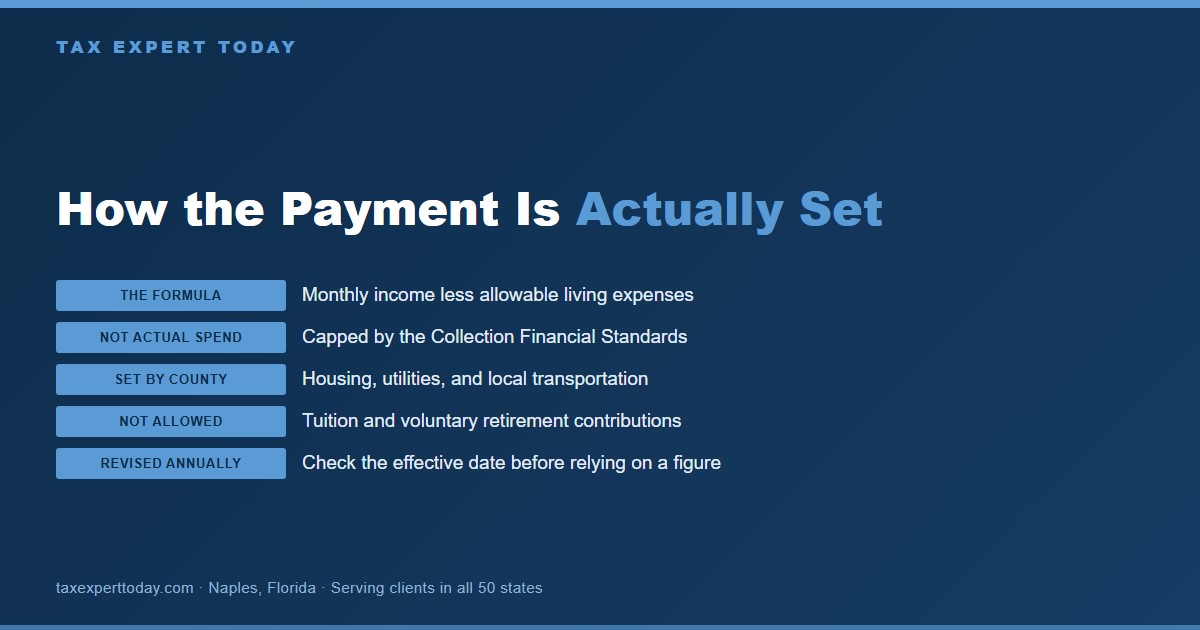
The payment equals monthly income less allowable living expenses, which is the same disposable income calculation the IRS uses across collection. Allowable expenses are not what the taxpayer actually spends. They are capped by the published Collection Financial Standards for food, clothing, out of pocket health care, housing and utilities, and transportation, with the local tables varying by county and household size.
This is the single most misunderstood part of a partial payment installment agreement. A taxpayer who spends more than the standard on housing does not get credit for the excess in most cases, so the calculated payment is often higher than the amount the household believes it can afford. The current tables are published on the IRS Collection Financial Standards page and are revised annually, so any figure quoted from an older article should be re-checked against the current effective date before it is relied on.
- National standards cover food, clothing, housekeeping supplies, personal care, and a miscellaneous allowance, allowed by household size without receipts.
- Local housing and utilities are capped by county, which matters in Collier and Lee counties where housing costs run above many national comparisons.
- Local transportation allows ownership and operating costs by region, subject to vehicle count limits.
- Out of pocket health care is allowed per person, with higher amounts for taxpayers above a threshold age.
- Conditional expenses such as private school tuition, voluntary retirement contributions, and payments on unsecured debt are generally not allowed against a delinquent federal tax liability.
Because the arithmetic is mechanical, the leverage in a partial payment installment agreement request is almost never in arguing the standards. It is in documenting the income figure correctly, substantiating the expenses that are allowed above standard, and establishing that the assets discussed below cannot be reached.
Which financial statement does a partial payment installment agreement require?
IRM 5.14.2.2.1 states that a full Collection Information Statement is required for all partial payment installment agreements. That means Form 433-A for a wage earner or self employed individual, or Form 433-B for a business. This is stricter than the guidance published elsewhere, and the discrepancy is a common reason a request is returned as incomplete.
The Taxpayer Advocate Service page on this topic points individuals to the shorter Form 433-F, while the Internal Revenue Manual section that governs the revenue officers actually approving these agreements calls for the full statement on Form 433-A. Both can hold in practice, because a case worked in a campus function may be resolved on the short form while a case assigned to field collection will not be, but a taxpayer who prepares only the short form for a field case should expect a request for more. Our guide to Form 433-A and Form 433-F walks through the line items and the substantiation each one attracts.
| Form | Purpose in a PPIA | Practical note |
|---|---|---|
| Form 433-A | Full Collection Information Statement for individuals and the self employed | What IRM 5.14.2.2.1 requires for all PPIAs |
| Form 433-F | Shorter financial statement | Referenced by the Taxpayer Advocate Service, and often insufficient for a field case |
| Form 9465 | Installment agreement request | Requests the plan, and does not by itself supply the financial analysis |
| Form 433-D | The signed agreement itself | IRM 5.14.2.2.4 directs the top to be marked PPIA in red |
| Form 900 | Tax Collection Waiver extending the collection period | Required only in the narrow situations described below |
That Form 433-D detail is worth noting because it explains something taxpayers observe and misread. A partial payment installment agreement is not a separate species of agreement with its own form. A partial payment installment agreement is an ordinary installment agreement annotated as partial pay and flagged in the case management system for a review cycle two years out.
Do I have to sell or borrow against my assets first?
Usually yes, at least as a good faith attempt. IRM 5.14.2.1.1 states plainly that before a partial payment installment agreement may be granted, equity in assets must be addressed and, if appropriate, used to make payment. Complete utilization of equity is not always required, but a taxpayer who declines to try is treated very differently from one who tries and fails.
The manual sets out recognized reasons equity may be left in place. Assets may carry minimal equity, or too little for a lender to work with. Legal constraints may block access. Liquidation may create economic hardship. The asset may itself generate the income that funds the payments, which is the common case for a work vehicle or business equipment. Where the taxpayer is asked to attempt a loan, IRM 5.14.2.2.2 contemplates that copies of the documents used in the loan application will be provided, so a declined application becomes evidence rather than an assertion.
- Minimal or unusable equity in an asset no lender will lend against.
- Legal impediment preventing the taxpayer from reaching the equity.
- Economic hardship that liquidation would cause.
- Income producing asset whose sale would remove the means of making the payments.
- Documented failed attempt to borrow, supported by the loan application paperwork.
The consequence of refusing is specific and severe. IRM 5.14.2.2.2 provides that a taxpayer who does not comply with the requirement of making a good faith attempt to use equity in assets, or who is not willing to make monthly payments consistent with ability to pay, will be treated as unwilling to pay, and that seizure or levy action may be appropriate. Where enforcement action is appropriate, the manual states a partial payment installment agreement will not be granted. This is the reason the equity question should be worked out before a partial payment installment agreement is requested rather than negotiated after it is pending. Where collection has already escalated to a final notice of intent to levy, the equity analysis and the response deadline run at the same time.
PPIA vs offer in compromise vs currently not collectible: which fits?
A partial payment installment agreement, an offer in compromise, and currently not collectible status all resolve a liability the taxpayer cannot pay in full, and they differ mainly in what is required now and what remains at the end. A partial payment installment agreement requires a monthly payment and leaves the balance to expire with the statute. An offer in compromise requires a funded settlement and closes the liability. Currently not collectible status requires no payment and defers the question.
| Feature | Partial payment installment agreement | Offer in compromise | Currently not collectible |
|---|---|---|---|
| Monthly payment | Yes, set by disposable income | No ongoing payment after the offer terms are met | No |
| Lump sum needed | No | Generally yes, or short term periodic payments | No |
| Liability closed at the end | No, it expires with the collection statute | Yes, compromised by agreement | No, it remains and can be reactivated |
| Full financial disclosure | Yes | Yes | Yes |
| Equity in assets addressed first | Yes, good faith attempt required | Yes, built into reasonable collection potential | Considered, and equity can defeat it |
| Effect on the collection period | None by itself, though a Form 900 waiver may extend it in narrow cases | Suspended while the offer is pending | None, and the statute keeps running |
| Periodic review | At least every two years under §6159(d) | Not applicable once accepted and performed | Reviewed against an income floor |
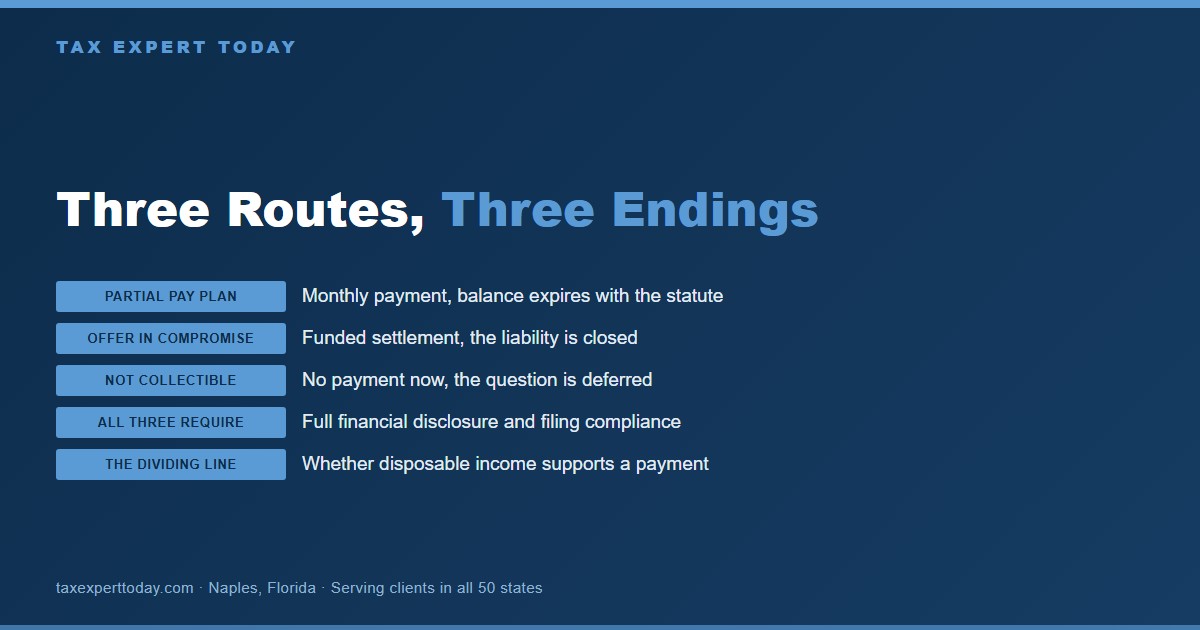
The decision is rarely a matter of preference. A taxpayer with sufficient disposable income to support a payment but no access to a lump sum is a partial payment installment agreement candidate rather than an offer candidate. A taxpayer with no disposable income at all is closer to currently not collectible. A taxpayer with a short remaining collection period and no reachable assets may find that the passage of time is doing more work than any application would. Our overview of the Fresh Start initiative explains how these options are marketed together under a single label they do not really share.
What happens to the remaining balance when the collection statute expires?
It ceases to be collectible. Under IRC §6502(a) the IRS generally has ten years from assessment to collect, and once that Collection Statute Expiration Date passes the Service may no longer levy or sue to collect. A partial payment installment agreement is built around that date, which is why the CSED is the whole mechanism rather than a footnote to it.
- Ten years from assessment under §6502(a), which is the starting point for every partial payment installment agreement calculation.
- One CSED per assessment, so multiple liability years carry multiple expiration dates rather than a single one.
- Suspensions push the date later, including bankruptcy, a pending offer in compromise, and a collection due process request.
- No further collection after it passes, meaning no levy and no suit to collect the remaining balance.
- Compute it from transcripts, because an estimate produces the wrong payment and the wrong expectation.
Two points are commonly stated too loosely. First, the ten years runs from assessment, not from the tax year or the filing date, and each assessment carries its own date, so a taxpayer with several years of liability has several CSEDs rather than one. Second, the period is suspended by a list of events including bankruptcy, a pending offer in compromise, a collection due process hearing request, and periods outside the United States, so the practical expiration date is frequently later than a simple ten year count suggests. Our article on the IRS ten year collection rule works through how those suspensions are counted.
Because the calculation drives everything, the CSED should be computed from account transcripts before a partial payment installment agreement is requested rather than estimated. An agreement structured around the wrong date produces the wrong payment and the wrong expectation about how long the payments continue.
Does a partial payment installment agreement extend the IRS collection clock?
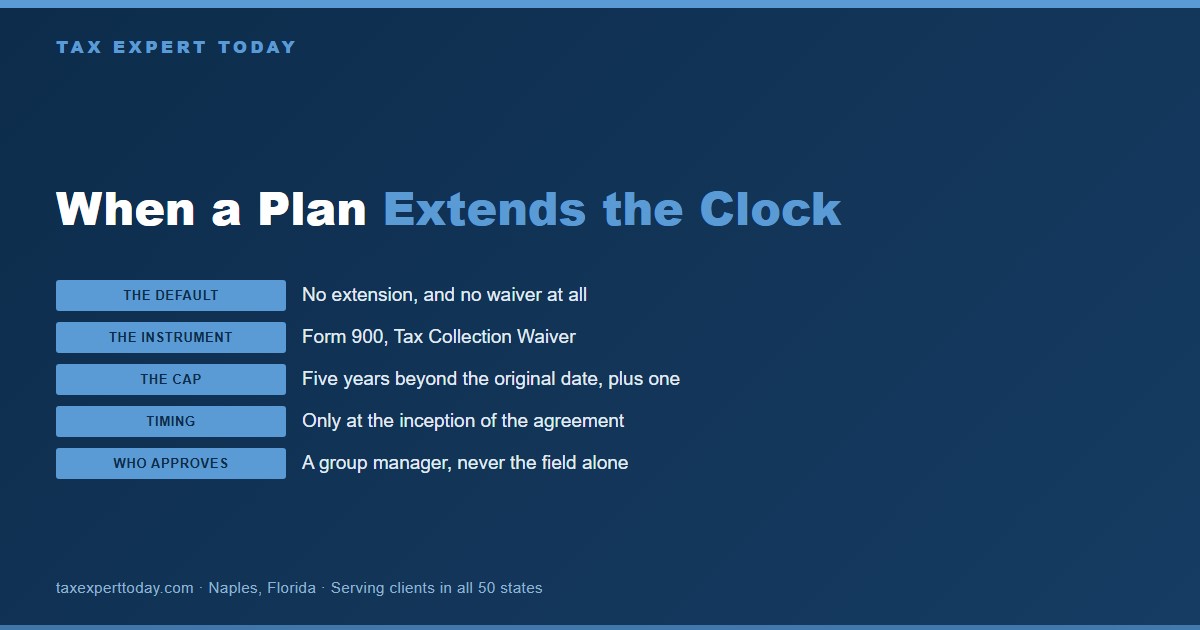
Not by itself, and in most cases no extension is involved at all. There is one narrow exception that most published guidance omits entirely. IRC §6502(a)(2)(A) permits the collection period to be extended by written agreement made in connection with granting an installment agreement, and IRM 5.14.2.3 states that as a policy matter the IRS permits those extensions only in conjunction with partial payment installment agreements, and only in certain situations.
This is the point at which a partial payment installment agreement can lengthen the very statute it relies on. The instrument is Form 900, Tax Collection Waiver, and the manual sets firm limits on it.
- The default is no extension. Most agreements are secured without a waiver at all.
- A waiver is tied to a future asset, typically one the taxpayer will receive only after the current CSED expires.
- It is capped, at five years beyond the original date plus up to one year.
- It requires managerial approval, so it is not a field level decision.
- Declining a required waiver has a cost, because refusal is a stated ground for not granting the agreement.
| Rule | What IRM 5.14.2 provides |
|---|---|
| Maximum extension | Five years beyond the original CSED for each tax account, plus up to one year to account for changes in the agreement |
| When it can be secured | Only at the inception of the agreement, not during the two year review, unless a new agreement is executed at that time |
| On reinstatement | A waiver should not be obtained when a partial payment installment agreement is reinstated |
| Approval | Group managers must approve CSED extensions |
| Actual expiration | A waiver secured with an installment agreement expires 90 days after the agreed period, under §6502(a)(2)(A) and Treas. Reg. 301.6502-1(b)(1) |
| When no waiver is needed | Where the only means of satisfying the liability after the CSED is continuation of the agreement, and the two year review shows no significant change in ability to pay |
The situation the manual actually has in mind is a taxpayer who will come into an asset after the current CSED expires. The illustrations in IRM 5.14.2 include a taxpayer entitled to trust principal in two more years with a CSED expiring in one, and a corporation holding undeveloped land that will be completed and sold in two years. In both, extending the statute is what makes an agreement possible instead of a seizure. Refusing to sign a waiver where one is genuinely required is listed as a ground for not granting the agreement, so the choice is sometimes between a longer clock and no agreement at all.
The contrast with an offer in compromise is worth holding onto, because it runs the other way. Time spent on a pending offer that is ultimately rejected is added back to the collection period, so an unsuccessful offer can leave the taxpayer with a later CSED than when they started. A partial payment installment agreement, absent a Form 900, does not have that effect.
Why does the IRS review a partial payment installment agreement every two years?
Because the statute requires it. IRC §6159(d) requires the Secretary to review installment agreements for partial collection every two years, and provides that for an agreement entered into for partial collection of a tax liability, the Secretary shall review the agreement at least once every two years. The review is not discretionary and it is not a sign that anything has gone wrong.
In practice the two year review of a partial payment installment agreement asks one question: has ability to pay significantly changed. If income has risen or allowable expenses have fallen, the payment can be increased. If the financial picture has deteriorated, the payment can be reduced, and a taxpayer whose circumstances have worsened should treat the review as an opportunity rather than a threat. IRM 5.14.2.2.4 describes the case being set with a review cycle two years forward at the time the agreement is established, so the date is scheduled from the beginning.
- The trigger for a change is a significant change in ability to pay, not any change at all.
- Updated financial information will be requested, and providing it is part of staying in the agreement.
- The payment can move in either direction, which is frequently overlooked.
- A waiver cannot normally be introduced at the review unless a new agreement is executed then.
- Failure to respond is itself a ground for modification or termination, as set out below.
Can the IRS terminate a partial payment installment agreement?
Yes, and IRC §6159(b) lists the grounds. The Secretary may terminate where information the taxpayer provided beforehand was inaccurate or incomplete, or where collection is in jeopardy, and may alter, modify, or terminate where the financial condition has significantly changed, where an installment or another tax liability goes unpaid when due, or where a requested financial condition update is not provided.
- Inaccurate or incomplete information supplied before the agreement was entered into, under §6159(b)(2)(A).
- Collection in jeopardy, under §6159(b)(2)(B), which also removes the advance notice protection.
- Significant change in financial condition, under §6159(b)(3).
- A missed installment or a new unpaid liability, under §6159(b)(4)(A) and (B), so staying current on later years matters as much as paying the plan.
- Failure to provide a requested financial update, under §6159(b)(4)(C).
That last ground, at §6159(b)(4)(C), is the one that connects the two year review to real risk. Ignoring a request for updated financials is not a passive act. It is an enumerated basis for terminating the agreement, which returns the account to active collection with levy authority under IRC §6331 restored.
There is a meaningful procedural protection. Under §6159(b)(5) the IRS generally may not act on any of those grounds unless notice of the action is provided to the taxpayer no later than 30 days before the date of the action, and the notice includes an explanation of why the Service intends to act. That protection does not apply where collection is believed to be in jeopardy. A taxpayer who receives such a notice has a short but real window, and §6159(e) requires the Service to maintain procedures for independent administrative review of terminations for taxpayers who request one.
What happens if the IRS rejects a partial payment installment agreement request?
A proposed rejection triggers an internal check before it becomes final. IRM 5.14.2.1.5 provides that Independent Administrative Review is required when a proposed rejection occurs, and that the taxpayer may administratively appeal a termination, modification, or rejection of a proposed installment agreement to the IRS Independent Office of Appeals. A rejection is therefore a stage rather than an endpoint.
Where a group manager concludes a partial payment installment agreement is not the appropriate resolution, IRM 5.14.2.2.5 directs the case into the independent review procedures at IRM 5.14.9, and requires the case history to document why the agreement was not granted. That documentation requirement is useful to know about, because it means there is a stated reason on the file to respond to rather than a general refusal.
| Common ground for denial | Source | What tends to address it |
|---|---|---|
| No good faith attempt to use equity in assets | IRM 5.14.2.2.2 | Documented loan applications, or evidence the equity falls in a recognized exception |
| Unwillingness to pay consistent with ability to pay | IRM 5.14.2.2.2 | Accepting the computed figure, or substantiating the expenses that change it |
| Incomplete financial statement | IRM 5.14.2.2.1 | Filing the full Collection Information Statement rather than the short form |
| Unfiled returns or current noncompliance | IRS payment plan requirements | Bringing filings and current deposits or estimates up to date first |
| Refusal to sign a required Form 900 | IRM 5.14.2.3 | Weighing the extension against the alternative of enforcement |
| Enforcement action is more appropriate | IRM 5.14.2.2.2 | Addressing the reachable asset that makes seizure the preferred route |
One further detail in IRM 5.14.2 is worth surfacing for anyone facing an ongoing wage levy. The manual states that a continuous wage levy should not be used in place of a partial payment installment agreement where the taxpayer is current with filing requirements and has provided the financial information needed to determine a payment amount, unless the taxpayer refuses to sign the agreement. It also notes that because continuous wage levies are not installment agreements, taxpayers subject to them do not receive the associated statutory rights, and no systemic redetermination of collectibility occurs. A taxpayer being levied who is otherwise compliant therefore has an argument grounded in the manual the IRS applies to itself. Where a bank account rather than wages has already been taken, our guide to obtaining an IRS bank levy release covers the separate and much shorter timeline that applies.
- Independent Administrative Review is mandatory on a proposed rejection, so a denial is checked before it becomes final.
- Appeals remains available for a termination, modification, or rejection.
- The file must state a reason, which gives the taxpayer something specific to answer.
- Most denials are curable, because they turn on documentation rather than eligibility.
- A levy is not a substitute for the agreement where the taxpayer is compliant and has supplied financials.
Partial payment installment agreement help Naples: PPIA cases in Naples and Southwest Florida
Taxpayers reach our office in Naples, Florida asking about a partial payment installment agreement in two distinct postures. The first is a retiree or a seasonal earner with a modest fixed income, a long remaining collection period, and equity in a homestead property that they assume disqualifies them. The second is a self employed contractor or hospitality operator whose income recovered after the year that created the liability, who now has real disposable income and needs the payment computed correctly rather than guessed. Tax resolution Naples clients in the first group are frequently surprised that the equity conversation has recognized exceptions, and those in the second are often surprised how much of the outcome is fixed by the county expense tables before anyone negotiates anything.
Tax Expert Today LLC
11983 Tamiami Trail N, Naples, FL 34110
Phone: (239) 441-2005
Hours: Monday through Friday, 10:00 to 5:00 ET
Does living in Florida change how a partial payment installment agreement works? The procedure is federal and identical in Naples, Fort Myers, Bonita Springs, and Marco Island. Two local facts do bear on the arithmetic. The local housing and utilities and local transportation standards are set by county, so a Collier County household and a Lee County household with identical income can produce different allowable expense figures and therefore different payments. Florida also imposes no state individual income tax, so there is no parallel state installment agreement to coordinate, although a Florida homestead interest still has to be addressed in the equity analysis even where it is ultimately left in place. Our IRS resolution and audit support service page and our Naples tax resolution page describe how these engagements are handled.
When to Engage a Professional
The value of representation on a partial payment installment agreement is concentrated at two moments: before the request is filed, when the CSED calculation and the equity position are still capable of being documented properly, and at the two year review, when the payment can move. Consider engaging a representative where equity exists in a home, a retirement account, or business assets, where the collection period for one or more years is close to expiring, where a Form 900 waiver has been raised, where a wage levy is already in place, where returns remain unfiled, or where a prior request has been rejected and an appeal window is open. Every case turns on its own transcripts and its own financial facts, and the figures published in the Collection Financial Standards change annually, so the analysis should be run against the tables in effect at the time rather than against any example.
This article is educational and general in nature. It does not constitute tax advice for any particular taxpayer, and outcomes depend on individual facts and circumstances.
Published September 3, 2026 by Dr. Pellumb Kabashi « Back to Learning Center
Have a question this article touches on?
Tax Expert Today LLC, based in Naples, Florida and serving clients across the United States.
Schedule a Consultation (239) 441-2005