
By Dr. Pellumb Kabashi, DBA, MBA, CES, CFE, EA
Founder, Tax Expert Today LLC · Tax advisors, enrolled agents, CPAs, and attorneys · Serving clients in all 50 states
Quick Answer: IRS Currently Not Collectible (CNC) status is a temporary hold the IRS places on active collection when a taxpayer proves that paying anything toward the balance would leave them unable to meet basic living expenses. The IRS verifies hardship from a financial statement, then codes the account status 53 and stops levies and garnishments. CNC does not erase the debt: under IRC Section 6601 interest keeps accruing, penalties continue, and the IRS can resume collection if your finances improve before the collection statute expires.
Published: June 29, 2026
Currently Not Collectible status is the relief most people reach for when the honest answer is that there is no money to pay the IRS without going without rent, food, or medicine. It is not a settlement and not a payment plan; it is a pause. Where there is some ability to pay, an IRS partial payment installment agreement is usually the closer fit, because it sets a reduced monthly payment instead of none at all. Used correctly, CNC stops the levies and buys time, and because the 10-year collection clock keeps running, some balances expire while the account sits in this status. This 2026 guide explains what CNC is, who qualifies, how to request it, what it does not stop, and how it compares to an offer in compromise and an installment agreement.
What Is IRS Currently Not Collectible Status?
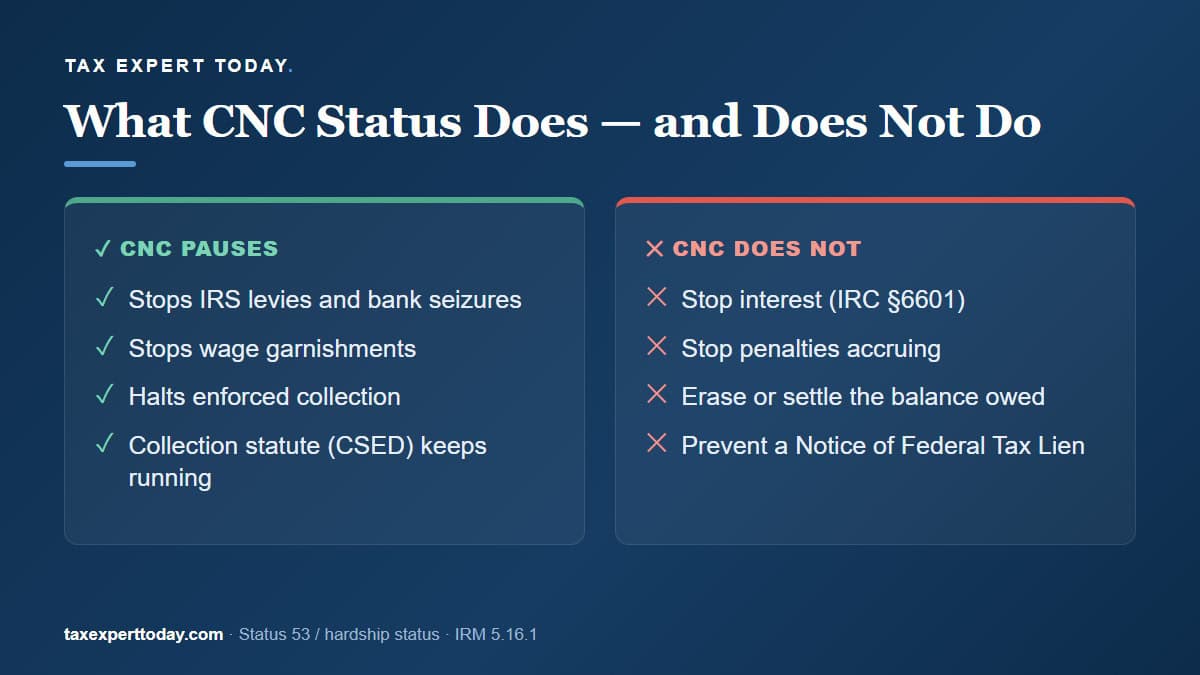
IRS Currently Not Collectible status, sometimes called “status 53” or hardship status, is an account designation the IRS uses when it determines that a taxpayer cannot pay both their reasonable basic living expenses and their tax debt. When an account is reported CNC, the IRS suspends active collection — it stops issuing levies and wage garnishments and pauses enforced collection — while the underlying liability remains owed. The authority comes from the economic-hardship standard in IRC Section 6343 and the procedures in Internal Revenue Manual 5.16.1.
The practical effect is breathing room, not forgiveness. The IRS still records the balance, still charges interest and penalties, and can still file a Notice of Federal Tax Lien to protect its interest. What changes is that the collection machinery stops pointing at your paycheck and bank account. CNC is best understood as the IRS formally agreeing that, given your current finances, there is nothing to collect right now.
Who Qualifies for Currently Not Collectible Status?
A taxpayer qualifies for CNC when allowable monthly living expenses meet or exceed monthly income, so there is no meaningful amount left to pay the IRS. The IRS measures this by comparing your income to your necessary expenses, using national and local Collection Financial Standards for categories like food, housing, transportation, and out-of-pocket health care. If the math shows little or no ability to pay, the account is a CNC candidate.
Common situations that support CNC include unemployment or a sharp drop in income, living on Social Security or a fixed retirement income, a serious illness or disability that consumes available funds, and households where essential expenses already absorb all income. The IRS does not grant CNC based on a hardship narrative alone — it relies on the numbers in your financial statement. Qualifying scenarios typically share one feature: after allowable expenses, the disposable income figure is at or near zero.
- Income at or below allowable expenses
- When the Collection Financial Standards show your necessary living costs equal or exceed your income, there is no disposable income for a payment plan, which is the core CNC test.
- Fixed or limited income
- Taxpayers living on Social Security, disability, or a modest pension, with no other assets to liquidate, frequently meet the hardship standard under Section 6343.
- Temporary loss of income
- Job loss, a business downturn, or a medical event can create a window where collection would cause hardship. CNC is well suited to temporary situations because the IRS reviews the account periodically and can lift the status when income recovers.
- No equity in assets to reach
- If you own assets but they carry no realizable equity, or liquidating them would itself create hardship, the IRS can still report the account CNC. Significant available equity, by contrast, usually has to be addressed first.
How Do I Request Currently Not Collectible Status?
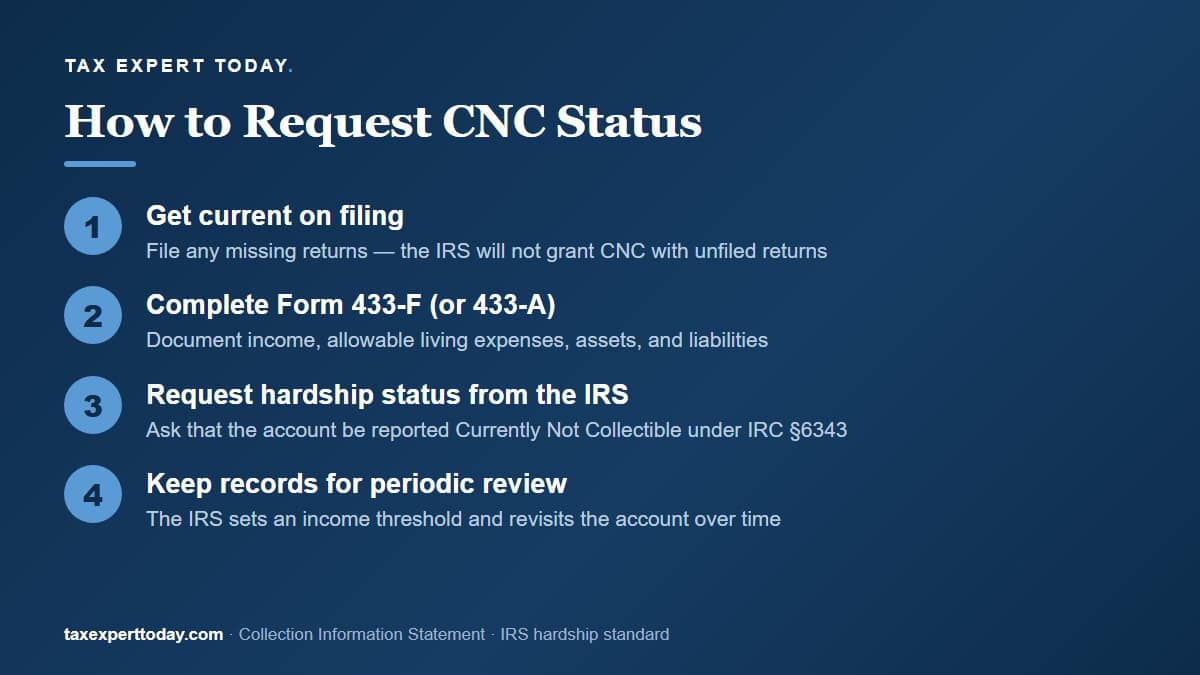
You request CNC by contacting the IRS and substantiating hardship with a Collection Information Statement — usually Form 433-F for most individuals, or Form 433-A for more complex cases and field collection. The form documents your income, allowable expenses, assets, and liabilities; the IRS compares those figures to its financial standards and, if you cannot pay, codes the account status 53. The steps below outline the process.
- Gather your financial documentation. Collect recent pay stubs or proof of income, bank statements, and bills showing rent or mortgage, utilities, transportation, health care, and other necessary expenses. The CNC decision is driven entirely by these numbers.
- Complete the Collection Information Statement. Fill out Form 433-F (or 433-A) accurately and completely. Understating expenses or omitting income undermines the request; the IRS verifies key figures against its own records.
- Contact the IRS and make the request. Submit the financial statement and ask that the account be reported Currently Not Collectible due to economic hardship. If a Revenue Officer is assigned, the request goes to them; otherwise it runs through the IRS collection function or the number on your most recent notice.
- Preserve your appeal rights. If the IRS denies CNC or threatens a levy, you may have Collection Due Process or Collection Appeals Program rights. Economic hardship is one of the alternatives you can raise on appeal.
- Keep records for the periodic review. CNC is not permanent. The IRS sets an income threshold and reviews the account, often when future returns show higher income, so retain your documentation.
Filing compliance matters here. The IRS generally will not place an account in CNC if required tax returns are unfiled, so any missing returns usually have to be filed first. Getting current on filing is frequently the first step in qualifying for any collection alternative.
Does CNC Stop Interest and Penalties?
No. Currently Not Collectible status stops active collection, but it does not stop interest or penalties. Interest continues to accrue on the unpaid balance under IRC Section 6601, and the failure-to-pay penalty under IRC Section 6651(a)(2) keeps building until the balance is paid or the collection statute expires. A debt parked in CNC can therefore grow over time, even though no payments are being demanded.
The feature that makes CNC valuable despite the accruing charges is that the collection statute expiration date (CSED) keeps running. The IRS generally has 10 years from assessment to collect, and time spent in CNC counts toward that deadline. If your finances do not recover, the balance — including the accrued interest and penalties — can expire when the CSED is reached. You can estimate how interest and penalties build on a balance over time with our IRS penalty and interest calculator. Because the math runs against the clock, the strategic question is always whether the statute will expire before your ability to pay returns.
CNC vs. Offer in Compromise vs. Installment Agreement
CNC pauses collection, an installment agreement pays the debt over time, and an offer in compromise tries to settle it for less — and which one fits depends on whether your inability to pay is temporary or permanent. CNC suits a taxpayer with no current ability to pay who may recover later or run out the statute. An installment agreement suits someone who can pay something monthly. An offer in compromise suits someone whose hardship is lasting and who can fund a reasonable settlement. The table compares them.
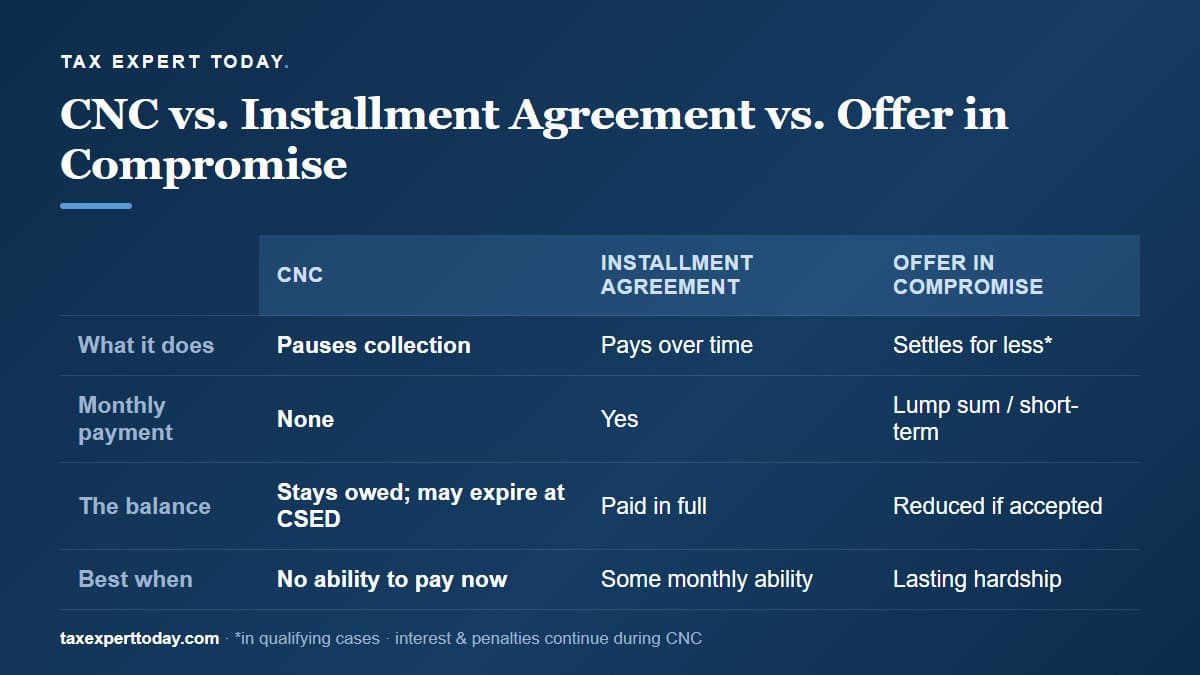
| Feature | Currently Not Collectible | Installment Agreement | Offer in Compromise |
|---|---|---|---|
| What it does | Pauses collection | Pays over time | Settles for less, in qualifying cases |
| Monthly payment | None | Yes | Lump sum or short-term |
| Interest and penalties | Continue to accrue | Continue (penalty rate may drop) | Stop on accepted, paid offer |
| Effect on the balance | Stays owed; may expire at CSED | Paid in full | Reduced to the accepted amount |
| Best when | No current ability to pay | Some monthly ability to pay | Lasting hardship, can fund a settlement |
These options are not mutually exclusive over time. A taxpayer often starts in CNC during a rough stretch, then moves to an installment agreement when income returns, or pursues an offer in compromise if the hardship proves permanent. Because each path turns on the same financial figures, the analysis usually begins with an honest Collection Information Statement and a look at how much time is left on the collection statute. The offer in compromise route in particular has grown far more selective. According to our research report on IRS Data Book figures, the IRS accepted only 14.1 percent of offers in fiscal year 2025, the lowest share in at least a decade, so a taxpayer weighing an offer against Currently Not Collectible status should test the numbers carefully before choosing that path.
Currently Not Collectible Help in Naples and Southwest Florida
Tax Expert Today LLC helps individuals and businesses in Naples and across Southwest Florida request Currently Not Collectible status, prepare the Collection Information Statement that supports it, and weigh CNC against an installment agreement or an offer in compromise. The work is documenting the financial picture accurately, getting unfiled returns current, and choosing the collection alternative that fits the facts. The firm is multidisciplinary, with enrolled agents, CPAs, and attorneys, and Dr. Kabashi is an Enrolled Agent authorized to represent taxpayers before the IRS in all 50 states. The office is at 11983 Tamiami Trail N, Naples, FL 34110, and the team can be reached at (239) 441-2005, Monday through Friday, 10am to 5pm ET.
Frequently Asked Questions
What is IRS Currently Not Collectible status?
Currently Not Collectible status, also called status 53 or hardship status, is when the IRS temporarily stops active collection because a taxpayer cannot pay their tax debt without being unable to cover basic living expenses. The IRS suspends levies and garnishments, but the balance remains owed, interest and penalties continue to accrue, and the IRS can resume collection if the taxpayer’s finances improve before the collection statute expires.
How long does Currently Not Collectible status last?
CNC has no fixed end date, but it is not permanent. The IRS sets an income threshold and reviews the account periodically, often when later tax returns show higher income, and can return the account to active collection if your ability to pay recovers. If your finances do not improve, the account can stay CNC until the 10-year collection statute under IRC Section 6502 expires, at which point the remaining balance generally can no longer be collected. For how that clock is calculated, see our guide to the IRS 10-year rule.
Does Currently Not Collectible status stop interest and penalties?
No. CNC stops active collection but not the accrual of interest or penalties. Interest continues under IRC Section 6601 and the failure-to-pay penalty continues under IRC Section 6651, so the balance can grow while the account is in hardship status. The advantage is that the collection statute keeps running during CNC, so the debt can expire on its own if your inability to pay continues.
Will the IRS file a tax lien if I am in Currently Not Collectible status?
It can. Placing an account in CNC does not prevent the IRS from filing a Notice of Federal Tax Lien to protect its claim, especially on larger balances. The lien is separate from a levy: CNC stops levies and garnishments, but a lien is a public claim against your property that can remain in place while the account is in hardship status. Whether a lien is filed depends on the balance and the facts of the case.
Where can I get help with Currently Not Collectible status in Naples, FL?
Tax Expert Today LLC, located at 11983 Tamiami Trail N, Naples, FL 34110, assists individuals and businesses in Naples and across Southwest Florida with Currently Not Collectible requests, Collection Information Statements, and the choice between CNC, an installment agreement, and an offer in compromise. The firm is multidisciplinary, with enrolled agents, CPAs, and attorneys, and represents taxpayers before the IRS nationwide. Consultations can be arranged at (239) 441-2005.
When to Engage a Professional for Currently Not Collectible Status
CNC turns on the numbers in your financial statement and on how much time is left on the collection statute, which is exactly where judgment matters. The calls that affect the outcome are how to present allowable expenses within the Collection Financial Standards, whether CNC or an offer in compromise is the better long-term path, and how to keep the account in hardship status through the periodic reviews. Getting unfiled returns current and documenting the financial picture accurately are usually the first steps. Tax Expert Today LLC represents individuals and businesses in IRS collection matters nationwide.
Call (239) 441-2005 or schedule a consultation to review whether Currently Not Collectible status fits your facts and how it compares to the other collection alternatives. Tax advisors, enrolled agents, CPAs, and attorneys serving clients in all 50 states. Reaching that conclusion requires a Collection Information Statement, and our guide to Form 433-A and Form 433-F covers what the IRS allows before it accepts that nothing remains.
Currently Not Collectible status is one of four federal programs, and which one fits depends on the financial picture rather than on preference. The firm overview of IRS audit representation and tax resolution sets the four options side by side with the authority for each.
Published June 29, 2026 by Dr. Pellumb Kabashi « Back to Learning Center
Have a question this article touches on?
Tax Expert Today LLC, based in Naples, Florida and serving clients across the United States.
Schedule a Consultation (239) 441-2005