
By Dr. Pellumb Kabashi, DBA, MBA, EA, CFE, CES
Founder, Tax Expert Today LLC · Tax advisors, enrolled agents, CPAs, and attorneys · Serving clients in all 50 states
Quick Answer: IRS allowable living expenses are the monthly amounts the IRS will count for food, clothing, health care, housing, utilities and transportation when it measures what a taxpayer can pay toward a tax debt. The current Collection Financial Standards took effect on June 29, 2026. National amounts are allowed in full, while local amounts are capped at the lesser of the standard or the amount actually spent. Call (239) 441-2005 for a free consultation.
What are IRS allowable living expenses?
IRS allowable living expenses are the published monthly amounts, formally called the Collection Financial Standards, that the IRS uses to decide how much of a taxpayer’s income is needed for basic living costs. Whatever income remains after those amounts is treated as available to pay the tax debt. They apply to individuals, not to business entities.
- Two families of standards. National Standards cover food, clothing and other items plus out-of-pocket health care. Local Standards cover housing and utilities plus transportation.
- A defined test. The IRS allows expenses that meet the necessary expense test, meaning they are necessary for the health and welfare of the taxpayer and family or for the production of income.
- A statutory origin. IRC §7122(d)(2)(A) directs the Treasury to develop and publish schedules of national and local allowances so that a taxpayer has an adequate means to provide for basic living expenses.
- A built-in limit on their use. Section 7122(d)(2)(B) tells IRS employees not to use the schedules where doing so would leave a taxpayer without adequate means to provide for basic living expenses.
That last point is the one most summaries of IRS allowable living expenses leave out. The standards are not a ceiling written into the Internal Revenue Code. The Code requires the IRS to publish them, and then it expressly limits how they may be applied. The Internal Revenue Manual at IRM 5.15.1.8 says the same thing in operational terms: the national and local expense standards are guidelines, and where a standard is inadequate for a specific taxpayer’s basic living expenses, the employee should allow a deviation and document the case file.
IRM 5.15.1.8 also sorts every allowable expense into three groups. The first is allowable living expenses based on the National and Local Standards. The second is other necessary expenses, which meet the necessary expense test and are normally allowed. The third is other conditional expenses, which may not meet the test but can be allowed on the facts of an individual case. This guide covers all three, because the published tables are only the first layer of the analysis.
The IRS applies IRS allowable living expenses whenever it needs to measure ability to pay. That includes a non-simple installment agreement, a partial payment installment agreement, an offer in compromise, and a request for currently not collectible status. The figures reach the IRS through the collection information statement, which our Form 433-A and 433-F guide covers line by line.
What are the 2026 IRS allowable living expenses national standards?
The 2026 National Standards for food, clothing and other items allow $867 a month for a household of one, $1,558 for two, $1,857 for three and $2,176 for four, plus $397 for each additional person. The IRS allows the full amount for the household size without asking what the taxpayer actually spent.
The IRS National Standards page breaks the total into five components. The figures below are the ones published with the June 29, 2026 effective date, confirmed against the live IRS table on the date this guide was published.
| Expense | One person | Two persons | Three persons | Four persons |
|---|---|---|---|---|
| Food | $496 | $893 | $1,073 | $1,278 |
| Housekeeping supplies | $44 | $85 | $94 | $95 |
| Apparel and services | $98 | $175 | $211 | $249 |
| Personal care products and services | $54 | $90 | $104 | $118 |
| Miscellaneous | $175 | $315 | $375 | $436 |
| Total | $867 | $1,558 | $1,857 | $2,176 |
For a household larger than four, the IRS adds $397 per additional person to the four-person total. A household of five is therefore allowed $2,573 and a household of six $2,970.
- Food covers food at home and food away from home, including meals, snacks and tips at restaurants and take-out.
- Housekeeping supplies covers laundry and cleaning supplies, stationery, postage, delivery services, and lawn and garden supplies.
- Apparel and services covers clothing, footwear, alterations, dry cleaning, and watches and jewelry with their repairs.
- Personal care covers hair care, oral hygiene, shaving, cosmetics and personal care appliances.
- Miscellaneous covers anything not captured elsewhere, including credit card payments, bank fees, reading material and school supplies.
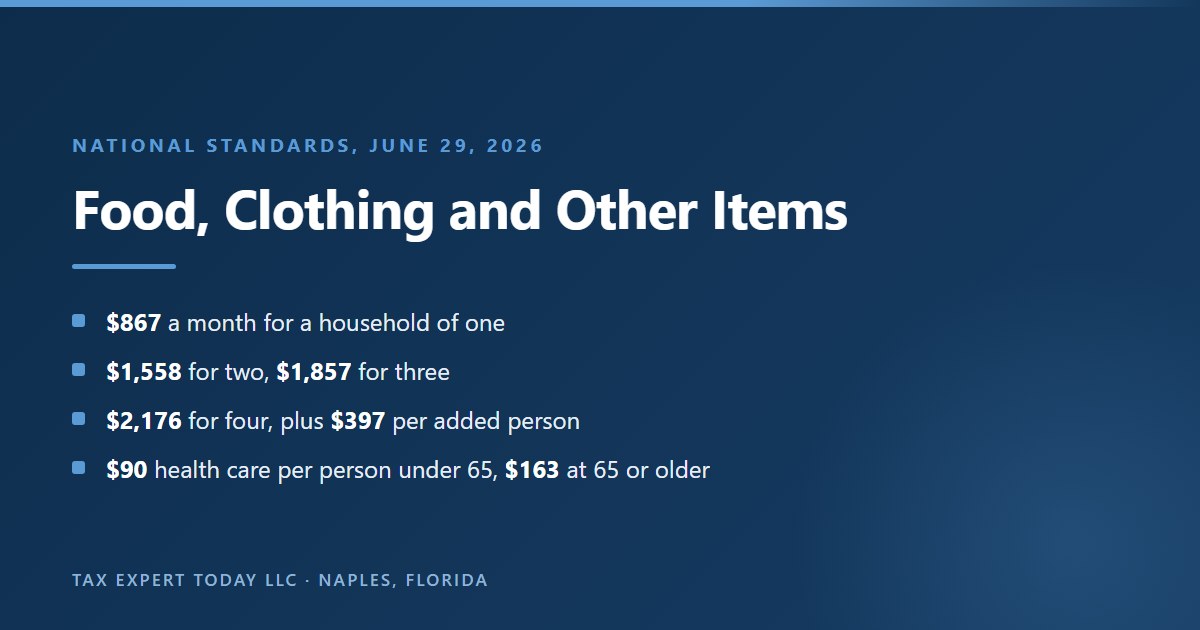
The single most useful fact about IRS allowable living expenses in this table is that the total is allowed as one figure. A taxpayer who spends less than the standard on food is still allowed the full National Standards amount. IRM 5.15.1.9 illustrates this with an example in which a taxpayer who actually spent less than the standard is allowed the full standard, because the employee is directed to allow the national amount for the family size without questioning the amount actually spent.
How much do IRS allowable living expenses allow for out-of-pocket health care?
The 2026 out-of-pocket health care standard is $90 a month per person under age 65 and $163 a month per person aged 65 or older. It is allowed per person for the taxpayer and each dependent, without verification, and it is allowed in addition to whatever the household pays for health insurance premiums.
- Per person, not per household. A married couple aged 70 and 68 is allowed $326 a month. A family of four with two adults under 65 and two children is allowed $360.
- What it covers. The IRS out-of-pocket health care page lists medical services, prescription drugs and medical supplies such as eyeglasses and contact lenses.
- What it excludes. Elective procedures, such as cosmetic surgery or elective dental work, are generally not allowed.
- Insurance sits on top. Premiums are a separate line and are not absorbed by the $90 or $163 figure.
A taxpayer whose medical costs exceed IRS allowable living expenses for health care can ask for more. IRM 5.15.1.9 says that taxpayers who claim more than the out-of-pocket standard may be allowed more if they provide documentation to substantiate and justify the additional expense, and it names taxpayers with no health insurance as a situation where this arises. For a household managing a chronic condition, the gap between the standard and the real monthly cost is often the most important number on the whole financial statement.
How do the local standards for housing and utilities work?
The housing and utilities standard is set county by county and by household size, from one person to five or more. The IRS allows the lesser of the published county figure or the amount the taxpayer actually pays. The figure is a single combined allowance covering both the home and every utility, including phone and internet.
According to IRM 5.15.1.10.1, housing expenses include mortgage or rent, property taxes, necessary maintenance and repair, homeowner’s or renter’s insurance, and homeowner dues and condominium fees. Utilities include gas, electricity, water, heating oil, trash collection, cable television, internet service, telephone and cell phone. All of it is measured against one number. The standard applies to the primary residence only, and IRM 5.15.1.10.1 allows expenses for any other residence only where disallowing them would cause economic hardship.
The range of IRS allowable living expenses between counties is wide. The IRS Florida housing and utilities table for 2026 shows the following for a selection of Florida counties:
| Florida county | Family of 1 | Family of 2 | Family of 3 | Family of 4 | Family of 5 or more |
|---|---|---|---|---|---|
| Collier County (Naples) | $2,375 | $2,789 | $2,939 | $3,277 | $3,330 |
| Lee County (Fort Myers) | $1,976 | $2,320 | $2,445 | $2,726 | $2,770 |
| Charlotte County | $1,850 | $2,172 | $2,289 | $2,552 | $2,593 |
| Miami-Dade County | $2,474 | $2,906 | $3,062 | $3,414 | $3,469 |
| Monroe County (Keys) | $3,099 | $3,640 | $3,836 | $4,277 | $4,346 |
- Lesser of, always. A Collier County taxpayer living alone who pays $1,900 a month for rent and utilities is allowed $1,900, not $2,375.
- Above the standard needs proof. A taxpayer who pays $3,100 is allowed $2,375 unless the excess is substantiated as necessary.
- Moving costs count in the decision. IRM 5.15.1.10.1 tells employees deciding on a deviation to weigh the cost of moving, the added cost of commuting from cheaper housing, and the tax consequences of losing a mortgage interest or property tax deduction.
- Inconvenience is not a reason. IRM 5.15.1.8 states that a deviation is not allowed merely because it is inconvenient to dispose of valued assets or reduce excessive necessary expenses.
For much of Southwest Florida, the IRS allowable living expenses figure for housing sits below the real cost of a home. A household paying a mortgage, property tax, flood and windstorm insurance, condominium fees and a special assessment can exceed the Collier County figure without anything about the home being unusual. The IRS does not automatically accept that argument, but the Manual does require the employee to consider it, and it is one of the areas where the quality of the documentation decides the outcome of the analysis.
How do the IRS allowable living expenses transportation standards work?
Transportation has three parts. Ownership costs allow up to $703 a month per vehicle for a loan or lease payment, for up to two vehicles. Operating costs vary by region and metropolitan area. Households with no vehicle receive a flat $220 public transportation allowance. Each part is capped at the lesser of the standard or the actual cost.
| Component (2026) | One car | Two cars | Rule |
|---|---|---|---|
| Ownership costs (national) | $703 | $1,406 | Lesser of the loan or lease payment or the standard; $0 if there is no payment |
| Operating costs, South region | $291 | $582 | Lesser of actual operating cost or the standard |
| Operating costs, Miami area | $423 | $846 | Applies in Broward, Miami-Dade and Palm Beach counties |
| Operating costs, Tampa area | $320 | $640 | Applies in Hernando, Hillsborough, Pasco and Pinellas counties |
| Public transportation (national) | $220 per household | Allowed without question to households with no vehicle | |
Operating costs, per the IRS transportation standards page, include maintenance, repairs, insurance, fuel, registrations, licenses, inspections, parking and tolls. They do not include personal property taxes. Florida sits in the South Census Region, and a taxpayer who lives outside the Miami and Tampa metropolitan areas, which includes Collier and Lee counties, uses the South region figure.
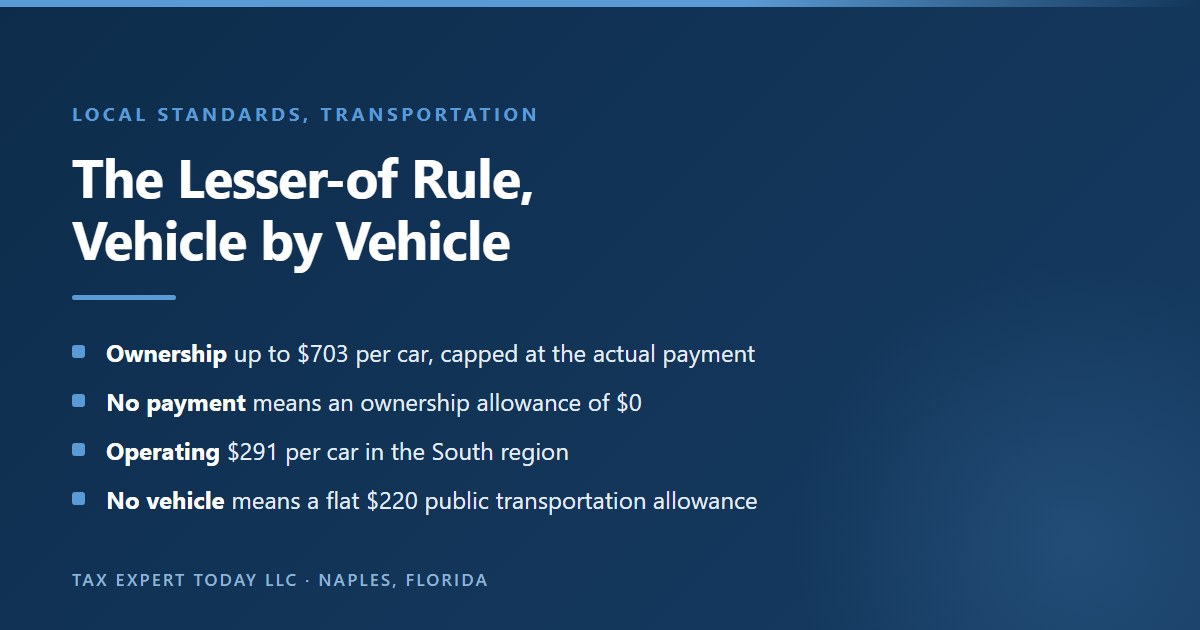
- No car payment, no ownership allowance. A taxpayer who owns a paid-off vehicle is allowed the operating figure only. The IRS page says the ownership allowance in that case is $0.
- One car for a single taxpayer. The IRS page states that a single taxpayer is normally allowed one automobile.
- Each vehicle is measured separately. IRM 5.15.1.10.2 works through examples in which one car payment is above the standard and the other is below it, and each is capped on its own.
- Long commutes can justify more. The Manual says a taxpayer who commutes a long distance to work may be allowed operating costs above the standard with substantiation, because the extra cost generally meets the production of income test.
The transportation line is where the lesser-of rule in IRS allowable living expenses produces the most surprises. A taxpayer with a $950 monthly truck payment is allowed $703 for ownership, and the $247 difference is not an allowable expense unless the vehicle is shown to be necessary at that cost. A taxpayer with an older vehicle and no payment may be allowed only $291 for everything the car costs to run.
When do the IRS allowable living expenses standards change, and why do older figures still circulate?
The IRS republishes the Collection Financial Standards periodically, and the current set took effect on June 29, 2026 for federal tax administration only. Many pages still quote earlier figures, and the bankruptcy version of the same tables runs on a separate effective date set by the U.S. Trustee Program.
- Check the date on the IRS page. The disclaimer at the top of every Collection Financial Standards page states the effective date. As of this guide, it reads June 29, 2026.
- Stale figures are common. Several pages ranking for this topic still list tables from 2024, when the four-person food figure alone was $1,143 rather than the current $1,278.
- Bankruptcy uses its own schedule. The U.S. Trustee Program means testing page states that the updated IRS standards apply to bankruptcy cases filed on or after July 15, 2026, and it keeps earlier tables for earlier filing dates.
- The IRS says so itself. The IRS disclaimer directs anyone computing bankruptcy expenses to the U.S. Trustee Program rather than to the IRS tables.
This matters in practice because a financial statement that applies last year’s IRS allowable living expenses figures understates or overstates the allowance, and the revenue officer or collection employee will recompute it with the current table anyway. A taxpayer who prints a table and returns to it months later should check the effective date first. The IRS page itself warns that the standard amounts change and asks anyone who prints them to check back periodically.
Which household members count for IRS allowable living expenses?
The number of people counted for the National Standards, the health care standard and the housing standard is generally the same as the number of taxpayers and dependents claimed on the most recent income tax return. The IRS verifies that each claimed dependent meets the Internal Revenue Code dependency rules, and it allows reasonable, documented exceptions.
- The return is the starting point. IRM 5.15.1.8 ties household size to the dependents claimed on the current year return.
- Exceptions exist. The Manual gives foster children and children whose adoption is pending as examples of reasonable exceptions.
- Size moves every table. Household size changes the National Standards amount, the per person health care amount and the column used in the county housing table.
- Shared households are analyzed. IRM 5.15.1.5 addresses shared expenses where the taxpayer lives with a person who is not liable for the tax, which affects how much of the household cost belongs to the taxpayer.
When IRS allowable living expenses are computed, a mismatch between the household on the financial statement and the household on the tax return is one of the first things an employee checks. Where an adult child has moved home, or an elderly parent now lives with the family but is not claimed, the explanation should be written into the submission rather than left for the IRS to question.
Can you claim more than the IRS allowable living expenses standards?
Yes, through a deviation. A taxpayer who spends more than a standard can be allowed the higher amount by substantiating that the excess is necessary for health and welfare or the production of income. Deviations are never allowed for the miscellaneous component, and each one must be verified, reasonable and documented in the case history.
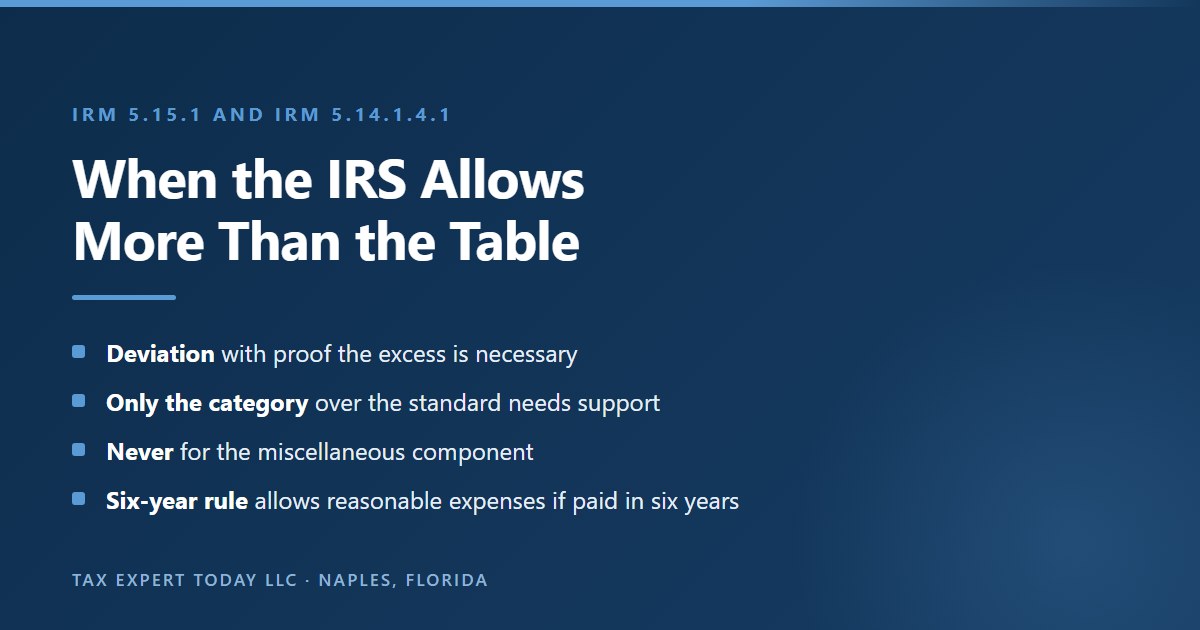
- Only the category over the standard needs proof. IRM 5.15.1.9 gives an example in which a taxpayer claims a higher food cost because of a prescribed diet, and states that only the food expense must be verified while the standard amounts are allowed for the other categories.
- Miscellaneous is fixed. The IRS National Standards page says deviations from the standard amount are not allowed for miscellaneous expenses.
- The review window can widen. IRM 5.15.1.8 notes that where the last three months of expenses do not reflect the yearly pattern, additional months, up to one year, may be reviewed.
- The IRS can allow actual expenses. The IRS overview page states that where the standards are inadequate to provide for basic living expenses, the agency may allow actual expenses if the taxpayer provides supporting documentation.
The practical test for a deviation from IRS allowable living expenses is whether a neutral reader of the documents would agree that the cost is necessary. Pharmacy records, a physician’s letter describing a required diet, a lease showing why a larger home is needed for a disabled family member, or an employer letter confirming a remote job site are the kinds of evidence that make the argument. A general statement that living costs are high in a particular area is not, because the county table already accounts for location.
What other necessary and conditional expenses does the IRS allow?
Beyond the published tables, IRM 5.15.1.11 lists other necessary expenses that are normally allowed when reasonable, such as court-ordered support, child care, term life insurance and current taxes, and other conditional expenses that may be allowed on the facts of the case. Every one must meet the necessary expense test or qualify under the six-year rule.
The table below summarizes how IRM 5.15.1.11 treats several of the expense items most often claimed by individuals.
| Expense item | When IRM 5.15.1.11 treats it as necessary | Common limitation |
|---|---|---|
| Accounting and legal fees | Fees for representation before the IRS, or fees that otherwise meet the necessary expense test | Must be reasonable for the complexity of the case; business fees are not personal expenses |
| Child care | When it meets the necessary expense test | Unusually large amounts are not allowed where reasonable alternatives exist |
| Court-ordered payments | Alimony, child support and restitution that are ordered and actually being paid | Not allowed if unpaid, unless nonpayment came from temporary job loss or illness |
| Dependent care for the elderly or disabled | When there is no alternative to the taxpayer paying | Documentation of the need is expected |
| Education | For a physically or mentally challenged child with no comparable public option, or when required for the taxpayer’s employment | General tuition is not a necessary expense |
| Life insurance | Term coverage on the taxpayer’s own life | Whole life policies are reviewed as assets that can be borrowed against |
| Charitable contributions | Only when required as a condition of employment | All other contributions are disallowed |
| Credit card payments | Treated as a method of paying other expenses, not a separate expense | Minimum payments are generally allowed only under the six-year rule; otherwise the miscellaneous allowance absorbs them |
- Involuntary deductions count. Union dues, required uniforms and work shoes are allowable when the job requires them.
- Secured debts need proof of payment. A secured or legally perfected debt is allowed when it meets the necessary expense test and the taxpayer shows the payments are actually being made.
- Charitable giving is usually out. The Manual’s example of an allowable contribution is a minister required to tithe by an employment contract.
- Current tax payments are central. Staying current on withholding or estimated payments is a condition of nearly every collection alternative, so current year taxes are part of the analysis rather than an afterthought.
Two items on this list regularly change the result once IRS allowable living expenses are applied. The first is representation fees, which the Manual expressly recognizes. The second is credit card debt. Many taxpayers expect minimum card payments to be allowed alongside the tables, and the Manual’s position is that the miscellaneous allowance inside the National Standards is the place those payments belong, unless the six-year rule applies.
What are the six-year rule and the one-year rule?
Under IRM 5.14.1.4.1, if the full liability including projected accruals can be paid within six years and within the collection statute, the IRS may allow all reasonable expenses without substantiation, even above the standards. A taxpayer who cannot meet that test may be given up to one year to reduce or eliminate excessive expenses under the one-year rule.
- Six-year rule conditions. The taxpayer must be able to stay current with filing and paying, must be able to full pay the liability and projected accruals within six years and within the collection statute expiration date, and must claim reasonable amounts.
- Financial information is still required. The IRM 5.14.1.4.1 text says taxpayers provide financial information in these cases but need not substantiate reasonable expenses.
- It is not a simple plan. The Manual states that an installment agreement under the six-year rule is a non-simple installment agreement, so a complete financial analysis is done and equity in assets must be addressed.
- The one-year rule stands alone. A taxpayer does not have to qualify for the six-year rule to use the one-year rule.
Penalties that are added to the balance also lengthen the payoff period the six-year test measures, so in qualifying cases a separate request for IRS penalty relief may change whether the test can be met. Both rules are unavailable to corporations, partnerships and LLCs identified as the liable taxpayer, and to business expenses generally. The collection statute referred to in the six-year test is the ten-year period explained in our IRS 10-year rule guide. The rules also interact with the 2026 revision of the payment plan framework, under which the smaller balances that once qualified for a streamlined agreement are now handled as a simple payment plan, a change covered in our IRS Fresh Start program guide.
Do IRS allowable living expenses apply to businesses or taxpayers abroad?
No to businesses and not in their domestic form to taxpayers abroad. IRM 5.15.1.8 states that the standards do not apply to corporations, partnerships, LLCs or any business expenses. Taxpayers living outside the United States are measured with the separate International Collection Financial Standards through a required IRS calculator.
- Business expenses are analyzed on their own. A business is evaluated on its actual income and expenses under the business sections of IRM 5.15.1, not against household tables.
- Sole proprietors are mixed cases. The owner’s household expenses are measured against the standards, while the business expenses are analyzed separately.
- No borrowed U.S. county. The Manual tells employees not to pick a location in the United States as a starting point for a taxpayer who lives abroad.
- Puerto Rico is covered. The IRS continues to publish housing and utilities standards for taxpayers residing in Puerto Rico.
Business owners often face both IRS allowable living expenses and a business analysis at once, particularly where payroll taxes are involved and the trust fund recovery penalty has been or may be assessed against them personally. In that situation the household standards govern the individual’s ability to pay, and the business analysis governs what the company can contribute.
How do IRS allowable living expenses fit into a real financial statement?
The standards are applied line by line on Form 433-A or Form 433-F. Each claimed expense is compared with the applicable standard, the allowable amount is recorded, and the total allowable expense is subtracted from verified monthly income. The standards decide the expense side of that comparison, not the income side.
Consider a hypothetical single taxpayer, aged 40, living in Collier County with one financed car. The taxpayer reports $2,600 a month for rent and utilities, a $650 car payment and $320 a month to run the car. Applying the 2026 IRS allowable living expenses standards produces the following allowable figures:
- National Standards: $867, allowed in full for a household of one.
- Out-of-pocket health care: $90, allowed in full for one person under 65.
- Housing and utilities: $2,375, the Collier County standard, because the $2,600 actually paid is higher.
- Vehicle ownership: $650, the actual payment, because it is below the $703 standard.
- Vehicle operating: $291, the South region standard, because the $320 actually spent is higher.
The allowable total from the tables in this illustration is $4,273 a month, before any other necessary expenses such as health insurance premiums, current tax payments or court-ordered support. The $225 of housing cost and $29 of operating cost above the standards would be allowed only through a substantiated deviation or the six-year rule. How the remaining income becomes a payment amount depends on which resolution is being requested, which is why the partial payment installment agreement and offer analyses each use these same figures differently.
IRS allowable living expenses help Naples: tax resolution Naples and Southwest Florida
Tax Expert Today LLC works with taxpayers in Naples, Florida and across Southwest Florida whose collection cases turn on the financial analysis. In this region the housing and utilities line is frequently the contested one, because insurance, condominium fees and assessments push actual costs above the county standard for households that are not living extravagantly. Organizing the documentation behind that line before the financial statement is submitted is usually more productive than arguing it afterwards. Most of these cases begin with a CP14 and the reminder notices such as the CP503, and the financial analysis tends to become urgent once a CP504 or a final notice of intent to levy arrives, because the Collection Due Process hearing is one of the formal places a collection alternative built on these figures can be raised.
Searchers looking for IRS allowable living expenses help in Naples usually fall into one of two groups. The first is a household whose actual costs are above the standards and who needs to know which deviations are worth supporting. The second is a household whose costs are below the standards and who does not realize the IRS will still allow the full National Standards amount. Tax resolution Naples clients in both groups benefit from seeing the allowable figures computed from the current table before any figures are sent to the IRS.
Tax Expert Today LLC
11983 Tamiami Trail N, Naples, FL 34110
Phone: (239) 441-2005
Hours: Monday through Friday, 10:00 to 5:00 ET
Which IRS allowable living expenses figures apply in Naples and Fort Myers? A Collier County household uses the Collier County housing and utilities figure, which for 2026 is $2,375 for one person and $3,277 for a family of four, and a Lee County household uses $1,976 and $2,726 for the same sizes. Both counties sit outside the Miami and Tampa metropolitan areas in the IRS transportation table, so both use the South region operating cost of $291 for one car. The National Standards and the out-of-pocket health care amounts are the same nationwide. Our IRS resolution and audit support service page and our Naples tax resolution page describe how these engagements are handled.
When to Engage a Professional
Many taxpayers can complete a collection information statement on their own, particularly where every expense is below the standards and the balance is modest. Consider engaging a representative where actual housing, medical or transportation costs exceed the standards and a deviation needs to be supported, where the household on the tax return does not match the household that actually lives in the home, where the taxpayer also owns a business or faces payroll tax exposure, where the choice between an installment agreement, a partial payment agreement, an offer in compromise and currently not collectible status depends on how the expenses are treated, or where a revenue officer has already disallowed expenses and the analysis needs to be revisited. Tax Expert Today LLC was founded by Dr. Pellumb Kabashi, and every engagement is built on the actual documents and the current published standards rather than on figures from a prior year.
This article is educational and general in nature. It does not constitute tax advice for any particular taxpayer, and outcomes depend on individual facts and circumstances. Standard amounts are those published by the IRS with a June 29, 2026 effective date and are subject to change.
Published September 17, 2026 by Dr. Pellumb Kabashi « Back to Learning Center
Have a question this article touches on?
Tax Expert Today LLC, based in Naples, Florida and serving clients across the United States.
Schedule a Consultation (239) 441-2005