
By Dr. Pellumb Kabashi, DBA, MBA, EA, CFE, CES
Founder, Tax Expert Today LLC · Tax advisors, enrolled agents, CPAs, and attorneys · Serving clients in all 50 states
Quick Answer: Form 1040-C is the U.S. Departing Alien Income Tax Return, filed in person at an IRS office before most noncitizens leave the United States to obtain a sailing permit, the certificate of compliance. It estimates the year’s tax and may require payment first. It is not a final return: Form 1040-NR or Form 1040 is still due after year end. Call (239) 441-2005 for a free consultation.
What is Form 1040-C?
Form 1040-C is the U.S. Departing Alien Income Tax Return. A noncitizen who must obtain a sailing permit files it in person at an IRS Taxpayer Assistance Center before leaving the country, reporting income received and expected for the year and, when required, paying the tax shown. The IRS then signs the certificate of compliance printed on the form.
- Full name: Form 1040-C, U.S. Departing Alien Income Tax Return (form revision January 2024, instructions revised January 2026).
- Who files it: resident and nonresident aliens who need a sailing permit and do not qualify for the shorter Form 2063.
- Where: a local IRS Taxpayer Assistance Center, by appointment only.
- When: no earlier than 30 days and ideally at least 2 weeks before departure.
- What it is not: a final return. Form 1040-NR or Form 1040 is still filed after the year ends.
Form 1040-C is one of the least understood forms the IRS publishes. Search for it and you will find pages about Schedule C, the sole proprietor schedule, because the letter C confuses search engines and readers alike. The form this page covers has nothing to do with Schedule C. It is a four page return that a departing noncitizen files before leaving the United States so that an IRS officer can certify that the person’s income tax obligations have been met, based on the information available that day. The signed certificate on the duplicate copy of the form is the document people call the sailing permit or departure permit.
The rule behind the form is short. Section 6851(d)(1) says that, subject to exceptions in the regulations, no alien shall depart from the United States unless the alien first procures a certificate that the alien has complied with all obligations imposed by the income tax laws. Treasury Regulation section 1.6851-2 then fills in who is excepted, how the IRS decides whether a departure puts collection in jeopardy, and which form the departing person files. Form 1040-C and its short companion, Form 2063, are the two ways to get the certificate.
We wrote this guide for the people we see most often in Southwest Florida: foreign professionals on work visas who are leaving after an assignment, green card holders moving back abroad, foreign owners of Florida condominiums who sell and leave in the same year, and Canadian and European seasonal residents who are unsure whether any of this applies to them. Each section opens with a short answer, and the hypothetical examples later in the guide work the 2026 figures from the January 2026 Instructions for Form 1040-C.
| Question | Short answer for 2026 | Where the rule lives |
|---|---|---|
| What does Form 1040-C produce? | A signed certificate of compliance, the sailing or departure permit | Section 6851(d); Treas. Reg. 1.6851-2(b) |
| Who is excepted? | Diplomats, certain students and trainees, short visitors, border commuters, and military trainees, with conditions | Treas. Reg. 1.6851-2(a)(2) |
| Is there a shorter form? | Yes, Form 2063, when there is no taxable income or a resident’s departure does not jeopardize collection | Treas. Reg. 1.6851-2(b)(2) |
| Earliest filing date | 30 days before departure | Instructions for Form 1040-C |
| Recommended filing date | At least 2 weeks before departure | Instructions for Form 1040-C |
| Is a refund paid at departure? | No, only on the final return after year end | Instructions for Form 1040-C |
| Does it replace the annual return? | No, Form 1040-NR, 1040, or a dual-status return is still required | Instructions for Form 1040-C, Final Return Required |
| Is the certificate a final determination? | No, more tax can be assessed later | Instructions for Form 1040-C, Certificate of Compliance |
What is a sailing permit, and is it the same as Form 1040-C?
A sailing permit is the popular name for the certificate of compliance a departing alien receives from the IRS. It is not a separate application. It is the signed certificate section of Form 1040-C, on the duplicate copy, or the certificate detached from Form 2063. The permit shows that, on the information available, U.S. income tax obligations were satisfied.
- Other names: departure permit, departing alien clearance, and certificate of compliance.
- Who signs it: an agent of the IRS Field Assistance Area Director.
- Form 1040-C version: the certificate printed at the bottom of page 2, signed on your copy.
- Form 2063 version: a detachable certificate at the bottom of the form.
- Where it is used: presented at the point of departure if requested.
The term sailing permit dates from an era when people left the country by ship. Today almost everyone leaves by air, but the IRS still uses the phrase on its departing alien clearance page, alongside departure permit. Whatever the name, the permit is evidence that you went through the process. The regulation says that either the certificate, properly executed, or evidence that you are excepted from needing one must be presented at the point of departure, and that a person who arrives at the point of departure without either is subject to examination there by an IRS officer or employee.
The permit also has a defined scope. A permit issued on Form 2063 can be used for all departures during the current year, and so can a Form 1040-C permit issued to a person whose taxable period was not terminated. A permit issued after the IRS found jeopardy and required payment or a bond applies only to the specific departure for which it was issued. In every case the IRS may revoke a permit for a later departure if it believes that departure would hinder collection.
| Version of the permit | How you receive it | How long it is good for |
|---|---|---|
| Form 2063 certificate | Detached from Form 2063 after the IRS signs it | All departures in the current year, subject to revocation |
| Form 1040-C, no termination of the tax period | Signed on the duplicate copy of Form 1040-C | All departures in the current year, subject to revocation |
| Form 1040-C after a jeopardy finding | Signed only after the tax is paid or a bond is posted | Only the specific departure it was issued for |
Who must get a sailing permit before leaving the United States?
Under section 6851(d) and Treasury Regulation section 1.6851-2, every alien, resident or nonresident, must obtain a certificate of compliance before departing the United States unless a listed exception applies. The rule turns on citizenship, not on how long you stayed or whether you plan to return, and it applies to permanent and temporary departures alike.
- Covered: resident aliens, including green card holders, and nonresident aliens.
- Not covered: U.S. citizens, who never need a sailing permit.
- Temporary trips: covered too, although the process is lighter when you will return and collection is not at risk.
- Exceptions: six categories in the regulation, each with conditions.
- Proof: a person relying on an exception should be able to show the identification or authority that supports it.
The breadth of the rule surprises people. The regulation states that, except as provided in its list of exceptions, no alien, whether resident or nonresident, may depart from the United States unless the alien first procures a certificate. The IRS page puts it more gently, saying the document is one most aliens must secure before leaving, and that it is proof you have settled your U.S. tax liabilities before a planned, long term, or permanent departure. In practice, the people who most clearly need a permit are those leaving after a period of U.S. work or U.S. income, especially those who do not plan to return.
It helps to separate three groups. First are people who fall inside one of the exceptions, such as a tourist on a B-2 visa with no U.S. income. Second are people who need a permit but qualify for Form 2063 because they had no taxable income, or because they are resident aliens whose departure does not threaten collection. Third are everyone else, who file Form 1040-C. The sections that follow walk through each group in order, and the IRS Publication 519 chapter on departing aliens follows the same order.
| Your situation | Sailing permit needed? | Form, if any |
|---|---|---|
| U.S. citizen leaving the country | No | None |
| Alien inside a listed exception, conditions met | No, but keep proof of the exception | None |
| Alien with no taxable income this year or last, returns filed | Yes | Form 2063 |
| Resident alien with income, departure does not jeopardize collection | Yes | Form 2063 |
| Nonresident alien with taxable income | Yes | Form 1040-C |
| Resident alien ending residence and leaving with income | Yes | Form 1040-C |
| Anyone the IRS believes is leaving to avoid tax | Yes | Form 1040-C |
Which departing aliens are exempt from the sailing permit?
The regulation excepts diplomats and their households, certain employees of foreign governments and international organizations, F, J, H-3, H-4, Q, and M visa students and trainees with only permitted income, short-term visitors, travelers in transit, military trainees on official orders, and Canadian or Mexican residents who commute to U.S. jobs with wages subject to withholding.
- Diplomats: holders of diplomatic passports, their households, and accompanying servants.
- Students and trainees: only if U.S. income is limited to allowances, authorized employment, and deposit interest.
- Visitors: B-2 pleasure visitors, and B-1 business visitors staying no more than 90 days in the year.
- Commuters: Canadian or Mexican residents with withheld U.S. wages.
- Important limit: the visitor, transit, and commuter exceptions fall away if the IRS believes there was taxable income and departure would hinder collection.
The exceptions are listed in Treas. Reg. section 1.6851-2(a)(2) and restated, with slightly different numbering, in the Form 1040-C instructions and in IRS Tax Topic 858, Alien tax clearance. Each category comes with conditions, and the conditions matter more than the label. A student on an F-1 visa is excepted only if the student received no U.S. source income other than allowances covering study expenses, the value of services or accommodations furnished incident to study, income from employment authorized under immigration law, and deposit interest that is not effectively connected with a U.S. business. A student who sold U.S. stock at a gain or earned unauthorized income is outside the exception.
The diplomat exception also has an important limit. A person who signed the waiver of rights, privileges, exemptions, and immunities under section 247(b) of the Immigration and Nationality Act, usually as a condition of holding both a job with a foreign government or international organization and immigrant status, is not entitled to the exception and must obtain a certificate. Line 5 of Form 1040-C asks about that waiver directly.
| Exception | Conditions in the regulation | Can the IRS override it? |
|---|---|---|
| Diplomatic passport holders and their households | Diplomatic passport or passport marking diplomatic service; servants must travel with the diplomat | No examination, unless a section 247(b) waiver was signed |
| Employees of foreign governments and international organizations | Pay excluded under section 893 and no other U.S. source income; household members with no U.S. source income | Not available after a section 247(b) waiver |
| F-1, F-2, H-3, H-4, J-1, J-2, Q students, trainees, and exchange visitors | Only study allowances, furnished services, authorized employment income, and non-business deposit interest | Exception lost if other U.S. income was received |
| M-1 and M-2 students | Only authorized employment income and non-business deposit interest | Exception lost if other U.S. income was received |
| B-2 visitors; B-1 or B-1/B-2 visitors; visa waiver and border card visitors | Business visitors must not stay more than 90 days in the tax year | Yes, if the IRS believes there was taxable income and collection is at risk |
| Travelers in transit, including C-1 visas | Passing through the United States | Yes, on the same jeopardy basis |
| Military trainees under Department of Defense orders | Departing on official military travel orders | Yes, on the same jeopardy basis |
| Canadian or Mexican residents commuting to U.S. jobs | Frequent commuting for employment, wages subject to withholding | Yes, on the same jeopardy basis |
A person who relies on an exception does not file anything, but the IRS page says such a person must be able to substantiate the claim with proper identification or by citing the applicable authority. In practical terms, travel with the visa, the employment authorization, and a short note of the exception you rely on, especially if your situation is close to a line, such as a business visitor who has spent close to 90 days in the country during the year.
Does a green card holder need a sailing permit?
Yes, as a rule. A lawful permanent resident is a resident alien, and resident aliens are not in the regulation’s list of exceptions. A green card holder leaving temporarily, with residence continuing, usually files the short Form 2063. One leaving permanently with income usually files Form 1040-C, and long-term holders surrendering the card must also consider Form 8854.
- Temporary trip, residence continues: departure is treated as not resulting in jeopardy unless the IRS has information the person is leaving to avoid tax.
- Permanent move abroad: a resident alien discontinuing residence is treated like a nonresident for the jeopardy test.
- Long-term resident: a green card held in at least 8 of the last 15 tax years brings the expatriation rules into play.
- Immigration step: the Department of Homeland Security must be notified of the termination of residency.
- Tax step: Form 8854 is filed with the final return for the year of expatriation.
The regulation draws a clear line between residents who intend to stay residents and those who are leaving for good. Under section 1.6851-2(b)(1)(ii), the departure of a resident who intends to continue that residence is treated as not resulting in jeopardy, so the tax period is not terminated, unless the IRS has information that the person intends by the departure to avoid payment of tax. For a nonresident, including a resident alien discontinuing residence, the intent to depart justifies termination of the tax period unless the person shows an intent to return and that departure will not jeopardize collection.
That is why a green card holder flying to see family for a month and a green card holder moving back to Europe permanently have very different appointments. The first can usually file Form 2063, receive a certificate good for all departures that year, and leave. The second is more likely to file Form 1040-C, report expected income for the year, and pay the tax shown before receiving the certificate. The instructions add that a lawful permanent resident with no definite plans to return must notify the Department of Homeland Security of the termination of residency and file Form 8854 if the person plans to surrender the card and has been a lawful permanent resident in at least 8 of the last 15 tax years. We explain that test and the possible exit tax in our guide to Form 8854 and the U.S. exit tax.
| Green card holder’s situation | Likely form | Other filings to plan |
|---|---|---|
| Short trip abroad, keeping U.S. residence | Form 2063 | Normal Form 1040 for the year |
| Leaving permanently, fewer than 8 of 15 years as a resident | Form 1040-C | Dual-status return for the year of departure |
| Leaving permanently, at least 8 of 15 years as a resident | Form 1040-C | Dual-status return plus Form 8854, possible section 877A tax |
| Treated as a treaty resident of another country | Depends on facts; residence may already have ended | Form 8833 and the section 7701(b)(6) notice rules |
Should I file Form 1040-C or Form 2063?
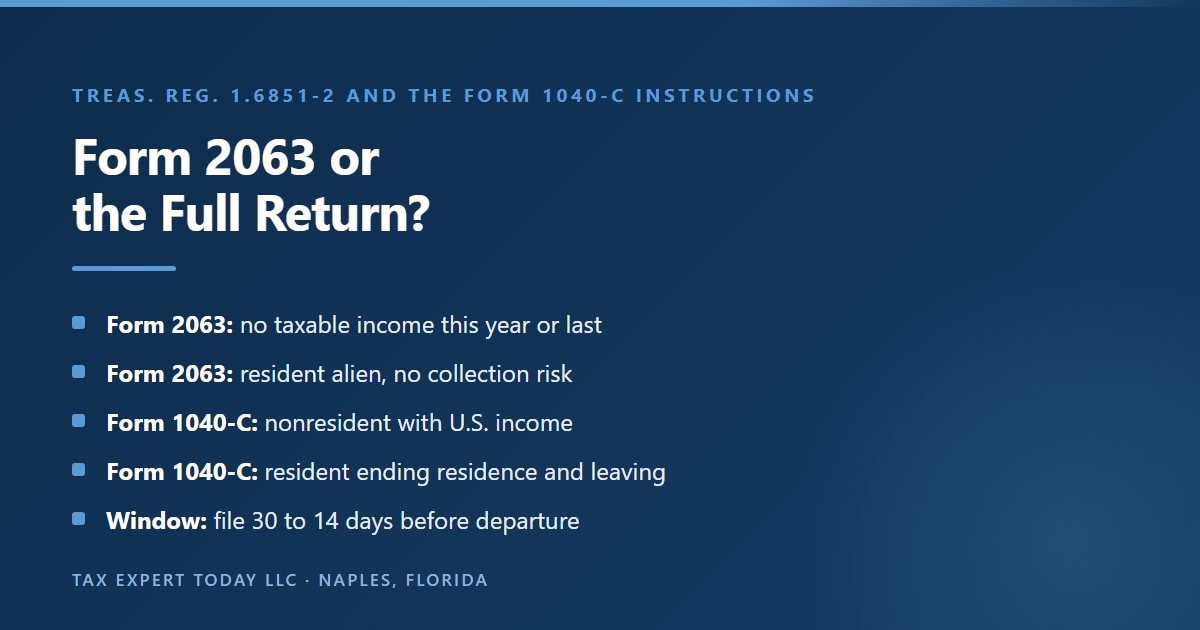
File Form 2063 if all required returns are filed, any tax due is paid, and either you had no taxable income this year or last year, or you are a resident alien whose departure the IRS finds will not hinder collection. Everyone else who needs a permit files Form 1040-C, which includes a full tax computation and may require payment.
- Form 2063: a short statement with no tax computation and a detachable certificate.
- Form 1040-C: a four page return with income schedules, deductions, and a tax computation.
- Nonresidents with income: generally file Form 1040-C, since Form 2063 covers nonresidents only when they had no taxable income.
- Possible avoidance: if the IRS has information that you are leaving to avoid tax, Form 1040-C is required.
- Filing gaps: either way, unfiled returns and unpaid tax for earlier years must be cleared first.
Form 2063, the U.S. Departing Alien Income Tax Statement, is the lighter path. The regulation in section 1.6851-2(b)(2) lists two groups who file it: residents whose tax period is not terminated, either because they had no taxable income or because the IRS has not found that their departure jeopardizes collection, and nonresidents who had no taxable income for the year up to departure and for the preceding year if that year’s return is not yet due. Form 2063 asks for identifying information and facts about your stay but no tax computation.
Form 1040-C is the default for everyone else. A nonresident with U.S. wages, rental income, or a gain on U.S. real property files Form 1040-C. So does a resident alien ending residence, and so does anyone the IRS believes is leaving to avoid paying tax. Both forms carry a certificate of compliance, and both require that every income tax return you were required to file has been filed and any tax due has been paid before the certificate is signed.
| Feature | Form 2063 | Form 1040-C |
|---|---|---|
| Official title | U.S. Departing Alien Income Tax Statement | U.S. Departing Alien Income Tax Return |
| Tax computation | None | Full computation in Part III and Schedule D |
| Who files | Aliens with no taxable income; residents whose departure is not a collection risk | Every other alien who needs a permit |
| Payment at filing | Only past due tax from earlier years | Tax shown, unless the IRS finds no jeopardy or a bond is posted |
| Certificate scope | All departures in the current year | All departures in the year, or one departure after a jeopardy finding |
| Copies filed | The statement, with the certificate detached for you | An original and one copy |
| Final return still required? | Yes, if a return is otherwise required | Yes, always if a return is otherwise required |
When should I apply for a sailing permit?
Apply in the window that opens 30 days before your planned departure and, according to the IRS, at least 2 weeks before you leave. You cannot file earlier than 30 days out. Because every Taxpayer Assistance Center works by appointment and some offices are booked for weeks, call to schedule before the window opens.
- Earliest filing: 30 days before the planned departure date.
- Target filing: at least 2 weeks before departure.
- Booking: call before the window opens, since appointments may not be available within it.
- January to April 15 departures: the prior year’s annual return must also be filed and paid.
- Bring: proof of the departure date, such as an airline ticket.
The timing rule appears in both the instructions and the IRS clearance page: you should get your permit at least 2 weeks before you plan to leave, you cannot apply earlier than 30 days before the planned departure date, and you should not wait until the last minute in case there are unexpected problems. The IRS page adds a practical warning that, depending on the time of year, some offices may not have appointments available within the required period, so you should allow enough time to schedule before your departure date.
Departures early in the calendar year have an extra step. The instructions state that a person departing between January 1 and April 15 must also file the annual Form 1040-NR, 1040, or 1040-SR and pay any tax due, which in practice means the return for the year just ended, since its due date has not passed. The regulation reaches the same result for a terminated tax period by requiring the return for the preceding taxable year where the period for filing has not expired. A February departure therefore means preparing two returns in a few weeks.
| Days before departure | What to do |
|---|---|
| 60 to 45 days | Confirm whether an exception applies; gather records; call 844-545-5640 to request an appointment |
| 45 to 31 days | Draft Form 1040-C or Form 2063; file any missing prior returns; arrange certified funds if tax will be due |
| 30 to 14 days | Attend the appointment with an original and a copy of Form 1040-C and all documents |
| 14 to 1 days | Keep the signed certificate with your passport; resolve any follow-up the officer requested |
| After the year ends | File the final Form 1040-NR, Form 1040, or dual-status return and claim the payments made |
How do I get an IRS appointment for a sailing permit?
Call the IRS appointment line at 844-545-5640, available from 7 a.m. to 7 p.m. local time, and ask for a departing alien clearance appointment at your local Taxpayer Assistance Center. If you worked in the United States, the IRS suggests an office near your employment, although an office near your departure point can also issue the permit.
- Phone: 844-545-5640, 7 a.m. to 7 p.m. local time.
- Service to request: departing alien clearance, also called the sailing permit.
- Office choice: near where you worked, or near where you will depart.
- Limited services: not every service is available at every office, so confirm when booking.
- Payment form: certified funds such as a cashier’s check, certified bank or postal money order, or cash; check the office’s options.
The IRS clearance page and the instructions both say that all Taxpayer Assistance Center offices operate by appointment. Southwest Florida residents typically book an office in the region, and it is worth asking during the call whether the office handles departing alien clearance on the date offered. When tax will be paid at the appointment, the instructions require certified funds, meaning a cashier’s check, a certified bank or postal money order, or cash, and they advise checking the local office’s payment options in advance.
If you will be represented, a Form 2848 power of attorney allows a representative to communicate with the IRS for you, but the signature rules on Form 1040-C are strict. The form is not a valid return unless you sign it. The instructions allow an agent in the United States to sign only if you are sick or otherwise unable to sign, and only with IRS approval obtained by filing a statement explaining why you cannot sign.
What documents should I bring to the IRS office?
Bring your passport with your visa or green card, copies of your U.S. returns for the past two years with proof of payment, records supporting deductions and dependents, employer statements of wages and withholding to date, self-employment income and expense statements, estimated tax receipts, sale documents, treaty support, proof of departure date, and your SSN or ITIN document.
- Identity and status: valid passport plus green card or visa.
- History: the last two years of returns and payment receipts.
- Current year income: employer statements to date, or a profit and loss statement if self-employed.
- Transactions: closing statements and records for sales of personal or real property.
- Proof of departure: airline ticket or itinerary.
The instructions list eleven categories of records, and bringing them is what turns a long appointment into a short one. If you are married and live in a community property state, the list applies to your spouse as well, whether or not your spouse needs a certificate. Florida is not a community property state, but couples who lived in a community property state earlier in the year should ask whether that rule reaches them.
| Record listed in the instructions | Why the officer needs it | Practical tip |
|---|---|---|
| Passport with green card or visa | Confirms identity, status, and any exception | Bring the I-94 record too if your status changed |
| U.S. returns for the past 2 years | Confirms past filing compliance | Include every Form 1040-NR, 1040, and amended return |
| Receipts for tax paid on those returns | Confirms no past balance remains | An IRS account transcript is a useful cross-check |
| Records proving deductions, expenses, and dependents | Supports amounts on prior and current returns | Organize by year and by line |
| Employer statement of wages and withholding to date | Supports current year income and credits | Request it from payroll before the last pay date |
| Self-employment income and expenses to departure | Supports business income and Schedule SE | A dated profit and loss statement is enough to start |
| Proof of estimated tax payments | Credits payments on line 28 | Print the payment confirmations |
| Documents for sales of personal or real property | Supports gains, losses, and withholding at source | Bring the closing statement and Form 8288-A if received |
| Scholarship or fellowship documents | Shows the grantor, source, purpose, and amounts | Include the award letter and payment history |
| Treaty benefit documents | Supports a reduced rate or exemption | Note the treaty article and the residence certificate |
| Proof of departure date and taxpayer number | Confirms timing and identity in IRS systems | An SSN card or the CP 565 notice issuing your ITIN |
What does jeopardy mean for a departing alien?
Jeopardy means the IRS believes your departure would put collection of income tax for the current or preceding year at risk. If it finds jeopardy, your tax period is terminated and the certificate issues only after you pay or post a bond. Without jeopardy, payment waits for the normal due date.
- Who decides: the IRS, on examination of all the facts in the case.
- Residents staying residents: treated as not creating jeopardy, absent information about tax avoidance.
- Nonresidents and residents leaving for good: the departure itself justifies termination unless they show an intent to return and no collection risk.
- Helpful evidence: a continuing U.S. trade or business, or property left in the United States sufficient to secure the tax.
- Result of a finding: a termination assessment under section 6851(a).
Jeopardy is the hinge of the whole departing alien system. The regulation in section 1.6851-2(b)(1) directs the IRS, upon the departure of an alien who needs a certificate, to determine whether the departure jeopardizes collection of income tax for the current or preceding year. If it does, the alien’s taxable period is terminated, which means the IRS treats the year as ending at departure for collection purposes, and the alien files Form 1040-C for that short period and pays the tax. If it does not, the alien still files the required form but does not pay income tax before the usual time for payment.
The regulation also tells you what kind of evidence helps. It gives as examples information showing that the alien is engaged in a trade or business in the United States, or that the alien leaves sufficient property in the United States to secure payment of tax for the year and any unpaid tax for the preceding year. A foreign professional who will return to the same U.S. employer after a short assignment abroad, or a foreign owner who keeps a valuable Florida property, is in a better position than a person who has sold everything and closed every account.
Termination itself comes from section 6851(a), which authorizes the IRS to make an immediate assessment when a taxpayer designs to do an act that would tend to prejudice collection. The instructions describe a termination assessment as a demand for immediate payment of income tax for the current year and the immediately preceding year. Section 6851(d)(2) supplies the other side: payment is not enforced early if the IRS determines that collection will not be jeopardized by the departure.
| Facts at the appointment | Likely IRS view | Practical effect |
|---|---|---|
| Resident alien, short trip, U.S. home and job continue | No jeopardy unless avoidance is indicated | Form 2063; certificate for all departures that year |
| Nonresident with U.S. wages, returning to the same employer | May show no jeopardy | Form 1040-C without paying the tax shown; certificate for the year |
| Nonresident leaving permanently with U.S. income | Departure itself justifies termination | Form 1040-C for the short period; pay or post bond |
| Resident ending residence and selling U.S. assets | Treated like a nonresident for this test | Form 1040-C; pay or post bond |
| Information that the person is leaving to avoid tax | Jeopardy | Form 1040-C required; payment or bond before departure |
Do I have to pay the tax shown on Form 1040-C before I leave?
Usually yes. Unless a bond is furnished or the IRS is satisfied your departure does not jeopardize collection, you pay the tax shown when you file, plus unpaid tax for past years. If you show an intent to return and no collection risk, the permit can issue without paying the tax shown.
- Default: pay the tax shown on line 31 at filing, in certified funds.
- Past years: any unpaid tax for earlier years must be paid, or a bond posted where allowed.
- Returning to the United States: the permit can be issued without paying the current year tax shown.
- Overpayment: if withholding exceeds the tax, nothing is paid, but no refund is issued at departure.
- Later liability: the final return may show more or less tax than Form 1040-C.
The instructions state the default plainly: except when a bond is furnished, or the IRS is satisfied that your departure does not jeopardize the collection of income tax, you must pay all tax shown as due on Form 1040-C at the time of filing it, and you must also pay any taxes due for past years. They also state that, generally, a certificate on Form 1040-C will be issued without your paying tax or posting bond if you have not received a termination assessment. Read together, the two statements mean the payment question is really the jeopardy question.
The returning-to-the-United-States path is worth understanding because it fits many foreign professionals on multi-year assignments. If you furnish information showing, to the satisfaction of the IRS, that you intend to return and that your departure does not jeopardize collection, you can get the permit by filing Form 1040-C without paying the tax shown on it. You still file any returns that have not been filed and pay any tax due on them, and your Form 1040-C must report all income received and reasonably expected for the entire year of departure, not just to the departure date. That permit can be used for all departures during the year, subject to cancellation if collection later appears to be at risk.
| Situation at filing | Pay current year tax shown? | Pay past due tax? | Permit scope |
|---|---|---|---|
| No jeopardy found, intent to return shown | No, paid by the normal due date | Yes | All departures in the year |
| Jeopardy found, tax paid | Yes, at filing | Yes | That departure only |
| Jeopardy found, bond posted | No, bond secures it | Yes, past taxes must be paid | That departure only |
| Withholding already exceeds tax shown | Nothing to pay | Yes | Depends on the jeopardy finding |
Can I post a bond instead of paying the tax?
Yes, in some cases. If you pay all tax owed for prior years, the IRS may accept a bond instead of payment of the tax shown on Form 1040-C, or on a preceding year return not yet due. The bond equals the tax due plus interest to the payment date, as figured by the IRS.
- Condition: all taxes owed for prior years are paid first.
- What the bond covers: the Form 1040-C tax, and the preceding year’s tax if its return is not yet due.
- Amount: tax due plus interest to the date of payment, figured by the IRS.
- Details: the form of bond and the security on it are arranged through the local office.
- Permit scope: a permit issued on these terms covers only that departure.
A bond is a tool for a person who has a real liability but whose cash is tied up, for example in a property sale that has not closed or in funds held abroad. The instructions describe it in a short paragraph titled Bond To Ensure Payment: usually you pay the tax when you file, but if you pay all taxes you owe for prior years, you can furnish a bond guaranteeing payment instead of paying the tax shown on Form 1040-C or the tax return for the preceding year if the period for filing that return has not expired. The office provides the details of the bond’s form and the security it requires.
Bonds are not common, and they take time to arrange. A person who expects to need one should raise it when booking the appointment, not at the counter. In many real estate cases, FIRPTA withholding already held by the IRS exceeds the tax shown on Form 1040-C, which removes the need for either a payment or a bond. We work through that situation in the condominium example later in this guide.
How do I fill out the top of Form 1040-C?
The heading asks for the tax period, names, SSN or ITIN, U.S. and foreign addresses, passport or alien registration numbers, the dates you first and last arrived and will depart, and your countries of citizenship and tax residence. Form 1040-C is a continuous-use form, so write the tax year at the top.
- Tax period: the full calendar year, or the short period ending at departure if your period is terminated.
- Identifying number: your SSN, or an ITIN if you are not eligible for an SSN.
- Two addresses: your U.S. address and your complete foreign address.
- Three dates: first arrival in the United States, last arrival, and planned departure.
- Two countries: citizenship and tax residence, which can differ.
The current Form 1040-C is the January 2024 revision, used with the January 2026 instructions, and the instructions describe it as a continuous-use form on which filers identify the tax year at the top. The caution printed under the heading repeats the most important point on the whole form: Form 1040-C is not a final income tax return, and you must file a final return on the correct form after your tax year ends.
The identifying number line causes delays for foreign property owners who never worked in the United States. If you do not have an SSN and are not eligible for one, you need an ITIN, applied for on Form W-7. The IRS says ITIN processing usually takes about 4 to 6 weeks, which is longer than the 30 day filing window. A foreign seller who expects to depart soon after a closing should start the ITIN application well before the sale, which we cover in our guide to Form W-7 for foreign owners. The instructions also warn that an ITIN not used on a return in 2023, 2024, or 2025 expires on December 31, 2026.
| Heading item | What to enter | Common problem |
|---|---|---|
| Tax period | Calendar year 2026, or the short period ending on the departure date | Leaving the year blank on the continuous-use form |
| Social security number or ITIN | The number the IRS has on file for you | No ITIN yet; an expired ITIN |
| Spouse’s identifying number | Only for a joint return | Listing a nonresident spouse on a joint form |
| Passport or alien registration number | Both spouses on a joint return | Using an expired passport number |
| Date first arrived and date last arrived | From passport stamps and travel records | Confusing first arrival with the most recent entry |
| Date of departure | Planned departure, matching the ticket | A date outside the 30 day window |
| Country of citizenship and tax residence | Both, even if they are different | Assuming they must match |
How do I complete Part I, resident or nonresident status?
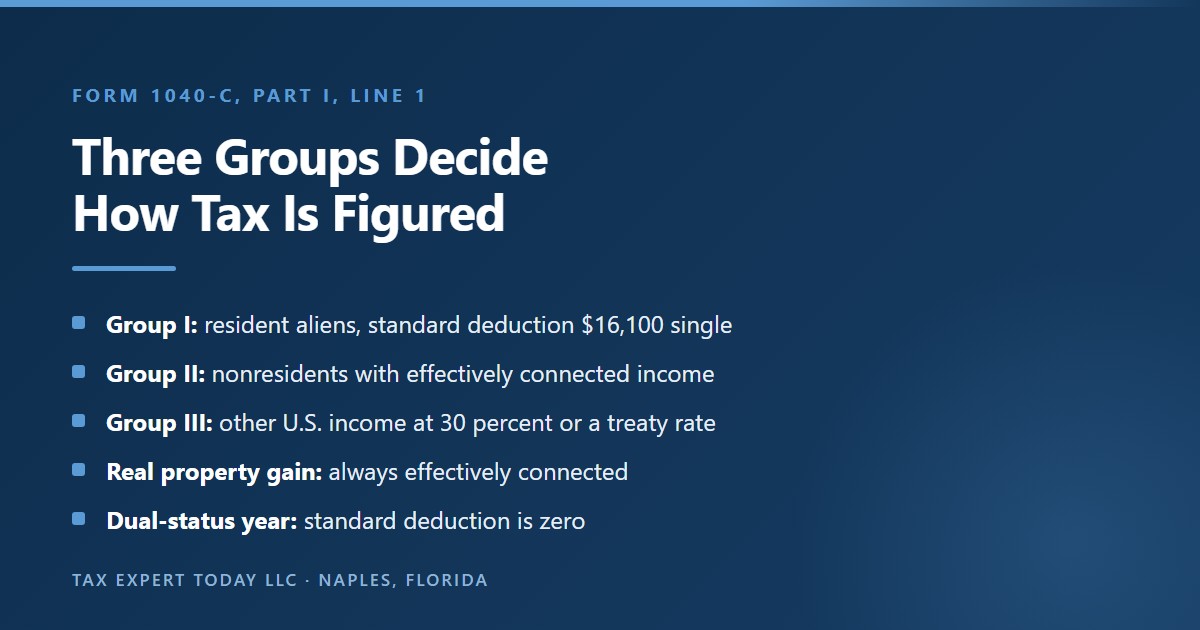
Line 1 of Part I places you in Group I for resident aliens, Group II for nonresidents with income effectively connected with a U.S. trade or business, or Group III for nonresidents with U.S. income not effectively connected. A nonresident can be in Groups II and III at once, and the group decides which tax lines you use.
- Group I: resident aliens, taxed like Form 1040 filers on worldwide income.
- Group II: nonresidents with effectively connected income, taxed at graduated rates.
- Group III: nonresidents with fixed or periodic U.S. income, taxed at 30 percent or a treaty rate.
- Real property: gain on a U.S. real property interest is effectively connected, so it belongs in Group II.
- Rental election: a nonresident may elect to treat U.S. real property income as effectively connected.
Part I is called Explanation of Status, and its first line drives the rest of the form. The note printed on line 1 of Form 1040-C contains two rules that matter to almost every foreign property owner in Florida: a nonresident alien who has income from U.S. real property may elect to treat that income as effectively connected income, and gain or loss on the disposition of a U.S. real property interest by a nonresident alien is effectively connected income or loss. The first rule lets a rental owner be taxed on net income instead of 30 percent of gross rent, and our guide to effectively connected income explains the category in detail. The second puts a condominium sale squarely in Group II.
The instructions tell resident aliens to use the current Instructions for Form 1040 to help complete the form, and nonresident aliens to use the current Instructions for Form 1040-NR. That is a useful signal about how Form 1040-C works. It does not have its own rules for what is income or what is deductible. It borrows the rules of whichever annual return you will file and applies them early.
| Group | Who belongs | Lines used | How tax is figured |
|---|---|---|---|
| Group I | Resident aliens | 16 to 23, Schedule D lines 1 to 6 | Graduated rates after the standard or itemized deduction |
| Group II | Nonresidents with effectively connected income | 16 to 23, Schedule D lines 7 to 12 | Graduated rates after itemized deductions allowed to nonresidents |
| Group III | Nonresidents with U.S. income not effectively connected | 24 and 25 | 30 percent of gross, or a lower treaty rate with a statement |
| Groups II and III together | Nonresidents with both kinds of income | 16 to 25 | Both computations, added on line 26 |
How do I know whether I am a resident alien in the year I leave?
You are a resident alien for 2026 if you held a green card at any time in the year or meet the substantial presence test: 31 days in 2026 and 183 days counting all 2026 days, one third of 2025 days, and one sixth of 2024 days. A closer connection or treaty tie-breaker can override it.
- Green card test: lawful permanent resident status at any time in 2026.
- Substantial presence test: 31 days this year and 183 weighted days over three years.
- Excluded days: regular commuting from Canada or Mexico, transit under 24 hours, crew days, medical days, and exempt individual days.
- Closer connection: fewer than 183 days in 2026, a foreign tax home, and a closer connection abroad, claimed on Form 8840.
- Treaty tie-breaker: a dual resident may be treated as a nonresident by treaty, disclosed on Form 8833.
Residency is the first judgment call on Form 1040-C, and it is often the most consequential. The instructions restate the two tests, explained in more depth in our guide to the substantial presence test, from section 7701(b) and add that intent generally is not a factor in determining residency status. The table below shows how a hypothetical professional who spent 150 days in Florida in 2026, 120 days in 2025, and 90 days in 2024 meets the substantial presence test with 205 weighted days, even though no single year reached 183 days.
| Year | Days present (hypothetical) | Multiplier | Testing days |
|---|---|---|---|
| 2026 | 150 | 1.000 | 150 |
| 2025 | 120 | 0.333 (one third) | 40 |
| 2024 | 90 | 0.167 (one sixth) | 15 |
| Total | 205, which meets the 183 day threshold |
That person would still be treated as a nonresident for 2026 if the closer connection exception applies: fewer than 183 days in 2026, a tax home in a foreign country during 2026, and a closer connection to that country than to the United States, claimed on Form 8840 with the final return. Seasonal residents use this rule every year, and we explain it in our guide to Form 8840 and the closer connection exception. A treaty tie-breaker, disclosed as described in our guide to Form 8833 treaty positions, is the other route, but the instructions note that a person treated as a treaty nonresident is still treated as a U.S. resident for purposes other than figuring income tax.
The year you leave is usually a dual-status year, in which you were a resident for part of the year and a nonresident for the rest. The instructions say the most common dual-status years are the years of arrival and departure, that different rules apply to each part of the year, and that you follow those rules in completing Form 1040-C. Our guide to the dual status tax return explains how the final return for that year is put together.
What do lines 2 through 14 of Part I ask?
Lines 2 through 14 ask about your U.S. occupation, visa class, reentry permit, any section 247(b) waiver, whether you gave a withholding agent Form W-9, any citizenship or green card application, your prior year return, pending tax charges, plans to return, family remaining here, property held here, digital asset activity, and arrangements for filing final returns.
- Status clues: visa class, reentry permit, and pending immigration applications.
- Withholding clue: a Form W-9 given to a payer may mean you were treated as a U.S. person.
- Collection clues: plans to return, family remaining, and property left in the United States.
- Digital assets: line 13 must be answered yes or no.
- Final return plan: line 14 asks how you will file and pay after leaving.
These questions are how the IRS officer gathers the facts for the jeopardy decision. The form asks you to complete lines 11 through 14 if you answer yes to line 10, meaning you plan to return. Family remaining in the United States, real property, investment accounts, and cash left behind all tend to show that collection is not at risk. Line 14 asks what arrangements you have made to file the final returns and pay the taxes if you will not be back before the due dates, and a clear answer, such as a named U.S. preparer and a funded U.S. account, helps.
| Line | Question in brief | Why it matters |
|---|---|---|
| 2 | Type of U.S. trade, business, or occupation | Supports effectively connected income |
| 3 | Visa number and class at last admission | Tests the exceptions and residency status |
| 4 | Permit to reenter the United States | Evidence of intent to return |
| 5 | Waiver of rights, privileges, exemptions, and immunities | Removes the diplomat and international organization exceptions |
| 6 | Form W-9 furnished to a withholding agent | May explain missing nonresident withholding |
| 7a, 7b | Citizenship application; green card steps | Can bear on residency and the closer connection exception |
| 8a to 8e | Prior year return type, address, income, payments, balance | Confirms past compliance |
| 9 | Current charges concerning U.S. taxes | Flags existing collection matters |
| 10, 11 | Plans to return; spouse and children remaining | Central to the jeopardy decision |
| 12a to 12d | Value and location of U.S. property | Shows assets that could secure the tax |
| 13 | Digital asset receipts or dispositions in the year | Must be answered yes or no |
| 14 | Arrangements to file and pay final returns | Shows how the year will be closed out |
Line 13 follows the same digital asset question found on Form 1040. The instructions say to check yes if at any time during the year you received digital assets as payment, reward, or award, from mining or staking, or from a hard fork, or if you sold, exchanged, or otherwise disposed of a digital asset. Simply holding a digital asset, moving it between your own wallets, or buying it with currency generally does not require a yes. The question may not be left blank.
How are dependents handled in Part II?
Part II lists each dependent’s name, SSN or ITIN, and relationship, and has boxes for the child tax credit and the credit for other dependents. Whether a person qualifies follows the Form 1040 or Form 1040-NR rules, and a child must have an SSN issued by the return’s due date to count for the child tax credit.
- Identifying numbers: each dependent’s SSN or ITIN is required.
- Child tax credit: requires an SSN issued before the due date, including extensions.
- ITIN children: may qualify for the credit for other dependents instead.
- Nonresidents: dependent credits are limited and follow the Form 1040-NR rules.
- More than four: attach a statement with the same columns.
Dependents matter mainly to Group I filers and to the limited categories of nonresidents the Form 1040-NR instructions allow to claim dependent credits. The instructions remind Group I filers who exclude foreign earned income on Form 2555 that they may not claim the refundable additional child tax credit on line 29, and may claim the child tax credit only to the extent allowable on line 20. A family that moved to the United States mid-assignment and is now leaving should check that every child has the right identifying number before the appointment.
How is the tax figured in Part III for Groups I and II?
Groups I and II use lines 16 through 23. Line 16 is total income, line 17 adjustments, and line 18 adjusted gross income. Schedule D subtracts deductions and applies the 2026 rate schedules for line 19. Credits on line 20 and other taxes on line 22 produce the Group I or II tax on line 23.
- Line 16: total income from Schedule A, column (d) for residents or column (e) for nonresidents.
- Line 17: adjustments allowed on Form 1040 or Form 1040-NR, including the qualified business income deduction and the excess business loss adjustment.
- Line 19: tax from Schedule D, including any alternative minimum tax.
- Line 20: credits allowed on Form 1040, or generally those allowed on Form 1040-NR.
- Line 22: other taxes, such as self-employment tax and the net investment income tax.
The Part III layout will be familiar to anyone who has seen a Form 1040, compressed into a few lines. Residents can take the adjustments allowed on Form 1040, nonresidents with effectively connected income can take those allowed on Form 1040-NR, and nonresidents whose income is all not effectively connected cannot take any adjustments. The instructions list the other taxes that belong on line 22, including self-employment tax at 15.3 percent for 2026 for residents and for nonresidents covered by the U.S. system under a totalization agreement, the Additional Medicare Tax, the net investment income tax, additional taxes on retirement plans, and household employment taxes. Whether a nonresident is covered by the U.S. system under one of those agreements is covered in our guide to totalization agreement rules.
| Line | What it holds | Source |
|---|---|---|
| 16 | Total income | Schedule A, line 4, column (d) or (e) |
| 17 | Adjustments | Form 1040 or Form 1040-NR rules; attach support |
| 18 | Adjusted gross income | Line 16 minus line 17 |
| 19 | Tax | Schedule D, line 6 for Group I or line 12 for Group II |
| 20 | Credits | Form 1040 credits for residents; Form 1040-NR credits for Group II |
| 21 | Tax after credits | Line 19 minus line 20, not below zero |
| 22 | Other taxes | Self-employment tax, Additional Medicare Tax, net investment income tax, and others |
| 23 | Tax for Group I or II | Line 21 plus line 22 |
Schedule D is where residents and nonresidents part ways. A Group I resident subtracts the standard deduction or itemized deductions. For 2026 the instructions list a standard deduction of $16,100 for single filers and married persons filing separately, $24,150 for heads of household, and $32,200 for married couples filing jointly and qualifying surviving spouses, plus additional amounts for age 65 or older or blindness. A Group II nonresident subtracts only the itemized deductions allowed to nonresidents. The instructions also warn that a dual-status alien who does not elect to be taxed as a resident has a standard deduction of zero.
| 2026 single rate schedule (Groups I and II) | Tax |
|---|---|
| $0 to $12,400 | 10 percent |
| $12,400 to $50,400 | $1,240.00 plus 12 percent of the excess over $12,400 |
| $50,400 to $105,700 | $5,800.00 plus 22 percent of the excess over $50,400 |
| $105,700 to $201,775 | $17,966.00 plus 24 percent of the excess over $105,700 |
| $201,775 to $256,225 | $41,024.00 plus 32 percent of the excess over $201,775 |
| $256,225 to $640,600 | $58,448.00 plus 35 percent of the excess over $256,225 |
| Over $640,600 | 37 percent bracket, as on the final return |
How is Group III income taxed at 30 percent?
Group III income is a nonresident’s U.S. source income not connected with a U.S. business, such as dividends, rents without the net basis election, royalties, and 85 percent of social security benefits. Line 25 taxes the gross amount at 30 percent, with no deductions, unless a treaty lowers the rate and a statement cites the article.
- Base: gross amount, with no deductions or adjustments.
- Rate: 30 percent unless a treaty provides less.
- Treaty claim: attach a computation and the treaty article on line 25.
- Treaty-exempt Group III income: report it on line 1, column (f), and explain the exemption in the line 25 statement.
- Withholding: tax withheld at source goes in column (c) and flows to line 27.
The instructions say that, generally, you enter 30 percent of the line 24 amount, and that if you are entitled to a lower rate or an exemption because of a treaty, you attach a statement showing the computation and the applicable treaty articles. Group III income includes interest, dividends, rents, salaries, wages, premiums, annuities, and other fixed or determinable annual or periodic income, prizes, awards and certain gambling winnings, and 85 percent of U.S. social security benefits, unless a treaty exempts or reduces the tax.
In many Group III cases the withholding agent has already taken the correct amount at source, so line 25 and line 27 match and nothing is due. Problems arise when a payer withheld at the wrong rate, did not withhold at all because the person furnished a Form W-9 while a resident, or withheld 30 percent where a treaty rate applied. Line 6 of Part I asks about Form W-9 for exactly this reason. A nonresident normally gives payers Form W-8BEN to claim foreign status and treaty rates, and the year-end statement of the income and tax withheld is Form 1042-S.
How do Schedules A, B, C, and D work together?
Schedule A lists each item of income by payer, with tax withheld in column (c) and the amount in column (d) for residents, (e) for effectively connected nonresident income, or (f) for other nonresident income. Schedule B nets certain nonresident gains, Schedule C lists itemized deductions, and Schedule D computes the tax for Groups I and II.
- Schedule A: income by payer and type, withholding, and exempt income on line 5.
- Schedule B: gains and losses of nonresidents on property not connected with a U.S. business.
- Schedule C: itemized deductions; nonresidents claim only those connected with effectively connected income, plus casualty losses and charitable gifts.
- Schedule D: taxable income and tax for Group I (lines 1 to 6) and Group II (lines 7 to 12).
- Not to be confused: these are Form 1040-C schedules, not Schedule C or Schedule D of Form 1040.
The schedule letters are a frequent source of confusion, because Form 1040 also has a Schedule A for itemized deductions, a Schedule C for business profit, and a Schedule D for capital gains. On Form 1040-C the letters mean something different. Schedule A of Form 1040-C is the income schedule, Schedule C is the itemized deduction schedule, and Schedule D is the tax computation. A nonresident’s capital gains from U.S. real property do not go on Schedule B of Form 1040-C at all, because the instructions say gain or loss on a U.S. real property interest is effectively connected and belongs in Schedule A, column (e).
| Form 1040-C schedule | What it does | Key rule |
|---|---|---|
| Schedule A, Income | Lists income by payer and type with withholding | Column (d) resident, (e) effectively connected, (f) not effectively connected |
| Schedule A, line 5 | Exempt income by Code or by treaty | Treaty-exempt column (f) income is reported on line 1 instead |
| Schedule B, Gains and losses | Nonresident gains on property not connected with a U.S. business | Capital gains count only if present at least 183 days in the year |
| Schedule C, Itemized deductions | Deductions for residents and Group II nonresidents | No deductions against column (f) income |
| Schedule D, Tax computation | Taxable income and tax for Groups I and II | Standard deduction for Group I only |
What income is exempt for a nonresident on Form 1040-C?
The instructions list exempt nonresident income, including U.S. bank and credit union deposit interest not connected with a business, portfolio interest, small personal service income for a foreign employer, non-business capital gains when present fewer than 183 days, certain annuities, and certain foreign corporation dividends. Gain on U.S. real property is never exempt.
- Bank deposit interest: exempt if not effectively connected with a U.S. business.
- Short visits for a foreign employer: exempt if in the United States 90 days or less and paid $3,000 or less.
- Capital gains: exempt if not connected with a business and present fewer than 183 days in the year.
- Real property exception: gain on a U.S. real property interest is not exempt.
- Where it goes: Schedule A, line 5, with any tax withheld on it in column (c).
Exempt income still has to be reported on Form 1040-C, on Schedule A, line 5, so the officer can see the whole picture. For income exempt under a treaty, the instructions draw a distinction: report it on line 5 only if it belongs in column (d) or (e), and attach a statement showing the treaty and article. Treaty-exempt income that belongs in column (f) is reported on line 1 instead and explained in the line 25 statement. Any tax withheld on exempt income, for example because a payer lacked documentation, is shown in column (c) so it can be credited.
The capital gains exemption is the one foreign owners most often misread. A nonresident who spends fewer than 183 days in the United States generally pays no U.S. tax on gains from selling U.S. stocks. But the instructions state the exception directly: gain or loss on the disposition of a U.S. real property interest is not exempt. A Florida condominium sale is taxed whatever the day count, which is why FIRPTA withholding exists and why the condominium example below works the way it does.
| Income of a nonresident | Exempt on Form 1040-C? | Condition |
|---|---|---|
| Interest on U.S. bank or credit union deposits | Yes | Not effectively connected with a U.S. business |
| Portfolio interest on obligations issued after July 18, 1984 | Generally yes | Meets the portfolio interest rules |
| Personal services for a foreign employer | Yes | 90 days or less in the United States and $3,000 or less paid |
| Gain on U.S. stocks or bonds | Yes | Not business connected and present fewer than 183 days |
| Gain on a U.S. condominium or house | No | Always taxed as effectively connected |
| Annuities from qualified plans | Yes, in limited cases | Both conditions in the instructions are met |
| U.S. source dividends from certain foreign corporations | Partly | Not effectively connected; see Publication 519 |
What does a resident alien leaving mid-year look like on Form 1040-C?
A resident alien leaving permanently mid-year usually files Form 1040-C as a Group I filer and reports wages to the departure date. Whether the standard deduction applies depends on whether the year is a dual-status year. In the hypothetical below, the same $96,000 of wages produces a small overpayment with the deduction and a $2,632 balance without it.
- Hypothetical: single filer, wages of $96,000 from January 1 to the July 15, 2026 departure, $13,200 withheld.
- With the $16,100 standard deduction: tax of $12,290 and an overpayment of $910.
- As a dual-status filer with no standard deduction: tax of $15,832 and a balance of $2,632.
- Overpayment: refunded only through the final return after year end.
- Balance: paid at the appointment unless the IRS finds no jeopardy or accepts a bond.
Consider a hypothetical engineer from Spain working in Naples on an L-1 visa since 2023. The engineer is a resident alien under the substantial presence test, accepts a position back in Madrid, and plans to leave the United States permanently on July 15, 2026. Wages from January 1 to July 15 total $96,000, and the employer has withheld $13,200 of federal income tax. The engineer is single, has no other U.S. income, and does not plan to return.
Because a resident discontinuing residence is treated like a nonresident for the jeopardy test, the engineer files Form 1040-C, not Form 2063. On the form, the wages go on Schedule A in column (d) as resident alien income, and the withholding goes in column (c). The question that changes the result is the deduction on Schedule D, line 2. The figures below use the 2026 single rate schedule printed in the Form 1040-C instructions.
| Hypothetical line item | With the standard deduction | Dual-status, no standard deduction |
|---|---|---|
| Wages to July 15 (line 16 and line 18) | $96,000 | $96,000 |
| Deduction (Schedule D, line 2) | $16,100 | $0 |
| Taxable income (Schedule D, line 3) | $79,900 | $96,000 |
| Tax: $5,800 plus 22 percent of the excess over $50,400 | $12,290 | $15,832 |
| Federal tax withheld (line 27) | $13,200 | $13,200 |
| Result | Overpaid $910 (line 32), no refund at departure | Owes $2,632 (line 31) |
Which column is right depends on facts the engineer must establish. A person who meets the substantial presence test in the year of departure can, under the residency termination rules, generally be treated as a resident only until the last day of presence if the person shows a closer connection to a foreign country for the rest of the year. That produces a dual-status year, and the instructions state that a dual-status alien who does not elect to be taxed as a resident for the year has a standard deduction of zero. A married engineer whose spouse is a U.S. citizen or resident may instead be able to elect resident treatment for the whole year and file jointly. These choices are made on the final return, but Form 1040-C should reflect the position the person expects to take, which is why the two columns differ.
Either way, the overpayment column does not produce a check at the airport. The instructions say the IRS cannot provide a refund at the time of departure, and a person due a refund must file Form 1040 or Form 1040-NR after the year ends. The engineer should leave a U.S. bank account open or plan for a paper refund check, and should keep the employer’s final pay statement, which will match the Form W-2 issued in January.
Does a foreign owner who sells a Naples condo need a sailing permit?
It depends on why the owner is here. A B-2 or visa waiver visitor generally falls within a visitor exception, unless the IRS believes there was taxable income and departure would hinder collection. An owner who lived or worked here and leaves after selling generally needs a permit, and the gain makes Form 1040-C the likely form.
- Visitor exceptions: B-2 visitors and visa waiver visitors for pleasure are excepted, subject to the jeopardy override.
- The override: taxable income in the year plus a collection risk removes the visitor exception.
- Residents and workers: not excepted, so a permit is required.
- The gain: effectively connected income, reported in Schedule A, column (e), as Group II.
- The withholding: FIRPTA withholding is tax withheld at source and is credited on the final return.
Florida has one of the largest populations of foreign property owners in the country, and the question we hear most from them is whether selling and leaving triggers a sailing permit. The answer runs through two parts of the regulation. The visitor exception in section 1.6851-2(a)(2)(iii) covers a B-2 pleasure visitor and a person admitted without a visa who visits for pleasure. But that whole subdivision applies only unless the IRS has reason to believe the alien received taxable income during the year up to departure, or during the preceding year, and that collection will be jeopardized by the departure.
A condominium sale produces taxable income, so the question becomes whether collection is at risk. In most sales the buyer has already withheld under section 1445, the FIRPTA rule, and paid that withholding to the IRS. When the amount withheld exceeds the likely tax on the gain, as it often does, the practical collection risk is low. But the exception is the IRS’s to apply, not the seller’s, and a seller who also lived or worked in Florida is outside the visitor exception altogether. We recommend that foreign sellers who are leaving soon after a closing review the sailing permit question with a preparer before booking a flight, and our guide to FIRPTA withholding for foreign sellers covers the closing side of the same transaction.
| Foreign owner’s profile | Sailing permit? | Why |
|---|---|---|
| B-2 or visa waiver visitor, no sale, no U.S. income | Generally no | Visitor exception applies |
| B-2 or visa waiver visitor who sold a condo this year | Possibly | Taxable income exists; the IRS may apply the jeopardy override |
| Owner who lived in Florida as a resident alien and is leaving | Yes | Residents are not excepted |
| Owner on a work visa who sold and is leaving | Yes | No exception covers workers with income |
| Owner whose condo is held by a corporation | The individual’s own income decides | The sale is the corporation’s, reported on its own return, such as Form 1120-F |
How does FIRPTA withholding count on Form 1040-C and the final return?
FIRPTA withholding is U.S. income tax withheld at source. On Form 1040-C it goes in Schedule A, column (c), and flows to line 27. On the final Form 1040-NR it is claimed with the stamped Copy B of Form 8288-A. When withholding exceeds the tax, nothing is due, and the refund comes only with the final return.
- Withholding rate: generally 15 percent of the amount realized under section 1445.
- Reduced rate: 10 percent if the buyer will use the property as a residence and the amount realized is $1,000,000 or less.
- No withholding: if the buyer will use it as a residence and the amount realized is $300,000 or less.
- Proof of credit: the stamped Copy B of Form 8288-A, which the IRS forwards to the seller.
- Refund timing: after year end on Form 1040-NR, unless a withholding certificate changes it earlier.
Here is a hypothetical that we see in many forms. A nonresident alien from Germany owns a Naples condominium used only by the family, never rented. The family has spent several seasons in Florida, the owner’s adult child is moving away, and the owner sells in March 2026 for $850,000 and plans to leave for good in April. The adjusted basis is $600,000 and selling costs are $50,000, so the gain is $200,000. The buyer is an investor, so the closing agent withholds 15 percent of the amount realized under the FIRPTA rules, which is $127,500.
On Form 1040-C the $200,000 gain goes in Schedule A, column (e), because the line 1 note and the instructions treat gain on a U.S. real property interest as effectively connected. The owner is in Group II. As printed, Schedule D, line 10 directs the tax to be figured using the current year’s tax rate schedules, which gives $40,598 on $200,000. The $127,500 of withholding goes in column (c) and on line 27. Because payments exceed the tax, line 32 shows an overpayment of $86,902 and there is nothing to pay before departure.
| Hypothetical condominium sale | Amount | Where it goes |
|---|---|---|
| Sale price (amount realized) | $850,000 | Closing statement |
| Adjusted basis | $600,000 | Purchase records and improvements |
| Selling costs | $50,000 | Closing statement |
| Gain | $200,000 | Form 1040-C, Schedule A, column (e) |
| FIRPTA withholding at 15 percent | $127,500 | Schedule A, column (c); line 27 |
| Tax figured with the rate schedule (Schedule D, line 10) | $40,598 | Line 19 and line 26 |
| Overpayment on Form 1040-C | $86,902 | Line 32; not refunded at departure |
| Tax on the final Form 1040-NR at the 2026 long-term capital gain rates | $22,582.50 | Zero percent on the first $49,450, 15 percent on the next $150,550 |
| Refund claimed on the final return | $104,917.50 | Form 1040-NR with the stamped Copy B of Form 8288-A |
The final return is where the real tax is set. Form 1040-NR applies the long-term capital gain rates to effectively connected gains, and for 2026 the zero percent rate covers taxable income up to $49,450 and the 15 percent rate covers income up to $545,500 for a single filer, under Rev. Proc. 2025-32. With no other U.S. income and no deductions, the tax on a $200,000 long-term gain is $22,582.50, and the refund is $104,917.50. The net investment income tax does not apply to nonresident aliens under section 1411(e)(1). A condominium that had been rented would add depreciation recapture and possibly state questions, which the example ignores. Florida has no personal income tax.
If the buyer had intended to live in the condominium, the amount realized of $850,000 is under $1,000,000, so section 1445(c)(4) would reduce withholding to 10 percent, or $85,000. That still exceeds both the $40,598 Form 1040-C figure and the $22,582.50 final tax, so the sailing permit picture would be the same, with a smaller refund of $62,417.50 waiting for the final return.
Two timing points trip up sellers. First, the Instructions for Forms 8288 and 8288-A explain that the IRS stamps Copy B and forwards it to the seller at the address on the form, and that a stamped copy is not provided if the seller’s taxpayer identification number is missing. A seller who leaves before Copy B arrives should bring the closing statement showing the withholding to the appointment and make sure the address on Form 8288-A will reach them abroad. Second, the stamped Copy B is what the final return needs to claim the credit, so it should be stored with the sailing permit.

Can Form 8288-B reduce withholding before the sale closes?
Yes. A foreign seller can apply on Form 8288-B for a withholding certificate that reduces FIRPTA withholding to the expected maximum tax liability, and section 1445(c)(3) directs the IRS to act within 90 days. A certificate can shrink the refund that would wait for the final return, but it does not replace the sailing permit.
- What it does: lowers the amount the buyer must withhold.
- Basis: the seller’s maximum tax liability on the gain, or other grounds in the regulations.
- Timing: the IRS is to act within 90 days after receiving a complete request.
- At closing: the closing agent typically holds the withholding until the IRS responds.
- Sailing permit: still a separate question decided at departure.
Section 1445(c) allows the IRS to prescribe a reduced amount to be withheld if it determines that a reduced amount will not jeopardize collection, and section 1445(c)(3)(B) directs it to act on such requests within 90 days. For the German owner above, a withholding certificate based on the expected tax on a $200,000 gain could reduce withholding from $127,500 to a figure much closer to the final tax, putting most of the sale proceeds in the seller’s hands at or soon after closing instead of after a Form 1040-NR is processed. The IRS FAQ on FIRPTA notes that when a certificate request is pending, the date shown on Copy B of Form 8288-A may differ from the actual date of disposition, and the sale is still reported in the year it occurred.
A withholding certificate and a sailing permit answer different questions. The certificate decides how much is withheld at closing. The permit decides whether the IRS is satisfied, at departure, that your income tax obligations for the year are met. A seller who obtained a reduced withholding certificate may find that the Form 1040-C now shows a balance due, because the reduced withholding was set close to the expected tax on long-term capital gain rates while Form 1040-C, as printed, uses the ordinary rate schedules. We cover the application in detail in our guide to Form 8288-B, the FIRPTA withholding certificate.
| Tool | Question it answers | When it is used |
|---|---|---|
| Form 8288-B withholding certificate | How much must the buyer withhold? | Before or at closing |
| Form 8288-A, Copy B | How much was withheld, and how is it credited? | After closing, attached to the final return |
| Form 1040-C and sailing permit | Are income tax obligations satisfied at departure? | Within 30 days before leaving |
| Form 1040-NR | What is the actual tax for the year? | After the year ends |
Do Canadian snowbirds need a sailing permit?
Usually not for a normal season. Canadians visiting for pleasure without a visa fall within the visitor exception, and commuters with withheld U.S. wages have their own. The exception can be lost if the IRS believes there was taxable income, such as Florida rent or a sale, and departure would hinder collection. Annual Form 1040-NR filing is separate.
- Seasonal visit for pleasure: excepted as a person visiting for pleasure without a visa.
- Cross-border commuter: excepted if wages are subject to withholding.
- Rental income or a sale: the jeopardy override can apply.
- Day count: a long season can make a Canadian a U.S. resident unless Form 8840 is filed.
- Annual filing: Florida rent still requires Form 1040-NR each year.
Southwest Florida has a large Canadian seasonal population, and most of them will never need a sailing permit. The regulation excepts a person admitted without a passport or visa requirement who is visiting for pleasure, and a business visitor who stays no more than 90 days in the tax year. The IRS Topic 858 summary groups these as certain other aliens temporarily in the United States who receive no taxable income, unless the IRS believes they had taxable income and that their leaving would hinder collection. Our Canada US tax treaty guide for Florida snowbirds covers the treaty side.
Rental income is the common complication. Take a hypothetical Canadian resident who rents a Naples condominium to other visitors for part of the year and collects $30,000 of gross rent. By default, rent is Group III income, taxed at 30 percent of the gross, or $9,000, typically withheld by the property manager. The note on Form 1040-C line 1 allows a nonresident with U.S. real property income to elect to treat it as effectively connected, which moves it to Group II and allows deductions. The table shows the difference using hypothetical expenses and a full year of depreciation on a $150,000 building basis over 27.5 years.
| Hypothetical Canadian owner, 2026 | 30 percent of gross (Group III) | Net basis election (Group II) |
|---|---|---|
| Gross rent | $30,000 | $30,000 |
| Condominium association fees | Not deductible | $7,200 |
| Property taxes | Not deductible | $6,800 |
| Insurance | Not deductible | $3,900 |
| Management fees | Not deductible | $3,000 |
| Depreciation ($150,000 divided by 27.5) | Not deductible | $5,455 |
| Taxable amount | $30,000 | $3,645 |
| U.S. tax | $9,000 | $364.50 at the 10 percent rate |
The election is made on the annual Form 1040-NR and, once made, generally continues for later years, so it is a decision to make with the whole holding period in view. If the owner sells later, the depreciation allowed reduces basis and is recaptured on the sale. Canadian residents should also coordinate the U.S. tax with the foreign tax credit available in Canada. The sailing permit question for this owner usually stays in the background: a normal season with the rental election in place and returns filed on time rarely creates a collection concern, but a sale followed by departure is different.
How does a nonresident with only U.S. dividends use Group III?
A nonresident whose only U.S. income is dividends reports them in Schedule A, column (f), and figures Group III tax on lines 24 and 25 at 30 percent, or at a treaty rate with an attached statement. If the payer withheld at the correct treaty rate, line 25 and line 27 match and nothing is due before departure.
- Hypothetical: $40,000 of U.S. dividends to a resident of a treaty country.
- Statutory tax: 30 percent, or $12,000.
- Treaty tax at a hypothetical 15 percent rate: $6,000, with the treaty article cited.
- Withheld at source: $6,000 shown in column (c).
- Result: no balance due, assuming correct documentation was on file with the payer.
A nonresident with only portfolio investments may wonder why a sailing permit matters at all. In many cases it will not, because a person who came as a visitor and had only dividends taxed at source may be within an exception, and the IRS has little reason to find a collection risk when the payer already withheld. But a nonresident who was here on a work visa, earned wages, and also holds U.S. stocks will report both kinds of income: wages in Group II and dividends in Group III. The two computations are added on line 26. Treaty rates differ by country and by type of dividend, so the line 25 statement should cite the specific article, and the IRS tax treaty tables are the starting point.
| Hypothetical Group III computation | Without a treaty | With a 15 percent treaty rate |
|---|---|---|
| U.S. dividends (line 24) | $40,000 | $40,000 |
| Tax (line 25) | $12,000 | $6,000, with treaty statement attached |
| Withheld at source (line 27) | $12,000 | $6,000 |
| Balance due (line 31) | $0 | $0 |
Can married couples file a joint Form 1040-C?
Only in limited cases. Nonresident aliens cannot file a joint Form 1040-C. A resident alien can file jointly with a spouse only if both reasonably expect to be eligible to file a joint return at the close of the tax period and, if one spouse’s tax period is terminated, the other spouse’s period is terminated at the same time.
- Two nonresidents: each files separately.
- Resident spouse: a joint Form 1040-C is possible if both conditions are met.
- Joint form entries: both names, numbers, and passport or registration numbers; both incomes in Part III.
- Part I: a separate Part I may be needed for each spouse.
- Signatures: both spouses sign a joint return.
The instructions repeat the joint return rule in two places with slightly different wording, but the substance is the same. A couple in which one spouse is a U.S. citizen and the other a nonresident may be able to make the election to treat the nonresident spouse as a resident on the final return, which we explain in our guide to the nonresident alien spouse. On Form 1040-C itself, however, the test is whether both spouses reasonably expect to qualify to file jointly at year end and whether their tax years end at the same time. A couple who expects to file a dual-status return for the year of departure generally cannot file jointly unless the resident election is available and will be made.
Does Form 1040-C replace the final Form 1040-NR or Form 1040?
No. Form 1040-C is a departure clearance return, not an annual return. After the year ends you file Form 1040 if you are a resident on December 31, Form 1040-NR if you are not, or a dual-status return if you changed status during the year. Tax paid with Form 1040-C is claimed as a credit on that final return.
- Resident on the last day of the year: Form 1040 or 1040-SR on worldwide income.
- Nonresident on the last day of the year: Form 1040-NR.
- Changed status during the year: a dual-status return.
- Credit: tax paid with Form 1040-C reduces the final return’s balance.
- Items not on Form 1040-C: some items, such as reconciling the premium tax credit, appear only on the final return.
The caution printed under the heading of Form 1040-C says it directly: Form 1040-C is not a final income tax return, and you must file a final return on the correct form after your tax year ends. The instructions explain that any tax paid with Form 1040-C counts as a credit against tax on the final return, and that some items not addressed on Form 1040-C must be taken into account there, giving the premium tax credit reconciliation as an example.
For most departing nonresidents the final return is Form 1040-NR, explained in our guide to Form 1040-NR, the nonresident alien return. The current Form 1040-NR instructions give the payment its own line, line 29, Credit for Amount Paid With Form 1040-C, and put FIRPTA withholding shown on Form 8288-A on line 25f, with the Form 8288-A attached to the front of the return. A resident filing Form 1040 instead includes the Form 1040-C payment in total payments and identifies it next to the entry. The final return is also where the long-term capital gain rates apply, where treaty positions are formally disclosed on Form 8833 when required, and where Form 8840 or Form 8843 is attached.
| Status on December 31, 2026 | Final return | What carries over from Form 1040-C |
|---|---|---|
| Resident alien all year | Form 1040 or 1040-SR | Tax paid with Form 1040-C, as a payment |
| Nonresident alien all year | Form 1040-NR | Tax paid with Form 1040-C, FIRPTA and other withholding |
| Resident to nonresident during the year | Dual-status return | Payments, with income split by period |
| Green card surrendered, long-term resident | Dual-status return plus Form 8854 | Payments; section 877A computation if covered |
Will I get a refund at departure if I overpaid?
No. If the Form 1040-C computation shows that withholding and payments exceed the tax, there is nothing to pay when you file, but the IRS cannot issue a refund at departure. The overpayment is refunded only if, and to the extent that, your final return for the year shows an overpayment.
- Line 32: shows the overpayment, for information only.
- Refund route: the final Form 1040, Form 1040-NR, or dual-status return.
- Refund amount: set by the final return, which may differ from Form 1040-C.
- Payment logistics: plan how a refund will reach you abroad.
- FIRPTA cases: a withholding certificate may release funds sooner than the final return.
The rule appears on line 32 of the form itself, which says any overpayment of tax will be refunded only when you file your final return for the tax year. People leaving permanently should think about the practical side early: whether to keep a U.S. bank account open for direct deposit, whether a paper check mailed abroad is workable, and who in the United States will handle mail. A foreign seller with a large FIRPTA overpayment has the most at stake, since the refund in the condominium example is more than $100,000 and cannot be issued until the final Form 1040-NR for the year of sale is processed.
What does the sailing permit settle, and what does it not settle?
The permit shows that, on the information available the day it was signed, the IRS was satisfied your income tax obligations were met for departure. It is not a final determination of tax, does not close the year, does not replace the final return, and does not address FBAR, Form 8938, gift tax, or immigration status.
- It settles: your clearance to depart under section 6851(d), for the departure or year stated.
- It does not settle: your final tax for the year, which can be more or less.
- It does not cover: non-income tax filings, such as FBAR or gift tax returns.
- It does not change: your immigration status or any Department of Homeland Security requirement.
- It can be revoked: for a later departure if collection appears to be in jeopardy.
The instructions put this in a caution box: issuance of a certificate of compliance is not a final determination of your tax liability, and if it is later determined that you owe more tax, you will have to pay it. The certificate on the form itself is worded the same way, certifying compliance according to all information available at that date. It is a clearance, not a closing agreement.
| Item | Settled by the sailing permit? | Where it is actually handled |
|---|---|---|
| Permission to depart under section 6851(d) | Yes | The signed certificate |
| Final income tax for the year | No | Form 1040, Form 1040-NR, or dual-status return |
| Refund of overpaid withholding | No | The final return |
| Prior year audits or later assessments | No | Normal examination and assessment periods |
| Foreign bank account reports (FBAR) | No | FinCEN Form 114, filed separately |
| Form 8938 specified foreign financial assets | No | Attached to the annual return when required |
| Expatriation reporting for long-term residents | No | Form 8854 with the final return |
| Immigration status or green card surrender | No | Department of Homeland Security procedures |
What happens if I leave without a sailing permit?
Section 6851(d) itself does not state a dollar penalty. The regulation says a person who arrives at the point of departure without a certificate or proof of an exception is subject to examination there and to completing returns and paying tax. The larger risks are a termination assessment, collection against assets left behind, and having to clear past years later.
- At departure: possible examination by an IRS officer or employee at the departure point.
- Termination assessment: the IRS can demand immediate payment for the current and preceding year when collection is in jeopardy.
- Assets left behind: unpaid tax remains collectible from U.S. property and accounts.
- Final return still due: the annual return and its normal penalties for late filing or payment are unaffected.
- Future clearances: a later permit requires all past returns filed and taxes paid.
The honest answer is that many people leave the United States without a sailing permit and nothing happens at the airport. Departure checks for tax clearance are not a routine part of international travel. That does not make the obligation optional. The statute says no alien shall depart without first procuring a certificate, subject to the regulatory exceptions, and the regulation provides for examination at the point of departure of a person who has neither a certificate nor evidence of an exception.
The practical exposure is usually financial rather than procedural. If tax is owed for the year of departure or an earlier year, it remains owed, with interest and any penalties for late filing or payment on the final return. If the person left property in the United States, such as a condominium, a brokerage account, or a bank account, those assets remain within reach of normal collection tools. And a person who later needs to deal with the IRS for another departure, or who returns and resumes U.S. filing, will have to bring every prior year into compliance first, since both Form 1040-C and Form 2063 require that all returns be filed and all tax paid before a certificate is issued. People with unfiled years should address them before the appointment rather than at it.
| Consequence | Source | How likely in practice |
|---|---|---|
| Examination at the departure point | Treas. Reg. 1.6851-2(a)(1) | Uncommon, but authorized |
| Termination assessment for the current and preceding year | Section 6851(a); Form 1040-C instructions | Possible where collection appears to be at risk |
| Collection from U.S. assets left behind | Normal collection rules | Real where tax is unpaid and assets remain |
| Penalties on the final return for late filing or payment | Normal penalty rules | Real if the final return is late or unpaid |
| Delay in a later sailing permit | Treas. Reg. 1.6851-2(b) | Certain if earlier years are not cleared |
How does Form 1040-C interact with the exit tax and Form 8854?
A long-term resident, meaning a green card holder in at least 8 of the last 15 tax years, who gives up the card may be an expatriate under section 877A, which can tax unrealized gain. The instructions apply the section 877A method on Form 1040-C, and Form 8854 is filed with the final return.
- Who is covered: citizens who renounce and long-term residents who cease to be lawful permanent residents.
- Long-term resident: lawful permanent resident in at least 8 of the 15 tax years ending with the year residence ends.
- Treaty years: years treated as a treaty resident of another country without waiving benefits do not count.
- Form 1040-C: the section 877A computation is reflected on the departure return.
- Final step: Form 8854 attached to the dual-status return for the year.
Section 877A defines an expatriate to include any long-term resident of the United States who ceases to be a lawful permanent resident within the meaning of section 7701(b)(6), and sets the expatriation date as the day that status ends. Section 7701(b)(6) in turn says a person ceases to be treated as a lawful permanent resident if the status is revoked or abandoned, or if the person begins to be treated as a resident of a foreign country under a treaty, does not waive treaty benefits, and notifies the IRS. That last route can end residence for tax purposes before the green card is physically surrendered, which matters for counting the 8 of 15 years.
The instructions for Form 1040-C carry two related warnings. First, a resident alien leaving during the year who is subject to section 877A computes tax under that section when completing Form 1040-C, with reference to Form 8854 and Publication 519. Second, anyone who ended long-term residency in 2026 files Form 8854 with the 2026 return and may owe tax on net unrealized gain as if the property had been sold for fair market value the day before expatriation. Whether a person is a covered expatriate depends on tests involving net worth, average income tax liability, and certification of five years of compliance, which we walk through in our guide to Form 8854 and the U.S. exit tax. A departing long-term resident should have that analysis done before the Form 1040-C appointment, not after.
| Departing green card holder | Section 877A in play? | Forms |
|---|---|---|
| Fewer than 8 of the last 15 years as a lawful permanent resident | No | Form 1040-C, then a dual-status return |
| At least 8 of 15 years, not a covered expatriate | Reporting only | Form 1040-C, dual-status return, Form 8854 |
| At least 8 of 15 years, covered expatriate | Yes, mark-to-market and related rules | Form 1040-C with the section 877A computation, dual-status return, Form 8854 |
| Residence ended earlier by treaty election | Depends on the year of the treaty position | Form 8833 history matters; review before filing |
Do I still have FBAR and Form 8938 duties in my departure year?
Often, yes. A person who was a resident alien during the year is generally a U.S. person for the FBAR and a specified individual for Form 8938 for the period of residence. A sailing permit does not address either filing. FBAR is filed separately with FinCEN, and Form 8938 is attached to the annual return when its thresholds are met.
- FBAR: FinCEN Form 114, filed electronically through the BSA E-Filing System, separate from any tax return.
- Form 8938: attached to the annual income tax return when thresholds are met.
- Departure year: resident status for part of the year can still bring the account rules into play.
- Accounts abroad: foreign salary, pension, and bank accounts held while resident count.
- Not on Form 1040-C: neither report is part of the sailing permit process.
Foreign professionals in the United States usually keep accounts at home, and many green card holders have pensions and bank accounts abroad. While they are resident aliens, those accounts are generally reportable on the FBAR once the aggregate maximum value exceeds $10,000 during the year, and on Form 8938 when its higher thresholds are met. Our pillar guide Do I need to file an FBAR? explains the threshold and what counts as a foreign account, and our comparison of FBAR vs Form 8938 explains how the two reports differ. A person who discovers missed reports from earlier resident years can read our guides to filing a late FBAR and to FBAR penalties before deciding how to proceed.
The departure year needs particular care because residence ends partway through. The FBAR is a calendar year report, generally due April 15 of the following year with an automatic extension to October 15, and a person who was a U.S. person for FBAR purposes during part of the year should review whether a report is due for that year. Form 8938 follows the annual return, so on a dual-status return the resident portion of the year is the starting point. None of this is reviewed at the sailing permit appointment, and the certificate of compliance does not speak to it, so it belongs on the to-do list for the final return.
What are the most common Form 1040-C mistakes?
The most common mistakes are treating Form 1040-C as the final return, applying too late or too early, arriving without records or certified funds, using the wrong residency status, leaving out income expected for the rest of the year, misplacing real property gain, missing FIRPTA withholding, and assuming an overpayment will be refunded at departure.
- Timing: booking after the 30 day window opens and finding no appointments.
- Status: filing as Group I when the year is dual-status, or the reverse.
- Income scope: omitting income reasonably expected for the full year when the period is not terminated.
- Real property: putting a condo gain on Schedule B or treating it as exempt.
- Follow-up: forgetting the final return and the refund it carries.
| Mistake | Why it causes trouble | How to avoid it |
|---|---|---|
| Treating Form 1040-C as the final return | The annual return is still required and carries any refund | Calendar the final Form 1040-NR or Form 1040 at the appointment |
| Applying more than 30 days out, or a few days before leaving | Too early is not allowed; too late may mean no appointment | Book early; file 30 to 14 days before departure |
| Arriving without certified funds | The certificate is not issued until tax due is paid | Bring a cashier’s check or money order, or confirm cash handling |
| Wrong residency status | Changes the deduction, the rates, and the income reported | Run the green card and substantial presence tests first |
| Reporting only income to date when the full year is required | A non-terminated period requires income expected for the entire year | Ask which period applies before completing Schedule A |
| Reporting a condo gain on Schedule B or as exempt | Real property gain is effectively connected and never exempt | Report it in Schedule A, column (e) |
| Leaving FIRPTA withholding off column (c) | Overstates the balance due at departure | Bring the closing statement and any Form 8288-A |
| No ITIN for a foreign seller | Delays the stamped Copy B and the return | Apply on Form W-7 well before closing |
| Expecting a refund at the airport | Refunds come only with the final return | Keep a U.S. account or plan for a check abroad |
| Ignoring Form 8854 as a long-term resident | Expatriation reporting and possible tax are separate duties | Count the 8 of 15 years before the appointment |
What should a departing foreign owner do before leaving in 2026?
Before leaving, confirm whether an exception applies, decide between Form 1040-C and Form 2063, book the appointment early, file any missing returns, gather the eleven records the instructions list, apply for an ITIN if needed, line up FIRPTA paperwork or a withholding certificate, arrange certified funds, and plan the final return and the refund route.
- Two months out: status review, exception check, and appointment call.
- Six weeks out: missing returns filed, ITIN application in, sale paperwork collected.
- Thirty days out: draft Form 1040-C or Form 2063 and confirm payment method.
- Appointment: original and copy of the form plus every record.
- After the year ends: final return with Form 1040-C payments and Form 8288-A credits.
Most departing alien problems are easier to prevent than to fix. A foreign owner selling a Florida property and leaving in the same season can apply for an ITIN and a withholding certificate before closing, which shortens the wait for money and makes the Form 1040-C appointment straightforward. A professional ending a U.S. assignment can request a payroll statement before the last pay date and confirm residency status with a preparer. A green card holder leaving after many years can count the 8 of 15 years and assess the exit tax before deciding when to surrender the card. A foreign owner who keeps Florida property after leaving should also know that U.S. property can bring a U.S. estate tax filing at death, covered in our guide to Form 706-NA.
| Task | Why it matters | Form or line affected |
|---|---|---|
| Check the exception list | May remove the need for a permit | Treas. Reg. 1.6851-2(a)(2) |
| Decide resident, nonresident, or dual-status | Sets the group and the deduction | Part I, line 1; Schedule D |
| Choose Form 1040-C or Form 2063 | Sets the work and any payment | Treas. Reg. 1.6851-2(b) |
| Call 844-545-5640 early | Appointments can be scarce within the window | Instructions, How To Get the Certificate |
| File missing prior returns | Required before any certificate | Part I, line 8 |
| Apply for an ITIN if needed | Needed on the form and for Form 8288-A credit | Heading; Form W-7 |
| Collect FIRPTA records or a withholding certificate | Credits withholding and may reduce it | Schedule A, column (c); Form 8288-B |
| Arrange certified funds or a bond | Needed if tax is due and jeopardy is found | Line 31; bond rules |
| Plan the final return and refund route | Refunds come only after year end | Form 1040-NR line 29 and line 25f, or Form 1040 |
| Review FBAR, Form 8938, and Form 8854 | Separate duties not covered by the permit | FinCEN Form 114; annual return |
Form 1040-C Help in Naples & Southwest Florida
Tax Expert Today LLC prepares Form 1040-C and Form 2063 and helps departing noncitizens through the sailing permit process from an office in Naples, Florida, serving clients in all 50 states and abroad. Southwest Florida has a large community this guide was written for: foreign professionals finishing assignments, green card holders returning home, Canadian and European seasonal residents, and foreign owners of condominiums and houses along the Gulf coast who sell and leave in the same year. Our team of tax advisors, enrolled agents, CPAs, and attorneys helps clients decide whether a permit is needed, choose between Form 1040-C and Form 2063, prepare the computation, coordinate FIRPTA withholding and Form 8288-B, and file the final Form 1040-NR or dual-status return that claims the credits.
- Form 1040-C help Naples: the departing alien return, the computation, and the appointment file.
- Sailing permit Naples: Form 2063, exceptions, and timing for Southwest Florida departures.
- International tax Naples FL: Form 1040-NR, dual-status returns, and Form 8854.
- Foreign tax Naples: treaty positions, FIRPTA, and foreign owner reporting.
- FBAR Naples: foreign accounts held while a resident alien.
Our international and expat tax services page explains how we work with departing residents, nonresidents, and cross-border families. The international tax Naples FL guide covers the wider picture for Southwest Florida, and owners planning a sale or a move can see our Naples, Florida tax planning page.
Office: 11983 Tamiami Trail N, Naples FL 34110
Phone: (239) 441-2005
Hours: Monday through Friday, 10:00 to 5:00 ET
Frequently Asked Questions
Where can I get help with Form 1040-C in Naples, Florida?
Tax Expert Today LLC, located at 11983 Tamiami Trail N in Naples, Florida, helps departing noncitizens with Form 1040-C, Form 2063, and the final Form 1040-NR or dual-status return. The firm includes tax advisors, enrolled agents, CPAs, and attorneys and serves clients in all 50 states and abroad. Call (239) 441-2005 to discuss your facts.
What is Form 1040-C used for?
Form 1040-C, the U.S. Departing Alien Income Tax Return, is filed before a noncitizen leaves the United States to obtain a certificate of compliance, also called a sailing permit. It reports income for the year, figures the expected tax, and may require payment before departure. It is not a final return.
How early can I file Form 1040-C?
No earlier than 30 days before your planned departure date. The IRS recommends getting the permit at least 2 weeks before leaving. Appointments at Taxpayer Assistance Centers are required and can be scarce, so call 844-545-5640 before the window opens.
What is the difference between Form 1040-C and Form 2063?
Form 2063 is a short statement with no tax computation, used by aliens with no taxable income and by resident aliens whose departure does not jeopardize collection. Form 1040-C is a full return with a tax computation, used by everyone else who needs a sailing permit, including nonresidents with U.S. income.
Do tourists need a sailing permit?
Generally no. Visitors for pleasure on a B-2 visa or without a visa, and business visitors who stay no more than 90 days in the year, are excepted. The exception does not apply if the IRS believes the visitor had taxable income and that leaving would hinder collection of the tax.
Will I get a refund when I file Form 1040-C?
No. If withholding exceeds the tax shown, there is nothing to pay, but the IRS cannot issue a refund at departure. Any refund is paid only through the final Form 1040 or Form 1040-NR for the year, which may show a different amount than Form 1040-C.
Does FIRPTA withholding count toward Form 1040-C?
Yes. FIRPTA withholding is U.S. income tax withheld at source and is shown in Schedule A, column (c), and on line 27. On the final Form 1040-NR it is claimed on the Form 8288-A line, with the form attached. Large FIRPTA withholding often means nothing is due at departure.
When to Engage a Professional
Form 1040-C looks like a short return, but each page asks for a judgment: whether you are a resident, a nonresident, or dual-status in the year you leave; whether an exception applies; whether the IRS is likely to find jeopardy; which period the return should cover; how real property gain, rental income, and treaty benefits are reported; and how FIRPTA withholding, Form 8288-B, and the final Form 1040-NR fit together. A mistake on any of these can mean paying too much before departure, waiting longer than necessary for a refund, or leaving with a filing gap.
A professional review is worth considering when you are selling U.S. real property in the year you leave, when you have been a lawful permanent resident for many years, when you have unfiled returns, when you have rental income or a treaty position, when your departure date is close and appointments are scarce, or when a spouse remains in the United States. Questions about immigration status, the surrender of a green card, or foreign law should also involve qualified legal counsel.
Tax Expert Today LLC is a tax advisory firm in Naples, Florida serving clients in all 50 states. Call (239) 441-2005 to discuss your facts.
This article is general information, not legal or tax advice for any particular taxpayer, and does not create a client relationship. The examples are hypothetical illustrations only, do not describe any client, use simplified figures, and ignore foreign taxes and state rules unless stated. Whether a person needs a sailing permit, whether a departure jeopardizes collection, how residency is determined, and how income, withholding, and credits are reported depend on the facts and on law and guidance that may change, and the IRS decides each certificate on the information available to it. The rules described here reflect 26 U.S.C. sections 877A, 1445, 6851, and 7701(b); Treasury Regulations section 1.6851-2; Form 1040-C (Rev. January 2024) and its Instructions (Rev. January 2026); the IRS pages on departing alien clearance and FIRPTA withholding; IRS Tax Topic 858; Publication 519; the Instructions for Forms 8288 and 8288-A; the Instructions for Form 1040-NR; and Rev. Proc. 2025-32, all reviewed on November 13, 2026.
Published November 13, 2026 by Dr. Pellumb Kabashi « Back to Learning Center
Have a question this article touches on?
Tax Expert Today LLC, based in Naples, Florida and serving clients across the United States.
Schedule a Consultation (239) 441-2005