
By Dr. Pellumb Kabashi, DBA, MBA, EA, CFE, CES
Founder, Tax Expert Today LLC · Tax advisors, enrolled agents, CPAs, and attorneys · Serving clients in all 50 states
Quick Answer: You can still file a late FBAR in 2026 by submitting each missed FinCEN Form 114 through the BSA E-Filing System, but the process changed on July 1, 2026, when the IRS eliminated the penalty-free Delinquent FBAR Submission Procedures. Filing late is now treated as a violation that may carry penalties, decided case by case. If you reported all of your foreign income and your failure was non-willful, you should file the missing reports as soon as possible with a reasonable-cause statement. If you also left income off your returns, the Streamlined Filing Compliance Procedures are usually the correct path instead.
Published: July 21, 2026
Realizing that you missed one or more years of FBAR filings is unsettling, and the path to fixing it just became more important to get right. For years, taxpayers who had reported all of their foreign income could quietly bring past FBARs current under a named IRS program that carried no penalty. That penalty-free program is gone as of July 1, 2026. Filing the missing reports is still the right move, and in most non-willful situations it remains a manageable fix, but the framework around it has shifted from predictable relief to discretionary penalty exposure. This 2026 guide explains what changed, how to file a delinquent FBAR now, how many years to go back, what to do if you also had unreported income, and how penalties and the reasonable-cause defense actually work. If you are still deciding whether you were required to file at all, start with our guide on whether you need to file an FBAR.
Can I Still File a Late FBAR in 2026?
Yes. You can still file a late FBAR at any time by submitting the missing FinCEN Form 114 for each year electronically through the BSA E-Filing System. Nothing stops you from filing late, and the IRS advises taxpayers who are not under examination to file as soon as possible to keep potential penalties to a minimum. What changed is the relief framework around late filing, not your ability to file.
The current IRS guidance is direct about the risk. Its FBAR page now states that filing an FBAR late or not at all is a violation and may subject you to penalties, and it advises that if the IRS has not contacted you about a late FBAR and you are not under civil or criminal investigation, you should file as soon as possible. The key phrase is as soon as possible. Coming forward before the IRS reaches you is the single most important factor in keeping a non-willful situation small, because the protections that remain are strongest for taxpayers who act on their own initiative.
What Changed on July 1, 2026?
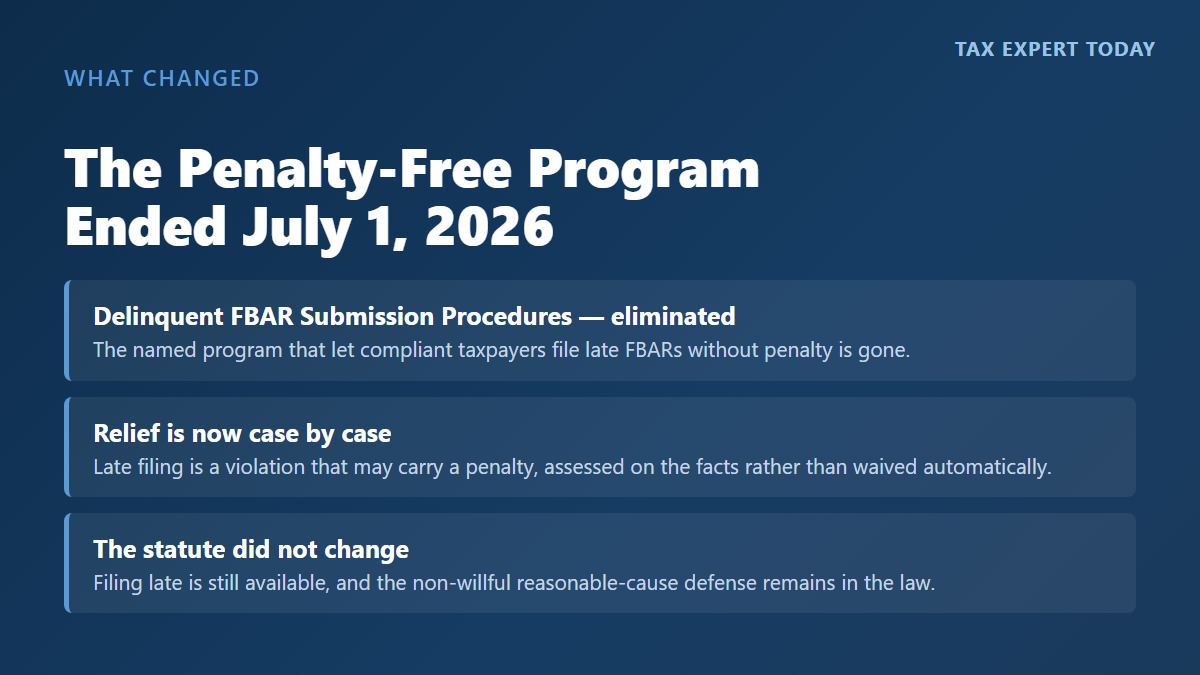
On July 1, 2026, the IRS eliminated the Delinquent FBAR Submission Procedures, the long-standing program that let taxpayers who had reported and paid tax on all of their foreign income file late FBARs without penalty. The dedicated IRS program page has been removed, and coverage in Forbes on July 2, 2026 confirmed the change. The practical effect is a move away from predictable administrative relief toward case-by-case penalty assessment.
Under the old procedure, a qualifying taxpayer attached a short statement of reasonable cause to the late filings and, in practice, faced no FBAR penalty as long as the income had been properly reported. That certainty is what ended. The statutory framework behind the FBAR did not change, so late filing is still possible and a non-willful taxpayer still has a reasonable-cause defense written into the law. What is gone is the branded, penalty-free on-ramp. Because most law-firm and expat-tax pages published before July 2026 still describe the eliminated program as if it were current, it is worth confirming any instructions you read against the live IRS and FinCEN pages before you rely on them.
How Do I File a Delinquent FBAR Now?
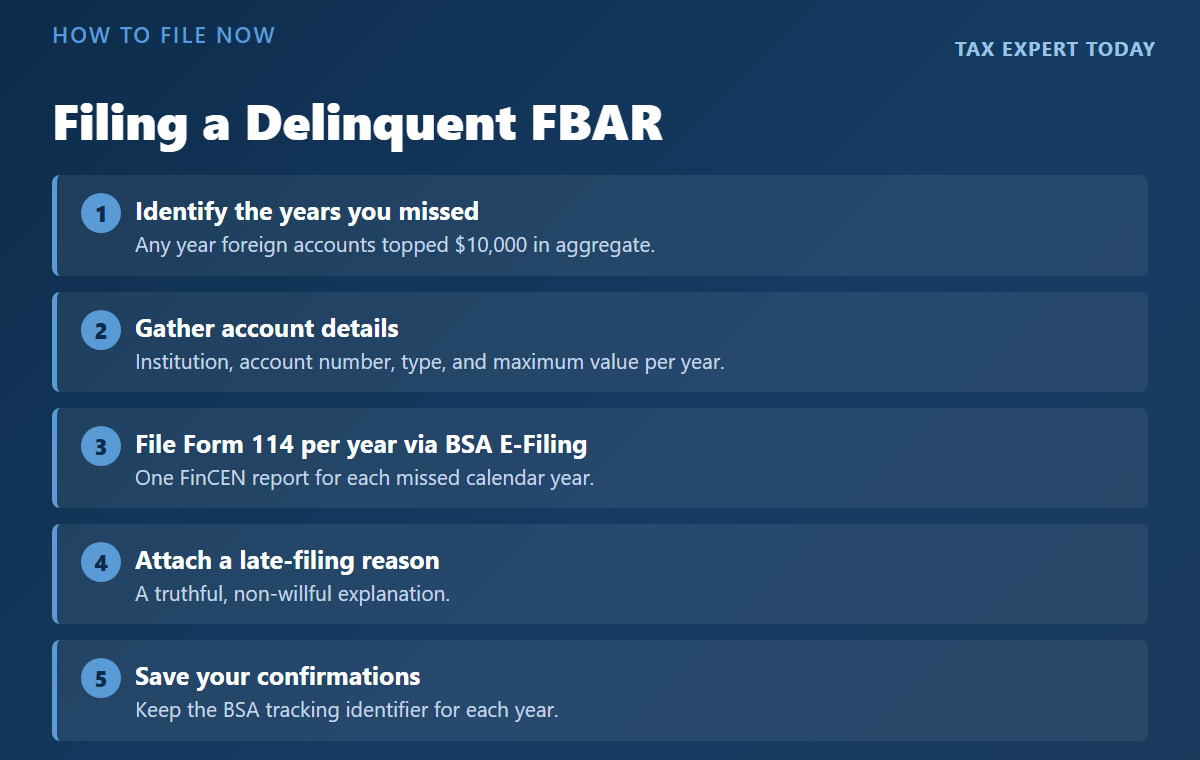
You file a delinquent FBAR the same way you would file a current one: electronically, through FinCEN, one FinCEN Form 114 per missed calendar year. The report goes to FinCEN under the Bank Secrecy Act, not to the IRS with your tax return, and there is no paper option for individuals in the ordinary case. The core steps are unchanged by the July 2026 program elimination.
The process breaks down into a few concrete steps:
- Identify the years you missed. For each calendar year, determine whether your foreign financial accounts exceeded $10,000 in aggregate at any point, which is the filing threshold under 31 CFR 1010.350.
- Gather the account details. For every account and every year, collect the institution name and address, the account number, the account type, and the maximum value during the year converted to U.S. dollars using the Treasury year-end exchange rate.
- File each year separately. Go to the BSA E-Filing System, complete a FinCEN Form 114 for each missed year, and submit. Individuals can file without registering for an account.
- Attach a reason for filing late. The system asks you to select a reason for late filing and lets you provide a brief explanation. A clear, truthful, non-willful explanation is the foundation of the reasonable-cause position discussed below.
- Save your confirmations. Keep the BSA tracking identifier and confirmation for each year as proof of what you filed and when.
None of these steps require you to amend a tax return, because a straightforward delinquent FBAR assumes your income was already reported correctly. If that assumption does not hold, the analysis changes and a different program applies, which is covered further down.
Do You Need a Cover Letter for a Delinquent FBAR?
A delinquent FBAR does not take a separate cover letter. FinCEN Form 114 is filed electronically, so the explanation belongs inside the filing itself. The BSA E-Filing System requires you to choose a reason for filing late from a list, and where none of the listed reasons fit, to type a short explanation in the field it opens.
The phrase “delinquent FBAR cover letter” survives from the period before July 1, 2026, when the Delinquent FBAR Submission Procedures invited filers to attach a statement explaining why the reports were late. That program has been withdrawn and its page removed from IRS.gov, so there is no longer a program to invoke by name and no separate letter to attach. What replaced it is the late-filing reason carried inside the BSA E-Filing System itself.
What belongs in the late-filing reason
Keep the statement short, factual, and consistent across every year filed. A useful statement identifies what the accounts were, why the filer did not understand the reports were due, when the filer learned of the requirement, and what was done once they learned. Statements that speculate about penalty exposure, or that argue law rather than state facts, tend to add little. Anything entered here is a representation to the government, so it should be accurate and capable of being supported by records.
Two situations call for more than the reason field. Where foreign income also went unreported, the Streamlined Filing Compliance Procedures require a signed certification of non-willful conduct rather than a free-text explanation, and that certification carries its own narrative requirements. Where the facts are not clearly non-willful, the choice of path is a question to settle before anything is transmitted, because a filing cannot be recalled once it is sent.
FBAR filing help Naples: Tax Expert Today LLC works from Naples, Florida on late and delinquent FBAR filings for clients across Southwest Florida and all 50 states. Call (239) 441-2005 for a free consultation.
How Many Years of Late FBARs Do I Need to File?
The FBAR carries a six-year statute of limitations under 31 U.S.C. §5321(b)(1), so the standard practice is to file the most recent six years of delinquent reports. Filing six years lines up the FBAR record with the period during which the government can still assess a penalty, and it matches the six-year FBAR lookback used by the Streamlined procedures for taxpayers who also had unreported income. If the missed reports involved accounts you signed on rather than owned, see our guide to FBAR signature authority.
There are practical wrinkles. You only file for years in which you actually crossed the $10,000 aggregate threshold, so a year below the line needs no report. If your accounts are older than six years, filing beyond the six-year window is generally unnecessary and can complicate a clean submission, though the right lookback depends on your facts and on whether any income was unreported. When the situation is not obviously simple, confirming the correct number of years before you file avoids both under-filing and over-filing.
What If I Also Had Unreported Income on the Accounts?
If you left income from your foreign accounts off your U.S. tax returns, a plain delinquent FBAR filing is not the right path.A missed Form 5471 for a foreign corporation runs on a separate track, because the delinquent international information return procedures were not affected by the July 2026 change. The delinquent-FBAR route has always been limited to taxpayers who reported and paid tax on all their foreign income and simply missed the separate FinCEN report. When income was unreported, the appropriate route for a non-willful taxpayer is usually the Streamlined Filing Compliance Procedures, which remain open in 2026.
The Streamlined procedures require you to file three years of amended returns and six years of FBARs, pay the tax and interest due, and certify under penalty of perjury that your failure was non-willful on Form 14653 for the foreign track or Form 14654 for the domestic track. Taxpayers who live abroad and qualify for the foreign track pay no miscellaneous offshore penalty, while U.S.-resident taxpayers on the domestic track pay a 5% penalty on the highest year-end value of the unreported assets. Streamlined is available only where the conduct was genuinely non-willful, and a taxpayer who was in fact willful risks a false certification, so the choice between simply filing late FBARs and entering Streamlined is a facts-driven decision that deserves careful review.
Which Path Fits Your Situation?
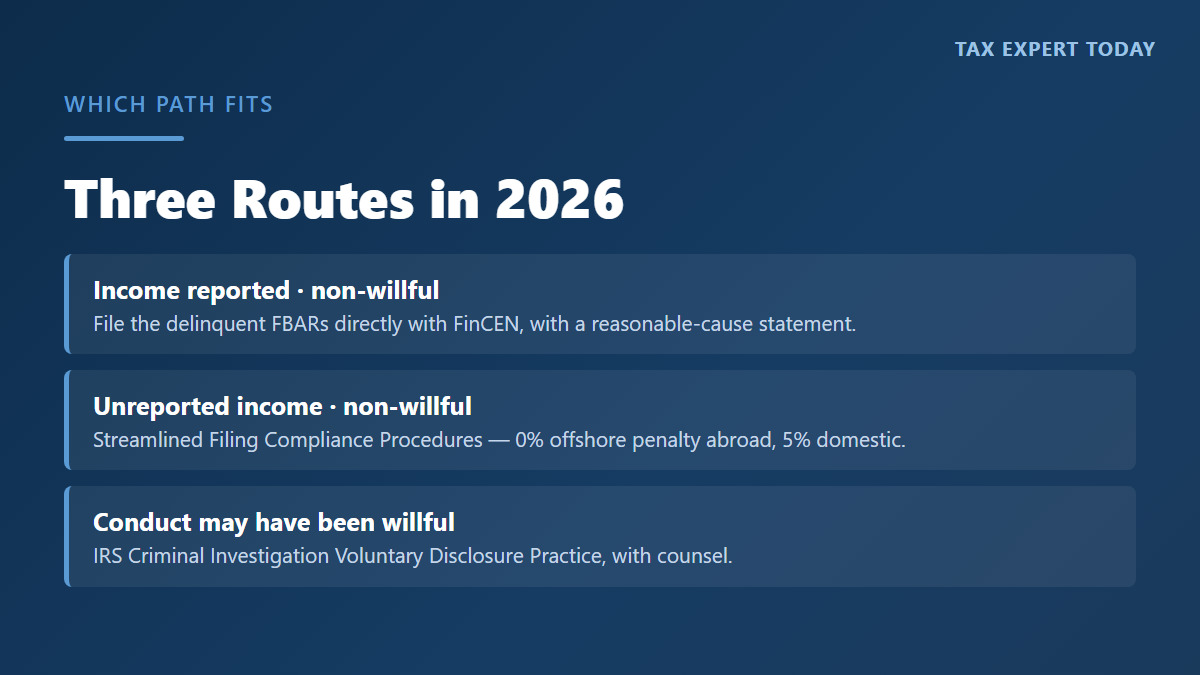
The right remediation route turns on two questions: did you report the income, and was the failure non-willful. The table below maps the common situations to the current 2026 options. It is a starting framework, not a substitute for reviewing your specific facts, because the willful-versus-non-willful line in particular carries serious consequences.
| Your situation | Current path (2026) | What you file | Penalty exposure |
|---|---|---|---|
| Income reported and taxed, non-willful, only the FBAR was missed | File the delinquent FBARs directly with FinCEN | FinCEN Form 114 for each missed year, with a late-filing reason | Penalty possible but discretionary; non-willful reasonable-cause defense applies |
| Unreported foreign income, non-willful | Streamlined Filing Compliance Procedures | 3 years amended returns, 6 years FBARs, Form 14653 or 14654 | 0% offshore penalty (foreign) or 5% (domestic), plus tax and interest |
| Conduct may have been willful | IRS Criminal Investigation Voluntary Disclosure Practice | Formal disclosure through IRS-CI, with counsel | Negotiated civil penalties; the route that addresses criminal exposure |
Will I Be Penalized for Filing a Late FBAR?
Possibly, but a penalty is now discretionary rather than automatic, and it is far from certain in a non-willful case where you come forward before the IRS contacts you. With the penalty-free program gone, the FBAR penalty statute is what governs, and it caps a non-willful penalty at an inflation-adjusted amount while reserving much larger penalties for willful conduct. Coming forward voluntarily and documenting reasonable cause are the levers that keep exposure low.
For violations assessed in 2026, the ceilings under 31 CFR 1010.821 are up to $16,536 per report for a non-willful violation and, for a willful violation, the greater of $165,353 or 50% of the account balance, per account, per year. These are statutory maximums, not the expected result in a routine non-willful catch-up, and the Supreme Court held in Bittner v. United States (2023) that the non-willful penalty accrues per report rather than per account. One important limit to know: because the FBAR is a Title 31 Bank Secrecy Act penalty rather than a Title 26 tax penalty, First-Time Abatement does not apply to it, and the tax-penalty relief tools you may have used before work differently here. Our guide to FBAR penalties walks through the willful-versus-non-willful distinction in more depth, and our overview of how to get IRS penalties removed explains the broader relief framework.
What Is the Reasonable-Cause Defense for a Non-Willful FBAR?
The reasonable-cause defense for a non-willful FBAR violation is statutory. Under 31 U.S.C. §5321(a)(5)(B)(ii), no penalty is imposed for a non-willful violation if the violation was due to reasonable cause and the balance in the account was properly reported. In plain terms, if you can show that a reasonable person in your circumstances would have made the same mistake, and the income was on your return, the statute itself directs that no penalty apply.
What counts as reasonable cause depends on the facts. Common supporting circumstances include reasonable reliance on a professional who did not flag the FBAR, a genuine and understandable lack of awareness of the separate FinCEN requirement, or a serious disruption that prevented timely filing. The reason-for-late-filing statement you submit with the delinquent reports is where this position is first stated, so it should be truthful, specific, and consistent with your records. Because reasonable cause is judged case by case and the second condition, that the balance was properly reported, has to hold, this is exactly the kind of determination where a careful review of your history before filing pays off.
Late FBAR Help in Naples and Southwest Florida
Tax Expert Today LLC helps individuals and business owners in Naples and across Southwest Florida bring past-due FBARs current the right way in the post-July-2026 environment. That work starts with the threshold question, deciding which years actually required a report, then classifying the situation as a straightforward delinquent filing, a Streamlined case, or something that needs a more formal disclosure, and finally documenting reasonable cause so a non-willful history is presented clearly. The firm is multidisciplinary, with enrolled agents, CPAs, and attorneys, and represents taxpayers before the IRS nationwide. Dr. Pellumb Kabashi is the founder of Tax Expert Today LLC. The office is at 11983 Tamiami Trail N, Naples, FL 34110, and the team can be reached at (239) 441-2005, Monday through Friday, 10am to 5pm ET.
Frequently Asked Questions
Can I still file a late FBAR in 2026?
Yes. You can file a late FBAR at any time by submitting each missed FinCEN Form 114 through the BSA E-Filing System. What changed on July 1, 2026 is that the IRS eliminated the penalty-free Delinquent FBAR Submission Procedures, so late filing is now a violation that may carry a discretionary penalty. The IRS advises taxpayers who are not under investigation to file as soon as possible to keep potential penalties to a minimum.
What happened to the Delinquent FBAR Submission Procedures?
The IRS eliminated the Delinquent FBAR Submission Procedures effective July 1, 2026. That program previously allowed taxpayers who had reported all foreign income to file late FBARs without penalty. The dedicated program page has been removed, and penalty relief for late FBARs is now evaluated case by case under the general penalty statute rather than granted automatically. Late filing itself remains available through FinCEN.
How many years of late FBARs do I have to file?
The FBAR has a six-year statute of limitations, so the common practice is to file the most recent six years for which you crossed the $10,000 aggregate threshold. You do not file for years in which your foreign accounts stayed below the threshold. If you also had unreported income and enter the Streamlined procedures, the FBAR lookback is likewise six years, paired with three years of amended returns.
Will I owe a penalty if I file a late FBAR now?
Not necessarily. A penalty is possible but discretionary, and it is unlikely in a routine non-willful case where you file before the IRS contacts you and can show reasonable cause. The 2026 non-willful ceiling is up to $16,536 per report, and willful violations can reach the greater of $165,353 or 50% of the account balance. Those are maximums reserved for more serious cases, not the expected outcome of a voluntary non-willful catch-up.
What if I did not report income from the foreign accounts?
Then a plain delinquent FBAR filing is not the correct route. When foreign income was left off your returns, the appropriate path for a non-willful taxpayer is usually the Streamlined Filing Compliance Procedures, which require three years of amended returns, six years of FBARs, and a non-willful certification. Streamlined remains open in 2026. If the conduct may have been willful, a formal voluntary disclosure through IRS Criminal Investigation is the route to consider.
Do I need a cover letter or reasonable cause statement for a delinquent FBAR?
No separate cover letter is filed. FinCEN Form 114 goes through the BSA E-Filing System, which requires you to select a reason for filing late and lets you add a brief written explanation. The former Delinquent FBAR Submission Procedures, which invited an attached statement, were withdrawn on July 1, 2026. Where foreign income also went unreported, the Streamlined Filing Compliance Procedures require a signed non-willful certification instead of a free-text explanation.
Where can I get help filing a late FBAR in Naples, FL?
Tax Expert Today LLC, located at 11983 Tamiami Trail N, Naples, FL 34110, assists individuals and businesses in Naples and across Southwest Florida with filing delinquent FBARs, choosing between a direct filing and the Streamlined procedures, and documenting reasonable cause. The firm is multidisciplinary, with enrolled agents, CPAs, and attorneys, and represents taxpayers before the IRS nationwide. Consultations can be arranged at (239) 441-2005.
When to Engage a Professional for a Late FBAR
Bringing past FBARs current is often manageable, but the decisions around it are where mistakes become expensive. Whether your failure was non-willful, whether any income was unreported, how many years to file, and how to frame reasonable cause all turn on facts that are easy to misjudge, and the penalty-free safety net that used to forgive a good-faith error is no longer there. The most common missteps are filing a quiet delinquent FBAR when unreported income actually called for Streamlined, or delaying until the IRS makes first contact and forfeiting the voluntary posture that keeps a non-willful case small. Tax Expert Today LLC represents individuals and business owners in foreign-account compliance matters nationwide.
Call (239) 441-2005 or schedule a consultation to review which foreign-account reports you owe, how many years to bring current, and the right way to file after the July 2026 changes. Tax advisors, enrolled agents, CPAs, and attorneys serving clients in all 50 states.
Published July 21, 2026 by Dr. Pellumb Kabashi « Back to Learning Center
Have a question this article touches on?
Tax Expert Today LLC, based in Naples, Florida and serving clients across the United States.
Schedule a Consultation (239) 441-2005