
By Dr. Pellumb Kabashi, DBA, MBA, CES, CFE, EA
Founder, Tax Expert Today LLC · Tax advisors, enrolled agents, CPAs, and attorneys · Serving clients in all 50 states
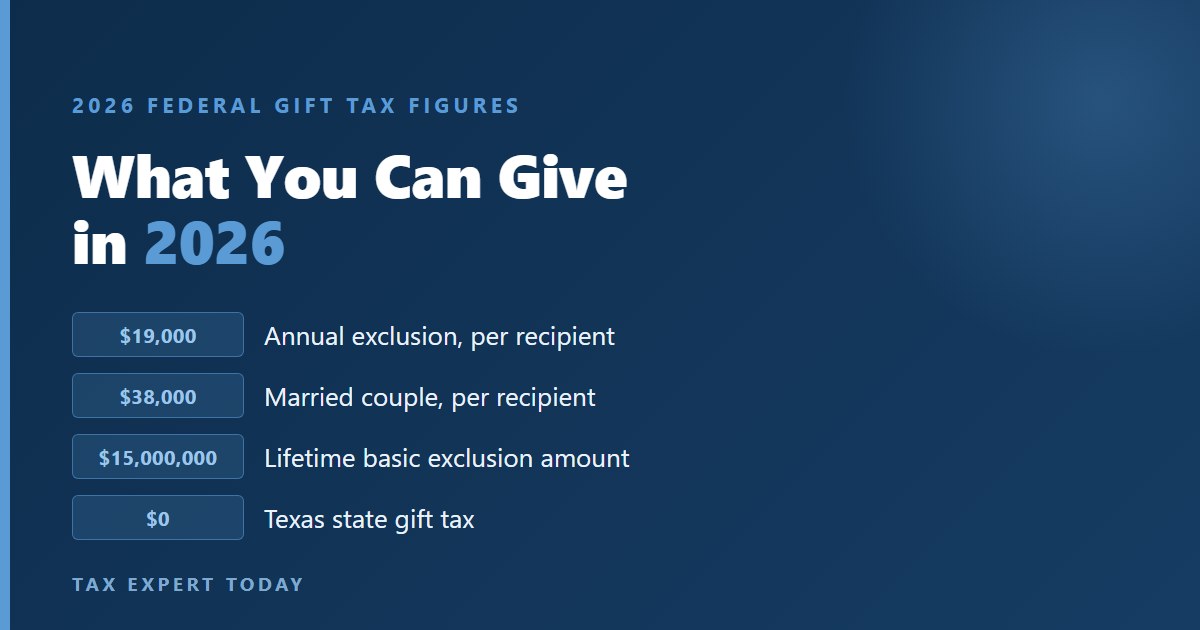
Quick Answer: Texas gift tax does not exist as a state tax, and the Texas Constitution now bars the Legislature from creating one. Every dollar of exposure is federal. For 2026 the annual exclusion is $19,000 per recipient and the basic exclusion amount is $15,000,000 per person, so most Texas families owe nothing yet still have a Form 709 filing obligation. Call (239) 441-2005 for a free consultation.
Is There a Texas Gift Tax in 2026?
No. Texas imposes no gift tax on the transfer of cash, securities, real property, or business interests, and since November 4, 2025 the state constitution prohibits the Legislature from enacting one. The only gift tax a Texas resident can owe is the federal gift tax, and one narrow state tax on gifted motor vehicles.
- No state gift tax return exists. Texas has no equivalent of Form 709 and no state office that accepts a gift tax filing.
- The ban is constitutional, not merely statutory. Article VIII, Section 26 reaches transfers by gift as well as transfers at death.
- Federal law still applies in full. Residency in a no-income-tax state changes nothing about Chapter 12 of the Internal Revenue Code.
- One carve-out survives. A gifted motor vehicle carries a separate $10 state tax, which is not the federal gift tax.
This is the single most common misunderstanding we correct for Texas clients. People read that there is no Texas gift tax, conclude that generous lifetime giving carries no reporting duty, and then discover years later that a Form 709 was required for a transfer that produced no tax at all. The absence of a state tax is real, and it is genuinely favorable, but it operates alongside a federal regime that is indifferent to where the donor lives.
The constitutional prohibition arrived through a statewide ballot measure approved on November 4, 2025. Because our guide to Texas inheritance tax covers Article VIII, Section 26 and its treatment of transfers at death in full, this article does not repeat that analysis. Read that guide for the constitutional history and the death-transfer rules; read this one for transfers you make during your lifetime.
Texas gift tax questions also arrive alongside the other taxes a Texas household actually pays. Nothing in this guide affects Texas payroll taxes for a business owner, or the self-employment tax a Texas contractor owes, because gift tax sits in an entirely separate chapter of the Internal Revenue Code and is triggered by transfers rather than by earnings.
What Is the Federal Annual Exclusion for 2026?
The annual exclusion is $19,000 per recipient for calendar year 2026, unchanged from 2025. A donor may give $19,000 to each of any number of people in the same year without using lifetime exemption and, in most cases, without filing. A married couple may combine their exclusions to reach $38,000 per recipient.
- Per recipient, not per donor. Ten recipients at $19,000 each is $190,000 moved in one year with no exemption consumed.
- It resets every January 1. An unused annual exclusion does not carry forward.
- It requires a present interest. A gift the recipient cannot access immediately does not qualify.
- It is indexed but sticky. The figure moves only in $1,000 increments, which is why 2025 and 2026 match.
The annual exclusion sits in IRC Section 2503(b). Note the present interest requirement, because it is where do-it-yourself gifting most often fails. Money placed into a trust that the beneficiary cannot reach until age thirty is a future interest, and a future interest gets no annual exclusion at all regardless of size. That single distinction converts what a family believed was an exempt $19,000 transfer into a reportable gift that consumes lifetime exemption.
| 2026 federal transfer tax figure | Amount | Authority |
|---|---|---|
| Annual exclusion per recipient | $19,000 | Section 2503(b), as adjusted |
| Annual exclusion, married couple combined | $38,000 | Sections 2503(b) and 2513 |
| Basic exclusion amount per person | $15,000,000 | Section 2010(c)(3), as amended by Public Law 119-21 |
| Annual exclusion, non-citizen spouse | $165,000 | Section 2523(i)(2), per Rev. Proc. 2025-32 |
| Top federal gift tax rate | 40 percent | Section 2001(c) |
| Texas state gift tax | None | Texas Constitution, Article VIII, Section 26 |
Every figure above was verified against IRS guidance on the date this guide was published. Several competing pages still circulate the $18,000 figure from 2024, so confirm any number you find elsewhere against the IRS gift tax page before acting on it.
How Much Can You Give Over Your Lifetime in 2026?
The basic exclusion amount is $15,000,000 per person for 2026, raised by Public Law 119-21, which amended Section 2010(c)(3). Gifts above the annual exclusion do not produce tax until cumulative lifetime taxable gifts exhaust that amount. A married couple can shelter $30,000,000 between them.
- Gift and estate tax share one exemption. Lifetime gifting reduces what remains at death.
- It is applied as a credit. Section 2505 converts the exclusion into a unified credit against gift tax.
- Portability is not automatic. A surviving spouse claims the unused amount only by filing Form 706.
- Reporting is how the running total is tracked. Without filed returns, the IRS has no record of exemption already used.
The 2026 increase is significant and it is worth understanding what actually changed. Prior law was scheduled to cut the exclusion roughly in half after 2025, and a great deal of rushed gifting was done in anticipation of that reduction. Public Law 119-21 removed that cliff and set the figure at $15,000,000. Families who accelerated transfers to beat a deadline that no longer exists may now hold assets in structures they no longer need, and that is worth reviewing rather than leaving in place by default.
For the overwhelming majority of Texas households, an exemption of this size means Texas gift tax planning is really federal reporting planning, and that no gift tax will ever be paid. The practical question is therefore not whether tax is owed. It is whether the return documenting the transfer was filed, and whether the asset was given during life or held until death. Those two decisions carry consequences long after the gift itself. The unified credit mechanism appears in IRC Section 2505, and the exclusion amount itself in IRC Section 2010. The federal mechanics behind that credit, including how the lifetime gift tax exemption interacts with portability and with the deceased spousal unused exclusion, are set out separately.
When Does a Texas Gift Tax Question Actually Require Form 709?
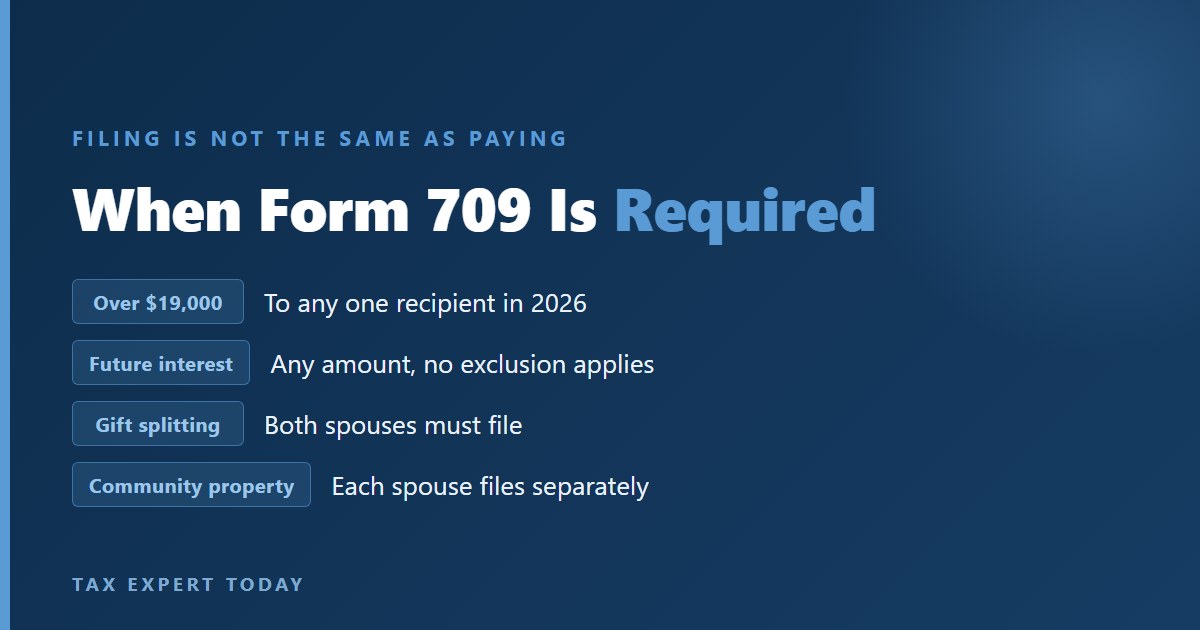
Form 709 is required whenever a donor gives any one person more than $19,000 in 2026, gives a future interest of any amount, elects to split gifts with a spouse, or gives community property or jointly held property. Filing is required in each case even when no tax is due and no meaningful exemption is consumed.
- Exceeding the annual exclusion. One dollar over $19,000 to a single recipient creates a filing duty.
- Any future interest. Amount is irrelevant, because no annual exclusion applies.
- Electing to split. The election exists only on a filed return.
- Community property and joint tenancy. Each spouse files a separate return.
The Instructions for Form 709 state the rule plainly for future interests: certain gifts are not subject to the annual exclusion and a return is required even if the gift was under the threshold. The instructions are equally direct on splitting, requiring a return to split gifts with a spouse regardless of amount.
| Situation in 2026 | Form 709 required? | Tax likely due? |
|---|---|---|
| $19,000 cash to an adult child | No | No |
| $40,000 cash to an adult child | Yes | No, exemption absorbs it |
| $10,000 into a trust the beneficiary cannot access | Yes, future interest | No |
| Spouses splitting a $38,000 gift | Yes, both spouses | No |
| $30,000 of Texas community property to a child | Depends on each half share | No |
| Tuition paid directly to a university | No | No |
| Any gift to a United States citizen spouse | Generally no | No |
Notice how many rows require a return while owing nothing. That pattern is the reason a Texas gift tax search so often ends in a false sense of security. The tax result and the filing result are separate questions, and only one of them is usually zero.
How Does Texas Community Property Change Who Files?
Texas is a community property state, and that changes federal gift tax reporting. A gift of community property is treated as made one-half by each spouse, so each spouse must file a separate Form 709 when their half shares exceed the annual exclusion. The division happens automatically, without any election.
- The split is automatic, not elective. Community character alone divides the gift.
- Two returns, not one. Each spouse reports their own half.
- Character depends on the asset. Separate property gifted by one spouse is not automatically halved.
- Most online guides omit this entirely. It is the most frequently missed Texas-specific mechanic.
The Form 709 instructions state that if a gift is of community property, it is considered made one-half by each spouse, and that each spouse must file a gift tax return. Texas couples reach this outcome constantly, because wages earned during marriage and assets bought with those wages are ordinarily community property. A married Texas couple who gives a child $30,000 from a joint checking account funded by salary has, for federal purposes, made two gifts of $15,000. Each is below the annual exclusion, which is favorable, and on those facts the couple may have no filing duty at all.
Raise the number and the picture changes. A $50,000 transfer of community property becomes two $25,000 gifts. Each spouse now exceeds $19,000, and each spouse files. This is missed regularly, because the couple thinks of the money as one gift from one household account rather than as two federal gifts from two donors.
| Feature | Community property division | Gift splitting election |
|---|---|---|
| Legal basis | Texas marital property law | IRC Section 2513 |
| Requires an election? | No, automatic | Yes, on a filed return |
| Requires spousal consent? | No | Yes, both must consent |
| Applies to separate property? | No | Yes |
| Number of returns | Two, if thresholds are met | Two |
| Common in Texas? | Very, most marital assets qualify | Used for separate property gifts |
Because Texas is a community property state, many couples never need the Section 2513 election for ordinary marital assets. The election matters when one spouse gives away property that is genuinely separate, such as an inheritance received individually or an asset owned before the marriage. Our guide to property transfers and buyouts between spouses covers related characterization issues, and families who later relocate should review estate planning for new Florida residents, because community property character does not simply disappear when a couple crosses a state line. The same tracing question decides whether a spousal lifetime access trust funded after a move is treated as created by one spouse or by both.
What Is Gift Splitting and When Should Texas Couples Use It?
Gift splitting under Section 2513 lets a married couple treat a gift made by one spouse as made one-half by each, doubling the effective annual exclusion to $38,000 per recipient. Both spouses must consent, both must be married at the time of the gift, and the election requires a filed Form 709.
- It doubles the shield. One spouse can move $38,000 per recipient using both exclusions.
- Consent is all or nothing. Electing to split applies to all qualifying gifts made that year.
- It creates a filing duty by itself. The election cannot be made informally.
- It uses the consenting spouse’s exemption. Half the taxable gift is charged to them.
Read IRC Section 2513 before relying on the election. The all-or-nothing feature surprises people. A couple cannot split one favorable gift and leave another unsplit in the same calendar year. Where a Texas couple is gifting community property anyway, the election is often unnecessary, which is a genuine simplification that a Texas resident enjoys and a resident of a common law state does not.
Which Transfers Are Not Taxable Gifts at All?
Several transfers are excluded from gift tax entirely, not merely sheltered by the annual exclusion. Tuition and medical expenses paid directly to the institution or provider, gifts to a United States citizen spouse, transfers to qualifying charities, and political contributions are outside the gift tax base under Section 2503(e) and related provisions.
- Direct payment is mandatory. Reimbursing the student destroys the exclusion.
- Tuition only. Room, board, books, and fees do not qualify.
- Medical means care and insurance. Paid straight to the provider or carrier.
- These stack with the annual exclusion. Direct tuition plus $19,000 in cash is entirely permissible.
The mechanics of Section 2503(e) reward precision and punish informality. A grandparent who writes a $60,000 check to a grandchild to cover tuition has made a $60,000 gift, reportable and exemption-consuming. The same grandparent who sends $60,000 directly to the university bursar has made no gift for federal purposes at all. The economics are identical and the tax outcomes are not, which makes this among the most valuable and most easily forfeited planning tools available to a family funding education.
| Transfer | Treatment | Authority |
|---|---|---|
| Tuition paid directly to the school | Not a gift, unlimited | Section 2503(e)(2)(A) |
| Medical care paid directly to the provider | Not a gift, unlimited | Section 2503(e)(2)(B) |
| Cash to the student for tuition | Gift, exclusion applies | Section 2503(b) |
| Gift to a United States citizen spouse | Unlimited marital deduction | Section 2523 |
| Gift to a non-citizen spouse | Limited to $165,000 in 2026 | Section 2523(i)(2) |
| Gift to a qualifying charity | Deductible, no gift tax | Section 2522 |
Charitable transfers deserve their own analysis rather than a passing mention. If charitable giving is part of the plan, our guides to the donor advised fund deduction and to charitable remainder trust taxation cover the income tax side, which is usually where the real benefit sits once gift tax is off the table.
What Is the $10 Texas Motor Vehicle Gift Tax?
Texas charges a flat $10 tax when a motor vehicle is gifted between eligible parties, typically close family members. This is a motor vehicle tax administered by the Texas Comptroller, not a gift tax on wealth transfers, and it is expressly carved out of the constitutional prohibition on transfer taxes.
- It is $10, flat. The vehicle’s value does not change the amount.
- Eligibility is limited. Spouse, parent, child, grandparent, grandchild, sibling, and certain others.
- Form 14-317 is required. The affidavit must be filed with the county tax office.
- It replaces sales tax, not federal gift tax. A high-value vehicle can trigger both.
This tax is the reason a search for Texas gift tax returns such confusing results. Roughly half of the current top-ranking pages for the phrase are about transferring a car title, which has nothing to do with the federal gift tax on lifetime wealth transfers. The two are unrelated taxes that happen to share a name, and conflating them leads people badly astray in both directions.
The Texas Comptroller motor vehicle gift tax guidance confirms the $10 amount and places responsibility on the recipient. Eligible relationships are set out in the family transfers guidance, and the affidavit itself is Form 14-317.
| Question | Federal gift tax | Texas motor vehicle gift tax |
|---|---|---|
| Who levies it | Internal Revenue Service | Texas Comptroller |
| What it applies to | Any gratuitous transfer | Motor vehicles only |
| Amount | Up to 40 percent above exemption | $10 flat |
| Who pays | The donor | The recipient |
| Form | Form 709 | Form 14-317 |
| Banned by Article VIII, Section 26? | Not applicable, federal | No, expressly carved out |
A meaningful practical point follows. Gifting a vehicle worth more than $19,000 to an adult child triggers the $10 state tax and a federal Form 709 filing obligation at the same time. The state side is trivial and the federal side is the one people overlook. Anyone searching Texas gift tax because of a car transfer should confirm which of the two taxes they are actually asking about before relying on what they read.

Is a Lifetime Gift Better Than an Inheritance?
Not always. A lifetime gift carries over the donor’s basis under Section 1015, while property held until death generally receives a basis step-up to fair market value under Section 1014. For highly appreciated assets, gifting during life can transfer a large unrealized capital gain to the recipient.
- Carryover basis follows the gift. The recipient inherits the donor’s original cost.
- Step-up resets at death. Appreciation during the decedent’s life escapes income tax.
- The tradeoff is gift tax versus income tax. Saving one can cost the other.
- Cash is neutral. Basis questions only matter for appreciated property.
Consider a hypothetical illustration. A parent bought Texas ranch land decades ago for $100,000 and it is now worth $1,000,000. Gifting it during life passes a $100,000 basis under Section 1015, so a later sale by the child at $1,000,000 realizes a $900,000 gain. Holding the same land until death gives the heir a $1,000,000 basis under Section 1014, and an immediate sale realizes almost nothing. With a $15,000,000 exemption available, no federal transfer tax is at stake either way on these facts, so the gift accomplishes little and costs a great deal of basis.
The calculus reverses for assets expected to appreciate sharply from today forward, where removing future growth from the estate can be valuable. It also reverses where the donor wants the asset out of their control for non-tax reasons. Because Texas imposes no state capital gains tax, the income tax consequence here is purely federal, and our guide to Texas capital gains tax works through how that interacts with a sale. This is the point at which Texas gift tax planning stops being about gift tax at all and becomes a basis decision, which is why the two guides are best read together with the Texas inheritance tax analysis.
| Factor | Lifetime gift | Transfer at death |
|---|---|---|
| Recipient’s basis | Donor’s basis, carried over | Fair market value at death |
| Code section | Section 1015 | Section 1014 |
| Future appreciation | Outside the estate | Inside the estate |
| Best for | Assets expected to grow sharply | Highly appreciated existing assets |
| Reporting | Form 709 during life | Form 706 if thresholds are met |
| Texas state tax | None | None |
When Is Form 709 Due and What Happens If You Miss It?
Form 709 for gifts made during 2026 is due no earlier than January 1 and no later than April 15, 2027, matching the individual income tax deadline. An extension of time to file Form 1040 extends Form 709 as well. Because most gifts produce no tax, the practical exposure from a late return is usually informational rather than financial.
- April 15 of the following year. The next business day if that date falls on a weekend or holiday.
- Form 4868 carries it along. An income tax extension extends the gift tax return.
- Penalties are computed on tax due. Where no tax is owed, a late-filing penalty generally has no base.
- The real cost is the record. An unfiled return leaves exemption usage undocumented.
That last point deserves emphasis, because it is the reason a return with no tax still matters. The statute of limitations on a gift is meaningfully affected by whether the gift was adequately disclosed on a filed return. A transfer that was never reported can remain open to valuation challenge for a long time, and the family members who have to defend the valuation are typically the ones who did not make the gift and were not there when it was made. Filing converts an open question into a closed one.
Unfiled prior-year gift tax returns are a fixable problem and, in our experience, a common one among families who gifted business interests or real property without advice. If that describes your situation, the reasonable first step is to reconstruct what was transferred and when, then decide how to bring the record current. Our IRS resolution and audit support practice handles matters of this kind, and Naples tax resolution describes how those engagements run.
What Gifting Mistakes Do Texas Families Make Most Often?
The recurring Texas gift tax errors are assuming that no state tax means no filing, paying tuition to the student instead of the school, gifting highly appreciated property that would have received a step-up, adding a child to a deed without understanding the consequence, and forgetting that community property creates two donors.
- Assuming no tax means no return. Filing and paying are separate questions.
- Indirect tuition payments. The check must go to the institution.
- Gifting appreciated assets reflexively. Basis is often worth more than the estate reduction.
- Adding a child to a deed. This is frequently a completed gift of a fractional interest.
The deed issue is worth expanding, because it happens quietly and is discovered late. A Texas parent who adds an adult child as a joint owner of a home has, in most circumstances, made a present gift of an interest in that property. If the value of that interest exceeds the annual exclusion, a return is due. The transfer also delivers carryover basis on the gifted portion, which can eliminate part of a step-up the family expected to receive. The intention is usually probate avoidance, and there are instruments that accomplish that objective without the gift tax and basis consequences.
A second pattern involves business interests. Owners of a Texas LLC often transfer membership units to children gradually, which is a sound strategy, but the units require valuation and the transfers require reporting. Interests in an entity that also owes Texas franchise tax carry their own reporting rhythm, and the two calendars are unrelated. Where the entity holds mineral rights, our guide to royalty income taxes covers the income side of what the recipient inherits along with the units.
Does Moving to or From Texas Change Gift Tax?
No. There is no Texas gift tax to gain or lose by moving. Federal gift tax applies to United States citizens and residents regardless of which state they live in, so relocating to Texas does not reduce gift tax and moving away does not increase it. What changes is exposure to other states, because a minority of states impose their own estate or inheritance tax.
- Federal law is state-blind. Domicile does not alter Chapter 12 exposure.
- Some states do tax transfers. Texas does not, but a former or future home state might.
- Situs still matters. Real property located elsewhere can be reached by that state.
- Timing of domicile change is provable. Document it the same way you would for income tax.
People relocating for tax reasons often overestimate what a move accomplishes for transfer taxes and underestimate what it accomplishes for income taxes. The genuine benefit of Texas domicile is the absence of a state income tax, which our guide to no state income tax in Texas explains, alongside our comparison of Texas versus Florida taxes for those weighing the two. If a move is planned, establishing Texas residency and, for owners, moving a business to Texas set out the evidence to assemble.
Gifts received from foreign persons follow different rules entirely and can require Form 3520 rather than Form 709. Our guide to the Form 3520 foreign gift and trust reporting requirements covers those thresholds, which catch many Texas families with relatives abroad.
Texas Gift Tax Help in Naples & Southwest Florida
Tax Expert Today advises Texas families and business owners on lifetime gifting, Form 709 reporting, and the basis tradeoffs between gifting and inheritance. The firm is based in Naples, Florida and serves clients in all fifty states, including Texas residents who prefer to work remotely with a single advisory team.
Whether you are searching for gift tax help Naples, estate planning Naples FL, or a Texas advisor who understands community property reporting, the analysis is the same and the engagement is handled the same way. Our Texas tax services page describes the state-specific work, and Naples tax planning covers the broader planning practice. For families who also face collection or examination issues, Naples tax resolution addresses that side.
Tax Expert Today LLC
11983 Tamiami Trail N, Naples FL 34110
Phone: (239) 441-2005
Hours: Monday to Friday, 10:00 to 5:00 ET
Do I need to be in Florida to work with your firm on a Texas gift?
No. The firm works with clients in all fifty states, and gift tax is federal, so the analysis does not depend on where the advisor sits. Texas clients typically work with us remotely by video and secure document exchange. Clients in Naples, Bonita Springs, Fort Myers, Marco Island, and Estero are welcome to meet at the Tamiami Trail office.
When to Engage a Professional
Engage an advisor before making a gift rather than after. Valuation, basis, and reporting decisions are far easier to structure in advance than to correct once the transfer is complete and the asset has moved.
- Gifting anything other than cash. Real property, business interests, and securities raise valuation and basis questions.
- Transfers above the annual exclusion. Any amount over $19,000 to one recipient in 2026.
- Prior gifts that were never reported. The record can usually be brought current.
- Trusts, or any gift a beneficiary cannot access now. Future interest treatment removes the annual exclusion.
- Estates approaching the exemption. Coordinated gift and estate planning becomes worthwhile.
Circumstances vary, and the Texas gift tax analysis above is general information rather than advice about your situation. A conversation about the specific asset, its basis, and your broader plan is what determines the right approach. Call (239) 441-2005 for a free consultation.
Frequently Asked Questions
How much money can you gift someone tax free in Texas in 2026?
$19,000 per recipient for 2026, and $38,000 for a married couple giving together. Texas adds no state gift tax, so the federal annual exclusion is the only limit that applies. There is no cap on the number of recipients, so a donor may give $19,000 each to any number of people in the same calendar year.
Can my parents give me $100,000 in Texas?
Yes. No Texas tax applies and federal gift tax is very unlikely to be owed, because the transfer would simply consume part of the $15,000,000 lifetime exclusion. The parents would, however, need to file Form 709 to report the amount above the annual exclusion. If the money is community property, each parent reports one half.
Does the recipient of a gift pay tax in Texas?
No. Gift tax is imposed on the donor, not the recipient, and Texas imposes no gift tax at all. The recipient also does not report the gift as income. The one exception is the $10 Texas motor vehicle gift tax, which is the responsibility of the person receiving the vehicle.
Do I have to file a gift tax return if I owe no gift tax?
Often yes. Filing and paying are separate obligations. A return is required for gifts above the annual exclusion, for any future interest, for gift splitting, and generally for gifts of community property where each half share exceeds the exclusion, even though the $15,000,000 exclusion means no tax is due.
Is there a Texas gift tax on real estate?
No state gift tax applies to a transfer of Texas real property. Federal gift tax rules do apply, so a deed transfer above the annual exclusion requires Form 709 and a valuation. Gifting appreciated real property also passes the original basis to the recipient rather than the step-up that would apply at death.
Published August 21, 2026 by Dr. Pellumb Kabashi « Back to Learning Center
Have a question this article touches on?
Tax Expert Today LLC, based in Naples, Florida and serving clients across the United States.
Schedule a Consultation (239) 441-2005