
By Dr. Pellumb Kabashi, DBA, MBA, CES, CFE, EA
Founder, Tax Expert Today LLC · Tax advisors, enrolled agents, CPAs, and attorneys · Serving clients in all 50 states
Quick Answer: Moving business to Texas is a tax event, not only a change of address. You decide how to move the legal entity (foreign registration, a statutory conversion, or a new entity plus a merger), register for Texas franchise tax with the Comptroller, obtain a sales tax permit if you sell taxable goods or services, set up Texas payroll accounts, and close or wind down the tax accounts you leave behind in your former state. The departure state often keeps taxing income and sales that trace back to activity there, so the old-state cleanup matters as much as the Texas setup.
What Does Moving a Business to Texas Mean for Taxes?
Moving a business to Texas means relocating where your company is organized, where it operates, and where its tax obligations sit. Texas imposes no personal income tax and no corporate income tax, so the arrival-year tax work centers on three state systems: the franchise (margin) tax, sales and use tax, and employment taxes. The move also starts the clock on closing your former state accounts.
Two separate decisions travel together. The first is legal: which mechanism you use to bring the entity into Texas. The second is fiscal: which Texas tax registrations you open and which departure-state registrations you close. Business owners who treat the move as a simple address change tend to miss the second decision, and that is where trailing liability accumulates. Because these are state and employment tax matters rather than IRS matters, the analysis spans multiple disciplines and applies to owners relocating from any state.
How Do You Move Your Business Entity to Texas?
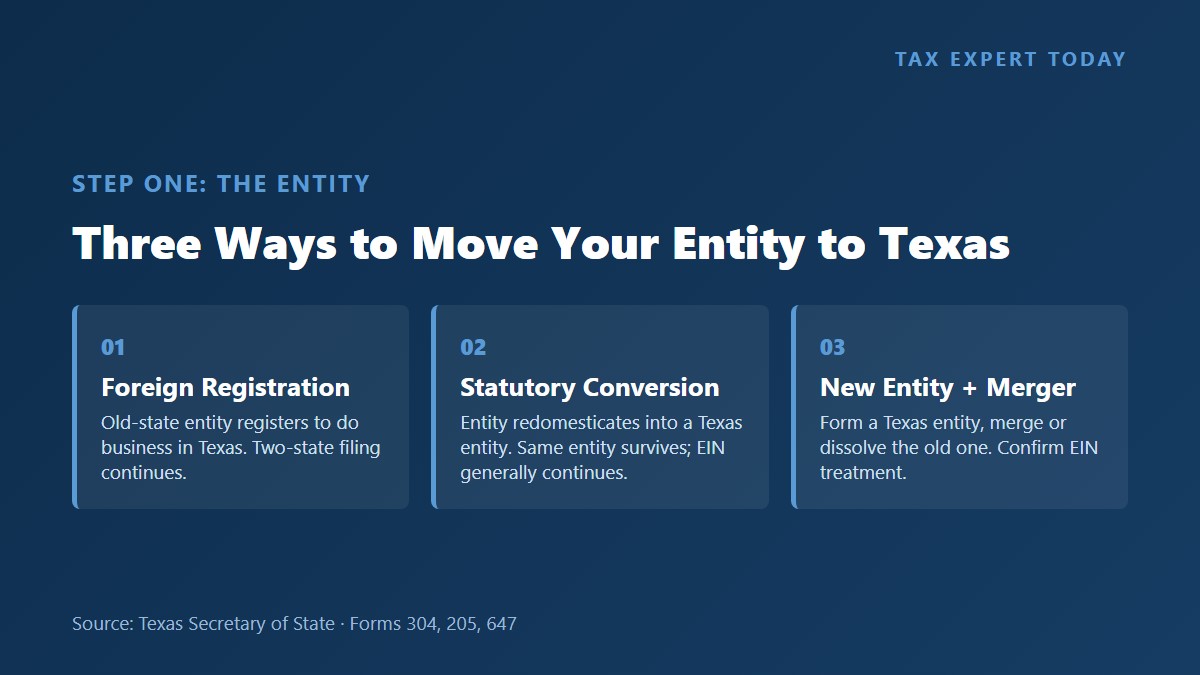
You generally have three ways to move a business entity to Texas: register the existing out-of-state entity as a foreign entity doing business in Texas, convert (redomesticate) the entity into a Texas entity through a statutory conversion, or form a new Texas entity and merge or dissolve the old one. Each path carries different filings, costs, and continuity consequences.
Foreign registration keeps your original entity in its home state and simply authorizes it to do business in Texas. That path suits a temporary presence or an expansion, but it leaves you filing and paying in two states. A statutory conversion under the Texas Business Organizations Code moves the entity itself to Texas, so a single entity continues with the same history. Forming a new entity and merging the old one into it reaches a similar end point but involves winding down the original entity. The Texas Secretary of State publishes the applicable forms, including Form 304 for a foreign limited liability company registration, Form 205 for a Texas certificate of formation, and Form 647 for the conversion of a foreign entity into a Texas filing entity. Filing fees apply and change from time to time, so confirm the current schedule with the Secretary of State before you file.
The federal side usually favors continuity. Under IRS guidance, a properly structured statutory conversion of an entity that keeps its federal classification generally continues to use the same Employer Identification Number, because the same entity survives the conversion. A merger or a dissolution followed by a new formation can produce a different result, and the allocation of income among related businesses is governed by IRC §482. Confirm the federal treatment of your specific path before you file the state paperwork, because reversing a chosen structure after the fact is costly.
| Path | What happens | Typical fit | Continuity note |
|---|---|---|---|
| Foreign registration | Old-state entity registers to do business in Texas (Form 304 and related) | Temporary presence or expansion, home state retained | Two-state filing continues |
| Statutory conversion | Entity redomesticates into a Texas entity (Form 647 plus a certificate of formation) | A true relocation of the business | Same entity survives; EIN generally continues |
| New entity plus merger | Form a Texas entity, merge or dissolve the old one | When conversion is unavailable in the old state | Continuity depends on structure; confirm EIN treatment |
When Does Texas Franchise Tax Apply After You Move?
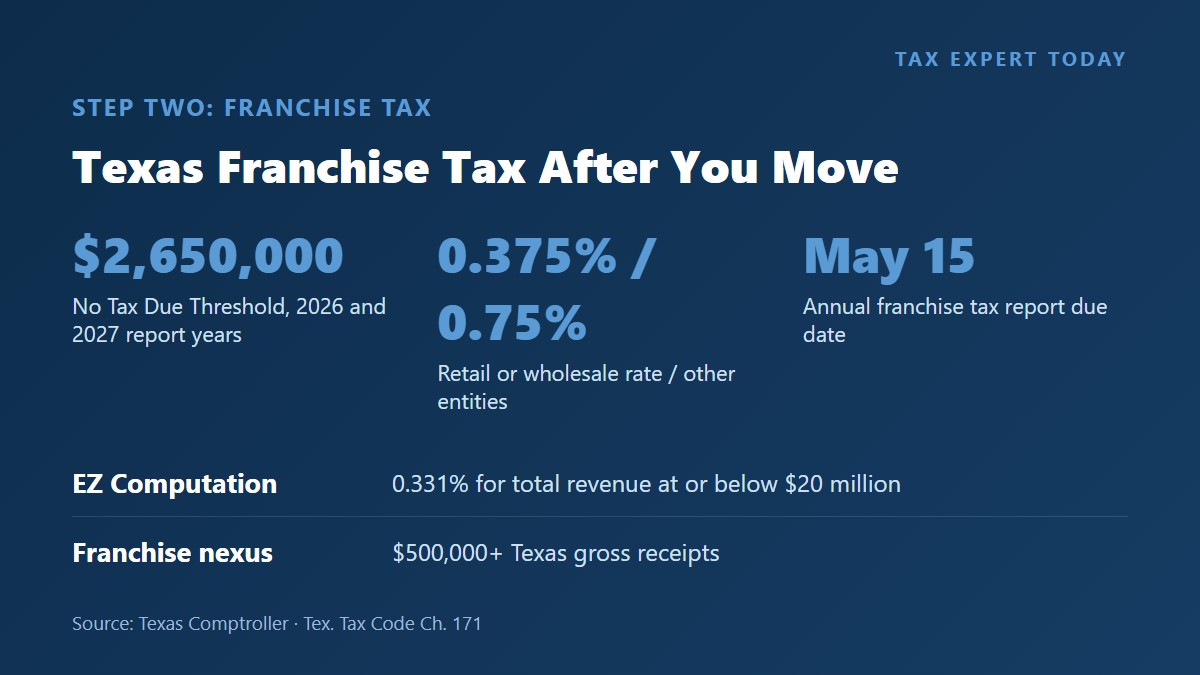
Texas franchise tax applies to most taxable entities that are organized in Texas or that do business in Texas, and the obligation begins when the entity becomes subject to Texas jurisdiction. The tax is a margin tax rather than an income tax. For the 2026 and 2027 report years, an entity with annualized total revenue at or below the No Tax Due Threshold of $2,650,000 owes no franchise tax, although an information report may still be required.
Above that threshold, the tax is computed on taxable margin at 0.375 percent for entities primarily engaged in retail or wholesale trade and 0.75 percent for other entities, per the Comptroller. Smaller entities with total revenue at or below $20 million may elect the EZ Computation, which applies a 0.331 percent rate to total revenue with a simplified calculation. The compensation deduction is capped at $480,000 per person for the 2026 report year. The annual franchise tax report is generally due May 15.
A practical timing point matters for relocations. A foreign taxable entity with gross receipts of $500,000 or more from business in Texas has franchise tax nexus, so revenue can create a Texas filing obligation even before a formal move is complete. The Comptroller also discontinued the standalone No Tax Due Report for reports originally due on or after January 1, 2024; entities below the threshold now file the Public Information Report (Form 05-102) or the Ownership Information Report (Form 05-167) as applicable. Register for franchise tax through the Comptroller and file the first report on the schedule the Comptroller assigns. For the mechanics of the margin calculation, see our guide to the Texas franchise tax and to Texas LLC taxes.
Do You Need a Texas Sales Tax Permit?
You need a Texas sales tax permit if your business sells, leases, or rents taxable goods, or sells taxable services, in Texas. Texas imposes a 6.25 percent state sales and use tax, and local jurisdictions may add up to 2 percent, for a maximum combined rate of 8.25 percent. You must hold the permit before you begin making taxable sales.
Relocating businesses face this on two sides. In Texas, you register for a sales tax permit through the Comptroller, collect at the correct combined rate for each delivery location, and file returns on the assigned schedule. If you sell into Texas from outside the state before your operations fully relocate, the remote-seller rules can already apply: the Comptroller provides a safe harbor for remote sellers with total Texas revenue of less than $500,000 in the preceding twelve calendar months, and sellers above that amount must register and collect, per the remote-seller guidance. On the departure side, do not simply stop filing your old-state sales tax returns. Close the account formally and file a final return, because an abandoned registration can generate assessments and penalties.
How Does Payroll Change When You Move to Texas?
Texas has no state personal income tax, so there is no state income tax withholding on Texas wages. Payroll does not disappear, though. Employers in Texas pay state unemployment tax through the Texas Workforce Commission, must report new hires, and continue to handle all federal payroll obligations, including federal income tax withholding, Social Security, Medicare, and federal unemployment tax.
The registration timing is the part that carries a hard deadline. An employer already liable under the Federal Unemployment Tax Act becomes a liable Texas employer the moment it pays Texas wages, and registration is due within ten days, which our guide to Texas payroll taxes works through alongside the 2026 rate range and the federal credit that depends on paying the state tax on time.
The cleanup in the old state is the part relocating owners overlook. If employees remain on payroll in the former state, or if you keep any presence there, you may still have withholding and state unemployment obligations tied to that state. When employees actually move to Texas, close the old-state withholding and unemployment accounts, file the final state payroll returns, and open the Texas Workforce Commission account for the Texas workforce. Remote employees who stay in the old state can keep you registered there, so map where each worker physically performs services before you assume the payroll footprint has moved.
What Does the Departure State Still Tax After You Leave?
The departure state generally continues to tax income and sales that trace to activity conducted there, a concept often called trailing nexus. Moving your headquarters to Texas does not erase the prior year, the transition-year apportionment, or obligations that survive until you formally withdraw. Final and short-year returns, account closures, and apportionment during the year of the move are where most post-move assessments originate.
In a corporate or pass-through income tax state, the year you move is usually a split year that apportions income between the old state and Texas based on where the activity occurred, and the old state keeps the right to tax income sourced there even after the entity relocates. Sales tax registrations, withholding accounts, and annual report or franchise obligations in the old state remain open until you file the paperwork to withdraw or dissolve. Owners planning a sale of the business around the same time as a move face an added layer, because the departure state may still tax gain sourced to in-state activity. Our guides to moving before selling a business and to the California exit-tax questions walk through the departure-state side in more depth, and establishing Texas residency covers the owner-level domicile change that often accompanies a business move.
Moving Business to Texas: A Tax Checklist
Use the checklist below as a working map. Sequence and detail depend on your entity type, your industry, and your former state, so treat it as a framework rather than a substitute for advice on your specific facts.
| Phase | Action | Authority or agency |
|---|---|---|
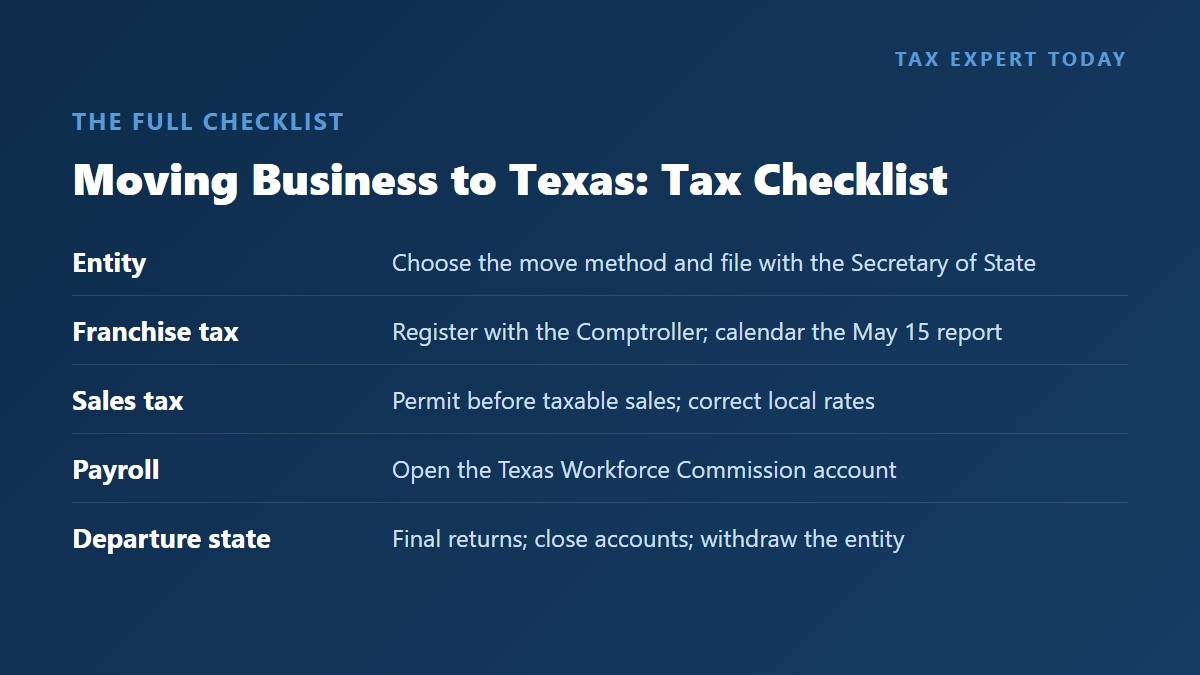
| Entity | Choose the move method and file the conversion, registration, or formation | Texas Secretary of State |
| Federal | Confirm EIN continuity and classification for the chosen structure | IRS; IRC §482 |
| Franchise tax | Register with the Comptroller and calendar the first report (May 15) | Tex. Tax Code Ch. 171 |
| Sales tax | Obtain a Texas sales tax permit before taxable sales; set correct local rates | Texas Comptroller |
| Payroll | Open the Texas Workforce Commission account; report new hires | Texas Workforce Commission |
| Departure state | File final returns; close sales, withholding, and franchise accounts; withdraw the entity | Former state tax and filing agencies |
| Transition year | Apportion income between the states; document the move date and activity shift | Multi-state apportionment rules |
Frequently Asked Questions
Does moving my business to Texas change my federal EIN?
Usually not, when you use a statutory conversion that keeps the same entity and its federal classification. IRS guidance generally treats the converted entity as the same entity, so it continues with the same Employer Identification Number. A path that dissolves the old entity and forms a new one can require a new EIN. Confirm the treatment for your specific structure before filing, because the choice is difficult to unwind later.
Is a foreign registration the same as moving my business to Texas?
No. A foreign registration authorizes your existing out-of-state entity to do business in Texas while it remains organized in its home state, so you continue filing in both states. A true relocation uses a statutory conversion or a merger to make the entity a Texas entity. Foreign registration suits a temporary presence or an expansion; a conversion suits owners who intend to leave the old state behind.
How soon do I have to register for Texas franchise tax?
Register when the entity becomes subject to Texas franchise tax, which for a relocating business is generally when it organizes in Texas or begins doing business here. A foreign entity with $500,000 or more of gross receipts from business in Texas has franchise tax nexus. The first annual report is generally due the following May 15, and entities at or below the No Tax Due Threshold still may owe an information report.
Does Texas have a business income tax?
Texas imposes no corporate income tax and no personal income tax. Instead, most taxable entities are subject to the franchise (margin) tax, which is calculated on taxable margin rather than net income. Many small businesses fall at or below the No Tax Due Threshold of $2,650,000 for the 2026 and 2027 report years and owe no franchise tax, though an information report can still be required.
Where can I get help moving my business to Texas from Naples, FL?
Tax Expert Today LLC, at 11983 Tamiami Trail N, Naples, FL 34110, advises business owners on relocation and multi-state tax matters and serves clients in all 50 states, including those moving to or from Texas. The firm helps map the entity move, the Texas registrations, and the departure-state cleanup as one coordinated plan. Call (239) 441-2005, Monday through Friday, 10am to 5pm ET.
Business Relocation Help in Naples & Southwest Florida
Tax Expert Today LLC advises founders and business owners on moving a company across state lines, whether the destination is Texas, Florida, or another state. Owners leaving California should also review how the California LLC franchise tax continues to run until the California registration is cancelled. Our team of tax advisors, enrolled agents, CPAs, and attorneys coordinates the entity conversion, the Texas franchise and sales tax registrations, the payroll transition, and the departure-state wind-down so the pieces do not fall out of sequence. Because these are state tax matters that reach across state lines, we work with clients nationwide from our Naples office at 11983 Tamiami Trail N, Naples, FL 34110. Call (239) 441-2005, Monday through Friday, 10am to 5pm ET, or visit our Texas tax services page.
When to Engage a Professional
Consider professional guidance when the move involves a statutory conversion, employees or contractors in more than one state, meaningful inventory or sales tax exposure, or a planned sale of the business near the time of the move. The interaction between the entity choice, franchise tax nexus, sales tax registration, and departure-state apportionment is where relocating owners most often incur unexpected liability, and the sequence of filings can affect the result. Outcomes depend on your entity type, your industry, and your former state, and this article is educational rather than advice on your specific facts. A brief planning conversation before you file can help you choose the path that fits your situation and avoid reopening a structure after the fact.
Published July 22, 2026 by Dr. Pellumb Kabashi « Back to Learning Center
Have a question this article touches on?
Tax Expert Today LLC, based in Naples, Florida and serving clients across the United States.
Schedule a Consultation (239) 441-2005