
By Dr. Pellumb Kabashi, DBA, MBA, CES, CFE, EA
Founder, Tax Expert Today LLC · Tax advisors, enrolled agents, CPAs, and attorneys · Serving clients in all 50 states
Quick Answer: Texas no state income tax is real and constitutionally protected, but the protection runs to individuals rather than to entities, and it does not reach backward. A former state can still tax wages, equity compensation, and business income sourced to it before and after the move, and Texas business owners still face the franchise tax. Call (239) 441-2005 for a free consultation.
What Does Texas No State Income Tax Actually Cover?
The Texas Constitution bans a tax on the net incomes of individuals, including an individual’s share of partnership and unincorporated association income. Three companion provisions ban capital gains, wealth, and death taxes. Read together they protect the individual taxpayer. None of them prevents the state from taxing a business entity, which is why the franchise tax exists.
Most published summaries treat the ban as a single rule. It is actually four separate amendments to the Texas Constitution adopted over six years, and the wording of each one controls what survives. Section 24-a, added November 5, 2019, addresses the net incomes of individuals and an individual’s distributive share of partnership and unincorporated association income. It says nothing about a tax measured on an entity’s revenue.
- Section 24-a reaches individual net income and pass-through shares allocated to an individual
- Section 24-b reaches realized and unrealized capital gains of an individual, family, estate, or trust
- Section 25 reaches any tax based on wealth or net worth, including asset minus liability formulations
- Section 26 reaches state death, estate, inheritance, and transfer taxes, measured against a January 1, 2025 baseline
- None of the four touches ad valorem property tax, sales tax, use tax, or an entity level margin tax
| Constitutional provision | What it prohibits | Adopted |
|---|---|---|
| Art. VIII, Sec. 24-a | Tax on the net incomes of individuals, including a share of partnership and unincorporated association income | November 5, 2019 |
| Art. VIII, Sec. 24-b | Tax on realized or unrealized capital gains of an individual, family, estate, or trust | November 4, 2025 |
| Art. VIII, Sec. 25 | Tax based on the wealth or net worth of an individual or family | November 7, 2023 |
| Art. VIII, Sec. 26 | State death tax and tax on the transfer of an estate, inheritance, legacy, succession, or gift | November 4, 2025 |

Section 24-b is explicit that it may not be construed to modify or prohibit an ad valorem tax on property, a sales tax on goods or services, or a use tax. The drafters were preserving the revenue base that replaces income tax, and they said so in the text. That drafting choice tells you exactly where the burden was moved rather than removed. The capital gains provision and its interaction with a business sale are covered in our guide to Texas capital gains tax.
The same article of the Texas Constitution was extended in November 2025 to transfers at death, when voters added Section 26. Our guide to the Texas inheritance tax covers what that ban reaches and what the federal estate tax still reaches.
What Does Texas Tax Instead?
Texas no state income tax means the revenue comes from consumption and entity level taxes instead. The state sales and use tax is 6.25 percent, local jurisdictions may add up to 2 percent for a maximum combined rate of 8.25 percent, and businesses face a franchise tax computed on taxable margin once revenue clears the annual threshold.
For a household, the practical question is whether the replacement taxes cost more or less than the income tax that was avoided. The answer turns on income level, consumption pattern, and property value. High earners who consume a modest share of income generally come out well ahead, while households with high consumption relative to income and a large home come out closer to even.
| Tax type | Rate or threshold for 2026 | Who it reaches |
|---|---|---|
| Individual income tax | None, prohibited by Art. VIII, Sec. 24-a | No one |
| State sales and use tax | 6.25 percent, plus up to 2 percent local, maximum 8.25 percent combined | Purchasers of most goods and taxable services |
| Franchise tax, no tax due threshold | $2,650,000 of total revenue for the 2026 and 2027 report years | Most taxable entities, including LLCs and partnerships |
| Franchise tax rates | 0.375 percent retail or wholesale, 0.75 percent other, 0.331 percent EZ computation at or below $20 million | Entities above the threshold |
| Ad valorem property tax | Set locally by appraisal district and taxing units | Property owners |
The compensation deduction limit is $480,000 per person for the 2026 and 2027 report years, and the annual report is due May 15. The margin computation, the deduction elections, and the reports that replaced the discontinued No Tax Due Report are covered in our guide to the Texas franchise tax.
Does Moving to Texas Stop Your Former State From Taxing You?
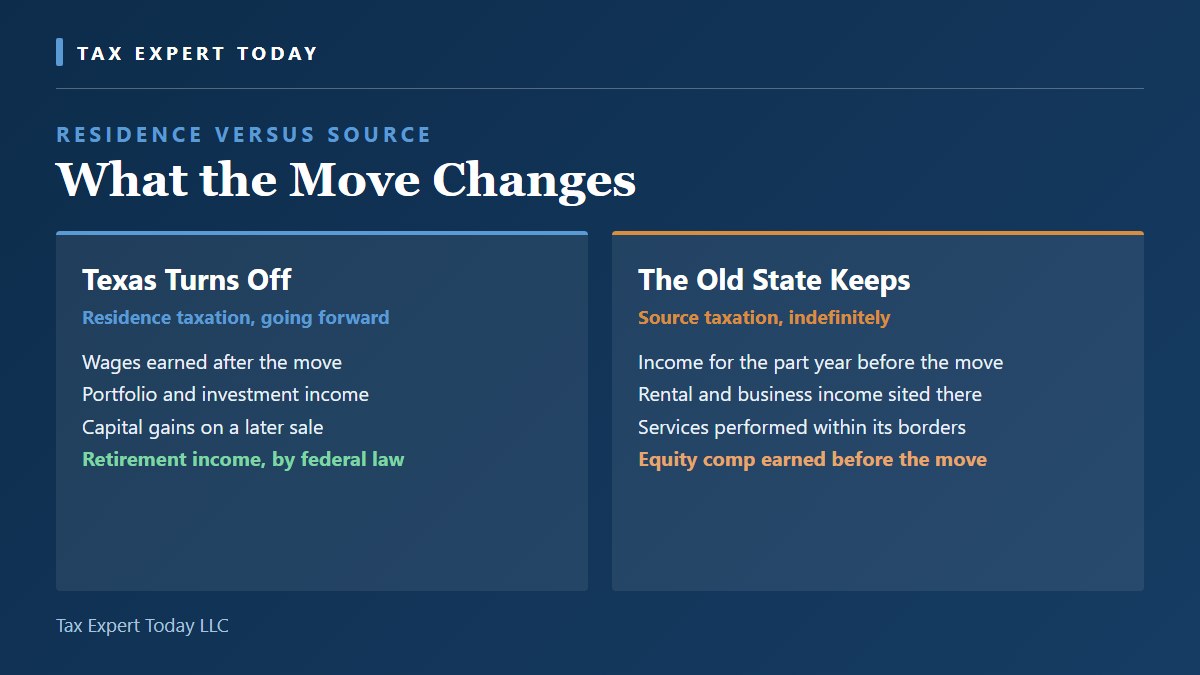
Not by itself, and not retroactively. A former state generally continues to tax income sourced within its borders regardless of where the taxpayer now lives, and it continues to tax worldwide income for any part of the year the taxpayer was still domiciled there. The move changes residency going forward. It does not erase source.
Two distinct rules operate at once. Residence taxation reaches everything a resident earns anywhere. Source taxation reaches income connected to the state no matter who earns it. Establishing Texas domicile turns off the first rule prospectively. It does nothing to the second.
- Part year exposure: the departure state taxes worldwide income for the portion of the year before domicile actually changed
- Continuing source income: rental property, business operations, and services performed in the former state remain taxable there
- Audit risk: high tax departure states routinely challenge the date and the fact of domicile change
- Documentation: the burden of proving a completed domicile change generally sits with the taxpayer
- Trailing filings: a nonresident return in the former state is often required for years after the move
The evidentiary standard for a completed change, and the specific records that support it, are set out in our guide to establishing Texas residency. Taxpayers leaving a state with an aggressive residency audit program should also review how those examinations work, which is covered in our discussion of the California exit tax and of leaving California taxes.
How Is Equity Compensation Taxed After a Move to Texas?
Equity compensation is generally sourced to the state where the services were performed, not to the state of residence when the award is taxed. Most states allocate the income using a workday fraction measured from grant to vest, so a Texas resident can owe tax to a former state on restricted stock units that vest years after the move.
An executive who spent the full vesting period working in a high tax state and who relocates one month before vesting has usually shifted almost none of the tax on that award. The allocation fraction is built from the service period, and the service period already happened. The timing of the move relative to grant and vest dates is the variable that actually changes the number, which is why the planning has to happen first.
- Restricted stock units are commonly allocated by workdays in the state between grant and vest
- Nonqualified stock options are commonly allocated between grant and exercise, or grant and vest, depending on the state
- Incentive stock options raise a separate alternative minimum tax question at exercise that Texas residency does not affect
- Bonus and commission paid after the move may still be allocated to the period in which it was earned
- Remote work can create source exposure even without physical presence in states applying a convenience rule
The last item matters for anyone who moved to Texas but still works for an employer headquartered elsewhere. A small group of states tax nonresident employees of in state employers on days worked outside the state, which can survive a relocation entirely. That regime is explained in our guide to the convenience of the employer rule.
Can a Former State Tax Your Retirement or Deferred Compensation?
Federal law blocks most of it. 4 U.S.C. Section 114 prohibits any state from imposing an income tax on the retirement income of an individual who is not a resident or domiciliary of that state. The protection covers qualified plans, individual retirement accounts, and certain nonqualified deferred compensation paid in substantially equal periodic payments.
This statute is the most valuable and least discussed feature of a move to a state with no income tax, and it repays close reading because the protection for nonqualified deferred compensation is conditional. Qualified plan distributions, simplified employee pensions, annuity plans under Sections 403(a) and 403(b), individual retirement plans, Section 457 plans, and governmental plans are covered directly.
Nonqualified deferred compensation described in Section 3121(v)(2)(C) is covered only if the payments meet one of two conditions. Either the income is part of a series of substantially equal periodic payments made at least annually over the life or life expectancy of the recipient, or over a period of not less than ten years, or the payment is made after termination of employment under a plan maintained solely to provide benefits in excess of the statutory limits on qualified plans.
| Payment type | Protected from former state tax | Governing condition |
|---|---|---|
| Qualified plan and IRA distributions | Yes | 4 U.S.C. Sec. 114(b)(1)(A) through (H) |
| Nonqualified deferred compensation paid over ten years or more | Yes | Substantially equal periodic payments test |
| Nonqualified deferred compensation paid as a lump sum | Generally no | Fails the periodic payment test |
| Excess benefit plan payments after termination | Yes | Plan maintained solely to exceed qualified plan limits |
| Equity compensation for prior services | No | Not retirement income, sourced to the service state |
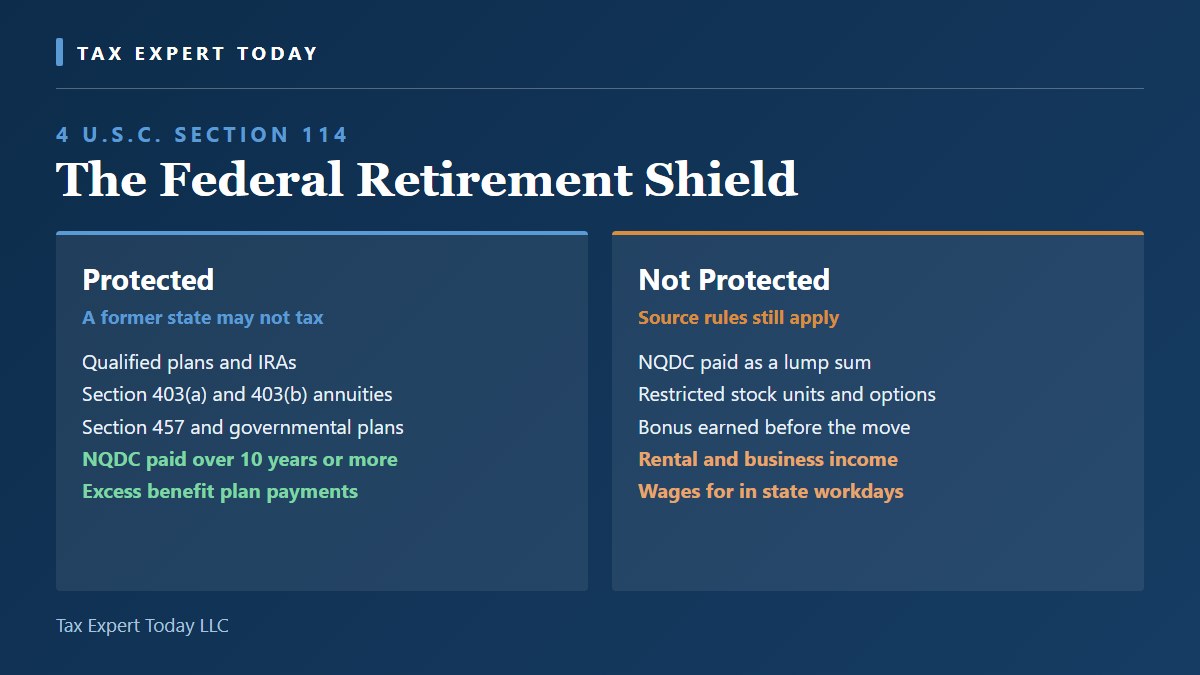
The planning consequence is direct. A taxpayer approaching a move to Texas who holds a material nonqualified deferred compensation balance may find that electing a payout period of at least ten years converts a stream the former state could tax into a stream it may not tax. That election is generally governed by plan terms and by the timing rules in IRC Section 409A, so it is rarely something that can be changed after the fact.
What Happens to Your SALT Deduction in Texas?
A Texas resident has no state income tax to deduct, so the federal state and local tax deduction is limited to property taxes and, by election, general sales taxes. IRC Section 164(b)(5) permits a taxpayer to elect state and local general sales taxes in lieu of state and local income taxes, which is the substitute that matters in a no income tax state.
The limitation amount changed substantially and is scheduled to change again. For taxable years beginning in 2026 the applicable limitation amount is $40,400. It is reduced by 30 percent of the excess of modified adjusted gross income over $505,000, and the reduction may not push the amount below $10,000. For taxable years beginning after calendar year 2029 the limitation reverts to $10,000.
| Item | 2025 | 2026 | After 2029 |
|---|---|---|---|
| Applicable limitation amount | $40,000 | $40,400 | $10,000 |
| Phasedown threshold, modified AGI | $500,000 | $505,000 | Not applicable |
| Phasedown rate | 30 percent of the excess | 30 percent of the excess | Not applicable |
| Floor after phasedown | $10,000 | $10,000 | Not applicable |
For a Texas household the interaction is worth modeling rather than assuming. Whether itemizing beats the standard deduction depends on the total, and the 2026 standard deduction is $32,200 for married individuals filing jointly, $24,150 for heads of households, and $16,100 for unmarried individuals and married individuals filing separately.
Do Business Owners Escape Income Tax in Texas?
Only at the individual level. Because Article VIII, Section 24-a protects individuals rather than entities, Texas may and does impose a franchise tax measured on an entity’s taxable margin. An entity above the no tax due threshold owes franchise tax on margin even in a year when the owner reports a loss for federal purposes.
This is the point where the popular framing breaks down for the very people who move to Texas because of it. The franchise tax is not an income tax and does not behave like one. It is computed on total revenue reduced by the largest of several elective deductions, so a low margin business with high revenue can owe more than a high margin business with modest revenue.
- Entity types reached: corporations, LLCs, partnerships other than certain general partnerships, and most other taxable entities
- Loss year exposure: the tax is on margin, so a federal loss does not eliminate a franchise tax liability
- Revenue threshold: $2,650,000 of total revenue for the 2026 and 2027 report years, below which no tax is due
- Filing obligation: an entity below the threshold still files a Public Information Report or an Ownership Information Report
- Deadline: May 15 annually, with an extension available on request
Owners evaluating entity structure should read our guide to Texas LLC taxes, which covers how federal pass-through treatment and the state franchise tax interact. Owners relocating an operating business rather than only a residence should start with the tax checklist for moving a business to Texas, and taxpayers weighing Texas against the other large no income tax state will find the entity level comparison in our analysis of Texas versus Florida taxes.
What Changes Federally When No State Withholds Tax?
The federal safe harbor becomes the only guardrail. Without state withholding to absorb error, an underestimated federal liability produces a penalty with nothing to offset it. IRC Section 6654 sets the required annual payment at the lesser of 90 percent of the current year tax or 100 percent of the prior year tax, raised to 110 percent when prior year adjusted gross income exceeded $150,000.
Two groups get caught by this. The first is the newly relocated employee whose take home pay rose noticeably and who did not revisit federal withholding. The second is the owner or investor whose income is not subject to withholding at all, where the estimated payment schedule is the entire compliance mechanism. The $150,000 threshold becomes $75,000 for a married individual filing a separate return.
- Recalibrate Form W-4 in the year of the move, since the state line on the pay stub disappears
- Use the prior year safe harbor when current year income is difficult to forecast
- Apply the 110 percent figure whenever prior year adjusted gross income exceeded $150,000
- Watch the arrival year, which often carries both a part year state liability and a changed federal picture
- Track quarterly deadlines, because a single missed installment generates its own interest charge
Taxpayers whose income shifted from wages to self employment should also review how that liability is computed, using our self-employment tax calculator. For 2026 the top federal bracket of 37 percent begins above $768,700 of taxable income for married individuals filing jointly, so the federal exposure that remains after a move is often the larger number by a wide margin.
Texas No State Income Tax Planning Help in Naples & Southwest Florida
Texas tax planning Naples: Tax Expert Today LLC advises relocating executives, business owners, and retirees from its office in Naples, Florida, and serves clients in all 50 states. Texas no state income tax questions rarely sit in one jurisdiction, because the departure state, the arrival state, and the federal return each apply a different rule to the same dollar of income.
Texas clients are served nationwide from the Naples office. Engagements typically cover the timing of a domicile change against vesting and payout dates, the part year and nonresident filings the departure state still requires, the deferred compensation election that determines whether federal law protects the stream, the franchise tax position of any entity that moves with the owner, and the estimated payment schedule for the first full year without state withholding. Where the move forms part of a broader plan, the work connects to our Texas tax services and Naples tax planning.
Tax Expert Today LLC
11983 Tamiami Trail N, Naples, FL 34110
Phone: (239) 441-2005
Hours: Monday through Friday, 10:00 a.m. to 5:00 p.m. ET
When Should You Engage a Professional?
The savings from a Texas move are real, but they are prospective, they apply to the individual rather than the entity, and the largest planning levers close before the move rather than after it. Professional review is worth considering in several situations.
- Any year in which domicile changes, since the departure state and Texas both have a claim on part of it
- A material balance of restricted stock units or options granted while working in another state
- A nonqualified deferred compensation balance where the payout election is still open
- Ownership of an operating entity that may cross the franchise tax threshold
- Continuing rental property, partnership interests, or business activity in the former state
- A first full year without state withholding, where the federal estimated payment schedule stands alone
Outcomes in tax matters depend on the specific facts, the documentation available, and applicable law, so nothing here is a prediction about a particular return. Taxpayers comparing a Texas move against a Florida move will find the residency mechanics side by side in our guide to establishing Florida residency. To discuss a relocation plan, call (239) 441-2005.
Frequently Asked Questions
Does Texas have any individual income tax at all?
No. Article VIII, Section 24-a of the Texas Constitution, added November 5, 2019, prohibits the legislature from imposing a tax on the net incomes of individuals, including an individual’s share of partnership and unincorporated association income. Three companion provisions separately prohibit capital gains, wealth, and death taxes.
Can my old state still tax me after I move to Texas?
Yes, in two situations. It taxes worldwide income for the part of the year you were still domiciled there, and it continues to tax income sourced within its borders after the move, including rental income, business income, and compensation for services performed there.
Will my restricted stock units be tax free once I live in Texas?
Usually not in full. Most states source equity compensation to where the services were performed, allocated by a workday fraction from grant to vest. Units earned largely while working in another state generally remain taxable there even though you vest as a Texas resident.
Can a former state tax my pension or 401(k) once I live in Texas?
Generally no. 4 U.S.C. Section 114 prohibits a state from taxing the retirement income of a nonresident. The protection covers qualified plans and individual retirement accounts, and it covers nonqualified deferred compensation only when paid in substantially equal periodic payments over at least ten years or as an excess benefit plan payment after termination.
If Texas has no income tax, why does my LLC owe franchise tax?
Because the constitutional ban protects individuals rather than entities. The franchise tax is imposed on a taxable entity’s margin, so it can apply even in a year the owner reports a federal loss. No tax is due below $2,650,000 of total revenue for the 2026 and 2027 report years, though a report is still filed.
Do you work with Texas clients from your Naples office?
Yes. Tax Expert Today LLC is based at 11983 Tamiami Trail N in Naples, Florida, and serves clients in all 50 states. Texas relocation and business tax engagements are handled remotely, with the same review process used for local Southwest Florida clients. The office number is (239) 441-2005. The federal tax that no state income tax does NOT remove is covered in our guide to self employment tax for Texas owners.
Published August 9, 2026 by Dr. Pellumb Kabashi « Back to Learning Center
Have a question this article touches on?
Tax Expert Today LLC, based in Naples, Florida and serving clients across the United States.
Schedule a Consultation (239) 441-2005