
By Dr. Pellumb Kabashi, DBA, MBA, CES, CFE, EA
Founder, Tax Expert Today LLC · Tax advisors, enrolled agents, CPAs, and attorneys · Serving clients in all 50 states
Quick Answer
There is no Texas inheritance tax in 2026, and no Texas estate tax. The Legislature repealed the state inheritance tax effective September 1, 2015, and voters wrote a permanent ban into the Texas Constitution on November 4, 2025. What still reaches a Texas family is the federal estate tax above the 2026 exclusion, income tax on inherited retirement accounts, and another state’s claim on property or a decedent located there. Call (239) 441-2005 for a free consultation.
Does Texas Have an Inheritance Tax in 2026?
No. Texas imposes neither an inheritance tax nor an estate tax in 2026. The Legislature repealed the inheritance tax through S.B. 752, signed June 19, 2015 and effective September 1, 2015. Since November 4, 2025, Article VIII, Section 26 of the Texas Constitution bars the Legislature from enacting one again.
The distinction between the two taxes matters, because the ranking pages on this subject often blur them. An estate tax is imposed on the estate before anything is distributed, and it is measured by the total value of what the decedent owned. An inheritance tax is imposed on the recipient, and it is measured by what each beneficiary receives and how closely that beneficiary was related to the decedent. Texas now imposes neither.
- No tax on the heir. A Texas beneficiary owes no state tax on cash, securities, real property, or personal property received from an estate.
- No tax on the estate. Texas collects nothing from the estate itself before distribution.
- No state filing. There is no Texas inheritance tax return, and no state clearance is required before an executor distributes assets.
- Federal rules are unaffected. The repeal and the constitutional ban reach state taxation only, and they do nothing to the federal estate tax or to federal income tax.
What Did the 2025 Constitutional Amendment Actually Change?
It converted a statutory repeal into a constitutional prohibition. Before November 2025 the absence of a Texas inheritance tax rested on an ordinary statute, which a future Legislature could reverse by passing another statute. Section 26 now requires a constitutional amendment, meaning two thirds of both chambers plus a statewide vote, to bring a death tax back.
The text is broader than most summaries suggest. Section 26(a) bars the Legislature from imposing a state tax on the property of a deceased individual’s estate because of the death, including an estate, inheritance, or death tax. It separately bars a tax on the transfer of an estate, inheritance, legacy, succession, or gift from an individual, family, estate, or trust to another, including a tax on a generation-skipping transfer, if that tax was not in effect on January 1, 2025. It also bars increasing the rate or expanding the applicability of any such tax that did exist on that date.
Two carve-outs in Section 26(b) are worth knowing, because they are the parts that survive. The section does not disturb an ad valorem tax on property, and it does not disturb a tax applicable to the transfer of a motor vehicle by gift, which Texas continues to impose under Chapter 152 of the Tax Code. A family transferring a vehicle out of an estate should not assume the constitutional ban makes that transfer free of state tax.
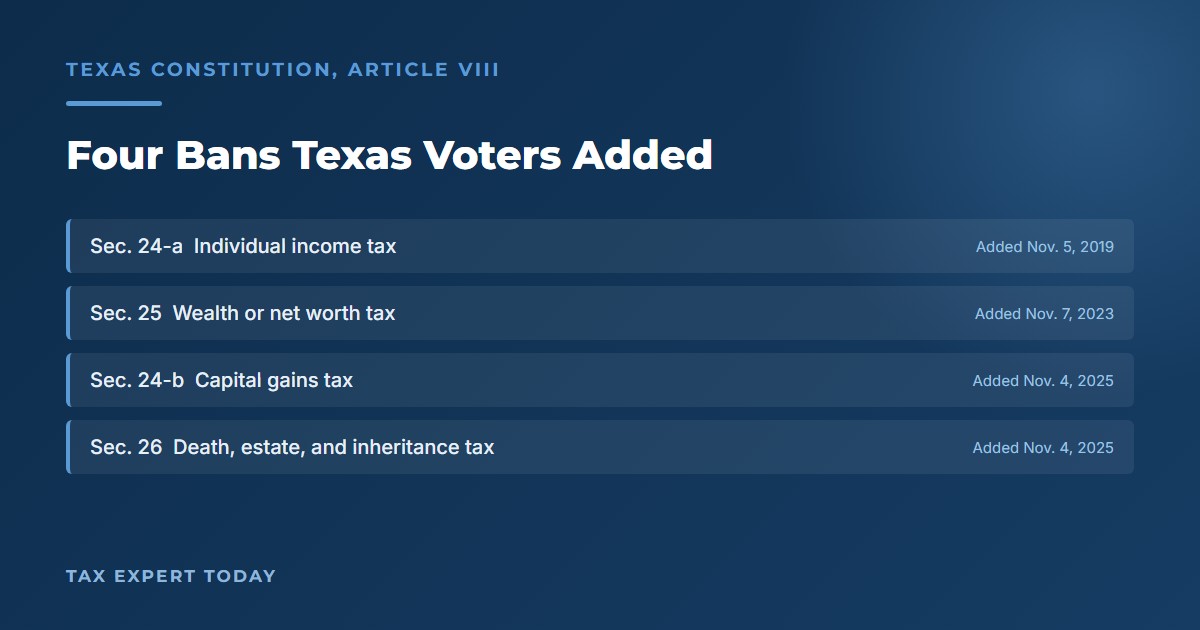
Section 26 is the fourth prohibition of its kind that Texas voters have added to Article VIII, and reading them together explains why the state can still collect a franchise tax from a business while collecting nothing from an individual.
| Constitutional section | What it prohibits | Added |
|---|---|---|
| Art. VIII, Sec. 24-a | A tax on the net incomes of individuals, including an individual’s share of partnership and unincorporated association income | November 5, 2019 |
| Art. VIII, Sec. 25 | A tax based on the wealth or net worth of an individual or family | November 7, 2023 |
| Art. VIII, Sec. 24-b | A tax on the realized or unrealized capital gains of an individual, family, estate, or trust | November 4, 2025 |
| Art. VIII, Sec. 26 | A death, estate, or inheritance tax, and a tax on the transfer of an estate, legacy, succession, or gift not in effect on January 1, 2025 | November 4, 2025 |
Each of these bans protects the individual, the family, the estate, or the trust. None of them limits a tax measured on an entity’s revenue, which is why the Texas franchise tax continues to apply to businesses, and why the absence of a state income tax does not mean an owner has no Texas filing obligation.
Can a Texas Heir Still Owe Another State’s Inheritance Tax?
Yes. This is the exposure that catches Texas families most often. A state inheritance tax generally follows the domicile of the decedent and the location of real property, not the residence of the heir. A Texas beneficiary who inherits from a relative domiciled in a state that still taxes inheritances may owe that state’s tax even though Texas taxes nothing.
Five states still impose an inheritance tax on beneficiaries. Every one of them exempts a surviving spouse, and most exempt children and other close relatives, so the tax usually falls on siblings, nieces and nephews, cousins, friends, and unrelated beneficiaries. A Texas resident who is named in an aunt’s Pennsylvania will, for example, is a collateral heir rather than a lineal one, and Pennsylvania taxes that transfer.
- The decedent’s domicile controls. Where the heir lives is generally irrelevant to whether an inheritance tax applies.
- Real property is taxed where it sits. Texas domicile does not shield a ranch, a rental, or a vacation home located in a state that imposes an estate or inheritance tax.
- Relationship drives the rate. The further the beneficiary is from the decedent on the family tree, the higher the rate tends to be.
- The estate tax question is separate. Roughly a dozen states impose their own estate tax with exclusions far below the federal amount, so a moderate estate can owe state tax in those jurisdictions while owing nothing federally.
| State | Who is exempt | Rates on taxable beneficiaries |
|---|---|---|
| Pennsylvania | Surviving spouse, and a parent inheriting from a child aged 21 or younger | 4.5 percent lineal descendants, 12 percent siblings, 15 percent other heirs |
| New Jersey | Class A, which includes a spouse, parent, child, and grandchild | Class C 11 to 16 percent after a $25,000 exemption, Class D 15 to 16 percent |
| Kentucky | Class A, which includes a spouse, parent, child, grandchild, and sibling | Class B 4 to 16 percent after a $1,000 exemption, Class C 6 to 16 percent after $500 |
| Maryland | Spouse, parent, grandparent, child, and other lineal descendants | 10 percent of clear value on everyone else, plus a separate Maryland estate tax |
| Nebraska | Surviving spouse | Administered and collected at the county level, so confirm the current rate and exemption with the county |
| Iowa | All beneficiaries, following the phase-out | Repealed. The tax does not apply to deaths occurring on or after January 1, 2025 |
The Iowa row is worth noting on its own, because a great deal of published material still lists Iowa among the inheritance tax states. The Iowa Department of Revenue now states plainly that the tax is not applicable for deaths occurring on or after January 1, 2025.
What Federal Estate Tax Applies to a Texas Estate in 2026?
The federal estate tax applies to every state, including Texas, but only above a high exclusion. For 2026 the basic exclusion amount is $15,000,000 per person, raised by Section 70106 of the One Big Beautiful Bill Act, which amended IRC Section 2010(c)(3). The rate above the exclusion reaches 40 percent under IRC Section 2001(c).
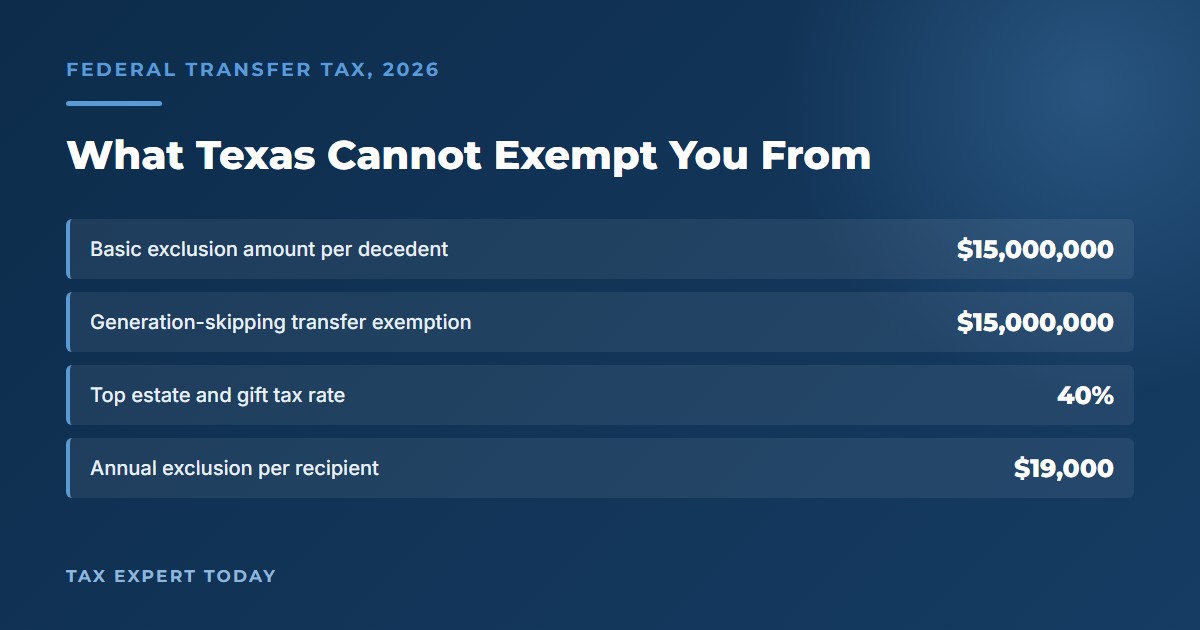
The figures below come from Revenue Procedure 2025-32, released for tax year 2026. Several pages currently ranking for this topic still publish the $13,610,000 amount from 2024 or the $13,990,000 amount from 2025, so confirm the year before relying on any figure you find.
| 2026 federal transfer tax item | Amount | Authority |
|---|---|---|
| Basic exclusion amount per decedent | $15,000,000 | Section 2010(c)(3), as amended by OBBBA Section 70106 |
| Generation-skipping transfer exemption | $15,000,000 | Section 2631(c) |
| Top estate and gift tax rate | 40 percent | Section 2001(c) |
| Annual exclusion per recipient | $19,000 | Section 2503(b) |
| Annual exclusion, spouse who is not a United States citizen | $194,000 | Section 2523(i)(2) |
| Special use valuation, maximum decrease in value | $1,460,000 | Section 2032A |
Two practical points follow from the size of that exclusion. Most Texas estates owe no federal estate tax at all, so the planning question is rarely about the tax and almost always about basis and about income tax on what the heirs receive. And for the estates that do approach the threshold, the return is due nine months after death under IRC Section 6075, with an available extension, which is a short window when a family is also settling an estate.
How Does Texas Community Property Change the Basis Step-Up?
Texas is a community property state, and that produces a result available in only a minority of states. Under IRC Section 1014(b)(6), when the first spouse dies, both halves of the community property receive a new basis equal to fair market value, not just the half belonging to the decedent.
Consider what that means in ordinary terms. A couple in a separate property state who bought a rental decades ago will see only the decedent’s half receive a new basis, leaving the survivor with the original basis on the other half and a large embedded gain. A Texas couple holding the same asset as community property sees the entire asset receive a new basis. If the survivor sells shortly after, the taxable gain can be close to nothing.
- Character has to be established. The double step-up applies to community property, so records that show whether an asset is community or separate property are worth keeping.
- Property acquired before the move matters. Assets a couple brought into Texas from a separate property state do not automatically become community property, and the treatment depends on how they were acquired and titled.
- Titling can defeat the result. Holding an asset in a form that converts it out of community property may cost the survivor the step-up on their own half.
- This interacts with residency. Couples who establish Texas residency late in life should review how their existing assets are characterized rather than assuming the move alone accomplishes it.
The step-up is the reason inherited assets are so often sold with little or no gain, and it is also the reason capital gains planning in Texas looks different from planning in a state that taxes gains.
Which Inherited Assets Are Still Taxed as Income?
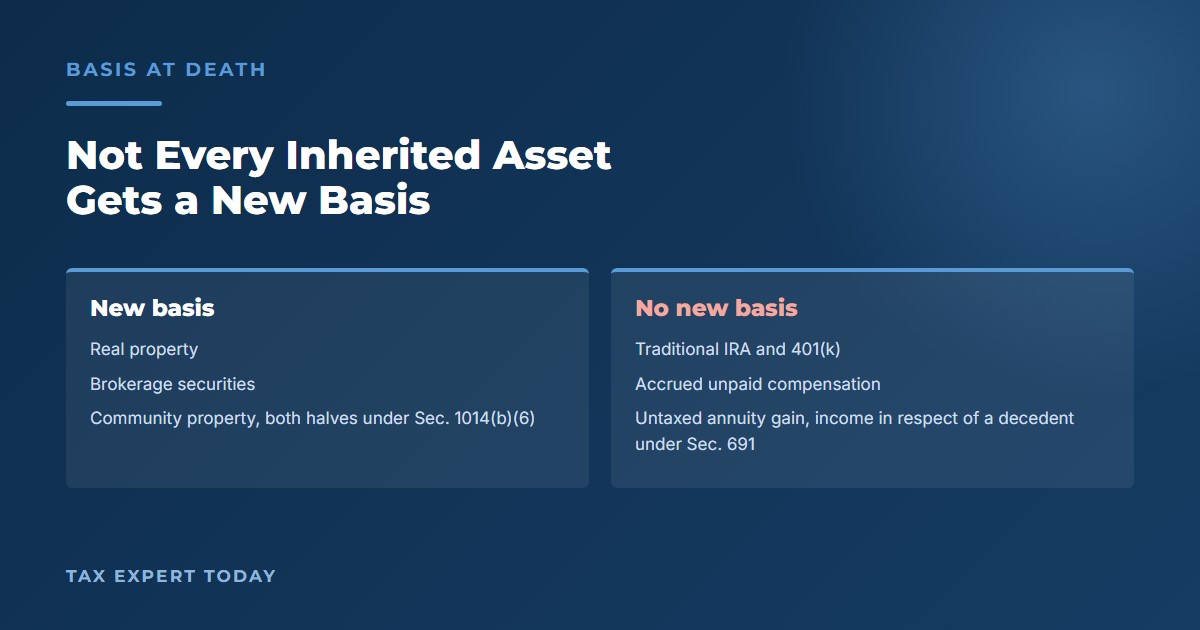
Not everything receives a new basis. Assets classified as income in respect of a decedent under IRC Section 691 are excluded from the step-up by Section 1014(c), so the beneficiary pays ordinary income tax on them exactly as the decedent would have. Traditional retirement accounts are the most common example, and they are frequently the largest asset in the estate.
This is the single most expensive misunderstanding in this area. A family hears that there is no Texas inheritance tax, concludes that the inheritance is tax free, and then withdraws a traditional IRA in one year, which stacks the entire balance on top of the beneficiary’s other income at ordinary rates.
| Inherited asset | New basis at death | How the beneficiary is taxed |
|---|---|---|
| Home, land, or other real property | Yes | Gain only above the new basis on a later sale |
| Brokerage securities held individually | Yes | Gain only above the new basis, and holding period is treated as long term |
| Community property held by a Texas couple | Yes, on both halves | Gain only above the new basis on the entire asset |
| Traditional IRA or 401(k) | No | Ordinary income as distributions are taken |
| Accrued but unpaid compensation, bonuses, or receivables | No | Ordinary income when received |
| Annuity with untaxed gain | No, as to the untaxed portion | Ordinary income on the amount that was never taxed |
| Roth IRA | Not applicable | Generally not taxable if the account met the qualification rules |
One relief provision goes unclaimed often enough to be worth naming. Where federal estate tax was actually paid on an item of income in respect of a decedent, Section 691(c) allows the beneficiary a deduction for the estate tax attributable to that item, which prevents the same value from bearing both taxes in full. It requires a computation, and it depends on the estate having filed and paid, so it applies only to the larger estates.
Do You Have to File Form 706 When No Tax Is Due?
Sometimes, and the reason is portability. A surviving spouse may use the deceased spouse’s unused exclusion, but only if the estate makes the election on a timely and complete Form 706. That means filing an estate tax return for an estate that owes nothing, which many families skip because IRC Section 6018 does not otherwise require it.
Portability preserves a substantial amount. When the first spouse dies without using the full exclusion, the unused portion can carry to the survivor rather than being lost. Families who assume no filing is needed can forfeit it by inaction alone, and the loss becomes apparent only years later when the survivor’s estate is settled.
- The election lives on the return. There is no separate portability form, so the estate makes the election by filing Form 706 and completing it properly.
- Late relief exists. Revenue Procedure 2022-32 provides a simplified method to make a late portability election for qualifying estates, generally within five years of death.
- Disclaimers have a deadline. A qualified disclaimer under IRC Section 2518 generally has to be made within nine months, so a beneficiary who intends to redirect an inheritance has to act early.
- Valuation supports future basis. Even where no tax is owed, contemporaneous date of death valuations support the new basis the heirs will use whenever they sell.
What Do Texas Families Most Often Get Wrong Here?
The recurring error is treating “no Texas inheritance tax” as “no tax on an inheritance.” The state answer is genuinely simple, and it is also the least consequential part of the analysis for most families. The decisions that change the outcome are federal, and they involve basis, retirement account timing, and whether another state has a claim.
- Assuming an inherited IRA is tax free. It is not, and the withdrawal schedule the beneficiary chooses can change the total tax substantially.
- Skipping Form 706 automatically. Filing is sometimes the only way to preserve the deceased spouse’s unused exclusion.
- Overlooking out-of-state property. Real property in another state can pull the estate into that state’s system regardless of Texas domicile.
- Failing to document date of death values. The heir needs those figures to compute gain years later, and reconstructing them after the fact is difficult.
- Treating the vehicle transfer as exempt. The motor vehicle gift tax is expressly carved out of the constitutional ban.
Families who want estate tax planning Naples support, or who need Texas inheritance tax questions reviewed alongside a federal return, generally benefit from having the state answer, the federal answer, and the basis question addressed together rather than in isolation. The same is true for anyone comparing Texas and Florida as destination states, since both eliminate these state taxes but differ in other respects.
Texas Inheritance Tax Help in Naples & Southwest Florida
Tax Expert Today LLC works from Naples, Florida and serves clients in all 50 states, including Texas families settling an estate and Texas residents who have inherited from a relative in another state. The firm brings together tax advisors, enrolled agents, CPAs, and attorneys, which matters on this subject because the state question, the federal estate tax question, and the income tax question on inherited accounts are answered under different bodies of law.
Estate and trust work is a core part of the practice, and the founder holds the Certified Estate and Trust Specialist designation alongside the enrolled agent credential. For Southwest Florida families, the same analysis applies with Florida substituted for Texas, and clients who have recently relocated often need estate planning reviewed after a move.
- Office: 11983 Tamiami Trail N, Naples, FL 34110
- Phone: (239) 441-2005
- Hours: Monday through Friday, 10:00 a.m. to 5:00 p.m. ET
- Service area: All 50 states, with concentrations in Florida, Texas, California, and Georgia
Texas business owners settling an estate that includes an operating company can review the related entity issues on our Texas tax services page, and Southwest Florida clients can start with Naples tax planning.
When to Engage a Professional
Many estates need no specialist at all. The situations below are the ones where the analysis usually justifies professional review, and where the cost of getting it wrong is not recoverable later.
- A surviving spouse who may want portability. The election window is limited, and the exclusion is lost if no return is filed.
- An estate approaching the exclusion. Valuation, deductions, and elections all become material near the threshold.
- Property or a decedent in another state. Multi-state exposure is where Texas domicile stops helping.
- A large retirement account. Distribution timing across the permitted period drives the beneficiary’s total income tax.
- A closely held business or ranch. Special use valuation and entity issues require analysis before any election is made.
Outcomes in this area depend entirely on individual facts, including domicile, the character of each asset, and the terms of the governing documents. Nothing here is a prediction about any particular estate.
Frequently Asked Questions
Does Texas have an inheritance tax in 2026?
No. Texas repealed its inheritance tax effective September 1, 2015, and Article VIII, Section 26 of the Texas Constitution, adopted November 4, 2025, prohibits the Legislature from imposing an estate, inheritance, or death tax. Texas also imposes no state estate tax. Transfers made during life follow a different set of rules, and our guide to Texas gift tax covers the annual exclusion, Form 709, and the community property reporting that applies to a married Texas couple.
How much can you inherit in Texas without paying taxes?
Texas imposes no tax on an inheritance at any amount. At the federal level, an estate generally owes no estate tax below the 2026 basic exclusion amount of $15,000,000 per decedent. Amounts above the exclusion are taxed at rates reaching 40 percent.
Do I pay tax on an inherited IRA in Texas?
Texas imposes no tax on it, but federal income tax still applies. A traditional IRA is income in respect of a decedent under IRC Section 691, so it receives no basis step-up and distributions are taxed as ordinary income to the beneficiary as they are taken.
Can a Texas resident owe inheritance tax to another state?
Yes. Inheritance tax generally follows the decedent’s domicile and the location of real property rather than the heir’s residence. A Texas beneficiary inheriting from a decedent domiciled in Pennsylvania, New Jersey, Kentucky, Maryland, or Nebraska may owe that state’s tax.
Does the surviving spouse get a step-up on all community property in Texas?
Under IRC Section 1014(b)(6), community property generally receives a new basis on both halves when the first spouse dies, not only the decedent’s half. The result depends on whether the asset is properly characterized as community property.
Can Tax Expert Today help a Texas family from Naples, Florida?
Yes. The firm is based at 11983 Tamiami Trail N, Naples, FL 34110 and serves clients in all 50 states, including Texas estates and Texas heirs with out-of-state exposure. Call (239) 441-2005, Monday through Friday, 10:00 a.m. to 5:00 p.m. ET.
Published August 12, 2026 by Dr. Pellumb Kabashi « Back to Learning Center
Have a question this article touches on?
Tax Expert Today LLC, based in Naples, Florida and serving clients across the United States.
Schedule a Consultation (239) 441-2005