
By Dr. Pellumb Kabashi, DBA, MBA, CES, CFE, EA
Founder, Tax Expert Today LLC · Tax advisors, enrolled agents, CPAs, and attorneys · Serving clients in all 50 states
Quick Answer: Divorce house buyout taxes are usually zero at the moment of the buyout. Under IRC §1041, no gain or loss is recognized when one spouse transfers an interest in the marital home to the other incident to the divorce. The tax is deferred rather than forgiven, because the spouse who keeps the house takes over the transferor’s basis. Call (239) 441-2005 for a free consultation.
For most divorcing couples the house is the largest asset on the table, and the buyout is the most common way to divide it. One spouse keeps the home, the other receives cash or an offsetting share of other assets, and a deed moves the departing spouse’s interest across. The federal treatment of divorce house buyout taxes at that moment is favorable and well settled. The treatment of what happens afterward is where the expensive surprises live, because the tax that was not collected at the buyout does not disappear. It attaches to the house and waits for a later sale. Where the asset being divided is a closely held company rather than the home, the analysis shifts to the redemption and entity rules covered in our guide to business owner divorce taxes.
This guide walks the mechanics of divorce house buyout taxes in the order they actually arise: the nonrecognition rule that makes the transfer itself tax free, the timing test that determines whether a transfer still qualifies years after the decree, the basis rule that decides who absorbs the deferred gain, and the principal residence exclusion that determines how much of that gain is ultimately excluded. It closes with the Florida deed tax question that a Southwest Florida closing raises and that national articles on this topic do not address.
Are Divorce House Buyout Taxes Owed on the Transfer Itself?
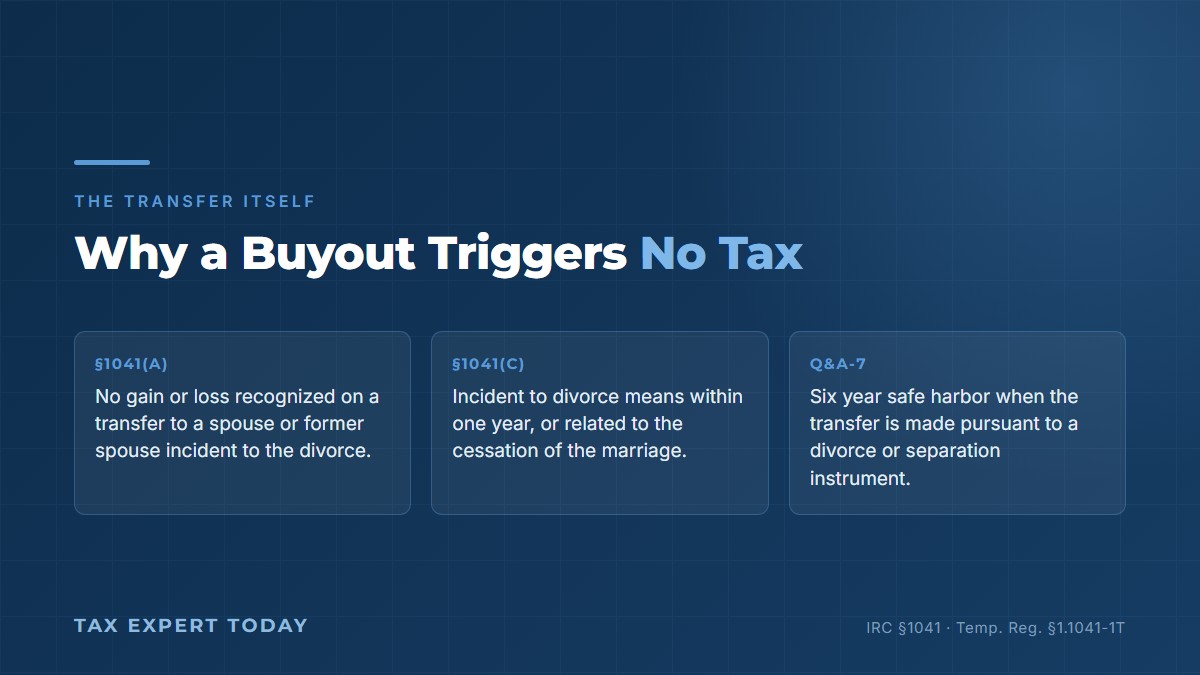
No. IRC §1041(a) provides that no gain or loss is recognized on a transfer of property from an individual to a spouse, or to a former spouse where the transfer is incident to the divorce. Divorce house buyout taxes are therefore not triggered by the deed itself, regardless of how much equity changes hands or how the buyout is funded.
- No gain to the departing spouse. The spouse who signs the deed away recognizes nothing, even where the cash received far exceeds that spouse’s share of basis.
- No loss either. Nonrecognition runs in both directions, so a home that has fallen in value produces no deductible loss on the transfer.
- Treated as a gift for basis purposes. IRC §1041(b) provides that the property is treated as acquired by the transferee by gift, and that the transferee’s basis is the transferor’s adjusted basis.
- Not a gift for gift tax purposes in the ordinary case. The transfer is a division of marital property, and the buyout payment is consideration in the family law sense, not a taxable gratuitous transfer.
- One statutory exception. IRC §1041(d) turns nonrecognition off where the receiving spouse or former spouse is a nonresident alien, which matters in cross border marriages.
The practical consequence is that the buyout price is a family law number rather than a tax number. Paying more or less for the departing spouse’s interest changes who ends up with what, but under §1041 it does not by itself create a federal income tax event for either party in the year of the buyout. Divorce house buyout taxes are not a function of the price the parties agree on. What the price does change, significantly, is the position of the spouse who keeps the house.
What Makes a Transfer Incident to the Divorce?
IRC §1041(c) supplies a two prong test. A transfer is incident to the divorce if it occurs within one year after the date on which the marriage ceases, or if it is related to the cessation of the marriage. The first prong is automatic and needs no instrument. The second prong is where deferred divorce house buyout taxes are won or lost.
- The one year prong is unconditional. Any transfer inside one year of the marriage ending qualifies, whether or not a decree required it.
- The six year safe harbor. Temp. Treas. Reg. §1.1041-1T(b), Q&A-7 treats a transfer as related to the cessation of the marriage if it is made pursuant to a divorce or separation instrument and occurs not more than six years after the marriage ceases.
- The presumption against late transfers. A transfer not made pursuant to an instrument, or one occurring more than six years out, is presumed not related to the cessation of the marriage.
- The presumption is rebuttable. The regulation permits the presumption to be overcome by showing the transfer was made to effect the division of property owned at the time the marriage ended, including where legal or business impediments caused the delay.
- Documentation is the whole battle. Where a buyout is deferred, the settlement should state the obligation and the reason for any delay, because that record is what supports the rebuttal later.
This matters in a common Southwest Florida pattern. A couple agrees that one spouse will stay in the home until a child finishes school, with the buyout to follow. If that arrangement is written into the marital settlement agreement and executes within six years, the safe harbor applies cleanly. If it is an informal understanding, or if the transfer slips past the six year mark, the parties are relying on a rebuttable presumption in the wrong direction, and a transfer that everyone assumed was tax free may be recharacterized as a taxable sale between unrelated parties. Divorce house buyout taxes then arise where the parties expected none, which is why the timing prong deserves attention at the drafting stage. Related timing questions on support payments are covered in our guide to alimony taxes after divorce.
How Does the Carryover Basis Trap Work in a Buyout?
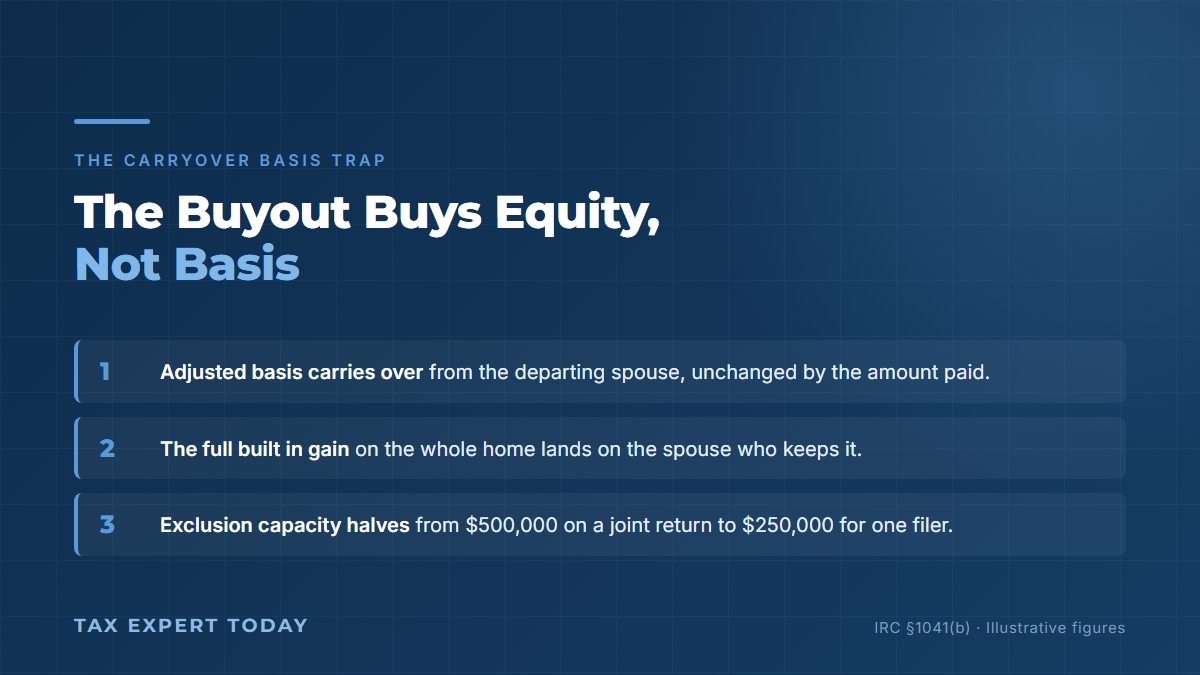
The buying spouse does not get a basis step up for the money paid. Under IRC §1041(b)(2) and Temp. Treas. Reg. §1.1041-1T(d), Q&A-11, the transferee takes the transferor’s adjusted basis. The buyout dollars purchase equity, not basis, so the entire built in gain on the whole house lands on the spouse who keeps it.
- Basis carries over in full. The receiving spouse’s basis in the acquired half is the departing spouse’s old basis in that half, not the amount paid for it.
- The gain is not split, it is transferred. Gain that would have been the departing spouse’s on a sale becomes the remaining spouse’s gain on a later sale.
- Carryover applies regardless of value. Q&A-11 states the rule applies whether the adjusted basis is less than, equal to, or greater than fair market value.
- The exclusion capacity is halved. Two spouses selling together may reach a $500,000 exclusion on a joint return, while one spouse holding alone afterward is generally limited to $250,000.
- Improvements still add basis. Capital improvements made before or after the buyout increase basis under the ordinary rules in IRS Publication 523.
The arithmetic behind divorce house buyout taxes makes the point better than description does. The figures below are illustrative and are used only to show how the mechanism operates.
| Step | Amount | Explanation |
|---|---|---|
| Original purchase price of the home | $300,000 | Joint basis before any improvements |
| Capital improvements during the marriage | $50,000 | Adjusted basis becomes $350,000 |
| Fair market value at the divorce | $950,000 | Equity of $950,000 assuming no mortgage |
| Buyout paid to the departing spouse | $475,000 | No gain recognized by either party under §1041(a) |
| Basis of the spouse who keeps the home | $350,000 | Carryover basis, not $825,000, because the buyout adds no basis |
| Built in gain now carried by one spouse | $600,000 | $950,000 value less $350,000 carryover basis |
| Exclusion available to a single filer | $250,000 | IRC §121(b)(1), assuming the ownership and use tests are met |
| Gain potentially taxable on a later sale | $350,000 | Subject to capital gain rates and the net investment income tax |
A spouse who accepts the house believing the two positions are equal has, in this illustration, accepted an asset carrying a deferred federal tax liability that the cash recipient does not carry at all. Whether that matters depends on facts, on how long the house is held, and on what the taxpayer’s rates look like at the eventual sale. It is a factor that belongs in the settlement negotiation rather than in a return prepared years later. Put plainly, divorce house buyout taxes are not avoided by the buyout, they are relocated by it. That relocation is the carryover basis rule at work, and it applies to every asset in the division rather than to the house alone, as our guide to what makes a divorce settlement taxable sets out.
Do Divorce House Buyout Taxes Change if the Mortgage Exceeds Basis?
No. Nonrecognition under §1041 is not limited by the amount of debt on the property. Temp. Treas. Reg. §1.1041-1T(d), Q&A-12 confirms that no gain is recognized even where the liabilities assumed exceed the adjusted basis, and the transferee still takes the transferor’s carryover basis in that situation.
- Debt relief does not create boot. Unlike a like kind exchange, a §1041 transfer does not produce recognized gain because the transferee assumes a mortgage.
- Basis is unaffected by the debt. The carryover basis figure does not adjust upward for liabilities taken over.
- Refinancing is a separate transaction. Cash taken out to fund a buyout is borrowing, not income, though it changes the interest deduction analysis.
- Mortgage interest deductibility follows ownership and payment. After the buyout, the deduction generally follows the spouse who owns the home and pays the interest, subject to the acquisition indebtedness limits.
- Assumption still requires lender consent. The tax result and the loan documents are independent, and a decree does not release a spouse from the note.
This is a meaningful protection in markets where a home was refinanced repeatedly. A couple can hold a property worth less than the balance owed, transfer it in a buyout structured around other assets, and still land inside nonrecognition without a phantom gain appearing on either return. In that respect divorce house buyout taxes are more forgiving than the rules that govern comparable transfers between unrelated parties.
How Does the Section 121 Exclusion Work After a Buyout?
IRC §121(a) excludes gain on a principal residence owned and used as such for periods aggregating two years within the five years before the sale. The limit is $250,000 under §121(b)(1), or $500,000 on a joint return meeting the conditions in §121(b)(2)(A), and the IRS summarizes the reporting side in Topic No. 701, Sale of Your Home. Divorce modifies how both tests are measured, and it is the exclusion, not §1041, that ultimately determines what divorce house buyout taxes cost.
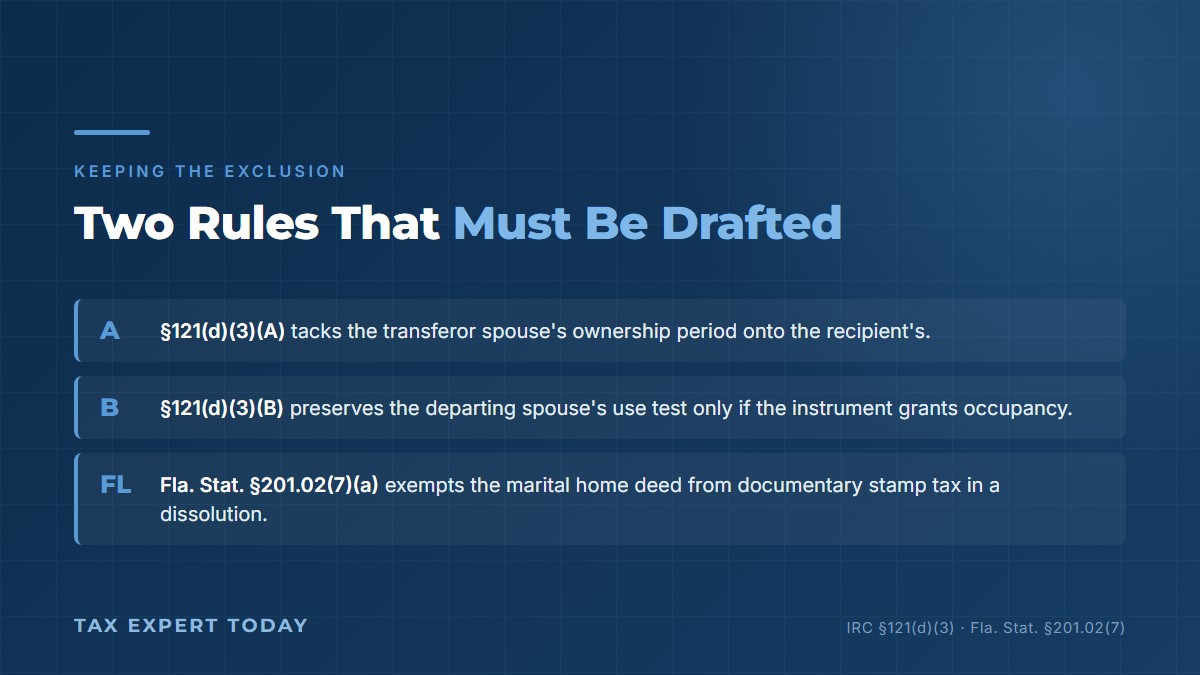
- Ownership tacks across a §1041 transfer. Under §121(d)(3)(A), the recipient’s ownership period includes the period the transferor owned the property.
- Use does not tack automatically. The buying spouse must satisfy the use test personally, which ordinarily presents no difficulty because that spouse lives there.
- The $500,000 amount requires a joint return. §121(b)(2)(A) applies only where the spouses file jointly, either spouse meets ownership, and both meet use.
- The two year lookback still applies. §121(b)(3) denies the exclusion where the taxpayer already used it on another sale within the prior two years.
- Nonqualified use and depreciation carry through. Periods of rental use and any depreciation allowed after May 6, 1997 continue to limit the exclusion.
The ownership tacking rule is more generous than it first appears. A spouse who receives full title in the buyout is not starting a fresh two year ownership clock, because §121(d)(3)(A) folds in the years the other spouse held the property. A sale shortly after the buyout can still qualify, provided the use test is independently satisfied. The table below sets out how each element of the exclusion is measured once divorce house buyout taxes are in the picture.
| Requirement | General rule | How divorce modifies it | Authority |
|---|---|---|---|
| Ownership, two of the last five years | Measured by the taxpayer’s own holding period | Includes the transferor spouse’s holding period after a §1041 transfer | IRC §121(d)(3)(A) |
| Use as a principal residence, two of the last five years | Measured by actual occupancy | Deemed satisfied while a former spouse occupies under a divorce or separation instrument | IRC §121(d)(3)(B) |
| Maximum exclusion | $250,000 per qualifying taxpayer | $500,000 only on a joint return meeting all three conditions | IRC §121(b)(1), (b)(2)(A) |
| Prior use of the exclusion | No qualifying sale in the prior two years | Unchanged, and it applies separately to each former spouse | IRC §121(b)(3) |
| Basis used to compute gain | Cost plus improvements, less depreciation | Carryover basis from the transferor, not the buyout price | IRC §1041(b); Temp. Reg. §1.1041-1T, Q&A-11 |
Can the Spouse Who Moves Out Still Use the Exclusion?
Yes, but only if the settlement says so. IRC §121(d)(3)(B) treats an individual as using the property as a principal residence during any period of ownership while that individual’s spouse or former spouse is granted use of the property under a divorce or separation instrument. Without that grant in the instrument, the use clock simply runs out.
- The grant must appear in the instrument. The statute conditions the deemed use on occupancy granted under a divorce or separation instrument, not on an informal arrangement.
- Ownership must continue. The deemed use applies during periods of ownership, so a spouse who deeds away all interest has nothing left to protect.
- Three years is the natural deadline. Absent the provision, a spouse who moved out fails the two of five year use test roughly three years after leaving.
- It preserves a deferred buyout. Where the house will be sold or bought out later, this provision is what keeps the departing spouse’s $250,000 exclusion alive in the meantime.
- Drafting is the entire remedy. The language costs nothing to include at the settlement stage and cannot be added retroactively.
This is the single most commonly missed provision in the marital home analysis. A spouse who retains a half interest, moves out, and sells four years later under a settlement that never granted the occupying spouse use of the home has no exclusion available on that half. The same facts with one sentence in the marital settlement agreement produce a fully excluded gain up to the statutory limit. Coordination between the tax advisor and the family law attorney at the drafting stage is what closes that gap, and it is the highest value hour anyone spends on divorce house buyout taxes.
Is It Better to Sell the Home Before or After the Divorce?
It depends on filing status and on whether both spouses can still meet the use test. Selling while a joint return is available can reach the $500,000 exclusion in one transaction. Selling after the divorce generally gives each former spouse a separate $250,000 limit, which reaches the same total only if both still qualify.
The table below compares the structures side by side, including how divorce house buyout taxes differ from an outright sale.
| Structure | Transfer taxed? | Basis result | Maximum exclusion | Governing authority |
|---|---|---|---|---|
| Sale to a third party while married, joint return | Gain recognized on the sale | Original adjusted basis applies | $500,000 if both use tests met | IRC §121(b)(2)(A) |
| Buyout between spouses, incident to divorce | No gain or loss recognized | Carryover basis to the buying spouse | Deferred to a later sale | IRC §1041(a), (b) |
| Sale to a third party after divorce, both still owners | Gain recognized, split by ownership | Each reports a share | $250,000 each if each qualifies | IRC §121(b)(1), (d)(3)(B) |
| Sale by one spouse alone after a buyout | Gain recognized by that spouse | Carryover basis on the whole home | $250,000 for that spouse | IRC §121(b)(1), (d)(3)(A) |
| Deferred buyout beyond six years, no instrument | May be treated as a taxable sale | Purchaser takes cost basis | Depends on the recharacterization | Temp. Reg. §1.1041-1T, Q&A-7 |
The timing question is genuinely fact dependent and it interacts with filing status for the year, which is analyzed separately in our guide to divorce filing status. Marital status for the entire tax year is determined on December 31 under IRC §7703, so a dissolution finalized in December removes the joint return option for a sale that closed in June of the same year. Where a large gain is in play, the closing date and the decree date belong on the same calendar.
How Do Florida Rules Affect Divorce House Buyout Taxes?
Florida imposes no state individual income tax, so the deferred gain on a marital home is a federal exposure only. Florida does impose documentary stamp tax on deeds at 70 cents per $100 of consideration under Fla. Stat. §201.02(1), and a divorce buyout deed sits inside a specific statutory exemption that is easy to overlook at closing.
- The marital home exemption. Fla. Stat. §201.02(7)(a) exempts a deed between spouses or former spouses in a dissolution proceeding where the real property is or was their marital home or an interest in it.
- A refund window exists. The statute permits a refund of tax paid on a qualifying deed recorded within one year before the dissolution became final.
- A second exemption for mortgage only consideration. Fla. Stat. §201.02(7)(b) covers a transfer of homestead property between spouses where the only consideration is the mortgage or lien encumbering the property.
- Effective date limit. The dissolution exemption in paragraph (7)(a) applies to deeds executed on or after July 1, 1997.
- Outside the exemptions, tax applies. An interspousal deed that does not meet these conditions remains subject to the 70 cents per $100 rate, and consideration includes a mortgage the grantee takes subject to.
Equitable distribution in Florida is governed by Fla. Stat. §61.075, which directs the court to begin from the premise of an equal division of marital assets and liabilities. That statute allocates the asset. It does not allocate the deferred federal tax embedded in it, and a distribution that is equal in gross equity can be unequal after tax once the carryover basis rule is applied. Raising that point is a tax function, and it belongs to the tax advisor working alongside counsel rather than to the family law analysis itself. For Florida couples, in other words, divorce house buyout taxes are entirely a federal question at the income tax level and a narrow documentary stamp question at the closing table. Where a joint return from an earlier year is also in dispute, that is a separate matter addressed in our guide to innocent spouse relief.
Divorce Tax Help Naples: Working With Your Family Law Attorney
Tax Expert Today LLC works with divorcing spouses in Naples, Florida, throughout Southwest Florida, and in all 50 states, on the tax side of a dissolution. The team includes tax advisors, enrolled agents, CPAs, and attorneys. We do not provide family law advice and we do not replace your attorney. We work alongside counsel so that the tax result matches what the settlement was drafted to accomplish.
Divorce house buyout taxes Naples: the work in this area typically includes reconstructing the adjusted basis of the home from the original closing documents and the improvement history, modeling the after tax value of the house against the after tax value of the offsetting assets, which are frequently retirement accounts carrying their own QDRO taxes analysis, confirming that a deferred buyout falls inside the six year safe harbor or is documented well enough to rebut the presumption, checking that the settlement grants occupancy in the terms §121(d)(3)(B) requires, and reviewing the deed and closing statement against the Florida documentary stamp exemption before recording.
The office is at 11983 Tamiami Trail N, Naples, FL 34110. Consultations can be scheduled by phone at (239) 441-2005, Monday through Friday, 10am to 5pm ET. Clients elsewhere in Florida and in other states are served remotely. Related work is described on our divorce tax consulting and Naples tax planning pages.
Local question: our Collier County home has appreciated substantially since we bought it in 2013. Is taking the house a fair trade for the retirement accounts? Not necessarily, and the comparison should be run after tax rather than on gross balances. The house carries a carryover basis and a single $250,000 exclusion once one spouse holds it alone, while a retirement account carries ordinary income tax on distribution and, in the case of a qualified plan divided by a domestic relations order, a distinct set of early distribution rules. Two assets with identical statement values can differ materially once the embedded tax on each is calculated, and in a long held Southwest Florida property the embedded gain is frequently the larger of the two figures. Divorce house buyout taxes and retirement account taxes are both deferred, but they are deferred at different rates and released under different rules, so the two are not interchangeable.
When to Engage a Professional
Divorce house buyout taxes are worth a professional review whenever the property has appreciated meaningfully, whenever the buyout is deferred rather than simultaneous with the decree, and whenever one spouse will move out while retaining an ownership interest. It is also worth review where the home was ever rented or used partly for business, because nonqualified use and depreciation recapture reduce the exclusion, and where either spouse is not a United States person, because §1041(d) removes nonrecognition entirely in that case.
A review before the marital settlement agreement is signed is materially more useful than a review afterward. The occupancy language required by §121(d)(3)(B), the documentation that supports a late transfer under Q&A-7, and the after tax comparison of the house against other assets are all fully adjustable at the drafting stage and largely fixed once the agreement is executed. Where minor children are involved, the same settlement usually decides the dependency claim as well, which is covered in our guide to Form 8332 and claiming a child after divorce. Where a large gain is expected on a later sale, the same review usually prompts a look at estimated payments for the year of sale, and our quarterly estimated tax calculator is a reasonable starting point for that check. Spouses who are also changing domicile in connection with the divorce should read our guide to establishing Florida residency, since the state result and the federal result are decided separately.
Outcomes depend on individual facts, on the terms of the decree and the marital settlement agreement, on the documented history of the property, and on IRS review of the return as filed. Nothing in this article is a promise about how a particular return will be treated, and nothing in it is family law advice. Coordinate the tax analysis with your family law attorney, who remains responsible for the terms of the settlement itself.
Frequently Asked Questions
Do I pay tax on the money I receive in a divorce house buyout?
Generally no. Under IRC §1041(a) the transfer of your interest to your former spouse incident to the divorce produces no recognized gain or loss, so the buyout proceeds are a division of marital property rather than taxable income. The tax consequence shifts to your former spouse, who takes your basis in the interest you transferred.
Does the spouse who keeps the house get a new basis equal to the buyout price?
No. IRC §1041(b) and Temp. Treas. Reg. §1.1041-1T(d), Q&A-11 require the transferee to take the transferor’s adjusted basis. The buyout payment buys equity and does not increase basis, which is why the full built in gain on the property remains with the spouse who keeps it.
How long after the divorce can a buyout still be tax free?
A transfer within one year after the marriage ceases always qualifies under §1041(c)(1). Beyond that, a transfer made pursuant to a divorce or separation instrument within six years is treated as related to the cessation of the marriage under Temp. Reg. §1.1041-1T(b), Q&A-7. Later transfers are presumed not to qualify, though the presumption can be rebutted.
Can I keep my $250,000 exclusion if I move out of the house?
Only if you keep an ownership interest and the divorce or separation instrument grants your former spouse use of the property. IRC §121(d)(3)(B) then treats you as using the home as your principal residence during that period. Without that grant, the two of five year use test generally fails about three years after you move out.
Are divorce house buyout taxes different if the mortgage is larger than our basis?
No. Temp. Treas. Reg. §1.1041-1T(d), Q&A-12 confirms that nonrecognition applies even where liabilities exceed the adjusted basis, and the carryover basis rule still governs. Assumption of the mortgage does not create recognized gain for the transferring spouse.
Does Florida charge tax on the deed transferring the marital home?
Fla. Stat. §201.02(7)(a) exempts a deed between spouses or former spouses in a dissolution proceeding where the property is or was the marital home, for deeds executed on or after July 1, 1997. Outside that exemption and the mortgage only exemption in paragraph (7)(b), documentary stamp tax applies at 70 cents per $100 of consideration.
Should the buyout amount be adjusted for the deferred tax?
That is a negotiation question rather than a tax rule, but the deferred gain is a real economic item and it can be quantified. Where a home carries substantial appreciation, an equal division of gross equity is not an equal division after tax, and the analysis is best presented to counsel before the agreement is signed.
Published August 8, 2026 by Dr. Pellumb Kabashi « Back to Learning Center
Have a question this article touches on?
Tax Expert Today LLC, based in Naples, Florida and serving clients across the United States.
Schedule a Consultation (239) 441-2005