
By Dr. Pellumb Kabashi, DBA, MBA, CES, CFE, EA
Founder, Tax Expert Today LLC · Tax advisors, enrolled agents, CPAs, and attorneys · Serving clients in all 50 states
Quick Answer: Royalty income tax applies at ordinary rates, so royalties are taxed under the same 10 to 37 percent brackets as wages rather than at capital gain rates. Passive royalties go on Schedule E and avoid self-employment tax, while royalties earned in your own trade or business go on Schedule C and carry it. Depletion and related expenses reduce the taxable amount. Call (239) 441-2005 for a free consultation.
How Is Royalty Income Taxed at the Federal Level?
Royalties are ordinary income. IRC Section 61(a)(6) lists royalties in gross income by name, so they are taxed at the same graduated rates that apply to wages and interest. There is no preferential rate for a royalty check, and no capital gain treatment for the income stream itself.
For taxable years beginning in 2026, Revenue Procedure 2025-32 confirms that the seven individual rates of 10, 12, 22, 24, 32, 35, and 37 percent remain in effect, made permanent by Section 70101 of Public Law 119-21. Where a royalty lands depends entirely on the rest of the return, which is why two owners receiving identical checks can face very different tax on them.
Royalties may also draw the 3.8 percent net investment income tax. IRC Section 1411 applies that surtax once modified adjusted gross income exceeds $250,000 on a joint return, $125,000 for a married taxpayer filing separately, or $200,000 for other individuals. Those thresholds are statutory and are not indexed for inflation, so more owners cross them each year. Royalties received in the course of a trade or business are generally outside the surtax.
| Filer type (2026) | Taxable income where the 37 percent bracket begins |
|---|---|
| Married filing jointly and surviving spouses | $768,700 |
| Head of household | $640,600 |
| Single | $640,600 |
| Married filing separately | $384,350 |
| Estates and non grantor trusts | $16,000 |
Figures above come from Revenue Procedure 2025-32, Section 4.01, Tables 1 through 5. The last row is not a typographical error, and it is addressed in its own section below.
Does Royalty Income Go on Schedule E or Schedule C?
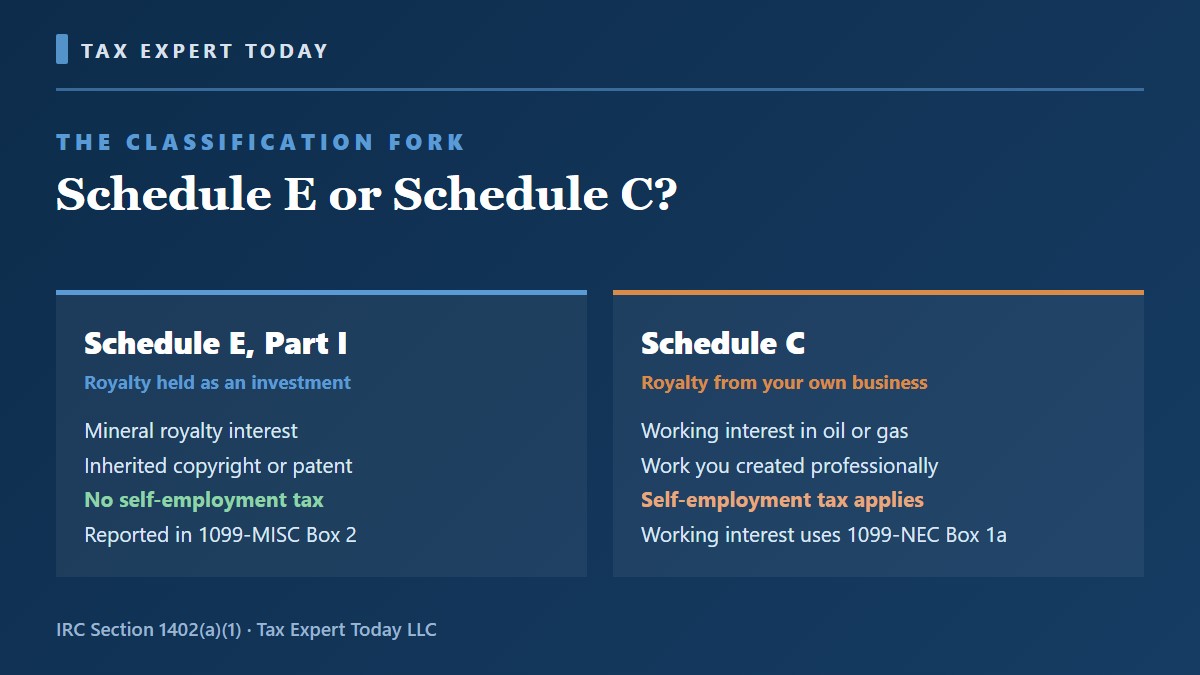
The dividing line is whether the royalty comes from property you hold as an investment or from a trade or business you actively conduct. Investment royalties are reported in Part I of Schedule E. Royalties generated by your own ongoing trade or business belong on Schedule C, where they become subject to self-employment tax.
The clearest illustration involves two people receiving checks from the same book. An author who writes professionally is in the trade or business of writing, so the publisher royalties are business receipts reported on Schedule C. A child who inherits that copyright is not in the writing business at all, so the same payments become investment royalties on Schedule E. IRS Publication 525 describes this split, and it turns on the recipient rather than on the property.
Classification is not a matter of preference. Placing active business royalties on Schedule E understates self-employment tax, and placing investment royalties on Schedule C creates a tax the law never imposed. Correcting either generally requires an amended return.
What Separates a Royalty Interest From a Working Interest?
A royalty interest entitles the owner to a share of production without bearing the cost of drilling or operating the well. A working interest carries those costs and the associated liability. The distinction decides the reporting form, the schedule, the self-employment tax result, and whether the passive activity loss rules apply.
The reporting difference is explicit in the instructions. The payer reports gross royalties of $10 or more in Box 2 of Form 1099-MISC, but the IRS instructions direct that oil or gas payments for a working interest are excluded from Box 2 and are reported instead in Box 1a of Form 1099-NEC. Surface royalties belong in Box 1 as rents, and timber royalties paid under a pay as cut contract go on Form 1099-S rather than on either form.
Self-employment tax follows the same fault line. IRC Section 1402(a)(1) excludes rentals from real estate, together with the deductions attributable to them, from net earnings from self employment. A mineral royalty interest is treated as an interest in real property, which is why a royalty owner generally escapes the 15.3 percent self-employment tax while a working interest owner conducting an oil and gas business generally does not. Owners weighing that difference can model the effect with our self-employment tax calculator.
The passive loss rules cut the other way, and in the working interest owner’s favor. IRC Section 469(c)(3) provides that a passive activity does not include a working interest in oil or gas property held directly, or through an entity that does not limit the owner’s liability. Losses from that interest are therefore available against other income rather than suspended. The statute adds a recapture feature, so once such a loss has been treated as non passive, later net income from the same property is non passive as well.
| Type of royalty or interest | Payer reporting | Schedule | Self-employment tax | Depletion available |
|---|---|---|---|---|
| Mineral royalty held as an investment | 1099-MISC Box 2 | Schedule E, Part I | No | Yes |
| Working interest in oil or gas | 1099-NEC Box 1a | Schedule C | Yes | Yes |
| Royalties on work you created professionally | 1099-MISC Box 2 | Schedule C | Yes | No |
| Inherited copyright or patent royalties | 1099-MISC Box 2 | Schedule E, Part I | No | No |
| Surface use payments | 1099-MISC Box 1 | Schedule E, Part I | No | No |
How Does the Depletion Deduction Reduce Royalty Income Tax?
Depletion is the deduction that recovers the owner’s investment in a wasting natural resource, and it is the largest single lever in royalty income tax. IRC Section 611 authorizes a reasonable allowance for depletion on mines, oil and gas wells, and other natural deposits. Two computational methods exist, and the owner takes whichever produces the larger deduction for that property in that year.
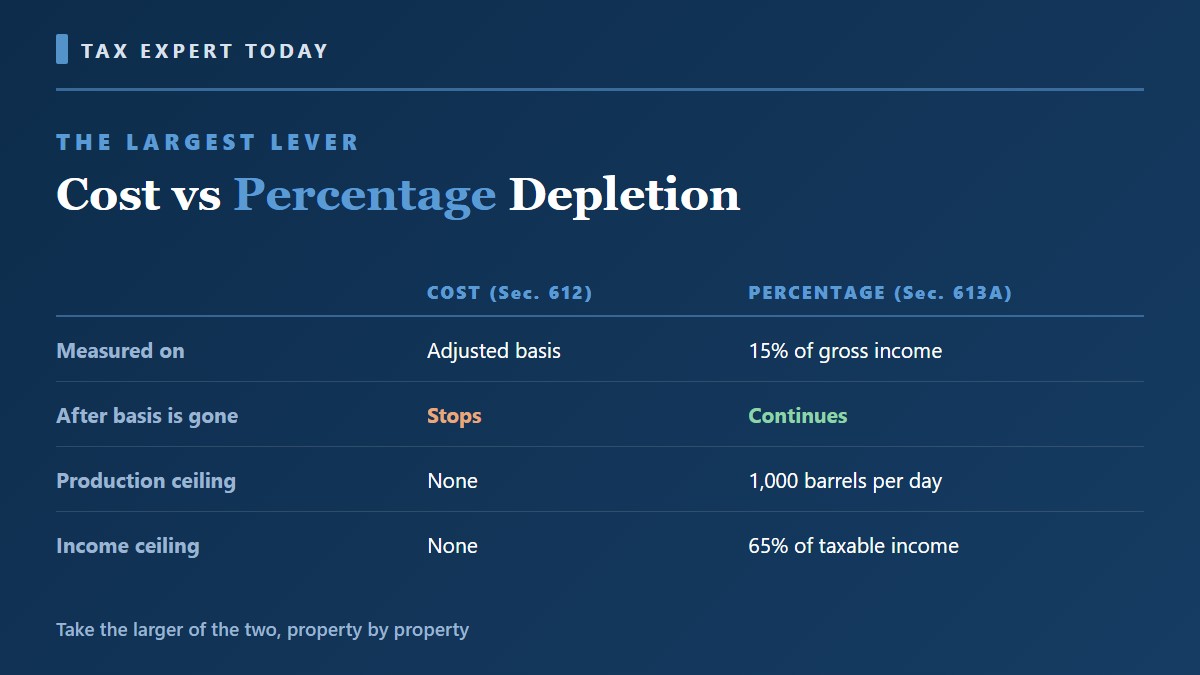
Cost depletion under IRC Section 612 recovers the adjusted basis of the property across the units expected to be produced, so it stops once basis reaches zero. An inherited interest often carries a stepped up basis that makes cost depletion meaningful for some years, while an interest held in the family for generations may carry almost no remaining basis.
Percentage depletion under IRC Section 613 instead applies a statutory percentage to gross income from the property, excluding rents or royalties the taxpayer itself paid on that property. Integrated oil companies generally lost access to percentage depletion, but IRC Section 613A(c) preserves it for independent producers and royalty owners at 15 percent, applied to production up to the depletable oil quantity. Section 613A(c)(3)(B) sets that tentative quantity at 1,000 barrels of average daily production, so ordinary family royalty interests sit comfortably inside the exemption.
Two ceilings then apply, and both are commonly missed. Section 613(a) limits percentage depletion to 100 percent of taxable income from the property for oil and gas properties, and to 50 percent for other minerals. Separately, Section 613A(d)(1) limits the deduction attributable to the independent producer exemption to 65 percent of the taxpayer’s taxable income for the year, computed without regard to that depletion. A high depletion figure on a return with modest other income can therefore be capped, with the excess carried forward.
The mechanics matter because percentage depletion is not tied to basis. On $40,000 of gross royalties from a producing mineral interest, percentage depletion at 15 percent produces a $6,000 deduction, and that deduction remains available in later years even after basis has been fully recovered, subject to the two ceilings above. Cost depletion cannot do that. Copyrights, patents, and trademarks are not wasting natural deposits, so royalties from intangible property draw no depletion at all.
| Feature | Cost depletion (Section 612) | Percentage depletion (Section 613 and 613A) |
|---|---|---|
| Basis of the deduction | Adjusted basis spread over recoverable units | 15 percent of gross income from the property |
| Continues after basis is exhausted | No | Yes |
| Who may use it | Any owner of an economic interest | Independent producers and royalty owners |
| Production ceiling | None | 1,000 barrels of average daily production |
| Income ceilings | None | 100 percent of taxable income from the property and 65 percent of overall taxable income |
| Applies to patents and copyrights | No | No |
Why Does the 1099-MISC Show More Than the Royalty Check?
Because Box 2 is a gross figure measured at the wellhead. The IRS instructions require the payer to report royalties from oil, gas, or other mineral properties before reduction for severance and other taxes that were withheld and paid. The check that arrives has already been reduced by that severance tax and frequently by post production costs as well, so the form and the deposit rarely agree.
This gap is a common source of error, and it fails in both directions. An owner who reports only the amount deposited understates gross royalties, which mismatches the information return and shrinks the gross income figure percentage depletion is computed on. An owner who reports Box 2 and stops there overstates taxable income by omitting allowable deductions.
The correct treatment is to report the gross Box 2 amount and then deduct the severance tax and other allowable expenses on Schedule E. The operator’s monthly check detail is the working document that supports those deductions, so owners should keep those statements. The 1099-MISC alone does not contain the information the return requires.
Do Texas Royalty Owners Owe State Tax on Royalties?
Texas imposes no individual income tax, a prohibition written into Article VIII, Section 24-a of the Texas Constitution, so a Texas resident pays no state income tax on a royalty. Texas still reaches the same production through a severance tax collected at the source, and through the franchise tax when an entity holds the interest.
Verified this week from the Texas Comptroller, the oil production tax is 4.6 percent of the market value of oil, and taxable barrels also carry an Oil Field Clean-Up Fee of $0.00625 per barrel for report periods from September 2015 forward. Certified exemptions reduce the rate, including 2.3 percent for enhanced oil recovery projects and 0.0 percent for a qualifying two year inactive well. On the gas side, the natural gas production tax is 7.5 percent of market value, condensate is taxed at 4.6 percent, and a regulatory fee of $0.000667 applies per 1,000 cubic feet of gas.
Owners who hold mineral interests inside an entity should also look at the franchise tax. Royalties received flow into total revenue for the margin computation under Chapter 171 of the Texas Tax Code, and the no tax due threshold for the 2026 and 2027 report years is $2,650,000, verified today from the Comptroller. A holding entity with substantial royalty revenue can therefore carry a franchise tax obligation even though neither it nor its owners owe state income tax. Our guides to the Texas franchise tax and Texas LLC taxes work through that computation.
| Layer | Applies to a Texas royalty owner | Rate or threshold |
|---|---|---|
| Federal income tax | Yes, at ordinary rates | 10 to 37 percent for 2026 |
| Net investment income tax | Yes, for investment royalties above the threshold | 3.8 percent above $250,000 joint or $200,000 single |
| Texas individual income tax | No, prohibited by the state constitution | None |
| Texas severance tax | Yes, withheld from production proceeds | 4.6 percent oil and 7.5 percent gas |
| Texas franchise tax | Only when an entity holds the interest | No tax due threshold of $2,650,000 |

How Are Royalties Taxed When a Trust Holds the Mineral Interest?
Far more aggressively than most families expect. An estate or non grantor trust reaches the 37 percent bracket at just $16,000 of taxable income for 2026 under Table 5 of Revenue Procedure 2025-32, against $768,700 for a married couple filing jointly. Royalties accumulated inside a trust can therefore hit the top rate at a level of income that would sit in a low bracket on an individual return.
The net investment income tax compounds the effect. Section 1411(a)(2) applies the 3.8 percent surtax to an estate or trust on the lesser of undistributed net investment income or the excess of adjusted gross income over the dollar amount at which the highest bracket begins. For 2026 that is the same $16,000 figure, against $250,000 for a joint filer. A trust that accumulates royalty income can therefore face the top rate and the surtax together.
The structural answer is usually distribution rather than accumulation. Income distributed to beneficiaries generally carries out distributable net income under IRC Sections 661 and 662 and is taxed in the beneficiaries’ brackets instead. Whether that suits a given family depends on the trust instrument, the fiduciary’s duties, and the beneficiaries’ own returns, which makes this a drafting and administration question as much as a computation. Families holding mineral interests alongside other assets may find our discussion of estate planning for new residents a useful companion.
When Are Estimated Tax Payments Required on Royalty Income?
Almost always, because domestic royalty payments to United States persons carry no federal withholding. The tax has to be paid through quarterly estimated payments on Form 1040-ES, and an owner whose prior income was wages with withholding is frequently caught by this in the first royalty year.
IRC Section 6654 sets the safe harbors. The required annual payment is the lesser of 90 percent of the tax shown on the current year return or 100 percent of the tax shown on the prior year return, and Section 6654(d)(1)(C)(i) raises that second figure to 110 percent when prior year adjusted gross income exceeded $150,000. Meeting either test avoids the underpayment penalty even if the final balance is large.
Royalty income is genuinely lumpy, since production, prices, and lease activity all move. Where income arrives unevenly across the year, the annualized income installment method under Section 6654(d)(2) can reduce or eliminate a penalty that the flat quarterly method would produce. Owners can size the payments with our quarterly estimated tax calculator and test exposure with the IRS underpayment penalty calculator.
Royalty Income Tax Help in Naples & Southwest Florida
Royalty income tax help Naples: Tax Expert Today LLC works with royalty owners, mineral interest holders, and authors from its office in Naples, Florida, and serves clients in all 50 states. Royalty questions rarely stay in one jurisdiction, since the property sits in one state, the owner often lives in another, and the trust may be administered in a third.
Texas royalty owners are served nationwide from the Naples office. Engagements typically cover the choice between Schedule E and Schedule C, the depletion computation and which method to use property by property, reconciliation of Box 2 against the operator’s check detail, the franchise tax question when interests sit inside an entity, and the estimated payment schedule. Where mineral interests form part of a larger relocation or liquidity plan, the work connects to our Texas tax services and Naples tax planning.
Tax Expert Today LLC
11983 Tamiami Trail N, Naples, FL 34110
Phone: (239) 441-2005
Hours: Monday through Friday, 10:00 a.m. to 5:00 p.m. ET
When Should You Engage a Professional?
Royalty returns are deceptively simple to file incorrectly. The figures arrive on an information return that reports more than the owner received, the largest deduction carries two statutory ceilings, and the self-employment answer turns on a property law distinction rather than on the dollar amount. Professional review is worth considering in several situations.
- The first year a royalty interest produces income, when the reporting pattern and the estimated payment schedule are both new
- Any year in which depletion may be limited by the 65 percent taxable income ceiling
- Interests held inside a trust, an estate, or an entity, where the rate structure changes materially
- A mix of royalty and working interests, which reach two different schedules and two different loss regimes
- A move between states while interests continue producing, or a planned sale of the interest itself
- Prior returns that reported check amounts rather than gross Box 2 figures
Outcomes in tax matters depend on the specific facts, the documentation available, and applicable law, so nothing here is a prediction about a particular return. Owners considering a sale of the interest rather than continued production should also review how a disposition is treated, which is covered in our guide to Texas capital gains tax. To discuss a royalty position, call (239) 441-2005.
Frequently Asked Questions
Is royalty income taxed as ordinary income or as capital gain?
As ordinary income. Section 61(a)(6) includes royalties in gross income, and they are taxed at the graduated rates that apply to wages, reaching 37 percent for 2026. Capital gain treatment can apply to a sale of the underlying interest, which is a different transaction from receiving the royalty stream.
Do I pay self-employment tax on oil and gas royalties?
Generally no for a royalty interest. Section 1402(a)(1) excludes rentals from real estate from net earnings from self employment, and a mineral royalty interest is treated as an interest in real property. A working interest is different, because the owner is conducting an oil and gas business and the income is reported on Schedule C.
Can I claim depletion if I inherited the mineral rights?
Yes. An inherited interest is an economic interest in the deposit, so both methods remain available. The inherited basis often makes cost depletion useful for a period, while percentage depletion at 15 percent under Section 613A continues to be available afterward, subject to the taxable income ceilings.
Why is my 1099-MISC larger than the royalties I received?
Because Box 2 reports gross royalties before reduction for severance taxes and other amounts withheld and paid. Report the gross figure and deduct the severance tax and allowable expenses on Schedule E. The operator’s check detail, not the 1099-MISC, is the document that supports those deductions.
Are royalties subject to the 3.8 percent net investment income tax?
Investment royalties generally are, once modified adjusted gross income exceeds $250,000 on a joint return or $200,000 for most other individuals. Royalties received in the course of a trade or business are generally excluded. For a trust, the surtax can begin at $16,000 of income for 2026.
Do you help royalty owners outside Florida?
Yes. The Naples, Florida office serves clients in all 50 states, and Texas mineral owners are a regular part of that work. Multi-state royalty situations are common, since the property, the owner, and the trust are frequently in three different states.
Published August 5, 2026 by Dr. Pellumb Kabashi « Back to Learning Center
Have a question this article touches on?
Tax Expert Today LLC, based in Naples, Florida and serving clients across the United States.
Schedule a Consultation (239) 441-2005