
By Dr. Pellumb Kabashi, DBA, MBA, CES, CFE, EA
Founder, Tax Expert Today LLC · Tax advisors, enrolled agents, CPAs, and attorneys · Serving clients in all 50 states
Quick Answer: Texas capital gains tax does not exist at the state level, and since November 4, 2025, Article VIII, Section 24-b of the Texas Constitution bars the legislature from creating one on an individual, family, estate, or trust. Federal capital gains tax still applies in full, and a former state can still tax gain sourced to it, so the timing of a move matters more than the Texas rate.
Does Texas Have a Capital Gains Tax in 2026?
No. Texas levies no state tax on capital gains, because Texas levies no personal income tax to attach one to. A Texas resident who sells stock, real estate, or a business in 2026 reports the gain federally and owes nothing on it to the State of Texas. The Texas capital gains tax rate is effectively zero for short-term and long-term gains alike.
That much is widely published. What matters more for anyone planning a sale is the second half of the picture: the federal tax that still applies, and the state that the seller moved away from. Those two items produce nearly all of the surprises, and neither one is affected by the Texas rate.
What Does the Texas Capital Gains Tax Ban Actually Cover?
Article VIII, Section 24-b of the Texas Constitution provides that the legislature may not impose a tax on the realized or unrealized capital gains of an individual, family, estate, or trust, including a tax on the sale or transfer of a capital asset payable by the party selling it. Voters approved it as Proposition 2 on November 4, 2025.
The provision was added by S.J.R. 18 of the 89th Legislature and adopted with roughly 65.4 percent of the vote, according to the Texas Legislative Council. Before 2025, the absence of a Texas capital gains tax rested on the absence of an income tax. Now it rests on an express constitutional prohibition, which is a meaningfully stronger footing for long-range planning.
Two limits deserve attention. First, Section 24-b expressly does not disturb ad valorem property taxes, sales taxes, or use taxes. Second, and more consequential for owners, it speaks to the gains of an individual, family, estate, or trust. It does not by its terms shield a taxable business entity from the franchise tax, which is discussed further below.
Texas has layered several similar prohibitions into the same article of its constitution over recent election cycles, which together describe what the state has removed from the table:
| Constitutional provision | What the legislature may not tax | Election | Approval |
|---|---|---|---|
| Art. VIII, §24-a | The net income of an individual | November 5, 2019 (Prop 4) | Adopted |
| Art. VIII, §25 | The wealth or net worth of an individual or family | November 7, 2023 (Prop 3) | 67.9 percent |
| Art. VIII, §24-b | Realized or unrealized capital gains of an individual, family, estate, or trust | November 4, 2025 (Prop 2) | 65.4 percent |
| Art. VIII, §26 | Death, estate, inheritance, and certain transfer taxes | November 4, 2025 (Prop 8) | 72.2 percent |
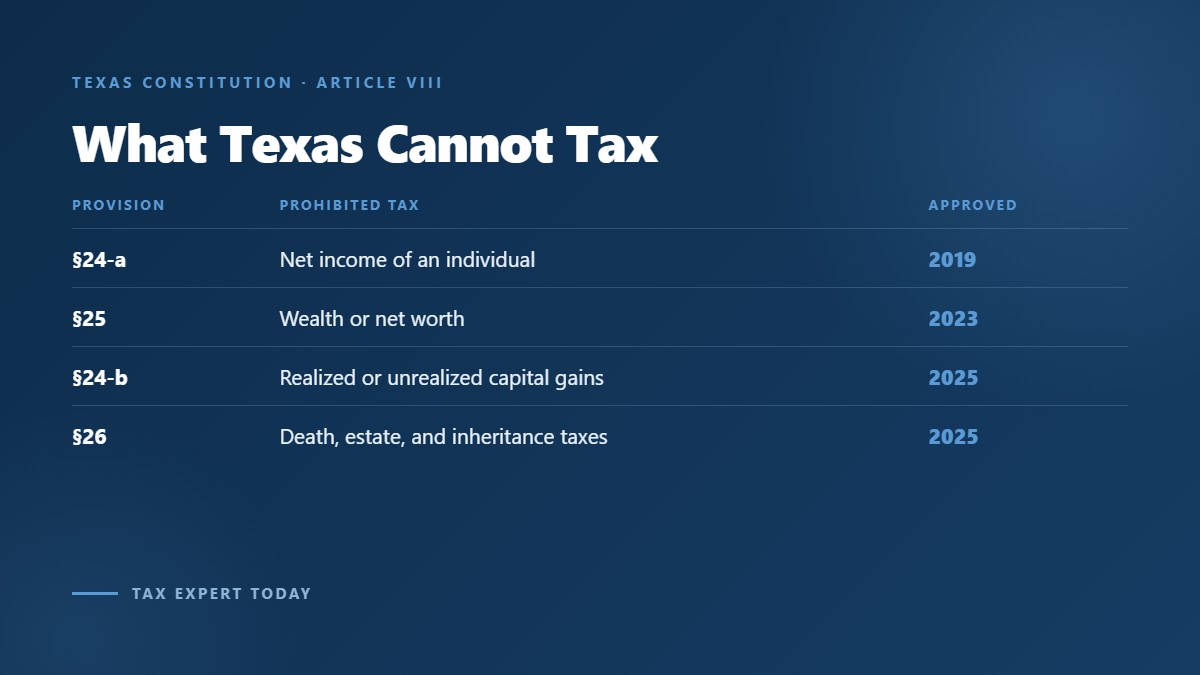
For a client weighing a long-term move, the estate and inheritance tax prohibition in H.J.R. 2 often matters as much as the capital gains provision, because it addresses the transfer of wealth rather than a single sale. Neither provision touches federal tax.
Section 24-b was adopted on the same day as Section 26, which bars a state death, estate, or inheritance tax. The companion guide to the Texas inheritance tax works through that prohibition and the basis rules that apply when an asset passes at death rather than by sale. Where the asset is given away during life instead, basis carries over rather than stepping up, a tradeoff our guide to Texas gift tax works through in detail.
What Federal Capital Gains Tax Do Texas Sellers Still Owe?
Federal tax applies in full. Gain on an asset held more than one year is long-term and taxed at 0, 15, or 20 percent depending on taxable income, while gain on an asset held one year or less is short-term and taxed at ordinary rates. For tax years beginning in 2026, the thresholds are set by Rev. Proc. 2025-32.
| Filing status (2026) | Maximum taxable income for the 0 percent rate | Top of the 15 percent rate band |
|---|---|---|
| Married filing jointly and surviving spouse | $98,900 | $613,700 |
| Head of household | $66,200 | $579,600 |
| Single and other individuals | $49,450 | $545,500 |
| Married filing separately | $49,450 | $306,850 |
| Estates and trusts | $3,300 | $16,250 |
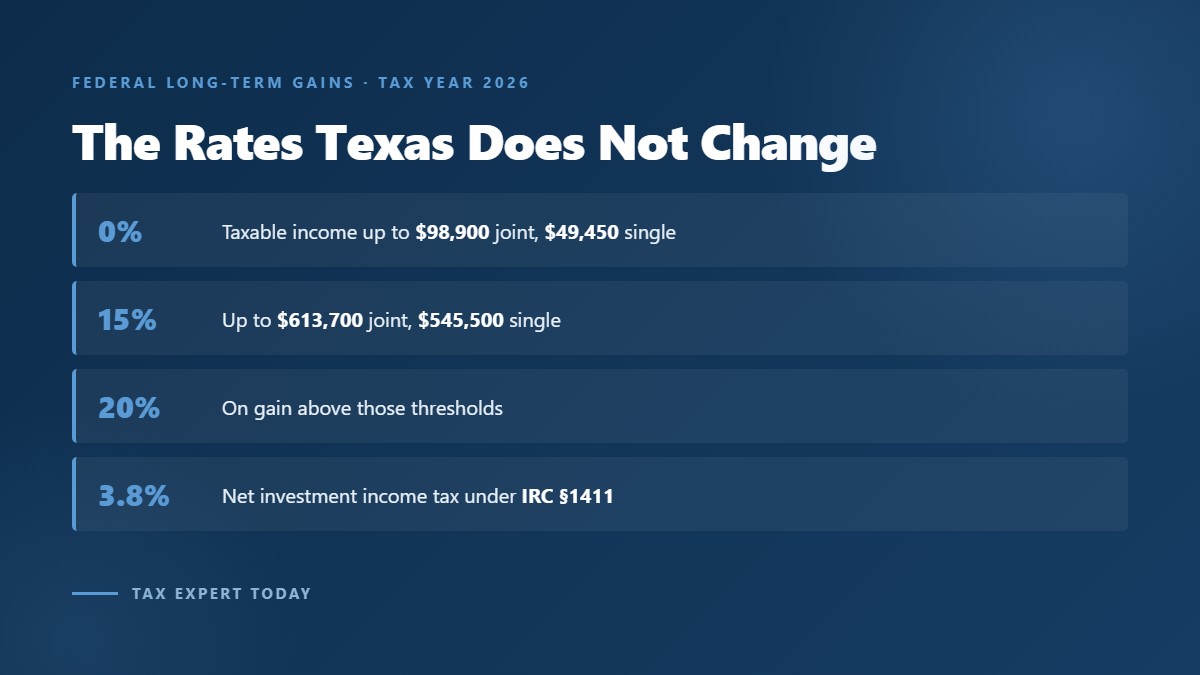
Taxable income above the top of the 15 percent band pushes the excess long-term gain to 20 percent. Note how compressed the brackets are for estates and trusts, which is why a sale held inside a non-grantor trust can reach the top rate on a modest gain.
Several federal items sit on top of those rates and are easy to miss when a seller is focused on the state question:
- Net investment income tax. IRC §1411 adds 3.8 percent on the lesser of net investment income or modified adjusted gross income above $250,000 for joint filers, $125,000 for married filing separately, and $200,000 for other individuals. These thresholds are statutory and are not adjusted for inflation, so a one-time sale frequently crosses them.
- Unrecaptured Section 1250 gain. Depreciation previously claimed on real property is taxed at a maximum 25 percent rate under IRS Topic no. 409 and IRC §1250.
- Collectibles and qualified small business stock. Net gain on collectibles is taxed at a maximum 28 percent rate, and the taxable portion of gain on IRC §1202 qualified small business stock carries the same 28 percent ceiling.
- Depreciation recapture on equipment. In an asset sale, amounts allocated to depreciated personal property are generally recaptured as ordinary income rather than taxed as capital gain, which changes the effective rate on that slice of the price.
Because Texas takes nothing, the entire planning benefit of a zero Texas capital gains tax sits in the state column, and the federal column is unchanged. Sizing those two columns separately is the correct way to evaluate a move before making a decision.
Can Moving to Texas Before a Sale Remove the Old State’s Tax?
Sometimes, and not automatically. Establishing Texas residency changes where you are taxed as a resident, but it does not change where income is sourced. A former state generally continues to tax gain that is sourced to it, and it taxes everything you received while you were still a resident there. The asset type and the closing date usually decide the outcome.
The general sourcing pattern, which varies by state and should be checked against the specific state’s rules, looks like this:
| What is being sold | Where the gain is generally sourced | Effect of moving to Texas first |
|---|---|---|
| Real property located in the former state | The state where the property sits | Generally none, the former state can still tax the gain |
| Tangible business assets located in the former state | The state where the assets are used or located | Generally none for that portion of the price |
| Corporate stock or an LLC or partnership interest | Often the seller’s state of residence when the sale closes | Can be significant if the move is complete and documented first |
| Goodwill and other intangibles of a multistate business | Frequently apportioned by the entity’s in-state activity | Partial at best, apportionment can follow the business |
| Installment payments received after the move | Often retains the character and source of the original sale | Limited, later payments can remain taxable to the former state |
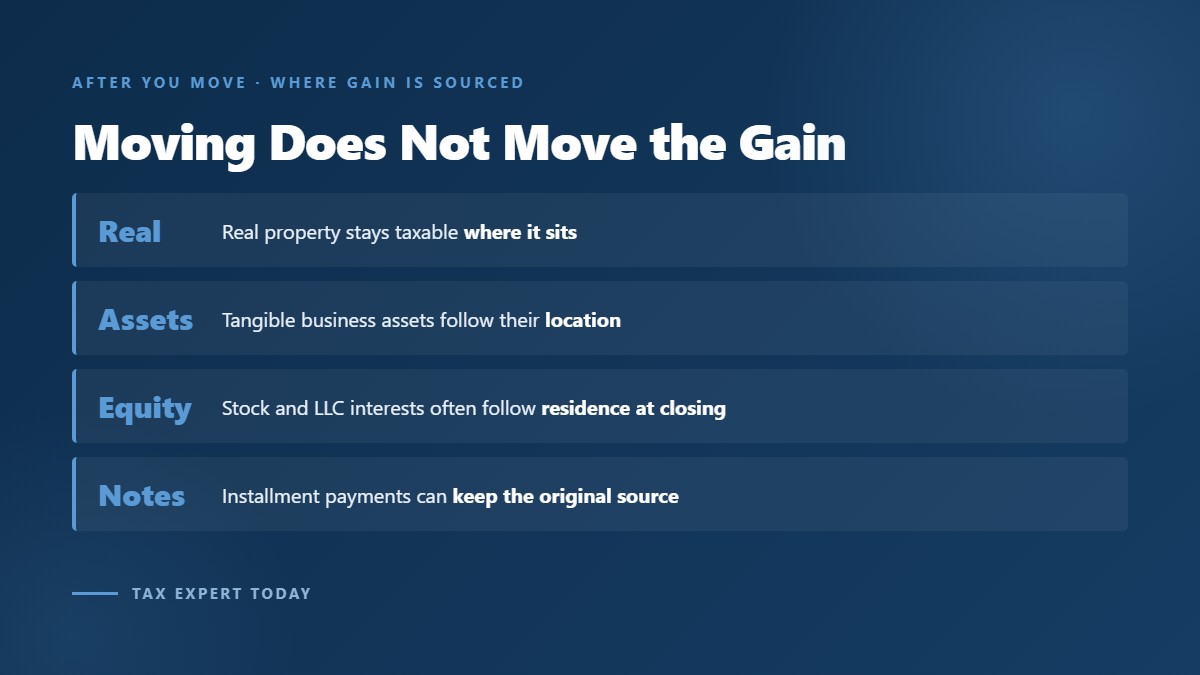
Four traps recur in practice. The first is a closing that happens before residency actually changes, which leaves the entire gain in the former state as resident income. The second is a binding sale agreement signed before the move, where a state may treat the economic event as substantially complete while the seller was still a resident. The third is the installment method under IRC §453, which spreads gain into later years and can carry the former state’s claim along with it, reported federally on Form 6252. The fourth is the residency audit itself, since a large gain in the year of a move is exactly the pattern that prompts a departure state to test whether the move was real.
States publish their own rules on this, and they are not uniform. California, for example, sets out its treatment of nonresidents and people who change residency in FTB Publication 1100, and taxpayers leaving that state should read our guides to leaving California and state taxes and part-year resident tax rules alongside this one. The mechanics of proving the Texas side of the move are covered in our guide to how to establish Texas residency. Owners who followed the same path to Florida may find the parallel discussion in moving to Florida before selling a business useful, since the sourcing analysis is similar even though the destination differs.
How Does the Texas Franchise Tax Reach a Business Sale?
Section 24-b protects an individual, family, estate, or trust. It does not by its terms exempt a taxable entity from the franchise tax, which is a margin tax rather than an income tax. When a Texas entity sells its assets, the proceeds and gain reported on the federal return can flow into total revenue for franchise tax purposes, depending on the entity type and how the sale is reported.
Total revenue for franchise tax purposes begins from specified federal return amounts under Tex. Tax Code Chapter 171, which is why the structure of the transaction matters. An equity sale by the owners and an asset sale by the entity can produce very different franchise tax results in the year of the sale, even where the federal outcome to the seller is similar. The same total revenue question reaches a royalty stream, which is covered in our guide to royalty income tax. The relevant figures for the 2026 and 2027 report years, confirmed with the Texas Comptroller, are a No Tax Due Threshold of $2,650,000, a rate of 0.375 percent for retail and wholesale and 0.75 percent for other taxable entities, a compensation deduction limit of $480,000, and an EZ computation rate of 0.331 percent for entities at or below $20 million in total revenue. The annual report is due May 15.
A one-time sale can lift an entity that is normally under the threshold above it for a single report year, which then requires a full report rather than an information report. Our guides to the Texas franchise tax and Texas LLC taxes cover the margin computation methods in detail, and owners relocating an operating company should also review the tax checklist for moving a business to Texas.
What Should You Document Before and After the Move?
Documentation is what turns a favorable sourcing position into a defensible one. A departure state reviewing a large gain will look at when domicile actually changed and whether the taxpayer’s pattern of life supports the claim. Contemporaneous records are far more persuasive than a reconstruction assembled after a notice arrives.
A practical file usually includes the closing date and the date the purchase agreement became binding, evidence of the date Texas domicile was established, day-count records for the year of the sale, the allocation of the purchase price among asset classes, appraisals supporting that allocation, and the apportionment data for any multistate operations. Where an installment note is involved, the amortization schedule and the sourcing position for each payment year should be documented once and applied consistently.
Capital Gains Tax Help in Naples & Southwest Florida
Tax Expert Today LLC advises business owners, executives, and families on the tax consequences of selling appreciated assets and on the multi-state questions that a relocation creates. Our team of tax advisors, enrolled agents, CPAs, and attorneys models the federal result, tests the sourcing position in the departure state, and coordinates the timing of a closing with the residency record. Because these are state tax matters that reach across state lines, we work with clients nationwide, including Texas residents and those planning a move to Texas, from our Naples office at 11983 Tamiami Trail N, Naples, FL 34110. Call (239) 441-2005, Monday through Friday, 10am to 5pm ET, or visit our Texas tax services and Naples tax planning pages.
When to Engage a Professional
Consider professional guidance when a sale is large relative to your other income, when the asset sits in a state that taxes income, when the buyer proposes an installment structure, or when the move to Texas and the closing fall in the same tax year. The interaction between residency timing, gain sourcing, the net investment income tax, and depreciation recapture is where sellers most often find an unexpected liability, and several of those levers can only be adjusted before the transaction closes. Outcomes depend on the asset, the state involved, the deal structure, and your broader tax picture, and this article is educational rather than advice on your specific facts. A planning conversation before the letter of intent is signed generally creates more options than a review afterward.
Frequently Asked Questions
Does Texas tax capital gains on real estate?
Texas imposes no state tax on the gain from selling real estate. Federal capital gains tax still applies, including the maximum 25 percent rate on unrecaptured Section 1250 gain from depreciation previously claimed. Property located outside Texas may remain taxable by the state where it sits, regardless of the seller’s Texas residency.
Can Texas ever enact a capital gains tax?
Not without another constitutional amendment. Article VIII, Section 24-b prohibits the legislature from imposing such a tax on an individual, family, estate, or trust. Changing that would require a new joint resolution passed by the legislature and approved by voters, which is a considerably higher barrier than ordinary legislation.
Do I still pay the 3.8 percent net investment income tax in Texas?
Yes. The net investment income tax under IRC §1411 is a federal tax and applies without regard to your state. It adds 3.8 percent on the lesser of net investment income or modified adjusted gross income above $250,000 for joint filers and $200,000 for most other individuals. Those thresholds are not indexed for inflation.
If I move to Texas in June and sell in August, is the gain tax free at the state level?
It depends on the asset and on whether the residency change was complete before the sale. Gain on real property or tangible assets located in the former state generally remains taxable there. Gain on stock or an ownership interest is often sourced to residence at closing, which is why the sequence and the supporting documentation matter.
Does the constitutional ban protect my LLC from the franchise tax on a sale?
No. The prohibition addresses taxes on the capital gains of an individual, family, estate, or trust, not the franchise tax on a taxable entity. Proceeds and gain from an asset sale can enter total revenue for the franchise tax margin computation, so the transaction structure should be reviewed before signing.
Where can I get help with capital gains planning from Naples, FL?
Tax Expert Today LLC, at 11983 Tamiami Trail N, Naples, FL 34110, advises clients on capital gains planning, business sale structuring, and multi-state residency questions, and serves clients in all 50 states, including Texas. The firm coordinates the federal analysis with the departure state position. Call (239) 441-2005, Monday through Friday, 10am to 5pm ET.
Published July 29, 2026 by Dr. Pellumb Kabashi « Back to Learning Center
Have a question this article touches on?
Tax Expert Today LLC, based in Naples, Florida and serving clients across the United States.
Schedule a Consultation (239) 441-2005