
By Dr. Pellumb Kabashi, DBA, MBA, CES, CFE, EA
Founder, Tax Expert Today LLC · Tax advisors, enrolled agents, CPAs, and attorneys · Serving clients in all 50 states
Quick Answer: Texas payroll taxes contain no state income tax withholding, because Texas imposes no personal income tax. What remains is a state unemployment tax paid to the Texas Workforce Commission at an effective rate between 0.32 and 6.32 percent for 2026 on the first $9,000 of each employee’s wages, plus the full federal payroll tax stack of Social Security, Medicare, and FUTA. Call (239) 441-2005 for a free consultation.
Most guidance on Texas payroll taxes stops at a rate table. That is enough for a payroll processor filling in a field, and it is not enough for an owner deciding whether to hire in Texas, an employer moving operations into the state, or a controller who has just discovered that the company became liable two quarters ago and never registered. This guide covers the mechanics that determine what you actually owe, including the statutory triggers that create liability, the arithmetic behind the published rate floor, and the one interaction between state and federal unemployment tax that costs more than any other mistake in this area.
Do Texas Payroll Taxes Include State Income Tax Withholding?
No. Texas imposes no personal income tax, so there is no state income tax withholding, no state W-4 equivalent, and no state withholding return to file. Texas payroll taxes for an employer consist of state unemployment insurance tax paid to the Texas Workforce Commission, plus the federal payroll taxes that apply in every state.
The absence of withholding is genuinely simplifying, and it is also the source of the most common misunderstanding among employers arriving from a withholding state. Removing state income tax withholding does not remove the employer from the state payroll system. Texas still runs an unemployment insurance program under the Texas Unemployment Compensation Act, and that program has its own registration, its own quarterly reporting, and its own rate calculation that has nothing to do with income tax.
- No state withholding certificate. Employees complete a federal Form W-4 and nothing at the state level.
- No state income tax return for the employer to file on behalf of employees, and no year end state reconciliation.
- A state unemployment tax account is still required once the employer meets any one of the liability tests described below.
- Quarterly wage reports still go to the state, because the unemployment program needs wage history even though no income tax is withheld.
- New hire reporting still applies, and it runs through the Office of the Attorney General rather than through a tax agency.
What Payroll Taxes Does a Texas Employer Actually Pay?
A Texas employer pays state unemployment tax to the Texas Workforce Commission and federal Social Security, Medicare, and FUTA taxes to the Internal Revenue Service. The employer also withholds federal income tax, the employee share of Social Security and Medicare, and the Additional Medicare Tax from employee wages, then remits those amounts on a deposit schedule.
It helps to separate the taxes the employer bears as a cost from the amounts the employer merely collects and forwards. The distinction matters for budgeting a Texas hire and for understanding which figures are negotiable through planning and which are fixed.
| Tax | Who bears it | 2026 rate | Wage base |
|---|---|---|---|
| Texas unemployment insurance (SUI) | Employer only | 0.32 to 6.32 percent | First $9,000 per employee |
| Federal unemployment (FUTA) | Employer only | 6.0 percent, reduced to 0.6 percent with full credit | First $7,000 per employee |
| Social Security (OASDI) | Employer and employee, each | 6.2 percent each | First $184,500 per employee |
| Medicare (HI) | Employer and employee, each | 1.45 percent each | No ceiling |
| Additional Medicare Tax | Employee only, no employer share | 0.9 percent | Wages above $200,000 |
| Federal income tax withholding | Employee, collected by employer | Per Form W-4 and the withholding tables | All wages |
| State income tax withholding | Not applicable in Texas | None | None |
Texas also imposes no state disability insurance tax, no paid family and medical leave contribution, and no paid sick leave assessment at the state level. Employers arriving from California, New York, New Jersey, or Washington should note that those line items simply disappear rather than converting into a Texas equivalent.
When Does a Texas Employer Become Liable for Unemployment Tax?
Liability begins when the employer meets any single test in the Texas Unemployment Compensation Act. The common tests are paying $1,500 or more in total gross wages in a calendar quarter, or employing at least one person during 20 different weeks in a calendar year. An employer already liable under FUTA that pays Texas wages is liable immediately.
That last trigger is the one that catches relocating employers, and it deserves emphasis. A company that already has employees in another state is already liable under the Federal Unemployment Tax Act. The moment it pays wages to a Texas employee, it is a liable Texas employer, without any waiting period and without regard to the $1,500 threshold or the 20 week count. There is no grace quarter for a first Texas hire.
Registration is due within ten days of becoming liable. The ten day clock runs from liability, not from the end of the quarter and not from the first payroll run.
| Employer type | Liability trigger |
|---|---|
| Already liable under FUTA | Immediately upon paying wages to a Texas employee |
| Regular employment | $1,500 or more in gross wages in a calendar quarter, or one employee in 20 different weeks in a calendar year |
| Domestic employment | $1,000 or more in cash wages in a calendar quarter |
| Farm and ranch labor | Three or more employees for 20 weeks, or $6,250 or more in gross wages in a calendar quarter |
| Section 501(c)(3) nonprofit | Four or more employees during 20 different weeks in a calendar year |
| Acquiring a liable business | Upon acquiring all or part of the organization, trade, business, or workforce |
| Political subdivisions | All are liable |
The 20 week tests contain a detail that is easy to miss. The weeks do not have to be consecutive, the employee does not have to be the same person across those weeks, and it makes no difference whether the work is full time or part time. A seasonal operation running a rotating crew can cross the threshold without ever having 20 continuous weeks of the same staffing.
What Is the Texas Payroll Taxes Rate for Unemployment in 2026?
For 2026 the minimum effective tax rate is 0.32 percent and the maximum is 6.32 percent, applied to the first $9,000 of each employee’s annual wages. The average rate across all Texas employers is 1.20 percent, and the average among experience rated employers is 0.99 percent. Both the floor and the ceiling rose from 2025.
The $9,000 taxable wage base is set by statute and has not moved in a decade. Because the base is low, the absolute cost per employee stays modest even at the top of the rate range, which is a meaningful contrast with states that apply unemployment tax to a much larger slice of wages.
| Year | Taxable wage base | Minimum rate | Maximum rate | Average rate | Average experience rate |
|---|---|---|---|---|---|
| 2026 | $9,000 | 0.32 percent | 6.32 percent | 1.20 percent | 0.99 percent |
| 2025 | $9,000 | 0.25 percent | 6.25 percent | 1.08 percent | 0.85 percent |
| 2024 | $9,000 | 0.25 percent | 6.25 percent | 1.05 percent | 0.81 percent |
| 2023 | $9,000 | 0.23 percent | 6.23 percent | 1.16 percent | 0.89 percent |
| 2022 | $9,000 | 0.31 percent | 6.31 percent | 1.35 percent | 1.13 percent |
Rates rose for 2026 at both ends of the range, and the average experience rate rose from 0.85 to 0.99 percent. An employer budgeting from a prior year figure will understate the 2026 cost, which is a small error per employee and a larger one across a growing headcount.
How Are the Five Components of the Texas UI Rate Calculated?
The effective rate is the sum of five components: the General Tax Rate, the Replenishment Tax Rate, the Obligation Assessment, the Deficit Tax Rate, and the Employment and Training Investment Assessment. Four of the five are set the same way for every employer in a given year. Only the General Tax Rate reflects an individual employer’s own history.
This decomposition is worth understanding rather than treating the rate as a single opaque number, because it shows precisely which part of the bill an employer can influence and which part is fixed by statewide conditions.
| Component | 2026 value at the floor | How it is determined |
|---|---|---|
| General Tax Rate (GTR) | 0.00 percent | Your benefit ratio multiplied by the 2026 replenishment ratio of 1.20 percent. Zero if you have no chargebacks over the measuring period. |
| Replenishment Tax Rate (RTR) | 0.21 percent | Flat for all employers. Already reduced by 0.10 percent to offset the ETIA. |
| Obligation Assessment (OA) | 0.01 percent | Bond obligation rate of 0.00 percent plus an interest tax rate of 0.01 percent. |
| Deficit Tax Rate (DTR) | 0.00 percent | The 2026 deficit tax ratio is 0.00 percent, so there is no deficit tax rate for 2026. |
| Employment and Training Investment Assessment (ETIA) | 0.10 percent | Flat 0.10 percent assessment on wages paid, offset by the RTR reduction. |
| Effective rate floor | 0.32 percent | The sum of the four fixed components when the General Tax Rate is zero. |
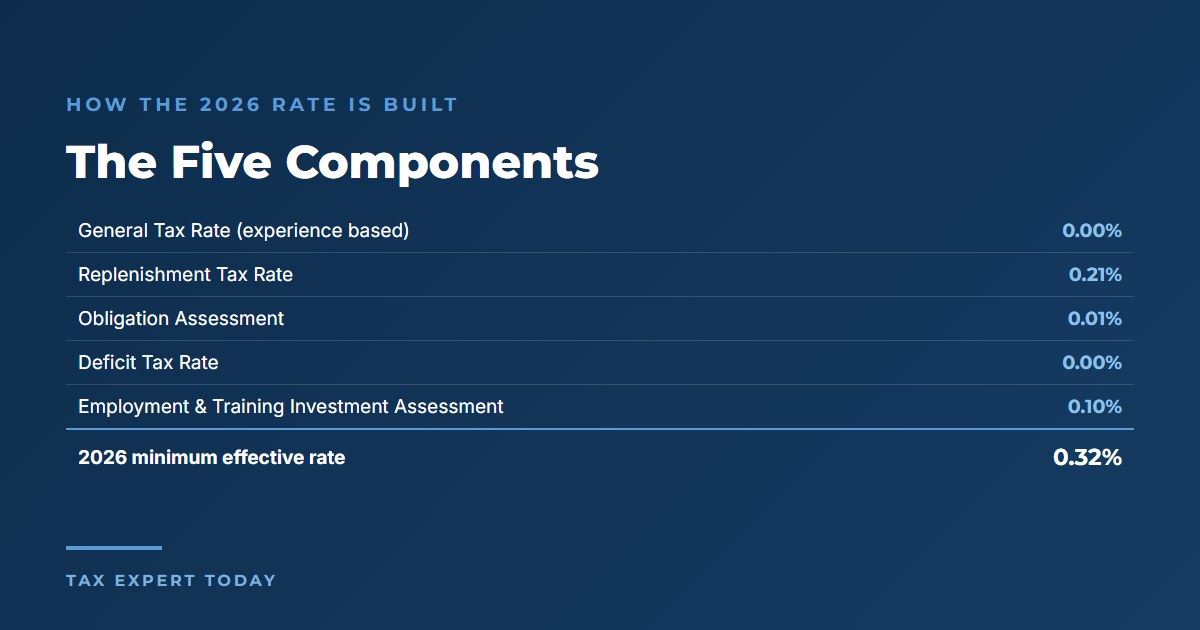
The arithmetic resolves cleanly. A Replenishment Tax Rate of 0.21 percent, plus an Obligation Assessment of 0.01 percent, plus an ETIA of 0.10 percent, equals 0.32 percent, which is exactly the published 2026 minimum. An employer with a spotless chargeback history pays the floor and nothing more, because the only component that responds to individual experience is already at zero.
The General Tax Rate is where employer behavior shows up. It equals the benefit ratio, which is three years of chargebacks divided by three years of taxable wages, multiplied by the replenishment ratio. The measuring window for the 2026 rate ran from the fourth quarter of 2022 through the third quarter of 2025, so a claim charged today affects rates for years afterward rather than immediately.
- Chargebacks drive the only variable component. Benefits paid to former employees and charged to your account are the numerator of the benefit ratio.
- Growing payroll dilutes the ratio, because taxable wages sit in the denominator across the same three year window.
- Late reporting can raise the General Tax Rate, so timeliness is a rate issue and not only a penalty issue.
- Rates are computed as of October 1 for the following calendar year, and rate notices are typically mailed in December.
- A voluntary contribution election allows some employers above the minimum rate to pay benefits directly instead of absorbing a higher rate.
What Rate Does a New Texas Employer Pay?
New Texas employers receive an entry level rate. Under TUCA section 204.006 the entry rate for each industry group is the higher of that group’s calculated average or 2.70 percent. For 2026 the entry level rate is 2.70 percent for all groups with no exceptions, and it applies until the employer completes four chargeable quarters.
The higher of rule is worth stating precisely, because many summaries describe 2.70 percent as a flat new employer rate. It is a floor rather than a fixed figure. TUCA section 204.005 directs the agency to calculate an average rate for each North American Industry Classification System group, and section 204.006 assigns the entry rate as the greater of that average or 2.70 percent. In a year when an industry group’s average exceeds 2.70 percent, new employers in that group pay the higher figure. For 2026 no group exceeded the floor.
The progression from entry rate to experience rate takes longer than most owners expect.
| Stage | What applies | Timing |
|---|---|---|
| Entry level rate | 2.70 percent for 2026, or the NAICS group average if higher | From liability until four chargeable quarters are complete |
| Interim rate | Based on taxable wages paid, timely payment, and any claims charged | For the remainder of the calendar year after four chargeable quarters |
| Experience rate | The full five component calculation | After the first four chargeable quarters and any interim period |
An employer is generally not chargeable until the third quarter in which it pays wages, and a minimum of six quarters of paid wages is required before an experience rating is assigned. A Texas operation opened in January should therefore plan on the entry rate for its first full year and part of its second.
How Much Does Texas Unemployment Tax Cost Per Employee?
Because the taxable wage base is only $9,000, the annual state unemployment cost per employee ranges from $28.80 at the 2026 minimum rate to $568.80 at the maximum. A new employer at the 2.70 percent entry rate pays $243.00 per employee per year, and the cost stops entirely once an employee crosses $9,000 in wages.
| Effective rate | Who it applies to | Annual cost per employee |
|---|---|---|
| 0.32 percent | 2026 minimum, no chargeback history | $28.80 |
| 0.99 percent | 2026 average among experience rated employers | $89.10 |
| 1.20 percent | 2026 average across all employers | $108.00 |
| 2.70 percent | 2026 entry level rate for new employers | $243.00 |
| 6.32 percent | 2026 maximum | $568.80 |
The practical consequence is that state unemployment tax is rarely the deciding cost in a Texas hiring decision. The gap between the best and worst rate is $540.00 per employee per year. That is real money across a large workforce, and it is small next to the federal exposure described in the next section, which is why the sequencing of payments matters more than the rate itself.
What Federal Payroll Taxes Apply to Texas Employers?
Texas employers owe the full federal payroll tax stack. Social Security is 6.2 percent from the employer and 6.2 percent from the employee on wages up to $184,500 for 2026. Medicare is 1.45 percent from each side with no ceiling. An Additional Medicare Tax of 0.9 percent is withheld from employee wages above $200,000 with no employer share.
The Social Security contribution and benefit base rose to $184,500 for 2026 from $176,100 for 2025. An employee at or above the ceiling contributes $11,439.00 to the Social Security program for the year, and the employer contributes the same amount.
| Federal tax | Employer share | Employee share | 2026 limit |
|---|---|---|---|
| Social Security | 6.2 percent | 6.2 percent | $184,500 of wages |
| Medicare | 1.45 percent | 1.45 percent | No ceiling |
| Additional Medicare Tax | None | 0.9 percent | Wages above $200,000 |
| FUTA | 0.6 percent with full credit | None | $7,000 of wages |
Two details on the Additional Medicare Tax trip up employers regularly. Withholding begins in the pay period in which wages exceed $200,000 for that employee and continues through the end of the year. The $200,000 withholding trigger is applied per employer without regard to the employee’s filing status or other household income, so an employee may be under withheld or over withheld relative to the amount ultimately due on the return.
How Does FUTA Interact With Texas Payroll Taxes?
FUTA is 6.0 percent on the first $7,000 of wages. A credit of up to 5.4 percent for state unemployment taxes paid reduces the effective rate to 0.6 percent. The full credit requires that Texas unemployment tax was paid in full and on time on the same wages, and that the state is not a credit reduction state.
This is the most expensive interaction in Texas payroll taxes, and it is the one that competitor rate tables almost never connect. The credit is not automatic. It is conditioned on the employer having actually paid its Texas unemployment tax, in full, by the due date, on the same wages that are subject to FUTA.
| Scenario | Effective FUTA rate | Annual FUTA cost per employee |
|---|---|---|
| Texas unemployment tax paid in full and on time | 0.6 percent | $42.00 |
| State tax unpaid, late, or on different wages | Up to 6.0 percent | Up to $420.00 |
| Difference | Up to 5.4 percent | Up to $378.00 |
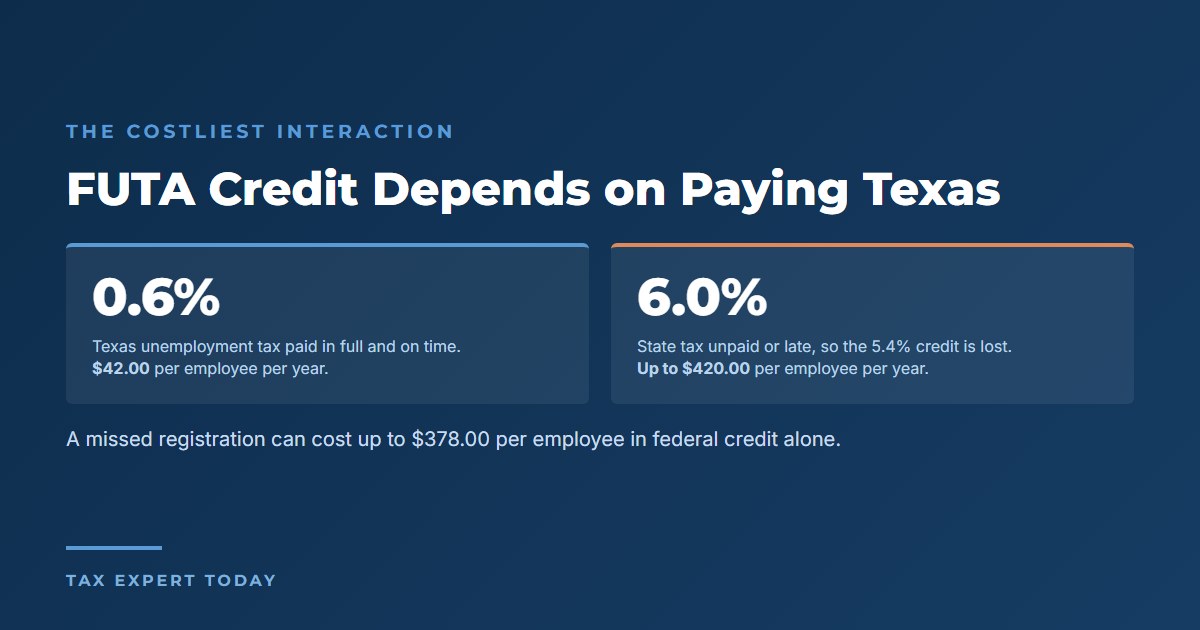
Consider the scale of that gap. An employer with 25 Texas employees that fails to register with the Texas Workforce Commission and therefore pays no state unemployment tax does not simply owe the state amount later. It also loses up to 5.4 percent of the federal credit, which is up to $378.00 per employee, or up to $9,450.00 across the workforce, on top of the state tax, interest, and any penalties. The federal consequence of a state registration failure is larger than the state tax itself, since Texas unemployment tax at the entry rate would have been $243.00 per employee.
- Pay the state tax on time to protect the federal credit. The credit turns on timeliness, not merely on eventual payment.
- Credit reduction states lose part of the credit when the state has outstanding federal loan balances, and the reduction is reported on Schedule A of Form 940. Check the current list each year rather than assuming.
- FUTA deposits are required for any quarter in which accumulated FUTA tax exceeds $500.
- Form 940 is annual, and is generally due January 31 for the preceding calendar year.
- The wage bases differ, at $7,000 for FUTA and $9,000 for Texas, so the two calculations do not share a stopping point.
When Are Texas Payroll Taxes and Reports Due?
Texas quarterly wage reports and unemployment tax payments are due by the last day of the month following the end of each calendar quarter. Federal Form 941 follows the same quarterly deadlines, while federal tax deposits follow either a monthly or a semiweekly schedule determined by a lookback period.
The state and federal calendars align at the quarterly filing level and diverge at the deposit level, which is where most compliance failures occur.
| Quarter | Period covered | Texas wage report and payment due | Form 941 due |
|---|---|---|---|
| Q1 | January through March | April 30 | April 30 |
| Q2 | April through June | July 31 | July 31 |
| Q3 | July through September | October 31 | October 31 |
| Q4 | October through December | January 31 | January 31 |

Federal deposit frequency is not a choice. It is determined before the year begins by looking back at reported liability. For calendar year 2026 the lookback period ran from July 1, 2024 through June 30, 2025. An employer that reported $50,000 or less of taxes in that window is a monthly schedule depositor. An employer that reported more than $50,000 is a semiweekly schedule depositor.
- Monthly depositors deposit by the 15th day of the following month.
- Semiweekly depositors deposit on a schedule keyed to payday, twice each week.
- The $100,000 next day rule overrides both. If accumulated employment taxes reach $100,000 or more on any day within a deposit period, the deposit is due by the next business day.
- New hire reports are due within 20 calendar days of the date the employee starts earning wages, filed with the Office of the Attorney General.
- Registration with the Texas Workforce Commission is due within ten days of becoming a liable employer.
The $100,000 next day rule catches growing companies during bonus or commission cycles. A single large payroll run can trigger a next business day deposit obligation for an employer that has been comfortably monthly all year, and the rule applies from the day the threshold is reached rather than from the next scheduled deposit date.
What Does an Employer Relocating to Texas Need to Do First?
An employer moving into Texas should register with the Texas Workforce Commission within ten days of paying the first Texas wages, confirm that new hire reports name Texas as the reporting state, and continue meeting any remaining obligations in the departure state. Existing FUTA liability makes the employer liable in Texas immediately, with no threshold period. An employer that is closing rather than arriving faces the reverse sequence, including a wage statement deadline that accelerates to the due date of the final Form 941, which our guide to closing a business in Texas covers.
Relocation is where Texas payroll taxes become genuinely multidisciplinary, because the questions span two state agencies and a federal one at the same time. Payroll tax help Naples clients ask about most often is not the Texas rate itself but the sequencing of the exit and the arrival.
- Register in Texas before assuming the threshold protects you. Prior FUTA liability makes the first Texas wage payment the trigger, not the $1,500 quarterly figure.
- Choose Texas as the reporting state for new hire reporting if you are a multi state employer. This is the only route by which the Texas Workforce Commission receives new hire information on Texas residents.
- Close out the departure state properly. Final wage reports, final withholding returns, and account closure requests are separate steps, and an unclosed account can generate assessments long after the last employee has moved.
- Do not assume the experience rate travels. A rate earned in another state does not transfer to Texas, so the entry level rate generally applies to the new Texas account.
- Watch the employee side. An employee who moves mid year may have part year residency and withholding obligations in the former state even after the employer has fully transitioned.
Employers moving operations should read our guide to moving a business to Texas alongside this one, since the entity, franchise tax, and sales tax steps run on their own timelines. Owners who are relocating personally will also want our guidance on how to establish Texas residency, because the personal and business analyses are separate and frequently conflated.
Do Independent Contractors and PEO Workers Count?
Payments to genuine independent contractors are not subject to Texas unemployment tax, and workers paid through a properly licensed Professional Employer Organization are reported by the PEO under its own account. Neither exception survives if the underlying facts fail, and misclassification shifts the liability back to the employer.
The Texas Workforce Commission is explicit that agreement between the parties does not determine status. An employer and a worker cannot contract into independent contractor treatment when the substance of the arrangement is employment, and the agency applies its own comparative analysis of service, wages, and direction and control.
The PEO exception carries a licensing condition that is easy to overlook. Only a properly licensed staff leasing company can be the employer of leased workers for TUCA purposes. If the PEO’s license is denied, revoked, or not yet active, each client company must report its own workers and pay tax under its own account number at its own assigned rate. An employer relying on a PEO has a direct interest in confirming that the license is active, because the consequence of an inactive license falls on the client rather than on the PEO.
- Independent contractor status is determined by the facts, not by the label in an agreement.
- A licensed PEO reports and pays under its own account, and the client does not report those wages.
- An unlicensed or inactive PEO shifts reporting back to the client, at the client’s own rate.
- An account inactive for more than three calendar years that resumes employment receives a new account number and a 2.7 percent rate.
What Happens to Your Rate When You Acquire a Business?
Experience rating transfers to a successor employer when all or part of another employer’s organization, trade, business, or workforce is acquired, the operation continues, and certain relationships exist between the parties. There is no provision for a voluntary total transfer of experience, and deliberately shifting operations to obtain a lower rate is unlawful.
Acquisitions therefore carry a rate consequence that belongs in diligence rather than in the first payroll run after closing. A buyer inheriting a seller’s chargeback history inherits a higher General Tax Rate along with it, and that cost persists across the three year measuring window.
Partial transfers are possible where the acquired part can operate independently, its wages are separate and distinct, and both parties sign an application that the agency approves. The filing deadlines are firm: postmarked within two years of the acquisition date for common ownership transfers, and within one year for transfers that are not under common ownership.
Practices designed to manufacture a lower rate by moving employees between related entities are known as State Unemployment Tax Act dumping, and they are unlawful. Any restructuring that has the effect of resetting an experience rate should be reviewed before it is implemented rather than defended afterward. Owners considering a sale should also review our guide to the tax treatment of selling a business.
Texas Payroll Tax Help in Naples & Southwest Florida
We advise employers on Texas payroll taxes from our office in Naples, Florida, and we serve clients in Texas and in all 50 states. The work is rarely about looking up a rate. It is about confirming when liability actually began, whether the federal unemployment credit is intact, how a relocation should be sequenced across two states, and whether a worker classification would survive review. Because the Texas Workforce Commission is a state agency rather than a federal one, this work sits alongside our federal practice rather than inside it, and our team includes tax advisors, enrolled agents, certified public accountants, and attorneys so that the state and federal pieces can be handled together.
Tax Expert Today LLC
11983 Tamiami Trail N, Naples, FL 34110
Phone: (239) 441-2005
Hours: Monday through Friday, 10:00 to 5:00 ET
We are based in Florida, so can you really handle a Texas payroll matter? Yes. Texas imposes no personal income tax and no state income tax withholding, so the state layer is the unemployment tax administered by the Texas Workforce Commission, which is handled remotely through its online systems in the same way a Florida reemployment tax matter is handled. The federal payroll layer of Social Security, Medicare, and FUTA is identical in both states. Southwest Florida employers expanding into Texas are a common engagement for us, and our Naples tax planning and advisory services pages describe how we structure that work.
When to Engage a Professional
Texas payroll taxes reward early review far more than late correction. Consider engaging an advisor when you are hiring your first Texas employee and are unsure when liability begins, when you have discovered that registration was missed and need to understand the federal credit exposure before it compounds, when an acquisition may carry a predecessor’s experience rating, when workers have been treated as contractors and the classification has never been tested, when a PEO relationship is ending, or when you are moving operations into or out of the state and need the two payroll systems sequenced. Outcomes depend on the specific facts, and the analysis needs actual wage data, account history, and rate notices rather than a general rule. Our guides to Texas LLC taxes and the Texas franchise tax cover the entity level questions that usually arrive with the payroll ones.
This article is educational and general in nature. It does not constitute tax advice for any particular taxpayer, and outcomes depend on individual facts and circumstances.
Published August 19, 2026 by Dr. Pellumb Kabashi « Back to Learning Center
Have a question this article touches on?
Tax Expert Today LLC, based in Naples, Florida and serving clients across the United States.
Schedule a Consultation (239) 441-2005