
By Dr. Pellumb Kabashi, DBA, MBA, CES, CFE, EA
Founder, Tax Expert Today LLC · Tax advisors, enrolled agents, CPAs, and attorneys · Serving clients in all 50 states
Quick Answer
To establish Texas residency for taxes, you make Texas your domicile: you move your permanent home there and form a genuine intent to stay. Texas imposes no personal income tax, so it runs no residency test of its own. The real test comes from the higher-tax state you are leaving, which may audit whether you truly abandoned domicile there. Objective evidence, a Texas driver license, voter registration, a homestead, and days actually spent in Texas, is what carries the burden.
What does it take to establish Texas residency for taxes?
To establish Texas residency for taxes, you must make Texas your domicile, meaning your true, fixed, and permanent home, and you must intend to remain there. Because Texas levies no personal income tax under Tex. Const. art. VIII, § 24-a, the state asks nothing of you to be treated as a resident. The scrutiny comes from the state you left.
This is the point most people miss. There is no Texas form that grants residency and no Comptroller registration that flips a switch. Instead, residency is proved after the fact, by the pattern of your life. When a former home state reviews your departure, it weighs where you actually live, where your family lives, where you keep your most valuable possessions, and where you spend your time. Establishing Texas residency is therefore less about a single act and more about relocating the center of your life and being able to document it.
Does Texas have a residency test or a 183-day rule?
No. Texas has no statutory residency test and no 183-day rule for income tax, because it has no individual income tax to apply one to. States that impose income tax, such as California and New York, use day-count and domicile tests to decide who owes. Texas simply has no reason to count your days.
That absence is a benefit and a trap at once. The benefit is obvious: once you are genuinely a Texan, no state income return is due to Texas. The trap is that the day-count discipline still matters, because your former state may run its own test in reverse. Many high-tax states treat a person as a resident if that person keeps a permanent home there and spends more than 183 days in the state during the year. So while Texas will not count your days, the state you left often will. Tracking presence remains essential even after the move.
What is domicile, and why does it decide your state taxes?
Domicile is your one true home, the fixed place you intend to return to after any temporary absence. Texas law defines residence as domicile in Tex. Elec. Code § 1.015, describing it as the home and fixed place of habitation to which a person intends to return. A person may own many houses, but may hold only one domicile at a time.
Domicile decides your state tax exposure because a change of domicile requires two things together: physical presence in the new place and the intent to make it home while abandoning the old one. Buying a Texas house while keeping your job, your doctors, your church, and most of your year in the old state generally does not change domicile. The law looks past labels to the facts. This is why relocation planning centers on aligning the objective record with the intent you claim, rather than on any single document.

What evidence proves Texas domicile?
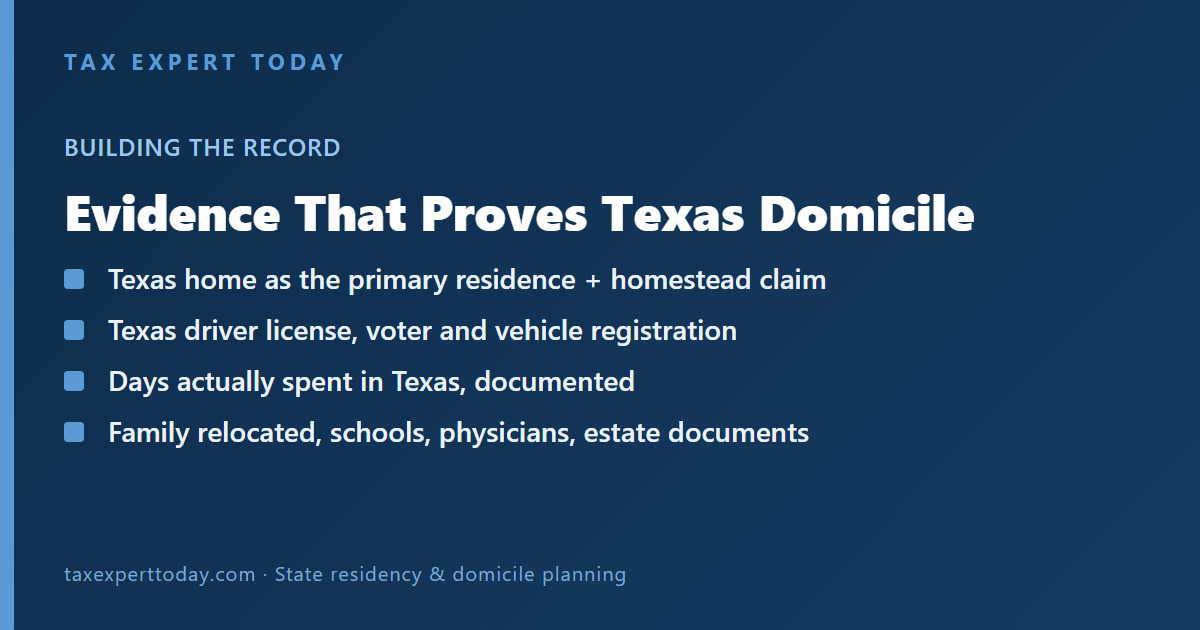
No single item proves domicile. Auditors weigh the whole picture, so the goal is a consistent record across the categories that signal where your life is genuinely centered. The strongest cases show Texas as the hub of home, family, time, and finances, not merely an address of convenience. The table below groups the evidence preparers most often assemble.
| Category | Evidence that supports Texas domicile | Notes |
|---|---|---|
| Home | Texas home owned or leased as the primary residence; homestead exemption claimed under Tex. Tax Code § 11.13 | The homestead claim is domicile evidence because you may claim it only on your principal residence, not a second home. |
| Official records | Texas driver license, Texas voter registration, Texas vehicle registration and titling | The DPS requires a Texas license within 90 days of establishing residency. |
| Time and presence | Day logs, travel records, and calendar showing the majority of the year in Texas | Presence is the fact most likely to be tested by a former home state. |
| Family and social ties | Spouse and dependents relocated, children enrolled in Texas schools, primary physicians and clergy in Texas | Where the family and daily life sit often carries more weight than any card. |
| Financial and professional ties | Texas bank branches, estate documents updated to Texas, professional advisors and memberships moved to Texas | Updating your will and trust to Texas law is a strong intent signal. |
According to the Texas Department of Public Safety, a new resident must obtain a Texas driver license within 90 days of establishing residency, and the agency treats acts such as registering to vote, enrolling children in school, or beginning employment as establishing residency. Its moving guide lists the documents that prove a Texas address. These steps do not, by themselves, decide a state income tax dispute, but each one adds to the objective record.
What does the departure state look at when it audits your move?
A former home state that taxes income may audit whether you actually abandoned domicile there, especially in a year with a large gain or bonus. The auditor compares the two states across the same domicile factors and asks where the weight of your life truly rests. The burden of showing a completed change of domicile generally falls on you.

| Factor the departure state weighs | What the auditor asks |
|---|---|
| Home | Which residence is larger, more valuable, and used as the primary home? |
| Days present | Where did you spend most of the year, supported by records rather than estimates? |
| Business ties | Where is your active work, and where are you physically when you perform it? |
| Family | Where do your spouse and dependents live and go to school? |
| Near and dear | Where are your heirlooms, pets, and the possessions you value most? |
This is the same battleground that residency disputes turn on when people move to any no-tax state. Our companion pieces on the California exit tax and on defending a residency move against an audit walk through the departure-state mechanics in depth. The Texas destination changes nothing about how a former state builds its case. What changes the outcome is the quality of your documentation and the cleanness of the break.
What does Texas not require to become a resident?
Texas does not require any state income tax filing, any residency registration, or any waiting period certificate, because it does not tax individual income. There is no Comptroller enrollment that makes you a resident and no annual state return for individuals. Your Texas status is established by living there, not by filing there.
Business owners are the exception to the no-tax comfort. While individuals owe no Texas income tax, entities that do business in Texas fall under the state franchise tax administered by the Texas Comptroller. Owners relocating a company should also work through our tax checklist for moving a business to Texas. Most small entities owe no franchise tax because their revenue sits below the no-tax-due threshold, which is set at 2,650,000 dollars in total revenue for the 2026 report year, yet they may still owe an information report. Our guide to the Texas franchise tax for business owners explains who files and what is due. Relocating your household to Texas and relocating your business to Texas are two separate projects, and the second carries its own registrations.
How should a high earner time a Texas move around a big income year?
Timing matters most when a large, one-time item of income lands near the move. Completing the change of domicile before the income is realized, and being able to prove it, is what determines whether the departure state can still reach the gain. The order of events, not merely the calendar year, is what an auditor examines.
In the year you move, you will usually file a part-year resident return in your former state for the portion of the year you lived there, then owe nothing to Texas afterward. Sourcing rules still let a former state tax income connected to that state, such as wages earned there or the sale of real property located there, even after you leave. For a liquidity event tied to a business, sequencing the move against the sale deserves careful planning, a subject we cover for departures generally and will expand for Texas specifically. High earners relocating for the no-income-tax advantage should also read what genuinely changes, and what does not, once they arrive, which we set out in our guide to Texas no state income tax. The savings are real, but they attach to a genuine change of home, not to a mailing address.
When the move is timed around a large sale, the state tax on the gain itself becomes the central question. Our guide to the Texas capital gains tax covers the constitutional ban added in 2025, the federal rates that still apply, and how a departure state sources the gain after a move.
Establishing Texas Residency: Help in Naples & Southwest Florida
Tax Expert Today is a multidisciplinary advisory firm led by Dr. Pellumb Kabashi and staffed by tax advisors, enrolled agents, CPAs, and attorneys. Residency and domicile are state tax matters, and because our practice is nationwide, we plan Texas relocations for clients from our Naples base and coordinate with the rules of whichever state a client is leaving. We help align the objective record with the intent behind the move, and we prepare the part-year and departure-state filings that a clean relocation requires.
You can reach the office here:
Tax Expert Today LLC
11983 Tamiami Trail N, Naples, FL 34110
Phone: (239) 441-2005
Hours: Monday to Friday, 10:00 a.m. to 5:00 p.m. ET
Can a Naples firm handle a Texas residency move? Yes. Texas residency and departure-state audits are governed by state law and case-by-case facts, not by where your advisor sits. We serve clients in all 50 states and regularly coordinate Texas relocations, including the part-year return owed to the state a client is leaving, from our Southwest Florida office.
When to Engage a Professional
Consider engaging a professional before you move if you expect a large income event near the transition, if you will keep property or a business in your former state, or if that state is one that audits departures closely. A short planning conversation early is far less costly than reconstructing a domicile record under audit later. A qualified advisor can map the evidence you need, set up the part-year filings, and coordinate the timing so the change of domicile is complete and documented before it matters. Learn more about our Texas tax services.
Frequently Asked Questions
How long does it take to establish Texas residency?
There is no fixed waiting period, because Texas has no income tax and no residency test. In practice, a change of domicile is complete once you have moved your permanent home to Texas and formed the intent to stay, and once the objective record supports it. The Texas DPS treats acts like registering to vote or beginning work as establishing residency and requires a Texas driver license within 90 days.
Do I have to file anything with Texas to become a resident?
No. Texas requires no state income tax return and no residency registration for individuals, because it does not tax individual income. Your residency is established by living in Texas with the intent to remain, not by filing a form. Business owners are separate, since entities doing business in Texas may owe the state franchise tax.
Can my old state still tax me after I move to Texas?
Yes, in defined situations. A former state can tax income sourced to that state, such as wages earned there or the sale of real property located there, and it can tax you as a resident for the part of the year before your domicile changed. If the state believes you never truly abandoned domicile, it may audit and assess the full year, which is why documentation matters.
Does buying a house in Texas make me a Texas resident?
Not by itself. Buying or leasing a Texas home is important evidence, but domicile requires both physical presence and the intent to make Texas your permanent home while abandoning the old one. If you keep your job, your family, and most of your year in the former state, an auditor may find your domicile never changed despite the Texas purchase.
Can a Naples firm handle my Texas residency planning?
Yes. Because residency and domicile questions are governed by state law and specific facts rather than by an advisor’s location, we plan Texas relocations for clients nationwide from our Naples, Florida office, including the departure-state and part-year filings a clean move requires.
If the decision between two no income tax states is still open, our comparison of Texas vs Florida taxes sets the two domicile routes and the two business tax systems next to each other.
Published July 20, 2026 by Dr. Pellumb Kabashi « Back to Learning Center
Have a question this article touches on?
Tax Expert Today LLC, based in Naples, Florida and serving clients across the United States.
Schedule a Consultation (239) 441-2005