
By Dr. Pellumb Kabashi, DBA, MBA, EA, CFE, CES
Founder, Tax Expert Today LLC · Tax advisors, enrolled agents, CPAs, and attorneys · Serving clients in all 50 states
Quick Answer: The IRS failure to file penalty is generally 5 percent of the unpaid tax for each month or part of a month a return is late, capped at 25 percent. It is figured on the balance left after timely payments and credits, so a refund return usually carries no penalty. Returns more than 60 days late face a minimum of $525 or the full tax due, whichever is less. Call (239) 441-2005 for a free consultation.
What is the IRS failure to file penalty?
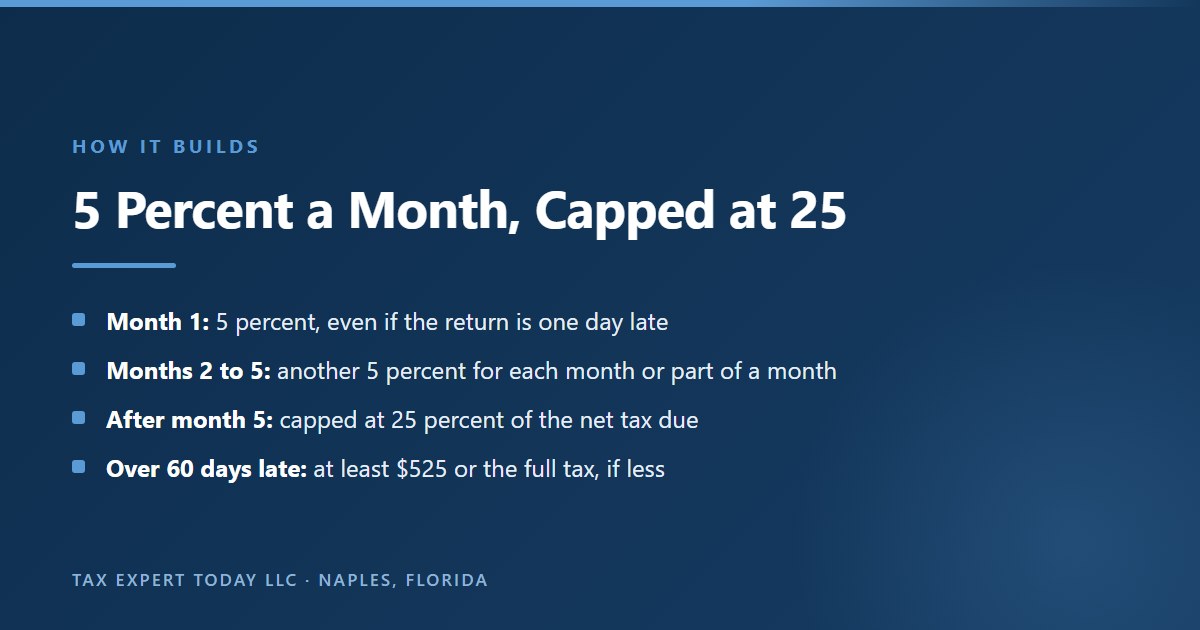
The failure to file penalty is a civil addition to tax under IRC §6651(a)(1) for a required return filed after its due date, including extensions, while tax is owed. It runs at 5 percent of the unpaid tax for each month or part of a month, up to 25 percent, unless the delay had reasonable cause.
The penalty exists to push people to file, not just to pay. Congress set it ten times higher than the monthly failure to pay rate, which tells you what the tax system values most: information. The IRS can work with a taxpayer who files on time and cannot pay. It has far fewer options with a taxpayer who goes silent, because without a return the agency does not know what is owed, cannot offer a payment plan on a known balance, and eventually has to build a return on its own.
For most individuals the penalty appears on a balance due notice months after the return is finally filed, listed as a separate line next to the failure to pay penalty and interest. Many people see the two penalty lines and assume they are the same charge counted twice. They are not, and the way they interact is one of the least understood parts of the failure to file penalty.
- Who it hits: individuals, corporations, estates, trusts, and other filers who owe tax with a late return.
- What it is measured on: the net tax due after timely payments and credits, not your gross tax.
- How fast it grows: 5 percent per month or part of a month, so one day late counts as a full month.
- Where it stops: 25 percent of the net tax due, usually reached after five months.
- How it is excused: reasonable cause, First Time Abate, or the newer Automatic Exemption from Penalty.
This guide explains how the IRS actually computes the failure to file penalty, works the arithmetic with hypothetical numbers, covers the business return versions that small business owners receive, and separates ordinary late filing from fraudulent failure to file. For the payment side of the story, our guide to the IRS failure to pay penalty covers the 0.5 percent monthly charge in depth.
How is the failure to file penalty calculated?
The IRS takes the tax required to be shown on the return, subtracts tax paid by the due date and credits claimed on the return, and multiplies the rest by 5 percent for each month or part of a month late. The total stops at 25 percent, with a minimum for income tax returns over 60 days late.
The statute lays this out in two pieces. IRC §6651(a)(1) sets the rate: 5 percent if the failure lasts not more than one month, with another 5 percent for each additional month or fraction of a month, not exceeding 25 percent in the aggregate. Then §6651(b)(1) tells you what the percentage applies to. The amount of tax required to be shown on the return is reduced by any part of the tax paid on or before the date prescribed for payment, and by any credit that may be claimed on the return.
The IRS failure to file penalty page walks through the same steps in plain order: tax required to be shown on the return, less any tax paid on time such as withholding or estimated tax payments, less available refundable credits, multiplied by 5 percent per month up to 25 percent.
| Step | What goes in | Where it comes from |
|---|---|---|
| 1. Start with the correct tax | Total tax required to be shown on the return | IRC §6651(a)(1) |
| 2. Subtract timely payments | Withholding, estimated payments, and extension payments made by the original due date | IRC §6651(b)(1) |
| 3. Subtract credits | Credits that may be claimed on the return, including refundable credits | IRC §6651(b)(1) |
| 4. Count the months | Each month or part of a month after the due date, including extensions | IRC §6651(a)(1) |
| 5. Apply the rate | 5 percent per month, capped at 25 percent | IRC §6651(a)(1) |
| 6. Check the minimum | For income tax returns more than 60 days late | IRC §6651(a), last sentence |
| 7. Apply the coordination credit | Reduce by the failure to pay penalty for overlapping months | IRC §6651(c)(1) |
Two points in that table do most of the work. First, the base is the correct tax, not whatever number you put on a late return and not whatever number the IRS put on a substitute return. Second, only payments made by the original due date reduce the base. A payment you send in June does not shrink the failure to file penalty for a return due in April, although it does slow the failure to pay penalty and interest from that point forward.
How are the months counted for the failure to file penalty?
The months run from the due date, as extended by a valid extension, to the date the IRS receives the return. Any part of a month counts as a full month, so one day late costs the same 5 percent as thirty days late, and five months and one day reaches the cap.
The partial month rule surprises people. If a 2025 Form 1040 was due on April 15, 2026 and arrives on April 16, 2026, the failure to file penalty is a full 5 percent of the net tax due. The second month begins on May 16, the third on June 16, and so on. In practice the penalty grows in steps, not in a smooth daily line, which matters when deciding whether to file an incomplete but accurate return now or a perfect return next week.
The filing date is generally the date the IRS receives the return. For paper returns, the timely mailing rule in IRC §7502 can treat a properly postmarked return as filed on the postmark date when it is mailed on or before the due date, but that rule protects timely returns, not late ones. Once you are already past the deadline, an e-filed return accepted today is the cleanest way to stop the count, because the acceptance record shows the date.
- Month 1: the day after the due date through the same day of the next month.
- Part of a month: counts in full, even if it is one day.
- Extension: a valid extension moves the starting point, not the payment deadline.
- Cap: month five and beyond add nothing more to this penalty.
What is the minimum failure to file penalty in 2026?
If an income tax return is more than 60 days late, counting from the extended due date, the failure to file penalty is at least the smaller of a fixed amount or 100 percent of the tax due. The IRS lists $525 for returns due after December 31, 2025, and $510 for returns due in 2025.
The minimum comes from the last sentence of §6651(a). The base figure written into the statute is $435, and it is adjusted for inflation each year. The IRS minimum penalty table for Forms 1040 and 1120 currently reads as follows.
| Return due date (without extension) | Minimum penalty if more than 60 days late |
|---|---|
| After December 31, 2025 | $525, or 100 percent of the tax due if less |
| January 1, 2025 to December 31, 2025 | $510, or 100 percent of the tax due if less |
| January 1, 2024 to December 31, 2024 | $485, or 100 percent of the tax due if less |
| January 1, 2023 to December 31, 2023 | $450, or 100 percent of the tax due if less |
| January 1, 2020 to December 31, 2022 | $435, or 100 percent of the tax due if less |
Three details about the minimum deserve attention. It only applies to returns of tax imposed by chapter 1 of the Code, which is income tax, so it does not apply to employment tax or excise tax returns. It only kicks in after 60 days, measured from the extended due date if an extension was valid. And it is a floor on a small balance, not an add-on. A taxpayer who owes $300 on a return filed 90 days late owes a failure to file penalty of $300, because 100 percent of the tax is less than $525. A taxpayer who owes nothing owes nothing, because 100 percent of zero is zero.
Many ranking pages still quote the 2024 figure of $485. If your return was due in 2026, the figure that applies is $525. If you are catching up on several years, each year uses the figure for that year’s original due date, which is why an older unfiled return can carry a lower minimum than a recent one.
How does the failure to file penalty interact with the failure to pay penalty?
When both penalties apply in the same month, IRC §6651(c)(1) reduces the failure to file penalty by the failure to pay penalty. A typical month costs 5 percent combined: 4.5 percent for filing late and 0.5 percent for paying late. After five months only the failure to pay penalty keeps running.
This coordination rule is why the two penalty lines on a notice are not double counting. The statute says that with respect to any return, the amount of the addition under §6651(a)(1) shall be reduced by the amount of the addition under §6651(a)(2) for any month to which both apply. The IRS restates the same rule: if both penalties apply, the failure to file penalty is reduced by the amount of the failure to pay penalty, and after five months the failure to file penalty maxes out while the failure to pay penalty continues.
There is one important limit. The coordination credit cannot push the failure to file penalty below the minimum described above. The last sentence of §6651(c)(1) says that in a case covered by the minimum, the failure to file addition shall not be reduced below that minimum. So on a small balance with a very late return, the minimum controls and the coordination credit does nothing.
- Months 1 to 5: about 4.5 percent for filing late plus 0.5 percent for paying late, for roughly 5 percent combined.
- After month 5: the failure to file penalty stops at 22.5 percent net of the credit, while the failure to pay penalty keeps adding 0.5 percent.
- Failure to pay cap: 25 percent, reached after about 50 months of nonpayment.
- Combined ceiling: roughly 47.5 percent of the net tax for ordinary late filing and late payment, before interest.
The failure to pay side has its own rules, including a reduced 0.25 percent monthly rate while an installment agreement is in effect for a timely filed return and an increase to 1 percent after a levy notice. Those details belong to the failure to pay penalty guide. For this page, the point is simple: the coordination rule exists, it is automatic, and it is one reason the failure to file penalty on your notice may look smaller than a simple 5 percent per month calculation.
What does the failure to file penalty look like in a worked example?
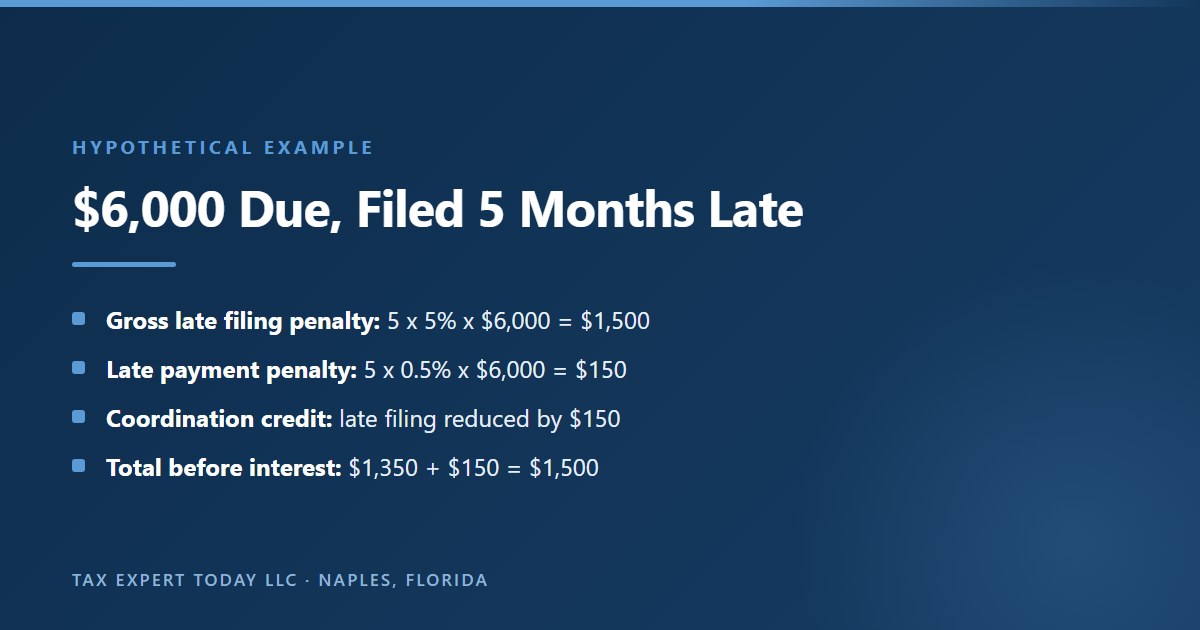
In a hypothetical case, a taxpayer with $10,000 of tax and $4,000 withheld files and pays on August 20, 2026 for a return due April 15, 2026. That is five months late on $6,000. The gross failure to file penalty is $1,500, and the $150 failure to pay credit cuts it to $1,350.
The numbers below are hypothetical and are not drawn from any client matter. They are there to show the mechanics. Interest is left out so the penalty arithmetic stays visible, and every figure assumes no reasonable cause or administrative relief applies.
| Line | Hypothetical amount | Note |
|---|---|---|
| Total tax required to be shown on the 2025 return | $10,000 | Correct tax, not an IRS estimate |
| Less withholding paid during 2025 | ($4,000) | Treated as paid on time |
| Net amount due on April 15, 2026 | $6,000 | The base for both penalties |
| Months late (April 16 to August 20) | 5 | The fifth month is a partial month |
| Gross failure to file penalty (5 x 5% x $6,000) | $1,500 | Exactly at the 25 percent cap |
| Failure to pay penalty (5 x 0.5% x $6,000) | $150 | Paid in full on August 20 |
| Coordination credit under §6651(c)(1) | ($150) | Same five months overlap |
| Net failure to file penalty | $1,350 | Above the $525 minimum, so the minimum does not control |
| Total penalties before interest | $1,500 | Exactly 25 percent of the net balance |
Now change one fact. Suppose the same taxpayer had filed Form 4868 by April 15, 2026 and sent $5,500 with it, leaving $500 unpaid, and then filed the return on November 20, 2026, after the extended due date of October 15, 2026. The extension was valid, so the failure to file clock starts on October 16. The return is two months late, counting the partial month, and only 36 days past the extended deadline, so the minimum does not apply.
| Line | No extension payment | With a $5,500 extension payment |
|---|---|---|
| Net amount due for penalty purposes | $6,000 | $500 |
| Months late for filing | 5 (from April 15) | 2 (from October 15) |
| Gross failure to file penalty | $1,500 | $50 |
| Failure to pay months | 5 | 8 |
| Failure to pay penalty | $150 | $20 |
| Coordination credit (overlapping months) | ($150) | ($5) |
| Total penalties before interest | $1,500 | $65 |
The difference is not the extension by itself. It is the payment that traveled with the extension. Because §6651(b)(1) measures the failure to file penalty on the net amount after timely payments, a well estimated extension payment shrinks the base for both penalties, and a valid extension pushes back the date on which the filing clock starts. That is the single most practical lesson in this guide, and it is also covered from the extension side in our article on what a tax extension does and does not do.
A third hypothetical shows the minimum at work. Assume a net balance of $400 on a return due April 15, 2026, filed and paid on July 20, 2026 with no extension. The return is 96 days late, so the minimum applies. The percentage calculation gives four months times 5 percent times $400, or $80, but the minimum is the lesser of $525 or 100 percent of the $400 tax, which is $400. The failure to file penalty is $400, and the coordination credit cannot reduce it below that floor. The failure to pay penalty adds another $8.
If you want to run your own figures, the IRS penalty and interest calculator on this site applies the same rules, including interest, and is a good way to sanity check a notice before calling the IRS.
Is there a failure to file penalty if you are owed a refund?
Generally no. The failure to file penalty is a percentage of the net tax due after timely payments and credits, so when withholding and credits exceed the tax, the penalty is zero, and so is the minimum. The real risk for a late refund return is losing the refund itself.
Under IRC §6511, a claim for refund generally has to be filed within three years from the time the return was filed or two years from the time the tax was paid, whichever is later, and an original late return can serve as the claim. Withholding and estimated tax are treated as paid on the original due date, so in practice a refund on a 2022 return due in April 2023 is at risk once April 2026 passes. After the window closes, the IRS keeps the overpayment and there is no penalty to argue about because there is no money to recover.
There is a trap here for people who assume they are owed a refund without running the numbers. Self employment tax, a 1099-K from a side business, a retirement distribution with too little withholding, or the loss of a credit can turn an expected refund into a balance due. If that happens, the failure to file penalty runs from the original due date on whatever net balance turns out to exist. The safest assumption is that a missing return is costing something until the return proves otherwise.
- Refund return, filed late: no failure to file penalty in the usual case.
- Refund return, filed more than three years late: refund generally lost under §6511.
- Balance due return, filed late: penalty from the original or extended due date.
- Business returns that show no tax: can still carry a penalty, as the next sections explain.
What is the penalty for a late partnership return under IRC 6698?
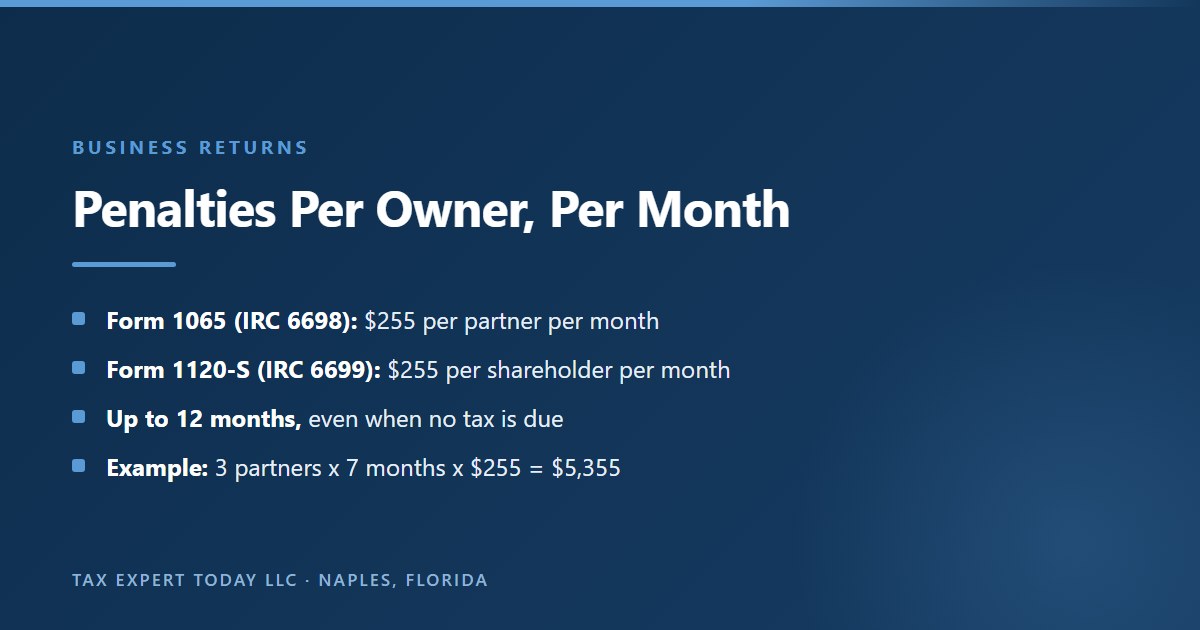
A partnership that files Form 1065 late or incomplete owes a penalty under IRC §6698 for each month or part of a month, up to 12 months. For 2025 returns filed in 2026, the IRS sets it at $255 times the number of partners during the year. It applies even when no tax is due.
This is the failure to file penalty that small business owners actually receive, and it catches many of them by surprise because a partnership does not pay income tax. The penalty is not a percentage of anything. It is a flat per partner, per month charge. Section 6698(b) starts at $195 and section 6698(e) adjusts it for inflation, and the 2025 Instructions for Form 1065 state the current figure as $255 for each month or part of a month, for a maximum of 12 months, multiplied by the total number of persons who were partners during any part of the tax year.
A few features make this penalty different from the individual version. It is assessed against the partnership itself under §6698(c). The deficiency procedures do not apply under §6698(d), so the IRS can assess it without first sending a notice of deficiency and the usual route to the Tax Court before payment is not available. It also applies to a partnership adjustment tracking report under the centralized audit regime. And it runs for up to 12 months, not 5.
| Hypothetical partnership | Partners | Months late | Penalty at $255 |
|---|---|---|---|
| Two member LLC taxed as a partnership | 2 | 3 | $1,530 |
| Three member LLC, 2025 Form 1065 due March 16, 2026, filed September 20, 2026 | 3 | 7 | $5,355 |
| Five member real estate partnership | 5 | 12 (the cap) | $15,300 |
| Same partnership, filed 18 months late | 5 | 12 (still the cap) | $15,300 |
The 2025 Form 1065 for a calendar year partnership was due March 16, 2026, because March 15 fell on a Sunday. A partnership that filed Form 7004 by that date had until September 15, 2026. The instructions also say not to attach a reasonable cause explanation to the return itself. If a penalty notice arrives after filing, the partnership may send an explanation and the IRS will decide whether it meets reasonable cause criteria.
What is the penalty for a late S corporation return under IRC 6699?
An S corporation that files Form 1120-S late or incomplete owes a penalty under IRC §6699 that mirrors the partnership rule: $255 per shareholder for each month or part of a month, up to 12 months, for 2025 returns. If the corporation also owes tax, the 5 percent penalty can apply on top.
Section 6699 uses the same structure as §6698. The base amount is $195, adjusted for inflation, multiplied by the number of persons who were shareholders at any time during the year. The 2025 Instructions for Form 1120-S state that for returns on which no tax is due, the penalty is $255 for each month or part of a month, up to 12 months, multiplied by the number of shareholders. If tax is due, the penalty is that amount plus 5 percent of the unpaid tax for each month or part of a month, up to 25 percent, and the minimum for a return required to be filed in 2026 that is more than 60 days late is the smaller of the tax due or $525.
Most S corporations owe no entity level income tax, so the per shareholder penalty is the one that shows up. A two shareholder S corporation that files its 2025 return a full year late faces 12 months times two shareholders times $255, or $6,120, even though the corporation owed nothing. That is a meaningful cost for a return that was mostly a formality, and it is why the deadline for the business return matters as much as the deadline for the owners’ personal returns.
- Who pays: the S corporation, under §6699(c).
- Deficiency procedures: do not apply, under §6699(d).
- Maximum months: 12, not 5.
- Shareholder count: anyone who was a shareholder at any point during the year counts.
- Relief: reasonable cause and First Time Abate are both available, as covered below.
What is the fraudulent failure to file penalty?
If a failure to file is fraudulent, IRC §6651(f) raises the rate from 5 percent to 15 percent per month and the cap from 25 percent to 75 percent. The IRS bears the burden of proving fraud, and it has to show a deliberate intent to evade tax, not just carelessness, procrastination, or financial hardship.
None of the leading pages on this topic explain much about this part of the statute, and it matters because people who have not filed for several years often fear they are automatically in fraud territory. They usually are not. Section 6651(f) applies only when the failure to file itself is fraudulent. Under IRC §7454(a), in any proceeding involving whether a taxpayer has been guilty of fraud with intent to evade tax, the burden of proof is on the IRS, and the Tax Court applies a clear and convincing evidence standard to that question.
Courts look for badges of fraud, which are circumstantial facts suggesting intent. Examples that commonly come up in reported cases include concealing assets, dealing heavily in cash to avoid records, giving false explanations to the IRS, filing false Forms W-4 claiming exemption from withholding, and failing to file while knowing that tax was owed for several years in a row. A single badge rarely decides a case. A pattern can.
| Feature | Ordinary failure to file | Fraudulent failure to file |
|---|---|---|
| Code section | IRC §6651(a)(1) | IRC §6651(f) |
| Monthly rate | 5 percent | 15 percent |
| Cap | 25 percent | 75 percent |
| Months to reach the cap | 5 | 5 |
| Who must prove it | Taxpayer must show reasonable cause to avoid it | IRS must prove fraud |
| Hypothetical penalty on $6,000 net due, 5 months | $1,500 gross | $4,500 gross |
| Abatement through First Time Abate | Possible if eligible | Not realistic |
The practical takeaway is the opposite of what fear suggests. Filing the missing returns, accurately and voluntarily, is the behavior that cuts against a finding of fraudulent intent. Waiting for the IRS to come looking does not make an ordinary late filer look better.
Is failure to file taxes a felony?
Willful failure to file a required return is a federal crime under IRC §7203, but it is a misdemeanor, not a felony, carrying fines up to $25,000 for individuals or $100,000 for corporations and up to one year in prison. Prosecution is uncommon and requires willfulness. Affirmative acts to evade tax can reach the felony statute, IRC §7201.
The civil failure to file penalty and the criminal statute are separate tracks. Section 7203 applies to any person required to make a return who willfully fails to make it at the time required by law, and it adds those criminal penalties in addition to other penalties provided by law. The partnership and S corporation penalty sections say the same thing from the other direction: §6698 and §6699 apply in addition to the penalty imposed by §7203.
Section 7201 is the felony. It covers anyone who willfully attempts in any manner to evade or defeat a tax or its payment, with fines up to $100,000 for individuals or $500,000 for corporations and up to five years in prison. Simply not filing is generally not enough for §7201. The government typically needs an affirmative act of evasion, such as hiding income, moving assets into nominee names, or lying to an investigator.
- Civil penalty: applies automatically when a return is late and tax is due, unless excused.
- Misdemeanor: willful failure to file under §7203, which requires a voluntary, intentional violation of a known legal duty.
- Felony: willful attempt to evade under §7201, which requires an affirmative act.
- Practical reality: most late filers face civil penalties and collection, not prosecution.
If you have several years of unfiled returns combined with cash income or assets held in other names, the analysis changes, and the order in which you approach the IRS matters. That is a situation for a confidential conversation with a professional before anything is filed, not a do it yourself project. Our guide to unfiled tax returns explains the general catch up process and the six year filing enforcement practice the IRS usually follows.
What happens to the failure to file penalty if the IRS files a substitute return for you?
When the IRS prepares a substitute return under IRC §6020(b), §6651(g) disregards it for the failure to file penalty, so you remain a nonfiler and the penalty generally runs to its 25 percent cap. The same IRS return counts as filed for the failure to pay penalty, which starts running.
The IRS can build a return from information it already has, such as Forms W-2, 1099, and 1098, under IRC §6020(b). That return usually uses single or married filing separately status and the standard deduction, and it often ignores the cost basis of property sold, business expenses, and dependents. The resulting tax figure is frequently higher than the correct tax. The IRS then sends a 30 day letter and, if nothing changes, a statutory notice of deficiency, the 90 day letter explained in our guide to the IRS notice of deficiency.
Section 6651(g) handles the penalties in two parts. Paragraph (1) says a §6020(b) return is disregarded for purposes of determining the failure to file addition. Paragraph (2) says it is treated as the return filed by the taxpayer for purposes of the failure to pay additions under §6651(a)(2) and (a)(3). The combined effect is that a substitute return does not stop the failure to file penalty, but it does start the failure to pay penalty on the tax it shows.
Here is the part that matters for the failure to file penalty. The penalty is figured on the amount required to be shown as tax, which is the correct tax, reduced by timely payments and credits. If the substitute return overstates the tax, filing an accurate original return can lower the base on which both the tax and the failure to file penalty are computed. The return does not erase the months that have already passed, and the IRS has to process it, but a correct return is usually the strongest response to an inflated substitute assessment. Whether that is done through the deficiency process, an audit reconsideration, or another route depends on where the case sits when you act.
| Question | Effect of an IRS substitute return under §6020(b) |
|---|---|
| Does it count as your return for the failure to file penalty? | No, §6651(g)(1) |
| Does it count as your return for the failure to pay penalty? | Yes, §6651(g)(2) |
| Is the tax on it the base for the failure to file penalty? | The base is the tax required to be shown, meaning the correct tax |
| Can filing a correct original return change the result? | It can, depending on timing and on IRS processing |
| Does it start a refund clock? | A refund generally requires a claim filed by the taxpayer within the §6511 limits |
Does interest accrue on the failure to file penalty?
Yes, and earlier than most people expect. Under IRC §6601(e)(2)(B), interest on the failure to file penalty runs from the due date of the return, including extensions, until the penalty is paid. Many other penalties only start accruing interest if they are not paid within 21 calendar days after notice and demand.
Section 6601(e)(2) splits penalties into two groups. The general rule in subparagraph (A) says interest on an assessable penalty or addition to tax runs only if it is not paid within 21 calendar days from notice and demand, or 10 business days if the amount is $100,000 or more. Subparagraph (B) carves out the failure to file addition under §6651(a)(1), along with a few others, and says interest on it runs from the date the return was required to be filed, including extensions, to the date of payment.
In practice this means that a failure to file penalty assessed today on a return that was due two years ago comes with two years of interest attached to the penalty itself. The interest rate is the federal underpayment rate, set quarterly and compounded daily. The IRS states on its administrative relief page that when a penalty is reduced or removed, the interest related to that penalty is reduced or removed automatically, which is one more reason abatement requests can be worth more than the face amount of the penalty.
- Interest on the tax: from the original due date, without regard to extensions.
- Interest on the failure to file penalty: from the due date including extensions, under §6601(e)(2)(B).
- Interest on most other penalties: only if unpaid 21 days after notice and demand.
- When a penalty is abated: related interest comes off with it.
Does a tax extension stop the failure to file penalty?
A valid extension holds off the failure to file penalty until the extended due date, October 15 for most individuals. It does not extend the time to pay, so the failure to pay penalty and interest still run from April, and an extension without a properly estimated tax can be treated as invalid.
Form 4868 grants an automatic six month extension of time to file. Treas. Reg. §1.6081-4 lists the conditions, and one of them is that the application must show the full amount properly estimated as tax for the year. Paragraph (c) of the same regulation states that an automatic extension of time for filing will not extend the time for payment of any tax due. Paragraph (d) allows the IRS to terminate an automatic extension by mailing a notice at least 10 days before the termination date.
The properly estimated requirement is usually satisfied by a good faith estimate based on information available at the time. It does not have to be exact. The risk arises when the estimate is plainly unreasonable, such as entering zero tax for a taxpayer who knows they had a large capital gain. In that situation the IRS can take the position that no valid extension existed, and the failure to file penalty runs from April rather than October.
| What you did by April 15, 2026 | Failure to file penalty starts | Failure to pay penalty starts |
|---|---|---|
| Filed the return, paid in full | Never | Never |
| Filed the return, paid nothing | Never | April 16, 2026 |
| Valid extension, paid the estimated balance | October 16, 2026 if still unfiled | Only on any shortfall |
| Valid extension, paid nothing | October 16, 2026 if still unfiled | April 16, 2026 |
| Nothing filed, nothing paid | April 16, 2026 | April 16, 2026 |
If you cannot pay, the right move is almost always to file anyway. Filing on time and paying nothing produces a 0.5 percent monthly charge. Not filing and paying nothing produces roughly 5 percent per month for the first five months. Our guide to the IRS installment agreement options covers how to set up payments once the return is in.
Does the IRS waive the failure to file penalty?
Often, if you qualify. The IRS offers three main routes: the new Automatic Exemption from Penalty, which began in summer 2026 for 2025 tax year returns; First Time Abate, which requires a request; and reasonable cause relief, which depends on facts showing ordinary business care and prudence. Each has different requirements and paperwork.
The biggest change on this topic in years is on the IRS administrative penalty relief page, last updated on October 22, 2026. It states that First Time Abate is transitioning to a new relief called Automatic Exemption from Penalty, or AEP, starting summer 2026. Under AEP, if you file or pay late in the current year but timely filed returns and paid tax due for the three prior years, or 12 consecutive quarters for quarterly filers, the IRS does not assess the penalty at all.
According to the IRS, AEP applies when an original return completes processing, it covers 2025 tax year returns and 2026 quarterly returns and later periods, and the eligible return series listed are Forms 1040, 1065, and 1120, plus Forms 940, 941, 943, 944, 945, and CT-1. The IRS says you will receive a letter explaining that the penalties were not assessed because of your timely compliance history, and you do not need to contact the IRS or respond. Form 1120-S is not named in that AEP list as of the October 2026 update, although §6699 penalties remain eligible for First Time Abate.
| Relief route | How it is granted | Main requirement | Where to read more |
|---|---|---|---|
| Automatic Exemption from Penalty | Automatic, no request | Clean three year history; 2025 returns and later | IRS administrative relief page |
| First Time Abate | By phone, letter, or Form 843 | Clean three year history; all required returns filed; balance paid or in a payment arrangement | First time penalty abatement |
| Reasonable cause | Written request with facts and documents | Ordinary business care and prudence, yet still unable to file | Reasonable cause abatement |
| Disaster postponement | Usually automatic for covered addresses | Address in a covered disaster area under IRC §7508A | IRS disaster relief announcements |
First Time Abate. FTA remains available for the 2025 tax year where AEP does not apply and for all earlier years. The IRS page says you must contact the IRS to request it, by calling the number on your notice or sending a written statement or Form 843, but you do not need to name FTA specifically. The eligibility details, including the three year look back and the payment requirement, are covered in our guide to first time penalty abatement.
Reasonable cause. Under Treas. Reg. §301.6651-1(c), a delay is due to reasonable cause if the taxpayer exercised ordinary business care and prudence and was nevertheless unable to file on time. Serious illness, a death in the immediate family, a fire or casualty, and records destroyed by events outside your control are the usual examples. Reliance on a preparer to file is generally not enough by itself, because the duty to file on time cannot be delegated. Our reasonable cause penalty abatement guide covers how to document a request.
For a broader view of every penalty relief path, including penalties that are not covered by FTA or AEP, see our guide on how to get IRS penalties removed.
What notice tells you that you owe a failure to file penalty?
The penalty normally appears on the balance due notice the IRS sends after it processes a late return, often a CP14, listed separately from tax, the failure to pay penalty, and interest. If the IRS prepared a substitute return, the penalty can show up on the assessment that follows the deficiency process instead.
The IRS says it sends a notice or letter if you owe the failure to file penalty. For most individuals that is the first balance due notice, explained in our guide to the IRS CP14 notice. If the balance stays unpaid, the notice sequence continues through reminders and, eventually, the CP504 notice of intent to levy and the final notice under Letter 1058 or LT11, which is often sent by certified mail. If you are holding a certified mail slip and do not know what it is, our guide to a certified letter from the IRS helps identify it.
Before responding, it helps to request an account transcript for the year. The transcript shows the date the IRS treated the return as received, the payments it credited and their dates, and each penalty as its own entry. Most disputes about the failure to file penalty come down to one of those three facts: the received date, a timely payment that was not credited, or a credit that should have reduced the base. The IRS topic on notices, penalties, and interest describes the general framework.
- Check the received date: an e-file acceptance or a certified mail receipt can prove an earlier date.
- Check the payments: an extension payment credited to the wrong year inflates the base.
- Check the credits: refundable credits reduce the base under §6651(b)(1).
- Check the minimum: make sure the IRS used the figure for the correct year.
- Check eligibility for relief: AEP, FTA, or reasonable cause before paying the penalty.
Does the failure to file penalty apply to payroll and other business returns?
Yes. The 5 percent per month failure to file penalty under §6651(a)(1) applies to many business returns, including Form 1120 and quarterly employment tax returns such as Form 941. The minimum for returns more than 60 days late applies only to income tax returns, and partnerships and S corporations use the separate per owner penalties described above.
The IRS failure to file penalty page states that the penalty applies to individuals and businesses that fail to file forms including Form 1040 and Form 1120, and it lists partnership returns separately. For employment tax, the late filing penalty is usually small compared with the failure to deposit penalty and, when trust fund taxes go unpaid, the personal liability that can follow under the trust fund recovery penalty. A business that is behind on payroll returns has a more urgent problem than the filing penalty itself.
| Return | Late filing penalty | Statute | Cap |
|---|---|---|---|
| Form 1040 | 5% of net tax due per month; minimum after 60 days | §6651(a)(1) | 25% |
| Form 1120 | 5% of net tax due per month; minimum after 60 days | §6651(a)(1) | 25% |
| Form 1065 | $255 per partner per month (2025 returns) | §6698 | 12 months |
| Form 1120-S | $255 per shareholder per month (2025 returns), plus 5% on any tax due | §6699 and §6651 | 12 months; 25% on tax |
| Form 941 | 5% of net tax due per month; no income tax minimum | §6651(a)(1) | 25% |
| Any return, fraudulent failure | 15% of net tax due per month | §6651(f) | 75% |
What mistakes make the failure to file penalty larger than it needs to be?
The most expensive mistakes are waiting to file until you can pay, filing an extension with no payment and no realistic estimate, sending payments without designating the right tax year, and ignoring a substitute return. Each one either enlarges the base the penalty is measured on or extends the months it runs.
Most failure to file penalty problems are not caused by the rate. They are caused by timing and by small administrative errors that compound. The list below comes from the structure of the statute rather than from any particular case, and each item points to a step you can control.
- Waiting to file until you can pay: the filing penalty is ten times the payment penalty, so the wait is the costly part.
- A zero estimate on Form 4868: an estimate that ignores known income invites the argument that no valid extension existed.
- Undesignated payments: a payment applied to the wrong year does not reduce the base for the year that was late.
- Ignoring a substitute return: the IRS figure often overstates the tax, and the failure to file penalty is measured on the correct tax, not the inflated one.
- Paying the penalty before asking for relief: relief is still available after payment through a refund claim, but it is simpler to raise eligibility first.
- Forgetting the business return: owners often file their personal returns on time and miss the 1065 or 1120-S, which carries its own per owner penalty.
Another common error is treating the failure to file penalty as the only exposure. A late return that also understates income can draw the accuracy related penalty on the understatement, and a return that takes positions with no basis in law can draw the frivolous tax return penalty. Filing late is fixable. Filing late and inaccurately creates a second problem on top of the first.
How does the failure to file penalty work for older unfiled years?
Each year is computed separately, using that year’s due date, that year’s net balance, and that year’s minimum penalty figure. For a return several years overdue, the ordinary failure to file penalty has long since reached 25 percent, so filing now does not raise it further, but interest on both the tax and the penalty keeps growing until paid.
People with several missing years sometimes assume the penalty grows without limit the longer they wait. For the ordinary failure to file penalty that is not true. After five months it is capped. What keeps growing is the failure to pay penalty, up to its own 25 percent cap, and interest, which has no cap. That is why the cost of delay for older years shows up mostly as interest, and why the collection clock matters as much as the penalty.
The IRS collection statute generally gives the agency ten years from assessment to collect, as covered in our guide to the IRS 10 year rule. For a year with no return, there is no assessment and the clock has not started. Filing starts it. That is one reason the order and timing of catch up filings is a strategic decision, not just a paperwork exercise. Programs sometimes grouped under the IRS Fresh Start label, such as streamlined installment agreements and offers in compromise, generally require that all required returns be filed first.
| Unfiled year (hypothetical) | Original due date | Minimum penalty figure if over 60 days late | Failure to file penalty status in November 2026 |
|---|---|---|---|
| 2025 | April 15, 2026 | $525 | At or near the 25 percent cap |
| 2024 | April 15, 2025 | $510 | At the 25 percent cap |
| 2023 | April 15, 2024 | $485 | At the 25 percent cap |
| 2022 | April 18, 2023 | $450 | At the 25 percent cap |
Large balance due notices can also carry consequences outside the penalty itself. A seriously delinquent tax debt above the annually indexed threshold can be certified to the State Department, which can affect a passport, as explained in our guide to IRS passport revocation. Filing and arranging payment is usually what removes a taxpayer from that category.
How do you stop the failure to file penalty from growing?
File the return. The penalty stops accruing on the date the IRS receives a valid return, and it cannot grow past 25 percent in any case. Paying as much as you can at the same time slows the failure to pay penalty and interest, and once the return is filed, payment options such as an installment agreement become available.
That advice sounds obvious, but people often delay filing because they cannot pay, because records are missing, or because they are afraid of what the return will show. Each of those reasons makes the problem larger. Missing records can usually be rebuilt from IRS wage and income transcripts, bank statements, and third party records. A return that shows a balance you cannot pay opens the door to payment arrangements that a missing return does not.
Once returns are filed and the balance is known, the main collection alternatives are an installment agreement, a partial payment installment agreement, currently not collectible status, and an offer in compromise. Penalties are part of the balance in each of those, and a penalty abatement request can be pursued alongside them. Before an offer or installment agreement, it is usually worth asking whether the failure to file penalty itself can be removed, because a smaller balance changes the math on every option.
- Gather records: request wage and income transcripts for each missing year.
- File the most recent year first when deadlines or refunds favor it, then work back.
- Pay what you reasonably can with the return to slow the failure to pay penalty.
- Check AEP and FTA eligibility before paying any assessed penalty.
- Choose a collection alternative for the remaining balance, if needed.
Failure to file penalty help Naples: tax resolution Naples and Southwest Florida
Tax Expert Today LLC provides IRS tax resolution from its Naples, Florida office: back taxes and IRS tax debt, payment plans and installment agreements, offers in compromise, wage garnishment and bank levy release, federal tax lien withdrawal, penalty abatement, unfiled returns, and audit representation. The firm is led by Dr. Pellumb Kabashi, an Enrolled Agent with unlimited rights to represent taxpayers before the IRS, a Certified Fraud Examiner, and a Certified Estate and Trust Specialist, with a team of enrolled agents, CPAs, and tax attorneys.
Florida has no state personal income tax, so for most Naples and Collier County residents the failure to file penalty is a federal problem only. That simplicity can be misleading. Southwest Florida has a large population of seasonal residents, retirees with required minimum distributions and little withholding, real estate investors with partnership and S corporation returns, and small business owners whose 1065 or 1120-S filings drive the per owner penalties described above. Hurricane seasons also matter: when a federal disaster declaration covers Collier or Lee County, the IRS has historically postponed filing deadlines under IRC §7508A, and a penalty notice issued for a postponed period may be correctable.
If you received a balance due notice with a late filing penalty, have unfiled years, or run a partnership or S corporation that missed its deadline, our team can review the transcripts, test the penalty computation, and pursue relief where the facts support it. Learn more about our Naples tax resolution services, our IRS resolution and audit support, and IRS tax debt help Naples residents use when a balance has already been assessed.
Tax Expert Today LLC
11983 Tamiami Trail N, Naples, FL 34110
Phone: (239) 441-2005
Hours: Monday to Friday, 10 a.m. to 5 p.m. ET
Frequently Asked Questions About the Failure to File Penalty
What is the failure to file penalty for 2026?
For returns due in 2026, the failure to file penalty is generally 5 percent of the net tax due for each month or part of a month the return is late, up to 25 percent. If an income tax return is more than 60 days late, the minimum is the smaller of $525 or 100 percent of the tax due.
Is failure to file worse than failure to pay?
Yes, in most cases. The failure to file penalty runs at 5 percent per month, while the failure to pay penalty runs at 0.5 percent per month. Filing on time even when you cannot pay generally avoids the larger of the two charges.
Does the IRS waive the failure to file penalty?
It can. For 2025 tax year returns and later, the IRS Automatic Exemption from Penalty may prevent the penalty from being assessed for taxpayers with a clean three year history. First Time Abate and reasonable cause relief remain available for other cases, subject to their requirements.
Is there a failure to file penalty if I am owed a refund?
Generally no, because the penalty is a percentage of the net tax due after timely payments and credits. The bigger risk is losing the refund, since a refund claim is generally limited to three years from the original due date for withheld tax.
What is the penalty for filing a partnership return late?
For 2025 Forms 1065 filed in 2026, the penalty under IRC 6698 is $255 for each month or part of a month the return is late, up to 12 months, multiplied by the number of partners during the year. It applies even when no tax is due.
Is failure to file taxes a felony?
Willful failure to file is a misdemeanor under IRC 7203, with fines and up to one year in prison. The felony statute, IRC 7201, generally requires an affirmative act of evasion. Most late filers face civil penalties rather than prosecution.
Does the failure to file penalty stop after five months?
The ordinary failure to file penalty reaches its 25 percent cap after five months and stops growing. The failure to pay penalty and interest continue until the balance is paid, and partnership and S corporation penalties can run for up to 12 months.
Where can I get help with a failure to file penalty in Naples, FL?
Tax Expert Today LLC helps taxpayers in Naples, Florida and throughout Southwest Florida review late filing penalties, file past due returns, and request penalty relief. The office is at 11983 Tamiami Trail N, Naples, FL 34110, and you can call (239) 441-2005, Monday to Friday, 10 a.m. to 5 p.m. ET.
When to Engage a Professional
Many people can handle a single late return with a modest penalty on their own, especially if AEP or First Time Abate applies. Professional help tends to be worth considering when several years are unfiled, when the IRS has already prepared a substitute return, when a partnership or S corporation penalty has been assessed across several owners, when a reasonable cause request needs to be built from medical, casualty, or business records, or when there is any concern about how past filing gaps might be viewed.
An enrolled agent, CPA, or tax attorney can pull transcripts under a power of attorney, recompute the penalty from the statute, identify relief the IRS did not apply, and coordinate penalty relief with a collection alternative. If you are dealing with a late filing penalty, unfiled returns, or an IRS balance, talk with our Naples tax resolution team or review our IRS resolution services. Call (239) 441-2005 for a free consultation. Outcomes depend on individual facts, and no particular result can be promised.
This article is for general educational purposes and is not legal or tax advice for any specific situation. Figures reflect IRS guidance available as of November 2026 and can change. Examples are hypothetical.
Published November 12, 2026 by Dr. Pellumb Kabashi « Back to Learning Center
Have a question this article touches on?
Tax Expert Today LLC, based in Naples, Florida and serving clients across the United States.
Schedule a Consultation (239) 441-2005