
By Dr. Pellumb Kabashi, DBA, MBA, CES, CFE, EA
Founder, Tax Expert Today LLC · Tax advisors, enrolled agents, CPAs, and attorneys · Serving clients in all 50 states
Quick Answer: Restaurant tax in Texas is the state sales tax of 6.25 percent plus up to 2 percent local tax on prepared food, soft drinks and most items a restaurant sells. Owners also decide how mandatory gratuities, delivery fees, catering charges and complimentary meals are treated, and they accrue tax on taxable items they give away. Call (239) 441-2005 for a free consultation.
Restaurant tax in Texas is not a separate tax with its own return. It is the ordinary Texas sales and use tax, applied to a business that sells almost nothing but taxable items and buys a long list of things that are partly taxable and partly exempt. A grocery store sells mostly exempt food. A restaurant sells prepared food, which the Tax Code carves back out of the food exemption, so nearly every ticket the dining room produces carries tax. The difficulty for an owner is not the headline rule. It is everything around the headline rule: the service charge on a large party, the delivery fee on an online order, the comped dessert, the shift meal for a line cook, the tablecloths and the fryer, and the orders that arrive through a delivery app.
The guidance most owners find first is Comptroller Publication 94-117, which carries a revision date of March 2014, and a handful of general sales tax pages written for diners who want to know what their meal will cost. This guide is written for the owner, the controller and the bookkeeper. It works through the rules that decide what goes on the sales tax return each period and the rules an auditor tests when a restaurant is selected for review. It relies on the Tax Code, the Comptroller’s current rules and the Comptroller’s own publications, and it says so when a question is not settled by those sources.
Texas sales and use tax is a state tax administered by the Texas Comptroller of Public Accounts. It is not an IRS matter, and nothing here concerns the federal income tax treatment of tips, meals or restaurant expenses. The guide describes how the statute and the rules work. It does not predict how the Comptroller will treat any particular restaurant, and facts that look alike on paper can produce different results.
What Is Restaurant Tax in Texas?
Restaurant tax in Texas is the state sales tax of 6.25 percent plus local sales tax of up to 2 percent, for a combined maximum of 8.25 percent, charged on prepared food, soft drinks, candy and most other items a restaurant sells. Alcohol served on premises is generally taxed separately under the mixed beverage taxes.
- State rate. 6.25 percent on taxable sales, as the Comptroller states on its sales and use tax page.
- Local rate. Cities, counties, transit authorities and special purpose districts can add up to 2 percent.
- Combined cap. 8.25 percent is the most a single sale can carry in combined state and local sales tax.
- Prepared food. Food served or sold ready for immediate consumption is outside the food exemption.
- Same return. Restaurant sales are reported on the ordinary Texas sales and use tax return.
The Comptroller’s sales and use tax page states the structure directly: Texas imposes a 6.25 percent state sales and use tax, and local taxing jurisdictions can impose up to 2 percent more, for a maximum combined rate of 8.25 percent. A restaurant collects the rate in effect for the location of the sale, which for a dining room is the location of the restaurant. A restaurant with several locations in different cities can owe different local rates at each one, and each location’s sales need to be reported to the right local jurisdiction.
The reason restaurant sales are taxable at all is the structure of Tax Code Section 151.314. Subsection (a) exempts “food products for human consumption.” Subsection (c-2) then takes prepared food back out of that exemption, including food and drinks “served, prepared, or sold ready for immediate consumption by restaurants, lunch counters, cafeterias, delis, vending machines, hotels, or like places of business.” The same sandwich can be exempt at one counter and taxable at another, depending on how and where it is sold.
| Component | Rate or treatment | Authority |
|---|---|---|
| State sales tax | 6.25 percent of the sales price | Comptroller sales and use tax page |
| Local sales tax | Up to 2 percent, depending on location | Comptroller sales and use tax page |
| Combined maximum | 8.25 percent | Comptroller sales and use tax page |
| Prepared food | Taxable; excluded from the food exemption | Tax Code 151.314(c-2); Rule 3.293(c)(7) |
| Alcohol served on premises | Generally mixed beverage taxes, not sales tax | Rule 3.293(c)(4); Tax Code Chapter 183 |
| Voluntary tips | Not part of the sales price | Rule 3.337(b) |
Which Restaurant Sales Are Taxable in Texas?
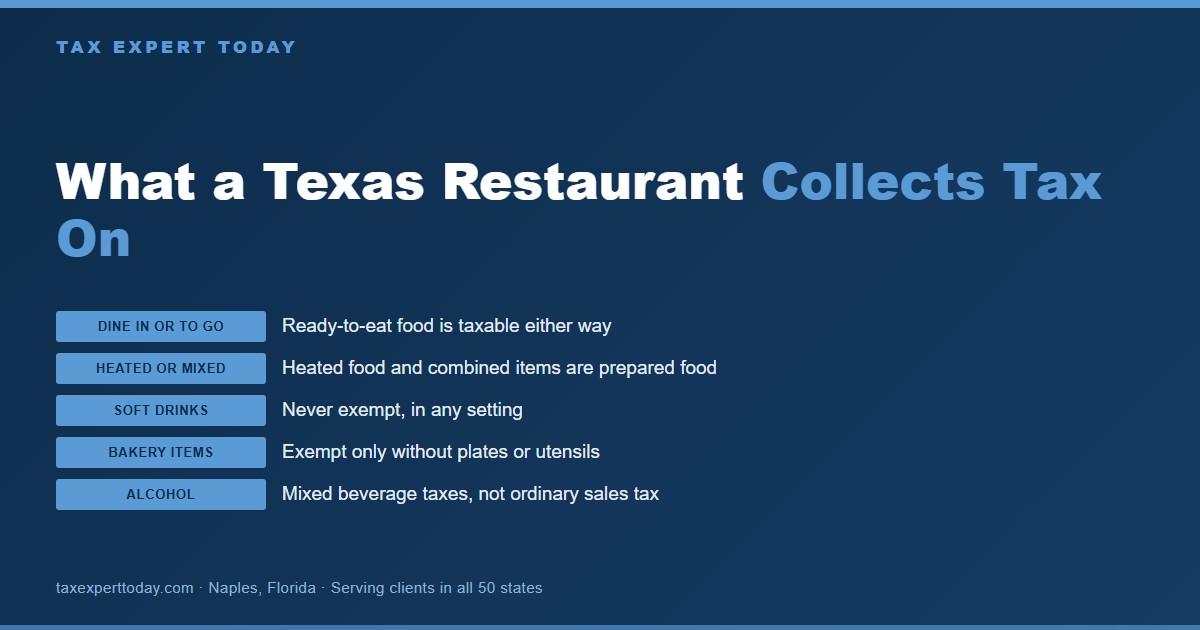
Nearly all of them. Prepared food is taxable, and Rule 3.293 defines prepared food broadly: food ready for immediate consumption, food sold heated or heated by the seller, food sold with eating utensils the seller provides, and two or more ingredients the seller combines into one item. Soft drinks, candy and ice are taxable in any setting.
- Ready to eat. Food that needs no further preparation by the buyer is prepared food when a restaurant sells it.
- Heated. Food sold hot, or heated by the seller, is prepared food.
- Utensils. Food sold with plates, forks or other utensils the seller provides is prepared food.
- Combined. Two or more ingredients mixed by the seller into one item, such as a salad, is prepared food.
- Never exempt. Soft drinks, candy and ice are excluded from the food exemption everywhere.
Rule 3.293(a)(12) gives the four part definition of prepared food, and Rule 3.293(c)(7)(A) applies it to food service directly: sales tax applies to “all food ready for immediate consumption sold by caterers, mobile vendors, or restaurants, fast food outlets, lunch counters, cafeterias, delis, hotels, and other like places of businesses.” Rule 3.293(a)(8) defines food ready for immediate consumption as food, drinks or meals prepared, served or sold by those businesses that require no further preparation by the purchaser before eating.
For a full service or quick service restaurant, the practical result is that the menu is taxable by default. The questions that matter are the exceptions, and there are fewer of them than many owners assume. Bakery items sold without plates or utensils have a carve-out, discussed below. Packaged food that the buyer must cook can fall back inside the exemption. Food sold by certain exempt organizations has its own rules, which do not apply to a commercial restaurant. Beyond those, the safer working assumption is that a sale from the kitchen or the bar is taxable unless a specific rule says otherwise.
Restaurants that also run a retail shelf, a market corner or a grab and go cooler face a second question: whether those items are sold by the restaurant as a “like place of business.” Rule 3.293(a)(8) treats a grocery or convenience store that contains a restaurant, lunch counter or deli as selling food ready for immediate consumption, but only for items sold at that location. Rule 3.293(m) gives the Comptroller’s own example: a bottle of unsweetened iced tea sold at a grocery store deli is taxable, while the same bottle sold at the checkout lane is not. A restaurant with a retail section should decide, item by item, where those items are rung up and how the register codes them.
| Item sold by a restaurant | Generally taxable? | Why |
|---|---|---|
| Plated entree served in the dining room | Yes | Food ready for immediate consumption |
| Hot sandwich sold to go | Yes | Sold in a heated state and ready to eat |
| Salad mixed in the kitchen | Yes | Two or more ingredients combined by the seller |
| Fountain soft drink | Yes | Soft drinks are excluded from the food exemption |
| Whole pie sold in a box without utensils | Generally no | Bakery item carve-out in Tax Code 151.314(c-3) |
| Raw marinated steaks the customer cooks at home | Often no | Raw animal foods requiring cooking by the consumer, 151.314(c-3)(3) |
| Gift card | No at sale | Tax is collected when the card is redeemed for a meal |
Is To-Go and Takeout Food Taxable in Texas?
Yes, generally. Publication 94-117 says ready-to-eat food is typically taxable even when it is sold to go, and the statute taxes food sold ready for immediate consumption by a restaurant regardless of where the customer eats it. Takeout, curbside, drive-through and pickup orders are generally taxed the same way as dine-in orders.
- Location of eating is irrelevant. The test is how the food is sold, not where the customer eats it.
- Drive-through and curbside. Treated like any other sale of ready-to-eat food.
- Online ordering on the restaurant’s own site. The restaurant collects, as on any direct sale.
- Exception for bakery items. Bakery items without plates or utensils follow their own rule.
- Delivery. The delivery charge raises its own question, covered later in this guide.
Some owners carry over an idea from other states, where food “to go” is treated differently from food eaten on premises. Texas does not draw that line for restaurants. Tax Code Section 151.314(c-2)(1) reaches food “served, prepared, or sold ready for immediate consumption” by a restaurant, and the words “or sold” cover the takeout bag as fully as the plate. Publication 94-117 repeats the point in its first rule on ready-to-eat food.
The takeout counter is where most restaurant classification errors start, because takeout is where restaurants are most likely to sell items that look like grocery products: a quart of soup, a pound of house-made salad, a bag of chips, a bottle of juice. Each item needs its own analysis. A quart of soup sold hot is prepared food. A pound of chicken salad mixed in the kitchen is prepared food under the combined ingredients test, even if it is sold cold by weight, because Section 151.314(c-2)(3) includes items “sold in an unheated state by weight or volume as a single item.” A bag of chips in an individual-sized portion is a taxable snack item under Rule 3.293(c)(9). A bottle of juice with more than 50 percent fruit juice is not a soft drink, but when a restaurant sells it ready to drink it is generally treated as a drink sold ready for immediate consumption.
The register setup is what turns these rules into tax collected. If the point of sale system has a single “food” button that does not distinguish a cold quart sold for later from a hot meal, the restaurant either over-collects on the occasional exempt item or under-collects on items it believed were grocery products. Neither error is unusual, and both are visible to an auditor who compares menu items to tax codes.
How Are Bakery Items Taxed in a Texas Restaurant?
It depends on who sells them and how. Since a 2017 amendment, Tax Code Section 151.314(c-3) exempts bakery items sold by a bakery even when heated or served with plates. A restaurant that is not a bakery sells bakery items tax free only without plates or utensils, and a roll served with a taxable meal is taxable.
- Sold by a bakery. Exempt even if heated or served with plates, under 151.314(c-3)(1).
- Sold by a restaurant without utensils. Exempt under 151.314(c-3)(2).
- Sold heated by a non-bakery. Taxable, because heated food is prepared food.
- Served with a meal. Taxable even if charged separately, under Rule 3.293(c)(8)(C).
- Not bakery items. Sandwiches, tacos, pizza, candy and snack items are excluded from the definition.
Tax Code Section 151.314(b-2) defines a “bakery” as “a retail location that primarily sells bakery items from a display case or counter, predominantly for consumption off the premises,” and defines bakery items to include bread, rolls, buns, biscuits, bagels, croissants, pastries, doughnuts, cakes, pies, muffins, cookies, tortillas and similar items. The statute’s history note shows the bakery language was added by House Bill 4054, effective September 1, 2017. Publication 94-117, dated March 2014, predates that change, which is one reason an owner relying on the publication alone can reach the wrong answer for a bakery cafe.
For a location that is not a bakery under the statutory definition, Rule 3.293(c)(8) states when bakery items become taxable: when sold in a heated state, when sold with plates or other eating utensils that the seller hands to the customer or places on a tray or plate, or when sold in conjunction with a taxable meal for which plates or utensils are provided, “even if the seller makes a separate charge for the bakery item.” The rule’s own example is a roll served with a restaurant meal, which is taxable even if served in a napkin.
A coffee shop that sells pastries from a case is the classic hard case. Whether it is a bakery depends on what it primarily sells and whether its sales are predominantly for consumption off the premises, which are facts that change from one location to the next. A shop that sells mostly espresso drinks to customers who stay is unlikely to meet the definition, and its pastries are then exempt only when handed over in a bag without a plate. The register needs a way to record which way each pastry was sold.
| Bakery item scenario | Seller is a bakery | Seller is a restaurant or cafe |
|---|---|---|
| Muffin sold in a bag, no plate | Exempt | Exempt |
| Muffin warmed by the seller | Exempt | Taxable |
| Croissant served on a plate | Exempt | Taxable |
| Roll served with a dinner entree | Not applicable | Taxable, even if charged separately |
| Whole cake sold in a box | Exempt | Exempt if no plates or utensils are provided |
Are Non-Alcoholic Drinks Taxable at a Texas Restaurant?
Generally yes. Soft drinks are excluded from the food exemption in every setting, and drinks served ready for immediate consumption by a restaurant fall within the prepared food rule. Coffee, tea, juice and milk drinks served in the dining room or at the counter are generally taxable as part of the restaurant’s sales.
- Soft drinks. Sweetened non-alcoholic beverages are never exempt food products.
- Served drinks. Section 151.314(c-2)(1) includes “drinks” sold ready for immediate consumption.
- Juice threshold. Juice over 50 percent fruit or vegetable juice is not a soft drink, which matters at retail.
- Water. Plain water has its own exemption rule in Rule 3.318, cross-referenced in Rule 3.293(b)(2).
- Refills. A free refill is part of the original taxable sale, not a separate sale.
Rule 3.293(a)(15) defines soft drinks as packaged carbonated and non-carbonated non-alcoholic beverages that contain natural or artificial sweeteners, including bottled and canned teas and coffees that are sweetened. Tax Code Section 151.314(c)(2) excludes them from the food exemption outright. That definition matters most at the grocery level. At a restaurant, the stronger rule is the prepared food rule in Section 151.314(c-2)(1), which names “drinks” among the items taxable when served or sold ready for immediate consumption by a restaurant.
Owners sometimes ask whether an unsweetened iced tea or a glass of milk is exempt because it would be exempt on a grocery shelf. When a restaurant serves it, the more useful question is whether it is sold ready for immediate consumption, and in the dining room it almost always is. Rule 3.293(m) illustrates the same idea in the grocery setting: an unsweetened iced tea sold at a store’s deli is taxable because it is sold ready for immediate consumption at that location.
Water deserves a short note because it is the one beverage where a different rule applies. Rule 3.293(b)(2) says water is exempt as explained in Rule 3.318, and Rule 3.293(d)(3) treats bottled, spring, sparkling and mineral water as exempt in vending sales while treating flavored water as a soft drink. A restaurant that charges for bottled water should confirm its treatment against Rule 3.318 rather than assume it is taxable or exempt.
How Are Alcoholic Drinks Taxed at a Texas Restaurant?
Alcohol served on premises by a permit holder is generally subject to the mixed beverage gross receipts tax and the mixed beverage sales tax under Tax Code Chapter 183 instead of the ordinary sales tax. Rule 3.293(c)(4) carves those sales out, so the alcohol and food sides of the same check are reported on different returns.
- Separate taxes. Mixed beverage taxes apply to alcohol served under a mixed beverage permit.
- Separate returns. Alcohol receipts are reported apart from food sales on the sales tax return.
- Retail alcohol. Beer and wine sold for off-premises consumption follow different rules.
- Split checks. The POS must separate alcohol from food and soft drinks on every ticket.
The mixed beverage taxes have their own rates, filing schedule and audit issues, and they are covered in our guide to the Texas mixed beverage tax. For this guide, the point that matters is the boundary: Rule 3.293(c)(4) makes beer, wine and other alcoholic beverages subject to sales tax “unless subject to mixed beverage gross receipts tax and mixed beverage sales tax under Tax Code, Chapter 183.” A bar with a kitchen is running two tax systems on the same ticket, and a mixer, a garnish or a soft drink sold on its own belongs on the sales tax side.
Are Mandatory Gratuities and Service Charges Taxable in Texas?
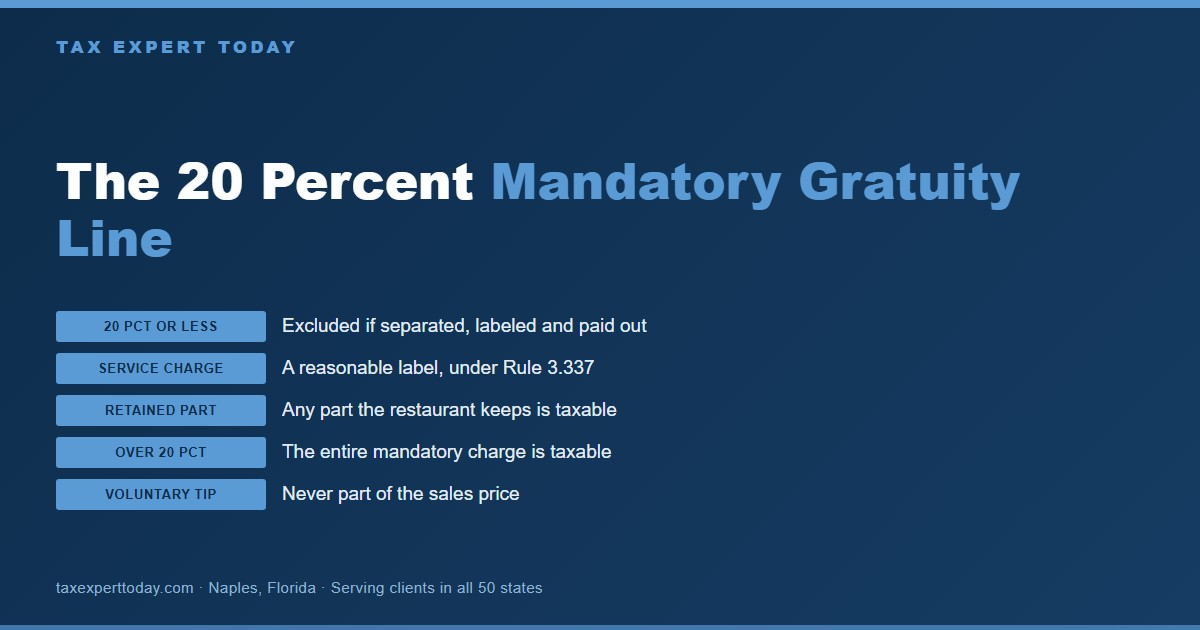
A mandatory gratuity of 20 percent or less is excluded from the sales price when it is separated from the price of the meal, identified as a tip or gratuity, and paid out to qualified employees. Any part the restaurant keeps is taxable, and a mandatory charge above 20 percent makes the entire charge taxable.
- Twenty percent ceiling. Rule 3.337(a)(3) defines a reasonable mandatory gratuity as one not exceeding 20 percent of the sales price.
- Separately stated. The charge must be separated from the price of the food.
- Labeled. Any reasonable label works, and the rule names “service fee” and “service charge.”
- Paid to qualified employees. The portion the employer retains is taxable.
- Over 20 percent. The whole mandatory charge is taxable, however it is distributed.
Rule 3.337 is the Comptroller rule on gratuities, and Rule 3.293(h)(2)(B) points to it for the exclusion. It defines a mandatory gratuity charge as “any amount required by the seller for the service of meals and food products for immediate consumption including soft drinks and candy.” Under Rule 3.337(c)(1), a reasonable mandatory gratuity is excluded from the sales price of taxable items only if it is (A) separated from the sales price of the meal, (B) identified as a tip or gratuity by any reasonable means, “including such terms as service fee or service charge,” and (C) disbursed to qualified employees. The rule then adds the sentence owners most often miss: “Any portion of a reasonable mandatory gratuity charge that is retained by the employer is subject to sales tax.”
Rule 3.337(c)(2) sets the cliff: “If a mandatory gratuity charge exceeds 20% then the entire mandatory gratuity charge is subject to sales tax regardless of how the gratuity is disbursed.” The cliff is all or nothing. A 22 percent automatic charge does not produce tax on 2 percent; it produces tax on the full 22 percent. Publication 94-117 states the same line in plain terms: mandatory gratuities exceeding 20 percent are taxable.
The labeling rule is broader than many owners realize. Rule 3.337 accepts “service fee” and “service charge” as reasonable labels for a gratuity. That cuts both ways. A restaurant that adds a “service charge” and keeps it as revenue, perhaps to fund kitchen wages or general operations, cannot treat that charge as an excluded gratuity, because the exclusion depends on disbursement to qualified employees. A restaurant that calls the charge a service fee and pays all of it to servers can generally exclude it if it is 20 percent or less and properly separated.
| Mandatory charge on the bill | How it is distributed | Sales tax treatment |
|---|---|---|
| 18 percent “gratuity,” separately stated | All paid to servers and bartenders | Excluded from the sales price |
| 18 percent “service charge,” separately stated | All paid to servers and bartenders | Excluded; “service charge” is a reasonable label |
| 18 percent “service charge,” separately stated | Half paid to servers, half kept by the restaurant | The retained half is taxable |
| 18 percent charge built into menu prices | Any | Taxable; not separated from the sales price |
| 22 percent automatic gratuity | All paid to servers | The entire 22 percent is taxable |
| Tip the customer adds voluntarily | Any | Not taxable under Rule 3.337(b) |
A short hypothetical shows the arithmetic. Assume a private dining event with a food and soft drink subtotal of $2,000, a separately stated 18 percent service charge of $360, and a combined sales tax rate of 8.25 percent. If the restaurant pays the full $360 to qualified employees, tax is computed on $2,000. If the restaurant keeps $120 of the charge, tax is computed on $2,120. If the charge were 22 percent, or $440, tax would be computed on $2,440. The figures are illustrative only and are not drawn from any client matter.
Who Counts as a Qualified Employee for the Gratuity Exclusion?
Rule 3.337 limits qualified employees to people who customarily and regularly provide the service the gratuity is based on, such as servers, bussers, service bartenders, wine stewards and maitres d’hotel. The rule expressly excludes janitorial help, chefs, cashiers and dishwashers, which matters for restaurants that pool mandatory charges with the kitchen.
- Included. Waiters, waitresses, busboys, service bartenders, wine stewards and maitres d’hotel.
- Excluded by name. Janitorial help, chefs, cashiers and dishwashers.
- Kitchen pooling. Sharing a mandatory charge with back of house staff raises a classification question.
- Records. The employer must be able to show the charge reached qualified employees.
Rule 3.337(a)(2) defines qualified employees as “employees who customarily and regularly provide the service upon which a gratuity is based, including, but not limited to, waiters, waitresses, busboys, service bartenders, wine stewards, and maitres d’hotel,” and it says the term “does not include janitorial help, chefs, cashiers, or dishwashers.” The definition was written for the sales tax exclusion. It is not a wage and hour rule, and it does not say how tips may be shared under federal or state labor law.
The practical question arises when a restaurant routes part of a mandatory service charge to the kitchen. The rule does not spell out the result for each pooling arrangement, so an owner should be careful about drawing a conclusion either way. What the rule does say is that the exclusion depends on disbursement to qualified employees, and it names chefs and dishwashers as people who are not qualified employees. A restaurant that shares mandatory charges with kitchen staff should document the arrangement and review whether the portion paid outside the qualified group is treated as retained revenue for sales tax purposes.
Rule 3.337(d) sets the documentation standard. The employer must keep records showing either (1) the amount of mandatory gratuity charges collected from customers and the corresponding disbursements to each qualified employee, or (2) that the total direct compensation due all qualified employees equals or exceeds the total collected as mandatory gratuity charges. Rule 3.337(a)(4) defines total direct compensation as total salaries paid to qualified employees, not counting benefits such as health insurance, sick leave or vacation time. The second test can be useful for a restaurant that pays servers above the mandatory charges it collects, but it requires payroll records that tie to the qualified group.
Are Voluntary Tips Taxable in Texas?
No. A voluntary tip that the customer adds to the bill, or leaves in cash, is not part of the sales price of the meal. Rule 3.337(b) excludes voluntary gratuities from the sales price, and Rule 3.293(h)(2)(B) repeats that voluntary tips left by customers for food service employees are not subject to sales tax.
- Customer’s choice. A tip added at the suggestion of the purchaser is voluntary.
- Suggested amounts. A printed tip guide does not make a tip mandatory.
- Tip line on a card slip. Amounts the customer writes in are voluntary.
- Not on the return. Voluntary tips are not reported as taxable sales.
Rule 3.337(a)(5) defines a voluntary gratuity as “a tip added to the bill at the suggestion of the purchaser or money given freely by the purchaser over and above the sales price.” The difference between a voluntary and a mandatory tip is whether the seller requires it. A suggested tip percentage printed on the receipt does not convert a voluntary tip into a mandatory one. An automatic charge for parties of six or more, which the customer cannot decline, is mandatory.
The federal treatment of tips, including reporting by employees and employers, is a separate system, and wage withholding on tips is covered in our guide to Texas payroll taxes. Federal changes to the income tax treatment of tips do not change how Texas sales tax treats a voluntary or mandatory gratuity, and the reverse is also true.
Are Delivery Fees Taxable at a Texas Restaurant?
Generally yes, when the restaurant itself delivers taxable food and bills the fee. Rule 3.293(h)(2) requires sellers to collect tax on the total sales price of taxable items, including separately stated charges for preparing, serving or delivering them. A delivery fee on an order of taxable prepared food is generally taxable at the same rate.
- Seller-billed delivery. A delivery fee the restaurant charges is part of the sales price.
- Separate line. Stating the fee separately does not exclude it.
- Service and packaging fees. Charges for preparing or serving food are part of the price too.
- Third-party courier. Fees charged by a separate delivery company raise a different question.
- Exempt items. A delivery fee on exempt bakery items follows the exempt item.
Rule 3.293(h)(2) is unusually specific. It says a seller must collect sales tax “on the total sales price of taxable items, including separately stated charges for preparing, serving, or delivering taxable items, charges for the room or facility in which the meals and beverages are served, and charges for the cost or expense of items such as reusable tables, chairs, tableware, and tablecloths used by the seller in providing the food service.” That one sentence covers delivery fees, room charges, setup fees and equipment charges on a catered event.
The same principle applies outside restaurants, where the general rule is that a delivery charge follows the taxability of the item delivered. Our guide to whether shipping is taxable in Texas explains the general rule and how a single delivery charge is split when an order mixes taxable and exempt items, a question that can arise when a restaurant delivers a mixed order of hot meals and boxed bakery items.
Restaurant owners sometimes add fees that are not delivery fees at all: a “kitchen appreciation” fee, a credit card surcharge, a packaging fee for to-go containers or a percentage “wellness” fee. The Comptroller’s rules do not list each of these by name, so the label is not the test. The useful question is whether the fee is a charge connected with the sale of taxable food, which Rule 3.293(h)(2) treats as part of the sales price, or a qualifying gratuity under Rule 3.337. A fee that is neither is generally safer treated as part of the taxable price until a reviewer concludes otherwise.
| Fee on a restaurant order | Generally taxable? | Basis |
|---|---|---|
| Delivery fee billed by the restaurant on taxable food | Yes | Rule 3.293(h)(2) |
| Setup or service fee on a catered event | Yes | Rule 3.293(h)(2) and (k)(1) |
| Room or facility charge for a private event | Yes | Rule 3.293(h)(2) |
| Charge for tables, linens or tableware the seller uses | Yes | Rule 3.293(h)(2) |
| Mandatory gratuity of 20 percent or less paid to qualified employees | No | Rule 3.337(c)(1) |
| Fee retained by the restaurant under any label | Generally yes | Part of the sales price; Rule 3.337(c)(1) retained portion |
What Changes When Orders Run Through a Delivery App?
If the app is a marketplace provider under Tax Code Section 151.0242, meaning it operates the marketplace and processes payments for the restaurant, the provider collects and remits Texas sales tax on those orders. A restaurant that accepts the provider’s certification in good faith excludes those sales from its own return but must keep records.
- Marketplace provider test. Owns or operates the marketplace and directly or indirectly processes payments for sellers.
- Provider collects. The provider assumes the seller’s duties for sales made through the marketplace.
- Certification. The provider certifies to the restaurant that it assumes those duties.
- Exclude from the return. A restaurant that accepts the certification in good faith excludes those sales.
- Keep the records. Section 151.0242(e) still requires records of all marketplace sales.
Section 151.0242(a) defines a marketplace as a physical or electronic medium through which persons other than its owner or operator make sales of taxable items, and expressly includes “a store, Internet website, software application, or catalog.” A marketplace provider is a person who owns or operates a marketplace “and directly or indirectly processes sales or payments for marketplace sellers.” Under subsection (c), the provider must certify to each marketplace seller that it assumes the rights and duties of a seller, collect the tax on sales made through the marketplace and report and remit it. Under subsection (d), a marketplace seller “who in good faith accepts a marketplace provider’s certification” excludes those sales from its own sales tax report.
The Comptroller’s marketplace provider page describes the same structure and says marketplace providers must collect and remit state and local sales and use tax on all third-party sales. Whether a particular delivery app meets the definition depends on how it operates: who the customer pays, whose menu the order is placed through and whether the app processes payment for the restaurant. Most owners will not need to decide that from first principles. The practical step is to locate the platform’s certification, keep it with the restaurant’s tax records and confirm that the platform’s reports show tax collected on the orders it handled.
Three problems come up often. First, double reporting: the restaurant’s POS records an app order as a sale, the bookkeeper reports it, and the platform also remits tax, so the same sale is taxed twice. Second, under-reporting on orders that do not run through a marketplace, such as orders placed on the restaurant’s own website and handed to a courier service that only delivers. Those are the restaurant’s own sales, and the restaurant collects. Third, information errors: Section 151.0242(f) requires the seller to give the provider the information needed to collect correctly, and subsection (g) shifts liability to the seller when the provider relies in good faith on incorrect or insufficient information the seller supplied. A menu that marks a taxable item as exempt in the app can leave the restaurant liable for the shortfall.
| Order channel | Who generally collects Texas sales tax | What the restaurant keeps |
|---|---|---|
| Dine-in, takeout or the restaurant’s own website | The restaurant | POS reports, sales journals, returns |
| App that processes payment as a marketplace provider | The marketplace provider | The provider’s certification and order reports |
| Own website order delivered by a courier service that only delivers | The restaurant, on the food and its own delivery fee | Order records and courier invoices |
| App that only refers customers and does not process payment | Generally the restaurant | The platform agreement and payment records |
How Is Catering Taxed in Texas?
A caterer is a seller of prepared food and must collect sales tax on all charges billed in connection with a taxable meal, including setup, service, delivery, room and equipment charges. The caterer pays tax on reusable items it uses, such as tables and linens, and can buy disposable items transferred to the customer for resale.
- All charges. Rule 3.293(k)(1) reaches “all charges billed in connection with the sale of taxable meals.”
- Reusable equipment. Tables, chairs, tablecloths and steam tables are taxable to the caterer.
- Disposables. Items transferred to the customer can be bought tax free with a resale certificate.
- Hotel rooms. A caterer using a hotel room pays the occupancy tax and collects sales tax on any pass-through.
- Gratuities. A qualifying mandatory gratuity on a catered event follows Rule 3.337.
Rule 3.293(k)(1) defines caterers as persons “engaged in the business of preparing and serving meals, drinks, or other food products at locations designated by customers,” and says a caterer “is a seller of prepared food and beverages and must collect sales tax on all charges billed in connection with the sale of taxable meals.” Under Rule 3.293(k)(2), the caterer owes tax on the purchase, lease or rental of tables, chairs, tablecloths, steam tables and table decorations used in providing catered meals, while it may claim a resale exemption on nonreusable items transferred to customers and a manufacturing exemption on qualifying food preparation equipment.
Rule 3.293(k)(3) addresses events held in a hotel. A caterer that uses a room or facility subject to Texas hotel occupancy tax pays the occupancy tax to the hotel and has no resale exemption for it. When the caterer passes the room cost to its customer as part of the taxable sale of catered meals, it collects sales tax on that separately stated charge, including the occupancy tax built into it. Event contracts that bundle food, staffing, rentals and a venue charge are where the most catering audit adjustments arise, because every line is part of the sales price unless it fits a specific exclusion.
Many restaurants cater only occasionally and run catering through the same POS as the dining room. The risk is that a catering invoice is prepared in a word processor, outside the POS, and never reaches the sales journal at all, or reaches it without tax on the delivery and setup lines. A simple control is to require every catering invoice to be entered in the system that feeds the sales tax return.
Are Complimentary Meals Taxable in Texas?
No tax is collected on a meal given away free, because there is no sales price. The restaurant must instead accrue and pay tax on the taxable items used to make it. Publication 94-117 says raw meat and vegetables used for a complimentary meal are not taxable, but soft drinks and other taxable items given away are.
- No sale, no sales tax. A comped meal has no sales price to tax.
- Taxable ingredients. The restaurant owes use tax on taxable items it consumes in giving food away.
- Exempt ingredients. Raw food products bought tax free remain untaxed.
- Two for one. Tax is due only on the amount actually charged.
- Record the comp. A void without a reason code looks like an unreported sale.
Publication 94-117 states the rule this way: “While complimentary meals and drinks are not taxable, tax is due on the taxable ingredients used in their preparation.” It gives the example that raw meat and vegetables used to prepare a complimentary meal are not taxable, “but a restaurant should accrue tax on soft drinks and other taxable items that are given away.” The logic is that a restaurant buys soft drink syrup, candy and similar taxable items tax free for resale. When it gives them away instead of selling them, the resale exemption no longer fits, and use tax is due on the cost of the items consumed.
The accrual is reported on the restaurant’s sales and use tax return. Our guide to Texas use tax explains how a business reports tax on items it bought tax free and then used itself, and our resale certificate guide explains why the original purchase was tax free. Rule 3.293(j)(4) gives a parallel example for hotels: a hotel pays tax on taxable items such as soft drinks, candy and ice that it provides to guests free of charge, but not on exempt food products such as bread, milk or fruit.
The weak point in most restaurants is not the rule but the record. A comped entree that is voided at the register without a reason code looks, to an auditor comparing sales to purchases, like a sale that was never reported. A comp reason code, a manager approval and a periodic summary of comped items allow the restaurant to show what was given away and to compute the accrual on the taxable components.
Are Employee Meals Taxable in Texas?
A restaurant may sell prepared food tax free to a food service employee immediately before, during or immediately after the employee’s shift, as a matter of convenience. The rule applies to employees involved in preparing or serving food at that location. Publication 94-117 says meals furnished under those conditions are not taxable.
- Timing. Immediately before, during or immediately after a work shift.
- Who. Employees involved in preparing or serving food at the food service location.
- Where. The location where the employee works.
- Off-shift meals. A meal bought on a day off is an ordinary taxable sale.
- Taxable ingredients. Free shift meals raise the same ingredient accrual question as comps.
Rule 3.293(h)(7) states: “As a matter of convenience, a food service business, such as a restaurant selling prepared food, may sell prepared food tax free to a food service employee immediately before, during, or immediately after the employee’s shift. This provision applies to employees involved in preparing or serving food at the food service location.” Publication 94-117 adds that meals furnished to employees under those conditions are not taxable when provided for the convenience of the restaurant owner.
The rule is narrower than many owners assume. A cashier, a manager who does not prepare or serve food or an employee eating on a day off is outside its words. A discounted family meal for an employee’s household is outside it as well. Free shift meals that include soft drinks or other taxable items bought for resale raise the same accrual point as complimentary meals. A separate employee meal code in the POS, used only for qualifying shift meals, keeps these transactions visible and explainable.
How Do Coupons, Discounts and Gift Cards Work for Texas Restaurant Tax?
A discount or coupon the restaurant is not reimbursed for reduces the taxable price, so tax is computed on what the customer actually pays. Gift card sales are not taxable when sold; tax is computed on the meal when the card is redeemed. Third-party funded discounts need separate review because reimbursement changes the result.
- Restaurant-funded coupon. Reduces the sales price.
- Two for one. Tax only on the price charged, under Rule 3.293(h)(2)(A).
- Gift cards. No tax at sale; tax on the meal at redemption.
- Reimbursed discounts. If someone else reimburses the discount, the reimbursed amount needs review.
- Loyalty rewards. A free item redeemed with points raises the comp accrual question.
Rule 3.293(h)(2)(A) says a cash discount, including a discount coupon, allowed by a seller reduces the sales price, and the seller collects tax on the actual amount the customer pays. It gives the two meals for the price of one example, in which tax is charged on the price of the single meal. Publication 94-117 adds an illustration of its own: when a restaurant places a $5 coupon in a newspaper and redeems it toward a $15 meal, tax is charged on $10, “as long as the restaurant owner receives no reimbursement for the amount of the discount.” That condition matters for promotions funded by a delivery platform, a card network or a beverage distributor.
Publication 94-117 also addresses gift cards: tax is not due on the sale of a gift card or certificate, and the tax is computed on the price of the meal and collected when the card is redeemed. A restaurant that rings a gift card as a taxable sale at purchase and then taxes the meal again at redemption has collected twice. A restaurant that treats the redemption as tax free because the card was “already paid for” has collected nothing.
What Can a Texas Restaurant Buy Tax Free?
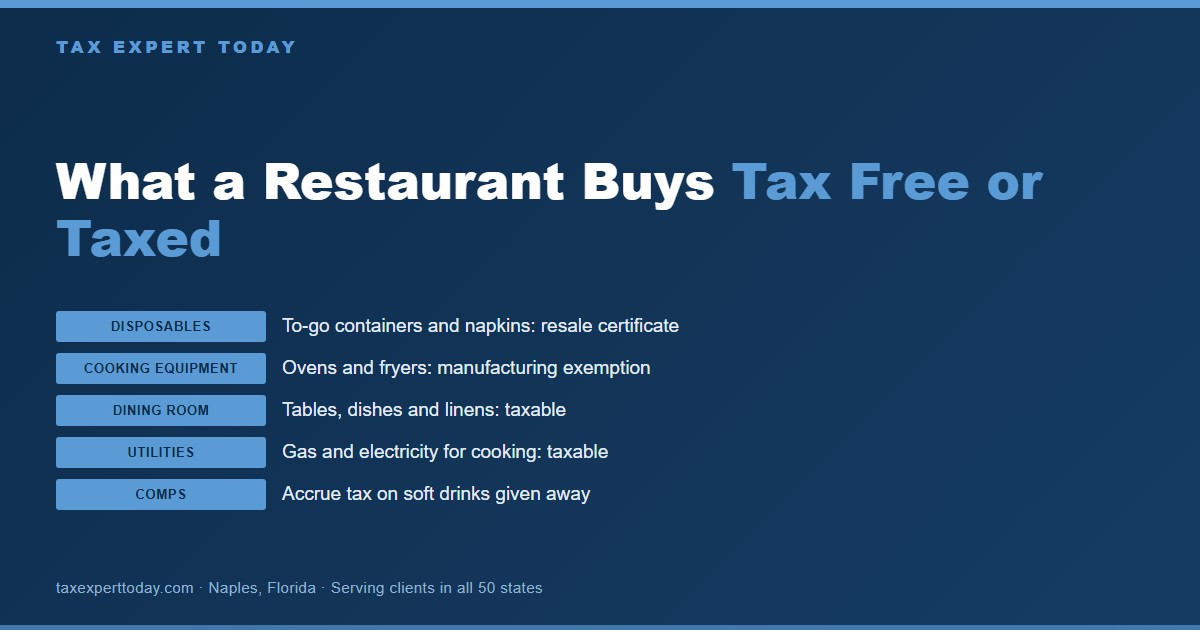
A restaurant can buy disposable items transferred to customers with their food, such as napkins, straws, to-go containers and plastic utensils, tax free with a resale certificate. Qualifying food processing equipment is exempt as manufacturing equipment, as are certain items required by health regulations. Food ingredients for resale are exempt as well.
- Disposables. Non-reusable items transferred to the customer, bought with a resale certificate.
- Taxable items for resale. Soft drink syrup, candy and similar items bought to resell.
- Processing equipment. Ovens, fryers, grills, mixers and similar equipment used to prepare food for sale.
- Regulatory items. Hairnets, gloves and similar items required by health rules during food preparation.
- Long-term equipment leases. Exempt for qualifying equipment when the lease term is at least one year.
Rule 3.293(h)(5) allows a seller to give a resale certificate for the tax-free purchase of items “transferred to the customer with the food or beverages,” as long as the items are not reusable by the seller. It lists examples including cake boxes, lunch boxes, disposable cups, paper and plastic containers, disposable plates, plastic knives, forks and spoons, paper napkins, soda straws, toothpicks, french fry boxes and stir sticks. Our guide to the Texas resale certificate explains how the certificate is completed and what the seller must keep on file.
Rule 3.293(h)(6) treats a person processing food for sale as a manufacturer that may claim the exemption in Tax Code Section 151.318, explained in our guide to the Texas manufacturing exemption on equipment that qualifies, with the example of an oven or a mixer directly used in baking or mixing. Publication 94-117 lists qualifying kitchen processing equipment, excluding hand tools, such as charbroilers, coffee makers, deep fat fryers, drink machines that mix or freeze ingredients, griddles, grills, microwave ovens, ovens, smokers and toasters. It adds that repair labor and replacement parts for exempt processing equipment are exempt when the equipment has not been incorporated into realty, and that rentals and leases of qualifying equipment are exempt only when the lease term is at least one year.
Publication 94-117 also describes an exemption for items necessary to comply with public health or pollution control requirements, giving hairnets, gloves and other work clothing required by law and worn during food preparation, and disinfectants applied in processing areas, as examples. It notes that there is no exemption for employee uniforms. To claim an exemption, the purchaser issues an exemption certificate to the seller, which is a different form from a resale certificate. Our guide to the Texas sales tax exemption certificate covers that form.
| Purchase | Generally | How the exemption is claimed |
|---|---|---|
| To-go containers, paper napkins, straws, plastic utensils | Exempt | Resale certificate, Rule 3.293(h)(5) |
| Soft drink syrup, candy and other taxable items for resale | Exempt | Resale certificate |
| Fryers, ovens, grills, mixers used to prepare food for sale | Exempt | Exemption certificate, Rule 3.293(h)(6) |
| Hairnets and gloves required during food preparation | Exempt | Exemption certificate, per Publication 94-117 |
| Qualifying equipment leased for less than one year | Taxable | Not applicable |
| Raw food ingredients | Exempt | Exempt food products; no certificate usually needed |
What Does a Texas Restaurant Pay Sales or Use Tax On?
A restaurant pays tax on most items it uses rather than resells: tables, chairs, dishes, glassware, silverware, cloth napkins, reusable menus, hand tools, steam tables and heat lamps, office equipment, and taxable services such as pest control and janitorial work. It also pays tax on gas and electricity used to prepare food.
- Dining room items. Tables, chairs, trays, glasses, dishes, silverware, tablecloths and reusable menus.
- Holding equipment. Soup warmers, steam tables, heat lamps and salad bars.
- Hand tools. Ladles, knives, egg beaters and similar utensils.
- Utilities. Natural gas and electricity used to prepare food and operate the restaurant.
- Taxable services. Pest control, security, janitorial, waste removal, landscaping and real property repair.
Rule 3.293(h)(4) requires a seller to pay sales or use tax on the purchase, lease or rental of all taxable items unless otherwise exempt, and lists items taxable to a food service business: tables, chairs, reusable place mats, tablecloths, cloth napkins, silverware, dishes, dispensers such as salt and pepper shakers, garbage cans and liners, janitorial items, grill bricks, aprons, menus and menu inserts, and hand tools such as cooking utensils, cutting knives and lime squeezers. Rule 3.293(h)(2) adds that reusable items used by the food service provider, and not rented to the customer, may not be purchased tax free for resale.
Publication 94-117 adds equipment used to store or maintain ingredients or completed food, such as soup warmers, steam tables, heat lamps and salad bars, together with trash compactors, waste disposal systems and dishwashers. Rule 3.293(h)(6) closes a gap owners sometimes assume is open: the exemption in Tax Code Section 151.317 for gas and electricity used in manufacturing “is not applicable when the gas or electricity is used to prepare or store prepared food.” Publication 94-117 lists taxable services as well, including pest control, security, janitorial cleaning, waste removal, landscaping and real property repair and remodeling. The broader list is covered in our guide to Texas taxable services.
When an out-of-state supplier does not charge Texas tax on a taxable purchase, the restaurant owes use tax and reports it on its next return, as Publication 94-117 notes. Restaurant groups that buy smallwares, furniture or equipment from national online suppliers should check each invoice. Our guide to Texas use tax covers how that accrual works and the records it requires.
What Records Does a Texas Restaurant Need for Sales Tax?
A restaurant must keep records that clearly separate exempt sales from taxable sales, such as invoices, receipts and register coding records. Rule 3.293(h)(3) says that when records do not clearly identify exempt sales, all sales are presumed taxable. Gratuity disbursement records, certificates and marketplace reports belong in the same file.
- Register coding. Item level tax codes that separate taxable, exempt and alcohol sales.
- Gratuity records. Mandatory charges collected and paid to qualified employees, under Rule 3.337(d).
- Comps and voids. Reason codes and approvals for every comp, void and employee meal.
- Certificates. Resale and exemption certificates given to suppliers.
- Marketplace files. Provider certifications and order reports, under Section 151.0242(e).
Rule 3.293(h)(3) states the records standard and its consequence: “A seller of taxable items must keep accurate records that clearly identify sales of exempt items and sales of taxable items. The records must separately state charges for the exempt items from the charges for taxable items. Examples of records include sales invoices, receipts, and cash register coding records. If a seller’s records do not clearly identify exempt sales from taxable sales, all sales are presumed taxable.” Tax Code Section 151.025 sets the general duty to keep records of sales and purchases.
For a restaurant, the register is the record. POS systems generate item level detail for every ticket, along with tax codes, discounts, voids, comps, gratuities and payment types. The return should be traceable from the POS summary to the amounts reported, and the summary should be traceable to the deposits in the bank account. When a restaurant changes POS systems, exports from the old system should be saved before the subscription ends, because the restaurant still needs them for periods that remain open.
Does One Rule Make Every Restaurant Sale Taxable?
Not a percentage rule. Some sales tax guides describe ratio tests for prepared food sellers, but the current text of Rule 3.293, as last amended effective December 18, 2018, contains no such percentage threshold. What can make every sale taxable in Texas is the records presumption in Rule 3.293(h)(3).
- No ratio test in Rule 3.293. The current rule classifies items, not businesses, by a percentage of sales.
- Item by item. Each sale is taxable or exempt under the prepared food and bakery tests.
- Records presumption. Without records that separate exempt sales, all sales are presumed taxable.
- Like place of business. Store locations with a deli or counter are treated as restaurants for items sold there.
Owners who research restaurant sales tax across several states may encounter percentage tests that treat all of a seller’s food as prepared food once prepared food passes a set share of sales. Those tests appear in other states’ rules. The Texas rule reviewed for this guide, 34 Tex. Admin. Code Section 3.293, defines prepared food item by item and contains no percentage threshold of that kind. Its notes show it was adopted effective September 18, 2006 and amended effective June 5, 2017 and December 18, 2018.
The rule that can sweep in exempt items is the records presumption. A cafe that sells boxed pastries tax free, bottled juice from a retail shelf and raw meats for home cooking alongside its taxable meals can support those exempt sales only with records that separate them. If the register lumps them together, Rule 3.293(h)(3) presumes the entire amount taxable. For a restaurant with a meaningful share of exempt sales, the POS tax code setup is the difference between a supportable exemption and a presumption it cannot rebut.
What Do Auditors Test in a Texas Restaurant Sales Tax Audit?
Restaurant audits commonly compare reported sales to POS records, card deposits and purchases, and then test the areas this guide covers: tax codes on menu items, mandatory gratuities, comps and voids, catering invoices, marketplace orders, and use tax on purchases of equipment and supplies. Each test follows from a rule an owner can apply in advance.
- Sales reconciliation. Reported sales compared to POS summaries and deposits.
- Purchase markup. Food and beverage purchases compared to reported sales.
- Gratuity review. Mandatory charges tested against the 20 percent line and disbursement records.
- Comps and voids. Unexplained voids treated as possible unreported sales.
- Purchases. Equipment, smallwares and services tested for unpaid use tax.
Our guide to the Texas Comptroller audit process explains how a sales tax audit is opened, how sampling works and how findings are presented. A restaurant audit is a sales tax audit with a few areas that recur. The first is whether reported sales tie to the POS and to card and cash deposits. When they do not, the auditor may rely on an indirect method, such as comparing purchases of food and beverages to sales, and differences between the two can become findings. The second is classification: menu items coded as exempt that are prepared food, mandatory charges over 20 percent treated as gratuities, and service charges partly retained by the restaurant. The third is the purchase side, where equipment and smallwares bought from out-of-state suppliers without tax produce use tax findings.
The outcome of any audit depends on the restaurant’s records and facts, and this guide does not predict results. What an owner can control is whether each tested area has a written treatment and a record behind it before the audit begins.
| Area an auditor may test | Rule that governs it | Record that supports it |
|---|---|---|
| Taxable versus exempt menu items | Tax Code 151.314; Rule 3.293(c) | POS item list with tax codes |
| Mandatory gratuities and service charges | Rule 3.337 | Disbursement records or payroll comparison |
| Comped meals and free items | Publication 94-117 | Comp reason codes and accrual worksheets |
| Employee meals | Rule 3.293(h)(7) | Employee meal code and shift schedules |
| Catering and event invoices | Rule 3.293(h)(2) and (k) | Invoices entered in the system feeding the return |
| Delivery app orders | Tax Code 151.0242 | Provider certifications and order reports |
| Equipment, smallwares and services | Rule 3.293(h)(4) and (h)(6) | Purchase invoices and certificates |
Can a Texas Restaurant Recover Sales Tax It Overpaid?
Generally yes, through a claim for refund to the Comptroller or, where the vendor collected the tax, a request to the vendor. Restaurants most often overpay by taxing exempt items, by charging tax on qualifying gratuities or by paying tax on exempt equipment purchases. Tax collected from customers raises its own refund questions.
- Purchases. Tax paid on exempt processing equipment or disposables bought for resale.
- Gratuities. Tax collected on mandatory charges that qualified for the exclusion.
- Double reporting. Marketplace sales reported by both the restaurant and the provider.
- Customer tax. Tax collected from diners generally must be addressed with those customers in mind.
Our guide to the Texas claim for refund explains who may file, the limitation period and the documentation the Comptroller expects. For restaurants, refund opportunities usually come from the purchase side, where kitchen equipment that qualifies under Section 151.318 was taxed by the vendor, and from the reporting side, where marketplace sales were reported twice. Where the overpayment is tax the restaurant collected from customers, the analysis is more involved, because the tax belonged to the customers when collected. A review should come before a claim. Where the problem runs the other way, and tax was under-collected for past periods, our guide to the Texas voluntary disclosure agreement explains one route the Comptroller offers.
How Do Food Trucks and Pop-Ups Handle Restaurant Tax in Texas?
The same way restaurants do. Rule 3.293 defines a mobile vendor as a person who sells food from a motor vehicle, push cart or other vehicle, and taxes food ready for immediate consumption sold by mobile vendors. A food truck needs a sales tax permit, collects tax on prepared food and soft drinks and reports sales by location.
- Same tests. Prepared food, soft drinks, candy and ice are taxable from a truck as from a dining room.
- Permit. A seller of taxable items needs a Texas sales tax permit under Rule 3.293(h)(1).
- Location. Local tax follows where sales are made, which changes as the truck moves.
- Events. Event organizers may have their own reporting requirements for vendors.
Rule 3.293(a)(11) defines a mobile vendor, and Rule 3.293(c)(7)(A) taxes “all food ready for immediate consumption sold by caterers, mobile vendors, or restaurants.” Tax Code Section 151.314(c-2)(1) reaches food sold ready for immediate consumption “from pushcarts, motor vehicles, or any other form of vehicle.” Rule 3.293(h)(1) requires a seller of taxable food to obtain a sales tax permit, file returns and remit the tax, and points to Rule 3.286 for the details of permits and reporting.
The practical difference for a truck is local tax. A truck that sells in several cities in a reporting period collects different local rates in each, and its records should show where each day’s sales were made. Pop-up operators and ghost kitchens selling through apps should also review the marketplace provider rules above, because a large share of their sales may already be collected by a provider. For restaurant owners who have recently moved a business to Texas, the permit and local reporting setup is part of the first month’s work.
Restaurants also face the Texas franchise tax at the entity level, which is a separate tax with its own report and thresholds. It is covered in our guide to the Texas franchise tax, and the way it applies to a restaurant LLC is covered in our guide to Texas LLC taxes. A restaurant group that also sells taxable items online to customers outside its local market should read our guide to Texas sales tax nexus for the collection rules that apply to remote sales.
Restaurant Tax in Texas Help in Naples & Southwest Florida
Tax Expert Today LLC is based in Naples, Florida, and serves Texas restaurant owners nationwide. We review how a restaurant’s POS codes its menu, how its mandatory gratuities and service charges are structured and paid, how comps and employee meals are recorded, how delivery app orders are reported and whether use tax is accrued on purchases. Because Texas sales tax is a state tax administered by the Texas Comptroller, our work for Texas restaurants is state tax advisory, coordinated with the owner’s bookkeeper or controller.
- Texas restaurant tax help Naples clients can reach in person. Our office is on Tamiami Trail North in Naples, Florida, and we work with clients locally and remotely.
- Restaurant sales tax advice Naples FL and nationwide. We serve restaurant owners and multi-unit operators in all 50 states.
- POS tax code review. Menu items, bakery items, drinks and retail shelves.
- Gratuity and fee review. Service charges, the 20 percent line and disbursement records.
- Purchase and accrual review. Certificates, equipment exemptions and use tax on comps.
Related services include our Texas tax services and our Naples tax planning work for Southwest Florida business owners.
Tax Expert Today LLC
11983 Tamiami Trail N, Naples, FL 34110
Phone: (239) 441-2005
Hours: Monday through Friday, 10:00 a.m. to 5:00 p.m. ET
Local question we are asked often: A Naples restaurant group is opening its first location in Texas. Does the Florida setup carry over? Not reliably. Texas has its own rules on prepared food, bakery items, mandatory gratuities and delivery fees, so the POS tax codes, the gratuity policy and the purchase exemptions should be set up for Texas before the location opens rather than copied from the Florida stores. Our comparison of Texas vs Florida taxes covers the broader differences between the two states.
When Should You Engage a Professional?
A single location restaurant with a simple menu, voluntary tips only, no catering and no delivery apps can often apply the rules in this guide directly. Professional review becomes worthwhile when the restaurant adds mandatory service charges, pools charges with kitchen staff, runs catering or private events, sells through several delivery platforms, operates a bakery case or retail shelf, runs locations in more than one city, changes POS systems or receives notice of a Comptroller audit. Texas sales and use tax is a state tax matter administered by the Texas Comptroller, not the IRS, and our multidisciplinary team of tax advisors, enrolled agents, CPAs and attorneys advises on state tax matters nationwide. Results depend on individual facts, and this guide describes how the rules work rather than what any particular restaurant should expect.
If you would like a review of your restaurant’s sales tax setup, contact Tax Expert Today at (239) 441-2005 or visit our Texas tax services page.
Frequently Asked Questions
What is the restaurant tax rate in Texas?
The state sales tax rate is 6.25 percent, and local jurisdictions can add up to 2 percent, for a combined maximum of 8.25 percent. A restaurant collects the combined rate in effect where the sale is made. Alcohol served under a mixed beverage permit is taxed under the separate mixed beverage taxes.
Is takeout food taxable in Texas?
Generally yes. Food sold ready for immediate consumption by a restaurant is taxable whether it is eaten on premises or taken to go. Bakery items sold without plates or utensils are an exception.
Are mandatory gratuities taxable in Texas?
Not when they are 20 percent or less, separately stated, identified as a tip, gratuity, service fee or service charge, and paid to qualified employees under Rule 3.337. Any part the restaurant keeps is taxable, and a mandatory charge above 20 percent is taxable in full.
Is a restaurant delivery fee taxable in Texas?
Generally yes when the restaurant delivers taxable food and bills the fee. Rule 3.293(h)(2) includes separately stated charges for preparing, serving or delivering taxable items in the sales price.
Who collects sales tax on delivery app orders in Texas?
When the app is a marketplace provider that processes payments for the restaurant, the provider collects and remits the tax under Tax Code Section 151.0242. The restaurant excludes those sales from its return after accepting the provider’s certification in good faith, and keeps records of them.
Are employee meals taxable at a Texas restaurant?
Meals for employees who prepare or serve food, provided immediately before, during or immediately after their shift at that location, may be sold tax free under Rule 3.293(h)(7). Other employee meals are ordinary taxable sales.
Do restaurants pay tax on free meals they give away?
No tax is collected on a free meal, but the restaurant accrues tax on taxable items used in it, such as soft drinks, according to Publication 94-117. Raw food ingredients remain untaxed.
Can a restaurant buy to-go containers tax free in Texas?
Yes. Non-reusable items transferred to customers with their food, such as to-go containers, paper napkins, straws and plastic utensils, can be bought tax free with a resale certificate under Rule 3.293(h)(5).
Published November 19, 2026 by Dr. Pellumb Kabashi « Back to Learning Center
Have a question this article touches on?
Tax Expert Today LLC, based in Naples, Florida and serving clients across the United States.
Schedule a Consultation (239) 441-2005