
By Dr. Pellumb Kabashi, DBA, MBA, EA, CFE, CES
Founder, Tax Expert Today LLC · Tax advisors, enrolled agents, CPAs, and attorneys · Serving clients in all 50 states
Quick Answer: IRS Form 843 is the claim form used to request a refund or an abatement of penalties, interest, additions to tax, certain fees, and certain taxes other than income, estate, or gift tax. It cannot be used to amend a return or to recover income tax, which is the most common reason a claim is returned. The filing window is set by IRC §6511, and it is computed separately for each tax period. Call (239) 441-2005 for a free consultation.
What is IRS Form 843?
IRS Form 843, Claim for Refund and Request for Abatement, is the form used to ask the IRS to refund money already paid or to remove an amount still assessed, where the item at issue is a penalty, interest, an addition to tax, a fee, or a tax other than income, estate, or gift tax. It is a standalone claim rather than an amended return, and the instructions direct that a separate form is generally filed for each tax period and each type of tax or fee.
The current revision is dated December 2024, and the Instructions for Form 843 describe that revision as a redesign. The practical consequence is that the form now opens with a block of checkboxes above the name field, and the instructions state that exactly one box must be checked to indicate the reason for filing. Guides written against the older layout describe a form that no longer exists, so anyone working from a saved copy or a summary published before 2025 should download the current version rather than rely on a remembered layout.
- It is a claim, not an amendment. Nothing on the underlying return is changed by filing it.
- One box, one reason. The instructions direct the filer to check a single box and not more than one.
- One form per period and per tax type. Combining several years on one sheet is a documented exception rather than the norm.
- Line 8 carries the case. The instructions require a detailed explanation of the reasons and a computation of the amount claimed.
- Supporting evidence is attached, not summarized. Copies of the notice, the advice relied on, or the employer statement travel with the form.
A point worth settling early, because it drives a large share of rejected claims: if the IRS has already sent a notice proposing or explaining a change, the instructions say to follow the directions on that notice, and note that an IRS Form 843 may not be required at all. A great many penalty questions are resolved by responding to the notice itself, without an IRS Form 843 at all. Our guide to the IRS CP14 notice covers that first balance due letter and the response window it carries.
What can and cannot be claimed on IRS Form 843?
IRS Form 843 covers penalties and additions to tax, interest attributable to IRS error or delay, certain fees, excess social security or Medicare tax withheld by one employer that the employer will not adjust, and taxes other than income, estate, or gift tax. It cannot be used to abate income, estate, or gift tax, to obtain a refund of income tax or Additional Medicare Tax, or to amend any previously filed income or employment tax return.
The exclusions are stated plainly in the instructions and they are absolute rather than discretionary. Employers cannot use this form to claim a refund or abatement of Federal Insurance Contributions Act tax, Railroad Retirement Tax Act tax, or income tax withholding. The instructions also bar its use to claim a refund of installment agreement fees, offer in compromise fees, or lien fees, which surprises taxpayers who assume a fee paid on a resolution that later failed is recoverable through this route.
Where another form is required, the instructions supply a substitution map. Using IRS Form 843 in place of the correct form does not preserve the claim, so this table is worth checking before anything is signed.
| If the claim involves | The correct form is | Authority |
|---|---|---|
| Amounts reported on Form 1040, 1040-SR, or 1040-NR | Form 1040-X | Instructions for Form 843 |
| FICA, RRTA, or withheld income tax reported on Form 941 | Form 941-X (or the matching X series form) | Instructions for Form 843 |
| Additional Medicare Tax liability | Form 1040-X with a corrected Form 8959 | Instructions for Form 843 |
| A share of a joint refund taken for a spouse debt | Form 8379 | Instructions for Form 843 |
| Excise taxes, other than adjustments to reported liability | Form 8849 | Instructions for Form 843 |
| Liability reported on a previously filed Form 720 | Form 720-X | Instructions for Form 843 |
| Return preparer or promoter penalties | Form 6118 | Instructions for Form 843 |
| A previously filed Form 940 (FUTA) | Form 940 for the year being amended | Instructions for Form 843 |
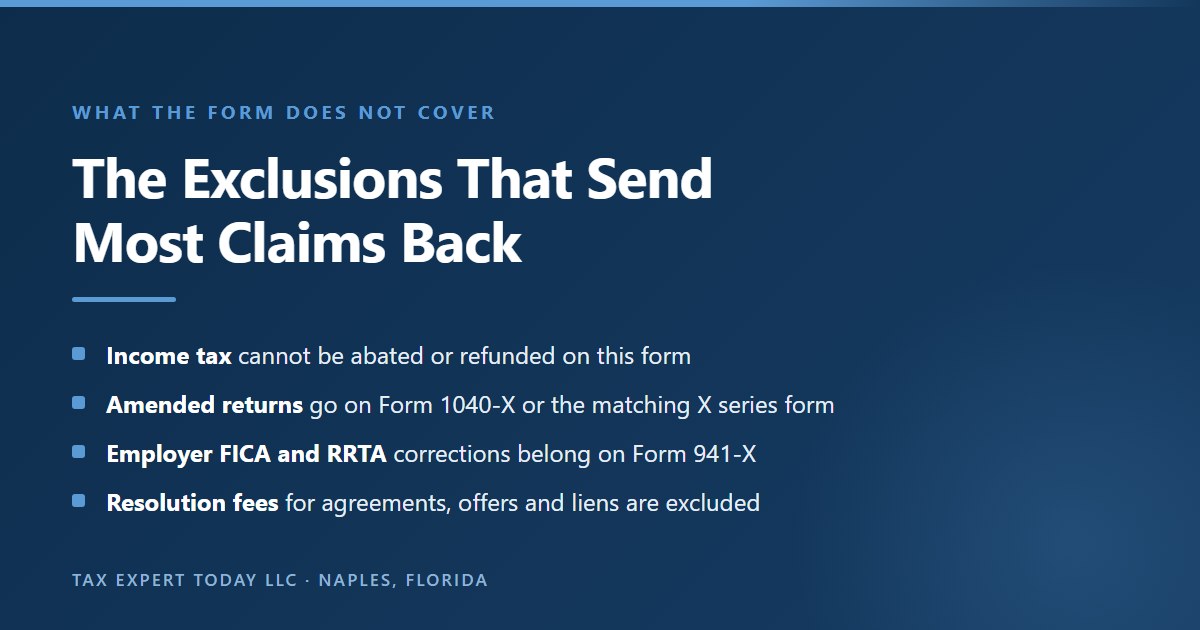
- Income tax is out, in both directions. Neither an abatement of income tax nor a refund of it belongs on this form.
- Amending is never the purpose. A previously filed income or employment tax return is corrected on its own X series form.
- Employer side employment taxes are excluded. FICA, RRTA, and withheld income tax are handled on Form 941-X or its equivalent.
- Resolution fees are not recoverable here. Installment agreement, offer in compromise, and lien fees are expressly listed as outside the form.
- The employee side is different. An employee whose employer will not adjust an overcollection of social security or Medicare tax does use this form.
The Form 8379 row is a common crossover. A taxpayer whose refund was applied to a spouse past due obligation is not making a penalty claim at all, and the correct route is the injured spouse allocation. Our guide to injured spouse relief explains that allocation, and the separate question of relief from a joint liability is covered in our guide to innocent spouse relief.
IRS Form 843 versus a penalty abatement request: which one do I use?
The form is the container, and the abatement argument is the contents. A first time abatement or a reasonable cause request can often be made by telephone or in a letter responding to the notice, and no IRS Form 843 is needed. IRS Form 843 becomes the appropriate vehicle where the penalty or interest has already been paid and money must come back, or where a written claim is required because the informal route has been exhausted or refused.
That distinction matters because the two paths have different timing. An abatement of an amount still assessed is limited by the period allowed for collection. A refund of an amount already paid is limited by IRC §6511, which is a shorter and less forgiving clock. Taxpayers who pay a penalty to stop collection pressure and then wait to argue about it frequently discover that paying started a limitation period they did not know was running.
- Still assessed and unpaid. Respond to the notice first. Abatement may be handled without any claim form.
- Already paid in full. A refund claim is required, and IRS Form 843 is the usual instrument.
- Reasonable cause is the argument, not the form. The facts establishing it are developed the same way in either channel.
- First time abatement is administrative. It rests on a clean compliance history rather than on an explanation of the failure.
This guide covers the form and the procedure. The substance of the argument is a separate subject, and we treat it separately: see our guide to how to get IRS penalties removed for the overall framework, reasonable cause penalty abatement for what the IRS actually weighs, and first time penalty abatement for the administrative waiver. Where the penalty at issue arose from an examination adjustment rather than a filing failure, our guide to the accuracy related penalty is the relevant one, and the mechanics of the two most common assessments are set out in our guide to the failure to pay penalty.
What is the deadline to file IRS Form 843?
Under IRC §6511(a), a claim for credit or refund must be filed within three years from the date the return was filed or two years from the date the tax was paid, whichever period expires later. If no return was filed, the window is two years from the date of payment. The period runs separately for each tax period, so a single claim covering several years can be timely for some of them and barred for others.
The statute contains a second limit that is routinely missed, and it decides how much money a late claim is actually worth. IRC §6511(b)(2) caps the recoverable amount by reference to a lookback period measured backward from the filing date of the claim, not from the tax year. Under subparagraph (A), a claim filed inside the three year period recovers no more than the portion of tax paid within the three years plus any extension of time to file, immediately preceding the claim. Under subparagraph (B), a claim not filed within that three year period recovers no more than the portion paid during the two years immediately preceding the claim.
Read together, those two provisions mean a claim can be timely and still recover nothing, if the payment being claimed falls outside the applicable lookback. They also mean the opposite, and this is the part that gets overlooked: a taxpayer who is past the three year window may still have a live claim for anything paid in the last two years.
| Situation | Filing window under §6511(a) | Amount limit under §6511(b)(2) |
|---|---|---|
| Return filed, payment made with the return | Three years from the filing date | Tax paid in the three years plus any filing extension, before the claim |
| Return filed, penalty paid years later | Two years from that payment, if later than the three year date | If outside the three year window, only amounts paid in the prior two years |
| No return was filed for the period | Two years from the date of payment | Amounts paid in the two years before the claim |
| Abatement sought on an unpaid assessed penalty | Governed by the collection period rather than §6511 | Not a refund, so no lookback cap applies |
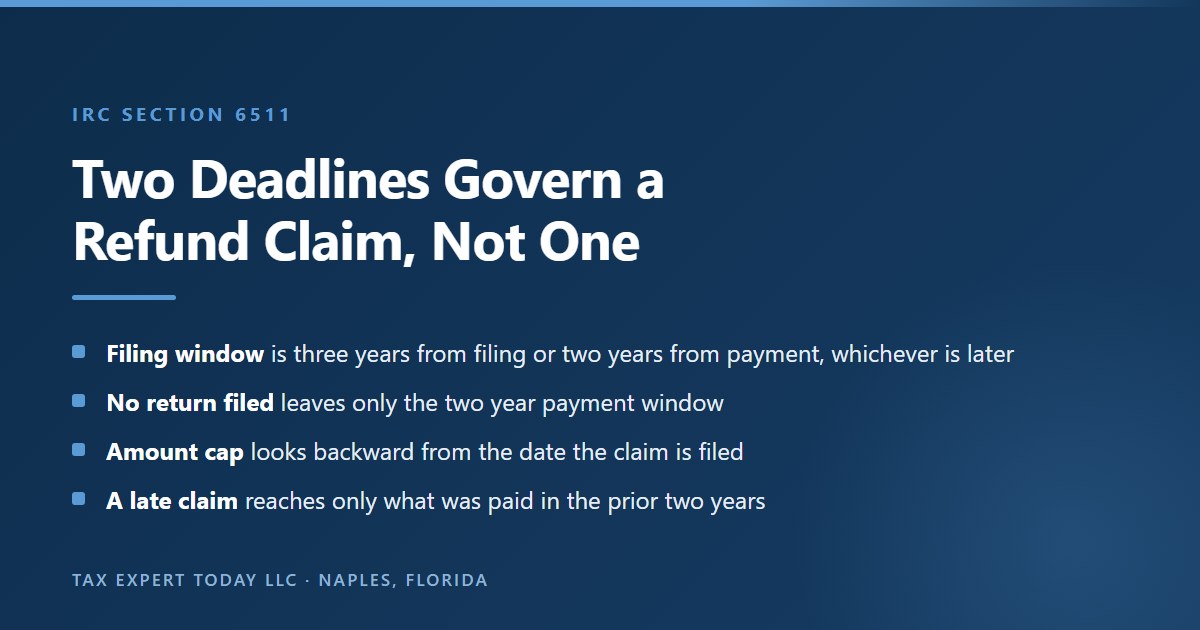
- Take the later of the two prongs. Three years from filing and two years from payment are alternatives, and the statute allows whichever expires later.
- Never filing a return shortens the window. Where no return was filed, only the two year payment prong is available.
- The lookback runs from the claim, not the tax year. Both caps in §6511(b)(2) measure backward from the date the claim is filed.
- An extension lengthens the cap. Subparagraph (A) adds the period of any extension of time for filing to the three years.
- Compute every period separately. One claim covering several years can be timely for some of them and barred for the rest.
Two practical consequences follow. First, the date of each payment belongs on line 3 of the form, and the instructions direct the filer to attach additional sheets where there are more payments than the line allows, because each payment carries its own lookback. Second, where several years are in play, the analysis is done year by year before anything is filed. Publication 556 covers the examination, appeal, and claim framework in more detail, and our IRS penalty and interest calculator is useful for establishing what was actually assessed and paid in each period.
Where do I mail IRS Form 843?
There is no single address. The instructions route the form by the reason for filing, and the general rule for penalty claims sends it to the service center where a current year return for the related tax would be filed. A form filed in response to a notice goes back to the address the notice came from, which overrides the general rule.
Sending a claim to the wrong campus does not automatically forfeit it, and the instructions note that a form mailed to an address that has since changed will be forwarded. The more serious risk is delay, because a misrouted claim can sit while a limitation period continues to run. The routing rules from the instructions and the IRS where to file page are summarized below.
| If the form is filed | Mail it to |
|---|---|
| In response to an IRS notice about a tax or fee | The return address shown on that notice |
| For a claim in a Form 706 or Form 709 matter | Internal Revenue Service, Attn: E&G, Stop 824G, 7940 Kentucky Drive, Florence, KY 41042-2915 |
| For a net interest rate of zero request | The service center where the most recent return was filed |
| For a matter related to Form 8300 | Internal Revenue Service, Rosa Parks Federal Building, P.O. Box 32621, Detroit, MI 48232 |
| As a nonresident alien claiming social security or Medicare tax withheld in error | The address in Publication 519 for those refunds |
| For penalties, or for any other reason not listed above | The service center where a current year return for the related tax would be filed |
- A notice overrides the general rule. When responding to a notice, the address on that notice controls.
- The general rule follows the related tax. Penalty claims go where a current year return for that tax would be filed.
- Several categories have dedicated addresses. Estate and gift, Form 8300, and the branded prescription drug fee each route separately.
- Kwong claims have their own address. Paper claims citing the case are directed to Ogden, Utah rather than through the general rule.
- Misrouting costs time, not usually the claim. The instructions note a form sent to a changed address will be forwarded.
Where a representative signs and files the claim, the instructions require the original or a copy of Form 2848, Power of Attorney and Declaration of Representative, to be attached, and the taxpayer must have authorized the representative for the purpose of the request. A claim filed by a representative without that authorization attached is a predictable source of correspondence and delay.
What about the Kwong COVID era penalty and interest claims?
Kwong v. United States, 179 Fed. Cl. 382, decided by the United States Court of Federal Claims in November 2025, read the mandatory disaster postponement then contained in IRC §7508A(d) as running from the beginning of the declared disaster period through its end and for sixty days afterward. Applied to the COVID-19 declaration, which ran from January 20, 2020 through May 11, 2023, that reading postpones affected deadlines to July 10, 2023. The Department of Justice was expected to appeal, and the decision has not been affirmed, so the position remains unsettled.
The IRS has published a page describing how it will handle claims that rely on the decision. That page states that individual taxpayers with an IRS Online Account may submit an IRS Form 843 electronically, that only claims relating to fully paid interest and penalties citing the case are being accepted electronically at present, and that business taxpayers and individuals who prefer paper may mail the current form to Internal Revenue Service, 1973 N Rulon White Blvd., Ogden, UT 84201, identifying the submission by writing the case name across the top of the form. That page does not state a filing deadline of its own.
The deadline that mattered was statutory, not administrative, and it has now passed for one of the two prongs. Because the Kwong reasoning treats the affected obligations as due on July 10, 2023, the three year prong of §6511(a) closed on July 10, 2026 for taxpayers measuring from that date. The National Taxpayer Advocate published a series of blog posts flagging that date in advance, including one specifically on acting before it. Most published guidance on this topic was written during that window and still speaks as though the date is approaching. It is not.
What remains open is a narrower question, and it is answered by the statute rather than by the news coverage:
- The two year payment prong survives independently. Under §6511(a) the window is the later of three years from filing or two years from payment, so a penalty or interest amount paid within the last two years can still support a timely claim.
- The two year lookback still limits the amount. Under §6511(b)(2)(B), a claim filed after the three year period recovers no more than what was paid in the two years immediately before it.
- The underlying law is not settled. A pending appeal can reverse the reasoning the claim depends on, and filing preserves a position rather than establishing an entitlement.
- The IRS is not obliged to hold claims. Denials on claims citing the case have been reported, and a denial begins its own separate response timetable.
- Each period stands alone. A household can be barred for one year and timely for another, which is why the year by year computation above is the whole exercise.
A caution belongs here, because this subject attracted a great deal of promotional activity. IRC §6676 imposes a penalty equal to twenty percent of the excessive amount where a claim for refund or credit with respect to income or employment tax is made for an excessive amount, unless the excessive amount is shown to be due to reasonable cause. A claim filed without regard to whether the amounts were actually paid, or whether the period is open, is not a free option. Anyone considering a claim on this basis should have the transcripts for the periods involved in hand first.
How do I request interest abatement under section 6404(e)?
Interest attributable to an unreasonable IRS error or delay may be abated under IRC §6404(e)(1), but only where the delay involved a managerial or ministerial act, only where the taxpayer did not cause any significant aspect of it, and only where the interest relates to a tax for which a notice of deficiency is required. That last condition excludes employment taxes and most other excise taxes entirely, and it is the single largest reason interest abatement requests fail.
The taxes for which a notice of deficiency is required include income taxes, generation skipping transfer taxes, estate and gift taxes, and certain excise taxes. Interest on employment tax is outside the provision no matter how long the IRS took. Our guide to the IRS notice of deficiency explains which assessments carry that requirement, which is the same test applied here.
The two operative terms are defined narrowly. A managerial act, under the instructions and Treasury Regulation §301.6404-2, means an administrative act during the processing of the case involving a temporary or permanent loss of records, or the exercise of judgment or discretion relating to management of personnel. A ministerial act means a procedural or mechanical act that involves no judgment or discretion and occurs after all prerequisites, such as conferences and supervisory review, have taken place. Both definitions exclude a decision about the proper application of federal or state law, which means disagreement with a legal position is not a ground for interest abatement however long it took to resolve.
- The tax type is a threshold test. Interest on employment tax cannot be abated under this provision at any length of delay.
- Legal disagreement does not qualify. A decision about the proper application of law is neither managerial nor ministerial.
- Taxpayer contribution defeats the request. The taxpayer must not have caused any significant aspect of the error or delay.
- The delay has to be unreasonable. Ordinary processing time is not an error or delay within the meaning of the section.
- One act affecting several years takes one form. This is an express exception to the separate form rule.
The instructions set out what belongs on line 8 of IRS Form 843 for such a request: the type of tax, when the IRS first gave written notice of the deficiency or payment, the specific period for which abatement is sought, the circumstances of the case, and the reasons why failing to abate would result in grossly unfair treatment. Where a single error or delay affected several years or several types of tax, the instructions permit one form rather than several, which is an express exception to the separate form rule.
What about penalties caused by erroneous IRS written advice?
IRC §6404(f) allows abatement of a penalty or addition to tax attributable to erroneous written advice from the IRS, but the instructions state three conditions that all have to be met: the taxpayer reasonably relied on the written advice, the advice responded to a specific written request the taxpayer or an authorized representative made, and the penalty did not result from the taxpayer failing to give the IRS adequate or accurate information.
The second condition is the one that defeats most requests. Advice that was not solicited in writing, general guidance from a publication or a website, and an answer given on the telephone do not qualify. Treasury Regulation §301.6404-3 supplies the detail. The instructions require three attachments: the written request for advice, the erroneous written advice received, and any report of tax adjustments identifying the penalty and the items connected to the advice.
- The advice must be in writing. A telephone answer does not support a claim under this provision.
- The request must also have been in writing. The advice has to respond to a specific written request from the taxpayer or an authorized representative.
- Reliance must be reasonable. The taxpayer has to have actually relied on the advice received.
- Accurate disclosure is required. Relief is unavailable where the penalty resulted from inadequate or inaccurate information supplied to the IRS.
- Three attachments are expected. The written request, the erroneous advice, and any report of adjustments identifying the penalty all travel with IRS Form 843.
The timing rule for this route is also distinct from the ordinary claim rule. The instructions provide that abatement is allowed only if the request is submitted within the period allowed for collection of the penalty, or the penalty was paid within the period allowed for claiming a credit or refund of it. In other words the general §6511 analysis still governs the refund side, while the abatement side tracks the collection period.
How do I claim a refund of a trust fund recovery penalty?
A trust fund recovery penalty assessed under IRC §6672 can be contested through IRS Form 843, but the instructions impose a payment prerequisite first. For each applicable tax period the taxpayer must pay the portion of the penalty attributable to one employee where the penalty is based on employment taxes, or to one transaction where it relates to excise taxes, before filing the claim.
That requirement reflects the divisible nature of the assessment. The penalty is treated as divisible among the employees or transactions that make it up, so paying the piece attributable to a single one establishes jurisdiction for a refund suit without requiring full payment of an assessment that is frequently very large. Our guide to the trust fund recovery penalty covers the responsibility and willfulness elements the IRS must establish, and the interview that usually precedes assessment.
One related mechanism deserves a mention because it is the other express exception to the one form per period rule. Where a taxpayer both owes interest on an underpayment and is due interest on an overpayment for the same period, IRC §6621(d) provides a net interest rate of zero to the extent the two overlap, and the instructions permit a single IRS Form 843 covering the separate periods involved rather than one for each.
Why do IRS Form 843 claims get rejected?
Most IRS Form 843 rejections are procedural rather than substantive. The claim asks for something the form does not cover, the period is closed or the lookback yields nothing, the wrong box is checked or several are, the required attachments are missing, or the narrative on line 8 asserts a conclusion without showing the computation the instructions require.
The pattern is consistent enough to be worth checking against before filing, because each of these is curable in advance and none of them is curable after a period closes.
| Reason the claim fails | Underlying rule | What addresses it |
|---|---|---|
| Claim seeks income tax, or amends a return | Purpose of Form, Instructions for Form 843 | File Form 1040-X or the matching X series form instead |
| Period closed under §6511(a) | IRC §6511(a) | Compute the window per period before filing, using the later of the two prongs |
| Timely but recovers nothing | IRC §6511(b)(2) | Check the lookback against the actual payment dates on line 3 |
| More than one box checked at the top | Instructions, Checkboxes | Check one box, and use Other (specify) only where no listed reason fits |
| Interest abatement sought on employment tax | IRC §6404(e)(1) | Confirm the tax is one for which a notice of deficiency is required |
| Written advice claim with no written request | IRC §6404(f), Reg. §301.6404-3 | Attach the original written request, or use reasonable cause instead |
| Representative filed without authorization attached | Instructions, Who Can File | Attach Form 2848 covering the specific request |
| Trust fund penalty claim with no divisible payment | Instructions, TFRP | Pay the portion for one employee or one transaction first |
| Line 8 states a conclusion with no computation | Instructions, Line 8 | Show the arithmetic and attach the supporting evidence |
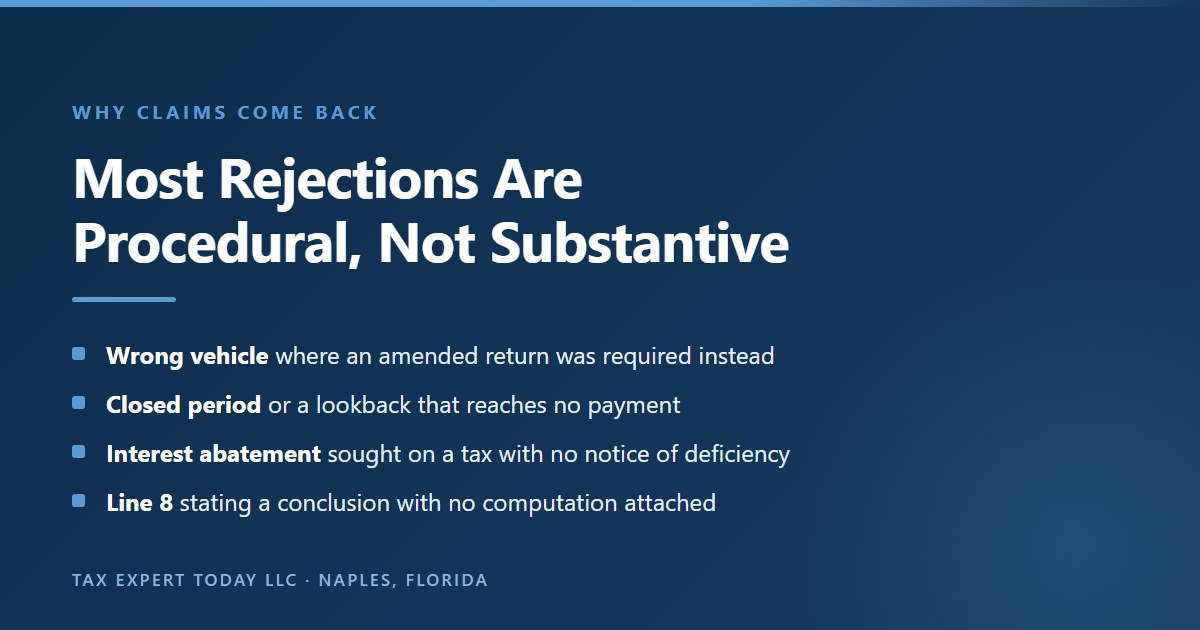
- Most failures are procedural. The claim is refused for how it was filed rather than for what it argued.
- Procedural defects are curable in advance only. None of them can be repaired after a limitation period closes.
- The computation is not optional. Line 8 requires the arithmetic, not simply the conclusion.
- Attachments carry the claim. The notice, the written advice, or the employer statement travels with the form.
- Signatures are checked. Joint claims need both spouses, and corporate claims need an authorized officer and title.
Two further points are worth noting. A claim relating to a joint return must be signed by both spouses, and a corporate claim must be signed by an officer authorized to sign with the title included. Separately, a claim for excess social security or Medicare tax withheld by one employer is expected to carry a statement from that employer, and where the employer will not provide one, the instructions permit a substitute statement from the taxpayer explaining why it could not be obtained, with a copy of the Form W-2 attached.
IRS Form 843 help Naples: penalty and interest claims in Naples and Southwest Florida
Taxpayers reach our office in Naples, Florida with IRS Form 843 questions in two recognizable postures. The first is someone who already paid a penalty, often to stop collection activity or to clear a matter quickly, and only later asked whether it was correctly assessed. For that person the whole question is whether §6511 still leaves a window and whether the lookback reaches the payment. The second is a small business owner facing a trust fund recovery penalty, where the divisible payment rule and the notice of deficiency distinction matter far more than the wording of any explanation. Tax resolution Naples clients in the first group are usually surprised that paying started a clock, and those in the second are usually surprised that a partial payment is the procedural key rather than a concession.
Tax Expert Today LLC
11983 Tamiami Trail N, Naples, FL 34110
Phone: (239) 441-2005
Hours: Monday through Friday, 10:00 to 5:00 ET
Does living in Florida change how IRS Form 843 works? The form and the statute are federal, so the procedure is identical in Naples, Fort Myers, Bonita Springs, and Marco Island. Two local facts do bear on it. Florida imposes no state individual income tax, so there is no parallel state penalty claim to file alongside the federal one, which simplifies the work relative to a taxpayer who moved here from a state that assessed its own penalties for the same years. Florida also has a large seasonal and retiree population whose returns are filed on extension, and because §6511(b)(2)(A) measures the lookback as three years plus the period of any extension of time for filing, an extended return can leave slightly more room than the bare three year figure suggests. Our IRS resolution and audit support service page and our Naples tax resolution page describe how these engagements are handled.
When to Engage a Professional
The value of representation on an IRS Form 843 claim sits almost entirely at the front end, because the limitation analysis cannot be redone once a period closes. Consider engaging a representative where a penalty or interest amount has already been paid and the payment dates are more than two years old, where several tax periods are involved and the windows differ between them, where the claim rests on the Kwong reasoning and the appeal remains undecided, where a trust fund recovery penalty is at issue and the divisible payment has not yet been made, where an interest abatement request depends on characterizing an IRS act as managerial or ministerial, or where a claim has already been rejected and the response window is open. Every case turns on its own transcripts and its own payment history, and the statutory analysis should be run against the actual dates in the account rather than against any general timetable.
This article is educational and general in nature. It does not constitute tax advice for any particular taxpayer, and outcomes depend on individual facts and circumstances.
Published September 7, 2026 by Dr. Pellumb Kabashi « Back to Learning Center
Have a question this article touches on?
Tax Expert Today LLC, based in Naples, Florida and serving clients across the United States.
Schedule a Consultation (239) 441-2005