
By Dr. Pellumb Kabashi, DBA, MBA, EA, CFE, CES
Founder, Tax Expert Today LLC · Tax advisors, enrolled agents, CPAs, and attorneys · Serving clients in all 50 states
Quick Answer: An IRS CP60 notice means the IRS found a payment it had credited to your account by mistake, moved that payment off your account, and now shows a balance due. The notice lists the date and amount of the payment removed and asks you to pay by a date about 21 days out. If the payment was yours, send proof of payment and trace where it went. Call (239) 441-2005 for a free consultation.
What is an IRS CP60 notice?
An IRS CP60 notice tells you that the IRS removed a payment it had applied to your account in error. Because that payment no longer counts toward your tax for the year shown, the account now has a balance due. The notice gives the date and amount of the payment removed, the new balance, and a date to pay.
- It is a correction notice. The IRS is fixing its own posting of a payment, not changing your return.
- It creates or restores a balance. The tax you owed never changed; the credit against it did.
- It is issued on individual accounts. The business version is the CP260.
- It can be wrong. The IRS invites you to send proof if the payment really was yours.
The IRS page for the CP60 explains the notice in one sentence: “We removed a payment that we incorrectly applied to your account.” The Internal Revenue Manual gives the formal title, “We Removed a Payment Erroneously Applied to your Account, Balance Due,” and places the notice inside the IRS credit transfer system. In plain terms, an IRS employee moved a payment from your tax module to another module, either on your own account, on a spouse’s account, or on another taxpayer’s account entirely, and the move left your module owing money.
That framing matters because an IRS CP60 notice is different from most balance due bills. A CP14 notice bills a balance shown on a return that was never fully paid. A CP11 or CP12 reports a math error correction. An audit changes the tax. The IRS CP60 notice changes none of those things. It changes only the payment side of the ledger. That is why the first question to ask is not “how much do I owe” but “where did the payment go, and was it mine.”
Many people search for the phrase IRS notice CP60 after opening an envelope and seeing a balance on a year they believed was paid. The reaction is understandable. If you paid, and the IRS has now taken the payment away, the notice can read like an accusation. It is not. It is a bookkeeping correction, and like any bookkeeping correction, it can be right or wrong. The rest of this guide walks through how to tell which.
Why did the IRS remove a payment from my account?
The IRS removes a payment when it decides the payment was posted to the wrong place. The most common causes are a payment that belonged to another taxpayer, a payment made under one spouse’s Social Security number that belonged on a joint account, and a payment applied to the wrong tax year or form. Each cause has a different fix.
- Another taxpayer’s payment: a transposed number or IRS keying error put someone else’s money on your account.
- A spousal payment: a payment under the secondary spouse’s SSN was moved to the joint account.
- The wrong year or form: a payment was moved to a different tax period on your own account.
- Your payment, moved in error: the IRS took a payment that really was yours, which you can dispute.
The Internal Revenue Manual explains the mechanics. Under IRM 21.5.8, a credit transfer “moves a payment or credit from one module to another, or reverses a credit previously applied.” A module is one tax form for one tax period on one taxpayer identification number, such as your 2024 Form 1040. When an IRS employee inputs a transfer that takes a payment off a module and the module then owes more than a small tolerance, the system generates the CP60 automatically. The manual states that “in general, the taxpayer receives a CP 60 within four weeks from the date the credit transfer was input,” and that multiple transfers are combined so the taxpayer receives only one notice.
The manual also explains what usually starts the process. Under IRM 21.5.7.4.6.6, when a taxpayer’s payment is found on the wrong account, the IRS transfers the credit to the correct account, and a CP60 “generates automatically notifying the incorrect taxpayer of a balance due.” In other words, in many cases another person called or wrote to the IRS to say a payment was missing, the IRS traced it, found it on your account, and moved it. The CP60 is the downstream effect of someone else’s payment tracer.
The other common trigger is a joint return. Payments made under the secondary spouse’s number, or made by one spouse before a joint return posts, may sit on that spouse’s individual account. The IRS has a systemic process that moves those payments to the joint account. When the move leaves one module short, a notice follows. The same logic applies when a payment intended for one tax year was found on another year and moved.
Finally, the IRS can make a mistake in the other direction. A transfer can take a payment that genuinely belonged on your module and move it somewhere it does not belong. The IRS CP60 page anticipates that: if you believe the payment was incorrectly removed, mail a copy of your proof of payment to the address on the notice. That is the dispute path, covered in detail below.
What does the IRS CP60 notice show?
The IRS CP60 notice shows a billing summary with three key lines: the balance on the account before the adjustment, the misapplied payments the IRS removed, and the amount due by a stated date. Page one also says how much was removed, and later pages explain how to pay, how to dispute, and that the IRS assumes agreement if it does not hear from you.
- Balance before adjustment: what the account showed before the payment came off.
- Misapplied payments: the total the IRS removed, which is the heart of the notice.
- Amount due by: the new balance and the date to pay it.
- Contact line: the phone number and mailing address for disputes.
The IRS sample CP60 is a useful map. In the sample, the IRS writes that it reviewed the account and “found that we misapplied payments,” that it adjusted the account to correct the error, and that the taxpayers now have a balance due. The billing summary lists the balance on the account before the adjustment, then the misapplied payments, then the amount due by a date exactly 21 days after the notice date. The sample is a joint return, and it notes that the IRS is required to send a copy of the notice to both spouses.
| Line on the CP60 | What it means | What to check |
|---|---|---|
| Notice date | The date of notice and demand for the new balance | Count 21 calendar days forward for the pay-by date |
| Tax year and form | The module the payment was removed from | Confirm it is the year you think you paid |
| Balance before adjustment | What the account showed before the removal | Compare to your own records for that year |
| Misapplied payments | The total amount the IRS took off this module | Match it to a specific payment you made, or did not make |
| Amount due by | The new balance, including interest to the notice date | Decide whether to pay, dispute, or both |
| Contact information | The phone line and mailing address for this notice | Use these, not a general address, for proof of payment |
The single most important number on an IRS CP60 notice is the amount of the misapplied payments. If that figure matches a payment you know you made, by the same amount and on or near the same date, the dispute question is live: the IRS has taken your money off your account, and you need to find out where it went. If the figure matches nothing you ever paid, the most likely explanation is that another taxpayer’s payment was sitting on your account and has now gone home. In that case the balance is real, and the question becomes how to pay it and whether any interest relief applies.
How long do I have to respond to an IRS CP60 notice?
The IRS CP60 asks you to pay the balance by the date printed on the notice, which in the IRS sample is 21 calendar days after the notice date. Paying in full within that window generally stops further interest on the billed amount. If you disagree, call or write promptly, because the IRS states that it assumes you agree if it does not hear from you.
- 21 calendar days: the usual pay-by window on the notice for balances under $100,000.
- 10 business days: the window under section 6601(e)(3) when the amount is $100,000 or more.
- No formal appeal deadline: unlike a deficiency notice, the CP60 has no 90 day Tax Court clock.
- Collection follows: unpaid balances move through the normal notice sequence.
The timing comes from two places. The notice itself sets the pay-by date. The statute explains why that date matters. Under IRC section 6601(e)(3), if notice and demand is made for any amount and the amount is paid within 21 calendar days (10 business days if the amount is $100,000 or more) after the date of notice and demand, interest is not imposed on the amount paid for the period after the notice date. An IRS CP60 notice is a notice and demand for the restored balance, so paying inside the window caps the interest at what the notice already shows.
The IRS CP60 does not carry a statutory protest deadline the way a statutory notice of deficiency does. The amount is not a new tax. It is a balance that results from removing a credit, so there is no 90 day petition right attached to it. That does not mean the matter can wait. The sample notice says that if you disagree you should call to review your account, and that the IRS will assume you agree with the information if it does not hear from you. In practice, a disputed IRS CP60 that receives no response moves into the normal collection stream, with reminder notices and, eventually, a notice of intent to levy.
There is also a practical reason to move quickly. Payment records are easiest to gather while they are recent. Banks keep images of cleared checks for a limited time, and online payment confirmations live in email inboxes that get cleaned out. If the payment on the IRS CP60 notice is yours, collect the proof the week the notice arrives.
How do I trace where the removed payment went?
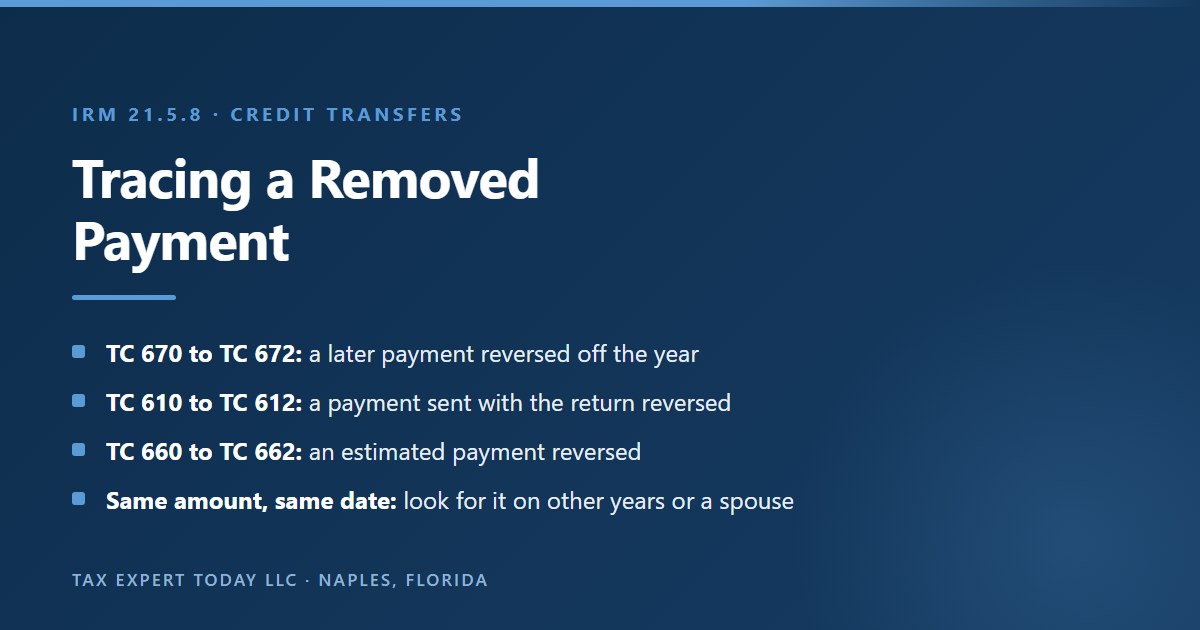
Start with your IRS account transcript for the year on the notice. A payment removed by a credit transfer shows as a reversal code paired with the original payment, such as a TC 672 reversing a TC 670. If the payment moved within your own account, the same amount and date will appear as a new credit on another year or form.
- Pull the account transcript: through your IRS online account or by mail.
- Find the reversal: look for a 6XX payment code followed by its reversal code for the same amount.
- Check your other years: a matching credit may have landed on a different tax period.
- Check your spouse’s account: on joint filers the payment may have moved between SSNs.
Every competing page on this topic says the same thing: send proof of payment. That advice is correct, but it skips the step that tells you whether to bother. The IRS account transcript records each payment and each transfer with a three digit transaction code. When the IRS moves a payment, it reverses the original code on the losing module and posts a new credit on the receiving module. The pairs are set out in the credit transfer table at IRM 21.5.8.4.2.
| Original payment code | What it was | Reversal code on your module | What to look for elsewhere |
|---|---|---|---|
| TC 610 | Payment received with the return | TC 612 | A TC 610 or TC 670 on the receiving module, same date |
| TC 660 | Estimated tax payment | TC 662 | A TC 660 or TC 670 on the receiving module |
| TC 670 | Subsequent payment, such as a Direct Pay or check after filing | TC 672 | A TC 670 on the receiving module, same amount and date |
| TC 710 | Overpayment credit elect from a prior year | TC 712 | A TC 710 on another module or a spouse’s account |
| TC 700 | Credit transferred in from another module | TC 702 | A matching TC 820 reversal on the module that sent it |
Read the transcript for the year on the IRS CP60 notice first. If you see a payment code and a matching reversal for the same amount, you have found the removal. Then pull the transcripts for the adjacent years. If the same amount appears as a new credit, dated the same as your original payment, the IRS moved it within your own account, and the CP60 balance on one year is offset by a credit or reduced balance on another. That is a timing and allocation question, not lost money.
If the money does not appear on any of your years, and you filed jointly, check the spouse’s individual account. The IRS spousal payment rules in IRM 21.5.7.3.2.2 describe a systemic process that moves payments made under one spouse’s number to the joint account, normally two to three weeks after the payment posts. When that process fails, or when an employee moves a payment manually, the paper trail sits on the other spouse’s transcript.
If the money does not appear on any account you can see, it has most likely gone to another taxpayer. Your transcript will not show where. At that point the only way to learn the destination is through the IRS, and the only way to get the payment back is to prove it was yours.
Two practical notes. First, transcripts update weekly, and the IRS CP60 notice can arrive up to four weeks after the transfer, so the transcript is usually current by the time the notice lands. Second, transcripts use internal codes and dates without explanation. A Form 2848 representative can request the full account history, including the internal research screens the IRS used to justify the transfer, which the taxpayer’s own transcript does not show.
What should I do if the payment really was mine?
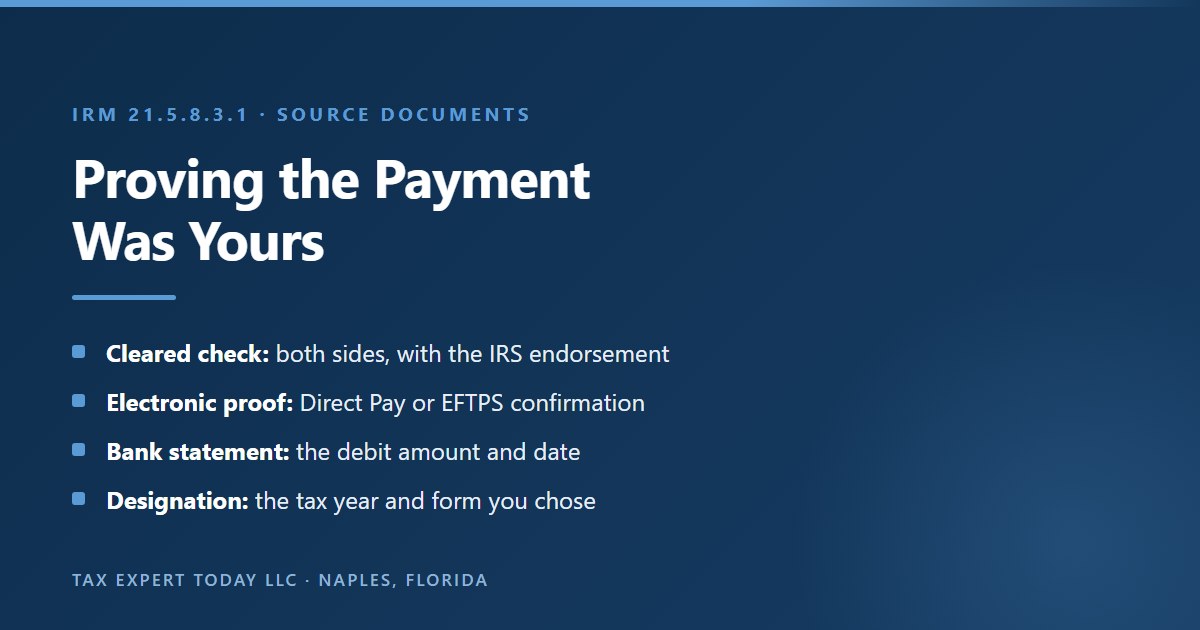
Gather proof that you made the payment and that it was meant for the year on the notice, then send it to the address on the IRS CP60 and call the number listed. Good proof is a cleared check showing the IRS endorsement, a bank statement showing the debit, or an IRS Direct Pay or EFTPS confirmation showing the tax year and form.
- Cleared check: front and back, showing the IRS endorsement.
- Electronic confirmation: Direct Pay, EFTPS, or card processor confirmation number.
- Bank statement: showing the debit amount and date.
- The year designation: the memo line or the tax year selected online.
The IRS uses the phrase “source document” for proof of this kind. Under IRM 21.5.8.3.1, a source document verifies that a credit transfer is correct, and when one is needed it includes a copy of the cancelled check showing the IRS endorsement or confirmation of the payment amount, the payment document locator number, the tax form and period, the payment date, and any additional pertinent information the taxpayer provides. The same manual section says a source document is required for a transfer between non-related accounts, and it gives the example of a payment that posted to an unrelated taxpayer because of an IRS error. Your proof is what an employee needs to move the payment back.
Put the package together in a way an IRS clerk can act on without calling you:
- A short cover letter. Name, SSN, tax year, form, the notice date, and one sentence: the payment of a stated amount on a stated date was mine and was intended for this year.
- A copy of the IRS CP60 notice. All pages, so the clerk sees the removal amount.
- The proof of payment. Both sides of the check, or the electronic confirmation, with the amount and date highlighted.
- The transcript page. The section showing the original payment code and its reversal.
- A request. Ask that the payment be restored to the module as of its original date and that interest and penalties be recomputed.
Send the package to the address on the notice, by a method that proves mailing, and keep a full copy. Then call the number on the notice to say a response is on the way and ask that the account be held from further collection while it is reviewed. If the balance has already moved into collection notices, mention the IRS CP60 by name so the call is routed correctly.
The date on the restored payment matters as much as the amount. The IRS credit transfer rules key the new posting to the original payment date. If a restored payment posts with a later date, interest and the failure to pay penalty may be computed as though you paid late. When the corrected account arrives, check that the payment date on the transcript matches your original payment date.
What if the payment was moved to my spouse or another tax year?
If the payment moved within your household or your own account, the money was not lost; it was reallocated. Check whether the receiving year or spouse’s account now shows a credit, refund, or lower balance. If the move was wrong, ask the IRS to transfer it back to the year you designated, with its original date.
- Joint return payments: payments under either spouse’s SSN can be moved to the joint account.
- Separate returns: a payment should stay with the spouse who made it.
- Another year: a payment can be moved to the year it was originally intended for.
- Possible refund: the receiving account may now be overpaid and due a refund or credit.
Joint filers see the IRS CP60 more than most, because the IRS system tracks payments by Social Security number. A payment made under the second spouse’s number before a joint return posts can sit on that spouse’s individual account. The IRM spousal payment section describes how those payments resequence to the joint account when the joint account already exists and shows a balance or an unsettled return. It also tells IRS employees, when payments are found under the secondary taxpayer’s number on a joint return, to transfer them to the correct account and to “remind the taxpayer to refer to the primary SSN for all future payments.”
The problem comes when the couple’s filing status changes, or when the system guesses wrong. Consider a hypothetical. A married couple files jointly for 2024 and pays $3,000 with the return using the second spouse’s number. For 2025 they file separately. Months later, the IRS moves a $3,000 payment from the second spouse’s 2025 account to the joint 2024 account, and the second spouse receives an IRS CP60 for 2025. If the $3,000 was a 2025 estimated payment, the transfer is wrong and should be reversed. If it was the 2024 balance, the transfer is right, and the CP60 balance reflects 2025 tax that was never paid. The transcript dates usually settle which it is.
Moves between tax years work the same way. A check with “2024 Form 1040” on the memo line, or a Direct Pay entry that selected tax year 2024, is evidence of what the payment was for. Bring that designation with the proof of payment. Where the IRS moved a payment to an older year with a balance, the IRS may have applied it where it judged best, and whether that can be undone depends on how the payment was designated when made. A careful review of each year’s transcript is the only way to answer that for a particular account.
Injured spouse relief is a different issue. It applies when a joint refund is taken to pay one spouse’s separate debt. If a joint refund was offset rather than a payment moved, the remedy is injured spouse relief on Form 8379, not a CP60 dispute.
What if I received a CP60 for a payment I never made?
If the removed payment never came from you, the IRS CP60 balance is very likely correct: another taxpayer’s money was credited to your account and has been returned to its owner. You owe the restored balance. If that misapplied payment produced a refund to you, the IRS treats the refund as erroneous and may ask for it back.
- The balance is real: it is tax your account always owed.
- A refund may be reclaimed: refunds generated by someone else’s payment are erroneous.
- Interest rules differ: section 6404(e)(2) can limit interest on certain erroneous refunds.
- Check for identity issues: confirm the payment was not tied to fraud on your account.
This scenario surprises people because the account looked paid, sometimes for months. The IRS posted a payment, the balance went to zero or a refund issued, and then the CP60 arrived. Under IRM 21.5.7.4.6.6, the IRS transfers the credit to the correct account and follows its erroneous refund procedures “if misapplied payment caused an erroneous refund.”
Interest on an erroneous refund follows a special rule. Under IRC section 6404(e)(2), the IRS shall abate all interest on any erroneous refund under section 6602 until the date demand for repayment is made, unless the taxpayer or a related party in any way caused the erroneous refund, or the erroneous refund exceeds $50,000. If you received a refund only because someone else’s payment landed on your account, and you did nothing to cause it, that rule may limit the interest charged before the IRS demanded repayment. Whether a given notice falls under the erroneous refund rule or the ordinary balance due rules depends on how the IRS coded the account, which is another reason to read the transcript.
The underlying tax is a different matter. If the payment that came off your account was never yours, the tax it appeared to pay was never paid. Interest on unpaid tax generally runs from the original due date under section 6601(a), and the failure to pay penalty may apply to the restored balance. The relief question in this scenario is usually interest abatement and penalty relief, not removal of the balance.
One more check is worth doing. If a payment you never made appeared on your account and you also see unfamiliar returns, refunds, or notices, contact the IRS about possible identity theft before paying. A CP59 notice about a return the IRS has no record of, arriving alongside a CP60, is another reason to look closer. Misapplied payments are almost always clerical, but the transcript review should rule out the rarer case.
Can I get interest abated if the IRS made the error?
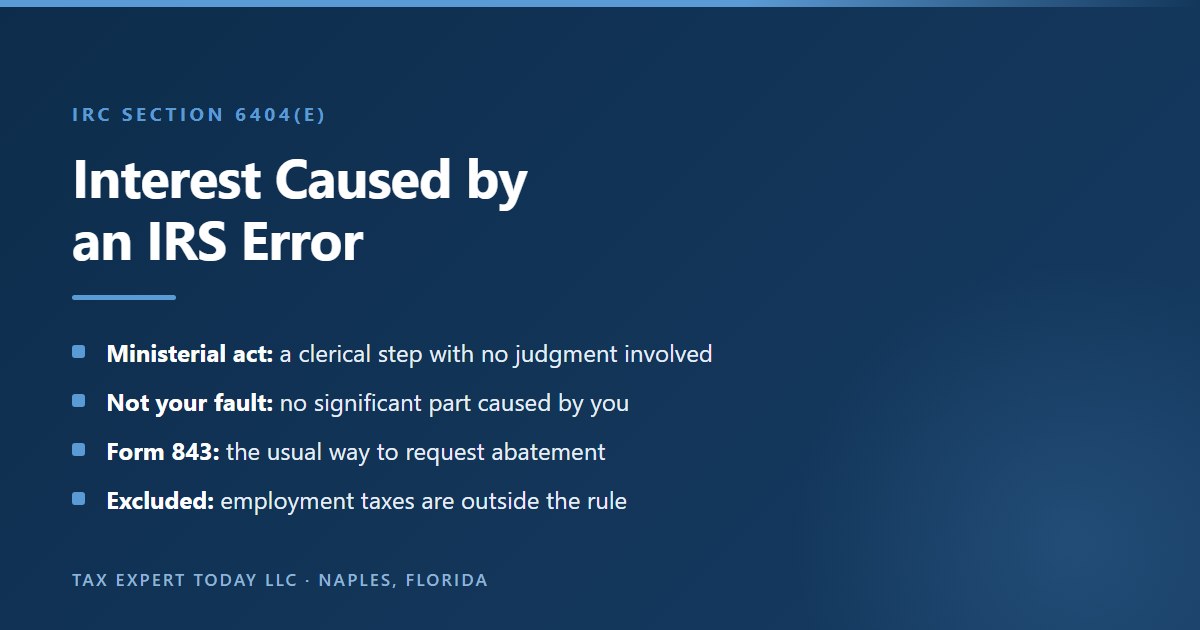
Possibly. IRC section 6404(e)(1) lets the IRS abate interest caused by an unreasonable IRS error or delay in a ministerial or managerial act, such as a clerical misposting, if no significant part of the error is attributable to you and the IRS had contacted you in writing. The request is usually made on Form 843 and applies only to income, estate, gift and certain excise taxes.
- Ministerial act: a procedural or mechanical act involving no judgment, such as posting a payment.
- Not your fault: no significant aspect of the error can be attributed to you.
- Written contact first: the error counts only after the IRS contacted you in writing.
- Tax Court review: a denial can be reviewed for abuse of discretion under section 6404(h).
This is the remedy most CP60 guides never mention. IRC section 6404(e)(1) allows the IRS to abate all or part of the interest assessed on a deficiency, or on a payment of tax described in section 6212(a), to the extent an unreasonable error or delay in the payment is attributable to an IRS officer or employee being erroneous or dilatory in performing a ministerial or managerial act. The statute adds two conditions: no significant aspect of the error or delay can be attributed to the taxpayer, and the error or delay counts only after the IRS has contacted the taxpayer in writing about the deficiency or payment.
The IRM on interest abatement, 20.2.7, defines the terms. A “ministerial act” is a procedural or mechanical act that does not involve judgment or discretion. A “managerial act” involves the temporary or permanent loss of records or the exercise of judgment about personnel. A decision about how tax law applies is neither. The same IRM section notes that the request must relate to interest on taxes described in section 6212(a), such as income, estate, gift and certain excise taxes, and that employment taxes are specifically excluded. That is why the remedy fits individual income tax accounts that receive an IRS CP60, and generally does not reach the payroll balances that appear on a business CP260.
How might this apply to a CP60? Suppose the IRS posted your own payment to the wrong year, sent you a notice confirming a zero balance, and then months later reversed the payment and billed you. If the original misposting was a clerical act by an IRS employee, and you designated the payment correctly, the interest that built up because of that error is a reasonable candidate for an abatement request. By contrast, if another taxpayer’s payment sat on your account and you never paid the tax yourself, the interest reflects money you always owed, and the case for abatement is weaker. Outcomes depend on the facts and on IRS discretion.
| Scenario | Likely remedy | Authority |
|---|---|---|
| Your payment was removed and is still missing | Restore the payment with its original date; recompute interest and penalties | IRM 21.5.8.3.1 source documents |
| Your payment was moved to another of your years | Confirm the credit on the other year, or ask for it to be moved back | IRM 21.5.8.4.2 transfer table |
| Your payment was moved to a spouse’s account | Check filing status and transfer back if the move was wrong | IRM 21.5.7.3.2.2 spousal payments |
| IRS clerical error delayed your payment | Request interest abatement on Form 843 | IRC §6404(e)(1), IRM 20.2.7.5 |
| Someone else’s payment created a refund to you | Repay; interest before demand may be abated | IRC §6404(e)(2) |
| Penalties on the restored balance | First-time abatement or reasonable cause request | IRC §6651, IRS penalty relief procedures |
The request is generally made on Form 843, Claim for Refund and Request for Abatement, which the IRS describes as the form to request abatement of certain taxes, interest, penalties, fees and additions to tax. Our guide to IRS Form 843 covers the line by line mechanics. For a CP60 case, the explanation should identify the specific IRS act (the misposting and the date), show that you did nothing to cause it, and attach the same proof of payment used in the dispute.
If the IRS denies the request, section 6404(h) gives the Tax Court jurisdiction to review whether the denial was an abuse of discretion, for taxpayers who meet the net worth limits referenced in section 7430(c)(4)(A)(ii). The action generally must be brought no later than 180 days after the IRS mails its final determination not to abate. That is a high standard of review, and most CP60 interest questions are resolved at the account level long before that point.
Do penalties apply to an IRS CP60 balance?
They can. Once a payment is removed, the account treats the tax as unpaid, so the failure to pay penalty and interest may be recomputed from the original due date. Penalties caused only by the IRS misposting should be reversed when the payment is restored, and penalties on a balance you truly owe may qualify for first-time abatement or reasonable cause relief.
- Failure to pay penalty: one half of one percent a month on unpaid tax shown on a return, up to 25 percent.
- Interest: runs from the due date at the quarterly federal rate, compounded daily.
- Estimated tax penalty: can change if a removed payment was an estimated payment.
- Relief: first-time abatement and reasonable cause remain available where you qualify.
The sample IRS CP60 asks the taxpayer to pay “to avoid additional interest and applicable penalties.” The penalty in play is usually the failure to pay penalty under IRC section 6651(a)(2), which runs at one half of one percent of the unpaid tax for each month or part of a month, up to 25 percent. When a payment comes off a module, the computer recomputes the penalty as though that payment had never been made. Our IRS penalty and interest calculator can estimate the figures for a specific balance. Interest runs at the federal short-term rate plus 3 percentage points for individuals; the IRS announced that the underpayment rate for individuals stays at 7 percent per year, compounded daily, for the quarter beginning October 1, 2026.
If the removed payment was an estimated tax payment, the estimated tax penalty for that year can also change, because the timing of payments drives that computation. A removed estimated payment can turn a year that met the safe harbor into one that did not. When the payment is restored with its original date, that penalty should recompute back.
For penalties on a balance you genuinely owe, the ordinary relief tools apply. First-time penalty abatement can remove failure to pay penalties for a taxpayer with a clean recent history, and reasonable cause relief can apply where circumstances were beyond your control. Our overview of how IRS penalties are removed explains both. A reasonable cause request built on a CP60 case often points to the IRS’s own posting history: you paid, the IRS credited the payment, the account showed paid, and you had no reason to think otherwise until the notice arrived.
How is a CP60 different from a CP22A, CP14, CP62 or a returned payment?
A CP60 is about a payment the IRS removed. A CP22A reflects a change you requested to your return. A CP14 bills a balance you never paid. A CP62 is the good news counterpart, telling you a payment was credited. A returned or dishonored payment is a bank problem, not an IRS transfer, and can carry its own penalty.
- CP60: payment removed from your account; balance due.
- CP22A: balance due after a change to your return that you asked for.
- CP62: payment transferred into your account; credit applied.
- Dishonored payment: your bank did not honor the payment; a separate penalty may apply.
Searchers often land on the IRS CP60 when another notice is what they actually have. The comparison below separates them.
| Notice or event | What happened | Typical next step |
|---|---|---|
| CP60 | The IRS removed a payment it had applied to your account in error | Trace the payment; pay or dispute with proof |
| CP260 | The business version: an erroneous payment was reversed on a business account | Same logic, under the business account rules |
| CP62 | The IRS transferred a payment into your account and credited it | Confirm the credit and the date |
| CP22A | The IRS changed your return as you requested, leaving a balance | Review the change; pay or request a payment plan |
| CP14 | First bill for a balance shown on a return and not paid | Pay, set up a plan, or dispute |
| Dishonored payment | Your bank returned or did not honor the payment | Pay again; check the section 6657 penalty |
The closest sibling is the IRS CP22A notice, which reports a balance due after a change you requested, such as an amended return. Both notices say “you owe more than you thought,” but the CP22A starts with your own request, while the IRS CP60 starts with the IRS moving money. The IRS CP62 is the mirror image of the CP60: the notice the receiving taxpayer gets when the same transfer credits their account.
A returned payment is different again. If your bank did not honor a check or electronic payment, the account reverses the payment and the penalty under IRC section 6657 may apply: generally 2 percent of the payment, or, for payments under $1,250, the lesser of $25 or the payment amount. That is not a CP60 situation, because the IRS did not misapply anything; the money never arrived. If your bank statement shows the debit cleared, though, a reversal is an IRS issue, and the CP60 dispute path applies.
Can I pay an IRS CP60 balance or set up a payment plan?
Yes. If you agree with the IRS CP60, pay online through IRS payment options or mail a check with the notice stub. If you cannot pay in full, pay what you can and request a payment plan online or by phone. If you dispute only part, consider paying the undisputed part to limit interest while the rest is reviewed.
- Pay online: IRS Direct Pay, debit or credit card, or your IRS online account.
- Pay by mail: check to the United States Treasury with the notice stub.
- Payment plan: short-term or long-term plans online or by phone.
- Partial dispute: paying what you agree with can reduce interest exposure.
The IRS CP60 page says to pay the amount owed by the date on the notice, and if you cannot pay in full, to pay as much as you can and make payment arrangements. The IRS payment plans page lists the current options. Our guide to IRS installment agreement options explains which plan fits which balance and the costs of each. Where paying would prevent meeting basic living expenses, currently not collectible status or an offer in compromise may be worth reviewing instead.
Payment and dispute are not mutually exclusive. If you believe the removed payment was yours, paying the balance while the dispute is reviewed stops interest, and if the IRS later restores the payment, the account will show an overpayment that can be refunded or applied. That path costs cash flow in exchange for certainty. Others prefer to dispute first and pay only what remains. Either choice can be reasonable; the key is to put the dispute in writing so the account history shows it.
When you pay, mark the payment clearly. Write your SSN, the tax year and the form number on any check, and select the same year in Direct Pay. A CP60 is, after all, a notice about a payment that ended up in the wrong place.
What happens if I ignore an IRS CP60 notice?
The balance moves into the standard collection sequence. Reminder notices such as the CP501 and CP503 follow, then a CP504 notice of intent to levy, and eventually a final notice with collection due process rights. Interest and the failure to pay penalty keep growing, and a refund in a later year may be applied to the balance.
- Reminder notices: CP501, then CP503.
- Intent to levy: CP504 for certain state refunds and other assets.
- Final notice: the LT11 or Letter 1058, with hearing rights.
- Refund offset: later refunds may be credited against the balance.
An IRS CP60 balance is collected like any other balance due. The sample notice says the IRS will assume you agree if it does not hear from you. Unpaid balances usually generate a CP501 reminder, then a CP503, then a CP504 notice of intent to levy. A final notice of intent to levy carries the right to a collection due process hearing, which is one of the few points where an independent Appeals officer can consider whether a balance is correct and what collection alternative fits.
Refunds are also at stake. Under IRC section 6402(a), the IRS may credit an overpayment against any internal revenue tax liability of the person who made it and refund only the balance. A CP60 balance left unpaid is a liability, so next year’s refund may be applied to it. Over time, an ignored balance can also lead to enforced collection such as a bank levy, within the limits of the ten year collection statute. If the CP60 was wrong, that offset compounds the problem, because a second year is now tangled with the first. Resolving the dispute before the next filing season avoids that knot.
How does the business version, the CP260, work?
The CP260 is the business counterpart. The Internal Revenue Manual titles it “An Erroneous Payment Previously Applied to Your Account Has Been Reversed, Balance Due.” It generates when a credit transfer leaves a business tax module owing money, and the same tracing and proof steps apply under the business account rules.
- Same trigger: a credit transfer that leaves a business module with a balance due.
- Different account system: issued on the Business Master File under an EIN.
- Stricter documentation: transfers between related business accounts that create a balance require a source document.
- No 6404(e) for payroll: employment taxes are excluded from that interest abatement rule.
Businesses see the same problem in a different form: a deposit made under the wrong EIN, a corporate payment that belonged to a partnership, or a payment from an owner’s personal account applied to the business. The IRM 21.5.8.3.1 source document tables say that a transfer between related business accounts that will result in a debit balance requires a source document, and that transfers involving a corporate account require the taxpayer to supply documentation identifying the misapplied payment and the correct account. For a business that has also received a balance due bill on the same period, our IRS CP161 notice guide covers deposit tracing and the failure to deposit penalty.
CP60 notice help Naples: tax resolution Naples and Southwest Florida
Tax Expert Today LLC works from 11983 Tamiami Trail N, Naples, Florida, with individuals and families in Collier and Lee Counties and across the country who have received an IRS CP60 notice. The work typically involves pulling transcripts, tracing where the payment went, preparing the proof of payment package, and requesting interest or penalty relief where the facts support it.
- Address: 11983 Tamiami Trail N, Naples, FL 34110.
- Phone: (239) 441-2005.
- Hours: Monday through Friday, 10 a.m. to 5 p.m. Eastern Time.
- Representation: on Form 2848, which lets us speak with the IRS on your behalf.
A large share of Southwest Florida households file jointly, make estimated payments, and split time between Florida and another state, which is exactly the profile where payments end up on the wrong spouse’s number or the wrong year. Retirees who pay quarterly estimates and families who switch between joint and separate returns are common recipients of the IRS CP60. Our Naples tax resolution services cover these account corrections alongside balance due notices, payment plans and penalty relief, and our broader IRS resolution and audit support covers the cases where a CP60 dispute overlaps with an examination or a collection action.
Because the IRS treats a CP60 as an account correction, most of the work is documentary. With a Form 2848 on file, a representative can request the full account history, speak with the IRS unit that made the transfer, and follow the case until the transcript shows the corrected posting. Clients outside Florida can work with the office remotely; representation before the IRS is not limited by state.
Frequently Asked Questions About the IRS CP60 Notice
What is an IRS CP60 notice?
An IRS CP60 notice tells you the IRS removed a payment it had applied to your account in error, leaving a balance due. The notice lists the date and amount of the payment removed and the new amount due, usually with a pay-by date 21 days after the notice date.
Why would the IRS remove a payment from my account?
The most common reasons are that the payment belonged to another taxpayer, that it was made under a spouse’s Social Security number and moved to a joint account, or that it was moved to a different tax year or form. Occasionally the IRS moves a payment that really was yours, which you can dispute with proof.
How do I dispute an IRS CP60 notice?
Mail a copy of your proof of payment, such as both sides of a cleared check or an electronic payment confirmation, to the address on the notice, with a short cover letter and a copy of the notice. Call the number on the notice as well, and ask that the payment be restored with its original date.
How long do I have to pay a CP60?
Pay by the date on the notice, which in the IRS sample is 21 calendar days after the notice date. Under IRC section 6601(e)(3), paying within 21 calendar days, or 10 business days for $100,000 or more, stops further interest on the billed amount.
Can interest on a CP60 balance be abated?
Possibly. IRC section 6404(e)(1) allows abatement of interest caused by an unreasonable IRS error or delay in a ministerial or managerial act, such as a clerical misposting, if no significant part of the error is attributable to you. The request is usually made on Form 843 and does not apply to employment taxes.
How do I find where my payment went?
Pull your IRS account transcript for the year on the notice and look for a payment code followed by its reversal, such as a TC 670 and a TC 672 for the same amount. Then check your other years and, for joint filers, your spouse’s account for a matching credit with the same date.
Is a CP60 the same as a CP22A?
No. A CP60 reports that the IRS removed a misapplied payment. A CP22A reports a balance due after a change to your return that you requested, such as an amended return. Both show a balance due, but the cause and the response are different.
What if I never made the payment the IRS removed?
Then another taxpayer’s payment was most likely credited to your account by mistake and has been returned. The restored balance is generally correct. If that payment produced a refund to you, the IRS may treat it as an erroneous refund, and section 6404(e)(2) may limit interest before repayment is demanded.
Will ignoring a CP60 make it go away?
No. The IRS states it will assume you agree if it does not hear from you. The balance moves through reminder notices, a CP504 notice of intent to levy and a final notice, and future refunds may be applied to it under IRC section 6402(a).
Where can I get help with an IRS CP60 notice in Naples, FL?
Tax Expert Today LLC, 11983 Tamiami Trail N, Naples, FL 34110, (239) 441-2005, helps individuals in Collier and Lee Counties and nationwide trace misapplied payments, prepare proof of payment packages, and request interest or penalty relief on CP60 balances. A representative authorized on Form 2848 can work with the IRS on your behalf wherever you live.
When to Engage a Professional
Many people can resolve an IRS CP60 notice on their own, especially when the removed payment clearly belonged to someone else and the balance is small, or when the transcript shows the payment simply moved to another of their own years. Consider engaging a representative when the payment was yours and has not reappeared on any account you can see, when a joint and separate filing history has scattered payments across two Social Security numbers, when the removal created penalties and interest on several years, when a refund was offset or reclaimed, or when you want to request interest abatement for an IRS error. Those are the cases where the transcript codes, the source document rules and the interest abatement standards decide the result. Dr. Kabashi is an Enrolled Agent authorized to represent taxpayers before the IRS in all 50 states, and every engagement starts from the statute, the regulations and the IRS’s own procedures rather than assumptions about what the IRS will do. Outcomes depend on each taxpayer’s facts.
This article is educational and general in nature. It does not constitute tax or legal advice for any particular taxpayer, and outcomes depend on individual facts and circumstances. Interest rates, penalty rules and IRS procedures are current as of the publication date and are subject to change.
Published October 19, 2026 by Dr. Pellumb Kabashi « Back to Learning Center
Have a question this article touches on?
Tax Expert Today LLC, based in Naples, Florida and serving clients across the United States.
Schedule a Consultation (239) 441-2005