
By Dr. Pellumb Kabashi, DBA, MBA, EA, CFE, CES
Founder, Tax Expert Today LLC · Tax advisors, enrolled agents, CPAs, and attorneys · Serving clients in all 50 states
Quick Answer: An IRS CP22A notice tells you that the IRS has already changed your Form 1040, usually after an amended return or a change you asked for, and that you now owe a balance. It is a bill, not a proposal. Pay within 21 calendar days of the notice date to avoid the failure-to-pay penalty, or call the number on the notice if the change is wrong. Call (239) 441-2005 for a free consultation.
What is an IRS CP22A notice?
An IRS CP22A notice tells you that the IRS has made changes to your individual income tax return for the year shown and that you owe a balance because of those changes. The IRS describes it simply: we made the changes to your tax return, and you owe because of the changes. The adjustment is already on your account.
- It reports a completed change. The IRS CP22A page says the notice was sent because the IRS made the changes to your return, and that you owe because of them.
- It usually follows your own request. The Taxpayer Advocate Service describes it as the IRS making the changes you requested, most often through a Form 1040-X amended return.
- It is a bill with a due date. The notice states the amount owed, including interest to the notice date, and a date by which to pay.
- It is not a collection threat yet. A CP22A is the first bill on a new balance. Levy warnings come later in the notice sequence, and only if the balance stays unpaid.
The practical meaning of the IRS CP22A notice is that a decision has already been made on your account. Unlike notices that ask you to agree or disagree before anything is assessed, the CP22A arrives after the assessment. That single fact shapes every choice that follows: how much time you have, whether you can take the matter to court, why interest is already on the bill, and which penalty can still be avoided. Most CP22A notices are routine. A taxpayer files an amended return that reports more income or a smaller credit, the IRS processes it, and the notice confirms the new balance. A smaller number come from changes the taxpayer agreed to by phone or in writing. The rest of this guide explains each step from the statute and the IRS’s own procedures, so you can decide whether to pay, plan, request relief or push back.
Why did I get a CP22A notice?
Most CP22A notices follow a change the taxpayer started: an amended return reporting additional tax, or a correction the taxpayer asked for by phone or letter. The IRS processes the change, assesses the extra tax, and sends the CP22A as the bill. If you do not remember asking for any change, call the number on the notice.
- You filed a Form 1040-X. An amended return that reports more income, fewer deductions or a smaller credit produces additional tax. Once the Form 1040-X is processed, the balance is billed on a CP22A.
- You asked for a correction another way. Some taxpayers call or write to fix a dependent, filing status or credit. If the fix increases tax, the bill follows on a CP22A.
- A corrected information return reached the IRS and you agreed. A late or corrected Form W-2 or 1099, followed by your agreement to the change, can lead to the same notice.
- The IRS processed your request differently than you expected. Errors happen, including duplicate adjustments or a payment that did not post. Those are reasons to call, not reasons to ignore the notice.
Timing often explains the surprise. The IRS asks taxpayers to allow 8 to 12 weeks to process a Form 1040-X, and some take longer, according to its Where’s My Amended Return page. By the time the CP22A arrives, many people have forgotten the amendment, changed preparers, or assumed the payment they sent with the 1040-X closed the matter. If you paid when you filed the amended return, compare that payment with the notice before you do anything else. A notice that arrives months later and shows the full increase plus interest can mean the payment was not matched to the right year, which is a call to the IRS rather than a second payment.
Is a CP22A the same as a CP2000?
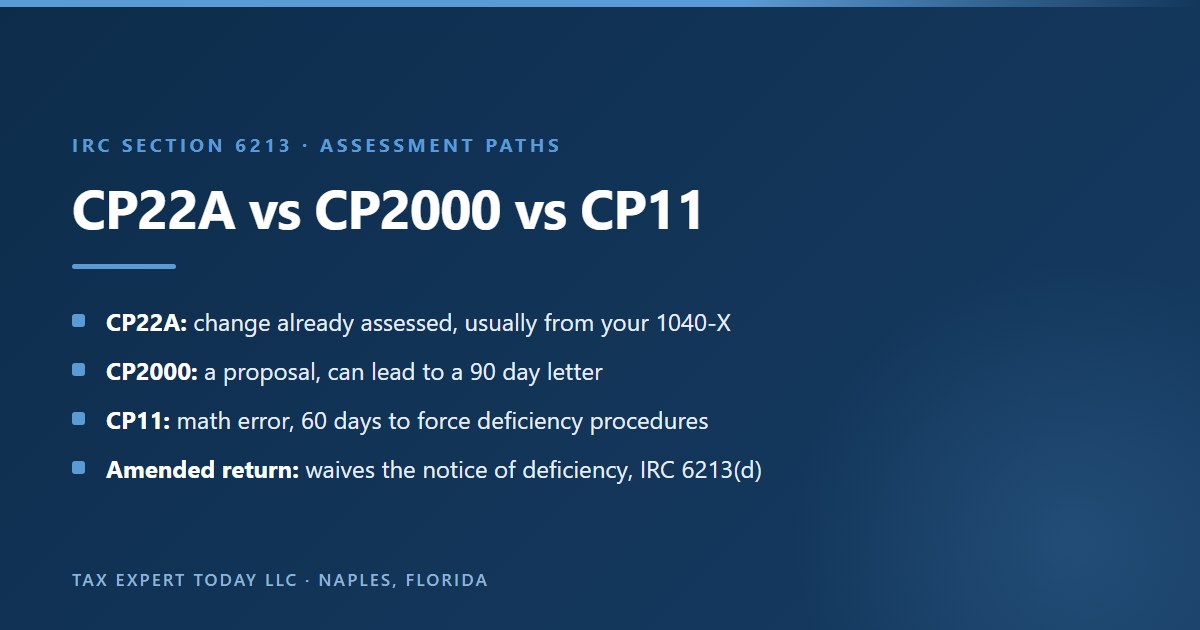
No. A CP2000 proposes a change based on mismatched income documents and asks you to agree or disagree before anything is assessed. A CP22A reports a change that has already been made and assessed, usually at your request. The CP2000 leads to a 90 day letter if unresolved; a CP22A from an amended return does not.
- CP2000 is a proposal. Our IRS CP2000 notice guide explains the underreporter process, where you respond before any tax is assessed.
- CP11 is a math error bill. The IRS corrected an error on your original return during processing, and a special 60 day rule applies.
- CP22A is an assessed adjustment. The change is on your account, the balance is due, and the main remaining questions are payment, penalties and whether the change was processed correctly.
- The paths after each one differ. Only the CP2000, if unresolved, leads to a notice of deficiency and a Tax Court petition right.
| Feature | CP22A | CP2000 | CP11 |
|---|---|---|---|
| What it is | Bill for a change already made to your return | Proposal based on income documents that do not match your return | Bill for a math or clerical error corrected during processing |
| Usual trigger | Your amended return or requested correction | Third-party information returns (W-2, 1099) | Error found when the original return was processed |
| Is tax already assessed? | Yes | No, it is proposed | Yes, under IRC §6213(b)(1) |
| Key deadline | Pay by the date on the notice, generally 21 calendar days | Respond by the date on the notice | 60 days to request abatement under IRC §6213(b)(2) |
| Route to Tax Court | Generally none for tax you reported on an amended return | Yes, through a notice of deficiency | Yes, a timely abatement request forces deficiency procedures |
The comparison matters because several widely read pages tell CP22A recipients they have 60 days to appeal. That 60 day period comes from IRC §6213(b)(2), which gives a taxpayer 60 days to request abatement of a math error assessment. It is the rule behind the CP11, and the IRS CP22A page does not mention it. For a CP22A, the IRS’s own instruction is to call the number on the notice if you disagree. Planning around a 60 day appeal window that does not apply to your notice is how a fixable problem turns into a penalty.
Why can I not take a CP22A to Tax Court?
When you file an amended return reporting more tax, you give up the notice of deficiency for that amount. IRM 20.1.2.3.1 says a taxpayer may waive deficiency procedures under IRC 6213(d), including by filing and signing an amended return reporting additional tax. Without a notice of deficiency, there is no 90 day Tax Court petition for that tax.
- Deficiency procedures are the default. Under section 6213(a), the IRS generally cannot assess a deficiency until it sends a notice of deficiency and the 90 day petition period runs.
- Section 6213(d) lets you waive them. A taxpayer may waive the restrictions on assessment at any time by a signed written notice.
- A signed amended return works as that waiver. IRM 20.1.2.3.1 lists filing and signing an amended return that reports additional tax as a waiver.
- The regulation treats the amount as yours. Treas. Reg. §301.6211-1(a) treats additional tax shown on an amended return filed after the due date as tax shown by the taxpayer, unless the return clearly indicates a protest.
This is the fact the CP22A pages in search results do not explain, and it changes how you should think about a dispute. If the CP22A simply bills the tax you reported on your own 1040-X, the IRS is collecting a number you gave it. The question is not whether the IRS can assess it but whether it was processed correctly. If you now believe your amended return was wrong, the fix is usually another amended return or a refund claim, not an appeal of the CP22A. If instead the IRS changed your return in a way you did not report or agree to, ask on the call how the change was made, because an IRS-determined increase that you never agreed to is normally subject to deficiency procedures. Your account transcript shows the adjustment; IRM 20.1.2.3.1 notes that deficiencies are assessed using transaction codes in the 290 and 300 series.
One later safeguard remains. If the balance reaches the final levy notice stage, IRC §6330(c)(2)(B) lets a taxpayer challenge the underlying liability at a Collection Due Process hearing if the taxpayer did not receive a statutory notice of deficiency or otherwise have an opportunity to dispute it. Whether that applies to a particular CP22A balance depends on how the tax was assessed, which is one reason to keep copies of the amended return, the notice and any correspondence.
How long do I have to pay a CP22A notice?
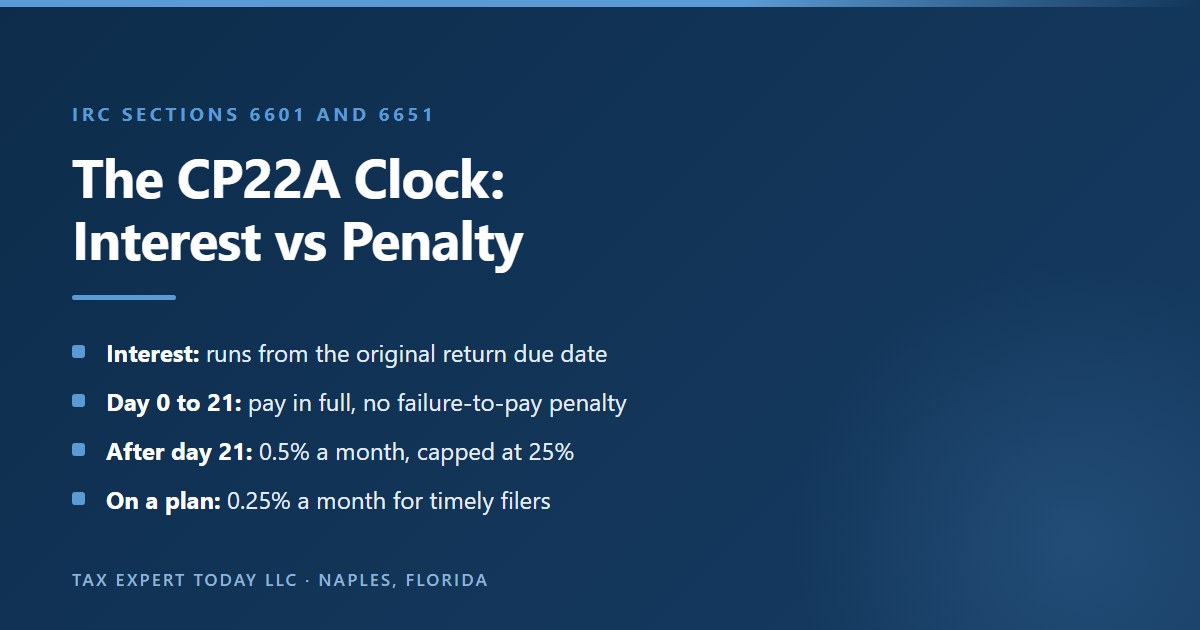
Pay by the date printed on the notice. Under IRC 6651(a)(3), the failure-to-pay penalty on tax that was not shown on the original return applies if it is not paid within 21 calendar days of the notice date, or 10 business days if the amount is $100,000 or more. Paying by that date avoids the penalty.
- 21 calendar days is the standard window. The IRS failure to pay penalty page confirms due dates are generally 21 calendar days after the notice.
- Large balances get less time. If the amount in the notice is $100,000 or more, the window is 10 business days.
- Amended return increases are covered. IRM 20.1.2.3.8.5 lists an amendment to the original return as one of the assessments subject to the section 6651(a)(3) penalty.
- Interest stops if you pay in full on time. The IRS interest page says you will not be charged further interest on the amount shown if you pay it in full by the pay by date.
The 21 day window is the most valuable part of the IRS CP22A notice. Interest has already been charged from the original due date and is built into the balance, but the failure-to-pay penalty on the new tax has not started. A payment made by the notice date removes that penalty from the picture entirely for the amount paid. If you cannot pay all of it, paying part of it still reduces the base on which the penalty and future interest are computed. Mailing also counts: IRM 20.1.2.3.8.5 points to the rule that timely mailing is timely paying, so a properly addressed payment postmarked by the due date is treated as on time. Electronic payment through IRS Direct Pay or your IRS payments options gives you a confirmation number, which is useful if the payment is later misapplied.
Why does my CP22A include interest I did not expect?
Interest on tax runs from the original due date of the return, not from the date of the notice. IRC 6601(a) charges interest from the last date prescribed for payment until the date paid. If you amend a 2023 return in 2026, the extra tax has been accruing interest since April 2024, and the CP22A includes it.
- The clock started long before the notice. Section 6601(a) measures interest from the last date prescribed for payment, which for individual income tax is generally the original April due date.
- Extensions do not move it. Section 6601(b)(1) says the last date for payment is determined without regard to any extension of time for payment.
- Interest accrues daily and the rate changes quarterly. The IRS interest page says rates may change each quarter and interest accrues daily until paid in full.
- Interest is not removed for reasonable cause. The IRS states it does not reduce interest for reasonable cause or as first-time relief, though interest on a penalty falls away if the penalty is removed.
Several pages that rank for this notice say interest begins only after the 21 days. That is not how the statute works for the tax itself, and it leads people to underestimate the bill or to dispute interest that is correctly charged. What the 21 days protect you from is additional interest beyond the amount on the notice and the failure-to-pay penalty, not the interest that had already built up before the IRS processed your change.
Two narrow interest provisions are worth knowing, and both are often misunderstood. IRC §6404(e) lets the IRS abate interest caused by an unreasonable error or delay by an IRS employee in performing a ministerial or managerial act, after the IRS has contacted you in writing. A long processing backlog alone is not automatically an unreasonable error, but a documented IRS mistake, such as losing a payment or misapplying your amended return, may support a request on Form 843. Section 6404(g) suspends interest when the IRS fails to notify an individual of additional liability within 36 months of a timely filed return, but for amounts you report yourself, the statute measures that period from the date you provided the signed documents showing the additional tax. For an amended return, that usually means the suspension does not help.
What penalties can a CP22A balance trigger?
The main risk is the failure-to-pay penalty under IRC 6651(a)(3): 0.5 percent of the unpaid amount for each month or part of a month after the notice due date, up to 25 percent. The rate drops to 0.25 percent during an installment agreement if you filed on time, and rises to 1 percent after a levy notice.
- Base rate. Section 6651(a)(3) adds 0.5 percent per month or fraction of a month, capped at 25 percent in the aggregate.
- Reduced rate on a payment plan. Section 6651(h) and IRM 20.1.2.3.8.1.2 cut the rate to 0.25 percent for any month an installment agreement is in effect, for individuals who filed the return on time.
- Increased rate after a levy notice. Section 6651(d) and IRM 20.1.2.3.8.1.1 raise the rate to 1 percent for months beginning more than 10 days after a notice of intent to levy, such as a CP504.
- A separate penalty clock for each notice. IRM 20.1.2.3.8.1 says a separate computation applies to each notice reflecting additional tax, so the 25 percent cap is measured per assessment.
The table below shows how the failure-to-pay penalty alone could grow on a hypothetical $6,000 CP22A balance. It is simplified for illustration: it ignores interest, which accrues separately, assumes no partial payments, and counts each month or part of a month after the notice due date as a full penalty month.
| Hypothetical scenario on a $6,000 CP22A balance | Rate applied | Failure-to-pay penalty |
|---|---|---|
| Paid in full within 21 days of the notice date | None | $0 |
| Paid 3 months after the due date, no plan | 0.5% x 3 months | $90 |
| Paid 6 months after the due date, no plan | 0.5% x 6 months | $180 |
| 6 months on an installment agreement, original return filed on time | 0.25% x 6 months | $90 |
| Unpaid for 50 months or more with no plan | Capped at 25% | $1,500 |
A CP22A that follows your own amended return does not usually carry an accuracy-related penalty, because the amended return is the correction. Where the change grew out of an examination or a correction the IRS made, an accuracy-related penalty may be part of the balance, and it should appear as a separate line. Read the penalty section of the notice line by line; our failure to pay penalty guide explains how the rate changes interact over a longer period.
Can I get the penalty on a CP22A removed?
Often, yes. The IRS lists the IRC 6651(a)(3) failure-to-pay penalty as eligible for First Time Abate, and from summer 2026 a new Automatic Exemption from Penalty applies to 2025 and later returns. Reasonable cause relief is also available. The tax and the interest on it stay, but interest on a removed penalty falls away.
- First Time Abate. The IRS administrative relief page lists section 6651(a)(3) among eligible penalties for taxpayers with three years of timely compliance. See our first-time penalty abatement guide.
- Automatic Exemption from Penalty. The IRS says AEP begins in summer 2026 for 2025 tax year returns and later, is applied when the original return completes processing, and does not require a request.
- Reasonable cause. Serious illness, disaster or other circumstances beyond your control may support relief. Our reasonable cause penalty abatement page covers the standard.
- Ask before the due date. The IRS CP22A page says that if you contact it by the payment due date, it may be able to remove the penalty, depending on your situation.
Because the IRS states that AEP is applied when the original return completes processing, it is not clear from the IRS page how AEP treats a penalty that arises later on an amended return balance. If a failure-to-pay penalty appears on a 2025 or later year and you had a clean three year history, ask the IRS whether AEP or First Time Abate applies. For earlier years, First Time Abate must be requested; the IRS says you do not need to name it or provide documents. IRM 20.1.2 also notes that reasonable cause for failure to pay is decided separately for each assessment, so a taxpayer who had no excuse for paying the original return late may still have reasonable cause for the amended return balance, and the reverse is also true. If you already paid the penalty, a refund request can be made on Form 843.
What should I do if I agree with the CP22A notice?
Pay the full amount by the date on the notice if you can, using IRS Direct Pay or another electronic option so you have a confirmation number. Correct your own copy of the return for your records, and check whether your state requires you to report the federal change. Keep the notice with your tax file.
- Pay electronically and keep proof. The IRS suggests paying online to ensure timely receipt. A confirmation number resolves most later disputes about whether a payment arrived.
- Update your records. The IRS asks you to correct your copy of the return. The corrected figures may matter for carryovers, basis or next year’s estimated payments.
- Look at the state side. Many states with an income tax require residents to report federal changes. Florida has no personal income tax, so Florida residents usually have nothing to amend at the state level for a personal return.
- Do not file another 1040-X to pay. A second amended return is for a new correction, not for paying the balance, and can delay processing.
If you agree with the change but the amount is larger than expected, the difference is almost always interest from the original due date. Ask the IRS for the payoff amount if you will pay after the notice date, because interest continues to accrue daily on any unpaid amount. If you are paying close to the deadline, pay electronically rather than by mail to avoid any question about timing.
What if I disagree with the CP22A notice?
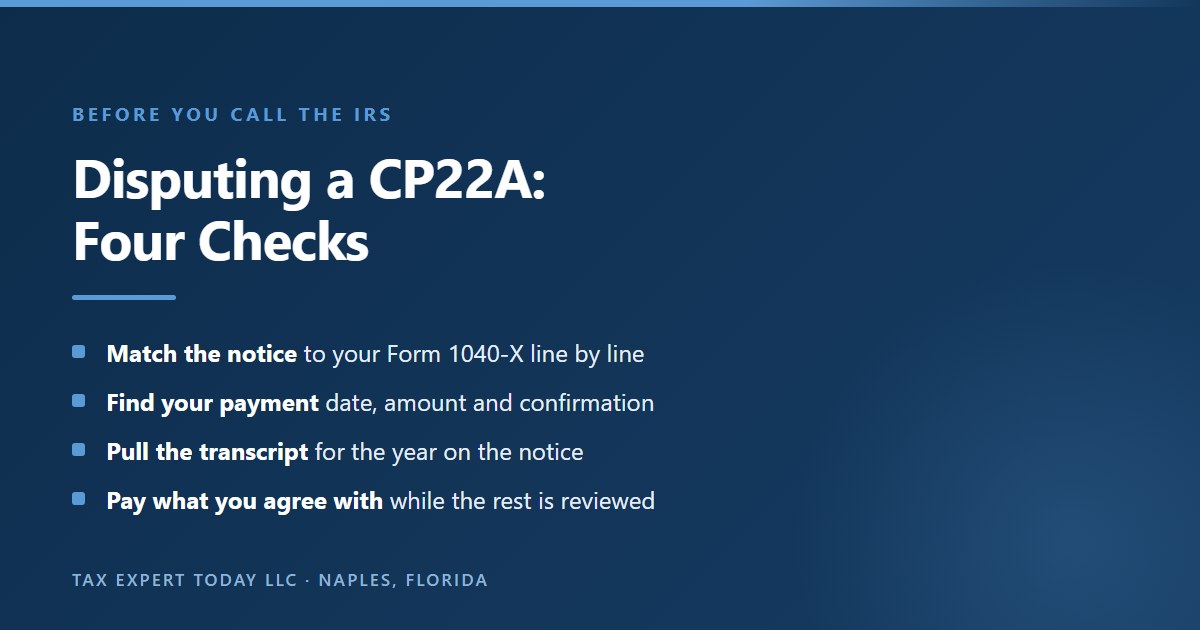
Call the number on the notice with your copy of the return, the amended return and proof of any payment. The IRS says to call if you disagree with the changes. Pull your account transcript first so you can point to the exact adjustment. Pay any amount you agree with while the rest is reviewed.
- Check whether the IRS applied the change you asked for. Compare the notice line by line with your Form 1040-X. Duplicated adjustments and transposed figures are fixable by phone or letter.
- Check whether a payment is missing. If you paid with the amended return, have the date, amount and confirmation number ready.
- If your own amended return was wrong. File a corrected amended return or a refund claim, within the time allowed for refund claims, rather than appealing the CP22A.
- If the change came from an audit. A taxpayer who did not have a fair chance to present documents may request IRS audit reconsideration.
| What you find | What it usually means | Usual next step |
|---|---|---|
| Notice amount equals the increase on your 1040-X plus interest | The amended return was processed as filed | Pay or set up a plan; no dispute needed |
| Notice shows the increase twice or uses different figures | A processing error in the adjustment | Call the number on the notice and follow up in writing |
| You paid with the 1040-X but the notice ignores it | Payment unapplied or credited to another year | Give the IRS the payment date, amount and confirmation number |
| You now think your amended return was wrong | The IRS assessed what you reported | File a corrected amended return or a refund claim within the time allowed |
| You never requested a change | Possible IRS-initiated change or identity theft | Ask how the change was made; see the IRS identity theft resources |
Two practical points make a dispute more likely to succeed. First, put your position in writing as well as on the phone, and keep a copy; a call log with the date, the employee identification number and what was said is useful if the matter escalates. Second, do not let a dispute run past the payment date if you can avoid it. Paying the undisputed portion stops interest and the failure-to-pay penalty on that portion, and if the IRS later agrees with you, overpayments are refunded or credited with interest. If you cannot get a correction after several contacts, the IRS CP22A page points to the Taxpayer Advocate Service at 877-777-4778, which may help where an IRS process is not working as it should.
What if I already paid or my online account shows $0?
Timing gaps between the notice and your online account are common. A CP22A is generated when the adjustment posts, while a payment you sent earlier may sit unapplied or be credited to a different year. Check the account transcript for the year on the notice, and call before paying twice.
- Compare dates. If your payment posted after the notice date, the notice may simply predate it. The IRS asks you to pay the amount by the date on the notice, not twice.
- Check the tax year. Payments sent with a 1040-X can be applied to the wrong year if the voucher or memo line was unclear.
- Use your IRS Online Account. The IRS CP22A page notes you can view and download the notice there, along with payment history.
- Keep the call short and specific. State the payment date, amount, method and confirmation number, and ask the IRS to move it to the correct period.
If a misapplied payment caused interest or a penalty that would not otherwise have been charged, ask the IRS to correct both. Penalty interest is removed automatically when the penalty is removed, and interest attributable to a documented IRS error may be addressed under section 6404(e).
What if I cannot pay the full CP22A balance?
Ask for a payment plan before the notice due date. Individuals who owe less than $100,000 can apply online for a short-term plan of up to 180 days, and those who owe $50,000 or less and have filed all returns can apply online for a long-term installment agreement. Larger or harder cases need other options.
- Short-term plan. The IRS payment plans page describes paying in 180 days or less, with penalties and interest continuing to accrue until paid.
- Long-term installment agreement. Monthly payments under IRC §6159, with a reduced failure-to-pay rate for timely filers. See our IRS installment agreement options guide.
- When the monthly amount is too high. A partial payment installment agreement or currently not collectible status may fit, based on a financial statement.
- When the debt cannot realistically be paid. An offer in compromise is the IRS settlement program, and it has its own eligibility rules.
| Option | Who it suits | What keeps running |
|---|---|---|
| Pay in full by the notice date | Anyone who can | Nothing on the amount paid |
| Short-term plan (180 days or less) | Individuals owing under $100,000 who can pay within six months | Interest and the 0.5% failure-to-pay penalty |
| Long-term installment agreement | Individuals owing $50,000 or less online; others by phone or mail | Interest; failure-to-pay at 0.25% for timely filers |
| Partial payment installment agreement | Taxpayers who cannot pay in full before the collection statute ends | Interest and penalties; financial review required |
| Currently not collectible | Taxpayers who cannot pay basic living expenses and the tax | Interest, penalties and the collection statute |
A CP22A balance is often added to an older balance. If you already have a plan for another year, the new balance can default that plan unless it is paid or added to a revised agreement; our guide to the IRS CP523 notice explains how the default rules work. Contact the IRS to add the CP22A balance before the due date rather than waiting for a default notice. Applying online usually costs less: the IRS payment plans page lists a $29 setup fee for a direct debit long-term agreement requested online, against $107 by phone, mail or in person, with the fee waived for low-income taxpayers.
What happens if I ignore a CP22A notice?
The balance moves into the standard collection notice sequence: generally a CP501 reminder, a CP503, then a CP504 notice of intent to levy, and eventually a final notice with Collection Due Process rights. Interest and the failure-to-pay penalty keep growing, and the penalty rate can double after the levy notice.
- Reminder notices. The CP501 and CP503 remind you of the unpaid balance.
- Levy warning. The CP504 is a notice of intent to levy certain assets, and it raises the failure-to-pay rate to 1 percent for later months.
- Final notice. Letter 1058 or LT11 gives the right to a Collection Due Process hearing before most levies.
- Lien and statute. A federal tax lien arises by law under IRC §6321 once tax is assessed, demanded and unpaid, and the 10-year collection statute runs from the CP22A assessment date.
The order and timing of later notices vary with the balance and the account, and some taxpayers receive a CP14 style balance due notice on other years at the same time. Ignoring the CP22A rarely makes it go away. The IRS can also offset future federal refunds against the balance. The earlier you act, the more options remain open, including penalty relief requested by the due date and a payment plan set up before any levy notice.
Is a CP22A notice legitimate or a scam?
A genuine CP22A comes by mail, names a specific tax year, and matches what you see in your IRS Online Account. Verify it there or by calling the IRS at a number you find on IRS.gov. Pay only through IRS.gov payment options or a check payable to the U.S. Treasury.
- Check your Online Account. The IRS says you can view and download this notice online, which is the simplest way to confirm it is real.
- Look for a year you amended. A CP22A for a year in which you filed a 1040-X is consistent with a real notice.
- Pay the U.S. Treasury only. TAS reminds taxpayers that checks are payable to the U.S. Treasury, and free electronic options are available through IRS.gov.
- Watch for identity theft. If you never filed or requested a change, the IRS CP22A page says to call the number on the notice and see its Identity Theft Central resources.
How does the CP22A fit with other IRS notices?
The CP22A creates a new assessed balance at the front of the collection sequence. It sits beside the CP2000 and CP11 as a way an assessment is made, and in front of the CP501, CP503 and CP504 notices that follow when a balance is unpaid. Paying or planning at the CP22A stage keeps the account out of that sequence.
- Before it: your amended return or agreed change. The CP22A is the result of that change.
- Alongside it: other ways tax is assessed. CP2000 proposals, CP11 math errors and notices of deficiency each lead to their own type of assessment.
- After it: the collection notices. Each later notice adds pressure and, at the CP504 stage, a higher penalty rate.
- At any stage: relief options. Payment plans, penalty relief and hardship status remain available, though some get harder to obtain later.
Seeing the notice in that sequence makes the best response clearer. A CP22A is the cheapest point at which to resolve the balance: the tax is known, the interest is fixed through the notice date, the penalty has not started, and every collection alternative is still on the table.
IRS CP22A notice help Naples: tax resolution Naples and Southwest Florida
Tax Expert Today LLC works with individuals and families in Naples, Florida and across Southwest Florida who receive an IRS CP22A notice after amending a prior return. Common situations here include retirees who amended a return after a corrected Form 1099-R or brokerage statement arrived, part-year residents who changed their filing status or residency position after moving to Florida, business owners whose amended return picked up a late Schedule K-1, and seasonal residents whose mail was forwarded late and who opened the notice well into the 21 day window. The most useful work happens before the notice due date, while penalty relief and a clean payment plan are still simplest to arrange.
People searching for IRS CP22A notice help in Naples usually want to know whether the balance is correct, why it includes so much interest, and whether they can avoid a penalty if they cannot pay at once. The short answers are that interest from the original due date is normally correct, that paying or setting up a plan before the due date limits the penalty, and that a processing error is fixed through the IRS rather than through Tax Court. Our IRS resolution and audit support service and our Naples tax resolution page describe how these matters are handled, from transcript review to penalty relief requests and payment plans.
Tax Expert Today LLC
11983 Tamiami Trail N, Naples, FL 34110
Phone: (239) 441-2005
Hours: Monday through Friday, 10:00 to 5:00 ET
Where can I get help with an IRS CP22A notice in Naples, FL? A CP22A is handled by phone, online or by mail with the IRS, so help does not depend on a local IRS office. A representative authorized on Form 2848 can review your account transcript, compare the adjustment with your amended return, request penalty relief and set up a payment plan for you. Tax Expert Today LLC is located at 11983 Tamiami Trail N in Naples and works with taxpayers in Collier and Lee Counties and nationwide. Because Florida has no personal income tax, a Naples resident usually has no state return to amend after a federal change.
When to Engage a Professional
Many CP22A notices can be resolved with one payment. Consider engaging a representative where the amount does not match your amended return, where a payment you made is missing, where you did not request any change and suspect identity theft, where the balance would default an existing payment plan, where the amount is large enough to fall under the 10 business day rule, where a penalty appears that may qualify for First Time Abate or the new automatic exemption, or where you now believe the amended return itself was wrong. Those are the situations in which the choice between paying, correcting, requesting relief and planning matters most. Dr. Kabashi is an Enrolled Agent authorized to represent taxpayers before the IRS in all 50 states, and every engagement starts from the statute, the regulations and the IRS’s own procedures rather than assumptions about what the IRS will do.
This article is educational and general in nature. It does not constitute tax or legal advice for any particular taxpayer, and outcomes depend on individual facts and circumstances. IRS procedures, payment plan thresholds, interest rates and penalty relief programs are current as of the publication date and are subject to change.
Published October 1, 2026 by Dr. Pellumb Kabashi « Back to Learning Center
Have a question this article touches on?
Tax Expert Today LLC, based in Naples, Florida and serving clients across the United States.
Schedule a Consultation (239) 441-2005