
By Dr. Pellumb Kabashi, DBA, MBA, EA, CFE, CES
Founder, Tax Expert Today LLC · Tax advisors, enrolled agents, CPAs, and attorneys · Serving clients in all 50 states
Quick Answer: An IRS CP59 notice means the IRS has no record of a prior year personal tax return it believes you had to file. You have three responses: send a signed copy if you already filed, file the return now if you did not, or explain on Form 15103 why no return was required. Ignoring it can lead to a substitute return with no time limit on assessment. Call (239) 441-2005 for a free consultation.
What is an IRS CP59 notice?
An IRS CP59 notice is a computer generated letter saying the IRS has no record of your personal income tax return for a prior year. The IRS believes a return was required, usually because employers, banks or brokers reported income under your Social Security number. It asks you to file now or explain why you need not.
- It concerns a prior year. The IRS CP59 page says the notice is about your prior year personal tax return, not the year you are currently filing.
- It is a nonfiler notice, not a bill. An IRS CP59 notice does not assess tax. It is the first step in the IRS return delinquency process.
- It comes with a response form. The notice encloses Form 15103, Form 1040 Return Delinquency, which covers every common answer.
- It was redesigned in 2024. IRS Fact Sheet FS-2024-06 describes a shorter notice with QR codes and clearer filing and payment instructions.
The IRS CP59 notice is one of the plainest letters the agency sends, and that is part of why people underestimate it. It does not show a balance, it does not threaten a levy and it does not set a 30 or 90 day deadline on its face. It simply says the IRS has no record of your return and tells you to file it immediately or explain why you do not need to. What makes it important is what sits behind it. An IRS CP59 notice opens a return delinquency case in the IRS systems, and that case moves forward on its own schedule whether or not you respond. Reminder notices follow, then a proposed assessment prepared by the IRS from the income documents it holds, then a statutory notice of deficiency, then a bill. Each step narrows your choices. The cheapest point to deal with a missing return is the first letter, which is this one.
It also helps to understand how the IRS decides a return is missing. The agency matches information returns, such as Forms W-2, 1099-NEC, 1099-INT, 1099-B and 1099-R, against the returns it has processed. When income above the filing threshold shows up under your taxpayer identification number and no Form 1040 has posted for that year, the case creation process flags the account. That matching is automated. It does not know whether you filed under a different name, whether a joint return listed your spouse first, whether the return is sitting unprocessed in a mail center, or whether the income actually belonged to someone else. The notice is the IRS asking you to fill in what its systems cannot see.
Why did I get a CP59 notice if I filed?
You can get an IRS CP59 notice even after filing if the IRS has not yet processed your return, if it was rejected electronically, if the name, Social Security number or tax year did not match, or if a joint return posted under your spouse. The IRS says no action is needed if you filed within the last eight weeks.
- Recent filing. The IRS says you do not have to do anything if you filed within the last eight weeks, because the notice and your return likely crossed in processing.
- Rejected e-file. A return that was transmitted but rejected was never filed. The IRS specifically tells CP59 recipients to check that the return was not rejected.
- Identity mismatch. The IRS asks you to compare the name, Social Security number and tax year on the notice with the same items on your return.
- Joint return issues. A married couple who filed jointly can see a notice addressed to the spouse whose number was listed second, or to a spouse whose information returns were not matched to the joint return.
“I already filed” is the single most common reaction to a CP59, and it is often correct. Before you mail anything, confirm what the IRS actually has. The fastest route is your IRS Online Account, which shows filed returns and lets you pull an account transcript for the year on the notice through Get Transcript. An account transcript that shows a transaction code 150 means a return posted for that year. If it shows no return, look for the gap. A paper return mailed during a backlog may not have posted yet. An electronic return may have been accepted by your software and then rejected by the IRS, which happens more often than people expect when a dependent was already claimed or a prior year adjusted gross income did not match. And a return filed under a different Social Security number, or with a misspelled name, can post to the wrong account entirely.
If the transcript confirms the return never posted, the IRS instructions are straightforward: mail a signed and dated copy of the return. The copy needs a fresh signature, because an unsigned return is not a valid return. When the IRS CP59 notice includes Form 15103, check the box stating that you already filed, list the form, the tax year and the date you filed, and send the form with the signed copy to the address or fax number on the notice. Keep proof of the original filing, such as a certified mail receipt or the e-file acceptance acknowledgment, because it matters later if penalties are charged.
How do I respond to an IRS CP59 notice?
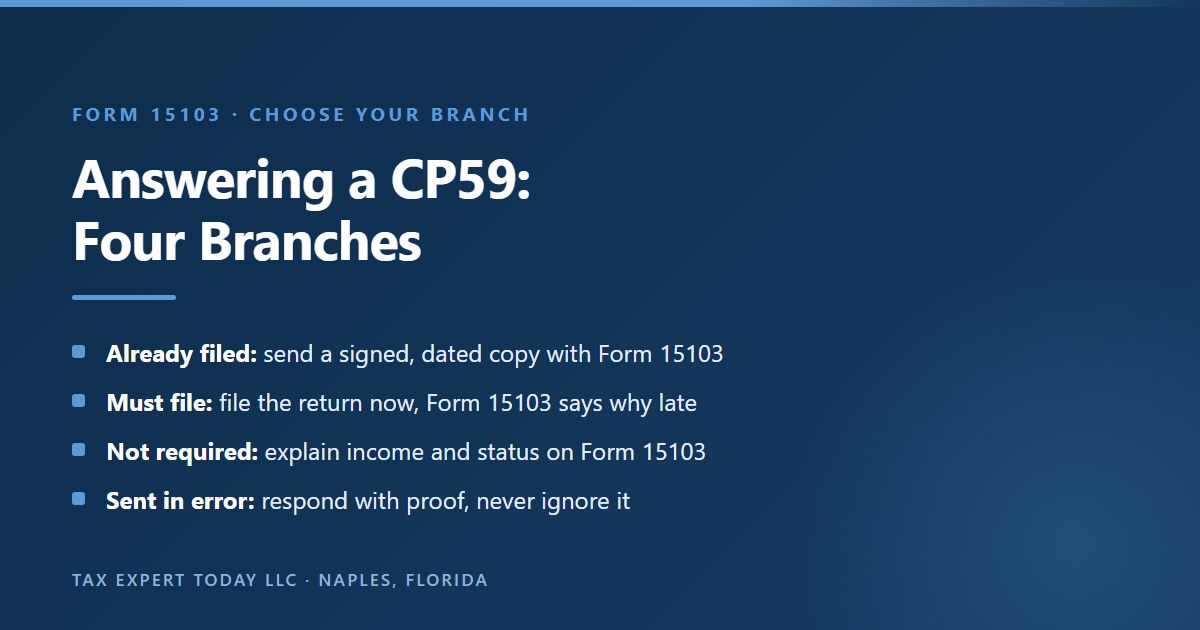
Respond by choosing the branch that fits your facts: send a signed copy of a return you already filed, file the missing return now, or explain on Form 15103 why no return was required. Mail or fax the response to the address or number on the notice, and keep copies of everything you send.
- Branch one, already filed. Send a signed and dated copy with Form 15103 showing the filing date.
- Branch two, must file. Prepare and file the missing return, with Form 15103 explaining why it is late.
- Branch three, not required. Complete the nonfiling section of Form 15103 with your filing status, age, income and reason.
- Branch four, notice in error. Use the same tools to show the error, such as an extension, a return under another number or income that is not yours.
The decision tree matters because the wrong response wastes time while the case keeps moving. A taxpayer who already filed and responds by preparing a second original return can create a duplicate filing that freezes the account. A taxpayer who was not required to file and ignores the notice because “I did not owe anything” can end up with a substitute return built from gross income figures, such as the full proceeds of a stock sale with no cost basis. A taxpayer who must file but waits until the return is perfect can miss the window before the IRS prepares its own version. Pick the branch first, then gather documents for that branch only.
| Your situation | What to send | Where the IRS addresses it |
|---|---|---|
| Filed within the last eight weeks | Nothing yet; recheck the transcript after eight weeks | IRS CP59 page, FAQ on recent filers |
| Filed more than eight weeks ago, return not on file | Signed, dated copy of the return plus Form 15103 | IRS CP59 page and Form 15103, page 1 |
| Never filed and a return was required | The original return, signed, plus Form 15103 explaining why it is late | FS-2024-06 and Form 15103 |
| Not required to file | Form 15103 nonfiling section with filing status, age, income and reason | Form 15103, page 1 |
| Taxpayer has died | Form 15103 with date of death, and Form 1041 details if an estate return was filed | Form 15103, page 1 |
| Refund or prior year credit you want released | The return, plus the credit election on Form 15103, page 2 | Form 15103, page 2 |
Two practical points apply to every branch. First, use the delivery method the notice gives you. The IRS lists a mailing address and a fax number on the notice, and the IRS CP59 page also allows Form 15103 to be uploaded through the IRS Online Account where the form requires a signature. Responses sent to a general service center address can take months to reach the right unit. Second, keep a complete copy with proof of the date you sent it. Certified mail with return receipt or a fax confirmation page is enough. If the case later escalates, the date of your response is the fact that most often decides whether the IRS should have stopped.
What is Form 15103 and how do I fill it out?
Form 15103, Form 1040 Return Delinquency, is the two page response form enclosed with a CP59 and its follow-up notices. It tells the IRS you already filed, that the taxpayer has died, that you were not required to file, or what to do with a refund or prior year credit. You sign it under penalties of perjury.
- Contact block. Social Security number, name, any new address and the best time to reach you by phone.
- Already filed. The year, the name or names on the return, the form filed and the date filed, with a signed copy attached.
- Not required to file. Filing status, age 65 or older, blindness, dependency, foreign work or residency status, total income and the reason.
- Credits and refunds. Page 2 asks whether you want a prior year credit applied to another return or paid to you as a refund.
The current version of Form 15103 is dated June 2017, and it has not changed much because its job is simple. It is a structured way to answer the question the IRS CP59 notice asks. Most of the form is check boxes. The parts that matter most are the free text lines. If you were not required to file, the “Reason for not filing” line is where you explain in a sentence or two why your income was below the threshold for your filing status and age, or why the reported income was not taxable to you. If you received a Form 1099-B for a sale, for example, and your cost basis was higher than the proceeds, say so and attach the brokerage statement showing basis. The IRS cannot see basis from the 1099-B in every case, and its matching program may treat gross proceeds as income.
The signature block is not a formality. The declaration covers the form and any attached return, and it is made under penalties of perjury. Do not check “I was not required to file” as a way to make the notice go away if your income was over the threshold. The IRS holds the same information returns you do. A false statement on Form 15103 converts a civil filing problem into a far more serious one, and it does not stop the delinquency case, because the system will compare your stated income with what third parties reported.
Form 15103 is also the form that carries forward through the reminder notices. The IRS pages for the CP515, CP516 and CP518 notices all instruct the taxpayer to file the return with a completed Form 15103 or to send the form alone to explain why no return is due, and they confirm that a Form 15103 explaining why you do not have to file can be submitted online through the IRS Online Account.
Do I have to file if the IRS sent a CP59?
Not always. A CP59 means the IRS believes you had to file, not that you did. Under IRC section 6012 the requirement depends on gross income, filing status and age, with separate rules such as the $400 self-employment threshold. If your income was below the threshold, explain that on Form 15103.
- Gross income test. IRC section 6012(a) generally requires a return when gross income equals or exceeds the threshold for your filing status, which tracks the standard deduction.
- Self-employment test. IRC section 6017 requires a return when net earnings from self-employment are $400 or more, even if no income tax is due.
- Other triggers. Advance payments of the premium tax credit, certain additional taxes on retirement accounts and household employment taxes can require a return below the income threshold.
- Refunds. Even when no return is required, you must file to recover withholding or claim refundable credits.
The nonfiler branch is the one where the IRS CP59 notice is most often wrong, and also the one where people get into trouble by guessing. Gross income for the filing test is not the same as taxable income. It includes wages, interest, dividends, the gain on sales of property, pensions and the taxable part of retirement distributions, rental income before expenses and business gross receipts less cost of goods sold. It generally excludes Social Security benefits unless other income makes part of them taxable. A retiree who receives Social Security and a small pension may be well under the line. A gig worker who netted $600 after expenses may be over it, because the $400 self-employment test applies regardless of the standard deduction.
Common reasons a CP59 reaches someone who did not have to file include a Form 1099-B reporting gross sale proceeds where the sale actually produced a loss, a Form 1099-R for a direct rollover that was coded as a distribution, a Form 1099-K for personal reimbursements or sales of personal items at a loss, and wages reported under the wrong Social Security number by an employer. In each case the fix is the same: complete the nonfiling section of Form 15103, explain the specific item in the reason line and attach the document that proves it, such as the brokerage statement with basis, the rollover confirmation or the corrected Form W-2. Where the information return itself is wrong, ask the payer for a corrected form, which helps prevent the same notice next year.
Be careful with the refund trap. If tax was withheld from your wages or pension, or you qualify for a refundable credit such as the earned income tax credit, there may be money owed to you even though no return was required. Form 15103 reminds taxpayers of this directly: you must file a return to be eligible for a refund even though you may not be required to file. The window to claim it is limited, as the next sections explain.
What is the difference between CP59, CP59SN and CP59R?
The CP59 concerns a prior year return the IRS has not received. The CP59SN says the IRS has not received your return for the current filing year. The CP59R is a reminder to file before the due date. The Taxpayer Advocate Service notes that the R and SN versions can reach people who filed a valid extension.
- CP59. Prior year, no return on record, response with a return or Form 15103.
- CP59SN. Current year return not received; the IRS CP59SN page says you may disregard it if you already filed or have a valid extension.
- CP59R. A reminder before the due date rather than a statement that the return is late.
- Extension filers. The TAS tax tip says there is no need for concern if Form 4868 was filed, and suggests confirming it in your online account.
The three versions look alike and are often confused with each other online, which is why the TAS published a tip on the subject in August 2025. The practical difference is timing. A CP59SN or CP59R usually arrives during or shortly after the filing season for the most recent year, so the first question is whether you are still inside an extension period or a federally declared disaster postponement. The IRS CP59SN page expressly says that taxpayers with a valid automatic extension, or who live in a covered disaster area, should file by the extended or postponed due date. Southwest Florida residents have seen several hurricane postponements in recent years, so it is worth checking whether your county was covered for the year in question before treating a CP59SN as a problem.
A standard IRS CP59 notice is different. By the time it arrives, the due date and any extension for that prior year have usually passed. That makes the CP59 the more serious of the three, because it is the version that feeds the return delinquency process described below. If you are holding an IRS CP59 notice for a year that is a year or more behind, treat it as the start of a case, not as a reminder.
What happens if I ignore a CP59 notice?
If you ignore a CP59, the IRS sends follow-up notices such as the CP515, CP516 and final CP518, then may prepare a substitute for return from third party income data, propose the tax in a 30 day letter, issue a CP3219N notice of deficiency and assess tax, penalties and interest that move into collection.
- Reminder notices. The IRS describes the CP516 as a follow-up to a previous notice and the CP518 as the final reminder.
- Substitute for return. The IRS may determine your tax for you under IRC section 6020(b).
- Notice of deficiency. FS-2024-06 says the IRS will send a CP3219N (90 day letter) proposing the assessment.
- Collection. Once assessed, the balance follows the normal bill and enforcement sequence.
The CP518 page lists what happens if the IRS does not hear from you in three short lines: it may determine your tax for you, penalty and interest may continue to accrue, and any refund you are owed may be delayed because of the unfiled return. The IRS fact sheet issued with the 2024 nonfiler initiative goes further. It says taxpayers who do not respond will receive additional notices and other actions, and that this can ultimately lead to collection and audit action as well as potential criminal prosecution. Criminal referral is rare and generally reserved for willful conduct over multiple years, but the civil steps are routine and automated. Most nonfiler cases run through the Automated Substitute for Return program without any IRS employee looking at them until the taxpayer responds.
| Stage | Notice or action | What it means for you |
|---|---|---|
| 1 | CP59 (or CP59SN for the current year) | No return on file; file, send a copy, or explain on Form 15103 |
| 2 | CP515 and CP516 reminders | The IRS still has no return and has reason to believe one is required |
| 3 | CP518 final reminder | The IRS warns it may determine your tax for you |
| 4 | ASFR Letter 2566 (30 day letter) | A proposed assessment built from income documents; 30 days to respond |
| 5 | CP3219N statutory notice of deficiency | 90 days to file your return or petition the Tax Court |
| 6 | Assessment, then CP14 and the collection notices | A balance due that can lead to liens and levies |
The exact letters you receive depend on your account, and the IRS does not send every notice in every case. Taxpayers who were already in the collection stream for another year, for example, may hear from the Automated Collection System rather than receive each reminder. The sequence above reflects the notices the IRS describes on its own pages and the Automated Substitute for Return process in IRM 5.18.1. The point is not the precise letter numbers. It is that each stage gives you less control than the one before it. At the CP59 stage you can simply file your return. By the CP3219N stage you are on a 90 day statutory clock, and after assessment you are dealing with a bill that already includes penalties calculated on the IRS figures.
What is an IRS substitute for return?
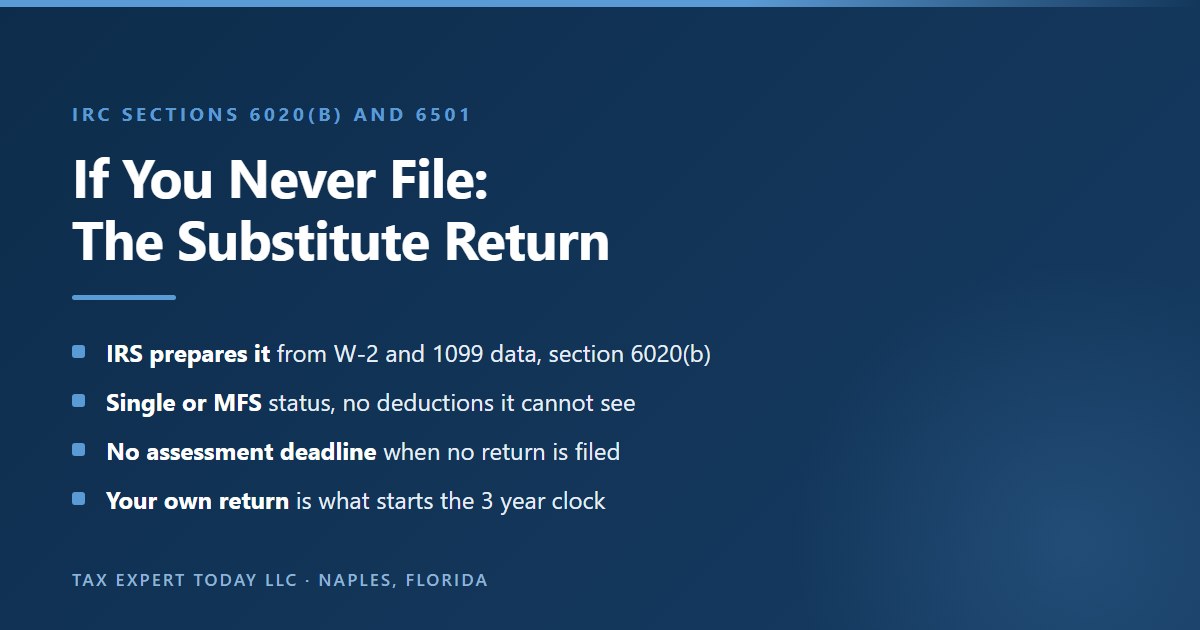
A substitute for return is a tax return the IRS prepares for you under IRC section 6020(b) when you do not file. It uses wage, interest, dividend and other income reported by third parties, generally applies single or married filing separately status and does not include deductions or credits the IRS cannot see.
- Legal authority. IRC section 6020(b) lets the IRS make a return from its own knowledge and information, and that return is prima facie good for all legal purposes.
- Filing status. IRM 5.18.1 says the automated program uses only single or married filing separately status when preparing the proposed assessment.
- Missing deductions. FS-2024-06 warns that the substitute return might not give you credit for deductions and exemptions you are entitled to.
- Gross figures. Sales of stock or property can be computed on gross proceeds when cost basis is not reported to the IRS.
The substitute for return is where a missing return becomes expensive. The IRS calculation is not designed to find your lowest correct tax. It is designed to establish a defensible liability from the documents the agency holds. A married taxpayer is treated as married filing separately, which loses the joint rate brackets and many credits. A self-employed taxpayer is taxed on gross receipts reported on Forms 1099-NEC or 1099-K, with no business expenses. A homeowner gets no itemized deductions. A parent gets no child tax credit. An investor who sold shares may be taxed on the full sale price. The result is often a proposed balance several times larger than the tax on a correctly prepared return, before penalties are added.
Under IRC section 6651(g), a return the IRS makes under section 6020(b) is treated as the return filed by the taxpayer for figuring the failure to pay penalties, while it is disregarded for figuring the failure to file penalty. In plain terms, the IRS substitute does not stop the late filing penalty from being computed as if no return exists, and it does start failure to pay charges on the amount it shows. The IRS still encourages you to file your own return even after a substitute is prepared. Its filing past due tax returns page says it is still in your best interest to file to take advantage of exemptions, credits and deductions you are entitled to, and that the IRS will generally adjust your account to reflect the correct figures. When the substitute has already been assessed, that adjustment usually runs through audit reconsideration, which is slower and less certain than filing first.
Is there a time limit on IRS action if I never file?
No. Under IRC section 6501(c)(3), when no return is filed the IRS can assess tax at any time. Section 6501(b)(3) adds that a substitute return the IRS prepares does not start the limitations period either. Only your own filed return starts the usual three year clock for assessment.
- No return, no clock. IRC section 6501(c)(3) lets the IRS assess at any time in the case of failure to file a return.
- A substitute does not help. Section 6501(b)(3) says executing a return under section 6020(b) does not start the period of limitations on assessment and collection.
- Your return starts it. Filing your own return generally starts the three year assessment period under section 6501(a).
- Collection follows assessment. Once tax is assessed, the separate 10 year collection period begins.
This is the part of the IRS CP59 notice that the ranking pages tend to skip, and it is the reason a CP59 should not be left in a drawer. Most people know the IRS generally has three years to audit a return. That rule depends on a return existing. If you never file, there is no starting point, and the year stays open indefinitely. The IRS can send a CP59 for a year that is six or eight years old and still prepare a substitute and assess tax. The IRS audit statute of limitations guide explains the general three and six year rules; the important point here is that none of them start until a return is filed.
The substitute return rule closes a loophole people sometimes assume exists. It is natural to think that once the IRS has made a return for you, the clock on that year starts running. Section 6501(b)(3) says it does not. The year stays open for assessment until you file your own original return. That has a practical consequence. If a substitute has already been assessed and you later file your own return showing more income or tax than the substitute, the IRS can still assess the difference. Filing your own correct return is what finally gives the year a fixed endpoint.
The collection side works differently. Once the IRS assesses tax, whether from your return or its substitute, the collection statute expiration date is generally 10 years from assessment under section 6502, as explained in our guide to the IRS 10 year rule on tax debt. A delinquent year therefore has no assessment deadline but does have a collection deadline once the bill is created.
What penalties apply after a CP59?
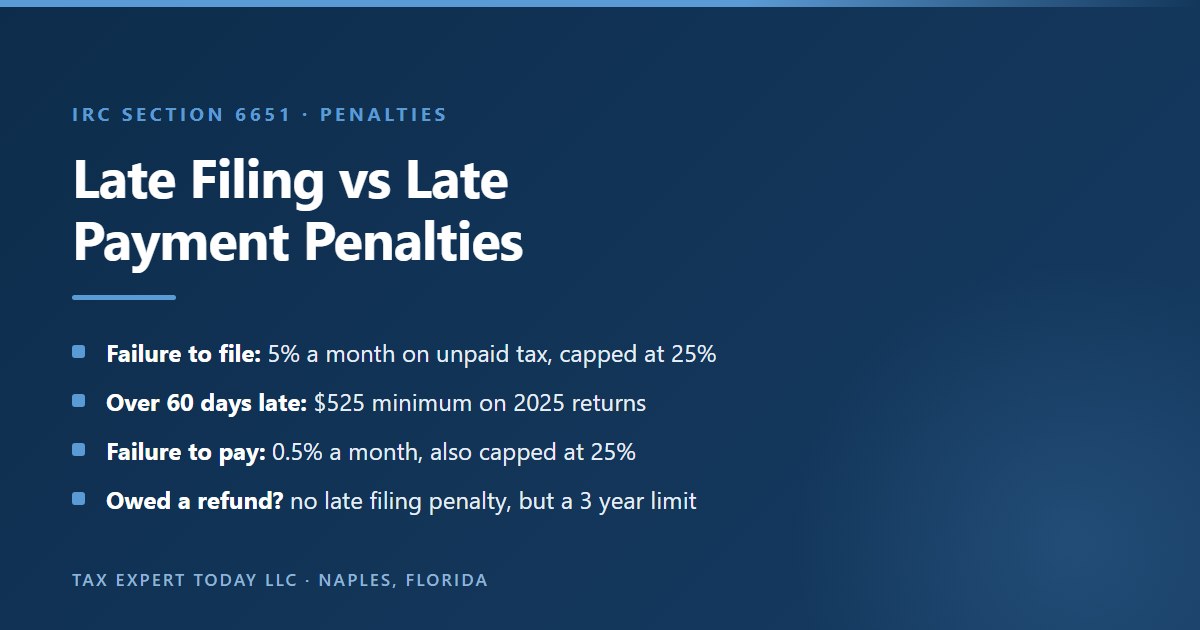
If you owe tax, the failure to file penalty under IRC section 6651(a)(1) is 5 percent of the unpaid tax per month, up to 25 percent, and the failure to pay penalty adds 0.5 percent monthly, also capped at 25 percent. A 2025 return filed over 60 days late has a $525 minimum penalty, or the full tax if less.
- Late filing. 5 percent of the net tax due for each month or part of a month, capped at 25 percent, per the IRS failure to file penalty page.
- Minimum penalty. $525 for returns due after December 31, 2025, and $510 for returns due in 2025, or 100 percent of the tax if less.
- Late payment. 0.5 percent per month under section 6651(a)(2), also capped at 25 percent.
- Interest. Interest runs on unpaid tax from the original due date and on most penalties.
The penalties apply only to tax that was owed and not paid on time, so a taxpayer who is owed a refund generally faces no failure to file penalty at all. For someone who does owe, the combination is steep. When both penalties apply in the same month, the failure to file penalty is reduced by the failure to pay amount, so the combined monthly charge is 5 percent for the first five months. After five months the late filing penalty has reached its cap, but the late payment penalty keeps running until it also reaches 25 percent. The hypothetical below shows how the two build up on an unpaid balance.
| Months late (unpaid tax of $10,000, hypothetical) | Failure to file | Failure to pay | Combined penalties |
|---|---|---|---|
| 1 month | $450 | $50 | $500 |
| 5 months | $2,250 | $250 | $2,500 |
| 12 months | $2,250 | $600 | $2,850 |
| 24 months | $2,250 | $1,200 | $3,450 |
| 50 months or more | $2,250 | $2,500 | $4,750 |
Hypothetical and simplified. Assumes the full $10,000 stays unpaid, no estimated payments or withholding, and no reduced failure to pay rate under an installment agreement. Interest is excluded and would be added on top.
Penalty relief is available in some cases. A taxpayer with a clean history for the prior three years may qualify for first time penalty abatement on one year, and a taxpayer who can show the failure was due to circumstances such as serious illness, a casualty or a death in the family may qualify for reasonable cause penalty abatement. The statute itself builds reasonable cause into section 6651(a). Relief requests are much easier to support when the return is filed promptly after the problem ends, which is another reason to answer the CP59 rather than wait for the substitute.
Can I lose a refund by not answering a CP59?
Yes. To claim a refund of withholding or estimated payments you must file within three years of the return due date, the IRS says, and the same deadline applies to refundable credits such as the earned income credit. The IRS also holds refunds for other years while a required return is past due.
- Three year window. The IRS past due returns page says a refund of withholding or estimated tax must be claimed within 3 years of the return due date.
- Lookback limit. Under IRC section 6511 the refund is limited to tax paid within the lookback period, and withholding is treated as paid on the due date.
- Refund holds. The IRS holds income tax refunds when its records show one or more required returns are past due.
- Substitute returns. A substitute return does not claim refundable credits it cannot see, so a refund owed to you is not paid by the IRS version.
Many people who receive an IRS CP59 notice are owed money rather than owing it. A worker whose employer withheld federal tax and who never filed may have a refund waiting, especially with the earned income tax credit or the child tax credit. The CP59 does not tell you that. It only says a return is missing. If the year is close to three years old, the refund deadline may be weeks away. Once it passes, the IRS keeps the money even though you were entitled to it. The same rule appears on Form 15103 itself, which notes that you must file a return to receive a refund even when you are not required to file.
The refund hold matters for the current year too. When the IRS shows a past due return on your account, it can hold your refund for another year until it receives the missing return or an acceptable explanation. Taxpayers sometimes discover the CP59 issue only because an expected refund for the most recent year did not arrive. Answering the CP59, either with the return or with Form 15103 explaining why none was required, is what releases that hold.
What if the CP59 was sent in error?
If the CP59 was sent in error, respond with proof rather than ignoring it. Show the return or extension the IRS missed, the correct Social Security number or name, or explain income that is not yours. The IRS has issued nonfiler notices in error before, and its CP59 FAQ points to Form 15103 for disagreements.
- Disagreeing. The IRS CP59 page says to complete and mail or fax Form 15103 if you believe the IRS made a mistake, or upload it through your Online Account.
- Extensions. TAS says extension filers who received a CP59R or CP59SN generally need not worry, but should confirm the extension was received.
- Territories. The IRS added guidance in 2026 for bona fide residents of Guam, the CNMI and the U.S. Virgin Islands who filed with their territory tax office.
- Identity theft. Income you never earned can signal identity theft, which follows a separate IRS process.
Errors happen at the system level as well as in individual cases. The Taxpayer Advocate Service has published warnings about nonfiler notices sent in error, including a 2020 tax tip about notices concerning non-receipt of 2019 returns, many of which were sitting unopened in IRS mail backlogs. Tax professionals also reported CP59SN notices reaching clients with valid extensions in 2025. When the notice is wrong, the answer is still to respond, because the case will not close on its own. Send a short cover letter with Form 15103 that states the error in one sentence and attaches the proof: the e-file acknowledgment, the certified mail receipt, the Form 4868 confirmation or the corrected information return.
If the income on which the IRS based the notice is not yours at all, such as a Form W-2 from an employer you never worked for, treat it as a possible identity theft case. The IRS handles that differently from an ordinary nonfiler response, and it may involve Form 14039, Identity Theft Affidavit, and an Identity Protection PIN for future returns. The CP59 page reminds taxpayers who already have an IRS issued IP PIN to include it on any return they send in response, including each spouse’s IP PIN on a joint return.
Can I file a late return electronically after a CP59?
Often, yes. The IRS says it accepts electronically filed returns for the two most recent prior years, through a provider that offers prior year e-file. Older years generally must be filed on paper. If you received a notice, send a paper return to the address on the notice.
- Two prior years. The CP59, CP515 and CP516 pages all say the IRS accepts returns electronically for the two most recent prior years.
- Provider required. You must find software or a preparer that offers prior year e-file; not all do.
- Paper returns. The IRS past due returns page says to send a past due return to the location on the notice you received.
- Prior year forms. Use the forms and instructions for the year on the notice, not the current year version.
Electronic filing is usually faster to post and gives you an acceptance acknowledgment that proves the return was received. For a return more than two years back, paper is the only route, and the address on the notice is the right one, because it routes the return to the unit handling your delinquency case rather than to general processing. Whichever method you use, send Form 15103 as the notice requests. On a paper filing, attach it to the return. When the return is e-filed, fax or mail Form 15103 separately to the notice address and note the e-file acceptance date on it so the IRS can match the two.
What if I cannot pay what I owe on the late return?
File the return anyway. The IRS CP516 and CP518 pages say to file even if you cannot pay and to request a payment plan for the balance. Filing stops the failure to file penalty from growing and replaces a substitute return with your correct figures, which usually lowers the balance.
- Short-term time. The IRS says you can request an additional 60 to 120 days to pay in full with no user fee.
- Installment agreements. Longer plans are available online for many balances; see our guide to IRS installment agreement options.
- Lower payments. A partial payment installment agreement or an offer in compromise may fit when full payment is not realistic.
- Compliance first. The IRS generally requires all required returns to be filed before it approves most payment plans and offers.
The worst response to an IRS CP59 notice is to delay filing because you cannot pay. The failure to file penalty is ten times the failure to pay penalty each month, so a filed but unpaid return costs far less over time than an unfiled one. Filing also puts your own deductions, filing status and credits on the record, which matters most for self-employed taxpayers and married couples. And filing is a condition of almost every IRS payment option. An installment agreement, an offer in compromise or currently not collectible status all generally require the taxpayer to be current on filing, so the missing return is the gate to every resolution tool.
Once the return posts and the tax is assessed, you will receive the regular balance due notice, usually a CP14 notice, and the account then follows the normal collection path. If you set up a payment plan promptly and keep future returns filed, the account stays out of the enforcement stage. If the balance goes unpaid, the reminders escalate through notices such as the CP501 and the CP504 notice of intent to levy, and then to a final notice of intent to levy. A balance that sits untouched for years can even be assigned to an IRS private debt collector.
What if I have several years of unfiled returns?
If the CP59 is one of several missing years, the response becomes a filing plan rather than a single return. Gather wage and income transcripts for each year, decide which years must be filed, and file in an order that protects refunds near their deadline. Our unfiled tax returns guide covers the catch-up strategy.
- Income transcripts. Wage and income transcripts show what the IRS has for each year, the same data it uses for substitutes.
- Refund deadlines first. A year close to its three year refund deadline usually goes to the front of the line.
- Substitute risk. Years already in the substitute process need attention before the 90 day letter expires.
- One response per notice. Each CP59 is tied to a specific year; answer each one, even if the answer is a short Form 15103.
An IRS CP59 notice often arrives for one year when the real problem covers several. The IRS sends nonfiler notices year by year, and they can arrive months apart. The full catch-up process, including how many years the IRS generally expects, how to reconstruct records and how to sequence filings with payment arrangements, is covered in our guide to unfiled tax returns. For the purposes of a single CP59, the key decision is whether to answer the notice year immediately and handle the others on a schedule, or to file everything together. When a substitute return is already in progress for one year, that year usually comes first, because the notice of deficiency carries a fixed 90 day deadline.
How does a CP59 compare with other IRS income notices?
A CP59 says no return is on file. A CP2000 says a return is on file but income is missing from it. A CP3219N is the statutory notice of deficiency that follows a substitute return. Each has a different response, and confusing them leads to the wrong filing.
- CP59. No return posted; file or explain on Form 15103.
- CP2000. A filed return does not match information returns; agree or disagree with the proposed change.
- CP3219N. A 90 day letter; file your return or petition the Tax Court.
- CP14. A bill for tax already assessed.
| Notice | What the IRS is saying | Typical response |
|---|---|---|
| CP59 | We have no record of your prior year return | Send a copy, file the return, or explain on Form 15103 |
| CP2000 | Your filed return omits income reported to us | Agree, partially agree, or disagree with documents by the response date |
| CP3219N | We propose tax based on a return we prepared | File your own return or petition the Tax Court within 90 days |
| Notice of deficiency | We have determined a deficiency | Petition the Tax Court within 90 days to contest before assessment |
| CP14 | You have a balance due on an assessed return | Pay, arrange a plan, or dispute the assessment |
The CP2000 is the sibling most often confused with the IRS CP59 notice, because both come from the same information return matching. The difference is whether a return exists. A CP2000 recipient filed, and the question is what was left off. A CP59 recipient, as far as the IRS knows, did not file at all. Responding to a CP59 with a CP2000 style letter disputing specific income items, without addressing the filing requirement, does not close the delinquency case. Responding to a CP3219N with Form 15103 alone, without filing or petitioning, generally does not stop the assessment either. Read the notice number in the corner before you write anything back.
IRS CP59 help Naples: tax resolution Naples and Southwest Florida
Our office in Naples, Florida works with taxpayers who have received an IRS CP59 notice and want to know which branch they are on before they respond. The first step is usually the same: pull the account transcript and the wage and income transcript for the year on the notice, confirm whether a return ever posted, and compare the income the IRS holds with the taxpayer’s records. That review shows quickly whether the right answer is a signed copy, a newly prepared return or a Form 15103 explaining that no return was required, and whether any refund for that year is close to its deadline.
People searching for CP59 notice help in Naples tend to ask whether the IRS will take money right away, whether they can file the old return electronically and what happens if they owe more than they can pay. The short answers are that a CP59 itself is not a bill, that the IRS accepts e-filed returns for the two most recent prior years, and that filing promptly and requesting a payment plan generally costs far less than waiting for a substitute return. Our IRS resolution and audit support service and our Naples tax resolution page explain how we handle nonfiler notices, substitute returns and the collection steps that can follow them.
Tax Expert Today LLC
11983 Tamiami Trail N, Naples, FL 34110
Phone: (239) 441-2005
Hours: Monday through Friday, 10:00 to 5:00 ET
Where can I get help with an IRS CP59 notice in Naples, FL? CP59 responses are handled by mail, fax and the IRS Online Account, so help does not depend on a local IRS office. A representative authorized on Form 2848 can pull transcripts, prepare and file the missing return or Form 15103, speak with the IRS about the delinquency case and request penalty relief where it applies. Tax Expert Today LLC is located at 11983 Tamiami Trail N in Naples and works with taxpayers in Collier and Lee Counties and nationwide. Because Florida has no personal income tax, a Naples resident answering a CP59 is dealing with a federal filing requirement only.
When to Engage a Professional
Many taxpayers can answer an IRS CP59 notice on their own, especially when the return was simply filed late or the IRS missed a return that is easy to document. Consider engaging a representative where several years are missing, where the IRS has already sent a 30 day letter or a CP3219N, where self-employment income, stock sales or rental property make the return hard to reconstruct, where a substitute return has already been assessed, where you believe the income is not yours, or where you owe more than you can pay. Those are the situations in which the order of filings, the treatment of the substitute and the choice of payment option matter most. Dr. Kabashi is an Enrolled Agent authorized to represent taxpayers before the IRS in all 50 states, and every engagement starts from the statute, the regulations and the IRS’s own procedures rather than assumptions about what the IRS will do.
This article is educational and general in nature. It does not constitute tax or legal advice for any particular taxpayer, and outcomes depend on individual facts and circumstances. Notice procedures, penalty amounts, filing thresholds and electronic filing rules are current as of the publication date and are subject to change.
Published October 9, 2026 by Dr. Pellumb Kabashi « Back to Learning Center
Have a question this article touches on?
Tax Expert Today LLC, based in Naples, Florida and serving clients across the United States.
Schedule a Consultation (239) 441-2005