
By Dr. Pellumb Kabashi, DBA, MBA, EA, CFE, CES
Founder, Tax Expert Today LLC · Tax advisors, enrolled agents, CPAs, and attorneys · Serving clients in all 50 states
Quick Answer: Injured spouse relief returns your share of a joint refund that the government applied to your spouse’s separate debt, such as past due child support, a defaulted student loan, or state income tax. You claim it on Form 8379 by allocating each line of the joint return between the two of you, and the IRS then computes your share. Call (239) 441-2005 for a free consultation.
What Is Injured Spouse Relief?
Injured spouse relief lets a spouse who filed a joint return recover the portion of the joint refund that belongs to them after the refund was applied to the other spouse’s separate past due obligation. It is claimed on Form 8379, Injured Spouse Allocation. The word injured refers to financial harm, not to any physical injury.
The relief exists because a joint refund is a single amount, while the debts behind an offset usually belong to only one person. Under IRC §6402, an overpayment can be applied to certain outstanding obligations before any money is issued. Form 8379 is the mechanism that separates the joint amount back into two shares so the non liable spouse can be paid.
- It is a refund allocation, not a liability defense. The claim does not dispute that the debt exists or that it is enforceable.
- It applies per year. The instructions state you must file Form 8379 for each year you meet the condition and want your portion refunded.
- The IRS performs the computation. You allocate the line items; the instructions state that the IRS will figure the amount of any refund due the injured spouse.
- It can be filed before or after the offset. The form is filed when you become aware your share was, or is expected to be, offset.
Injured Spouse or Innocent Spouse: Which One Do You Need?
These are two different remedies that are frequently confused. Injured spouse relief recovers your share of a refund taken for a debt that is your spouse’s alone. Innocent spouse relief removes your legal responsibility for a tax liability created by your spouse’s errors on a joint return. One is about a refund; the other is about liability.
The Form 8379 instructions are explicit on the point: do not file Form 8379 if you are claiming innocent spouse relief, and file Form 8857 instead. Our guide to innocent spouse relief and Form 8857 covers that remedy in full, including the three statutory paths and the deadline rules that differ by path.
| Question | Injured spouse (Form 8379) | Innocent spouse (Form 8857) |
|---|---|---|
| What is at stake | Your share of a joint refund | Your liability for joint tax owed |
| Triggering event | Refund offset for the other spouse’s separate debt | Understatement of tax from the other spouse’s items |
| Is the tax itself disputed | No | Yes |
| Typical debt involved | Child support, student loan, state tax | Federal income tax assessed on the joint return |
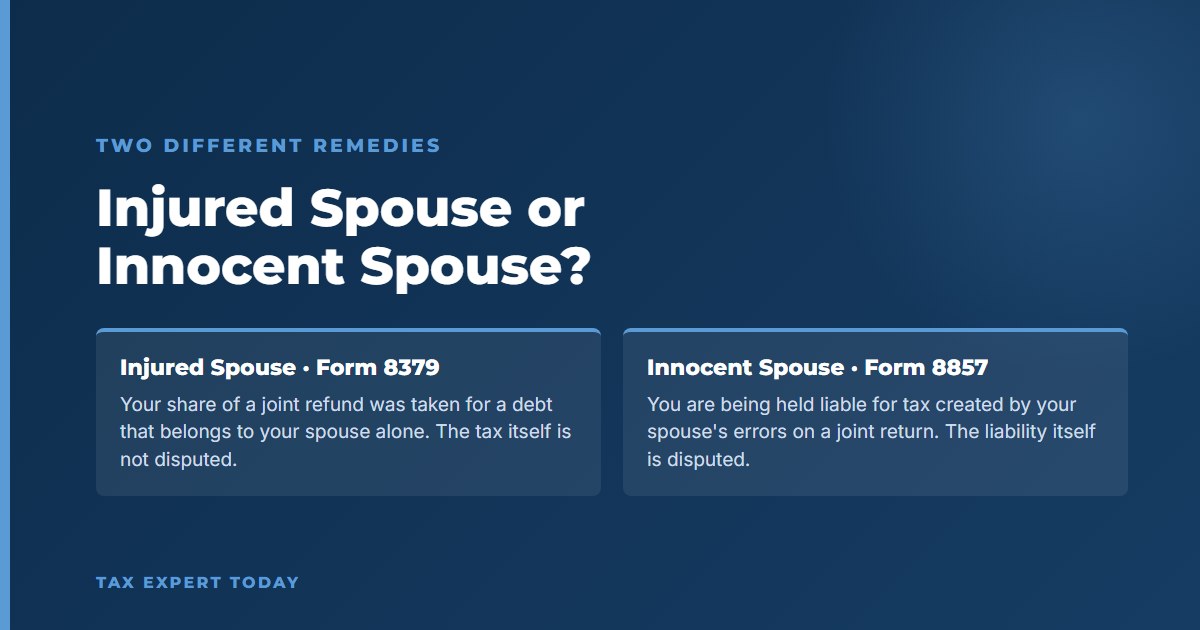
If a joint refund was taken for a debt that was never yours, Form 8379 is the correct filing. If the IRS says you owe tax because of income or deductions your spouse reported incorrectly, that is the other remedy entirely.
Do You Qualify for Injured Spouse Relief?
You may qualify if you filed a joint return, your share of the overpayment was applied to your spouse’s legally enforceable past due obligation, and you are not legally responsible for that debt. You must also have contributed to the overpayment, through withholding, estimated payments, or a refundable credit.
That last condition is the one taxpayers overlook. If the entire refund is traceable to your spouse’s withholding and you reported no income and no payments, there may be no share to allocate to you. The IRS injured spouse page frames the requirements this way:
- A joint return was filed. The relief has no application to a separately filed return outside community property situations.
- The refund was applied to the other spouse’s overdue debt. The debt must be legally enforceable and subject to offset.
- You are not responsible for the debt. A jointly incurred obligation does not qualify.
- You made payments or claimed a refundable credit. Withheld wages, estimated tax payments, or a refundable credit establish your share.
The instructions add a practical warning worth heeding: filing Form 8379 when no past due obligation exists will delay your refund rather than speed it.
Which Debts Can Take a Joint Refund?
A joint overpayment can be offset for a legally enforceable past due federal tax debt, state income tax, state unemployment compensation debt, child support, or a federal nontax debt such as a defaulted student loan. Two different agencies issue the notices, and knowing which one wrote to you tells you where the money went.
Under the offset framework in IRC §6402, the IRS issues the Notice of Offset for federal tax debts. For everything else, the notice comes from the Bureau of the Fiscal Service, which operates the Treasury Offset Program. Tax Topic 203 states that the notice will show the original refund amount, the offset amount, and the agency receiving the payment.
- Federal tax debt. Notice issued by the IRS. If the balance is yours jointly, see our guide to the IRS CP14 notice and to installment agreement options, an offer in compromise, or currently not collectible status.
- Past due child support. Notice issued by the Bureau of the Fiscal Service.
- Federal nontax debt. Student loans are the common example.
- State income tax and state unemployment compensation debt. Also routed through the Treasury Offset Program.
To confirm whether a non federal debt is actually in the offset system before filing, the instructions direct taxpayers to the Bureau of the Fiscal Service at 800-304-3107. That call is worth making first, because it establishes whether there is anything to allocate.
How Is the Refund Actually Split?
The allocation is made as if each spouse had filed a separate return instead of a joint one. Each item of income, adjustment, deduction, credit, other tax, and payment is assigned to the spouse who would have reported it separately. Part III of Form 8379 is where that assignment happens, line by line.
This is the part of the process that most published guidance skips, and it is where the outcome is decided. The Form 8379 instructions give a specific rule for each category rather than leaving it to judgment.
| Form 8379 Part III line | What it covers | How it is allocated |
|---|---|---|
| Line 13a | Wages from Forms W-2 | To the spouse who earned them |
| Line 13b | All other income | Joint items, such as interest on a joint account, allocated as you determine |
| Line 14 | Adjustments to income | To the spouse who would have claimed it, for example the IRA deduction to the IRA owner |
| Line 15 | Standard or itemized deductions | Standard deduction split one half to each spouse; itemized deductions follow each spouse’s own items |
| Line 16 | Nonrefundable credits | Child tax credit, credit for other dependents, and dependent care credit follow the spouse who would have claimed the dependent |
| Line 17 | Refundable credits | Additional child tax credit follows the dependent; earned income credit is excluded here |
| Line 18 | Other taxes | Self employment tax to the spouse who earned the self employment income |
| Line 19 | Federal income tax withheld | To the spouse whose Forms W-2, W-2G, or 1099 show the withholding |
| Line 20 | Other payments | Joint estimated payments by agreement, or by the statutory formula if there is no agreement |
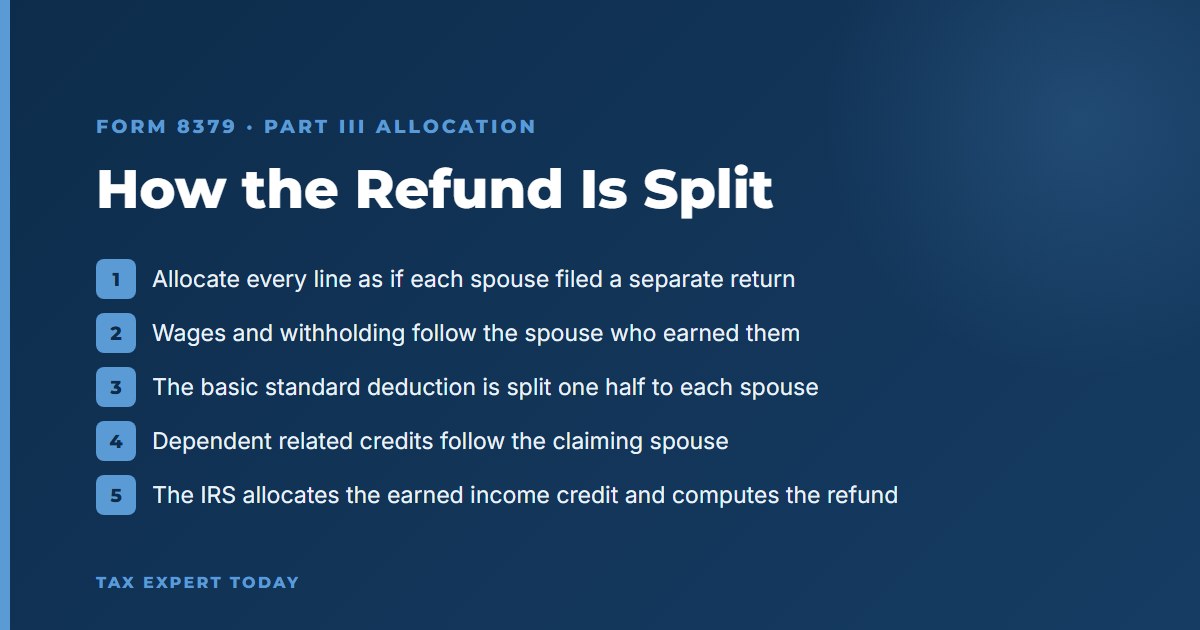
Several details in that table repay close attention:
- The earned income credit is not allocated by you. The instructions direct taxpayers not to include it on line 17, because the IRS allocates it based on each spouse’s earned income.
- The standard deduction is halved, not traced. Each spouse takes one half of the basic standard deduction. For 2026 the basic standard deduction for a joint return is $32,200 under the IRS inflation adjustments for tax year 2026, so $16,100 is allocated to each column.
- The additional standard deduction is not halved. Where boxes for age or blindness were checked, the per box additional amount is multiplied by the number of boxes for that spouse and assigned to that spouse’s column. The instructions print $1,550 for 2024 and $1,600 for 2025, and the amount is adjusted annually.
- Estimated payments have a fallback formula. Absent agreement, each spouse’s separate tax liability divided by both separate tax liabilities, multiplied by the estimated tax payments.
- Credits unavailable on a separate return are still split. Where a deduction or credit would not be allowed on a separate return, such as the student loan interest deduction or the dependent care credit, the joint amount is used and allocated between the spouses rather than dropped.
One further rule covers the residual cases. Items that do not clearly belong to either spouse, such as a penalty on early withdrawal of savings from a joint bank account, are divided equally.
How Does the Allocation Change in a Community Property State?
In the nine community property states the ordinary allocation rules do not control the answer. Overpayments are treated as joint property, and state law determines what is refundable. As a general matter, 50 percent of a joint overpayment, excluding the earned income credit, is applied to non federal tax debts regardless of who earned the income.
The instructions list the nine states as Arizona, California, Idaho, Louisiana, Nevada, New Mexico, Texas, Washington, and Wisconsin. This is the single factor most likely to change the result for a taxpayer who reads only a national explainer, because a spouse who earned every dollar of the income may still see half the overpayment applied to the other spouse’s child support or student loan debt.
| If the injured spouse lives in | Controlling revenue ruling |
|---|---|
| Arizona or Wisconsin | Rev. Rul. 2004-71 |
| California, Idaho, or Louisiana | Rev. Rul. 2004-72 |
| Nevada, New Mexico, or Washington | Rev. Rul. 2004-73 |
| Texas | Rev. Rul. 2004-74 |

All four rulings appear in Internal Revenue Bulletin 2004-30. They address how much of a joint overpayment the IRS may offset against a spouse’s separate federal tax liability, and the answer differs by state, which is why the instructions route each state to a specific ruling rather than stating one national rule. IRM 25.18.5 sets out how the Service applies community property principles to these allocations internally, and Publication 555 covers the factors that determine whether community property law reaches a given taxpayer at all.
Note the earned income credit carve out in both directions. It is excluded from the 50 percent rule, and it is allocated to each spouse based on each spouse’s earned income.
When and Where Do You File Form 8379?
Form 8379 can be filed with the original joint return, with an amended joint return on Form 1040-X, or by itself after the joint return has already been processed. Where it is mailed depends on which of those routes applies, and the filing method changes what must be attached.
- With the joint return. Attach it in order of the attachment sequence number and write “Injured Spouse” in the upper left corner of page 1 of the joint return.
- By itself after the offset. Attach copies of all Forms W-2 and W-2G for both spouses, and any Forms 1099 showing federal income tax withholding.
- Do not attach the joint return to a standalone filing. The instructions list this as a processing delay, not a helpful addition.
- With an amended return. A separate Form 8379 is attached to Form 1040-X when an amendment claims an additional refund that you do not want offset.
The mailing destination follows a short chart in the instructions. Filed with the joint return, both go to the service center for the area where you live. Filed by itself after a paper joint return, it goes to the service center where the original return was filed. Filed by itself after an electronic joint return, or with a Form 1040-X, it goes to the center for the area where you live. Taxpayer Assistance Centers are not service centers and cannot accept the form.
How Long Does Form 8379 Take to Process?
The published timeframes depend entirely on how the form reaches the IRS. Filing it with a paper joint return takes the longest, filing electronically with the return is faster, and filing it alone after the return has been processed is the shortest of the three. Processing errors extend all three figures.
| How Form 8379 is filed | Approximate processing time |
|---|---|
| With a joint return, on paper | About 14 weeks |
| With a joint return, filed electronically | About 11 weeks |
| By itself, after the joint return was processed | About 8 weeks |
These are the figures printed in the Form 8379 instructions. They describe normal processing and are not commitments. IRM 21.4.6 governs how the Service handles refund offsets and injured spouse cases procedurally. Providing a daytime phone number on the form can shorten the timeline, because the instructions note that questions answered by phone may allow processing to continue without mailing a letter.
What Is the Deadline to File Form 8379?
Form 8379 must be filed within three years from the due date of the original return, including extensions, or within two years from the date the tax that was later offset was paid, whichever is later. Certain circumstances described in IRC §6511 may extend that period.
Read that carefully, because it is commonly restated in a way that is slightly wrong. The measuring point for the three year test is the due date of the original return including extensions, not the date the return happened to be filed. That distinction matters for a taxpayer who filed late, and it can move the deadline by months. The statutory framework sits in IRC §6511.
- Three years from the original due date, including extensions. An extended return carries the later date.
- Or two years from payment of the offset tax. Whichever of the two produces the later date controls.
- File for each affected year separately. One form does not cover multiple years.
- Do not wait for the offset notice if you expect one. The form may be filed when the offset is expected, not only after it occurs.
What Mistakes Delay an Injured Spouse Claim?
The instructions include a short list of common mistakes, and each one maps to a specific processing delay. Most rejected or slowed claims fail on attachments and allocation logic rather than on eligibility, which means they are largely avoidable at the preparation stage.
- Attaching the joint return to a standalone Form 8379. This slows processing rather than supporting the claim.
- Omitting the withholding documents. Forms W-2 and W-2G for both spouses, and any Forms 1099 showing withholding, must be enclosed on a standalone filing.
- Failing to mark the joint return. “Injured Spouse” belongs in the upper left corner of page 1 when the form is filed with the return.
- Allocating items to the wrong spouse. Each item goes to the spouse who would have entered it on a separate return.
- Filing when no offset obligation exists. Confirm the debt through the Bureau of the Fiscal Service before filing.
- Missing the community property question. Line 5 asks whether you resided in a community property state, and the answer changes the calculation.
One more item is worth flagging for anyone preparing a claim from a printed copy of the instructions. The standard deduction table inside the November 2024 revision reflects the amounts known when it was published. The figure for a joint return has since been adjusted by later legislation and by annual indexing, so the amount to halve is the basic standard deduction for the year of the return being allocated, not the number printed in an older instruction booklet.
Injured Spouse Relief Help in Naples and Southwest Florida
Tax resolution Naples clients often reach our office in Naples, Florida after a refund has already disappeared and the notice explaining why came from an agency they did not expect to hear from. The allocation itself is mechanical once the facts are assembled, and the work is in assembling them correctly the first time, because a corrected claim restarts the clock.
Tax Expert Today LLC
11983 Tamiami Trail N, Naples, FL 34110
Phone: (239) 441-2005
Hours: Monday through Friday, 10:00 to 5:00 ET
Does living in Florida change an injured spouse allocation? Yes, in one favorable respect. Florida is not a community property state, so the ordinary allocation rules apply and a Southwest Florida taxpayer is not exposed to the 50 percent rule that reaches earners in the nine community property states. Florida also imposes no state individual income tax, which removes one category of offsettable debt from the picture entirely. A former resident of a community property state should still expect the community property analysis to apply to the years lived there, and filing status questions after a separation are covered in our guide to filing status during and after a divorce. Our IRS resolution and audit support service page and our Naples tax resolution page describe how we handle these matters.
When to Engage a Professional
An injured spouse claim is worth professional review when the allocation is not obvious. Consider engaging a representative when you lived in a community property state during the year at issue, when self employment income or business credits must be divided, when dependents and the related credits are contested, when estimated payments were made jointly and the spouses do not agree on the split, when a prior Form 8379 was already returned or adjusted, or when the offset involves a federal tax debt that both spouses may share. Where that shared federal balance is the underlying problem, the collection statute expiration date often shapes which resolution path fits. Outcomes depend on the specific facts, and the allocation needs the actual figures from the return rather than a general rule.
This article is educational and general in nature. It does not constitute tax advice for any particular taxpayer, and outcomes depend on individual facts and circumstances.
Published August 20, 2026 by Dr. Pellumb Kabashi « Back to Learning Center
Have a question this article touches on?
Tax Expert Today LLC, based in Naples, Florida and serving clients across the United States.
Schedule a Consultation (239) 441-2005