
By Dr. Pellumb Kabashi, DBA, MBA, EA, CFE, CES
Founder, Tax Expert Today LLC · Tax advisors, enrolled agents, CPAs, and attorneys · Serving clients in all 50 states
Quick Answer: A CP11 notice means the IRS corrected what it treats as a math or clerical error on your return and now says you owe more. Under IRC section 6213(b)(2), a request for abatement made within 60 days of the notice date requires the IRS to reverse the change and use regular deficiency procedures, which keeps your path to the Tax Court open. Call (239) 441-2005 for a free consultation.
What is a CP11 notice?
A CP11 notice is the IRS letter that says it corrected one or more mistakes on your return and, as a result, you owe more than the return showed. It is both an explanation of the change and a bill. The IRS made the change without an audit, using its summary math error authority.
- It is a correction notice. The IRS CP11 page says the IRS “corrected one or more mistakes” and the amount you owe “has changed.”
- It is also a balance due notice. The notice shows the new amount and a date to pay it.
- It rests on special authority. The change is made under IRC section 6213(b)(1), which lets the IRS assess without first mailing a notice of deficiency.
- It carries a 60 day right. Section 6213(b)(2)(A) gives you 60 days from the notice to request abatement of the added tax.
Most IRS notices that change your tax follow a slow, formal path. An examiner or an automated program proposes a change, you get a chance to respond, and if you still disagree the IRS must send a statutory notice of deficiency before it can assess. That notice is what opens the door to the United States Tax Court, where you can contest the tax before paying it. A CP11 notice skips that path. Congress allowed the IRS to fix certain obvious errors, the kind visible on the face of the return, by simply assessing the corrected tax and telling you about it afterward. The trade for that speed is a narrow but powerful right: if you ask within 60 days, the IRS must undo the assessment and go back to the slow path.
That is the single most important fact about the CP11 notice, and it is the fact that most explanations leave out. Many pages describe the 60 days as a window to “call the IRS if you disagree.” The statute is stronger than that. A timely request for abatement is not a request the IRS weighs and grants or denies. Under section 6213(b)(2)(A), “upon receipt of such request, the Secretary shall abate the assessment.” What happens next may still cost you money, but the procedural right itself is automatic.
Why did the IRS send me a CP11 notice?
The IRS sends a CP11 notice when its processing systems find an error on the face of your return that increases the tax or reduces a credit, leaving a balance due. Common triggers are arithmetic mistakes, a credit computed for the wrong age, a missing or mismatched Social Security number, or a deduction above a statutory limit.
- Arithmetic. A total that does not add up, or a tax figured from the wrong column of the tax table.
- Credits. The child tax credit, earned income tax credit or education credits claimed for someone whose identification number or age does not support the claim.
- Missing forms. A credit claimed without the schedule that substantiates it, such as Form 8863 for education credits.
- Limits. A deduction or credit that exceeds a dollar or percentage cap when the figures needed to apply the cap are on the return.
The notice has a section titled “What we changed on your return” or a similar heading that lists each error. The IRS CP11 page tells recipients to review that section first and, if the reason is still unclear, to call the number shown on the notice. Before you call, have the return you filed, any schedules, and the documents behind the line that changed. If a credit was reduced because of an identification number, confirm the number against the Social Security card and confirm the name matches exactly, because the IRS compares both with Social Security Administration records.
The IRS also sends related notices with similar numbers. A CP12 reports a math error correction that changed your refund or created one. Notices for specific credits, such as the earned income tax credit, may carry their own suffix. The response rights in this guide come from the statute, not the notice number, so they apply to any notice that assesses additional tax on account of a math or clerical error. A CP59 notice, by contrast, concerns a return the IRS never received and has nothing to do with math errors. If you are unsure whether your letter is a math error notice, look for language saying the IRS “corrected” your return and for the 60 day contact date.
What counts as a math or clerical error under section 6213(g)?
Section 6213(g)(2) lists the errors the IRS can correct through a CP11 notice. The list covers arithmetic, misuse of IRS tables, inconsistent entries, missing substantiating information, deductions over statutory limits, and a growing set of missing or incorrect identification numbers for credits and deductions. Anything outside that list requires deficiency procedures instead.
- Arithmetic and tables. Errors in addition, subtraction, multiplication or division, and incorrect use of an IRS table that is apparent from the return.
- Inconsistency and omissions. An entry inconsistent with another entry, or an omission of information required to substantiate an entry.
- Statutory limits. A deduction or credit above a limit expressed as a dollar amount, percentage, ratio or fraction.
- Identification numbers. A missing or incorrect number required for the child tax credit, earned income credit, dependent care credit, education credits and several newer provisions.
| Category in IRC §6213(g)(2) | Hypothetical example | What usually fixes it |
|---|---|---|
| (A) Arithmetic | Schedule totals added incorrectly | Agree if the IRS math is right; show the correct figures if not |
| (B) Incorrect use of an IRS table | Married filing separately status, but tax figured from the joint column | Usually agree; confirm the filing status the IRS used |
| (C) Inconsistent entries | A figure on Form 1040 that does not match the attached schedule | Send the corrected schedule or explain which figure is right |
| (D) Missing substantiating information | Education credit claimed without Form 8863 | Send the missing form within 60 days |
| (E) Over a statutory limit | A deduction claimed above its dollar or percentage cap | Agree, or show the limit was applied correctly |
| (F), (H), (I), (J) and later items: identification numbers | Child tax credit claimed with a number that does not match Social Security records | Correct the record with the Social Security Administration and document it |
| (L) Age based on the number | Credit claimed for a child the records show as too old | Proof of age, or agree if the claim was wrong |
The list has grown over time. The 2025 budget law, Public Law 119-21, added items for a missing Social Security number on the new deduction for seniors, the qualified tips deduction, the qualified overtime deduction, certain student loan discharges and the Trump accounts contribution pilot. The practical effect is that more of the new provisions taxpayers claimed on 2025 returns can be denied by math error notice rather than through an audit. If your CP11 notice cites one of those deductions, the first question is whether the number you reported matches what the issuing agency has on file.
Just as important is what the list does not cover. The Internal Revenue Manual at 21.5.4.2.1 says a correction to withholding or estimated tax payments is not a math error for purposes of the 60 day abatement request. Those are handled as payment and credit questions. Likewise, a change based on income reported by third parties that you left off the return is not a math error; that is the underreporter process that produces a CP2000 notice. If the IRS changed something that required judgment about facts outside the return, ask whether math error authority applied at all.
What is the 60 day rule on a CP11 notice?
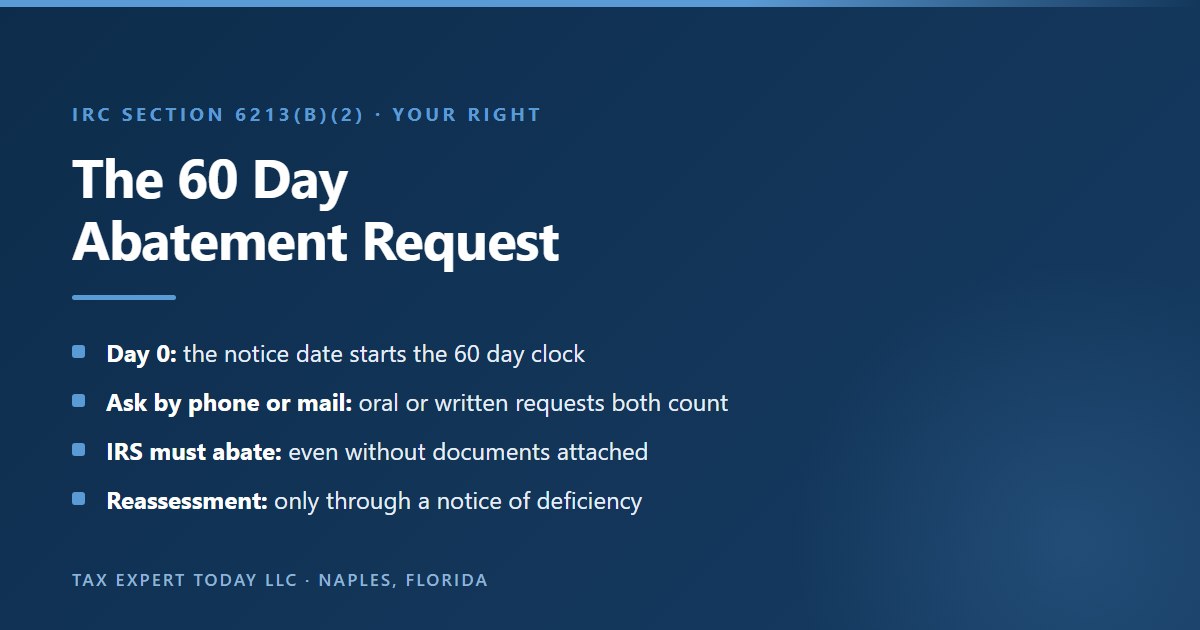
The 60 day rule is the CP11 notice right in IRC section 6213(b)(2)(A). You may request abatement within 60 days after the notice is sent, and the IRS must then abate the assessment. Any reassessment of that tax must go through deficiency procedures, including a notice of deficiency and the right to petition the Tax Court.
- The clock starts on the notice date. The 60 days run from when the notice is sent, not from when you open it.
- Mail is judged by postmark. IRM 21.5.4.3 tells employees to use the postmark date to decide whether a mailed request was timely.
- Abatement is mandatory. The statute uses “shall abate,” and IRM 21.5.4.3.2 says the IRS must abate even when the request has no supporting documents.
- Collection pauses. Section 6213(b)(2)(B) bars levy or court collection while the 60 day window is open.
| CP11 notice clock | What happens | Source |
|---|---|---|
| Notice date | Tax already assessed; the 60 day abatement window opens and levy is stayed | IRC §6213(b)(1) and (b)(2)(B) |
| Within 21 calendar days | Paying an agreed amount generally avoids the failure to pay penalty and interest after the notice date | IRC §6651(a)(3), §6601(e)(3) |
| Within 60 days | A request, oral or written, requires abatement; mail is judged by postmark | IRC §6213(b)(2)(A), IRM 21.5.4.3 |
| After 60 days | Discretionary reconsideration, a claim for refund after payment, or in some cases collection due process | IRM 21.5.4.3, IRC §6511 |
| Notices sent after November 25, 2026 | The abatement date must appear in bold beside your address on page 1 | Public Law 119-39 |
Read the statute and it becomes clear why this right matters. Section 6213(b)(1) says a math error notice “shall not be considered as a notice of deficiency” and that the taxpayer “shall have no right to file a petition with the Tax Court based on such notice.” In other words, the CP11 notice by itself gives you no court. The 60 day abatement request is the mechanism that restores one. Once the IRS abates, it can only reassess the same tax by issuing a statutory notice of deficiency, and that notice carries the 90 day window to petition the Tax Court before paying. Our guide to the IRS notice of deficiency explains that stage.
The IRS CP11 page puts the same point in plain words. If you do not contact the IRS by the date on the notice, “you will lose formal rights to have the change(s) reversed, as well as your right to appeal our decision to the U.S. Tax Court.” That sentence is the reason to put the 60 day date on your calendar the day the CP11 notice arrives.
How do I request abatement of a CP11 notice?
You can request abatement of a CP11 notice by calling the number on the notice or by writing to the address on it, within 60 days. The IRS says most changes are reversed on request and no explanation is required, though supporting documents can speed resolution. A written request with proof of mailing is the safest record.
- Find the date. Note the notice date and count 60 days. Use the contact date printed on the notice if it is later.
- Decide what you dispute. Identify each changed line and whether you disagree with all or part of it.
- Call or write. IRM 21.5.4.3.2 says “an abatement request may be written or oral.” The IRS page says the telephone is usually fastest, and documents can be faxed during the call.
- Use the statutory words. In a letter, state that you request abatement of the assessment under IRC section 6213(b)(2)(A).
- Keep proof. Mail by certified mail with a postmark receipt, or keep the call date, the employee name or badge number and a fax confirmation.
The IRS frames the disagreement route generously. Its CP11 page says the IRS will reverse most changes that increased the amount you owe, and that you do not need to provide an explanation or additional documents when you ask for the reversal. That matches the statute. It also warns that if the IRS does not receive information supporting the original return, it “may forward your case for audit,” and audit staff will contact you within about six weeks.
A phone call is valid, but it leaves the burden of proof about timing on your notes. When a CP11 notice involves real money or a credit you expect to defend, many practitioners call to start the process and then send a short confirming letter the same week. The letter identifies the tax year, the notice number and date, the changes disputed, and the request under section 6213(b)(2)(A). Attach a copy of the notice and any substantiation. If you have a representative, the representative can make the request once your Form 2848 authorization is on file.
If your disagreement is with only one of several changes, say so. The IRS treats each math error item on its own, and agreeing with the arithmetic fix while disputing a credit denial keeps the record clean. Do not send an amended return as your response. IRM 21.5.4.3.2 says an amended return that does not specifically address the math error issue is processed without regard to it, and an amended return signed before the notice date is not treated as a reply at all.
What happens after I request abatement?
After a timely request, the IRS reverses the CP11 notice assessment. If you sent documents that prove the original return, the case usually closes there. If you sent none, the IRS abates and then refers the case to Exam Classification, which may open an examination and eventually issue a notice of deficiency you can take to the Tax Court.
- Substantiated protest. Documents prove the IRS calculation wrong; the account is corrected and the balance removed.
- Unsubstantiated protest. The IRS still abates, then routes the case for possible audit.
- Appeal before a notice. IRM 21.5.4.3.2 says a taxpayer who disagrees with Exam’s determination can appeal before a notice of deficiency issues.
- Tax Court after a notice. If a notice of deficiency issues, you can petition the Tax Court within 90 days.
The Internal Revenue Manual divides responses into two kinds. A substantiated protest is one where the taxpayer provides documents, orally or in writing, that show the math error was wrong. Those are corrected in Accounts Management. An unsubstantiated protest is a timely request without proof. The IRS must still abate, but IRM 21.5.4.3.2 says it then refers the case to Exam Classification, which decides whether to examine. From that point the matter runs like an ordinary IRS audit: a letter, a chance to send information, a report, an appeal right, and finally a statutory notice of deficiency if the disagreement remains.
That sequence is the payoff of the 60 day rule. In an examination, the IRS has to build its case through the normal process, you can present facts the processing system never saw, and the Independent Office of Appeals is available before any court filing. If the case reaches a notice of deficiency, the Tax Court can hear it without the tax being paid first. Compare that with letting the CP11 notice stand, where the tax is already assessed and the only path to court generally runs through paying and suing for a refund.
Should I always request abatement within 60 days?
Not always. Requesting abatement of a CP11 notice makes sense when you believe the original return was right or the IRS lacked math error authority. If the IRS correction is plainly correct, forcing abatement mostly delays the bill, may invite an examination, and lets interest continue to grow on the tax you will owe anyway.
- Request it when the credit, deduction or number was correct and you can document it.
- Request it when the change involved judgment about facts outside the return, which falls outside section 6213(g).
- Think twice when the IRS simply fixed arithmetic you got wrong.
- Request partial abatement when only one of several changes is wrong.
An abatement request is a procedural tool, not a refund. The assessment comes off the account, but if the IRS later proves the tax is owed, it reassesses through deficiency procedures, and interest under IRC section 6601 runs from the original due date of the return regardless of the detour. An unsubstantiated request also routes the file to Exam Classification, which can look beyond the single line the CP11 notice changed. For a taxpayer whose return has other soft spots, that is a real consideration.
On the other hand, the cost of missing the window can be larger than it looks. A credit denial for a missing or mismatched identification number is often a records problem rather than an eligibility problem. If the 60 days pass, getting that credit back requires a formal claim for refund rather than a phone call that triggers mandatory reversal. Where the facts support the original return, the default should be to use the statutory right. The decision is fact specific, and the 60 day date is the reason to make it early rather than late.
What if I agree with the CP11 notice?
If you agree with the CP11 notice, pay the balance by the date shown to limit penalties and interest, or arrange a payment plan if you cannot pay in full. Correct your own copy of the return for your records, but do not mail a corrected return back to the IRS.
- Pay by the notice date. The IRS says paying in full by that date avoids additional penalties and interest.
- Use an IRS payment channel. Direct Pay, the Electronic Federal Tax Payment System, a debit or credit card processor, or the IRS Online Account.
- Request a plan if needed. An online payment agreement or Form 9465 for an IRS installment agreement.
- Fix next year’s carryovers. Correct your copy so carryforward figures and next year’s return start from the right numbers.
Agreeing does not require any reply beyond payment. The IRS CP11 page specifically says to correct the copy of the return you kept, “but do not send it to us.” Sending an amended return to concede a math error can create a duplicate adjustment and slow the account. If the same error came from tax software or a preparer, have the preparer correct their copy too, because a repeat of the same mistake next year produces the same notice.
If you agree with the change but believe the penalty is unfair, those are separate questions. The IRS page says you can contact it by the notice due date if you cannot pay because of circumstances beyond your control, and it may be able to remove the late payment penalty. Our pages on first time penalty abatement and reasonable cause penalty abatement explain how relief from penalties works. Interest generally cannot be removed on those grounds.
Does interest and penalty keep running on a CP11 balance?
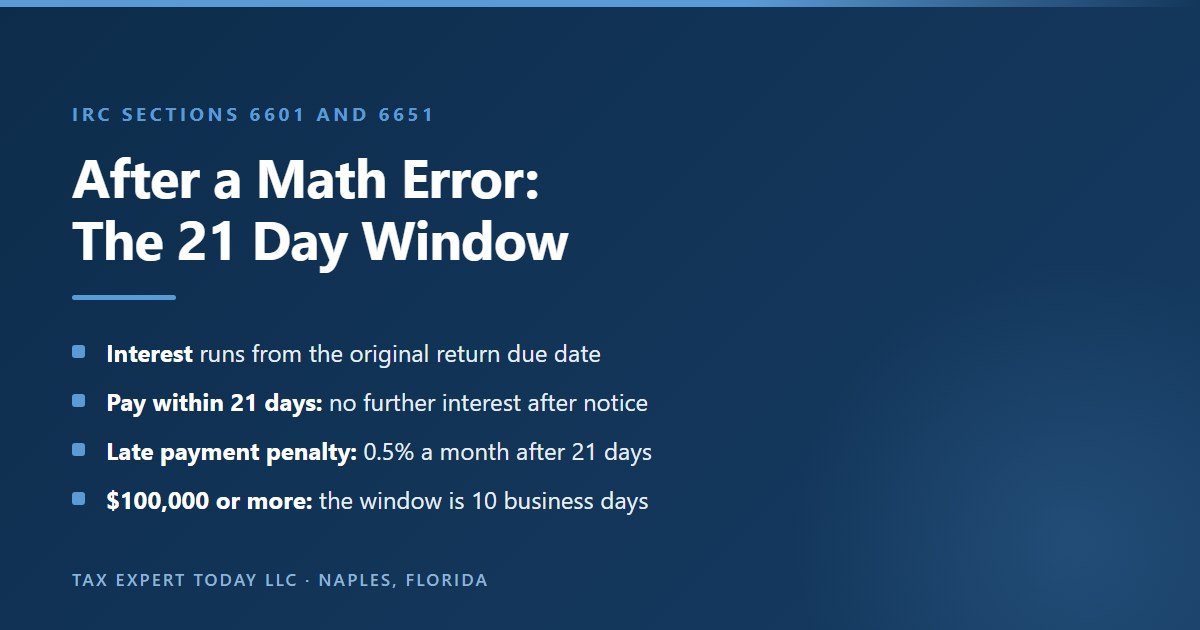
Yes. Interest on a CP11 notice balance runs from the original due date of the return, not from the notice date. A failure to pay penalty under IRC section 6651(a)(3) generally applies if the assessed amount is not paid within 21 calendar days of notice and demand, or 10 business days for amounts of $100,000 or more.
- Interest from the due date. The IRS says that if you do not pay in full by the notice date, interest accrues on the unpaid balance “from the date the return was due.”
- The 21 day interest rule. Under section 6601(e)(3), paying within 21 calendar days of notice and demand stops interest for the period after the notice date.
- The 21 day penalty rule. Section 6651(a)(3) expressly includes “an assessment made pursuant to section 6213(b).”
- The penalty rate. The failure to pay penalty is one half of one percent a month on the unpaid amount, capped at 25 percent.
The CP11 notice amount usually already includes interest figured to the payment date printed on it. That is why the IRS emphasizes paying by that date. The timing rules in IRC section 6651(a)(3) are different from the ordinary late payment penalty on tax you showed on your own return. For tax the IRS adds by math error, the penalty clock starts with the notice and demand, which gives you a short grace window to pay the new amount.
| Hypothetical: $2,000 added by a CP11 notice | Paid within 21 days | Paid 6 months later |
|---|---|---|
| Additional tax | $2,000 | $2,000 |
| Interest from the return due date to the notice date | Owed (shown on the notice) | Owed |
| Interest after the notice date | Generally none under §6601(e)(3) | Accrues at the quarterly underpayment rate |
| Failure to pay penalty under §6651(a)(3) | Generally none | About 0.5% a month, roughly $60 over 6 months |
The figures above are simplified and hypothetical. They ignore compounding, which applies daily under section 6622, and they assume no other balances on the account. Our IRS penalty and interest calculator can estimate the figures for a specific balance. The point is the shape, not the numbers: the IRS adds a short grace period after a math error notice, and money paid inside it avoids both the penalty and further interest. If you are requesting abatement of only part of a CP11 notice, consider paying the undisputed part within that window.
What if I miss the 60 day deadline on a CP11 notice?
If you miss the 60 day deadline, the assessment stands and the statutory right to force abatement is gone. You can still ask the IRS to reconsider, file a formal claim for refund after paying, or in some cases dispute the liability at a collection due process hearing. Each route is slower and less certain than a timely request.
- Late documents still count. The IRS says it will still consider supporting documents sent after the date and “may reverse” the change if it agrees.
- Claim for refund. Pay the tax and file a claim, generally within 3 years from the return filing or 2 years from payment, whichever is later.
- Collection due process. IRM 21.5.4.3 says the taxpayer “may still contest that liability” under collection due process procedures.
- Refund suit. After a claim is denied or six months pass, a refund suit in federal district court or the Court of Federal Claims is the court route.
The difference between a timely and a late response is not whether the IRS will listen; it often will. The difference is who carries the burden. Inside the window, abatement is required and the IRS must justify any reassessment through deficiency procedures. Outside it, you are asking for a discretionary reversal, or you are a refund claimant who must prove the overpayment. IRM 21.5.4.4.5 also tells employees not to apply the unsubstantiated protest procedures to responses postmarked after 60 days, and to handle them as late claims instead.
The collection due process route deserves a note. When the IRS later issues a final notice of intent to levy, the taxpayer can request a collection due process hearing. A math error notice is not a notice of deficiency, so the taxpayer generally has not had a prior opportunity to dispute the liability in the way the hearing rules contemplate. Whether a particular dispute qualifies depends on the facts and the timing, so treat it as a fallback rather than a plan.
How will CP11 notices change under the IRS MATH Act?
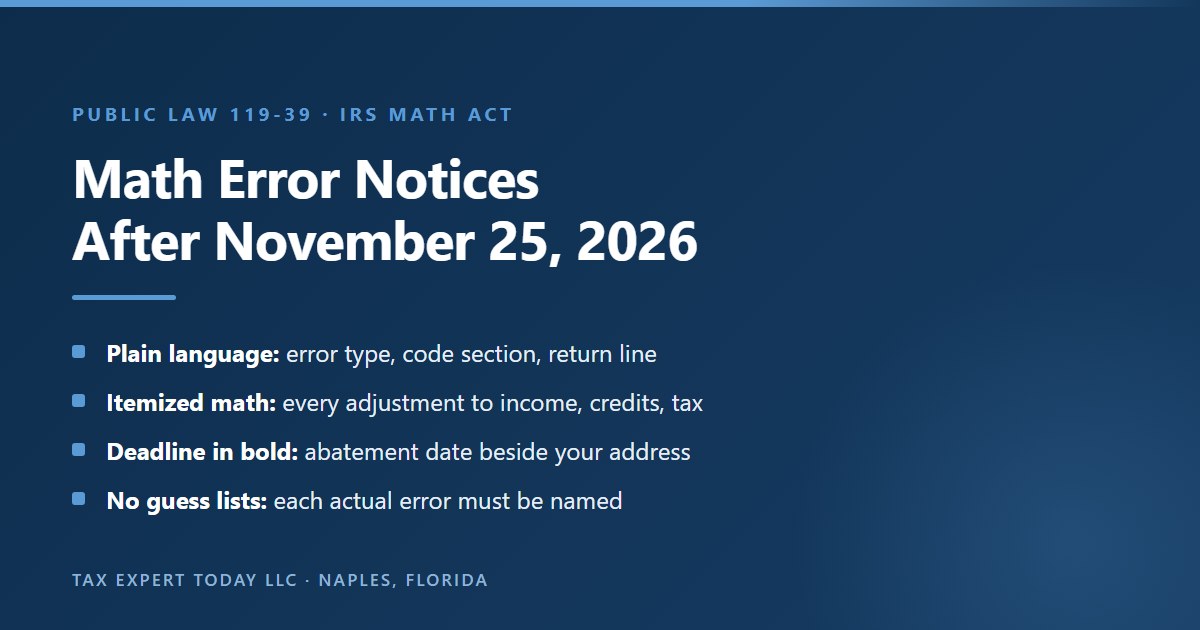
The Internal Revenue Service Math and Taxpayer Help Act, Public Law 119-39, signed November 25, 2025, requires math error notices sent after November 25, 2026 to describe each error in plain language, cite the code section and return line, itemize the adjustments, and print the 60 day abatement date in bold next to your address.
- Specific errors only. A notice listing several possible errors is not specific enough; every actual error must be listed.
- Itemized computation. The notice must show changes to adjusted gross income, taxable income, deductions, credits, total tax, withholding, payments and the refund or amount owed.
- The date up front. The abatement deadline must appear in bold, 14 point type, beside the address on page 1.
- A notice of abatement. New section 6213(b)(2)(C) requires a plain language notice with an itemized computation when the IRS abates.
The new law amends section 6213(b)(1) by adding a subparagraph (B) on the “specificity of math or clerical error notice.” Under the enacted text, each notice must be sent to the taxpayer’s last known address, describe the error including its type, the code section, the nature of the error and the specific line of the return, include an itemized computation of the adjustments, include the telephone number for the automated transcript service, and display the abatement deadline prominently on the first page. Section 2(c) of the act makes these changes apply to notices sent after the date 12 months after enactment, which places the start in late November 2026.
The act also directed Treasury to provide procedures, within 180 days of enactment, for requesting abatement “in writing, electronically, by telephone, or in person,” and to run a pilot within 18 months that sends a sample of math error notices by certified or registered mail and reports the results to Congress. What the act does not change is the 60 day period itself or the mandatory abatement rule. For a CP11 notice dated before the effective date, the older notice format applies, and the 60 day right works exactly as described above. Check the notice date carefully if yours arrives near the end of November 2026.
What is the difference between CP11 and CP12?
Both notices come from the same math error process. A CP11 notice says the correction left you owing a balance. A CP12 notice says the correction changed your refund or created one, so no payment is due. The 60 day abatement right in section 6213(b)(2) applies to the additional tax in either case.
- CP11. Balance due after a math error correction; pay or request abatement.
- CP12. Refund changed after a correction; the IRS says no response is needed if you agree.
- Same disagreement path. Both pages tell recipients to contact the IRS by the date shown if they disagree.
- Same software lesson. Both usually trace to a line on the return that software or a preparer computed differently from the IRS.
The IRS CP12 page says the IRS corrected one or more mistakes and that you are “now either due a refund or your original refund amount has changed.” If you agree, the corrected refund generally follows in four to six weeks unless offset to another debt. A reduced refund is still additional tax compared with your return, so the 60 day request remains available if the correction is wrong. People often ignore a CP12 because no bill is attached, which is the reason the window expires unnoticed.
How does a CP11 notice compare with CP2000, CP22A and a notice of deficiency?
A CP11 notice is an assessment already made for an error on the face of the return. A CP2000 is only a proposal based on third party income reports. A CP22A is a balance due after a change you requested or agreed to. A notice of deficiency is the formal letter that opens the Tax Court door.
| Notice | Source of the change | Assessed yet? | Your key deadline | Tax Court route |
|---|---|---|---|---|
| CP11 | Math or clerical error on the return | Yes | 60 days to request abatement | Only after abatement and a notice of deficiency |
| CP12 | Math error that changed a refund | Yes | 60 days to request abatement | Same as CP11 |
| CP2000 | Income reported by third parties | No, proposed | Response date on the notice | Through a later notice of deficiency |
| CP22A | Change you requested, such as an amended return | Yes | Pay or dispute promptly | Generally waived by agreement |
| Notice of deficiency | Examination or underreporter case | No, determined | 90 days to petition | Direct |
The confusion between these notices costs people real rights. A CP2000 recipient who treats the letter like a CP11 notice and simply pays may give up arguments that a response would have preserved. A CP11 recipient who treats the letter like a CP2000 and waits for a formal notice of deficiency may watch the 60 days expire while the tax is already on the books. The notice number is printed in the upper right corner of the first page. Read it before deciding what kind of response you owe.
A CP11 notice also differs from the routine balance due notice. A CP14 generally bills tax that you yourself reported but did not pay, so there is nothing about the return to dispute. A CP11 notice bills tax the IRS added. That is why the CP11 notice carries a statutory dispute right and the CP14 does not.
What if I cannot pay the CP11 notice balance?
If you agree with the CP11 notice but cannot pay in full, request a payment plan rather than ignoring the bill. Individuals can usually set up a short term plan or an installment agreement online. Interest and the reduced failure to pay penalty continue, but a plan generally keeps the account out of enforced collection.
- Short term plan. Up to 180 days to pay for qualifying balances.
- Installment agreement. Monthly payments through the IRS Online Payment Agreement or Form 9465.
- Penalty rate drops. While an installment agreement is in effect, the failure to pay rate is generally reduced to one quarter of one percent a month for timely filed returns.
- Hardship. If paying would prevent meeting basic living expenses, currently not collectible status or other options may apply.
A CP11 notice is the first bill on the account, so an unpaid balance moves through the same reminder sequence as any other assessed tax. If nothing is paid or arranged, the account generally progresses to the CP501 reminder, the CP503 second reminder, and then the CP504 notice of intent to levy. Setting up a plan early is usually simpler than doing it after a levy notice arrives.
If you dispute part of the CP11 notice and agree with the rest, you can request abatement of the disputed part and arrange payment of the undisputed part at the same time. Keep the two separate in your letter so the IRS does not treat your payment as agreement with the whole change.
What happens if I ignore a CP11 notice?
Ignoring a CP11 notice lets the 60 day abatement right lapse, leaves the added tax assessed, and starts penalties and interest growing. The IRS then sends balance due reminders and, eventually, a notice of intent to levy. It may also keep future refunds and apply them to the balance.
- Rights lapse. After 60 days, the IRS no longer has to reverse the change on request.
- Collection begins. The stay on levy in section 6213(b)(2)(B) ends with the window, and an unpaid balance can eventually lead to a bank levy.
- Refund offsets. Future federal refunds are generally applied to the assessed balance.
- Liens are possible. Larger unpaid balances can lead to a federal tax lien filing, and a later lien withdrawal is a separate process.
A CP11 notice that goes unopened is one of the most avoidable problems in the notice system. The tax involved is often modest, the question is often a single line of the return, and the statute gives the taxpayer an unusually strong remedy if the answer is wrong. The cost of ignoring it comes from losing that remedy and from letting a small balance pick up penalties and interest for months.
CP11 notice help Naples: tax resolution Naples and Southwest Florida
Our office in Naples, Florida works with taxpayers who have received a CP11 notice and need to decide, within the 60 days, whether to agree, pay, or request abatement. The review usually starts with the account transcript and the return as filed, comparing each line the IRS changed against the documents behind it. That comparison shows whether the IRS fixed a genuine arithmetic mistake, whether an identification number problem can be cured with records, or whether the change went beyond math error authority altogether.
Taxpayers searching for CP11 notice help in Naples often ask whether calling the IRS is enough, whether they should send an amended return, and what to do about a balance they agree with but cannot pay. Short answers: a call is a valid request but a confirming letter is a better record, an amended return is generally not the right reply to a math error notice, and a payment plan can be arranged alongside a partial dispute. Our IRS resolution and audit support service and our Naples tax resolution page describe how we handle math error disputes, abatement requests and the examinations or collection steps that can follow them.
Tax Expert Today LLC
11983 Tamiami Trail N, Naples, FL 34110
Phone: (239) 441-2005
Hours: Monday through Friday, 10:00 to 5:00 ET
Where can I get help with an IRS CP11 notice in Naples, FL? CP11 notice responses are handled by phone, fax and mail, so help does not depend on visiting an IRS office. A representative authorized on Form 2848 can review transcripts, make the abatement request under section 6213(b)(2)(A), send substantiation, set up payment of any undisputed balance and follow the case into examination or Appeals if it goes there. Tax Expert Today LLC is located at 11983 Tamiami Trail N in Naples and works with taxpayers in Collier and Lee Counties and nationwide. Because Florida has no personal income tax, a Naples resident with a CP11 notice is dealing with a federal adjustment only.
When to Engage a Professional
Many taxpayers can resolve a CP11 notice on their own, especially when the IRS fixed a simple arithmetic mistake or the dispute turns on one document that is easy to send. Consider engaging a representative when the notice denies a significant credit, when the change involves facts beyond the face of the return, when the 60 day window is close to expiring, when you are unsure whether an unsubstantiated request could open a broader examination, when several years carry the same issue, or when the window has already passed and you need a claim for refund or a collection due process strategy. Those are the situations in which the order of steps and the wording of the request matter most. Dr. Kabashi is an Enrolled Agent authorized to represent taxpayers before the IRS in all 50 states, and every engagement starts from the statute, the regulations and the IRS’s own procedures rather than assumptions about what the IRS will do.
This article is educational and general in nature. It does not constitute tax or legal advice for any particular taxpayer, and outcomes depend on individual facts and circumstances. Notice procedures, penalty rates, interest rates and the effective dates of new legislation are current as of the publication date and are subject to change.
Published October 12, 2026 by Dr. Pellumb Kabashi « Back to Learning Center
Have a question this article touches on?
Tax Expert Today LLC, based in Naples, Florida and serving clients across the United States.
Schedule a Consultation (239) 441-2005