
By Dr. Pellumb Kabashi, DBA, MBA, EA, CFE, CES
Founder, Tax Expert Today LLC · Tax advisors, enrolled agents, CPAs, and attorneys · Serving clients in all 50 states
Quick answer: Tax preparation Bonita Springs households need is mostly federal and former-state work, because Florida has no individual income tax. The local specifics are the Lee and Collier county line on the city’s southern edge, which moves the sales surtax, the transient rental taxes on a seasonal rental, and the residency tests a second home up north can trigger. Call (239) 441-2005 for a free consultation.
What does tax preparation in Bonita Springs actually involve?
Tax preparation in Bonita Springs is mostly federal work plus whatever the taxpayer still owes a former state, because Florida imposes no individual income tax. The city sits in Lee County, borders Collier County on the south, and draws a large seasonal population, so county-line sales tax and multi-state residency questions come up far more often than local filings.
Bonita Springs is the southernmost city in Lee County. It is not split between Lee and Collier, which is a common assumption, and the Lee County Tax Collector runs a Bonita Springs service center on South Tamiami Trail alongside its Cape Coral and South Fort Myers offices. The city’s southern boundary is also the county line, and Naples, in Collier County, begins a short drive south. That geography turns out to matter on several tax questions that have nothing to do with property.
The households that need real help with tax preparation in Bonita Springs tend to share a profile. Many hold a second home somewhere else, many arrived from a state with a high income tax, and many earn income that is large, irregular, or tied to a business or a portfolio rather than a paycheck. For those households the difficult questions are about which state has a claim and when, not about a Florida form.
- No Florida individual return. There is no state income tax return, no Florida withholding, and no local income tax in Lee County or the City of Bonita Springs.
- The federal return is unchanged by residency. Form 1040 follows the same rules in Bonita Springs as it did in Chicago or Boston.
- The former state is where the exposure sits. A part-year return, a nonresident return, or a residency examination is usually the real engagement.
- The county line is a genuine local fact. Sales surtax and transient rental taxes differ a few miles apart, which touches purchases and seasonal rentals.
This guide is the third in our set of Lee County city guides. The Fort Myers tax advisor guide covers the small-business side of the county, including the tangible personal property return and business-level Florida filings, and the Cape Coral tax preparation guide covers the retiree relocation year, the federal bar on a former state taxing pension income, and canal-home rentals. This page does not repeat those. It works the situations that set Bonita Springs apart.
Why does the Lee and Collier county line matter for Bonita Springs taxes?
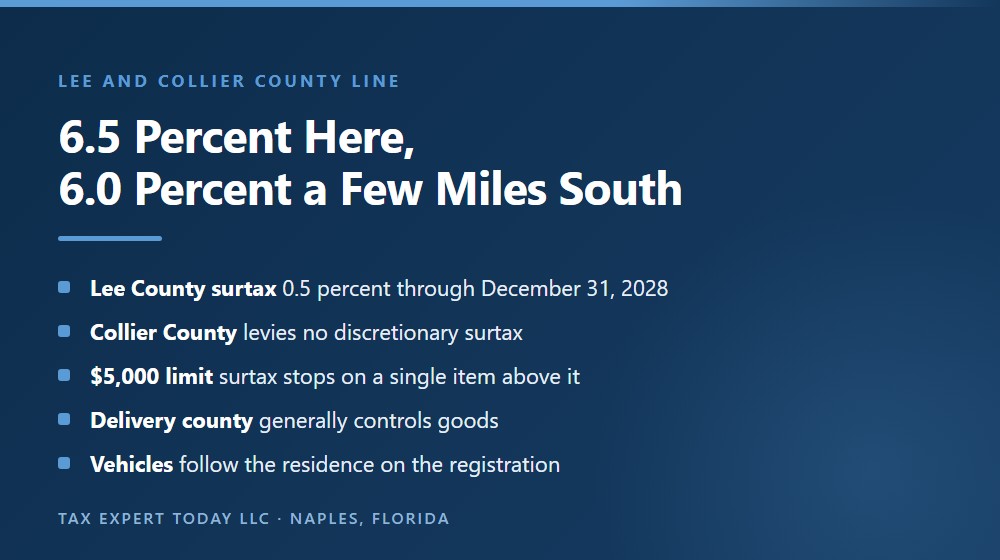
The county line decides the sales surtax. Lee County levies a 0.5 percent discretionary sales surtax through December 31, 2028, so the combined rate in Bonita Springs is 6.5 percent. Collier County levies none, so the rate a few miles south in Naples is 6.0 percent. Where a sale is deemed to occur, not where the buyer lives, usually controls.
The figures come from the Department of Revenue’s calendar year 2026 surtax schedule, which lists Lee at 0.5 percent from January 1, 2019 through December 31, 2028 and lists Collier with no surtax. The difference is half a percent, and for most everyday purchases it is not worth a thought. It becomes relevant on large purchases, on seasonal rentals, and on business purchasing decisions, and the rules that apply are more specific than most people expect.
- The $5,000 single-item limit. Under section 212.054(2)(b), Florida Statutes, the sales amount above $5,000 on any item of tangible personal property is not subject to the surtax, so the county difference on a single large item is capped at $25.
- Delivery generally sets the county. A sale of tangible personal property is deemed to occur in the county where the item is delivered, so furniture bought in Naples and delivered to a Bonita Springs home generally carries the Lee surtax.
- Vehicles follow the buyer’s residence. The sale of a motor vehicle or mobile home is deemed to occur only in the county shown as the purchaser’s residence on the registration or title, regardless of where the dealer sits.
- Transient rentals follow the property. A short-term rental of a Bonita Springs condominium carries the Lee surtax because the rental transaction occurs in Lee County.
| Transaction | County that generally controls | Combined sales tax rate |
|---|---|---|
| Furniture bought in Naples, delivered to a Bonita Springs home | Lee, the delivery county | 6.5 percent, surtax limited to the first $5,000 per item |
| Furniture bought in Bonita Springs, delivered to a Naples home | Collier, the delivery county | 6.0 percent |
| Car bought from a Naples dealer by a Bonita Springs resident | Lee, the residence on the registration | 6.5 percent, surtax limited to the first $5,000 |
| Seasonal rental of a Bonita Springs condominium for three months | Lee, where the rental occurs | 6.5 percent sales tax plus the county tourist development tax |
| Seasonal rental of a Naples condominium for three months | Collier, where the rental occurs | 6.0 percent sales tax plus the county tourist development tax |
The surtax is a sales tax rather than an income tax, and it is collected by the seller, so for most households it never appears on a return. It matters on the return for two groups: a business that makes purchases on which the seller did not collect tax and therefore owes use tax, and an owner who rents a unit for short stays and is therefore the one collecting the tax. Both are covered below.
How are seasonal rentals in Bonita Springs taxed at the state and county level?
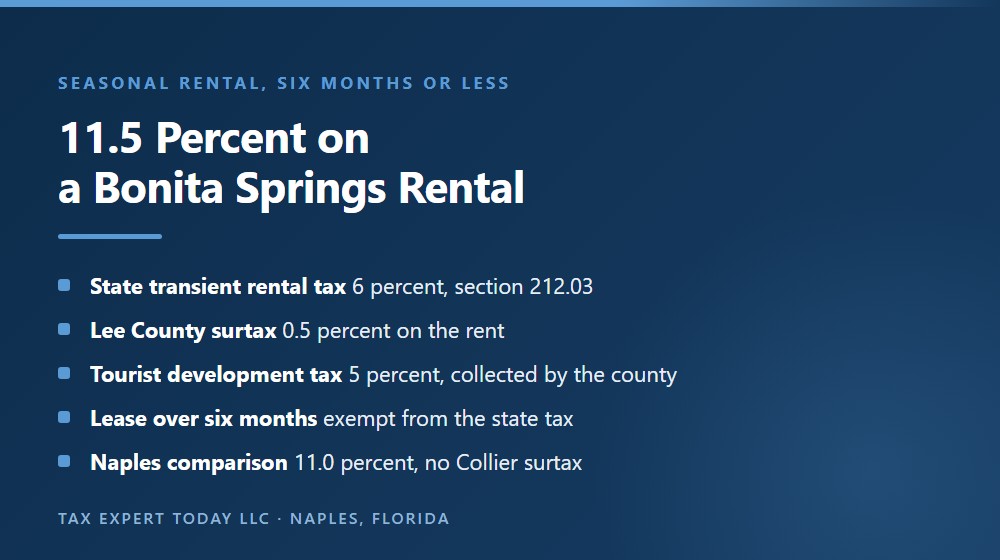
A Bonita Springs unit rented for six months or less carries Florida’s 6 percent transient rental tax under section 212.03, the 0.5 percent Lee County surtax, and Lee County’s 5 percent tourist development tax. The owner or the platform collects and remits these taxes. A bona fide written lease longer than six months is exempt from the state tax.
Bonita Springs has a deep seasonal rental market, from beach condominiums near Bonita Beach to homes inside gated golf communities that are rented for the winter months. The federal side of those rentals, including the personal-use day count under section 280A, is covered in detail in our Cape Coral guide. The state and county side is different, and owners who live elsewhere most of the year often do not realize they have a Florida collection obligation at all.
- The state tax. Section 212.03, Florida Statutes imposes a 6 percent tax on the total rental charged for living or sleeping accommodations, and exempts a person who has entered into a bona fide written lease for longer than six months.
- The county surtax. The 0.5 percent Lee surtax applies on top, because the rental transaction occurs in the county.
- The tourist development tax. The Department of Revenue’s local option transient rental tax schedule (Form DR-15TDT, revision 03/25) lists Lee County at 5.0 percent, collected by the county rather than by the state.
- Registration comes first. An owner who rents directly, rather than entirely through a platform that collects on the owner’s behalf, generally registers with the Florida Department of Revenue for sales tax and with Lee County for the tourist development tax.
| Rental arrangement | State 6 percent tax | Lee 0.5 percent surtax | Lee 5 percent tourist development tax |
|---|---|---|---|
| Weekly or monthly stays during season | Yes | Yes | Yes |
| A single winter lease of four months | Yes | Yes | Yes |
| A bona fide written lease of seven months or more | No, exempt under section 212.03 | No | No, the local tax reaches terms of six months or less |
| Occasional family use with no rent charged | No | No | No |
The combined rate on a short-term Bonita Springs rental is therefore 11.5 percent of the rent, against 11.0 percent on an equivalent Naples rental, where Collier County also levies a 5 percent tourist development tax but no surtax. The half-point difference is the same county line described above. For the federal return, the collected taxes are generally not income to the owner when they are separately stated and remitted, but the rent itself is reported on Schedule E, and IRS Publication 527 governs how expenses are allocated. Our guide to the short-term rental rules covers the separate question of when a short-stay rental can offset other income.
Owners who hand the rental to a management company should confirm in writing who is registered, who files, and whose account number the returns are filed under. A management agreement that assumes the owner handles the taxes, paired with an owner who assumes the manager does, is the most common way a Florida collection gap opens, and it tends to surface only when the county or the state writes to the owner.
Can a Bonita Springs seasonal resident keep a home up north?
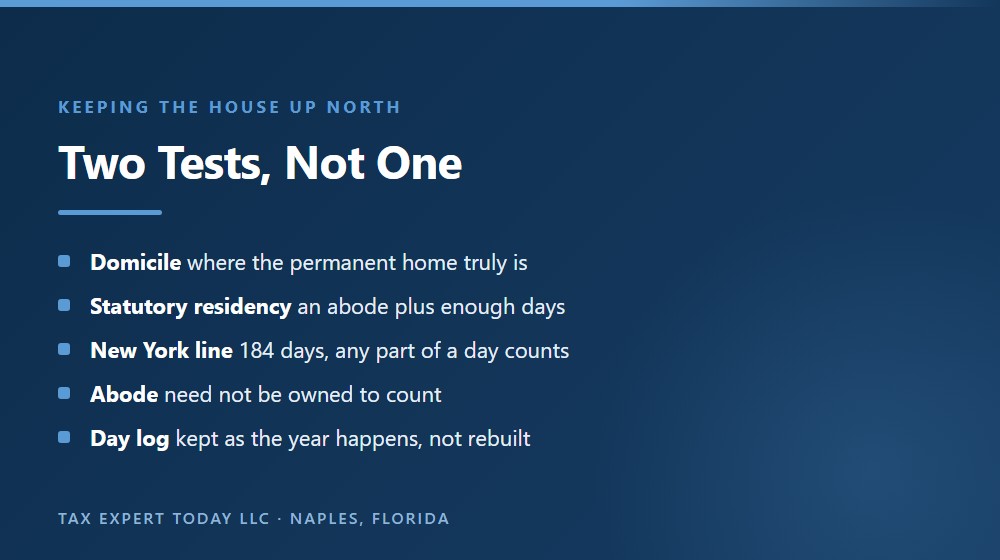
Yes, but keeping it changes the analysis. Several states treat a person as a resident if they keep a permanent place of abode there and spend enough days in the state, even after domicile moves. New York’s test is a place of abode maintained for substantially all of the year plus 184 days in the state.
This is the question that separates Bonita Springs from the other Lee County cities. A large share of Bonita Springs households are not one-home retirees. They are working or recently retired professionals who bought in a gated community, spend the winter and spring in Florida, and keep the house in Westchester, Connecticut, New Jersey, or the Chicago suburbs. Keeping that house is entirely legal. It simply means two separate tests have to be passed, not one.
- Domicile. The first test asks where the taxpayer’s true, permanent home is. Moving domicile to Florida is necessary but not sufficient.
- Statutory residency. The second test ignores domicile and asks whether the taxpayer kept a dwelling in the state and was present for enough days. The New York Department of Taxation and Finance sets the line at 184 days and states that any part of a day counts as a day.
- The abode need not be owned. New York treats a dwelling suitable for year-round use and permanently maintained as a permanent place of abode whether or not the taxpayer owns it.
- Days are proved, not estimated. The taxpayer generally bears the burden of showing the day count, and phone location data, card statements, and toll records are the evidence examiners request.
| Situation for a Bonita Springs resident who keeps a New York home | Domicile test | Statutory residency test | Likely result |
|---|---|---|---|
| Domicile moved to Florida, 150 days in New York | Florida | Not met, under 184 days | Nonresident of New York, taxed only on New York source income |
| Domicile moved to Florida, 190 days in New York | Florida | Met, abode plus 184 days or more | Taxed as a New York resident on worldwide income |
| Domicile never effectively moved, 120 days in New York | New York | Not reached | Taxed as a New York resident on worldwide income |
| Northern home sold, domicile moved, 60 days of visits | Florida | No permanent place of abode | Nonresident, subject to the part-year return in the move year |
The third row is the one that surprises people. A taxpayer who spends most of the year in Bonita Springs can still be a New York domiciliary if the rest of the record points north. Our Florida 183-day rule calculator helps with the day count, our guide to the dual-state residency trap explains how two states can each claim the same person, and the rules differ by state, so the former state’s own test is the one that governs.
What does a former state examine in a Bonita Springs residency audit?
A residency examination looks at where the taxpayer’s life actually is, not at the Florida paperwork alone. New York’s audit practice weighs the taxpayer’s homes, active business ties, time spent in each place, the location of items near and dear, and where close family lives. The day count and the domicile evidence are read together.
New York is the state Bonita Springs arrivals encounter most often in an examination, and its approach is a useful model because other high-tax states work in a similar way. The examination usually begins one to three years after the move, when the first nonresident or part-year return shows a large drop in income reported to the state. Our detailed guide to the New York residency audit covers that process from the first letter.
- Home. The size, value, and use of the Bonita Springs home compared with the home kept up north.
- Active business involvement. Whether the taxpayer still runs or actively manages a business in the former state.
- Time. Where the days were spent, established by records rather than by recollection.
- Items near and dear. Where family heirlooms, art, collections, and pets are kept.
- Family. Where minor children attend school and where a spouse lives.
The Florida side of the record still matters, and section 222.17, Florida Statutes lets a new resident file a sworn declaration of domicile with the clerk of the circuit court, which for Bonita Springs is the Lee County Clerk. A Florida driver license, vehicle registration, and voter registration in Lee County all point the same direction. None of those items decides the case on its own. They are corroboration for the pattern of life the examiner is testing, and a declaration filed while the family, the business, and the art all stayed north carries little weight. Our guides to establishing Florida residency and Florida domicile for executives set out the full checklist.
How should a Bonita Springs arrival time the move around a large gain?
The timing of a large gain relative to the domicile change can decide which state taxes it. Gain on intangible property such as stock is generally taxed by the state of domicile when the sale occurs. Several states apply accrual or sourcing rules that narrow this, so the sequence must be planned rather than assumed.
Bonita Springs draws a meaningful number of business owners and executives who relocate around a liquidity event: the sale of a company, a large block of stock, or a concentrated position being diversified. For those households the move date and the closing date are the two most valuable numbers in the entire plan, and they are frequently set by people who are not thinking about either state’s tax rules.
- Intangible gains generally follow domicile. A sale of publicly traded stock after Florida domicile is established is generally outside the former state’s reach.
- Real property gains follow the property. A sale of a building or a home in the former state is taxed there regardless of where the seller lives.
- Accrual rules can pull income back. Some states require a part-year resident to accrue items that had become fixed before the move, which can capture a sale agreed before the move and closed after it.
- Business sales can be sourced. Gain on the sale of an active business, or on assets inside a pass-through entity, can be sourced to the state where the business operates.
- Installment payments need their own review. Payments received after the move on a sale made before it are often still taxed by the former state.
| Type of gain or income | Sold or received before Florida domicile | Sold or received after Florida domicile |
|---|---|---|
| Publicly traded stock or mutual funds | Generally taxed by the former state | Generally not taxed by the former state |
| Home or rental building in the former state | Taxed by the former state | Still taxed by the former state as source income |
| Interest in a business operating in the former state | Taxed by the former state | Often still taxed there, depending on the state’s sourcing rules |
| Deferred bonus for work performed in the former state | Taxed by the former state | Often still taxed there, because it follows where the work was done |
| Qualified pension and IRA distributions | Taxed by the former state as a resident | Protected by 4 U.S.C. 114, covered in our Cape Coral guide |
The practical sequence for a planned sale is usually to establish Florida domicile fully, with the record described above, before the transaction is agreed, rather than before it closes. Our guide to moving to Florida before selling a business walks through that sequence in detail, and 4 U.S.C. § 114 is the federal rule that protects qualified retirement income after the move. The federal tax on the gain does not change with the move date. Only the state layer does, which is why the question is one of sequence rather than of amount.
Does a Bonita Springs resident with a northern home face estate tax exposure?
Florida has no estate tax and no inheritance tax, so a Florida domiciliary owes Florida nothing at death. Real property kept in a state with an estate tax can still create a filing there. New York requires a nonresident estate to file if it holds New York real or tangible property and exceeds the basic exclusion amount.
This question usually arrives late, often after the first Florida years are settled and the family begins estate planning. It deserves attention earlier, because the northern home that keeps the family connected to the old community is also the asset that keeps the old state in the estate plan.
- The federal exclusion is high. The IRS lists the federal basic exclusion amount at $15,000,000 for calendar year 2026, under 26 U.S.C. § 2010.
- State exclusions are often lower. A state estate tax can apply to an estate that owes no federal estate tax at all.
- Nonresident filing is triggered by property. The New York estate tax guidance requires a nonresident estate to file where it includes real or tangible property located in New York and the federal gross estate plus includible gifts exceeds the basic exclusion amount.
- Inheritance taxes work differently. A state such as New Jersey taxes the transfer to certain beneficiaries rather than the estate itself, a distinction covered in our guide to the New Jersey inheritance tax for nonresidents.
How the northern home is titled, and whether it is held directly or through an entity or trust, changes how the former state views it, and that is a planning decision to make with an estate attorney. Our guide to Florida estate planning for new residents covers the Florida side of the documents, and the domicile record described above is equally relevant here, because a state that successfully claims the decedent as a domiciliary taxes the whole estate rather than only the property located in the state.
How does the first full Florida year change a Bonita Springs household’s federal return?
The federal rules stay the same, but the inputs change. State income tax paid falls away after the move year, which can move a household from itemizing to the standard deduction. Estimated tax needs a fresh look, since the prior-year safe harbor for higher-income households is 110 percent of the prior year’s tax rather than 100 percent.
The first full Florida year is often the first year in a long time that a high-earning household has no state income tax to deduct. That is a welcome change, but it moves several parts of the federal return at once, and the household that files the first Florida return on autopilot tends to find a surprise in one of them.
- Itemizing may stop paying. With state income tax gone, the remaining itemized deductions may fall below the standard deduction, which changes the value of timing charitable gifts.
- The safe harbor rises with income. Under 26 U.S.C. § 6654(d)(1)(C), a taxpayer whose prior-year adjusted gross income exceeded $150,000 generally meets the prior-year safe harbor only by paying 110 percent of the prior year’s tax.
- Withholding stops splitting. Combined federal and state withholding on a pension or a paycheck becomes federal only, and the federal amount alone may not cover the year.
- The move year is a hybrid. It carries a partial state deduction and a part-year state return, so it rarely serves as a good model for the year after.
A mid-year estimate using IRS Publication 505 and Form 1040-ES prevents an avoidable underpayment penalty in the first Florida filing season. Our quarterly estimated tax calculator is a reasonable starting point, and a household with irregular income from a sale, a bonus, or a fund distribution should plan the timing of each payment rather than divide the year into four equal pieces.
What should a Bonita Springs business owner expect from the former state?
A business owner who moves to Bonita Springs but keeps a business operating in the former state generally still files there as a nonresident. Income from a pass-through entity is sourced to the states where the business operates, so the owner’s share of profit earned in the former state remains taxable there after the move.
The move changes the owner’s residence, but it does not move the business. An S corporation or partnership that keeps its operations, employees, and customers in the former state continues to generate income sourced to that state, and the owner’s distributive share of that income is reported on a nonresident return there. Florida does not tax it, so there is no Florida credit to claim, and the result is a single layer of state tax paid to the state where the business earns its money.
- Nonresident returns continue. The owner’s share of in-state business income is reported on the former state’s nonresident return each year.
- Composite returns and withholding. Many states let or require the entity to file a composite return or withhold on nonresident owners, which can replace an individual return.
- Pass-through entity tax elections. An entity-level election in the former state can still be available, and whether it helps a Florida owner turns on how the federal deduction and the state credit interact for a nonresident.
- Wages follow the work. Compensation for work performed in the former state is taxed there, which is a reason to document where the owner actually works after the move.
The owner who stays actively involved in a business in the former state also hands the examiner one of the residency factors described above. That does not make the move ineffective, but it does mean the rest of the record has to be stronger. Our guide to nonresident state tax returns covers the filing mechanics, and the convenience of the employer rule applies to remote employees of a handful of states and can tax wages as though the work were still done in the employer’s office.
Which Lee County filings reach a Bonita Springs household?
A Bonita Springs household with only wage, retirement, or investment income generally has no county filing at all. A business, a rental operation, or a self-employed professional may owe the DR-405 tangible personal property return, and an owner renting for short stays collects the sales, surtax, and tourist development taxes described above.
These are shared Lee County facts, and the small-business side of them is worked in depth in our Fort Myers guide. For tax preparation Bonita Springs filers need, they are usually a short checklist rather than the substance of the engagement.
| Item | Who it reaches | Timing and figure |
|---|---|---|
| Lee County discretionary sales surtax | Buyers of taxable goods and services in the county | 0.5 percent through December 31, 2028, limited to the first $5,000 of a single item |
| Transient rental taxes | Owners renting a unit for six months or less | 6 percent state, 0.5 percent surtax, and 5 percent county tourist development tax |
| Form DR-405, tangible personal property | Businesses, furnished rentals, and self-employed professionals with tangible assets in the county on January 1 | Due April 1; exemption of up to $25,000 of assessed value |
| Homestead exemption filing | Owner-occupants of a permanent Florida residence | Relevant here only as domicile evidence for the residency analysis above |
| Storm and casualty losses | Owners with damage from a declared disaster | Worked in our Fort Myers and Cape Coral guides |
The tangible personal property row matters more in Bonita Springs than people expect, because a furnished seasonal rental holds furniture and appliances that the county treats as tangible personal property. The Department of Revenue guidance confirms the April 1 due date and the exemption of up to $25,000 of assessed value, and the Lee County Property Appraiser administers the filing. On casualty losses, the 2026 change under Public Law 119-21, which extends the personal casualty loss deduction to state-declared disasters, is explained on the IRS casualty loss page. As of the date of this article the most recent Florida entries on the IRS disaster relief list postponed deadlines to May 1, 2025, and there is no open Florida filing postponement.
What records should a Bonita Springs seasonal resident keep?
The record set for a two-home household has to prove three things: where the domicile is, how many days were spent in each state, and what the Florida and northern properties were used for. Kept during the year it is manageable. Reconstructed during an examination two years later it is often incomplete, and gaps are usually read against the taxpayer.
- A contemporaneous day log for every year the northern home is kept, supported by phone location history, card statements, and travel records.
- The dated declaration of domicile filed with the Lee County Clerk, with the Florida driver license, vehicle registration, and Lee County voter registration.
- Evidence of where life moved, including physicians, advisors, clubs, houses of worship, and the location of items near and dear.
- Transaction timelines for any large sale, showing when terms were agreed, when the contract was signed, and when it closed.
- Rental records for a seasonal unit, including the rental calendar, the sales and tourist development tax filings, and the management agreement.
- Title documents for the northern property and any entity or trust that holds it.
None of these records is difficult to keep, and none of them requires a professional to collect. The work is deciding in January which records next year’s filings, and a possible examination after that, will need. Most of the difficulty in tax preparation for a Bonita Springs seasonal household is a documentation problem that looks like a technical one.
When does a Bonita Springs tax question become a resolution matter?
It becomes a resolution matter when a notice arrives or a balance is assessed rather than merely computed. A former state questioning a residency change, an IRS notice on an estimated tax penalty or a reported gain, or a letter about uncollected transient rental taxes all move the work from preparation into representation.
- A departure-state residency examination, which asks for the day log, the domicile evidence, and the transaction timeline.
- A proposed adjustment to a gain, usually over basis, holding period, or which year the sale belongs to.
- A Florida or county inquiry into rental taxes, where a unit was rented without registration or the manager and owner each assumed the other was filing.
- Unfiled nonresident returns, where a business owner assumed the move ended every filing in the former state.
These are ordinary matters and they are workable, but they are answered with documentation rather than with argument. Where a Bonita Springs matter has already reached the notice stage, our Naples tax resolution practice and our IRS resolution and audit support service handle that side of the work.
Tax preparation Bonita Springs FL from Tax Expert Today
Households looking for tax preparation Bonita Springs residents can rely on reach us at an office in Naples, Florida, a short drive south across the county line on Tamiami Trail. We serve Bonita Springs and the rest of Lee County in person as well as remotely, and our team includes tax advisors, enrolled agents, CPAs, and attorneys.
Searches such as tax preparation Bonita Springs FL and tax preparer Lee County tend to come from three situations. One is a household in its first Florida filing season, still holding a W-2 or a brokerage statement from a state it has left. Another is a seasonal resident who kept the house up north and has received, or expects, a residency questionnaire. The third is an owner who began renting a Bonita Springs unit for the season and has discovered that Florida expects the owner to collect tax on the rent. All three are routine engagements, and all three go better before April than during it.
Tax Expert Today LLC, 11983 Tamiami Trail N, Naples, FL 34110. Telephone (239) 441-2005. Office hours Monday through Friday, 10:00 to 5:00 Eastern time. Our Naples tax planning practice covers the residency, timing, and rental planning described above, and our Florida tax services page sets out the full range of work we handle across the state. For the wider picture of households relocating to this coast, our article on Florida wealth migration is a useful companion.
Is the Naples office convenient for a Bonita Springs client?
Yes. The office on Tamiami Trail North in Naples, Florida is a short drive south of Bonita Springs, and many Lee County clients meet with us there. Most of the work can also be handled through a secure document portal with scheduled calls, so seasonal residents who are up north for the summer can keep the engagement moving without a visit.
When should you bring in a professional?
A Bonita Springs household with one home, wage or retirement income, and no rental activity has a return most people can handle themselves. Florida’s absence of an income tax genuinely simplifies a settled household’s filing, and it would not be honest to suggest otherwise.
The situations that reward professional attention are the ones where a decision has to be made rather than a form completed. A northern home kept alongside the Florida one, with a day count that could land on either side of a statutory line. A business sale or a large stock sale whose closing date sits near the move date. A seasonal rental with no clear answer on who is collecting the Florida and county taxes. A business still operating in the former state. An estate plan that still treats the northern property as though the family never left. In each of these, the outcome is set by analysis done before the filing rather than by the filing itself.
If any of those describe your year, a conversation about tax preparation in Bonita Springs is worth having early. Call (239) 441-2005 to arrange a consultation, and bring the prior year returns for both states along with whatever records exist for the item in question.
Published September 18, 2026 by Dr. Pellumb Kabashi « Back to Learning Center
Have a question this article touches on?
Tax Expert Today LLC, based in Naples, Florida and serving clients across the United States.
Schedule a Consultation (239) 441-2005