
By Dr. Pellumb Kabashi, DBA, MBA, EA, CFE, CES
Founder, Tax Expert Today LLC · Tax advisors, enrolled agents, CPAs, and attorneys · Serving clients in all 50 states
Quick Answer: An IRS CP49 notice tells you the IRS used all or part of your refund to pay a federal tax balance you owe for another year or account. Section 6402(a) of the Internal Revenue Code allows that credit without your consent. Any refund left over is generally mailed within about 3 weeks, and you call the number on the notice if you disagree. A spouse who does not owe the debt may file Form 8379. Call (239) 441-2005 for a free consultation.
What is an IRS CP49 notice?
An IRS CP49 notice is the letter the IRS sends after it applies all or part of your tax refund to a federal tax debt you already owe, usually for an earlier tax year. It tells you how much of the refund was applied, which tax year or account received the money, and whether any refund or any balance remains.
- It is a notice of action already taken. The refund has been applied before the letter is printed.
- It concerns federal tax only. Child support, student loans, and state debts are handled through a different program and a different notice.
- It is not a bill by itself. If a balance remains, the regular balance due notices continue.
- It often needs no reply. If the debt is yours and the math is right, the notice is informational.
The IRS describes the notice in one line on its CP49 page: the agency used all or part of your refund to pay a tax debt. The code appears in the upper right corner of the letter, and IRS systems sometimes refer to it as CP 0049. Account transcripts can show a related line such as a transaction code 971 with a notice issued entry, which is why some people search for “971 notice issued CP 0049” after looking at their online account.
For most people the IRS CP49 notice is a surprise because it arrives in place of a refund they were counting on. A taxpayer files a return in the spring, sees an expected refund, and then receives a letter explaining that the money went to a 2021 or 2022 balance they had forgotten, a balance from an audit or a CP2000 adjustment, or an old joint return liability. Understanding why the IRS can do this, what the letter is really saying, and which situations allow a reversal is the purpose of this guide.
Why did the IRS apply my refund to a prior tax balance?
The IRS applied your refund because section 6402(a) of the Internal Revenue Code allows it to credit any overpayment, including interest, against any federal tax liability you owe, and to refund only the balance. No court order, prior warning, or consent is required, and the credit must be made within the applicable period of limitations.
- The statute: IRC §6402(a) lets the Secretary credit an overpayment against “any liability in respect of an internal revenue tax.”
- The liability must be yours. The debt must be on the part of the person who made the overpayment.
- The scope is broad. Income tax, assessed penalties, interest, and civil penalties assessed against you all qualify.
- The timing is automatic. The offset is computer generated when the return posts and a balance due module exists.
The word “overpayment” matters. When your withholding, estimated payments, and refundable credits exceed the tax on your return, the difference is an overpayment. Section 6402(a) does not treat that overpayment as money that already belongs to you in cash. It treats it as a credit that the IRS first measures against everything you owe in federal tax. Only what survives that step becomes a refund. That is why the IRS can apply a 2025 refund to a 2022 balance without a levy, without a collection due process hearing, and without a separate notice beforehand.
The Internal Revenue Manual describes the mechanism the same way. IRM 21.4.6 explains that under section 6402(a) the IRS may apply a taxpayer’s overpayment, including interest, to any outstanding federal tax debt and shall refund the remaining balance subject to the other offset subsections. When that happens on an individual account, the IRM calls it a tax offset, and IRS Publication 594 lists “applying your subsequent tax year refunds to tax due (until paid in full)” as one of the first collection steps after the bills go unpaid.
This authority is separate from the IRS levy power. A levy under section 6331 requires notice and, in most cases, the right to a collection due process hearing first. A refund offset under section 6402(a) does not, because the IRS is not seizing property from you; it is crediting its own payment obligation against your debt. That is the single most misunderstood point about the IRS CP49 notice, and it is why a CP49 can arrive even when the IRS has not yet sent a final notice of intent to levy.
What does an IRS CP49 notice show, and how do you read it?
An IRS CP49 notice shows the overpayment on the return you filed, the amount applied to each balance and the tax year or form it was applied to, any remaining refund, and any balance still owed after the credit. Reading it alongside your account transcript shows exactly which module received the money.
- Original overpayment: the refund figure from your return, as the IRS processed it.
- Amount applied: how much was moved, and to which year and form.
- Remaining refund: any amount that will still be paid to you.
- Remaining balance: anything still owed on the debt that received the credit.
The table below lists what to look for on the IRS CP49 notice and the matching entries that usually appear on an IRS account transcript. Transaction codes come from IRM 21.4.6.4.1, which identifies TC 820 as a manual credit transfer, TC 826 as a computer generated tax offset, and TC 896 as a computer generated offset from an individual account to a business, IRA, or shared responsibility module.
| What the IRS CP49 notice shows | Where it appears on your transcript | What to check |
|---|---|---|
| Refund or overpayment from the return you filed | The return line (TC 150) and credits on the refund year | Does the overpayment match your return? If not, the IRS may also have adjusted the return, which usually brings a separate notice. |
| Amount applied to another year or form | TC 826 or TC 820 on the refund year; TC 706 (credit transferred in) on the receiving year | Is the receiving year one you actually owe? Is it your own liability, a joint liability, or a business or penalty account? |
| Amount applied to a business or civil penalty account | TC 896 without an agency code | Is the receiving account a penalty assessed against you personally, such as a trust fund recovery penalty? |
| Remaining refund to be issued | TC 846 refund issued, generally for the remaining amount | Allow about 3 weeks, and watch for any separate Treasury Offset Program notice. |
| Balance still owed after the credit | Remaining balance on the receiving module | Is a payment plan already in place? If not, plan for the regular balance due notices that follow. |
An account transcript is the fastest way to confirm what the notice says. You can pull one through the IRS Get Transcript service or your IRS online account. Look at the refund year first, find the offset line and its date, then open the receiving year and confirm that a matching credit posted on the same date. If the two figures match and the receiving year is a balance you recognize, the IRS CP49 notice is usually correct. If the receiving year surprises you, that is the year to research before doing anything else.
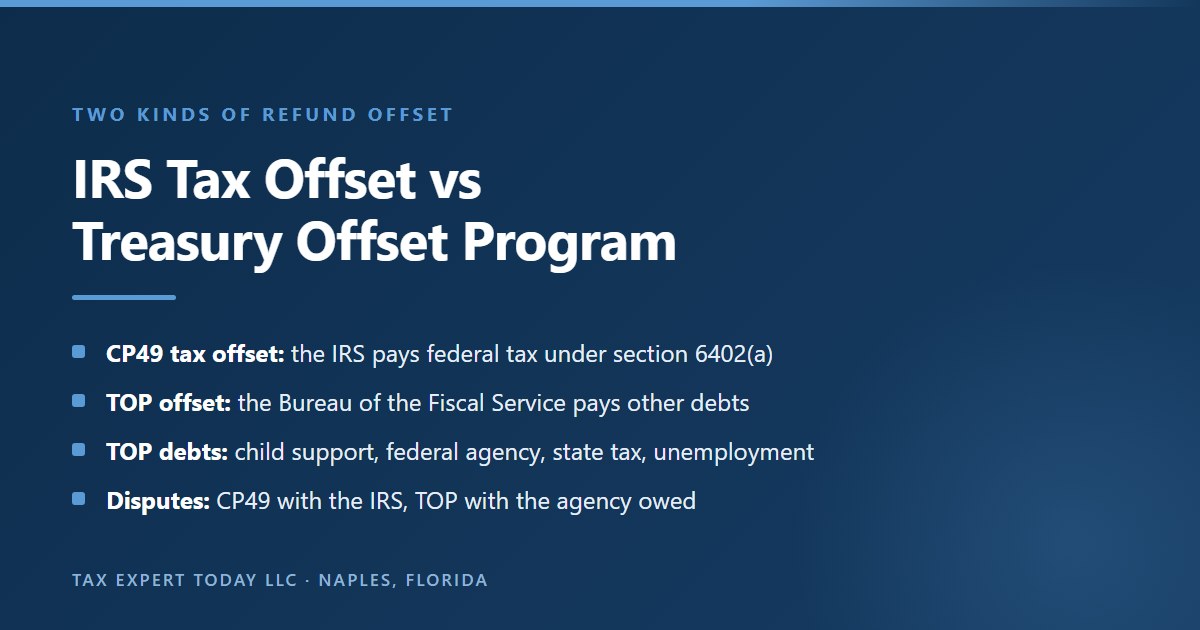
How is a CP49 tax offset different from a Treasury Offset Program offset?
A CP49 tax offset is made by the IRS to pay a federal tax debt, while a Treasury Offset Program offset is made later by the Bureau of the Fiscal Service to pay child support, a federal agency debt such as a student loan, a state income tax debt, or a state unemployment debt. They come with different notices, different contacts, and different dispute routes.
- Who acts: the IRS for a tax offset; the Bureau of the Fiscal Service for a TOP offset.
- What it pays: federal tax for a tax offset; non-tax and state debts for a TOP offset.
- Which notice: the IRS CP49 notice for a tax offset; a Bureau of the Fiscal Service offset notice for TOP.
- Whom to call: the IRS number on the CP49 for a tax offset; the agency owed the debt for TOP.
This is the distinction almost every page on the IRS CP49 notice blurs, and it changes what you should do next. IRS Topic No. 203 explains that debt offsets for past-due child support, federal agency non-tax debts, state income tax obligations, and certain state unemployment compensation debts are conducted by the Department of the Treasury’s Bureau of the Fiscal Service, which runs the Treasury Offset Program. The IRM adds the sequence: TOP offsets happen after the IRS has certified a refund for payment, but before the Bureau of the Fiscal Service issues it. So a single refund can be reduced twice, first by the IRS for federal tax and then by the Bureau of the Fiscal Service for other debts, and each step produces its own notice.
| Feature | IRS tax offset (CP49) | Treasury Offset Program offset |
|---|---|---|
| Legal authority | IRC §6402(a) | IRC §6402(c), (d), (e), and (f), administered through 31 U.S.C. 3720A |
| Debts paid | Federal income tax, penalties, interest, and other federal tax liabilities | Past-due child support, federal agency non-tax debts, state income tax, state unemployment compensation debts |
| Who makes the offset | IRS, before the refund is certified | Bureau of the Fiscal Service, after certification and before payment |
| Notice you receive | IRS CP49 notice | Notice from the Bureau of the Fiscal Service naming the agency that received the money |
| Transcript code | TC 826, TC 820, or TC 896 | TC 898 or TC 971 AC 598 with an offset trace number |
| Where to dispute | IRS, at the number on the notice | The agency that is owed the debt; Topic 203 lists the TOP line at 800-304-3107 |
| Hardship bypass | Possible in limited cases through an Offset Bypass Refund | Only the agency owed the debt can grant hardship relief |
| Court review | Refund suit rules apply to tax matters | Section 6402(g) bars suits against the United States to restrain or review the reduction; action runs against the agency |
Two practical consequences follow. First, if your refund was reduced and you did not receive an IRS CP49 notice, the reduction may have been a TOP offset. Topic 203 says the details of a TOP offset are not provided to the IRS and that you should contact the IRS only if the refund amount on the Bureau of the Fiscal Service notice differs from the refund on your return. Second, if you received both an IRS CP49 notice and a Bureau of the Fiscal Service notice, the IRS applied part of the refund to federal tax and the Bureau of the Fiscal Service took part of what remained for another debt. Each piece is disputed with a different office, and the IRS cannot reverse the TOP piece on the merits.
Section 6402(g) is blunt about that second point. No court of the United States has jurisdiction to restrain or review a reduction under subsections (c), (d), (e), or (f), and no such reduction is subject to administrative review by the Secretary. The statute preserves actions against the federal agency or state that received the money. In plain terms, if a student loan agency took part of your refund, your argument is with the agency, not with the IRS.
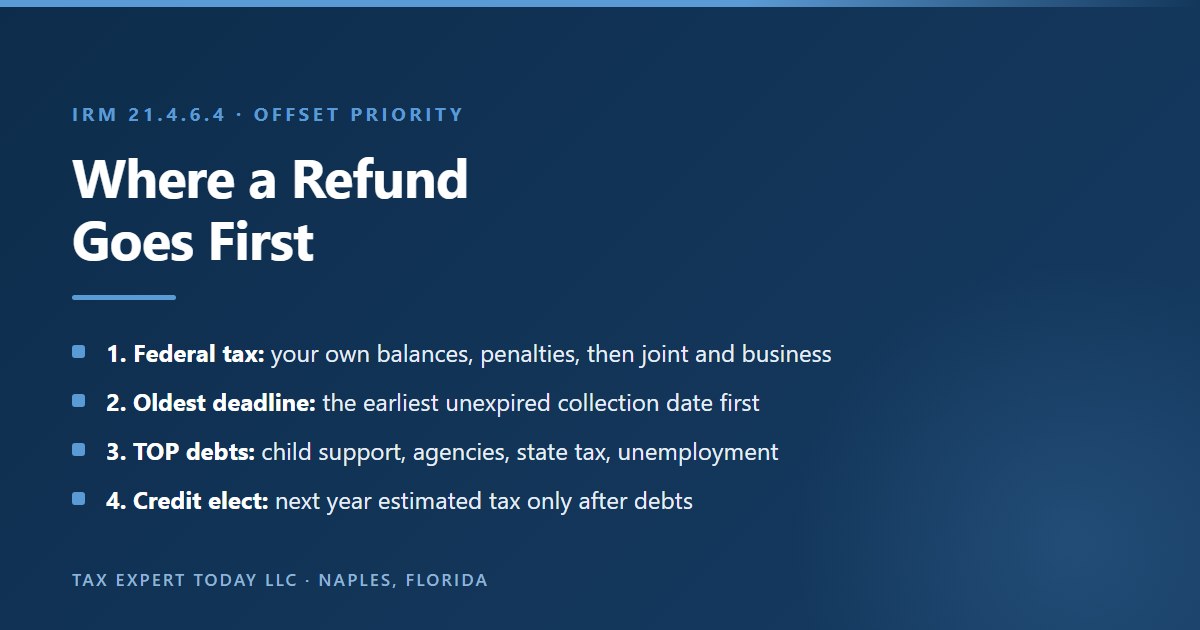
In what order does the IRS apply a refund to debts?
A federal tax overpayment is applied to federal tax debts first, then to Treasury Offset Program debts, and only then to a credit elect for next year’s estimated tax. Within federal tax, the IRM sets a priority list that starts with the primary taxpayer’s individual tax and moves through penalties, the spouse’s tax, business accounts, and non-master file accounts.
- Federal tax first: IRM 21.4.6.4 states that a tax overpayment must offset to an outstanding federal tax debt before it offsets against other debts.
- Then TOP debts: child support, federal agency debts, state income tax, unemployment compensation.
- Credit elect last: an amount you asked to apply to next year is honored only after debts are paid.
- Oldest collection deadline first: within certain account types, the IRM directs the offset to the earliest unexpired collection statute date.
The Internal Revenue Manual lists the federal tax priorities in order. The table below follows IRM 21.4.6.4 and the statutory order in section 6402(c) through (f).
| Order | Debt type | Who applies it | Notice |
|---|---|---|---|
| 1 | Federal tax of the primary taxpayer (individual income tax) | IRS | IRS CP49 notice |
| 2 | Additional tax on IRAs and retirement plans reported on Form 5329 | IRS | IRS CP49 notice |
| 3 | Shared responsibility payment | IRS | IRS CP49 notice |
| 4 | Civil penalty assessed against you | IRS | IRS CP49 notice |
| 5 | Federal tax of the secondary taxpayer on a joint return | IRS | IRS CP49 notice |
| 6 | Business master file tax | IRS | IRS CP49 notice |
| 7 | Non-master file tax | IRS | IRS CP49 notice |
| 8 | Treasury Offset Program debts: child support, then federal agencies, then state income tax, then unemployment compensation | Bureau of the Fiscal Service | Bureau of the Fiscal Service offset notice |
| 9 | Credit elect to next year’s estimated tax | IRS | Shown on the return account |
The note under that list deserves attention. The IRM states that the collection statute expiration date must be considered in all cases and that the overpayment will offset to the earliest unexpired imminent collection statute date for certain individual, shared responsibility, and civil penalty modules. In practice, if you owe several years, the IRS generally applies the refund to the year whose ten year collection window is closest to expiring. That ordering protects the government’s ability to collect, and it also explains why a CP49 sometimes applies a refund to an older year rather than the year you expected.
Within the Treasury Offset Program, section 6402(d)(2) adds that when more than one federal agency debt is owed, the overpayment is applied in the order the debts accrued. The IRM notes that the Bureau of the Fiscal Service reduces the offset against the oldest certified debt first. Those rules are why two people with the same refund and the same debts on paper can see slightly different results.
What should you do after you receive an IRS CP49 notice?
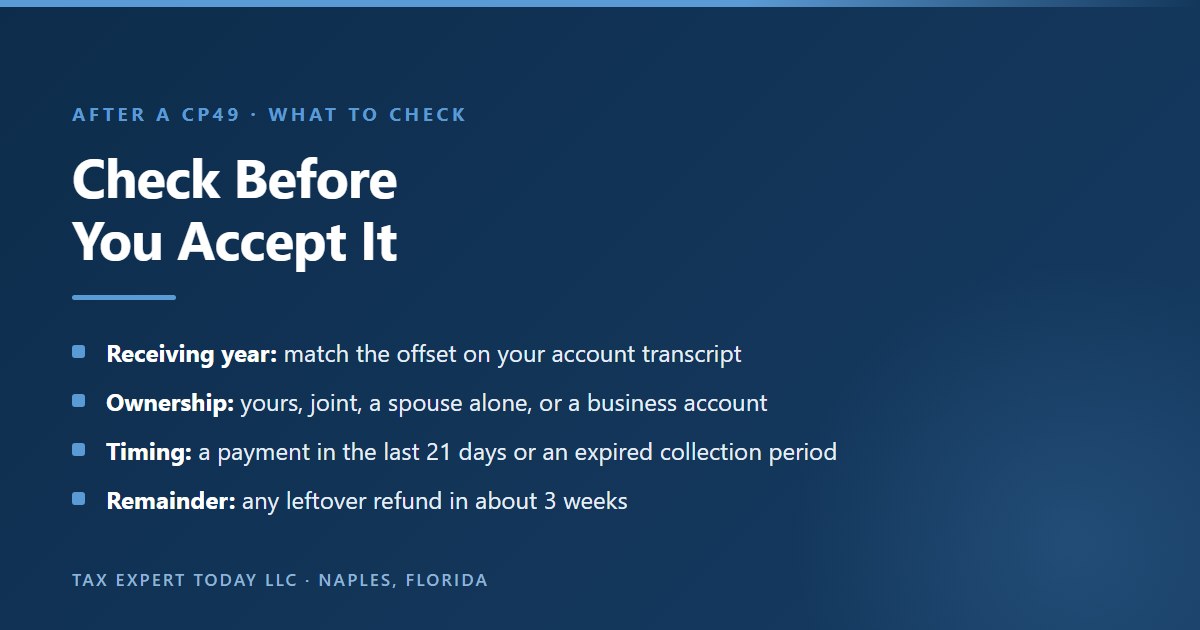
After you receive an IRS CP49 notice, confirm which year received the money, check that the debt is yours and still collectible, decide whether a spouse should file Form 8379, and then deal with any remaining balance through payment, a payment plan, or another resolution option. If everything checks out, no reply to the notice is required.
- Read the notice line by line. Write down the refund year, the amount applied, and each receiving year.
- Pull your account transcript. Match the offset on the refund year with the credit on the receiving year.
- Test the debt. Confirm it is your liability, that it is not already paid, and that the collection period has not run.
- Handle the remainder. Watch for any leftover refund, and plan for any leftover balance.
The IRS page lists only a few actions: pay online if you still owe, keep making payments if you already have a payment plan for that tax year, apply for a payment plan or consider an offer if you cannot pay, and call the number on the notice if you disagree. Those are the right starting points, but each one has a condition behind it. The step by step order below is how a representative typically works an IRS CP49 notice from the moment it arrives.
| Step | What to do | Why it matters |
|---|---|---|
| 1. Identify the receiving years | List every tax year and form the notice names | Each receiving year is a separate debt with its own history, assessment date, and collection deadline |
| 2. Confirm ownership | Check whether each debt is yours, joint, your spouse’s alone, or a business or penalty account | A spouse who does not owe may qualify for injured spouse relief; a joint debt from a prior marriage has special reversal rules |
| 3. Check for recent payments | Compare the notice date with any payment you made in the last 21 days | The IRS says it will refund a resulting credit if you owe nothing else |
| 4. Check the collection deadline | Estimate the ten year collection statute date for each receiving year | Amounts collected after the period of limitation are overpayments under section 6401(a) |
| 5. Check for a pending adjustment | Look for an open amended return, audit reconsideration, or abatement request on the receiving year | If the underlying assessment later drops, the credit can create a refund on that year |
| 6. Plan for the remainder | Expect any leftover refund in about 3 weeks; address any leftover balance | The normal balance due notices continue on any unpaid amount |
Keep the notice and your transcript together. If a question comes up months later, for example when a spouse files Form 8379 or when an amended return changes the receiving year, the notice date and the offset date are the reference points the IRS will use.
What if you already paid the balance in the last 21 days?
If you paid the full balance for the tax period within the 21 days before the IRS CP49 notice and your account now shows a credit, the IRS says it will refund that credit as long as you owe no other taxes and have no other debts it is required to collect. Verify the account and call the number on the notice if the credit does not appear.
- Timing overlap is common. A payment and an offset can post close together, so the debt is paid twice.
- The duplicate becomes a credit. The extra amount sits on the receiving year as an overpayment.
- The credit is refundable. It is refunded if nothing else is owed, including TOP debts.
- Proof helps. Keep the bank record or the payment confirmation number.
This rule comes straight from the IRS CP49 FAQ, and it covers a frequent situation. Many people pay a balance after a CP14 notice arrives, file the next year’s return a few weeks later, and then see the refund applied to a year they believe they already paid. When the payment and the offset cross in processing, the account ends up overpaid. The IRS position is that the resulting credit will be refunded unless another tax or a debt it must collect exists.
The last condition matters. If you owe another year, the credit can be offset again, and you may receive a second IRS CP49 notice for the new application. If you have a TOP debt, the Bureau of the Fiscal Service can take the refund of the credit when it issues. Before calling, confirm on your transcript that the payment posted to the right year. If a payment you made for one year posted to another, the issue may be a misapplied payment rather than an offset, which is the situation covered in our CP60 notice guide.
What if you already have an installment agreement?
If you already have an installment agreement, the IRS still applies refunds to the balance, and you should keep making every scheduled payment. The IRS payment plan page states that future refunds will be applied to your tax debt until it is paid in full, and the CP49 page says to continue your payments if a plan exists for that tax year.
- A refund is not a skipped payment. The offset reduces the balance but does not replace the monthly installment.
- Missing a payment can default the plan. Default can lead to termination and renewed collection.
- The balance drops faster. An offset can shorten the plan or reduce the final payment.
- Disregard is allowed. If an arrangement already exists for the unpaid balance, the IRS says to disregard the notice.
The IRS payment plans page is explicit: “Your future refunds will be applied to your tax debt until it is paid in full,” and “Make all scheduled payments even if we apply your refund to your account balance.” That is the single most important line for anyone on a plan who receives an IRS CP49 notice. People sometimes read the refund offset as a large payment and assume they can skip the next installment or two. An installment agreement does not work that way. The monthly payment stays due on its schedule, and the offset simply reduces the amount the plan still has to cover.
The same page lists “Avoid offset of your future refunds” as a benefit of paying in full, which is a fair summary of the trade off. A payment plan stops most enforced collection, but it does not stop refund offsets. If you are choosing between plan types, our guide to IRS installment agreement options on Form 9465 explains the simple, streamlined, and partial pay structures, the other agreement types, and what each one requires. If a refund offset leaves your plan paid in full or nearly so, the transcript is the place to confirm the final payoff before you stop the automatic payments.
What if the refund went to your spouse’s debt?
If you filed a joint return and your share of the refund went to a debt only your spouse owes, you may be an injured spouse and can request your share back on Form 8379. You generally must file within 3 years from the due date of the original return, including extensions, or 2 years from the date the tax that was offset was paid, whichever is later.
- Who qualifies: a joint filer whose portion of the overpayment was applied to the other spouse’s separate past-due debt.
- What counts: federal tax, state income tax, state unemployment debts, child support, or a federal non-tax debt such as a student loan.
- How to file: with the joint return, with an amended joint return, or by itself afterward.
- Not innocent spouse: Form 8379 allocates a refund; it does not relieve you of a joint tax debt.
The IRS CP49 page answers this directly: if part of the refund was yours and was used for taxes your spouse owes, and you do not owe any taxes, you may still be eligible to claim your share by filing a Form 8379. The Form 8379 instructions confirm that the IRS issues the notice of offset for federal tax debts while the Bureau of the Fiscal Service issues it for other debts, and they set the deadline quoted above. The IRM adds a useful clarification: Form 8379 is not a separate claim, and the date of the offset is not relevant for timeliness. What matters is whether the original joint return or amended return was timely under section 6511.
Injured spouse relief reallocates the joint overpayment between the spouses based on each spouse’s income, withholding, payments, and credits. The mechanics, including how earned income credit and community property are treated, are covered in detail in our injured spouse relief guide on Form 8379. If you expect an offset again next year, filing Form 8379 with the joint return can protect your share before the refund is applied rather than after.
Do not confuse Form 8379 with Form 8857. The Form 8379 instructions point out that a spouse claiming relief from a joint tax liability itself, rather than a share of a refund, files Form 8857 for innocent spouse relief instead. That distinction is covered in our innocent spouse relief guide. If the IRS CP49 notice applied your refund to a joint year where you believe you should not be liable at all, the question is innocent spouse relief, not injured spouse relief.
What if the refund went to a joint debt from a prior marriage?
If your separate refund was applied to a joint balance from a prior marriage, the offset is generally valid because you remain jointly liable for that joint year. However, if the joint assessment is later abated in full or in part, the IRM directs the IRS to move qualifying credits back to the account they came from rather than refund them jointly.
- Joint liability survives divorce. Each spouse on a joint return is generally liable for the full joint balance.
- Your later refund can be applied. A single or new joint return refund can offset to the old joint year.
- Abatement can reverse it. If the joint tax is later reduced, qualifying credits return to their source.
- Four conditions apply. The IRM limits that return of credits to specific facts.
This situation is common after an audit of an earlier joint return. The couple divorces, the IRS assesses additional tax on the old joint year, and then one former spouse files a separate return with a refund. The IRS CP49 notice shows that refund applied to the joint year. Under IRM 21.4.6.5.1.1, if the joint assessment is later abated, a refund generated by the abatement must usually be paid jointly to both spouses, unless one or more transferred credits (TC 706) are present and four conditions are all true: the credit came from one spouse’s separate or new joint account; no payments or credits other than TC 706 posted to the joint account after the assessment; for a partial abatement, all TC 706 credits came from the same person; and the credits posted within two years before the abatement and are not barred by section 6511(b)(2). When all four apply, the IRS moves the credit back to the module it came from.
The practical lesson is that a refund offset to an old joint year is not always the end of the story. If you are contesting the joint assessment through audit reconsideration, an appeal, or innocent spouse relief, keep the IRS CP49 notice. If the contest succeeds, the transferred credit may come back to your own account rather than being split with a former spouse.
How do you dispute an IRS CP49 notice you believe is wrong?
To dispute an IRS CP49 notice, call the number on the notice and have your return, any amended return, and proof of payment ready. Common grounds are a debt that was already paid, a debt that belongs to someone else, a receiving year past its collection deadline, and an underlying assessment that is itself wrong and should be corrected first.
- Already paid: show the payment date and confirmation; see the 21 day rule above.
- Wrong person: confirm the receiving account carries your name and taxpayer identification number.
- Expired collection period: amounts collected after the period of limitation are treated as overpayments.
- Wrong assessment: challenge the underlying tax, and the credit follows the corrected balance.
The IRS answer on its CP49 page is simple: call the number on the notice and have your paperwork, such as a tax return or amended return, ready. What that call can accomplish depends on why you believe the offset is wrong.
The debt was already paid. If the receiving year was paid in full before the offset, the result is a credit on that year, and the IRS says it will refund it if nothing else is owed. Bring the payment confirmation and the date. If your payment was posted to the wrong year, that is a payment application problem rather than an offset problem.
The debt is not yours. Mixed entity and scrambled identification number cases are rare but real, and the IRM has separate procedures for them. If the receiving account is in another person’s name, or is a business account you never owned, raise it on the first call and ask the IRS to research the entity.
The collection period had expired. Section 6402(a) requires that a credit be made within the applicable period of limitations, and section 6401(a) treats any amount assessed or collected after the expiration of the limitation period as an overpayment. The IRS generally has ten years from assessment to collect, subject to suspensions for things like installment agreement requests, offers, and bankruptcy. If an IRS CP49 notice applies your refund to a year you believe was past that window, the computation of the collection statute date is the question to raise. Our explanation of the IRS 10-year rule for tax debt walks through how that date is calculated and extended.
The underlying tax is wrong. A CP49 offset is only as good as the balance it pays. If the receiving year comes from a CP2000 adjustment, a math error correction such as the one explained in our CP11 notice guide, or a substitute return after a CP59 notice, the remedy is to fix that assessment through an amended or original return, audit reconsideration, or a claim for abatement. Penalties on the receiving year can be challenged separately; our guides to first-time penalty abatement and IRS Form 843 explain how. When the assessment is reduced, the credit that the offset created can produce a refund on that year, subject to the usual refund limitation periods.
Disputes about a Treasury Offset Program reduction run differently. The IRS cannot reverse a TOP offset because you disagree with the child support or student loan debt; section 6402(g) sends that dispute to the agency that is owed the money. The IRM does list narrow situations in which a TOP offset is reversed, such as an injured spouse claim, a correction of a math or processing error on the return, an offset made in violation of a bankruptcy automatic stay, or an offset of a payment that was specifically intended for an IRS balance.
Can you stop the IRS from keeping your refund because of hardship?
Sometimes, but only if you act before the offset happens. The IRS can issue an Offset Bypass Refund when a taxpayer shows economic hardship, meaning an inability to pay basic living expenses, but the request generally must be made before the assessment date of the return that created the refund, and it cannot bypass a Treasury Offset Program debt.
- Standard: economic hardship within the meaning of section 6343, judged case by case.
- Timing: generally before the return’s assessment date, known as the 23C date.
- Limit: the bypass is limited to the documented amount needed to relieve the hardship.
- No TOP bypass: the IRS has no authority to bypass child support or federal agency debts.
IRM 21.4.6.5.7.1 describes the Offset Bypass Refund. Under certain hardship circumstances the IRS may issue a manual refund without first satisfying the outstanding balance. Hardship for this purpose is economic hardship within the meaning of section 6343 and its regulations, and the IRM says there is no exclusive list of qualifying expenses. The taxpayer must document both the hardship and the specific dollar amount needed to relieve it, and the IRS will not exceed that amount.
Timing is the obstacle most people miss. Once the return is assessed, the overpayment is created and the offset occurs automatically. The IRM says that if the current date is more than 30 days past the assessment date and no clerical error occurred, the IRS should tell the taxpayer the overpayment has been applied and cannot be undone. Exceptions exist when a freeze code held the overpayment on the account, when a later adjustment creates a new overpayment, or when an IRS or Taxpayer Advocate clerical error prevented a timely request from being processed. By the time an IRS CP49 notice arrives, the window for a bypass has usually closed, which is why hardship planning belongs before you file, not after.
Here is how the amount is measured, using hypothetical figures. Suppose a return shows a $3,000 overpayment, the taxpayer owes $1,800 for an earlier year, and the taxpayer documents a need for $2,000 to avoid a utility shutoff and an eviction. Without a bypass, $1,800 would offset and $1,200 would be refunded. To deliver $2,000, the IRS would need to bypass only $800 of the offset; the remaining $1,000 would still apply to the debt. The bypass covers the gap between what would be refunded anyway and the documented need, not the whole debt.
If you face a hardship and expect a refund to be offset, the Taxpayer Advocate Service refund help page explains how to ask for assistance, and Form 911 is the request form. The IRM notes that refunds subject to the PATH Act cannot be issued before mid-February even with a hardship, because section 6402(m) bars refunds before the 15th day of the second month after the year ends when the return claims the earned income credit or the additional child tax credit.
Does a CP49 offset happen during an offer in compromise or currently not collectible status?
Yes. Refunds continue to be offset while an offer in compromise is pending, and the IRS keeps refunds for returns assessed before the date it accepts an offer. Currently not collectible status also does not stop offsets, because the IRS says it may apply your federal refund to your tax debt while collection is paused.
- Pending offer: systemic offset continues under section 6402(a) until the acceptance date.
- Not a payment: an offset refund is not credited toward the amount you offered.
- Currently not collectible: collection is delayed, but refunds can still be applied.
- Hardship help: the IRS notes that assistance may be available for individuals facing economic hardship while an offer is pending.
The current Form 656-B Offer in Compromise booklet states that the IRS may keep any refund, including interest, for a tax return assessed before the date the IRS accepts your offer, by offsetting it against your tax debt. It gives an example of a return filed in April, assessed in May, offset, and then an offer accepted in July: the overpayment reduces the outstanding liability. The booklet also says the refund is not considered a payment toward the offer, and that refunds from an amended return for a tax period ending before acceptance will be offset. Because the offer terms changed over the years, read the version that applies to your offer rather than relying on older summaries. Our IRS offer in compromise guide covers the full process.
The IRS page on temporarily delaying collection lists the same point for hardship status: “We may apply your federal tax refund to your tax debt.” Penalties and interest also continue to accrue. Our guide to IRS currently not collectible status explains what that status stops and what it does not. For a household in currently not collectible status, an IRS CP49 notice each spring is normal, and the offset counts toward the balance even though active collection is paused.
Bankruptcy is different. The IRM sends injured spouse and offset questions involving a bankruptcy to the IRS Insolvency function, and it lists an offset made in violation of the automatic stay as a reason to reverse a TOP offset. If you are in bankruptcy and receive an IRS CP49 notice, coordinate with your bankruptcy counsel before calling the IRS.
Does the IRS pay interest on a refund that is applied to a prior year?
Usually little or none. Under section 6611(b)(1), interest on a credit runs only from the date of the overpayment to the due date of the amount the credit is applied to. When a refund is applied to an older year whose due date came first, that period is generally zero, so little or no credit interest is allowed on the applied portion.
- Credits: interest runs from the overpayment date to the due date of the debt being paid.
- Older debts: their due date usually precedes the overpayment, which leaves no interest period.
- Refunds: any remaining refund follows the separate refund interest rules.
- The debt side: interest and the failure to pay penalty stop accruing on the portion that is paid.
Section 6611(b)(1) sets the period for interest on a credit as “from the date of the overpayment to the due date of the amount against which the credit is taken.” Withholding on wages is generally treated as paid on the original due date of the return under section 6513(b), so a refund created by withholding for 2025 generally arises in April 2026. If that overpayment is credited to a 2022 balance that was due in April 2023, the due date of the debt is earlier than the overpayment date, and the statute produces no interest period on the credit.
That is why the figures on an IRS CP49 notice usually show the refund applied without an added interest line. It also explains why waiting for refunds to pay off an old balance is an expensive strategy. The balance continues to accrue interest and, in many cases, the failure to pay penalty until each offset posts. Our IRS penalty and interest calculator can estimate how much a balance grows between offsets.
What happens to the rest of your refund, and when will it arrive?
Any refund left after the IRS applies the offset is generally mailed as a check within about 3 weeks, unless you owe other taxes or debts the IRS or the Bureau of the Fiscal Service is required to collect. A remaining refund can still be reduced by a Treasury Offset Program debt before it is paid.
- Timing: the IRS CP49 page says to expect the check for the remaining amount within 3 weeks.
- Form of payment: the remainder often arrives by paper check rather than direct deposit.
- Second reduction: a TOP offset can take part of the remainder and produces its own notice.
- No remainder: if the whole refund was applied, nothing further is paid.
The IRS CP49 FAQ says you will receive a check for the remaining amount within 3 weeks unless you owe other taxes or debts the IRS is required to collect. The IRM adds a caution worth repeating: the amount of a refund certified by the IRS for payment may not be the amount issued, because a TOP offset happens after certification. If your check is smaller than the remaining refund on the IRS CP49 notice, look for a separate Bureau of the Fiscal Service notice, which names the agency that received the money. Topic 203 lists the Bureau of the Fiscal Service line at 800-304-3107 (TTY/TDD 800-877-8339) for anyone who did not receive that notice.
If more than a month passes with no check and no TOP notice, check the refund status online or by phone and confirm your address on file. A remaining refund returned as undeliverable stays on the account until the address is updated.
Does an IRS CP49 notice mean a levy or a lien is coming next?
Not by itself. An IRS CP49 notice records a credit, not an enforcement action. But if a balance remains after the offset, the regular collection notice sequence continues on that balance, and an unpaid balance can lead to a federal tax lien filing or a levy after the required notices.
- Paid in full by the offset: the receiving year closes, and that collection stream ends.
- Balance remains: expect the normal balance due notices on that year.
- Levy notices: a levy generally requires a final notice of intent and hearing rights first.
- Lien filings: the IRS may file a Notice of Federal Tax Lien on an unpaid assessed balance.
The notices that follow an unpaid balance usually start with a CP14 balance due notice, continue with reminders such as the CP501 notice and the CP503 notice, and escalate to the CP504 notice of intent to levy. Where a receiving year has already moved further along that sequence, the CP49 offset reduces the balance but does not reset the clock. If you see a CP504 or a final notice after a CP49, the remaining balance is the issue to address, and the options are the same as for any IRS balance: full payment, a payment plan, an offer, currently not collectible status, or a challenge to the assessment.
A refund offset can also change the math of an existing lien. If a lien is on file and the offset pays the balance in full, section 6325(a) requires the IRS to release the lien within 30 days after the liability is satisfied. If you are selling or refinancing before then, our IRS lien discharge guide explains how to free a specific property. Business owners who receive a CP49 for an amount applied to a business account should also review our CP161 notice guide, which covers the business balance due notice that often sits behind those accounts.
How do you prevent an IRS CP49 notice next year?
The most reliable way to prevent another IRS CP49 notice is to resolve the underlying balance, either by paying it, by entering a plan that pays it before the next refund posts, or by securing another resolution. Adjusting withholding so you do not overpay, and filing Form 8379 with a joint return when only one spouse owes, also limit what can be offset.
- Pay or plan: an open balance will absorb next year’s refund.
- Reduce overpayment: smaller withholding means less refund to apply, but never underpay the current year.
- Protect a non-owing spouse: attach Form 8379 to the joint return.
- Fix the assessment: a wrong balance is cheaper to correct now than to recover later.
Some people deliberately use refunds to pay an old balance, which works, but it is slower and costlier than a structured plan because interest keeps running between offsets. Others reduce withholding to avoid a large refund. That can make sense if the old balance is in an installment agreement with comfortable payments, but it should be done carefully, because underpaying the current year creates a new balance and potentially an estimated tax penalty. A practical middle ground is to set withholding so the current year comes out close to even while a payment plan retires the old balance on a known schedule.
For married couples where one spouse owes, the timing of Form 8379 matters. Filing it with the joint return asks the IRS to allocate before the offset rather than after, which usually shortens the wait for the non-owing spouse’s share. Filing separately is another option, but it can change credits and rates, so compare the two before choosing.
CP49 notice help Naples: tax resolution Naples and Southwest Florida
Tax Expert Today LLC provides IRS tax resolution from its Naples, Florida office: back taxes and IRS tax debt, payment plans and installment agreements, offers in compromise, wage garnishment and bank levy release, federal tax lien withdrawal, penalty abatement, unfiled returns, and audit representation. The firm is led by Dr. Pellumb Kabashi, an Enrolled Agent with unlimited rights to represent taxpayers before the IRS, a Certified Fraud Examiner, and a Certified Estate and Trust Specialist, with a team of enrolled agents, CPAs, and tax attorneys.
- Address: 11983 Tamiami Trail N, Naples, FL 34110.
- Phone: (239) 441-2005.
- Hours: Monday through Friday, 10 a.m. to 5 p.m. Eastern Time.
- Representation: on Form 2848, which lets us speak with the IRS on your behalf.
Refund offsets look a little different for Florida residents. Florida has no state personal income tax, so there is no Florida income tax debt for the Treasury Offset Program to collect, and section 6402(e)(2) limits the state income tax offset to returns whose address is within the state seeking it. That does not protect a refund from federal tax debts, child support, federal agency debts, or unemployment compensation debts. Many Southwest Florida households also include seasonal residents, recent retirees, and couples who remarried after a prior joint return was audited, which is exactly the profile behind joint year offsets and injured spouse questions.
Our Naples tax resolution services handle IRS CP49 notice reviews alongside the payment plans, offers, and penalty requests that usually follow, and our IRS resolution and audit support covers cases where the receiving year comes from an audit or a disputed assessment. If the balance behind the offset is the bigger problem, our IRS tax debt help Naples page explains the options for the debt itself.
Most of the work is account research. With a Form 2848 on file, a representative can pull the transcripts for the refund year and every receiving year, confirm the offset and credit dates, compute the collection statute date for each year, check for pending adjustments and payments that crossed in processing, and decide whether an injured spouse allocation, an abatement request, or a payment plan is the right next step. Clients outside Florida can work with the office remotely; representation before the IRS is not limited by state.
Frequently Asked Questions About the IRS CP49 Notice
What does an IRS CP49 notice mean?
An IRS CP49 notice means the IRS used all or part of your tax refund to pay a federal tax debt you owe for another year or account. Section 6402(a) allows this credit without your consent. The notice shows the amount applied, the receiving year, and any refund or balance that remains.
Do I need to respond to a CP49 notice?
Usually not. If the debt is yours and the figures are correct, no reply is required. Pay or set up a plan for any remaining balance. Call the number on the notice if you disagree, if the debt is already paid, or if the receiving account is not yours.
How long does it take to get the rest of my refund after a CP49?
The IRS says any remaining refund is generally issued as a check within about 3 weeks, unless you owe other taxes or debts it is required to collect. A Treasury Offset Program debt, such as child support or a student loan, can still reduce the remaining amount before it is paid.
Can the IRS take my refund if I am on a payment plan?
Yes. The IRS states that future refunds will be applied to your tax debt until it is paid in full, even with an installment agreement. Keep making every scheduled payment, because a refund offset does not replace the monthly installment and a missed payment can put the plan in default.
Is a CP49 the same as a Treasury Offset Program offset?
No. A CP49 reflects an IRS offset to federal tax debt under section 6402(a). A Treasury Offset Program offset is made by the Bureau of the Fiscal Service for child support, federal agency debts, state income tax, or unemployment debts, and it comes with a separate notice naming the agency paid.
My spouse owes the IRS but I do not. Can I get my share back?
Possibly. A joint filer whose share of the refund was applied to a debt only the other spouse owes can file Form 8379, Injured Spouse Allocation, generally within 3 years from the original return due date, including extensions, or 2 years from the date the offset tax was paid, whichever is later.
Can I stop a refund offset because of financial hardship?
Only in limited cases and usually only before the return is assessed. The IRS can issue an Offset Bypass Refund for documented economic hardship, limited to the amount needed, but it cannot bypass child support or other Treasury Offset Program debts. Once the offset posts, it generally cannot be undone.
Can the IRS apply my refund to a tax year that is past the 10 year collection period?
Section 6402(a) requires credits to be made within the applicable period of limitations, and section 6401(a) treats amounts collected after the limitation period as overpayments. If a CP49 applies a refund to a year you believe is past its collection statute date, ask the IRS to review that date.
Where can I get help with an IRS CP49 notice in Naples, FL?
Tax Expert Today LLC, 11983 Tamiami Trail N, Naples, FL 34110, (239) 441-2005, helps taxpayers in Collier and Lee Counties and nationwide review IRS CP49 notices, research transcripts and collection deadlines, prepare injured spouse allocations, and resolve remaining balances. A representative authorized on Form 2848 can work with the IRS on your behalf.
When to Engage a Professional
Many people can handle an IRS CP49 notice on their own, especially when the receiving year is a balance they recognize and the remaining refund arrives on time. Consider engaging a representative when the notice applies your refund to a year you do not recognize, a business or penalty account, or a joint year from a prior marriage; when you believe the receiving year is past its ten year collection period; when you paid the balance and the credit has not come back; when a spouse needs an injured spouse allocation or innocent spouse relief; when an offer, a payment plan, or a bankruptcy is in progress; or when the receiving year comes from an audit or a CP2000 adjustment you dispute. Those are the cases where transcript research, the collection statute computation, and the order of the next filings decide whether money can be recovered. You can review our IRS resolution and audit support services, or start with our tax resolution Naples page. Dr. Kabashi is an Enrolled Agent authorized to represent taxpayers before the IRS in all 50 states, and every engagement starts from the statute, the regulations, and the IRS’s own procedures rather than assumptions about what the IRS will do. Outcomes depend on each taxpayer’s facts.
This article is educational and general in nature. It does not constitute tax or legal advice for any particular taxpayer, and outcomes depend on individual facts and circumstances. All dollar figures are hypothetical illustrations. IRS forms, phone numbers, and procedures are current as of the publication date and are subject to change.
Published October 29, 2026 by Dr. Pellumb Kabashi « Back to Learning Center
Have a question this article touches on?
Tax Expert Today LLC, based in Naples, Florida and serving clients across the United States.
Schedule a Consultation (239) 441-2005