
By Dr. Pellumb Kabashi, DBA, MBA, EA, CFE, CES
Founder, Tax Expert Today LLC · Tax advisors, enrolled agents, CPAs, and attorneys · Serving clients in all 50 states
Quick Answer: Innocent spouse relief is a set of remedies under IRC Section 6015 that can release one spouse from joint and several liability for tax, penalties, and interest arising from a jointly filed return. You request it on Form 8857, and the IRS considers three paths, which are traditional relief, separation of liability, and equitable relief. Each path carries its own qualifying conditions and its own filing deadline.
Published: July 27, 2026
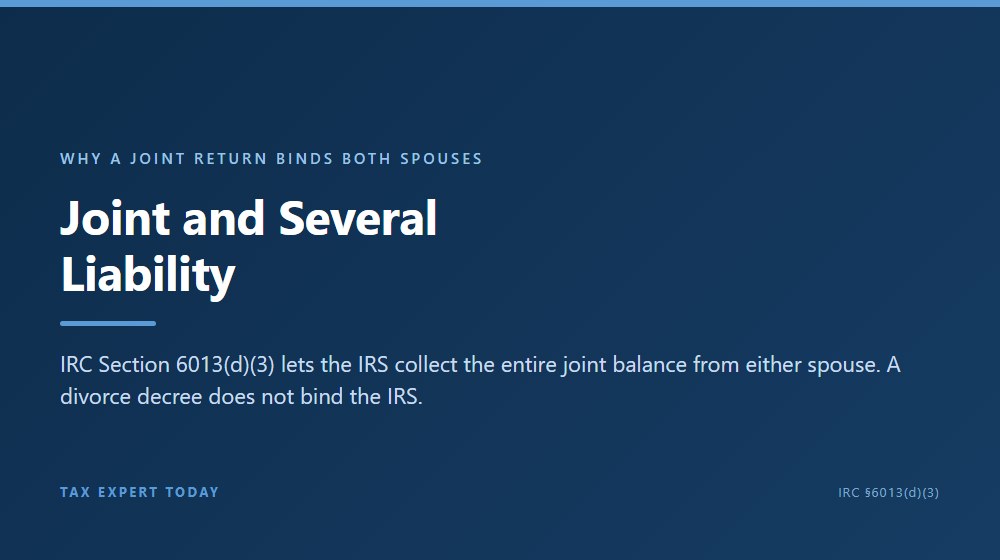
Signing a joint return creates joint and several liability, which means the IRS may collect the entire balance from either spouse regardless of who earned the income or who made the error. That rule does not soften after a divorce, and a divorce decree assigning the tax debt to a former spouse does not bind the IRS. Innocent spouse relief exists because Congress recognized that the rule produces unfair results in real households, particularly where one spouse controlled the finances, concealed income, or left the other holding a balance created entirely by someone else. This 2026 guide explains the three statutory paths, the deadline that applies to each one, how the IRS weighs an equitable request, and how the remedy differs from injured spouse relief, which is a separate form solving a separate problem.
What Is Innocent Spouse Relief?
Innocent spouse relief is statutory relief from joint and several liability for a tax debt reported on or assessed against a joint return. When the IRS grants it, the requesting spouse is relieved of all or part of the tax, penalties, and interest, and the liability remains with the other spouse. The relief is requested on Form 8857 and evaluated under IRC Section 6015.
The starting point is IRC Section 6013(d)(3), which makes spouses who file jointly liable together and individually for the income tax from that return. For this purpose the word tax includes penalties, additions to tax, and interest, so a relief request covers the whole balance and not merely the underlying tax. Section 6015 then carves out three routes back, and the IRS evaluates a single Form 8857 against all three rather than requiring separate applications for each.
It is equally important to know what the remedy does not reach. According to the IRS, innocent spouse relief is not available for household employment taxes, individual shared responsibility payments, business taxes, or the trust fund recovery penalty. Those liabilities follow different rules, and a taxpayer facing a personally assessed payroll tax penalty needs a different strategy entirely.
Innocent Spouse vs Injured Spouse: Which One Do You Need?
Innocent spouse relief removes you from a joint liability you should not have to pay. Injured spouse relief, requested on Form 8379, recovers your share of a joint refund that the government seized to pay your spouse’s separate debt. The two remedies are commonly confused because the names sound similar, but they solve opposite problems. Our guide to injured spouse relief and the Form 8379 allocation covers that remedy in full, including how the refund is actually split.
An injured spouse claim is appropriate when a refund on a jointly filed return was applied to a debt that belongs solely to the other spouse, such as defaulted student loans, past due child support, or that spouse’s own pre-marriage tax balance. Nothing is wrong with the return in that scenario. The return is correct, the refund is legitimate, and the only question is how to split it. An innocent spouse claim, by contrast, asserts that you should not be liable for the balance at all. Where the disputed item is a child claimed on two returns rather than a joint liability, the analysis runs through Form 8332 and the dependency tiebreaker rules instead.
| Question | Innocent Spouse (Form 8857) | Injured Spouse (Form 8379) |
|---|---|---|
| What is the problem? | You are being held liable for a balance created by your spouse | Your share of a joint refund was taken for your spouse’s separate debt |
| What do you want? | Release from the tax, penalties, and interest | Your portion of the refund returned to you |
| Governing authority | IRC Section 6015 | Refund offset allocation rules |
| Is the return itself wrong? | Usually yes, or the balance went unpaid | No, the return is correct |
| Is your spouse contacted? | Yes, notification is required by statute | No separate participation right |
A taxpayer occasionally needs both, filed for different years or even for the same year on different facts. Reading the notice carefully is the fastest way to tell which applies, because a refund offset letter points toward Form 8379 while a balance due notice or an examination report points toward Form 8857.
Who Qualifies Under Sections 6015(b), 6015(c), and 6015(f)?
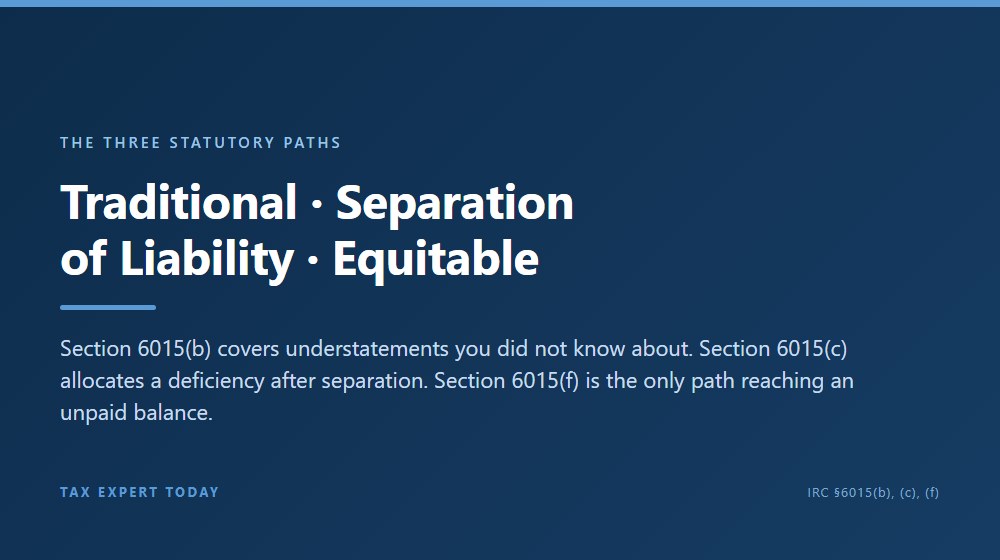
Section 6015 provides three paths. Subsection (b) is traditional innocent spouse relief for an understatement you did not know about. Subsection (c) allocates a deficiency between spouses who are divorced, separated, or living apart. Subsection (f) is equitable relief, available only when the first two do not apply, and it is the only path that can reach an unpaid balance reported on the return.
Traditional relief under Section 6015(b) requires a joint return, an understatement of tax attributable to an erroneous item of the other spouse, and proof that you did not know and had no reason to know of the understatement when you signed. The IRS must also conclude that holding you liable would be inequitable given all the facts. Partial relief is possible where you knew of some of the understatement but not its full extent.
Separation of liability under Section 6015(c) does not ask whether the result is inequitable. It asks a status question first, which is whether you are divorced, legally separated, widowed, or have not been a member of the same household as your spouse for the twelve months ending on the date you request relief. If you qualify, the deficiency is allocated between the spouses roughly as it would have fallen on separate returns, and you pay only your share. One practical limit deserves attention, because Section 6015(g)(3) provides that no credit or refund is allowed as a result of an election under subsection (c). This route reduces what you owe going forward and does not return money you already paid.
Equitable relief under Section 6015(f) is the catch-all. It applies when relief is unavailable under (b) or (c) and it would be inequitable to hold you liable, taking into account all the facts and circumstances. It is the only route that reaches an underpayment, meaning a balance that was correctly reported on the joint return and simply never paid, which is a common pattern when one spouse handled the finances and promised to pay.
| Relief Path | Core Requirement | Reaches an Unpaid Balance? | Refund Possible? |
|---|---|---|---|
| Section 6015(b) Traditional |
Understatement from the other spouse, no knowledge or reason to know, inequitable to hold liable | No, understatements only | Yes, within the refund period |
| Section 6015(c) Separation of liability |
Divorced, legally separated, widowed, or living apart for 12 months | No, deficiencies only | No, barred by Section 6015(g)(3) |
| Section 6015(f) Equitable |
Relief unavailable under (b) or (c) and inequitable to hold liable on all facts | Yes, this is the only path that does | Yes, within the refund period |
What Deadlines Apply to Each Type of Relief?
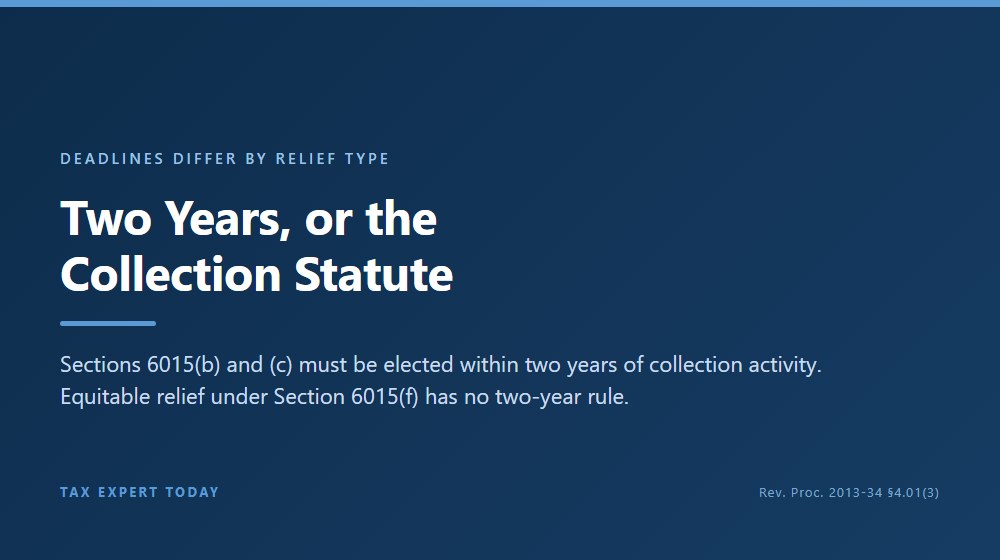
The deadlines are not the same across the three paths, and this is where taxpayers most often go wrong. Relief under Sections 6015(b) and 6015(c) must be elected no later than two years after the date the IRS began collection activity against you. Equitable relief under Section 6015(f) has no two-year rule at all.
The two-year clock in subsections (b) and (c) runs from the start of collection activity, not from the date you filed, not from the date of assessment, and not from the date of any notice the IRS happened to send. Collection activity generally means an action that puts you on notice the IRS intends to collect from you specifically, such as a notice of intent to levy under Section 6330 or an offset of a refund. Several sources state the deadline loosely as two years from receiving a notice, which is close enough to be dangerous, because the operative event is the collection action.
Equitable relief follows a different and more generous rule. Revenue Procedure 2013-34, Section 4.01(3), sets the timing condition as follows. If you seek relief from a liability that remains unpaid, the request must be made on or before the Collection Statute Expiration Date, which is generally ten years after assessment under IRC Section 6502. If you seek a credit or refund of an amount already paid, the request must be made within the ordinary refund period under IRC Section 6511, which is three years from filing or two years from payment, whichever is later. Our guide to the IRS 10-year rule explains how that collection window is calculated and what pauses it.
| Relief Requested | Filing Deadline | Clock Starts From |
|---|---|---|
| Section 6015(b) traditional | 2 years | The date the IRS began collection activity against you |
| Section 6015(c) separation of liability | 2 years | The date the IRS began collection activity against you |
| Section 6015(f) equitable, balance still unpaid | Through the Collection Statute Expiration Date, generally 10 years | The date the tax was assessed |
| Section 6015(f) equitable, seeking a refund | 3 years from filing or 2 years from payment, whichever is later | The return filing date or the payment date |
| Section 66(c) community property | Generally 6 months before the assessment period expires against your spouse | The assessment statute of limitations |
The practical consequence is worth stating plainly. A request that arrives after the two-year window has closed is not necessarily dead, because the IRS evaluates every Form 8857 for equitable relief as well, and that path may still be open for years afterward. Filing late forecloses subsections (b) and (c), and it does not automatically foreclose subsection (f).
How Does the IRS Decide an Equitable Relief Request?
Revenue Procedure 2013-34 governs equitable relief and applies a three-stage analysis. First the request must clear seven threshold conditions. Then the IRS checks whether the facts support a streamlined determination granting relief. If not, the request is weighed against a nonexclusive list of balancing factors, where no single factor and no simple majority controls the outcome.
The seven threshold conditions in Section 4.01 require that you filed a joint return, that relief is unavailable under Section 6015(b) or (c), that the claim is timely as described above, that no assets were transferred between the spouses as part of a fraudulent scheme, that the nonrequesting spouse did not transfer disqualified assets to you, that you did not knowingly participate in filing a fraudulent joint return, and that the liability is attributable to an item or an underpayment of the nonrequesting spouse. Several of these carry exceptions, and the abuse exception is significant, because a requesting spouse who could not challenge the return for fear of retaliation may still be considered even where attribution would otherwise defeat the claim.
A streamlined determination granting relief requires three elements together, which are that you are no longer married to the nonrequesting spouse, that you would suffer economic hardship if relief were not granted, and that you did not know or have reason to know of the understatement or that the tax would go unpaid. Failing the streamlined test is not a denial. It moves the request into the full balancing analysis.
The balancing factors in Section 4.03(2) are marital status, economic hardship, knowledge or reason to know, legal obligation to pay under a divorce decree or agreement, significant benefit received from the unpaid tax or understatement, subsequent compliance with the income tax laws, and mental or physical health. Two design choices in the current revenue procedure matter in practice. A lack of economic hardship is neutral rather than negative, and abuse or financial control by the other spouse can flip the knowledge factor in favor of relief even where knowledge otherwise existed. Outcomes depend on the specific facts presented, and no combination of factors assures a particular result.
How Do You File Form 8857?
File Form 8857, Request for Innocent Spouse Relief, and the IRS will consider all applicable relief types from that single filing. The current revision is dated June 2021. File one form even if the request covers several tax years, and expect the review to take six months or longer according to the IRS.
The form asks for the years at issue, your marital and household history, your involvement in preparing the returns, your knowledge of the items in question, and your current financial circumstances. The narrative sections carry more weight than taxpayers expect, because they are where the knowledge factor and the economic hardship factor are established. Supporting documentation strengthens a request considerably, and useful attachments include the divorce decree or separation agreement, records showing who controlled the bank accounts, and documentation of health conditions or abuse where relevant.
Two points of sequencing help. Do not file an amended return in place of Form 8857, because an amended return does not request relief from joint liability and does not start the Section 6015 process. Also, collection is generally suspended on the disputed liability while a timely request is pending, subject to the statutory rules, which is one reason filing promptly can matter as much as filing well.
Will My Former Spouse Be Notified?
Yes. The IRS is required by law to notify the nonrequesting spouse that a request has been filed and to give that person an opportunity to participate in the process. This requirement cannot be waived, and it applies even when the spouses are divorced and even in cases involving abuse.
What the IRS does not do is disclose your personal information. The agency states that it will not release your current address, telephone number, employer, or similar identifying details to the other spouse. The notification tells the nonrequesting spouse that a claim exists for particular tax years and invites that person to submit information, which the IRS then weighs alongside yours. For taxpayers who left a difficult marriage, this is understandably the hardest part of the process, and it is better addressed with a clear plan than discovered midway through.
What Happens If the IRS Denies Innocent Spouse Relief?
A denial is not the end of the matter. The IRS issues a preliminary determination first, and you may file a written protest with the IRS Independent Office of Appeals, generally using Form 12509, Innocent Spouse Statement of Disagreement. If Appeals sustains the denial, the IRS issues a final determination.
Section 6015(e) then provides judicial review. You may petition the United States Tax Court no later than the ninetieth day after the IRS mails its final determination notice. You may also petition once six months have passed since you filed the request, even if the IRS has not issued a determination, which prevents an indefinite administrative delay from blocking review. The ninety day period is jurisdictional in effect, so calendaring it correctly from the date on the notice is essential.
Where relief is genuinely unavailable, the balance does not disappear, and the ordinary collection alternatives remain. Depending on the facts, that can mean an installment agreement to pay over time, an offer in compromise if you qualify to settle for less than the full balance, or currently not collectible status when paying anything would create hardship. If the denial arrives alongside a final notice of intent to levy, a Collection Due Process hearing may allow both the collection alternative and, in some circumstances, the spousal defense to be raised. Penalties on the remaining balance may separately qualify for abatement, and our guide to reasonable cause penalty abatement explains those standards.
What If You Live in a Community Property State and Did Not File Jointly?
Section 6015 applies only to joint returns. If you are domiciled in a community property state and filed separately, community property law may still attribute half of your spouse’s income to you. IRC Section 66(c) provides the parallel remedy in that situation, and it is also requested on Form 8857.
Relief under Section 66(c) reaches income tax liability that arises purely from the operation of community property law rather than from a joint filing. The equitable branch of Section 66(c) is evaluated under the same Revenue Procedure 2013-34 factors described above, with the threshold conditions adjusted, because the requirements of filing a joint return and exhausting Sections 6015(b) and (c) do not apply. The deadline is different as well. Publication 971 describes the request as due no later than six months before the period of limitations on assessment against your spouse expires, with a narrow exception when an examination of your return begins during that period. Florida is not a community property state, so this provision typically arises for clients who previously lived or worked in one of the nine states that are.
Innocent Spouse Relief Help in Naples and Southwest Florida
Tax Expert Today LLC helps individuals in Naples and across Southwest Florida evaluate whether innocent spouse relief, separation of liability, equitable relief, or an injured spouse claim fits their facts, prepare and document Form 8857, and respond when the IRS issues a preliminary or final determination. Because so many of these matters arise during or after a divorce, the analysis is often handled alongside the firm’s divorce tax consulting work, where the decree language and the tax exposure need to be read together. The office is at 11983 Tamiami Trail N, Naples, FL 34110, and the team can be reached at (239) 441-2005, Monday through Friday, 10am to 5pm ET.
Frequently Asked Questions
How long does innocent spouse relief take?
The IRS states that a review may take six months or longer. The timeline depends on the complexity of the facts, whether the nonrequesting spouse responds and submits contrary information, and whether the case moves to Appeals. Collection on the disputed liability is generally suspended while a timely request is pending, so the delay itself does not usually expose you to levy action on the amount at issue.
Does a divorce decree assigning the tax debt to my ex protect me?
No. A divorce decree binds the two former spouses, and it does not bind the IRS, which may still collect the full joint balance from either party. The decree is relevant to a relief request, because the legal obligation to pay is one of the balancing factors under Revenue Procedure 2013-34, but it operates as evidence within the analysis rather than as a defense to collection on its own.
Can I get innocent spouse relief if I knew about the income?
Knowledge generally defeats traditional relief under Section 6015(b) and weighs against equitable relief, but it is not always fatal. Under the current revenue procedure, abuse by the other spouse or financial control that restricted your access to financial information can cause the knowledge factor to weigh in favor of relief even where you knew or had reason to know. Partial relief is also possible where you knew of part of an understatement but not its full extent.
What is the deadline to file Form 8857?
It depends on the relief sought. Traditional relief and separation of liability must be elected within two years after the IRS began collection activity against you. Equitable relief has no two-year deadline and may be requested through the collection statute expiration date for an unpaid balance, or within the ordinary refund period of three years from filing or two years from payment when you are seeking money back.
Will requesting relief hurt my former spouse?
Granting relief to you leaves the liability with the nonrequesting spouse, so that person has a genuine interest in the outcome and the statute gives them the right to participate. The IRS must notify them that a request exists, though it does not disclose your address, telephone number, or employer. Many taxpayers find it useful to prepare for that notification in advance rather than be surprised by it.
Where can I get help with innocent spouse relief in Naples, FL?
Tax Expert Today LLC, located at 11983 Tamiami Trail N, Naples, FL 34110, helps taxpayers in Naples and throughout Southwest Florida determine which form of relief fits their circumstances, prepare Form 8857 with supporting documentation, and pursue an appeal or Tax Court petition where a determination is unfavorable. The firm is multidisciplinary, with enrolled agents, CPAs, and attorneys, and represents taxpayers before the IRS nationwide. Consultations can be arranged at (239) 441-2005.
When to Engage a Professional for Innocent Spouse Relief
Innocent spouse cases are decided on narrative and documentation more than on arithmetic, which makes them different from most tax controversies. The knowledge question, the economic hardship showing, and the abuse or financial control history all have to be established with evidence, and the same underlying facts can support or undermine a claim depending on how they are presented and corroborated. A representative can also identify which of the four remedies actually fits, because a request filed under the wrong provision loses time that the deadlines may not give back.
Engaging help early is most valuable in three situations, which are when the two-year collection window is approaching, when the nonrequesting spouse is likely to contest the request, and when a preliminary determination has already been denied and the ninety day Tax Court window has started to run. Outcomes depend on the specific facts and no result can be assured. Tax Expert Today LLC, founded by Dr. Pellumb Kabashi, represents individuals in IRS collection and controversy matters nationwide.
Call (239) 441-2005 or schedule a consultation to review a joint tax balance, a Form 8857 already filed, or an IRS determination letter, and build a plan around your specific facts. Tax advisors, enrolled agents, CPAs, and attorneys serving clients in all 50 states.
Published July 27, 2026 by Dr. Pellumb Kabashi « Back to Learning Center
Have a question this article touches on?
Tax Expert Today LLC, based in Naples, Florida and serving clients across the United States.
Schedule a Consultation (239) 441-2005