
By Dr. Pellumb Kabashi, DBA, MBA, EA, CFE, CES
Founder, Tax Expert Today LLC · Tax advisors, enrolled agents, CPAs, and attorneys · Serving clients in all 50 states
Quick Answer: The Georgia alcohol tax is a state excise tax collected by licensed wholesalers when they deliver to retailers. For 2026 it is $1.08 per standard case of beer, 11 or 40 cents per liter of table wine, and 50 cents or $1 per liter of distilled spirits, depending on where the product was made. Local excise taxes and sales tax are added to that. Call (239) 441-2005 for a free consultation.
Search for the Georgia alcohol tax today and the results are a county ordinance, a Tax Foundation ranking from 2023, a federal research report, a city page about liquor by the drink, and an eight year old Reddit thread. Each holds one piece of the answer. None of them puts the state rates, the local rates, the sales tax, and the federal tax in one place, and none explains who actually files the return, when it is due, or how the tax follows a business through licensing and renewal.
This guide treats the Georgia alcohol tax as a working compliance system. It covers the state excise rates for beer, wine, and spirits, why Georgia charges more on alcohol made outside the state, the local excise taxes that cities and counties add, the liquor by the drink tax, how sales tax stacks with excise, the federal layer, and what the tax means for restaurants, package stores, wholesalers, breweries, distilleries, and wineries. Every state rate below was checked against the Department of Revenue on October 28, 2026. For the wider picture of Georgia income, sales, and business taxes, see our Georgia tax services overview.
What Is the Georgia Alcohol Tax in 2026?
The Georgia alcohol tax is a state excise tax on malt beverages, wine, and distilled spirits, collected by licensed wholesalers at delivery to the retailer and remitted to the Department of Revenue. The rate depends on the product, its alcohol content, and for wine and spirits, whether it was made inside or outside Georgia.
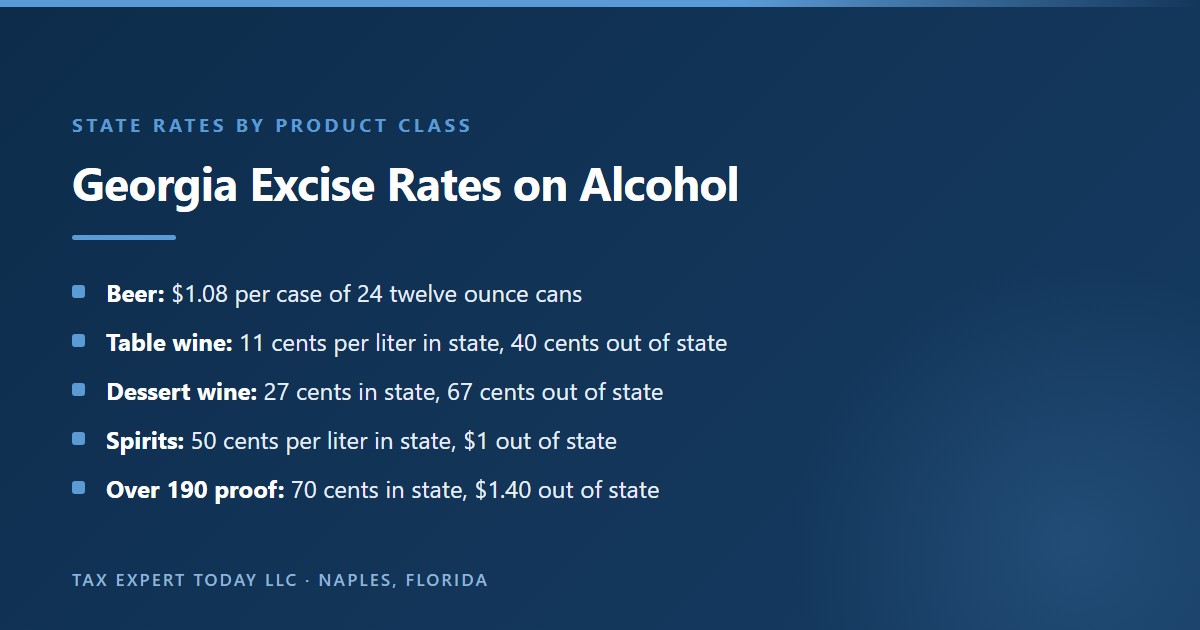
- Beer: $1.08 per standard case of 24 twelve ounce containers, about 4.5 cents per can.
- Table wine: 11 cents per liter if made in Georgia, 40 cents if made elsewhere.
- Dessert wine: 27 cents per liter in state, 67 cents out of state.
- Distilled spirits: 50 cents per liter in state, $1 per liter out of state.
- Local layers: city and county excise taxes, plus state and local sales tax at retail.
The table below is taken from the Department of Revenue alcohol excise page as it reads on October 28, 2026. The Department states that Georgia alcohol taxes are collected by the wholesaler at the time of delivery to the retailer, and that wholesalers remit all taxes collected to the Department.
| Product | Definition | Made in Georgia | Made outside Georgia |
|---|---|---|---|
| Malt beverages (beer) | Standard case of 24 twelve ounce containers | $1.08 per case (4.5 cents per can) | $1.08 per case (4.5 cents per can) |
| Table wine | 14 percent alcohol by volume or less | 11 cents per liter | 40 cents per liter |
| Dessert wine | Over 14 and up to 24 percent alcohol by volume | 27 cents per liter | 67 cents per liter |
| Fortified wine | Fortified with spirits to over 24 percent alcohol by volume | Taxed as distilled spirits | Taxed as distilled spirits |
| Distilled spirits | Less than 190 proof | 50 cents per liter | $1 per liter |
| Alcohol | Any product over 190 proof | 70 cents per liter | $1.40 per liter |
Two features of this table matter more than the numbers. First, the tax is collected one step before the consumer, at the wholesale tier, so most bars, restaurants, and package stores never write a check to the Department for the state excise tax itself. They pay it inside the price they pay their wholesaler. Second, the in state and out of state split means two bottles on the same shelf, at the same proof and size, can carry different amounts of Georgia alcohol tax.
How Much Is the Georgia Alcohol Tax on Beer?
The Georgia alcohol tax on beer is $1.08 per standard case of 24 twelve ounce containers, which the Department of Revenue describes as 4.5 cents per can. A uniform local beer tax of $1.20 per case, or 5 cents per can, also applies, for a combined $2.28 per case before sales tax.
- State rate: $1.08 per case, the same for Georgia and out of state brewers.
- Local rate: $1.20 per case, set statewide under O.C.G.A. 3-5-80.
- Per gallon: about 48 cents state and 53 cents local.
- Draft beer: local tax of $6 per container of up to 15.5 gallons.
- Hard cider: some cider is taxed as beer under a separate return schedule.
Beer is the one product where the state does not charge a higher rate on out of state production. A case of Georgia craft beer and a case brewed in another state carry the same $1.08 state excise. The local layer is unusual too. Most states let local governments choose whether to tax beer and at what rate. Georgia instead sets one uniform local excise rate in O.C.G.A. 3-5-80: 5 cents per 12 ounces for bottles and cans, and $6 per container of up to 15.5 gallons for draft beer sold in barrels or bulk, prorated for other sizes. That is why the Tax Foundation notes that Georgia adds a statewide uniform local tax of roughly 50 cents per gallon on beer.
Under the companion section, O.C.G.A. 3-5-81, the local malt beverage tax is paid by the licensed wholesale dealer, or by a licensed brewer that sells directly to the public, to the city or county where the beer is sold. The Department of Revenue rate table shows both figures side by side, which is the easiest way to see the full Georgia alcohol tax on a case of beer.
One product line deserves a note. Beginning with the July 2024 monthly return, the Department added a schedule to the Farm Winery and Winery excise return called Hard Cider known as Beer. Wine producers that make hard cider meeting the Department’s regulatory definition of beer file and pay that tax on the beer schedule at the end of their winery return, rather than under the wine rates.
How Is Wine Taxed Under the Georgia Alcohol Tax?
Georgia taxes wine by the liter and by alcohol content. Table wine at 14 percent or less pays 11 cents per liter if made in Georgia and 40 cents if made elsewhere. Dessert wine above 14 and up to 24 percent pays 27 or 67 cents. Wine fortified above 24 percent is taxed as distilled spirits.
- Table wine: 14 percent alcohol by volume or less.
- Dessert wine: more than 14 and not more than 24 percent alcohol by volume.
- Fortified wine: over 24 percent, taxed at the spirits rates.
- Local tax: some localities add up to 22 cents per liter.
- Origin matters: out of state wine pays about 2.5 to 3.6 times the Georgia rate.
The alcohol content break at 14 percent is where classification errors usually start. A wine labeled at 14.5 percent is dessert wine for Georgia purposes even if it is sold as a dry red, and it moves from 40 cents to 67 cents per liter when it comes from outside the state. Wholesalers carry the classification risk because they file the return, but retailers and restaurants feel it through pricing, and wineries that self distribute or ship carry it directly.
For a standard 750 milliliter bottle, the state excise on out of state table wine works out to 30 cents, and on Georgia table wine to about 8 cents. Where a local wine tax applies at the 22 cent ceiling, it adds about 16.5 cents per bottle. Those amounts are small per bottle and large across a distributor’s monthly volume, which is why the classification column of the return gets attention in an audit.
What Is the Georgia Alcohol Tax on Liquor and Distilled Spirits?
Distilled spirits under 190 proof pay a Georgia alcohol tax of 50 cents per liter if made in Georgia and $1 per liter if made outside the state. Products over 190 proof pay 70 cents or $1.40 per liter. Some localities add a local tax of up to 22 cents per liter on package sales.
- Standard spirits: less than 190 proof, 50 cents or $1 per liter.
- High proof alcohol: over 190 proof, 70 cents or $1.40 per liter.
- Per gallon: the $1 per liter rate is about $3.79 per gallon.
- Per 750 milliliter bottle: 75 cents out of state, 37.5 cents in state.
- By the drink: a separate local tax of up to 3 percent may apply.
The $3.79 per gallon figure that appears in national rankings, including the Tax Foundation’s 2023 table of distilled spirits taxes by state, is the out of state rate converted from liters to gallons. It is accurate for most of what a package store sells, because most spirits on Georgia shelves are distilled elsewhere. It overstates the state tax on spirits made by a Georgia distillery, which pay half that rate.
Liquor is also where the local layers multiply. A bottle sold at a package store can carry the state excise, a local package excise of up to 22 cents per liter, and state and local sales tax. A cocktail sold at a bar can carry the state excise already paid upstream on the bottle, a local liquor by the drink tax of up to 3 percent of the price, and sales tax on the check. Each layer is set by a different statute and, for local taxes, by a different ordinance.
Why Does the Georgia Alcohol Tax Charge More on Out of State Products?
Georgia sets lower state excise rates on wine and spirits manufactured inside the state, so out of state wine and spirits pay roughly double or more. The split appears in the Department of Revenue rate table for every wine and spirits class. Beer is the exception, with one rate regardless of where it was brewed.
- Table wine: 11 cents in state versus 40 cents out of state.
- Dessert wine: 27 cents versus 67 cents.
- Spirits: 50 cents versus $1.
- High proof alcohol: 70 cents versus $1.40.
- Beer: $1.08 per case either way.
For a business, the practical question is documentation. The lower rate depends on where the product was manufactured, so a wholesaler or a Georgia producer claiming it needs records that show it. Contract production, private labels, and products bottled in Georgia from spirits distilled elsewhere are the cases where the answer is not obvious from the label. When the origin is uncertain, the safer course is to read the statutory definition with an advisor before filing at the lower rate, because the difference compounds across every month in an audit period.
Whether a rate preference for in state products is good policy, and whether it would survive a legal challenge, is a separate question that this guide does not try to answer. The rates in the table are the rates the Department publishes and applies today, and they are the rates a return should reflect until the law changes.
What Local Alcohol Taxes Do Georgia Cities and Counties Charge?
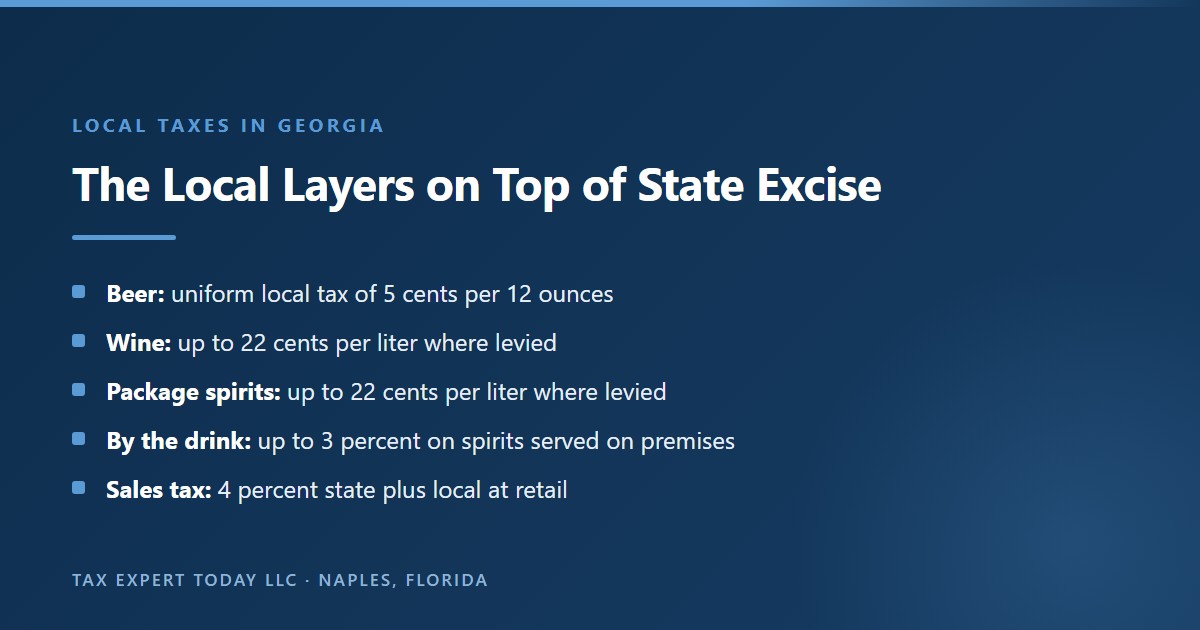
Georgia cities and counties can add their own alcohol excise taxes in addition to the state tax: a uniform local beer tax of 5 cents per 12 ounces, a local wine and package spirits tax of up to 22 cents per liter, and a liquor by the drink tax of up to 3 percent. Local sales taxes apply too.
- Beer: 5 cents per 12 ounces, or $6 per 15.5 gallon keg, under O.C.G.A. 3-5-80.
- Wine: up to 22 cents per liter where the locality levies it.
- Package spirits: up to 22 cents per liter where the locality levies it.
- Spirits by the drink: up to 3 percent of the charge, under O.C.G.A. 3-4-130 and 3-4-131.
- Wet or dry: local voters decide what may be sold at all.
The local layer is where most Georgia alcohol businesses actually interact with a tax collector. A restaurant that pours cocktails files a monthly liquor by the drink return with its city or county, not with the state. Due dates, forms, penalties, and interest are set by the local ordinance. As one example, the City of Port Wentworth’s liquor by the drink ordinance makes collected tax due on or before the 20th of every month and imposes a 15 percent penalty on late payment, with a $25 minimum and interest of 1 percent per month. Other cities and counties use different dates and different penalty terms, so the ordinance where the business operates is the controlling document.
| Local tax | Rate | Authority | Who remits |
|---|---|---|---|
| Beer, cans and bottles | 5 cents per 12 ounces | O.C.G.A. 3-5-80 | Wholesaler or brewer selling direct |
| Beer, draft | $6 per container up to 15.5 gallons | O.C.G.A. 3-5-80 | Wholesaler or brewer selling direct |
| Wine | Up to 22 cents per liter | Local ordinance; DOR rate table | Wholesaler |
| Package spirits | Up to 22 cents per liter | Local ordinance; DOR rate table | Wholesaler |
| Spirits by the drink | Up to 3 percent of the charge | O.C.G.A. 3-4-130 and 3-4-131 | Bar, restaurant, or hotel |
Local authority also decides whether alcohol may be sold at all, and in what form. Georgia counties and cities hold referendums on package sales, sales by the drink, and Sunday sales, and a business near a jurisdiction line can find that the rules, the license, and the tax change across the street. Before signing a lease, an operator should confirm which jurisdiction the address sits in and which local taxes that jurisdiction levies.
What Is the Georgia Liquor by the Drink Tax?
The Georgia liquor by the drink tax is a local excise tax that a city or county may levy on distilled spirits sold by the drink for consumption on the premises. O.C.G.A. 3-4-130 caps it at 3 percent of the charge to the public. Malt beverages are excluded, and the licensed business collects and remits it locally.
- Who levies it: municipalities under 3-4-130, counties under 3-4-131.
- Ceiling: 3 percent of the amount charged for the drink.
- No double county tax: a county may not levy it where a city tax already applies.
- Who remits: the bar, restaurant, or hotel licensed to pour.
- Where: the city or county, on its own form and schedule.
This is the tax behind the familiar comment that a cocktail in Savannah or Atlanta carries more tax than the food on the same check. The drink carries the local 3 percent by the drink tax and the full state and local sales tax. The food carries only the sales tax. Some local return forms allow the business to keep a small collection allowance before remitting. Whether an allowance exists, and how much it is, depends on the ordinance.
The by the drink tax is computed on gross receipts from spirits, so the point of sale system has to separate liquor drinks from beer, wine, food, and service charges. Restaurants that track all beverages in one category end up either overpaying or underpaying, and a local audit will rebuild the split from the vendor invoices and the menu prices.
Who Pays the Georgia Alcohol Tax and Who Files the Return?
Consumers bear the Georgia alcohol tax in the price, but licensed wholesalers collect the state excise at delivery to retailers and file the monthly return. Breweries, distilleries, and wineries that sell directly also file. Retailers usually remit only local by the drink tax and sales tax, not the state excise.
- Wholesalers and distributors: collect and remit state excise and the local beer tax.
- Manufacturers: file monthly excise returns for their own taxable sales.
- Brewpubs and farm wineries: may owe excise on product sold on site.
- Retailers: pay the tax in their purchase price; collect sales tax.
- Bars and restaurants: also collect the local liquor by the drink tax.
Georgia runs a three tier system for most alcohol: the manufacturer sells to a licensed wholesaler, and the wholesaler sells to a licensed retailer. The state excise sits at the wholesale tier because that is the narrowest point in the chain, with the fewest filers and the cleanest records. A retailer that buys only from licensed Georgia wholesalers has, in the ordinary case, already paid the state excise through its invoices.
The exceptions are where compliance problems tend to appear. Producers that have statutory authority to sell some product directly to consumers, such as brewery taprooms, distillery tasting rooms, brewpubs, and farm wineries, owe excise on those sales themselves. Out of state producers that ship to Georgia under a special order shipping license have their own reporting duties. Anyone who brings alcohol into Georgia for resale outside the licensed chain is outside the system the tax was built for, and should expect the Department to treat that as a problem rather than a planning opportunity.
When Are Georgia Alcohol Tax Returns Due?
Georgia alcohol excise tax returns are due by the 15th of each month and are filed through the Georgia Tax Center. Tobacco returns, by contrast, are due by the 10th. Local beer taxes and liquor by the drink taxes follow their own schedules, set by statute or by the local ordinance where the business operates.
- State alcohol excise: monthly, by the 15th, through the Georgia Tax Center.
- Local beer tax: by the 10th of the following month under O.C.G.A. 3-5-81.
- Liquor by the drink: monthly, on the date the local ordinance sets.
- Sales tax: on the business’s assigned Georgia sales tax filing schedule.
- Tobacco excise: by the 10th, for businesses that sell both.
The Department of Revenue states on its alcohol and tobacco excise tax page that excise returns for malt beverages, wines, and distilled spirits are submitted through the Georgia Tax Center, with alcohol due by the 15th of each month. A convenience store or wholesaler that handles both alcohol and tobacco therefore carries two state excise dates five days apart, plus a sales tax date and any local dates. Putting all of them on one calendar, with an owner for each, is the simplest control a business can adopt.
| Tax | Who files | Where | Due |
|---|---|---|---|
| State alcohol excise | Wholesalers, manufacturers, direct sellers | Georgia Tax Center | 15th of each month |
| Local malt beverage excise | Wholesalers, brewers selling direct | City or county | 10th of the following month |
| Local liquor by the drink | Bars, restaurants, hotels | City or county | Set by local ordinance |
| Sales and use tax | Retailers, bars, restaurants | Georgia Tax Center | Assigned filing frequency |
| Federal excise | Producers and importers | Alcohol and Tobacco Tax and Trade Bureau | Federal return period |
Does Georgia Sales Tax Apply to Alcohol as Well as the Georgia Alcohol Tax?
Yes. Retail sales of beer, wine, and spirits are subject to Georgia sales tax at the 4 percent state rate plus local sales taxes, in addition to the excise taxes already built into the price. Bars and restaurants also add the local liquor by the drink tax on spirits, so a cocktail can carry three separate taxes.
- Excise: per unit of volume, paid upstream and built into the price.
- Sales tax: a percentage of the retail price, collected at the register.
- By the drink: a percentage of the drink price, for spirits served on premises.
- No resale exemption for the consumer: the end buyer pays sales tax.
- Use tax: applies when alcohol for business use is bought untaxed.
Excise and sales tax work differently, and the difference matters when prices change. Excise is a fixed amount per liter or per case, so it does not move when a bottle goes on sale. Sales tax is a percentage of the price, so it does. A restaurant or store that runs promotions, happy hours, or comps should make sure the sales tax and by the drink tax are computed on the price actually charged, and that comped drinks are handled the way the local ordinance and the Department’s sales tax rules require.
Retailers buy inventory for resale without paying sales tax, using the resale certificate rules covered in our guide to Georgia sales tax exemption certificates. Alcohol a business consumes itself, such as wine used in cooking or bottles given away at an event, is a different matter, and our guide to Georgia use tax explains when tax is owed on items bought for resale and then used instead.
How Much Georgia Alcohol Tax Is in a Bottle, a Case, or a Drink?
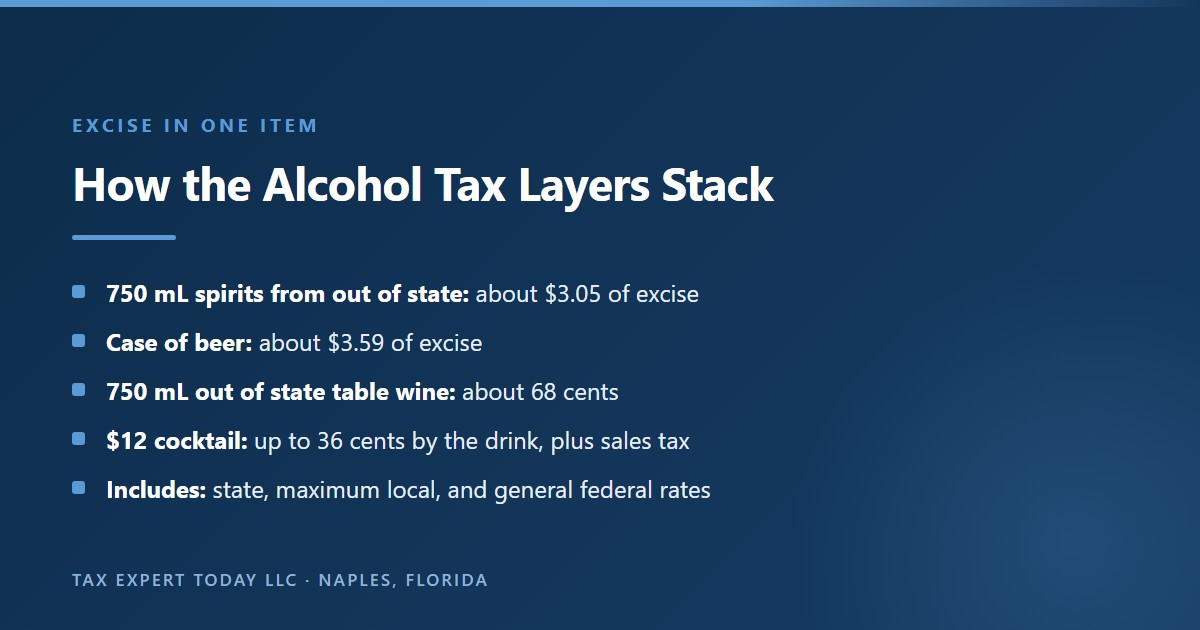
A 750 milliliter bottle of out of state spirits carries 75 cents of Georgia alcohol tax, a case of beer carries $1.08 state plus $1.20 local, and a bottle of out of state table wine carries 30 cents. Local taxes, federal excise, and sales tax are added. The examples below show how the layers stack.
- Spirits bottle: about $3.05 of state, local, and federal excise at 80 proof.
- Case of beer: about $3.59 of excise at the general federal rate.
- Wine bottle: about 68 cents of excise before federal credits.
- Cocktail: up to 3 percent by the drink tax plus sales tax.
The table uses the Department of Revenue state rates, the maximum local rates, and the general federal rates published by the Alcohol and Tobacco Tax and Trade Bureau. These are illustrations only. Actual local taxes depend on where the product is sold, federal tax depends on the producer’s credits and reduced rates, and sales tax depends on the price and the county.
| Item | Georgia state excise | Local excise (maximum) | Federal excise (general rate) | Excise total |
|---|---|---|---|---|
| 750 mL spirits, 80 proof, made outside Georgia | $0.75 | $0.165 | about $2.14 | about $3.05 |
| 750 mL spirits, 80 proof, made in Georgia | $0.375 | $0.165 | about $2.14 | about $2.68 |
| Case of 24 twelve ounce beers | $1.08 | $1.20 | about $1.31 | about $3.59 |
| 750 mL table wine, 13 percent, made outside Georgia | $0.30 | $0.165 | about $0.21 | about $0.68 |
| $12 cocktail served at a bar | Paid upstream on the bottle | Up to $0.36 by the drink | Paid upstream | Plus sales tax on $12 |
Two things stand out. The federal tax on spirits is larger than the Georgia state tax, by a wide margin, at the general rate. And for beer, the local tax is larger than the state tax. Anyone comparing Georgia with another state on state excise alone is looking at only one of the layers.
How Does Federal Excise Fit With the Georgia Alcohol Tax?
Federal excise tax is imposed separately by the Alcohol and Tobacco Tax and Trade Bureau and is paid by producers and importers, not by Georgia wholesalers or retailers. The general rates are $18 per barrel of beer, $1.07 per gallon of still wine at 16 percent or less, and $13.50 per proof gallon of spirits.
- Beer: $18 per barrel general rate; $3.50 on a small brewer’s first 60,000 barrels.
- Still wine: $1.07 per gallon at 16 percent or less, with producer credits.
- Spirits: $13.50 per proof gallon; $2.70 on the first 100,000.
- Who files: breweries, wineries, distilleries, and importers.
- Separate system: federal permits, bonds, and returns.
The federal rates below come from the bureau’s tax and fee rate table as it reads on October 28, 2026. For a Georgia brewery, distillery, or winery, the reduced federal rates on the first tier of production are often worth more per unit than the in state preference in the Georgia alcohol tax, so both systems belong in any pricing or expansion decision.
| Product | Federal general rate | Reduced rate tier |
|---|---|---|
| Beer | $18 per barrel | $3.50 per barrel on a domestic brewer’s first 60,000 barrels; $16 above that up to 2,000,000 |
| Still wine, 16 percent or less | $1.07 per wine gallon | Credit of $1 per gallon on the first 30,000 gallons, stepping down after that |
| Still wine, over 16 to 21 percent | $1.57 per wine gallon | Same credit structure |
| Still wine, over 21 to 24 percent | $3.15 per wine gallon | Same credit structure |
| Distilled spirits | $13.50 per proof gallon | $2.70 on the first 100,000 proof gallons; $13.34 above that up to 22,230,000 |
How Are Georgia Breweries, Distilleries, and Wineries Taxed?
Georgia producers pay the lower in state rates on wine and spirits, file monthly excise returns through the Georgia Tax Center for taxable sales they make directly, and remain subject to federal excise. Like any Georgia business, they also owe income or pass through taxes, payroll taxes, and sales tax on their retail sales.
- Taproom and tasting room sales: excise and sales tax on product sold on site.
- Self distribution limits: most product still moves through a licensed wholesaler.
- Hard cider: wineries report qualifying cider on the beer schedule.
- Bonds: some manufacturer and wholesaler licenses require a surety bond.
- Entity taxes: the business itself files its own Georgia returns.
A small Georgia distillery illustrates how the layers work together. Its spirits carry the 50 cent per liter Georgia rate instead of $1. Its first 100,000 proof gallons carry a $2.70 federal rate instead of $13.50. Its tasting room sales carry sales tax, and any cocktails it is licensed to serve may carry a local by the drink tax. The business itself, if it is an LLC or S corporation, files the Georgia return that matches its federal classification, which our guide to Georgia LLC taxes walks through, and its employees put it on the Georgia withholding tax schedule.
Producers also face a question that wholesalers do not: how much of the product’s cost is tax. When a new distillery or winery builds its pricing model, the Georgia alcohol tax, the local tax, and the federal tax should each be a separate line, with the reduced rate tiers noted and a plan for what happens when production passes the threshold.
How Does an Alcohol License Connect to Georgia Alcohol Tax Compliance?
Every tier of the Georgia alcohol business needs both a local license and a state license from the Department of Revenue, applied for through the Georgia Tax Center. The application can require a tax clearance, so unpaid Georgia tax balances can hold up a new license or a renewal. Renewal season runs from September through December 31.
- Local first: the city or county license usually comes before the state license.
- State license: filed online through the Georgia Tax Center.
- Tax clearance: may be required, along with background and fingerprint checks.
- Renewal: the first business day of September through December 31.
- Target date: renew before November 1 to have the license by January 1.
The Department explains on its alcohol licensing page that O.C.G.A. 3-2-7.1 requires a statewide centralized application process for retail licenses, covering retail beer and wine, retail package, consumption on premises, and special event licenses. It also notes that background investigation, tax clearance, and fingerprinting may be required for some licenses. The tax clearance piece is where this guide and the licensing process meet: a business with an unfiled sales tax return, an unpaid withholding balance, or an open excise assessment can find its license application stalled until the balance is resolved.
For the 2027 license year, the Department’s renewal page says to renew before November 1 to ensure the license arrives before January 1. As of the date of this guide, October 28, 2026, that is a matter of days. A business that knows it has an open Georgia tax balance should deal with it now, before the renewal is reviewed, rather than after a delay.
This guide addresses the tax side of licensing only. Zoning, distance rules, ownership disclosures, and the specific requirements for each license type are regulatory questions that the local licensing authority and, where needed, an alcohol licensing attorney should answer.
The license side has its own tax rule. Georgia will not consider an alcohol license application, including a renewal, while any owner of the business is behind on any Georgia tax, and a delinquency can lead to suspension. Our guide to the Georgia alcohol license covers state fees, renewal dates, and how a payment plan fits in.
What Records Should a Georgia Alcohol Business Keep?
A Georgia alcohol business should keep purchase invoices showing the wholesaler and the excise paid, sales records separated by product class, monthly excise and local returns, sales tax returns, license files, and inventory counts. Wholesalers and producers also need origin and alcohol content records that support the rate class claimed on each return.
- Retailers: invoices from licensed wholesalers, sales by category, and sales tax returns.
- Bars and restaurants: liquor sales separated from beer, wine, and food.
- Wholesalers: deliveries by customer, jurisdiction, product class, and origin.
- Producers: production, removals, and taproom sales reconciled to returns.
- Everyone: license applications, renewals, and correspondence.
The records that matter most are the ones that tie purchases to sales. When the Department or a local government reviews an alcohol business, the usual approach is to start from purchases, estimate what should have been sold, and compare that to what was reported. A business that can show its invoices, its inventory counts, and its returns line up has a much shorter conversation than one that cannot.
What Happens if a Georgia Alcohol Business Falls Behind on Taxes?
A business that falls behind on Georgia alcohol tax, local liquor by the drink tax, or sales tax faces penalties and interest, and the tax clearance requirement can put its license renewal at risk. Georgia offers payment plans and, in limited cases, offers in compromise, and disputed assessments can be appealed to the Georgia Tax Court.
- State penalties and interest: accrue on late excise and sales tax returns.
- Local penalties: set by ordinance, such as 15 percent in one city.
- License risk: an open balance can delay a renewal.
- Payment plans: available for many Department of Revenue balances.
- Appeals: disputed assessments have deadlines that start with the notice.
For the mechanics, see our guides to the Georgia Department of Revenue payment plan, the Georgia offer in compromise, and the Georgia Tax Court, which replaced the Georgia Tax Tribunal. Each path has its own eligibility rules and deadlines, and whether one fits depends on the business’s facts, its records, and the size of the balance. Local liquor by the drink balances are handled with the city or county, not the Department, and the local ordinance controls what relief, if any, is available.
Georgia Alcohol Tax Mistakes That Cost Money
The most expensive Georgia alcohol tax mistakes are misclassifying wine above 14 percent, claiming the in state rate without origin records, mixing beer and wine into liquor by the drink receipts, missing the 15th of the month due date, charging sales tax on the wrong price, and renewing a license with an unresolved tax balance.
- Rate class errors: a 14.5 percent wine is dessert wine in Georgia.
- Origin assumptions: bottled in Georgia is not the same as made in Georgia.
- Mixed receipts: by the drink tax applies to spirits, not beer.
- Comps and promotions: sales tax and local tax on the actual charge.
- Late renewal planning: an open balance found in December is hard to fix in time.
Each of these can be fixed in advance with a short written procedure: who classifies new products, who keeps origin documents, how the point of sale system codes each drink, and who checks the Georgia Tax Center account for open balances before renewal season. After the fact, they become audit findings with penalties and interest.
Georgia Alcohol Tax Help in Naples & Southwest Florida
Tax Expert Today LLC helps bar, restaurant, package store, and producer owners with Georgia alcohol tax questions from its office in Naples, Florida, including excise classification, sales tax, tax clearance for licenses, and notices. Georgia clients are served nationwide from Naples, Florida, by phone and secure document exchange. Call (239) 441-2005.
- Georgia alcohol tax help Naples: rate classification and return review.
- Restaurants and bars: liquor by the drink and sales tax reconciliation.
- Producers: state and federal excise planning for breweries, distilleries, and wineries.
- Licensing: clearing Georgia tax balances before renewal.
- Owners in Florida: Southwest Florida residents who own Georgia businesses.
Tax Expert Today LLC is based at 11983 Tamiami Trail N, Naples, FL 34110, and our office is open Monday through Friday, 10 a.m. to 5 p.m. Eastern time. You can reach us at (239) 441-2005. Many Georgia questions come from Collier and Lee County residents who own a restaurant, a package store, or a share of a brewery or distillery in Georgia, and from families who split the year between Southwest Florida and Georgia. We work with Georgia clients remotely, and there is no need to visit Naples to work with us.
For the full range of our Georgia work, see our Georgia tax services page. If you also sell tobacco or vapor products, our guide to the Georgia tobacco tax covers that excise system. A point of scope, stated plainly: the Georgia alcohol tax is administered by the Georgia Department of Revenue and by local governments, and these are state and local tax matters. Our team of tax advisors, enrolled agents, CPAs, and attorneys handles state tax matters nationwide, and we explain how the Georgia rules apply to your facts rather than predicting any particular result.
When to Engage a Professional
Many retailers handle the Georgia alcohol tax through their wholesaler without help. A review makes sense when a business opens a bar or package store, starts producing or self distributing, adds on premises spirits sales, receives a Department or local notice, or faces a license renewal with an open Georgia tax balance.
- Before opening: to set up sales tax, local tax, and records correctly.
- Before producing: to map state, local, and federal excise into pricing.
- Before renewal: to clear balances that could hold up tax clearance.
- After a notice: when an assessment questions classification or receipts.
Call (239) 441-2005 to schedule a free consultation. We will look at your licenses, purchase records, and returns, and explain the options in writing.
Frequently Asked Questions About the Georgia Alcohol Tax
What is the Georgia alcohol tax rate on beer?
Georgia charges a state excise tax of $1.08 per standard case of 24 twelve ounce containers, about 4.5 cents per can, plus a uniform local beer tax of $1.20 per case, or 5 cents per can. Licensed wholesalers collect both, and state and local sales tax apply at retail.
How much is the Georgia tax on liquor?
Distilled spirits under 190 proof pay 50 cents per liter if made in Georgia and $1 per liter if made elsewhere. Some localities add up to 22 cents per liter on package sales, and bars may owe a local liquor by the drink tax of up to 3 percent of the drink price.
How is wine taxed in Georgia?
Table wine at 14 percent alcohol or less pays 11 cents per liter if made in Georgia and 40 cents if made elsewhere. Dessert wine above 14 and up to 24 percent pays 27 or 67 cents. Wine fortified above 24 percent is taxed as distilled spirits.
Who pays the Georgia alcohol tax?
Consumers bear it in the shelf price, but licensed wholesalers collect the state excise when they deliver to retailers and remit it to the Department of Revenue. Producers that sell directly file their own returns. Retailers generally collect sales tax, and bars also collect the local liquor by the drink tax.
When are Georgia alcohol excise tax returns due?
State alcohol excise tax returns are due by the 15th of each month and are filed through the Georgia Tax Center. Local beer taxes are due by the 10th of the following month, and local liquor by the drink taxes follow the schedule in the local ordinance.
Is there sales tax on alcohol in Georgia?
Yes. Retail sales of beer, wine, and spirits are subject to the 4 percent state sales tax plus local sales taxes. Sales tax is charged on the retail price, in addition to the state and local excise taxes that are already built into that price.
Do I need a tax clearance to renew a Georgia alcohol license?
The Department of Revenue says tax clearance may be required for some alcohol licenses, along with background checks and fingerprints. Renewal season runs from the first business day of September through December 31, and the Department recommends renewing before November 1.
I live in Naples, Florida, and own a restaurant in Georgia. Can you help with the Georgia alcohol tax?
Yes. Tax Expert Today LLC reviews Georgia alcohol excise, sales tax, and liquor by the drink questions from its Naples, Florida office at 11983 Tamiami Trail N, and Georgia clients work with us remotely. Call (239) 441-2005 for a free consultation.
Published October 28, 2026 by Dr. Pellumb Kabashi « Back to Learning Center
Have a question this article touches on?
Tax Expert Today LLC, based in Naples, Florida and serving clients across the United States.
Schedule a Consultation (239) 441-2005