
By Dr. Pellumb Kabashi, DBA, MBA, EA, CFE, CES
Founder, Tax Expert Today LLC · Tax advisors, enrolled agents, CPAs, and attorneys · Serving clients in all 50 states
Quick Answer: A Georgia alcohol license is a state license issued by the Department of Revenue through the Georgia Tax Center, and it is valid only alongside a local license. State fees for 2026 run from $50 for retail beer or wine to $1,000 for a manufacturer. Georgia will not consider an application while any owner is behind on Georgia taxes. Call (239) 441-2005 for a free consultation.
Search for a Georgia alcohol license and page one is the Department of Revenue portal, a row of county and city licensing pages, a restaurant association tip sheet, and a bond company. Each one tells you where to click. None of them explains the part that most often stops an application or a renewal cold: Georgia ties the alcohol license to the tax record of every person who owns a piece of the business.
This guide treats the Georgia alcohol license as a tax compliance matter as well as a licensing step. It covers which license your business needs, what each one costs at the state level in 2026, how the centralized application works with your city or county, why an unpaid sales tax or withholding balance can block a license, what the Department of Revenue does when a licensee falls behind, how a payment plan fits in, the renewal calendar, bonds, and what changes when owners change. Every fee and rule below was checked against the Department of Revenue and the Georgia rules on October 29, 2026. For the wider picture of Georgia income, sales, and business taxes, see our Georgia tax services overview.
What Is a Georgia Alcohol License and Who Issues It?
A Georgia alcohol license is the state permission to make, distribute, or sell beer, wine, or distilled spirits. The Department of Revenue issues it through the Georgia Tax Center, but it is only valid with a local license from the city or county where you operate. Georgia runs a dual system, and both licenses must stay current.
- State license: issued by the Alcohol and Tobacco Division of the Department of Revenue.
- Local license: issued by your city or county, which sets its own fees, hours, and background rules.
- Link between them: under Rule 560-2-2-.02, if the local license becomes invalid, the state license is invalid too.
- Annual cycle: licenses run by calendar year and must be renewed each fall.
The Department of Revenue says it plainly on its licensing page: applicants must file online in the Georgia Tax Center, and a background investigation, tax clearance, and fingerprints may be required for some licenses. The local side comes from O.C.G.A. 3-3-2, which lets cities and counties set their own standards for granting, refusing, suspending, and revoking licenses. In practice that means two applications, two fees, and two sets of rules, all keyed to the same business and the same owners.
Server permits are not part of the state license. The Department of Revenue tells applicants to contact their local government for pouring and server permits, and those vary from one jurisdiction to the next.
Which Georgia Alcohol License Type Does Your Business Need?
The license type follows what you sell and where it is consumed. Stores selling beer or wine in sealed packages need a retail dealer license, liquor stores need a retail package license, bars and restaurants need consumption on premises, and events need a special event permit. Wholesalers, brewers, distillers, wineries, and importers each have their own non-retail license.
- Retail dealer: beer and wine in unbroken packages, sold to consumers and not for resale.
- Retail package: a package store selling beer, wine, and distilled spirits in unbroken packages.
- Consumption on premises: spirits, beer, and wine served for drinking on site.
- Hotel in-room: a separate license for delivery to guest rooms, apart from the hotel bar license.
- Non-retail: wholesaler, broker, importer, brewery, brewpub, distillery, winery, and farm winery.
| Business | Georgia alcohol license type | Centralized with local? |
|---|---|---|
| Convenience store or grocery selling beer and wine | Retail dealer (malt beverage, wine, or both) | Yes |
| Liquor store | Retail package | Yes |
| Restaurant or bar serving spirits | Consumption on premises | Yes |
| Hotel delivering to guest rooms | Hotel in-room (separate from the bar) | Applied for in the Georgia Tax Center |
| Festival, fundraiser, or one-time event | Special event permit (profit or nonprofit) | Yes |
| Restaurant brewing its own beer | Brewpub, after a consumption on premises license | No, non-retail |
| Distributor | Wholesaler for wine, malt beverage, or spirits | No, non-retail |
The Department of Revenue describes the retail dealer license as covering any person who sells alcoholic beverages, malt beverages, or wine in unbroken packages to consumers, except distilled spirits. Spirits in sealed bottles require the retail package license, and spirits by the glass require consumption on premises. A brewpub must hold a consumption on premises license before it applies, and the Department defines an eating establishment for this purpose as one that earns at least 50 percent of its annual food and beverage sales from prepared meals or food.
Choosing the wrong license is not just a paperwork problem. The license type drives which bond you post, which excise and sales tax filings follow, and how the local government classifies you for its own fees and taxes.
How Much Does a Georgia Alcohol License Cost in 2026?
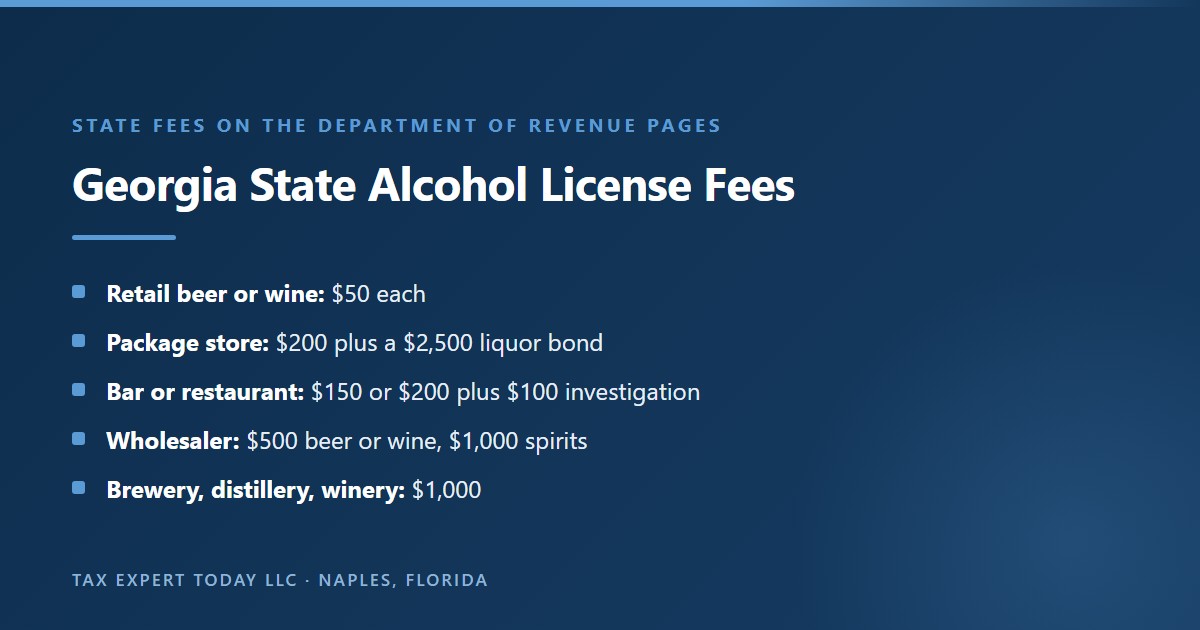
State fees on the Department of Revenue pages for 2026 are $50 for retail malt beverage, $50 for retail wine, $200 for a retail package store, $150 or $200 for consumption on premises plus a $100 investigation fee, and $1,000 for a brewery, distillery, winery, or brewpub. Local fees are separate and often much higher.
- Retail dealer: $50 for malt beverage and $50 for wine.
- Retail package store: $200, plus a $2,500 liquor bond.
- Consumption on premises: $150 for liquor and beer or liquor and wine, $200 for all three, plus $100 investigation.
- Wholesaler: $500 for wine, $500 for malt beverage, $1,000 for distilled spirits.
- Special events: $25 nonprofit, $50 for profit beer or wine, $100 for profit spirits.
| State license | 2026 state fee | Other state cost or requirement |
|---|---|---|
| Retail malt beverage | $50 | Citizenship verification |
| Retail wine | $50 | Citizenship verification |
| Retail package store | $200 | $2,500 liquor bond, surveyor certificate, publication notice |
| Consumption on premises, liquor and beer or liquor and wine | $150 | $100 investigation fee on all applications |
| Consumption on premises, liquor, beer, and wine | $200 | $100 investigation fee on all applications |
| Wholesaler, wine or malt beverage | $500 each | Performance and tax liability bond |
| Wholesaler, distilled spirits | $1,000 | Performance and tax liability bond |
| Brewery, distillery, winery, brewpub | $1,000 | Federal permit or brewers notice, bond for brewpubs |
| Farm winery | $50 | Federal permit |
| Adding officers | $100 | New personnel statement |
These are the state amounts listed on the Department of Revenue retail package, consumption on premises, and wholesaler pages as of today. Your city or county charges its own license fee, and local fees in Georgia commonly run far above the state amount, with some jurisdictions adding application, investigation, and server permit fees. Budget for the local schedule first, because the state license cannot issue without it.
How Does the Georgia Alcohol License Application Work Through the Georgia Tax Center?
Retail applicants file one application in the Georgia Tax Center, and the system sends it to the state and the local licensing authority at the same time under O.C.G.A. 3-2-7.1. You pay state and local fees separately. The state finishes its review only after the local license issues, so the local approval sets the pace.
- Contact the local government first: learn its documents, zoning, distance, and background rules.
- Scan every document: each one is uploaded as a separate PDF file.
- File in the Georgia Tax Center: the application routes to both the state and the city or county.
- Pay two fees: the portal gives separate payment instructions for each authority.
- Receive two licenses: one local, one state.
The Department of Revenue centralized licensing FAQ confirms that the process covers retail beer and wine, retail package, consumption on premises, and special event permits, and that a valid local license is still required before the Department can issue the state license. Fingerprint and criminal background requirements come from the local authority under O.C.G.A. 3-3-2. Since November 1, 2023, Rule 560-2-2-.02 treats a local license issued outside the centralized process as invalid until the local government meets the 3-2-7.1 requirements, and no state license issues in the meantime.
The documents the Department lists for most retail and consumption on premises applications include:
- Citizenship verification: a notarized affidavit with secure and verifiable identification.
- Form ATT-17: the Georgia Alcohol and Tobacco Personnel Statement, notarized.
- Financial affidavit: for package stores, consumption on premises, and non-retail licenses.
- Form RD-1061: the power of attorney and declaration of representative, if a CPA, attorney, or enrolled agent files for you.
Rule 560-2-2-.02 also warns that any untrue, misleading, or omitted statement in an application is cause for denial, and for revocation if the license already issued. That reaches the tax questions too, which is why the account review described below should come before you sign the application.
Why Do Unpaid Georgia Taxes Block a Georgia Alcohol License?
Georgia rules make tax compliance a condition of holding an alcohol license. Rule 560-2-2-.09 says no application will be considered while the applicant, or any person or entity holding any interest in the business, has failed to meet an obligation under any Georgia tax law. The same failure is grounds to suspend, revoke, or cancel an existing license.
- Any Georgia tax counts: the rule says any tax law of Georgia, not only alcohol excise.
- Any owner counts: a person, firm, or corporation holding any interest in the business is covered.
- Applies at the start: an application is not considered while the obligation is unmet.
- Applies during the license: an unmet obligation is grounds for suspension, revocation, or cancellation.
The text of Rule 560-2-2-.09 is short, and its reach is wide. Paragraph (1) bars consideration of an application, and paragraph (2) makes a tax failure grounds to suspend, revoke, or cancel a license, permit, or registration. Rule 560-2-2-.02(9) repeats the point for applications, making a failure to meet obligations under the tax laws grounds for denial. The rules cite O.C.G.A. 3-2-2 and 48-2-12 as authority.
The words “any interest” matter. A restaurant group adding a new partner, a family adding a child to the LLC, or an investor taking a small stake can bring that person’s Georgia tax history into the license file. A business that is fully current can still be held up because one owner has an unfiled return or a balance on an unrelated account.
This is the part of a Georgia alcohol license that the licensing pages mention only in passing as “tax clearance,” and it is the part where a tax professional, rather than a licensing service, does the work.
Which Tax Accounts Should Be Current Before a Georgia Alcohol License Application?
Every Georgia account tied to the business and its owners should be filed and paid before you apply or renew. That usually means sales and use tax, employer withholding, any alcohol or tobacco excise account, corporate or pass through returns, and the personal income tax returns of each owner. One missing return can hold up the whole file.
- Sales and use tax: retailers, bars, and restaurants collect sales tax and file through the Georgia Tax Center.
- Withholding: any business with employees runs a Georgia payroll withholding account.
- Excise: wholesalers, brewers, distillers, and tobacco sellers file monthly excise returns.
- Entity returns: corporate income and net worth, partnership, or S corporation returns.
- Owner returns: each owner’s individual Georgia income tax return.
| Georgia account | Who usually has it | Related guide |
|---|---|---|
| Sales and use tax | Retail stores, restaurants, bars | Georgia use tax |
| Employer withholding | Any business with Georgia employees | Georgia withholding tax |
| Alcohol excise | Wholesalers, producers, some importers | Georgia alcohol tax |
| Tobacco and vapor excise | Stores also selling tobacco, distributors | Georgia tobacco tax |
| Entity income and net worth | Corporations, LLCs, partnerships | Georgia LLC taxes |
Most retail alcohol businesses must hold a sales tax number, which the Department of Revenue issues through the Georgia Tax Center on its sales and use tax page. Restaurants that buy equipment or supplies from out of state sellers can also owe use tax that never appears on a sales tax return, and that liability is one that owners often do not know exists until an audit. If a store also sells cigarettes or vapor products, its tobacco license and monthly obligations sit in the same Georgia Tax Center account.
Before an application or renewal, the practical step is to log in to the Georgia Tax Center for the business and for each owner, confirm every return period shows as filed, and confirm there are no open balances or notices. Where a period is missing, file it first. Where a balance exists that cannot be paid at once, set up a payment arrangement before the license is reviewed, not after.
What Happens When a Georgia Alcohol Licensee Falls Behind on Taxes?
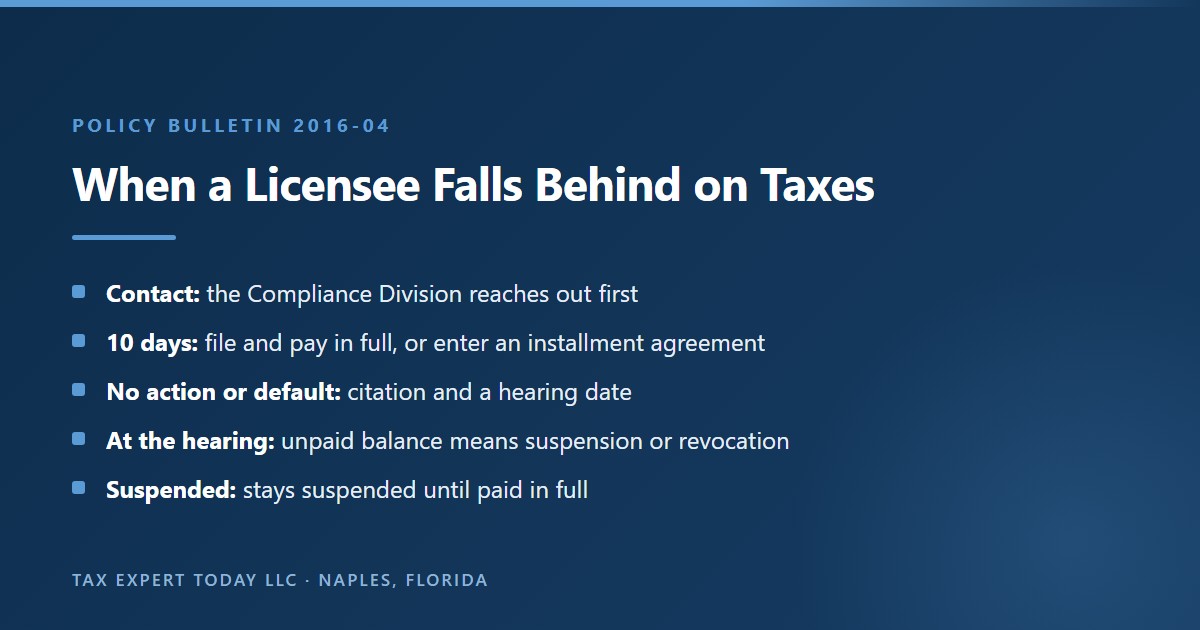
Under Department of Revenue Policy Bulletin 2016-04, the Compliance Division contacts the licensee first and allows ten calendar days to file missing returns and pay in full, or to enter an installment payment agreement. If neither happens, the Alcohol and Tobacco Division issues a citation, sets a hearing, and the license may be suspended or revoked.
- Step one: the Compliance Division contacts the licensee about the delinquency.
- Ten days: file all missing returns and pay in full, or apply for an installment agreement.
- Citation: issued if the licensee does neither, or later defaults on the agreement.
- Hearing: pay in full before the hearing date, or the license is suspended or revoked.
- Suspension: the license stays suspended until the liability is paid in full.
The policy bulletin took effect September 15, 2016, and replaced an older practice of citing a licensee the moment a delinquency appeared. It cites O.C.G.A. 3-2-2, 3-2-3, 3-2-6, and 48-2-12 as authority. The bulletin states that a licensee suspended at a hearing may still be eligible for an installment agreement at the discretion of the Compliance Division, but the license remains suspended until the liability is paid in full. For a bar or package store, a suspension stops sales of the product that often carries the margin, so the cost of the delinquency is far larger than the tax and penalty alone.
| Stage | Licensee action | Result |
|---|---|---|
| Compliance contact | File missing returns and pay in full within 10 calendar days | No citation |
| Compliance contact | Enter an installment payment agreement within the window | No citation while the agreement is current |
| No action, or agreement in default | Pay in full before the hearing date | Citation issued, suspension avoided |
| Hearing with balance unpaid | None in time | License suspended or revoked |
| After suspension | Pay the liability in full | Suspension continues until paid |
The ten day window is short. A licensee who receives a compliance contact should treat it as urgent, pull the account history the same day, and decide whether to pay, file, or request an agreement before the window closes.
Can a Payment Plan Keep a Georgia Alcohol License Active?
Yes, in many cases. The policy bulletin says a licensee avoids a citation by paying in full or by entering an installment payment agreement with the Department of Revenue. Staying current on that agreement matters, because a default leads to a citation and a hearing. Once a license is suspended, it stays suspended until the balance is paid.
- Before a citation: an installment agreement avoids the citation entirely.
- Default: the Department allows a limited time to cure before declaring the agreement in default.
- After default: a citation issues and a hearing is set.
- New balances: new delinquencies while on a plan create the same exposure.
A Georgia installment agreement is a Department of Revenue arrangement, separate from any IRS payment plan, and it has its own terms and eligibility rules. Our guide to the Georgia Department of Revenue payment plan walks through how those agreements work. Where the balance cannot realistically be paid, the Georgia offer in compromise program may be worth evaluating, though it is a longer process and does not by itself pause the alcohol license review. If the dispute is over whether the tax is owed at all, the Georgia Tax Court is the forum for many state tax appeals.
The key planning point is to keep current period filings and payments on time while an older balance is being paid down. An agreement on old periods does not protect a licensee who stops filing new sales tax or withholding returns.
When Must a Georgia Alcohol License Be Renewed?
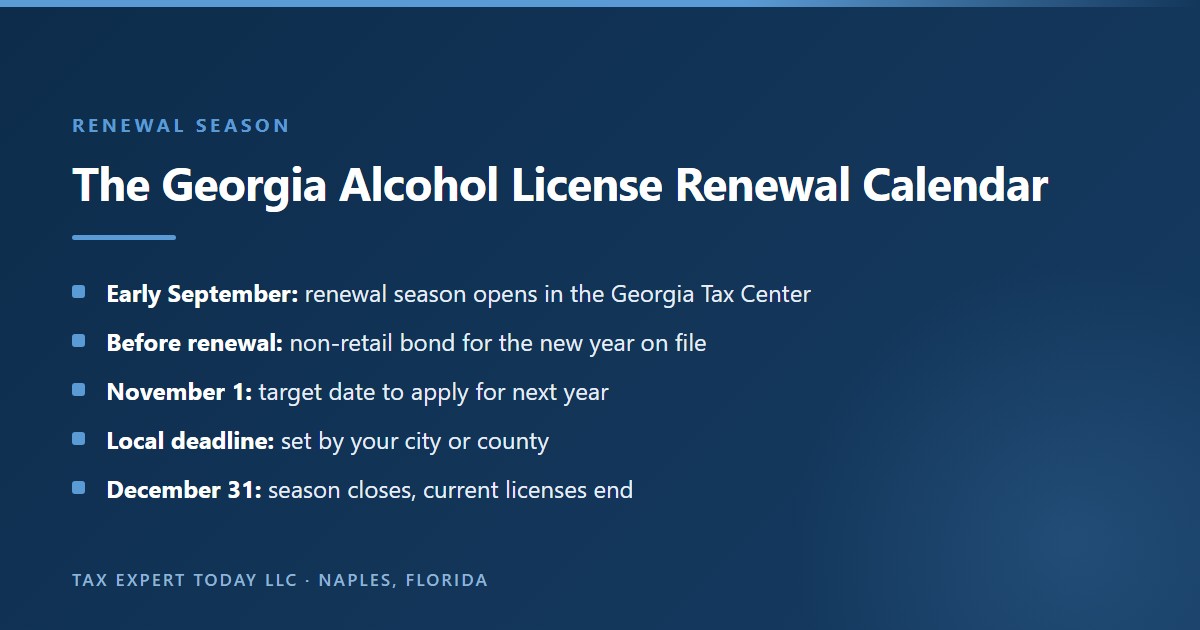
Georgia alcohol license renewal season runs from the first business day of September through December 31, and the Department of Revenue asks licensees to renew before November 1 so the license arrives before January 1. Rule 560-2-2-.02 says a licensee continuing into the next year must apply on or before November 1. Both state and local licenses must be renewed.
- Season opens: the first business day of September.
- Target date: November 1, per the Department of Revenue and Rule 560-2-2-.02(7).
- Season closes: December 31.
- Two renewals: the state renewal and the local renewal are filed separately in the Georgia Tax Center.
| Renewal milestone | What happens | Source |
|---|---|---|
| First business day of September | State renewal season opens in the Georgia Tax Center | Department of Revenue renewal page |
| Before renewal | Non-retail licensees file the bond for the renewal year | Non-retail renewal instructions |
| November 1 | Target date to apply for the next calendar year | Rule 560-2-2-.02(7) and the Department of Revenue |
| Local deadline | Set by each city or county, often with late fees | Local ordinance |
| December 31 | Renewal season closes and current licenses end | Department of Revenue renewal page |
The Department of Revenue renewal page sets out the season and the November 1 target. For retail licenses, the state renewal asks about arrests in the previous 12 months, requires a notarized citizenship affidavit with identification, and ends with a payment by ACH debit or credit card. The local renewal is a separate filing in the same portal, with fees and documents set by the city or county. Many local governments set their own earlier deadlines and late fees, so check the local ordinance rather than relying on the state calendar alone.
Renewal is also the moment when tax problems surface, because it is a fresh application under Rule 560-2-2-.02(7), and Rule 560-2-2-.09 bars consideration of any application while a tax obligation is unmet. A business that let a sales tax return slip in the summer can find its renewal stalled in November.
What Causes Georgia Alcohol License Renewal Delays?
The Department of Revenue says renewal is usually immediate, but it lists changes and errors that cause delays: adding or changing officers or responsible parties, changing licensees, citizenship affidavit errors, payments sent to the wrong account or period, multiple renewal attempts, paying without filing the renewal return, and stored status renewals.
- Ownership changes: new officers or a new licensee trigger additional review.
- Affidavit errors: a missing notarization or identification copy stops the renewal.
- Payment errors: paying the wrong account or period, or paying without filing.
- Repeat attempts: filing more than once can create a conflict in the system.
The list comes from the Department of Revenue page on renewal delays for alcohol and tobacco licenses. Several of these are accounting errors rather than licensing errors. A payment applied to the wrong period on a sales tax or excise account can make the account look delinquent, and that can feed directly into the tax compliance problem described above. Reconciling the Georgia Tax Center ledger before renewal season avoids most of them.
What Bonds Does a Georgia Alcohol License Require?
A retail package store posts a $2,500 liquor bond with its application. Wholesalers, brewpubs, and other non-retail licensees post performance and tax liability bonds, and Georgia requires non-retail applicants to file an annual bond, or keep a multi-year bond on file, for each renewal year. A bond secures the state’s tax and penalty claims, so it is a tax instrument.
- Package store: $2,500 liquor bond.
- Wholesalers: separate performance and tax liability bonds for malt beverage, wine, and spirits.
- Brewpubs: a brewpub performance and tax liability bond.
- Renewal: non-retail bonds must extend through the end of the renewal year.
The Department of Revenue non-retail renewal instructions say the bond must meet the same conditions as the bond filed with the initial application and is submitted in the Georgia Tax Center before the renewal itself. A lapsed bond is one of the simplest ways to miss a renewal, and bond companies price the bond partly on the applicant’s financial and tax standing.
How Does a Georgia Alcohol License Connect to Excise and Sales Tax Filing?
The license determines which returns follow. Wholesalers and producers file monthly alcohol excise returns due by the 15th. Retailers generally do not file state excise because wholesalers collect it, but they collect sales tax on every retail sale. Bars may also owe a local liquor by the drink tax set by the city or county.
- Wholesalers and producers: state excise returns by the 15th of each month.
- Retailers and bars: state and local sales tax on retail sales.
- Bars and restaurants: local liquor by the drink tax where the city or county levies it.
- Everyone with staff: Georgia withholding returns.
The rates, due dates, and worked examples for the excise side are in our guide to the Georgia alcohol tax. The point for licensing is that each of these returns is a Georgia tax obligation under Rule 560-2-2-.09. A missed liquor by the drink return is a local matter, but a missed state sales tax or excise return can reach the state license directly.
What Do Georgia Special Event Alcohol Permits Cost?
The Department of Revenue lists special event fees of $25 for a nonprofit, $50 for a for profit malt beverage or wine permit, and $100 for distilled spirits. It asks applicants to request the permit 10 days before the event starts and warns that a permit submitted with less notice may not issue in time.
- Nonprofit: $25.
- For profit beer or wine: $50 each.
- For profit spirits: $100.
- Timing: apply at least 10 days before the start date.
Special event permits run through the same centralized process, so the local government approves them too. Sales at a for profit event are still taxable retail sales, and the event operator needs a way to collect and report sales tax for them.
The Department of Revenue lists four special event categories on its licensing page: special event for profit, special event nonprofit, special event use, and special event wine auction. Each runs through the Georgia Tax Center, and each asks for a notarized citizenship verification, plus Form RD-1061 when a representative files for the applicant. Because a special event permit is an application like any other, Rule 560-2-2-.09 applies to it as well, so an organizer with an unfiled Georgia return or an open balance can see the permit held up. Nonprofits that host several events a year should ask their local government whether it limits the number of events, check the local permit fee alongside the state fee, and plan the sales tax side of each event before the first ticket or drink is sold.
What Changes When a Business With a Georgia Alcohol License Is Sold or Reorganized?
A new owner generally needs its own Georgia alcohol license, and adding officers or responsible parties requires new personnel statements and a $100 state fee. Because Rule 560-2-2-.09 covers any person holding an interest, every new owner’s Georgia tax record becomes part of the license review.
- New licensee: a change of licensee is listed as a renewal delay and usually means a new application.
- New officers: each files Form ATT-17, and the state charges $100 to add officers.
- Inventory: a package store buying a prior owner’s stock files an itemized inventory listing.
- Entity change: converting a sole proprietorship to an LLC creates a new licensee and new accounts.
Buyers should ask for the seller’s Georgia sales tax, withholding, and excise filing history before closing and should plan the license application timeline around the local approval. Sellers should close out their own accounts properly once the sale is done. For a fuller view of how a Georgia LLC is taxed after a reorganization, see our guide to Georgia LLC taxes.
What Should an Out of State Owner of a Georgia Alcohol License Business Check?
An owner who lives outside Georgia still holds an interest in the business for purposes of Rule 560-2-2-.09. If the business is a partnership, LLC, or S corporation earning Georgia income, that owner usually has a Georgia filing obligation, either a nonresident return or inclusion in a composite return. A missed one can surface in the license review.
- Nonresident return: owners with Georgia source income from a pass through entity generally file one.
- Composite return: the entity can file for qualifying nonresident owners instead.
- Pass through entity election: an entity level election changes how owners report Georgia income.
- Moving owners: an owner who moved into or out of Georgia mid year may need a part year return.
Florida has no personal income tax, so a Florida resident who owns part of a Georgia restaurant or package store may never have filed a Georgia return and may not know one was due. The Georgia rule does not distinguish between resident and nonresident owners. It looks at whether any person holding an interest has met obligations under any Georgia tax law. Our guides to the Georgia composite return, the Georgia pass through entity tax election, and the Georgia part year resident tax return explain how each route works.
The practical step for a multi owner business is a short written check before each renewal season: list every owner and every Georgia account, confirm which returns each owner files and how, and fix any gap before November 1. That review takes far less time than answering a compliance contact in a ten day window.
Georgia Alcohol License Mistakes That Cost Money
The costliest mistakes are not the license fees. They are the tax problems that stop a license from issuing or renewing: an unfiled return for one owner, a sales tax payment applied to the wrong period, a lapsed bond, a missed renewal target, or ignoring a compliance contact until the ten day window closes.
- Applying before checking every owner: one owner’s unfiled personal return can hold up the application.
- Treating “tax clearance” as a formality: Rule 560-2-2-.09 is a hard bar, not a checkbox.
- Renewing late: waiting past November 1 risks a gap in sales on January 1.
- Letting a payment plan slip: a default leads to a citation and a hearing.
- Answering the application loosely: an omitted statement is grounds for denial or revocation.
Georgia Alcohol License Help in Naples & Southwest Florida
Tax Expert Today LLC helps Georgia restaurant, bar, package store, and distribution owners with the tax side of a Georgia alcohol license from its office in Naples, Florida. We serve Georgia clients nationwide and remotely, reviewing state tax accounts, filing missing returns, and requesting payment arrangements before a license review.
- Office: 11983 Tamiami Trail N, Naples FL 34110.
- Phone: (239) 441-2005.
- Hours: Monday through Friday, 10 a.m. to 5 p.m. Eastern.
- Service area: Naples and Southwest Florida in person, Georgia and all 50 states remotely.
Many of our Georgia clients are owners who live in Southwest Florida part of the year, or Florida residents who hold an interest in a Georgia restaurant or store. Our work covers the Georgia Department of Revenue accounts behind the license: sales and use tax, withholding, excise, entity returns, and owner returns. We work as tax advisors on state tax matters nationwide, and we coordinate with local licensing counsel where the question is a zoning, distance, or local ordinance issue. For our wider Georgia services, see the Georgia tax services page.
When to Engage a Professional
Engage a tax professional before you apply for or renew a Georgia alcohol license if any owner has an unfiled Georgia return or an open balance, if you received a Department of Revenue compliance contact, if a renewal stalled, or if ownership is changing. Acting before the review usually costs less than acting after a citation.
- A compliance contact arrived: the ten day window in the policy bulletin starts quickly.
- A renewal is pending: the November 1 target is close each fall.
- Owners are changing: new partners bring their own Georgia tax records.
- A balance is too large to pay at once: an agreement should be in place before the license review.
Tax Expert Today LLC reviews Georgia tax accounts, prepares missing returns, and helps clients resolve Georgia Department of Revenue balances as part of our state tax work nationwide. Call (239) 441-2005 for a free consultation. This guide is general information about Georgia rules as of October 29, 2026, and is not legal or tax advice for your situation. Results depend on the facts of each case.
Frequently Asked Questions About the Georgia Alcohol License
How much does a Georgia alcohol license cost?
State fees for 2026 are $50 each for retail malt beverage and retail wine, $200 for a retail package store, $150 or $200 for consumption on premises plus a $100 investigation fee, and $1,000 for a brewery, distillery, winery, or brewpub. Local license fees are separate and are often higher.
Do I need both a state and a local alcohol license in Georgia?
Yes. Georgia uses a dual system. Retail applicants file once in the Georgia Tax Center and the application goes to both the state and the local licensing authority, but the state license issues only after the local license, and it becomes invalid if the local license lapses.
Can unpaid taxes stop a Georgia alcohol license?
Yes. Georgia Rule 560-2-2-.09 says no application will be considered while the applicant or anyone holding an interest in the business has failed to meet an obligation under any Georgia tax law, and the same failure is grounds to suspend, revoke, or cancel an existing license.
When is the Georgia alcohol license renewal deadline?
Renewal season runs from the first business day of September through December 31. The Department of Revenue asks licensees to renew before November 1 so the new license arrives before January 1, and the state and local renewals are filed separately.
What happens if my Georgia alcohol license business owes back taxes?
Under Policy Bulletin 2016-04, the Compliance Division contacts you and allows ten calendar days to file and pay in full or enter an installment agreement. If you do neither, or later default, a citation and hearing follow, and the license may be suspended or revoked.
Does a Georgia package store need a bond?
Yes. The Department of Revenue lists a $2,500 liquor bond for a retail package store application. Wholesalers, brewpubs, and other non-retail licensees post performance and tax liability bonds, which must stay in force through each renewal year.
How far ahead should I apply for a Georgia special event alcohol permit?
The Department of Revenue asks for special event permit requests at least 10 days before the event starts and warns that a permit submitted with less notice may not issue in time. State fees are $25 for a nonprofit and $50 or $100 for a for profit event.
I live in Naples, Florida, and own part of a Georgia restaurant. Can you help with the tax side of its Georgia alcohol license?
Yes. Tax Expert Today LLC reviews the Georgia tax accounts behind an alcohol license from its Naples, Florida office at 11983 Tamiami Trail N, and Georgia clients work with us remotely. Call (239) 441-2005 for a free consultation.
Published October 29, 2026 by Dr. Pellumb Kabashi « Back to Learning Center
Have a question this article touches on?
Tax Expert Today LLC, based in Naples, Florida and serving clients across the United States.
Schedule a Consultation (239) 441-2005